Abstract
Introduction
Species selection and improvement
Gliricidia germplasm collection and evaluation
Establishment of gliricidia
Fodder tree cultivation systems
The alley cropping/grazing rotation trial
Conclusions
Acknowledgements
References
A.N. Atta-Krah, J.E. Sumberg and L. Reynolds
Humid Zone Programme, ILCA, P.M.B 5320, Ibadan, Nigeria
The potential of leguminous fodder trees in farming systems of humid West Africa is considered in the light of research work carried out by the Humid Zone Programme of the International Livestock Centre for Africa (ILCA) at Ibadan, Nigeria. ILCA's agronomy research effort focuses on the leguminous species, Leucaena leucocephala and Gliricidia sepium. The paper reviews a variety of research trials ranging from the improvement of germplasm materials to the development of fodder production systems, and concludes with a recommendation for more research and development attention on the integration of fodder trees within existing farming systems.
Trees are the dominant natural vegetation in most tropical ecosystems and should therefore be recognised as essential for stability in land-use systems in these areas (Nye and Greenland, 1960; Rachie, 1983). The tree component in these systems is necessary to protect the fragile tropical soils from the effects of torrential rainfall and scorching sunshine.
Traditional farming systems in the tropics have been known to rely on trees and shrubs for soil fertility maintenance and regeneration. The dominant farming system in these areas is based on the shifting cultivation and bush fallow concepts by which a piece of land is cropped for a period, usually 3-5 years, and then left fallow, commonly for 4-10 years, to allow the soil fertility to regenerate. Trees play a vital role in this process and leguminous trees, which are able to fix atmospheric N2, have an added advantage over other trees in this respect. Judicious use-of leguminous trees in the farming system can aid in the recycling of nutrients and water from deep in the soil, fix N. lower soil temperature, reduce soil evaporation, minimise leaching and run-off, provide shade for animals and crops, provide animal feeds and in some cases supply human food.
In the farming system these trees are capable of enhancing both crop production, through soil fertility maintenance, and livestock production, through increased availability of high quality feeds. The-efficiency of this, however, depends on the species used and the manner of their integration and management within the cropping system.
The dominant ruminant livestock species in the humid zone are the trypanotolerant West African Dwarf sheep and goats. These animals are very widespread in the zone, especially in rural areas, where they are said to contribute 5-10% of total farm income of the mainly arable-crop-farmer population. Their management is generally sub-intensive and low-investment oriented and their integration into the farming system is loose. The potential exists, however, for an improvement in the integration of crop and livestock systems through cultivation of leguminous fodder trees within arable-crop farms. This potential has been the backbone of research of ILCA's Humid Zone Programme (HZP) based in Ibadan, Nigeria.
The objective of the HZP of ILCA has been to improve the overall productivity of the small farmer in the zone, through the development of improved livestock production technologies and their integration into the existing farming system. Improved feeding and disease control are the programme's major areas of activity. The former is met largely through research on leguminous browse production and utilisation, and is the central theme in this paper.
The choice of browse rather than grasses or herbaceous legumes was influenced by the dominant role that trees play in the tropical environment and also by their relative ease of integration into farming systems of the area. Browse trees also have the advantage of remaining productive during the critical dry season, when most grasses and legumes dry out.
ILCA's research aims at documenting how crops and soil fertility are affected by linking small ruminant production with cultivated fodder trees, and at developing production techniques that are relevant and workable for the small-scale farmer. In the context of this paper, and in the humid zone of West Africa generally, a "small farmer" usually has about 2-5 hectares of farmland, may own a few sheep and goats (usually 2-6 animals per farmer) and might also keep some poultry or pigs, all under sub-intensive management.
The choice of tree species for use in any intercropping system with arable crops is of utmost importance (Rachie, 1983), as it determines, to a large extent, the success or failure of the system. ILCA's choice of Leucaena leucocephala (Lam) de Wit and Gliricidia sepium (Jacq.) Steud. was influenced by the availability of information on the two species, and also by earlier research carried out on the two species at the International Institute of Tropical Agriculture (IITA).
In 1981 ILCA initiated a species screening trial of native leguminous trees, with the objective of identifying local alternatives to leucaena and gliricidia - both of which are exotic. Twenty-two native browse species were selected on the basis of their reported palatability, rapidity of initial growth, ability to coppice and dry season leaf retention, and screened with leucaena and gliricidia as control species. Some of the species screened were Acacia albida, Afzelia africana, Albizia lebbeck, Antiaris africana, Azadirachta indica, Cassia siamea, Daniella oliveri, Ficus thonningii, Moringa oleifera and Parkia clappertoniana.
After 2 years of observations, it was clear that none of the species could match the productivity of leucaena and gliricidia. This line of research was therefore suspended and research effort intensified on leucaena and gliricidia.
No basic research was thought necessary on leucaena because of the wealth of information already available on the species and the availability of improved leucaena germplasm lines. Gliricidia on the other hand was relatively unknown, unstudied, and unimproved. A major gap was therefore apparent - the lack of any systematic effort to improve gliricidia germplasm.
In March 1983, ILCA embarked on joint collection trip with CATIE (Centro Agronomico Technico de Investigation y Ensenenza), to Turialba, Costa Rica, in Central America, believed to be the origin of the species. Forty-seven accessions of gliricidia were collected which are being evaluated for productivity, under a frequent pruning regime similar to that used in alley farming, with the "Ibadan Local" gliricidia as control. Considerable variation in vigour and productivity has been detected over six harvests made so far. A number of lines have been found to be superior to "Ibadan Local" though the yield of latter was near the overall mean yield at each harvest (ILCA, 1984). The four highest-yielding accessions have shown a high degree of stability by consistently out-yielding-"Ibadan Local" by 20 - 32% in the last four harvests (Table 1). In April 1984, seed from these four lines were sown in a bulk "high yield population" plot for multiplication. Bulk harvest of seed from this orchard will give a "synthetic" or a "blend," depending on whether gliricidia proves to be cross- or self pollinated. This approach of combining accessions was adopted to minimise the need for seed production in isolated blocks while hopefully producing populations with high yield potential and sufficient genetic diversity for wide adaptation within the tropics.
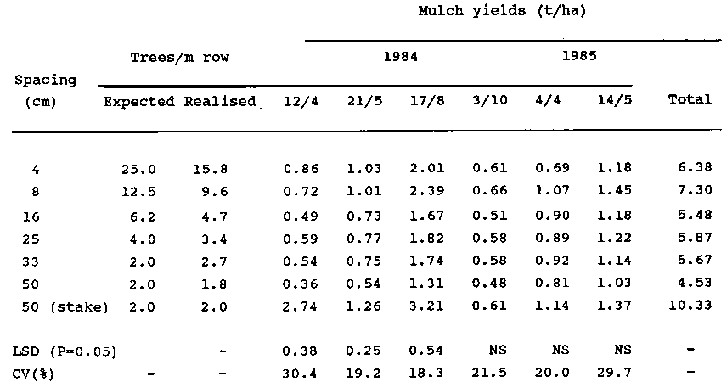
Table 1. Mulch DM yields of gliricidia at different planting densities.
The programme's germplasm collection and evaluation work also includes a recently initiated evaluation of gliricidia germplasm collected in Central America and Mexico by the Commonwealth Forestry Institute (CFI), Oxford, U.K. This evaluation is being done in eight West African countries under a network sponsored by the International Development Research Centre (IDRC).
Traditionally, gliricidia is established from stakes, and all of ILCA's early work with this species was with stake establishment. In 1982, however, it became apparent from ILCA's on-farm research that this method of establishment could seriously hinder the adoption and spread of any technologies developed with the species. There was therefore the need for research on flowering, seed production and propagation of gliricidia from seed.
Research in this direction, initiated in November 1982, showed a wide range of variation in flowering, fruiting and seed production (Table 2). The effective flowering and fruiting period for gliricidia was observed to be from November to March. The single variable most closely related with seed yield per tree was the number of set racemes per tree. Earlier flowering trees produced and set more racemes, and thus yielded more seed (Sumberg, 1985).
Gliricidia pods are linearly dehiscent and seeds are dispersed from pods on drying. In seed collection, it is therefore necessary that pods are picked green on maturity, before drying commences. Such pods could then be sun dried, with a wire mesh covering to prevent excessive seed scattering.
Table 2. Flowering and seed production variables among 20 sample gliricidia trees, Ibadan, Nigeria.
|
Variable |
Range |
Meana |
Coefficient of variation (%) |
|
Total racemes/tree |
16 - 633 |
311.8 |
66.9 |
|
set racemes/tree |
0 - 219 |
73.8 |
86.9 |
|
Percentage raceme set |
0 - 46.4 |
21.7 |
53.8 |
|
Buds/raceme |
18.2 - 40.1 |
25.9 |
20.0 |
|
Pods/raceme |
1.0 - 2.0 |
1.2 |
18.1 |
|
Percentage pod set |
4.2 - 8.6 |
5.7 |
22.8 |
|
Seeds/pod |
2.9 - 5.3 |
4.2 |
16.0 |
|
Number of seeds/tree |
0 - 1442 |
420.3 |
95.9 |
|
Seed yield/tree (g) |
0 - 89 |
24.6 |
93.0 |
|
Days to maturity |
37 - 45 |
40.6 |
7.6 |
|
Branch fresh weight/tree (g) |
5.5 - 18 |
10.4 |
30.7 |
a. Includes only trees which set pods, n=18. Source: Sumberg (1985).
Seed propagation trials with seed collected this way and seed harvested dry from parent trees showed no significant differences in germination and seedling vigour, thus establishing that seeds could be effectively collected from fresh green pods and sun-dried for seed propagation purposes. Trials are currently in progress to study the storage potential (longevity) of such seeds under different storage conditions.
Gliricidia planting density
With the successful propagation of gliricidia from seed, all subsequent work with the species was with seed establishment. It therefore became necessary to establish the optimum spacing for seed-established gliricidia and to compare productivities of seed- and stake-established gliricidia at their optimum densities.
A trial with six intra-row spacing treatments ranging from 4 to 50 cm (seed establishment) plus a 50 cm spacing stake-established gliricidia as control was established in a randomised complete block design at Ibadan in May 1983. Plots were single rows, 5 m long, and spaced 4 m apart. Trees were established with two maize crops each year from 1983 to 1985. The first tree cutting (harvesting) was made in April 1984; as at May 1985, six harvests had been made.
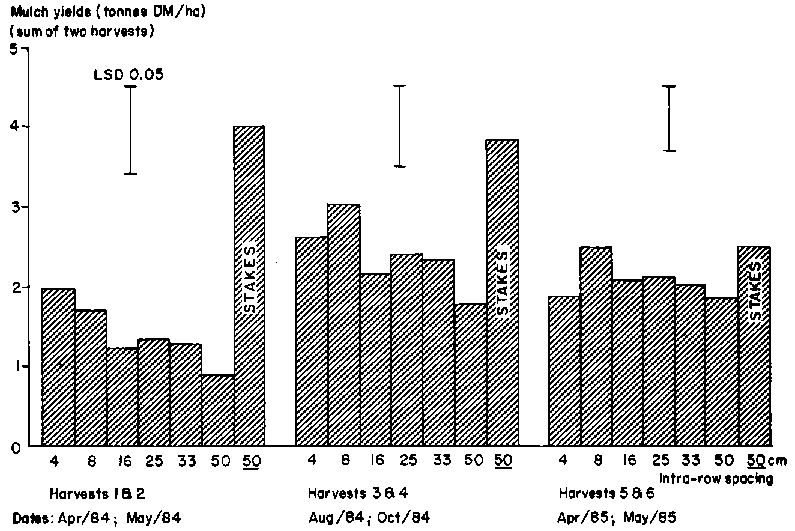
Up-to-date results, summarised in Table 3, indicate that stake-established gliricidia at 50 cm spacing was more productive than all spacings of seed-established gliricidia in the initial harvests. Stakes are clearly able to sprout and establish faster than seeds, which require a long period of seedling establishment during which the seedlings are sensitive to weed competition.
The superior productivity of the stake plants was, however, completely eroded by the fourth harvest as the seeded trees increased their productivity with each harvest. In general, mulch yield in seeded trees increased with increasing tree density. Eight centimetre spacing of seeded trees, which gave approximately 10 established trees per metre row (25,000 trees/ha) is emerging as the most competitive of the seed-establishment spacings tested (Figure 1).
This trend is expected to continue with more of the seeded trees increasing in productivity in subsequent harvests and out-yielding the stake-established trees, especially during the dry season. The major reason for this expectation is the development in seeded trees of a more prominent tap-root system, which is capable of tapping water and probably nutrients from deeper soil layers. It has been observed that stake-established trees have shallow root development.
Table 3. Fresh mulch yields from Gliricidia sepium germplasm evaluation.
|
|
Harvest date |
Total |
|||||
|
20/10 |
13/4 |
1/6 |
6/9 |
7/12 |
10/4 |
||
|
Yield (t/ha)
|
|||||||
|
overall mean |
8.2 |
6.6 |
7.2 |
13.2 |
8.9 |
3.8 |
47.9 |
|
''Ibadan local" |
7.2 |
6.1 |
7.6 |
13.2 |
8.9 |
5.2 |
48.9 |
|
|
(100) |
(100) |
(100) |
(100) |
(100) |
(100) |
(100) |
|
4 "high" yielding |
10.7 |
11.1 |
9.0 |
15.9 |
11.3 |
6.5 |
64.5 |
|
accessions |
(149) |
(182) |
(118) |
(120) |
(127) |
(125) |
(132) |
|
Range |
4.5- |
3.8- |
4.9- |
8.7- |
5.6- |
1.8 |
|
|
|
11.9 |
11.7 |
9.2 |
17.0 |
12.7 |
8.0 |
- |
|
LSD(P=0.05) |
3.1 |
3.3 |
3.8 |
4.4 |
3.8 |
NS |
- |
|
CV(%) |
18.7 |
24.5 |
12.6 |
16.4 |
21.3 |
44.0 |
- |
Values in parentheses indicate yield expressed as a percentage of "Ibadan Local'' yield.
Three main points need to be taken into consideration in the development of fodder production strategies for small ruminant farmers in the humid tropics. These are:
i) The overwhelming importance and dominance of crops relative to livestock in the zone.ii) The fact that small ruminants, the major ruminant livestock species in the zone, are kept mainly by arable and tree-crop farmers, usually as a minor farm enterprise.
iii) Management of small ruminant production is generally sub-intensive, with minimal investments in feeding, housing and health.
These three factors together dictate that fodder production systems for improvement of small ruminant production in the zone should be low-investment oriented and should not impinge unduly on land and/or labour required for the production of the farmers' primary product - arable crops. ILCA's approach to fodder intervention in the farming system places emphasis on integration of leguminous fodder trees in food-crop farms, as a means of linking small ruminant production with arable-crop production. Use of the trees for fencing and as shade trees, as well as for the establishment of feed gardens on small plots in and around compounds is also encouraged. The main production systems that ILCA is developing are alley farming, grazed fallow and the intensive feed garden (IFG) systems.
Alley farming has its roots in the alley cropping concept (Kang et al, 1981) of the International Institute of Tropical Agriculture (IITA), and is a system of cultivation in which food crops are grown between rows of leguminous fodder trees. The trees in the system are managed to produce both N-rich green manure for soil fertility maintenance and high-protein feed for small ruminants.
The grazed fallow is an off-shoot of the alley farming system and involves the grazing of fallow alleys in the periods when no crop is carried on alley farms. Such situations might range from short dry-season fallows to precise grazing rotations within alley farming. This system, which is also refered to as "alley grazing," permits even more integration of crop and livestock production, since manure is returned to the soil with potential soil fertility implications. However, it demands a higher level of management and might require extra investment. In this regard it is seen as a system with potential for the future. A number of on-going trials at Ibadan are giving useful indications of the parameters involved in linking alley farming and grazing. One such project is described in some detail in the following section of this paper. A detailed analysis of both alley farming and grazed fallow systems is given in a paper by Sumberg (1984).
This long-term trial, conducted in cooperation with the Farming Systems Program (FSP) of IITA, occupies a key position in ILCA's alley farming research and development effort. The primary objective is to determine the effects of grazing natural pasture under fodder trees (alley fallow) over short periods (2 years) on soil fertility and subsequent crop yields. In addition, the trial provides some preliminary observations on animal performance within the alley grazing system.
The five treatments in the trial are:
i) Continuous cropping without trees;
ii) Continuous cropping in leucaena alleys;
iii) 2-year grazing/2-year cropping rotation in leucaena alleys;
iv) 2-year cropping/2-year grazing rotation in leucaena alleys;
v) Continuous grazing in leucaena alleys.
Treatments were arranged in a randomised complete block design with six replications. Alleys between rows of leucaena measured 4 m, and plots were 12 m x 10 m. The trial was started in May 1982 with the establishment of leucaena (treatments ii-iv) in an unfertilized uniform crop of maize. Two crops of maize have been planted in the trial each year since 1983. Except for the second season crops of 1984 and 1985, all cropping treatments received a basal dose of 30-45 kg N/ha and also received the same level of management. Leucaena trees within alley-cropped plots are pruned to a height of SO cm, 2 or 3 times each cropping season and the entire foliage used as mulch.
In the grazing plots, the trees were cut once a year in 1983 and 1984. Cutting frequency in these plots is currently twice yearly, to minimise canopy closure and undergrowth shading of the "natural pasture" in alleys. The grazing plots are rotationally grazed for 2-day periods with stocking rates ranging from two to six sheep/plot (corresponding to 14-42 sheep/ha) depending on season and age group of grazing animals.
Yields of leucaena prunings
Prunings, in this paper, refers to the harvested foliage and branches that go back to the soil as mulch. When trees are pruned immediately following the dry season, foliage is stripped from the main stems and applied as mulch; stems are removed from the plots, and do not constitute a part of the prunings. In subsequent cuttings, both foliage and young stems and branches are applied as mulch, and constitute 'prunings'. Table 4 shows the productivity of the trees in the alley cropping plots from 1983 to first season 1985.
Table 4. Dry-matter yields of leucaena mulch in alley cropping plots.
|
Treatments |
1983 |
1984 |
1985 |
||||
|
FS1 |
SS2 |
Total |
FS |
SS |
Total |
FS |
|
|
|
Tonnes dry mulch/ha |
||||||
|
2 |
2.56 |
2.78 |
5.34 |
4.03 |
2.15 |
6.18 |
5.34 |
|
33 |
- |
- |
- |
- |
- |
- |
7.17 |
|
4 |
3.00 |
3.22 |
6.22 |
4.35 |
2.22 |
6.57 |
- |
|
Mean |
2.78 |
3.00 |
5.78 |
4.19 |
2.19 |
6.38 |
6.57 |
|
LSD (P=0.05) |
NS |
NS |
- |
NS |
NS |
- |
7.50 |
|
CV(%) |
15 |
12 |
- |
15 |
12.5 |
- |
18 |
1. FS - First season
2. SS - Second season
3. This was a grazing treatment until FS 1985
* Significant at P = 0.05
From two or three mulch applications per crop, the trees provided approximately 4.5 and 2.6 tonnes of dry mulch per hectare in the first and second season respectively. In situations in which three prunings were carried out, the third is believed to contribute little or nothing to the crop, which would be in the late maturity stage at the time of the pruning. On an annual basis the trees yielded a mean of 6 tonnes/ha in the first 2 years after establishment.
The prunings applied to the maize crops contributed a mean of 115 and 62 kg N/ha to the first and second season crop, respectively (Table 5). This represents a significant N input, especially in areas where the use of inorganic N fertilizer is uncommon. It has been estimated, however, that only about 30-40% of the N in leucaena mulch is available to the maize crop (Guevarra, 1976).
Table 5. Nitrogen content of leucaena prunings applied as mulch alley cropping plots.
|
Treatments |
1983 |
1984 |
1985 |
||||
|
FS1 |
SS2 |
Total |
FS |
SS |
Total |
FS |
|
|
|
Tonnes dry mulch/ha |
||||||
|
Continuous |
88.9 |
66.7 |
155.6 |
106.3 |
53.6 |
159.9 |
106.1 |
|
alley cropping |
|
|
|
|
|
|
|
|
Alley grazing/ |
- |
- |
- |
- |
- |
- |
165.2 |
|
cropping |
|
|
|
|
|
|
|
|
Alley cropping/ |
105.8 |
72.2 |
178.0 |
118.2 |
54.3 |
172.5 |
- |
|
grazing |
97.4 |
69.5 |
166.8 |
112.3 |
54.0 |
166.2 |
135.7 |
|
Mean |
15 |
12 |
- |
15 |
12.5 |
- |
18 |
1. Only 2 prunings/crop considered.
2. FS - First season.
3. SS - Second season.
Crop yields
The 1983 second season crop was lost due to drought. Maize/cowpea intercrop was substituted for sole maize in all plots in the second season of 1984. Crop yields from 1983 to first season 1985 are given in Table 6. In 1983 the alley-cropped plots yielded an average of 0.36 tonnes/ha (16%) more than the continous maize (no tree) plots. In the first season of 1984 the leucaena inputs of mulch and N contributed a peak 40% increase in maize yield compared to non-alley-cropping plots. This yield advantage was maintained, but reduced to 17% in the second season crop, which was intercropped with cowpea.
The response of the intercropped cowpea to the alley cropping situation appeared to be negative, as the non-alley-cropping yield was significantly greater than the mean yield in the alley cropping plots. This negative response has also been observed in work done by the Farming Systems Program of IITA (Kang, personal communication), and probably indicated that cowpea, being a legume, does not require the extra N made available through alley cropping. Excess N is known to increase vegetative growth rather than grain yield in grain legumes. Compared with maize, cowpea probably also suffers more from competition for light and other factors in alley cropping on account of its morphology relative to the hedgerows (even when pruned). The maize/cowpea intercropping situation in alley cropping will be repeated during the second season of 1985 for further observation.
Table 6. Maize and cowpea yields in alley cropping trial.
|
Treatment |
FS-1983 |
FS-1984 |
SS-1984 |
FS-1985 |
|
|
Maize |
Maize |
Maize |
Cowpea |
Maize |
|
|
continuous crop. |
2.19 |
2.55 |
1.16 |
0.66 |
2.49 |
|
cont. alley crop. |
2.54 |
3.75 |
1.45 |
0.49 |
2.83 |
|
Alley grazing/crop. |
- |
- |
- |
- |
3.88 |
|
Alley crop./grazing |
2.56 |
3.43 |
1.27 |
0.45 |
- |
|
Ave. cont. crop. |
19(100) |
2.55(100) |
1.16(100) |
0.66(100) |
2.49(100) |
|
Ave. alley crop. |
2.55(116) |
3.59(141) |
1.36(117) |
0.47(71.2) |
3.36(135) |
|
LSD (P= 0.05) |
NS |
0.92 |
NS |
0.15 |
0.37 |
|
CV (%) |
25.3 |
22.0 |
25.6 |
21.5 |
24.5 |
Values in parentheses indicate yield expressed as percentage of non-alley-cropping yield.
The cropping/grazing rotation came into effect in 1985 as plots under Treatment 4, which had been under alley cropping for 2 years (1983-84), were put to grazing in February 1985. Treatment 3 plots which were under grazing during the period were alley cropped with maize in April 1985. All plots received 45 kg N/ha during this season. Maize yield during this first season of the rotation is shown in Table 6. The yield obtained from the continuous alley cropping plot fell from 3.75 t/ha in first season 1984 to 2.83 tonnes, and was only about 14% over that obtained from the control (non-alley-cropping) plot. The alley grazing/cropping plot however yielded 3.88 t/ha, exceeding production under continuous cropping and continuous alley cropping by 56 and 37% respectively.
Effect on soil
The effect of the various treatments under study on soil chemical properties is only briefly mentioned in this paper. Changes in soil parameters are expected to develop over a number of years. However, it appears from preliminary data obtained that the alley cropping and alley grazing plots tend to be higher in organic C and total N than the non-alley-cropping plots (Table 7). This probably explains the observed yield response for maize. Other major nutrients such as K and P have so far not shown consistent trends, and are being continuously monitored.
Alley grazing
The 'limitations' of this trial, such as the size of unit plots (120 m) and the inter-row spacing (4.0 m for alley cropping) do not allow a thorough study of the alley grazing system. However, some indication of the problems and potentials were observed during the study which were consistent with earlier observations made in a preliminary study of alley grazing (Sumberg, 1985).
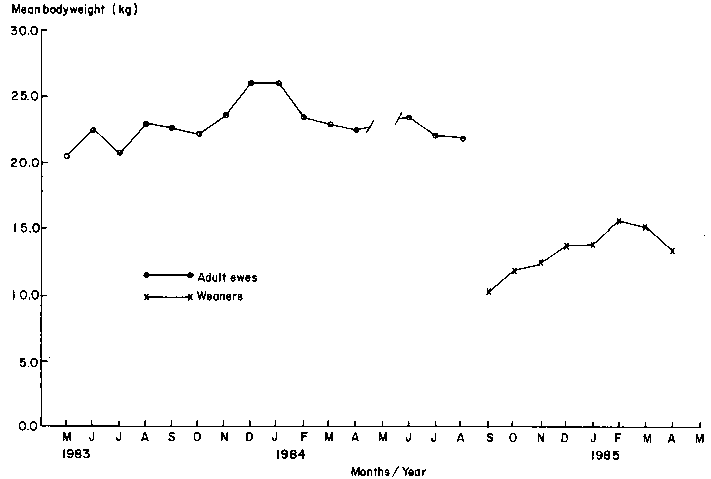
Initial stocking rates (May 1983 - August 1984) were 14 and 28 sheep/ha for the dry and rainy season respectively. At the onset of the dry season in September 1984, the first group of grazing animals, which consisted mainly of mature ewes, was replaced by a fresh batch of weaners to enable growth responses to be more adequately expressed. Overall stocking rate has been 26 sheep/ha since this period. The average bodyweights of the grazing sheep are shown in Figure 2. The observed trends for both groups of animals indicate a gradual rise in bodyweight through the dry season, which drops at the onset of the rains in March/April. It therefore appears that the environmental and probably disease stress of the rainy season is of far greater consequence than the diminishing ground vegetation of the dry season.
Table 7. Organic carbon and total nitrogen content of soil on three sampling dates.
|
Treatment |
Sampling date |
||
|
15/5/82 |
31/8/83 |
15/8/84 |
|
|
organic carbon (%) |
|
|
|
|
sole maize (no trees) |
1.09 (100)1 |
1.27 (100) |
1.09 (100) |
|
Alley cropping |
1.13 (104) |
1.42 (112) |
1.05 (96) |
|
Alley grazing |
1.29 (118) |
1.50 (118) |
1.19 (109) |
|
Total nitrogen (%) |
|
|
|
|
Sole maize |
0.155 (100) |
0.132 (100) |
0.122 (100) |
|
Alley cropping |
0.161 (104) |
0.148 (112) |
0.129 (106) |
|
Alley grazing |
0.164 (106) |
0.154 (117) |
0.137 (112) |
1. Figures in parentheses indicate organic carbon and total nitrogen content of the soils as a percentage of contents in sole maize plots.
Another problem encountered in the system was the tendency of the sheep to debark the trees. This behaviour is suspected to be linked to the inadequacy of feed, as it is more intensive during the dry season. The alley cropping hedgerow spacing of 4 m also appears to be too close for a grazing system, especially if stockpiling of browse is intended for the dry season. An 8 m spacing would prevent canopy closure, and allow more light to the undergrowth pasture and the animals. Obviously the alley grazing system presents a lot of unanswered questions and more research is needed in its development.
Figure 2. Mean bodyweight of sheep grazing natural pasture in Leucaena alleys.
The intensive feed garden (IFG)
This is a relatively new concept which is currently receiving a lot of research attention at ILCA. The IFG aims at intensive cultivation of fodder trees and grasses on a small plot of land, usually close to the farmer's animal holding area. It is especially suitable for situations where alley farming may be inappropriate for one reason or the other, and can also be used, in some cases, to supplement feed resources from alley farms.
The prototype IFG contains the legumes leucaena and gliricidia on one half and the grasses Panicum maximum and Pennisetum purpureum on the other. The gardens are 200 m and predicated on intensive nutrient cycling through the application of manure or fertilizer to maximise feed production from a limited area. The goal is to have gardens which will provide the major feed requirements for 4-6 animals.
Current research aims at further intensifying the gardens through modifications in spacing and design (spatial arrangement of trees and grasses), as well as quantification of their productivities and carrying capacities.
Animal response to browse supplementation
ILCA's research on fodder cultivation and management is backed by a series of controlled nutrition trials to determine the value of browse supplementation to the productivity of the animals. In general, small ruminants, especially goats, utilise browse more than cattle. The strong preference of small ruminants for leguminous browse leucaena and gliricidia - is immediately evident when the animals are offered a mixed diet of browse and grasses or household scraps such as cassava peels. One farmer in ILCA's on-farm project site complained that his goats no longer accept cassava peels since he introduced them to leucaena.
Results from one ILCA study have shown that supplementation of leguminous browse to sheep and goats increases daily feed intake (ILCA, 1983). Similar results have been reported by Ademosun et al (1984) using leucaena and gliricidia in separate trials as supplements to panicum hay. The same authors also reported a linear relationship between the amount of legume fed and digestibility, dry-matter intake and digestible dry matter.
In another ILCA on-station trial to determine the effect of supplementation on long-term animal productivity, different levels of supplementation are being tested on West African Dwarf sheep (Table 8). Animals received one of four diets, irrespective of physiological condition, throughout the period. Chopped Panicum maximum was available ad libitum to all animals, together with water and mineral lick. Preliminary results of the first 2 years of the trial are summarised in Table 9. Overall lambing interval was 239 days, ranging from 262 days on the control diet (basal diet, no browse supplementation) to 226 days at supplementation level of 400 g browse DM/day. Birthweight of lambs and dam weight before birth were 1.68 and 25.5 kg, respectively, with no significant effect of dietary regime.
Table 8. Dietary regimes for West African Dwarf sheep in browse supplementation trial.
|
Regime |
Basala diet |
Supplementaryb browse (g DM/day) |
|
1 |
Ad libitum |
0 g DM/day |
|
2 |
Ad libitum |
200 |
|
3 |
Ad libitum |
400 |
|
4 |
Ad libitum |
800 |
a. Basal diet - Panicum maximum.
b. Browse - 50% Leucaena leucocephala and 50% Gliricidia sepium.
Mortality rates of lambs decreased as the level of supplementation increased, with twin lambs improving from 0.43 on the basal diet to 0.25 at the highest level of supplementation. Lambs on the basal diet gained 64.4 g/day compared with 83.8 g/day for those receiving 800 g of browse daily.
These preliminary results give some indication of the potential of leguminous browse for improving small ruminant productivity through improved feeding. However, in order to improve the correlation between level of supplementation and performance, animals have been penned individually rather than in groups, and synchronisation of oestrus has been effected, so that all offspring should be born over a short time. This will minimise variations in physiological stress among animals in the trial.
Table 9. The effects of browse supplementation on the productivity of West African Dwarf sheep. (Mean ±SE).
|
Observations |
1 |
2 |
3 |
4 |
Mean |
|
Parturition interval |
262 |
228 |
226 |
241 |
239 |
|
(days) |
±13.5 |
±19.1 |
±8.4 |
±8.9 |
±8.4 |
|
Litter size |
1.26 |
1.27 |
1.19 |
1.17 |
1.22 |
|
|
+0.087 |
±0.089 |
±0.082 |
±0.078 |
±0.04 |
|
Survival to 90 days |
0.65 |
0.52 |
0.65 |
0.82 |
0.65 |
|
Birth weight (kg) |
1.80 |
1.61 |
1.52 |
1.72 |
1.68 |
|
|
+0.069 |
±0.104 |
±0.073 |
±0.067 |
±0.04 |
|
Daily liveweight gain to 90 days (g) |
64.4 |
60.3 |
73.4 |
83.8 |
70.5 |
|
|
±2.98 |
±3.51 |
±4.98 |
±3.69 |
±2.14 |
The basal diet on offer in the experiment has been found to be inferior to the diet of free-ranging village animals, when judged from growth rates. To achieve a growth rate of 74 g/day as reported for village sheep up to 90 days of (Mack, 1983) would require the basal diet of panicum to be supplemented with around 400 g of browse DM/day. However, the addition of high quality leucaena and gliricidia as a supplement to a village diet is expected to increase productivity. Efforts are currently being made to set-up a browse supplementation trial with free-ranging animals within the village to provide an accurate response of village animals to browse supplementation.
The potential of leguminous fodder trees within the farming system of the lowland tropics should be seen in their multipurpose nature and their ease of integration into existing farming systems. Leguminous fodder trees can be used for the improvement of both crop and livestock production and thus offer a means of linking small ruminant production with arable crop production. Both leucaena and gliricidia are highly productive, contain significant amounts of N (about 4% N; 20% protein) and establish well under tropical environments. They are therefore immensely suitable for the improvement of farming systems through soil fertility maintenance (for crop production) and increased availability of high-protein feed for small ruminants. Generally, the inclusion of leguminous trees in tropical land-use systems offers many advantages at minimum expense. Increased research and development attention in this area is therefore strongly recommended.
Most of the work reported in this paper was carried out under the joint sponsorship of ILCA and IDRC. The authors, on behalf of ILCA, are grateful to IDRC for their continued support of ILCA's research programme. The authors are also grateful to Mr Samson Adegbanke who provided competent technical assistance in the various studies.
Ademosun A A, H J Jansen and V van Houtert. 1984. Goat management research at the Univeristy of Ife. In: Sheep and goats in humid West Africa. ILCA, Addis Ababa, Ethiopia. p. 34-37.
Guevarra A B. 1976. Management of Leucaena leucocephala for maximum yield and nitrogen contribution to intercropped corn. Ph.D. Thesis, University of Hawaii, Honolulu, Hawaii, USA.
ILCA (International Livestock Centre for Africa). 1983. Annual Report for 1983. ILCA.
ILCA (International Livestock Centre for Africa). 1984. Annual Report for 1984. ILCA.
Kang B T. G F Wilson and L Sipkens. 1981. Alley Cropping maize and Leucaena in southern Nigeria. Plant and Soil 63:165-179.
Mack S D. 1983. Evaluation of the productivities of West African Dwarf sheep and goats in southern Nigeria. Programme Document No. 7. Humid zone Programme, ILCA, Ibadan, Nigeria.
Nye P H and D J Greenland. 1960. The soil under shifting cultivation. Tech. Comm. 51. Commonwealth Bureau of Soils, Harpenden, Herts, England.
Rachie K O. 1983. Intercropping tree legumes with annual crops. In: Huxley P A (ed.). Plant research and agroforestry. International Council for Research in Agroforestry, Nairobi, Kenya. pp. 103-116.
Sumberg J E. 1984. Small ruminant feed production in a farming systems context. In: Sheep and goats in humid West Africa. ILCA, Addis Ababa, Ethiopia. pp. 41-46.
Sumberg J E. 1985. Note on flowering and seed production in a young Gliricidia sepium seed orchard. Trop. Agric. (Trinidad), 62:17.