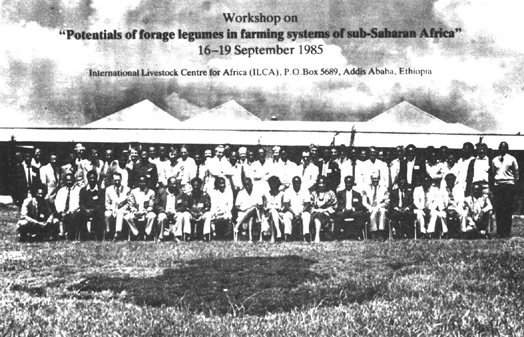
Appendix I - Participants and observers
Synthesis statements and recommendations were prepared by two working groups (one for each session) and refined in discussion during the concluding session.
The recommendations were made for consideration by national research institutes as well as by ILCA. They reflect a consensus on the suggestions emerging from individual presentations.
Nutrient and water constraints to forage legume growth
· Nutrient and water constraints are related to the specific requirements of particular legumes.· If a forage legume is grown in combination with food crops, water and nutrient management are basically dictated by the requirements of the food crops. Low nutrient requirements of legumes help reduce the need for fertilizer inputs.
· Even though there are large differences among sub-Saharan farming systems in terms of access to fertilizers, nutrient management practices will have to work with generally low levels of inputs.
· Both forage legumes and their associated rhizobia are affected by nutrient and water constraints. Determining their relative responses to these constraints requires adequate measuring techniques.
Recommendations
1. Phosphorus· Studies of the efficiency of use of P in farming systems, with special reference to residual P in crop rotations.
· Studies of the use of alternative P sources in relation to costs and efficiencies.
· Selection of cultivars adapted to low available P and possibly use of mycorrhizae.
· Determination of appropriate points of P fertilizer interventions in cropping systems.
· Strengthening of soil testing facilities as a means of predicting response to P fertilization.
· Studies of interactions between P. soil and crop species/cultivar for optimisation of P inputs.
· Determination of the P status of forage legumes.2. Other elements
· Studies of the differential requirements among species and cultivars.
· Survey of the distribution of various nutrient-deficient soils, and their description.3. Water
· Studies of the relative water-use efficiency of legumes.
· Studies of management of soils and crops to improve water-use efficiency.
· Selection of cultivars that tolerate or escape drought.
· Measurement of soil/water relations.4. Biological nitrogen fixation (BNF)
· Studies of BNF measurement techniques.
· Selection and production of adapted rhizobia.
· Determination of N budgets for cropping systems.
· Determination of the fate of biologically fixed N.
Forage legumes in production systems
Forage legumes fix a larger proportion of the N they need for growth than do most grain legumes, and are therefore more effective in restoring soil fertility.
In subsistence cropping systems legumes are the most important source of N. since little fertilizer is used. The use of forage legumes in both pasture and food crop production systems is essential in order to promote food security in subsistence farming systems. Forage legumes, including leguminous shrubs and trees, provide generally high-quality feed that can be used to supplement crop residues, which are the main source of animal feed in many smallholder farming systems.
The ability of forage legumes to provide high-quality feed and to increase soil fertility makes them central to the exploitation of the complementarities between livestock and crop enterprises. Much of the potential of many African farming systems lies in these synergies.
Recommendations
1. Legume feed production systems
1.1. Intercropping forage legumes with food crops
· Selection of legume species and cultivars and food crops in order to match growth patterns and architecture of partners for optimum resource utilisation.· Studies on how to minimise competition between species in intercropping systems.
· Use of simulation models in the development of intercropping systems.
· Determination of the fate of N in intercropping systems (especially with reference to long-term transfer patterns).· Economic evaluation of intercropping systems with emphasis on long-term effects and with reference to other systems of legume use.
1.2. Ley farming (rotation of cereals and forage legumes)
· Correct identification of forage legume species and cultivars.· Studies of the constraints on and the scope for the introduction of ley-farming in different farming systems.
· Emphasis on long-term soil fertility management for sustained crop production.
· Determination of the fate of N under ley systems.
· Studies of the contribution of ley-farming to soil and water conservation.
1.3. Alley farming, fodder banks
· Economic assessment.
· Studies of long-term effects (agronomy, nutrients, tree survival and (re)establishment, management.
· Germplasm selection, priority ranking in selection criteria according to regional setting.
· Germplasm selection for dry and for cool ecosystems and for problem soils.
· Maximisation of animal utilisation of alley offtake.
2. Research approaches and priority areas
· On-farm research and effective research-extension links on farmers' fields are necessary for effective development of forage legume technologies.· Successful development of forage legume technologies requires the early involvement of the animal in the evaluation process.
· Forage or shrub legumes should be used as supplements to diets based on crop residues (N supplementation).
· More research is needed into establishment of forage legumes in a variety of systems (legume-based pastures, legume leys, intercrops, sole crops, alley crops, protein banks, rangelands improvement).
· Application of successful legume technologies will not be feasible without an effective legume seed production programme.
· Existing information on forage legumes needs to be compiled in order to contribute to more rapid progress in technology generation.
PARTICIPANTS
R.L. McCown
CSIRO
Davies Laboratory
P.O. Box Aitkenvale
Queensland
AUSTRALIA, 4814
S.K.A. Danso
IAEA
Wagramerstrasse 5
P.O. Box 100
A. 1400
Vienna, AUSTRIA
C. Kirda
IAEA
Wagramerstrasse 5
P.O. Box 100
A. 1400
Vienna, AUSTRIA
Amare Abebe
Research Officer
P.O. Box 103
IAR
Nazareth, ETHIOPIA
Asnakew Woldeab
Research Officer
IAR
Addis Ababa, ETHIOPIA
Lulseged G/Hiwot
Research Officer
IAR
Addis Ababa, ETHIOPIA
Taye Bekele
Research Officer
IAR
Addis Ababa, ETHIOPIA
Tadesse Dadi
N.W. Regional Planning Office
P.O. Box 217
Bahir Dar, ETHIOPIA
Alemayehu Mengistu
Senior Pasture Agronomist
Ministry of Agriculture
Addis Ababa, ETHIOPIA
P.A. Chadhokar
Silvipasture Adviser
FAO, Addis Ababa, ETHIOPIA
S.L. Russo
Forage Agronomist
Gambia Mixed Farming Project
C/O American Embassy
P.O. Box 2596
Banjul, GAMBIA
F. Riveros
Senior Officer
Grassland Group
FAO, Rome, ITALY
M. Djimde
Post Doctoral Fellow
ICRAF
Nairobi, KENYA
R.K. Jones
ACIAR/CSIRO Dryland Project c/o Australian High Commission P.O. Box 30360
Nairobi, KENYA
B.A. Keating
ACIAR/CSIRO Dryland Project
Box 41567
Nairobi, KENYA
B.H. Dzowela
Senior Research Officer
Department of Agric. Research
Chitedze Agric. Res. Station
P.O.. Box 158
Lilongwe, MALAWI
E. Agishi
NAPRI
P.O. Box 1096
Shika
Zaria, NIGERIA
C.F. Ijeoma Onwuka
Department of Agriculture
University of Cross River
State P.M.B. 1017
UYO
C.R.S., NIGERIA
L. Akundabweni
IITA
P.M.B. 5320
Oyo Road
Ibadan, NIGERIA
E.O. Ajileye
Assistant Chief Livestock
Development Officer
Federal Livestock Dept.
Canchi, NIGERIA
A. Blair Rains
Private Consultant
Rosebank
Queen street, Castle Douglas
Kirkcudbrightshire
DG7 IEH, SCOTLAND
D.S. Amara
Department of Agronomy
Njala University College
Njala, SIERRA LEONE
A.T. Ayoub
National Coordinator
(Soils)
Agricultural Research Corp.
Gezira Research Station
P.O. Box 126
Wad Medani, SUDAN
H.M. Abdel Magid
Department of Biochemistry and Soil Science
Faculty of Agriculture
Shambat, SUDAN
R.H. Ogwang
University of Swaziland
Luyengo, SWAZILAND
P.S. Cocks
Program Leader
Pasture, Forage and
Livestock Program
ICARDA
P.O. Box 5466, Aleppo
SYRIA
M.L. Kusekwa
Senior Scientific Officer
Livestock Production Insti
tute Private Bag
Mpwapwa, TANZANIA
R.W. Snaydon
Lecturer
Department of Agricultural
as Botany
Reading University
Reading
UNITED KINGDOM
N. Luyindula
Head, Microbiology Dept.
Centre Regional d' etudes
Nucleaires
B.P. 868, Cren K,
Kinshasa XI, ZAIRE
G.-S. Nambayo
Research Officer
Mochipapa Research Station
P.O. Box 630090
Choma, ZAMBIA
G. van Rootselaar
Cattle Development Area
Coordinator
Department of Agriculture
ZAMBIA
A.R. MacLaurin
Crop Science Dept.
University of Zimbabwe
Harare, ZIMBABWE
P.J. Grant
Senior Research Officer
Department of Research and
Specialist Services
Private Bag 3701
Marondera, ZIMBABWE
ILCA
Humid Zone Programme
PMB 5320, Ibadan
Nigeria
A. Atta-Krah
Forage Agronomist
Arid and Semi-arid Zones
Programme
BP 60, Bamako, Mali
H. Hulet
Subhumid Zone Programme
PMB 2248, Kaduna
Nigeria
M.A. Mohamed-Saleem
Agronomist
R. Otsyina
Post-doctoral Associate
Headquarters
P.O. Box 5689, Addis Ababa
Ethiopia
Abate Tedla
N. Ahmad
Consultant
E. Akyeampong
Asfaw Y.
Asres Tsehau
J. Kahurananga
J. Lazier
W. Migongo-Bake
L.R. Mytton
Consultant
P.J.H. Neate
L.A. Nnadi
Visiting Soil Scientist
Mohammed Ali Omar
I. Peter
A. Russel-Smith
Takalegne Tadesse
Tekalegne Mamo
S. Weise
Yimer Hassen
OBSERVERS
J. Diamoungana
Directeur General
Direction generale de la recherche scientifique et technique
Republique Populaire du Congo
Betru Nedessa
Ministry of Agriculture
Addis Ababa, Ethiopia
M. Dougnac
Farming Systems Agronomist
Dept. of Agriculture
Mansa, Zambia
ORGANIZERS
I. Haque
Soil Scientist
ILCA
S. JUTZI
Forage Agronomist
ILCA
J. Tothill
Head, Plant Science Division
ILCA
R.G. Scholtens
Director of Training and Information ILCA
SECTRETARIAT
Worque Mekasha
Training Officer
ILCA
Zerfechiwal Seifu
Secretary
ILCA
Yilma B. Asfaw
Assistant Training Officer
(Conferences)
ILCA
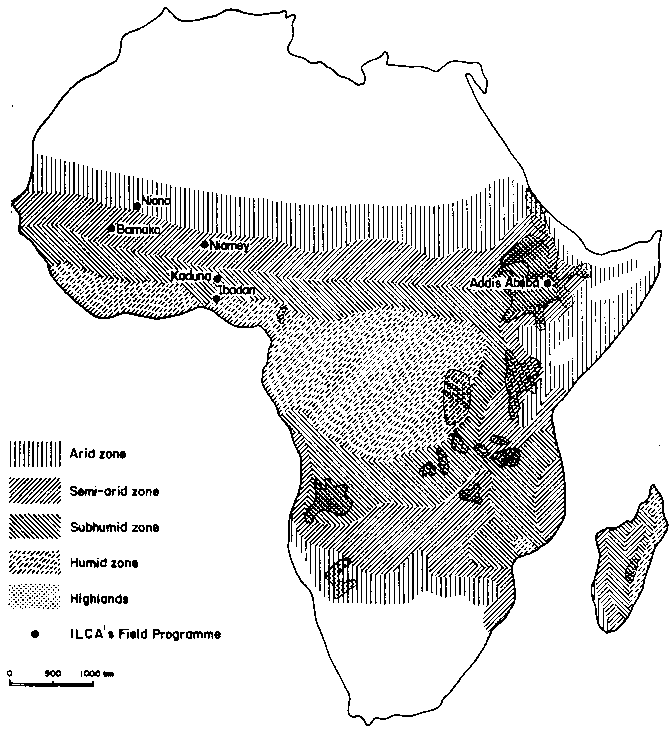
Figure X: Environmental zones of sub Saharan Africa