


E.N. Tambi institute of Animal Research, Bambui
P.O. Box 80, Bamenda, Cameroon
Abstract
Introduction
Model
Results
Discussion
References
This study made use of information collected from a formal survey of sheep and goat farmers in the North West Province of Cameroon to test the hypothesis that the ability of a farmer to adopt a particular technology with which to increase production depends on the resources of the farmer, his/her socio-economic characteristics and expectations as well as factors outside his/her own control.
The framework of analysis was based on a multistage economic model of the adoption process relating to agricultural innovations. A general profit function was estimated by the method of maximum likelihood to derive coefficients and probabilities of explanatory variables likely to influence farmer attitudes towards increased sheep and goat production.
Estimated coefficients showed that current herd size, available pasture land, housing and fencing facilities, current income from sales, and market price for sheep and goats had significant effects on the ability to increase sheep and goat production through adopted technology. The variables - family and hired labour, age, and expected future returns from sheep and goat - did not significantly affect the decision to increase sheep and goat production. From the interviews, over 80 percent of farmers were willing to increase sheep and goat production if constraints on production and marketing were lifted. This suggested that a substantial number of farmers were being prevented by a number of factors from expanding production. Against this background of constraints, a strategy for developing the sheep and goat sectors in the North West
Province should aim at not only minimising constraints against increased productivity, but also exploiting the biological, economic, management and institutional possibilities available for sheep and goat production.
Small ruminant production in general, and sheep and goat production in particular, has in recent years gained increasing popularity in most of the developing countries. Apart from the social and economic functions small ruminants play in developing societies, they also provide most of the meat supply for human consumption. Increased demand for goat meat for example provides potential economic advantages to farmers of small ruminants over large ruminants (Cross, 1974; McDowell and Bove, 1977). Adu and Ngere (1979) and Brinkman and Adu (1977) have estimated that sheep and goats contribute 11 and 20 percent of the meat supply in Nigeria respectively, while Bayer (1986) estimated they supply 35 percent.
The most serious constraint, however, on small ruminant production in Africa in general and Cameroon in particular is the small size of the average farm. It is estimated that there are approximately 20,000 and 57,000 sheep and goat farmers in the North West Province of Cameroon (18.3 and 13.1 percent of the national total) with sheep and goat population representing 10.9 and 12.6 percent of the national herd size respectively. The average herd size per farm is 8.8 sheep and 7.8 goats with births making up 61.7 and 56.6 percent of the increase in herd size and mortality accounting for 39.5 and 36.5 percent of the reduction in herd size respectively (Cameroon Agricultural Census, 1984). Since the herd size is small, one way of increasing it is by means of intensification; that is, increasing output in a way that is economically worthwhile to the farmer.
The key to intensification and increase in output of sheep and goat production is the application of improved production and marketing technologies. These include significant increases in the use of purchased cereal/protein feeds (concentrates) including crop byproducts (Fomunyam and Meffeja, 1985) and conserved grasses (Tait, 1973), improvement of existing vegetation by upgrading soil fertility, improvement of seeding (Newbold, 1974), investments in improved stock breeds and the application of processing and marketing techniques. These measures of intensification are difficult to come by because of low income levels, inadequate resources and managerial skills as well as general socio-economic characteristics which, together, constitute production and marketing constraints in sheep and goat production. The testing of innovations and monitoring of sheep and goats on smallholder farms outside the station therefore requires an understanding of existing constraints relating to available resources, management practices, ownership patterns as well as marketing conditions.
This study made use of a formal survey with a pre-designed questionnaire to collect information on these parameters from a sample of 60 sheep and goat farmers in the North West Province of Cameroon. This was being done as a follow-up of a diagnostic survey of sheep and goat farmers carried out as part of the IRZ-IDRC on-farm research project. Given the several production and marketing constraints identified in that survey, it was observed that most sheep and goat farmers were reducing the number of animals they keep and were shifting towards crop production which seemed to offer a better alternative to subsistence life.
Based on these findings, it was hypothesised that the ability of a farmer to adopt a particular technology with which to increase productivity depends on the resources he/she has available, his/her socio-economic characteristics as well as those factors outside the farmers' own control. To the extent that these constitute constraints to the farmer, they will affect his ability to adopt the technology and therefore his ability to expand his farm size. The object of this paper therefore is to correctly identify those factors which influence the farmers' decision to increase production through improved technology.
A farmers' attitude towards sheep and goat production is influenced by his resources, his socio-economic characteristics and expectations, and also the attributes of the present and alternative job opportunities available. The model used in analysing these factors is based on previous research concerning factors influencing the adoption of agricultural innovations (Kennedy, 1977) generally, and on explanatory variables identified from research specific to constraints on sheep and goat production and marketing in Africa (Lebbie and Mastapha, 1985; Tambi and Fomunyam, 1985).
The procedure used to measure farmer response to increased sheep and goat production was to utilise binary as well as non-binary variables to quantify factors likely to influence the positive/negative attitudes of farmers towards sheep and goat production. The economic framework rests on a multistage model of the adoption process relating to agricultural innovation (Leuthold, 1966; Kennedy, 1977; Hill and Kau, 1973; McFadden, 1976 and Opare, 1977). In the model, the farmer is confronted with a choice (to expand his/her sheep and goat operation or not to do so) to which he/she reacts positively or negatively depending upon his/her resources, expectations and socio-economic characteristics. The task is to quantify factors (Table 1) which influence this decision.
The probit procedure (Hill and Kau, 1973 and Turner et al, 1983) which specifies a binary dependent variable as a function of a number of quantitative explanatory variables (Kmenta, 1971 and Gujarati, 1978) was chosen for use here because of its ability to generate bounded probability estimates for each individual farmer. The model can be specified as :

where the Xis represent vectors of n (n=9) explanatory variables of the ith farmer, and Yi is a binary variable such that Yi = 1 if the ith farmer wants to expand production = 0 otherwise
In the model, the Xi s are assumed to be stochastic and independent of the zero mean random variable Ei. Since Yi can only assume two different values, 0 and 1, the following expected probability can be obtained:
E(Yi) = 1Xfi (1) + 0Xfi (0) = fi (1) (2)
where fj (1) is the probability that a farmer with a set of resources and economic characteristics (Xi) would expand his operation. From (1) and (2),
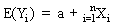

meaning that the probability fi (1) would be different for farmers with different levels of resources and economic characteristics. Thus, the expected probability E(Yi) which can be interpreted to mean the proportion of all farmers with resources and economic characteristics (Xi) likely to expand operation would be given by:
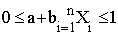
The larger the proportion the greater the decision to expand operation and vice versa.
Following Turner et al (1983) the general probit form for the ith farmer is :
INT = f (HDS, PLD, HOU, LAB, FNC, PRI, GIN, AGE, EXP)
where the independent variables are defined as in Table 1 and INT is a hypothetical index signifying the farmers, intention to expand his sheep and goat farm or not to do so. The maximum likelihood technique (Kmenta, 1971; Gujarati, 1978) was used to estimate coefficients and to test hypotheses about factors relevant in shaping farmers' attitudes towards expanding sheep and goat production.
Table 1. Variables hypothesised to influence farmer attitudes towards increased sheep and goat production in the North West Province, Cameroon.
|
Variable name |
Description |
Measurement |
Mean |
Expected |
|
HDS |
Herd size (no. of animals available on farm) |
Actual number of animals reported |
16.05 |
- |
|
PLD |
Land area containing pastures for grazing |
No. of hectares of pasture land reported |
8.00 |
+ |
|
HOU |
Housing facility for sheep and goats |
1 - housing available |
0.85 |
+ |
|
LAB |
Labour resources (no. of hired and family labour) |
Actual number of persons working on farm at least half time |
2.25 |
+ |
|
FNC |
Fencing facility for confining sheep and goats. |
1 - Fencing available |
0.85 |
+ |
|
FRI |
Current market price for sheep and goats |
Actual market price observed per live adult animal (CFA)* |
11.975 |
+ - |
|
GIN |
Gross income from sheep and goat sales |
Actual gross income reported from sales of sheep and goat (CFA) |
44.800 |
+ |
|
AGE |
Age of farmer |
Actual age of farmer reported from sales of sheep and goat (CFA) |
46.45 |
- |
|
EXP |
Farmer's expectation of future farm income |
1 - rising |
0.55 |
+ |
* 1 US$ = 315.5 CFA
Estimated coefficients obtained from the likelihood function specifying explanatory variables likely to influence farmers, attitudes towards increased sheep and goat production in the North West Province of Cameroon are given in Table 2. Current herd size (HDS) was hypothesised to be inversely related to the decision to expand production because the probability of a positive response increased for farmers with smaller herd sizes and vice versa. At P<0.10 the results in Table 2 supported this hypothesis. Sample data obtained on farmer response bear this out since farmers with fewer animals showed a greater desire to increase herd size to fulfil household cash needs while farmers with larger herd sizes were not only constrained by land and pasture shortages (particularly in the dry season), but also by problems of marketing.
Available pasture land (PLD) was an important positive factor influencing farmers' attitudes towards increased sheep and goat production. The results supported the hypothesis that farmers who have grazing land were more apt to increase herd size than those with little or no pasture land.
Two other factors that seemed to influence farmers' attitudes were facilities available for housing (HOW) and fencing (FNC) sheep and goats. These variables exerted, as hypothesised, a positive influence on attitudes. Existing housing and fencing facilities provide positive environments for improved management of small ruminants. Most farmers interviewed in this survey provided housing (68 percent) and fencing (54 percent) for their sheep and goats. This agrees with the findings of Agyemang et al (1985) who reported 82 percent of farmers housing sheep in the Ethiopian highlands.
Table 2. Coefficient estimates, student t's and probability levels of farmers exhibiting positive attitudes towards increased sheep and goat production in the North West Province, Cameroon.
|
Explanatory variables |
Estimated coefficients (standard errors) |
Student t's |
Probability of farmer exhibiting a positive response |
|
HDS |
0.30 |
1.428 |
0.210 |
|
PLD |
0.015 |
1.667 |
0.204 |
|
HOU |
0.876 |
1.320 |
0.196 |
|
|
(0.663) |
|
|
|
LAB |
-0.170 |
-0.727 |
0.130 |
|
FNC |
0.210 |
1.680 |
0.220 |
|
FRI |
0.731 |
2.107 |
0.310 |
|
GIN |
0.073 |
1.932 |
0.240 |
|
AGE |
0.37 |
1.224 |
0.141 |
|
EXP |
-0.386 |
-0.682 |
0.072 |
|
Constant degrees of |
1.179 |
|
|
|
freedom |
8 |
|
|
Available family and hired labour (LAB) was hypothesised to be positively related to increased production. Households with a larger work force are more apt to increase production as this makes the task for tethering, herding, feeding etc. easier. The results did not support this hypothesis. The variable had the wrong sign and was not significant (P>0.05). This is not surprising, however, given that family labour, which makes up the largest chunk of the labour force in subsistence agriculture often is shared among different alternative farm activities (see for example Jones, 1983). Assuming from neoclassical theory that household members do not have conflicting interests over the allocation of labour time for farm work, the contrary was observed for sheep and goat farmers in the North West Province. As became apparent through interviews with men and women and observations, there was frequent and sometimes pronounced conflicts between men and women over the division of labour for crop and livestock production. In the North West Province sheep and goats are tended mostly by men while women are concerned more with crop production (Tambi and Fomunyam, 1985). Although children assist on the farm, this often is restricted to vacation periods (June to September). It is probable therefore, that the combined effects of the division of labour together with this variable's correlation with other variables in the equation might have biased the results.
AGE was hypothesised to be inversely related to the probability of a positive response because older persons tend to be less vigorous on the farm than younger ones. The results obtained here did not verify this because AGE was not significantly (P>0.05) affecting the decision to expand production. From the interviews, older men seemed to have preferred having larger herd sizes. The results reported here did not agree with the findings of Glazner and Sporleder (1979) who showed AGE to be significantly affecting producer attitudes towards a computerised feeder cattle marketing nor did they agree with those of Turner et al (1983) on the effect of AGE on producer attitudes towards multicommodity electronic marketing.
The variables gross income (GIN) and the expected income potential (EXP) from sheep and goat production (proxies for initial capital and future returns) were hypothesised to directly influence farmers' attitudes. That is the more income a farmer has and the more optimistic he/she is about future returns, the more likely will he/she have a positive attitude towards increased production. Only GIN was statistically significant (P<0.05) indicating that the proxy for initial capital has a major effect on the decision to increase production. By implication, any commercially oriented approach to sheep and goat production will require substantial initial cash inputs to purchase more animals, for better housing, improved pastures and the necessary infrastructure (Lebbie and Mastapha, 1985). The average gross income of 44,800 CFA reported per farmer is too low to meet these costs. The variable EXP was not only insignificant (P>0.05) but had the wrong sign; an indication that higher anticipated returns do not necessarily influence farmers to invest to increase production particularly if the investments are associated with higher levels of risks (Tambi, 1985). Of the farmers interviewed, only 36 percent indicated that they would increase production if future income from sheep and goat production proved good.
Current market price (PRI) was another variable tested and found statistically significant at P<0.0S. It was expected a priori that the levels of current market prices would exert either a positive or a negative force on the decision to increase herd size depending on whether they are relatively higher or lower than the previous year's price.
The likelihood estimates shown in Table 2 give an indication of farmers' response to constraints (explanatory variables) affecting his/her decision to expand production through improved technologies. The estimates were used to derive the probability of a farmer reacting positively towards the expansion of production. To obtain this probability the mean values of the explanatory variables in the equation were used to arrive at the value to the dependent variable, which in turn was used to derive the probability of a positive reaction towards increased sheep and goat production. These probabilities are shown in Table 2.
The random sample of sheep and goat farmers in the North West Province, Cameroon revealed that over 80 percent of those interviewed were willing to expand production if constraints on production and marketing were lifted. This suggested that a substantial number of farmers were being prevented by several factors from expanding production. The average herd size of 11 for example, provided limited scope for a commercially oriented approach to sheep and goat production in the North West Province. A market-oriented approach, if it is to be of practical value, must take account not only of the biological (nutrition and health) possibilities, but also, of a variety of economic and management constraints. Economic constraints have a major effect on the extent to which some of the biological factors can be employed. It is, for example, technically possible to improve the nutrition and health of animals by concentrate supplementation and other management factors, but the relationships between input costs and product prices serve to limit their use. Dry season supplementation of sheep and goat diets for example, offers an effective means of increasing output during periods of scarce pastures but the high concentrate and labour costs incurred render it uneconomic.
Land and pasture improvement for sheep and goat production is an expensive operation particularly in regions where there is dominance of native pastures (Newbold, 1974; Eadie and Maxwell, 1975). Studies by Maxwell et al (1976) have shown clearly that beyond a certain point investments in land improvement for development of improved systems of production can lead to severe disadvantages to the enterprise concerned. This is more so when labour and capital costs are high as a proportion of total cost. In the sheep and goat production system of the North West Province capital for the purchase of additional stock is lacking and skilled labour for management is a scarce commodity so that improved systems must seek to provide a framework within which capital and labour can be more efficiently used.
1 US$ = 315.5 CFA
Against this background, a strategy for developing the sheep and goat sector in the North West Province, if it is to be successful, should aim at fully exploiting the animal, human and land resources by removing or minimising the current and future constraints against improved productivity. There is a need to move away from traditional methods by intensifying production through the adoption of simple techniques of improved feeding, more efficient health regime, and improved marketing services and facilities. Although more research into the economic viability of feeding concentrates, use of improved pastures, controlled breeding, health maintenance and marketing is needed to provide a stronger base for any development programme, it is important that before the programme is drawn, the economic consequences of investments in intensive sheep and goat production be known.
Adu, I.F. sod Ngere, L.O. 1979. Indigenous sheep of Nigeria. World Review of Animal Production 15 (3): 51-67.
Agyemang, K.; Negussie Akalework, Voorthuizen, K. and Anderson, F.M. 1985. A rapid survey of sheep production in the traditional sector of Debre Berhan, Ethiopian highlands. In: R.T. Wilson and D. Bourzat (eds), Small ruminants in African agriculture. Proceedings of a Conference held at ILCA, Addis Ababa, Ethiopia, 30 September - 4 October 1985. ILCA, Addis Ababa. pp. 174-185.
Bayer, W. 1986. Traditional small ruminant production in the subhumid zone of Nigeria. In: R Von Kaufmann, a Chater and R Blench (eds), Livestock systems research in Nigeria's subhumid zone. Proceedings of the Second ILCA/NAPRI Symposium held in Kaduna, Nigeria. 29 October - 2 November 1984. ILCA, Addis Ababa, Ethiopia. pp. 141-166.
Brinkman, W.L. and Adu, I.F. 1977. The problems of goat production in the savannah region of Nigeria. NAPRI (manuscript), Zaria. Cameroon, Agricultural Census, 1984.
Cross, E.G. 1974. Goat marketing in Rhodesia. Rhodesian Agricultural Journal 71 : 159-160.
Eadie, J. and Maxwell, T.J. 1975. Systems research in hill sheep farming. In: G.E. Dalton (ed), Study of agricultural systems. Applied Science Publishers Ltd. London, UK. 441 pp.
Fomunyam, R.T. and Meffeja, F. 1986. Maize stover in maintenance diets for sheep and goats in Cameroon. In: T.R. Preston and M.Y. Nuwanyakpa (eds), Towards optimal feeding of agricultural by-products to livestock in Africa. Proceedings of a workshop held at the University of Alexandria, Egypt, October 1985. ILCA, Addis Ababa, Ethiopia. pp. 135-139.
Glazner, G. and Sporleder, T.L. 1979. Potential producer acceptance of electronic marketing of feeder cattle in Texas. Agricultural Market Research and Development Center. Res. Rep. MRC 3-79.
Gujarati, D. 1978. Basic econometrics. McGraw-Hill Book Co., New York, N.Y.
Hill, L. and Kau, P. 1973. Application of multivariate probit to a threshold model of grain dryer purchasing decisions. American Journal of Agricultural Economics 55: 19-27.
Jones, C. 1983. The mobilisation of women's labour for cash crop production: A game theoretic approach. American Journal of Agricultural Economics 65: 1049-1054.
Kennedy, L. 1977. Evaluation of a model building approach to the adoption of agricultural innovations. Journal of Agricultural Economics 28: 55-60.
Kmenta, J. 1971. Elements of econometrics. Macmillan Press.
Lebbie, S.H.B. and Mastapha, P.R. 1985. Goat production in the Swaziland middleveld. In: R.T. Wilson and D. Bourzat (eds), Small ruminants in African agriculture. Proceedings of a conference held at ILCA, Addis Ababa, Ethiopia, 30 September - 4 October 1985, ILCA, Addis Ababa, Ethiopia. pp. 225-234.
Leuthold, F.D. 1966. Communication and diffusion of improved farm practices in two northern Saskatchewan farm communities. Canadian Centre for Community Studies, Saskatoon, Saskatchewan, Canada.
Maxwell, T.J.; Eadie, J. and Sibbald, A.R. 1976. Economic appraisal of investments in hill sheep production. Rept. 6 H F RO: 24-42.
McDowell, R.E. and Bove, L. 1977. The goat as a producer of meat. (Cornell Int'l Agric. Mimeo.) Cornell University Press, Ithaca, New York.
McFadden, D. 1976. Quantal choice analysis: A survey. Ann. Economics and Soc. Measure 5: 363-390.
Newbold, P. 1974. The improvement of hill sheep for agriculture: A review. Journal of British Grassland Society 29: 241 and 30: 41.
Opare, K.A. 1977. The role of agricultural extension in the adoption of innovations by cocoa growers in Ghana. Rural Sociology 42: 72-82.
Tait, R.M. 1973. The utilization of dried grass by early weaned lambs. Journal of British Grassland Society 27 (4): 217-220.
Tambi, E.N. 1985. Income risk in livestock and poultry production: The case of dairy and egg production in the North West Province of Cameroon. Review of Science and Technology 1 (4): 31-38.
Tambi, E.N. and Fomunyam, R.T. 1985. Survey of sheep and goat production and marketing systems. By-products Cameroon Progress Report, 1985-86.
Turner, S.C.; Epperson, J.E. and Fletcher, S.M. 1983. Producer attitudes toward multicommodity electronic marketing. American Journal of Agricultural Economics 4: 818-822.
