


T. Smith, C. Chakanyuka¹, S. Sibanda² and B. Manyuchi
Department of Research and Specialist Services
Grasslands Research Station
P. Bag 3701, Marondera, Zimbabwe
¹ ARDA, Box Bw 41, Harare, Zimbabwe.
² Dept. of Animal Science, University of Zimbabwe, Mt. Pleasant, Harare, Zimbabwe.
Abstract
Introduction
Discussion
Acknowledgements
References
Maize stover, the major crop residue in Zimbabwe, is characterised by a low protein and high fibre content. Little attempt has been made to improve its nutritive value. Two experiments have been completed, the first of which considered the effect of amount of plain untreated stover offered on intake in both cattle and lambs. Stover offered increased from 1.5 - 3.0% of body weight with increased intake at the higher level (P<0.05). There was little evidence of selectivity. A supplement of protein increased intake at all rates of offer in Lambs.
In the second experiment untreated stover was compared with stover treated with 3, 5 or 7% urea for 5 weeks. In cattle and lambs intakes were greatest with less than 7% urea (P<0.05) although digestibility in lambs was greatest with 7% urea (P<0.05). These results were supported by measurements of dry matter degradability in cattle, using the nylon bag technique, and in vitro digestibility. The in vitro study confirmed 5 weeks as being the optimum treatment period in the prevailing experimental conditions. Between experiments intake was improved by coarse grinding and it is concluded that physical aspects of collecting and feeding residues should be considered together with alkali treatment and supplementation in order to reduce wastage.
Crop residues are characterised by low protein and high fibre content and this limits their nutritive value for ruminants. Nitrogen (N) supplementation increases digestibility and intake. (sampling, Freer and Balch, 1962). Maximum intake of cereal straws occurs when crude protein concentration is 66-85 g/kg dry matter (DM) (Elliott and Topps, 1963; Smith et al, 1980).
Chemical treatment of residues also increases intake and digestibility. The benefits to be gained from alkali treatment of residues have been reviewed by Jackson (1977) and Sundstol (1981). Although Sundstol (1981) and Smith et al (1984) found sodium hydroxide more effective than ammonia, the use of alkali containing N reduces the need for protein supplementation (Smith and Balch, 1984). Treatment with urea has been effective in warm (Saadullah et al, 1981) but not temperate climates (Mason and Owen, 1986; Sherwood and Owen, 1987).
Physical treatment usually implies a reduction of particle size. Greenhalgh and Wainman (1972) demonstrated that although intake was improved, a reduction in digestibility was often associated with physical treatment. Walker (1984) concluded that a combination of chemical and physical treatments would be most effective in upgrading crop residues.
The role of crop residues in ruminant nutrition in Zimbabwe was summarised by Sibanda (1986). Maize stover is the principal residue and is either grazed in situ or removed from the land prior to feeding. There has been no attempt to upgrade residues although dry season feed is in short supply. In this study the effects of amount of stover on offer, protein supplement and level and period of urea treatment on nutritive value of maize stover in cattle and sheep were investigated.
Experimental procedure and results
Two experiments were conducted. In the first the effects of varying the amount of maize stover on dry-matter intake (DMI) in cattle and sheep were measured. In the second maize stover was treated with urea and changes in digestibility and intake were assessed by in vivo and in vitro techniques.
The stover (Var SR 52) came from a single batch produced on the station. After harvesting the grain and cob the residue was rotor slashed and baled. In Experiment 1, it was fed direct from the bale to cattle and coarse ground (14 mm screen) when fed to sheep. For Experiment 2, the stover was subdivided into four stacks. One stack was left untreated, the remaining stacks being treated with 3,5 or 7% urea (w/w) and kept wrapped in clear plastic sheeting for 5 weeks. The urea was added as a solution so that regardless of urea concentration 20% of water was added to the stover (w/w). The untreated stover was kept dry to avoid the risk of mould. Small amounts of the stover were treated as above and sealed in plastic bags for 1, 3 or 5 weeks. Treatment dates were staggered so that the stacks and bags were all opened on the same day. Composition of the stover and the climatic conditions during the treatment period are given in Table 1.
Experiment 1
Twenty steers (initial liveweight 224 kg) and 20 lambs (initial liveweight 37 kg) were each ranked according to liveweight and then randomised to give five replicates of four treatments. The treatments were defined as amount of stover offered (1.5; 2.0; 2.5; 3.0% stover DM per day of initial body weight). No other feeds were given except where stated. All animals were individually penned with refusals being taken and fresh feed offered daily.
Table 1. Composition of maize stover fed to cattle and sheep during Experiments 1 and 2 and ambient temperature (°C) and relative humidity (%) during the treatment period of stover for Experiment 2.
|
|
DM |
DM basis g/kg DM |
|||
|
|
g/kg |
Nitrogen |
Acid-detergent fibre |
Ash |
|
|
Expt. 1. |
|||||
|
|
Cattle |
936 |
58 |
431 |
45 |
|
|
Sheep |
933 |
- |
- |
|
|
Expt. 2. |
|||||
|
|
0% urea |
926 |
58 |
431 |
45 |
|
|
3% Urea |
913 |
180 |
465 |
49 |
|
|
5% urea |
905 |
218 |
443 |
45 |
|
|
7% urea |
907 |
324 |
458 |
47 |
|
|
|
Maximum |
Minimum |
|
Temperature (°C) |
September |
25.5 |
10.1 |
|
October |
25.6 |
12.0 |
|
|
Humidity (%) |
September |
79.3* |
28.1+ |
|
October |
86.6* |
39.9+ |
*Measured at 6.00 h
+Measured at 14.00 h
The steers were grazed on stover for 10 days and were then penned for 50 days. Intake was recorded over the last 30 days. Both total intake (kg DM/d) and g DM/kg W0.73/d were in the order 1.5% = 2.0 and 2.5% = 3.0% (P<0.05) (Table 2). Chemical composition of refusals was similar to that of the fresh stover.
Table 2. Dry-matter intake of stover*, in cattle and lambs, as affected by the amount offered (Stover DM kg/d as % liveweight).
|
|
Stover allocation: |
1.5 |
2.0 |
2.5 |
3.0 |
SE |
|
Cattle: |
Total intake (kg DM/d) |
2.17 |
2.17 |
2.56 |
2.58 |
0.07 |
|
Intake g DM/kg W0.73 |
41.5 |
42.9 |
49.9 |
49.0 |
1.56 |
|
|
Refusals as % of amount offered |
31.8 |
48.5 |
51.2 |
59.5 |
|
|
|
Sheep: |
a) No protein |
|
|
|
|
|
|
Total intake g DM/d |
325 |
294 |
313 |
400 |
29.1 |
|
|
Intake, g DM/kg 0.73. |
23.2 |
21.4 |
22.3 |
29.1 |
1.91 |
|
|
Refusals as % of amount offered |
41.9 |
60.6 |
66.5 |
64.3 |
|
|
|
b) With protein* |
|
|
|
|
|
|
|
Total intake, 9 DM/d |
376 |
400 |
354 |
493 |
37.4 |
|
|
Intake, B DM/kg W0.73 |
26.6 |
29.4 |
25.3 |
36.1 |
2.52 |
|
|
Refusals as of amount offered |
32.8 |
46.4 |
62.1 |
56.0 |
|
* Values shown refer to stover intake alone.
+The protein supplement (270 9 DM/d) was eaten by all sheep.
Sheep were fed the stover for 28 days with intakes being measured over the last 7 days. Following this all lambs received 270 g DM/d of a protein (15.0% CP) concentrate and the same stover allocation. After a further 14 days, intake was again measured for 7 days.
At the start of the second period one lamb died from a condition unrelated to the experiment and a missing plot value for intake was calculated (Snedecor, 1956). Intake in both measurement periods was greatest at the 3% rate of offer (Table 2). When the periods were combined total DMI of stover and DMI g/kg W0.73 were significantly increased at the 3% rate of offer (P<0.05). Between the first and second measurement periods mean intake increased by 71±16.1 g DM/d (P<0.01). This last difference is probably attributable to the supplement of protein fed in the second period. Changes in the composition of the refusals were small, acid-detergent fibre being lowest at the 3% level of offer (1.5%, 3.0% = 59.9%, 58.1%) and in vitro DM digestibility highest at the 2.5% level (1.5%, 2.5% = 0.18, 0.24%).
Experiment 2
In this experiment estimates of the nutritive value of urea treated maize stover were made using steers, lambs and in vitro digestibility (Tilley and Terry, 1963).
In order to estimate the pattern of degradability (dg) of the stover and measure DMI in steers, 12 animals were individually fed (8 kg fresh stover/d) to appetite on milled stover which had been treated with either 0,3,5 or 7% urea. No other feeds were offered. After a 20-day adaptation period 10 nylon bags, each containing 5 g of the appropriate dietary stover, were inserted into the rumen of each steer. Two of the bags were withdrawn after 12, 24, 48, 72 and 96 h respectively in order to measure DM loss. Estimates of the dg of stover DM were made using a modification of the non-linear model (p = a + b (1 - e ct)) proposed by Orskov and McDonald (1979). The degradability of dry matter increased with the level of urea treatment and nitrogen in the treated stover was highly and rapidly degraded (Table 3).
Table 3. Dry-matter (DM) and nitrogen (N) loss (%) from maize stover treated with 0, 3, 5 and 7 percent urea incubated in nylon bags in the rumen of steers.
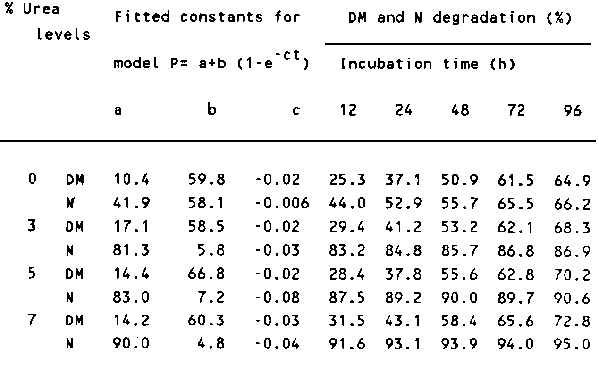
Daily dry-matter intake, measured over the last 10 days of the trial, for the 0, 3, 5 and 7% urea treatments was respectively: 3.99, 5.72, 4.97, 4.27±0.245 kg/d; 51.6, 66.9, 55.5±1. 96 kg W0.73.
Digestibility and intake of the stovers was also measured using 16 lambs, ranked according to initial liveweight (mean 44 kg) and then randomised to the four treatments. Twenty-one days of adaptation to the diet was followed by 7 days measurement of intake and then a further 7 days of intake and digestibility measurements.
Intake was similar during the two measurement periods and the data presented are for the 14 days. All the treated stovers were eaten more readily than the control (P<0.05), the greatest intake following treatment with 5% urea (Table 4). Digestibilities of dry matter (DM), organic matter (OM) and acid-detergent fibre (ADF) are given in Table 4 with the differences between 0% and 7% significant at P<0.05 (Table 4).
Table 4. Intake and digestibility of maize stover, either untreated or treated with 3, 5 or 7% urea, offered to lambs.
|
|
%Urea |
|||||
|
0 |
3 |
5 |
7 |
SE |
||
|
Intake: |
||||||
|
|
g DM/d |
437 |
658 |
698 |
583 |
27.4 |
|
|
g DM/kg W 0.73/d |
28.3 |
40.9 |
44.8 |
37.4 |
2.01 |
|
|
OM g/d |
418 |
626 |
667 |
556 |
26.0 |
|
Digestibility: |
||||||
|
|
DM |
0.458 |
0.478 |
0.535 |
0.584 |
0.0240 |
|
|
OM |
0.476 |
0.491 |
0.552 |
0.597 |
0.0230 |
|
|
ADF |
0.549 |
0.524 |
0.604 |
0.646 |
0.0202 |
In vitro digestibility of DM was greatest after 5% treatment with urea and 5 weeks sealed in plastic. An incubation time of 72 h gave higher values than 48 h. Digestibility of acid-detergent fibre was not improved by lengthening the period sealed from one to five weeks but was by the inclusion of urea. Incubation time was 48 h (Table 5).
Table 5. In vitro digestibility of maize stover before and after treatment with urea.
|
|
Time of treatment |
Time of incubation |
% urea treatment |
||
|
3 |
5 |
7 |
|||
|
DM |
7d |
48 h |
0.46 |
0.47 |
0.47 |
|
72 h |
0.52 |
0.51 |
0.52 |
||
|
21d
|
48 h |
0.51 |
0.53 |
0.47 |
|
|
72 h |
0.55 |
0.57 |
0.53 |
||
|
35d
|
48 h |
0.53 |
0.52 |
0.50 |
|
|
72 h |
0.56 |
0.58 |
0.57 |
||
|
0% urea = 0.46 |
|||||
|
ADF |
7d |
48 h |
0.49 |
0.50 |
0.44 |
|
21d |
48 h |
0.52 |
0.50 |
0.50 |
|
|
35d |
48 h |
0.51 |
0.46 |
0.46 |
|
|
|
0 urea = 0.444 |
||||
Treatment of roughage is undertaken to increase intake and digestibility. In the two experiments reported intake was increased by varying the amount of stover offered, feeding protein as a supplement, treatment with urea and by altering the physical form.
Increased intake through increasing the amount of stover offered supports the findings of Wahed and Owen (1986). They found increasing the refusal level of barley straw from 20 to 50% increased intake in goats by 33%. In Experiment 1 increasing the refusal rate from 31 to 59% increased intake by 19% in cattle. With lambs the refusal rate increased from 42 to 64% of that offered and intake increased 24%. With the high protein concentrate, fed at 21 g DM/kg W0.73, refusal rate increased from 32 - 56% of that offered (the amount of stover offered was constant in both periods of the trial with lambs) and intake rose 31%. The overall effect of the protein supplement was to increase stover intake by 23%. The apparent lack of selective feeding, as measured by changes in refusals, probably reflects to some extent the difficulty of sub-sampling a stover with widely divergent components.
It is probable that the higher rates of stover offered were less than those confronting cattle grazing fresh stover. For maximum utilisation maize stover should be collected, rather than grazed in situ, and consideration given to chemically treating refusals (Wahed and Owen, 1987). To minimise wastage troughs permitting little or no spillage should be provided. Trampled or excreta-contaminated stover is of no further use as a feed.
There were differences in DMI between steers receiving the lowest rate of feeding in Experiment 1 and those on control in Experiment 2 (41.5 vs 51.6 g DMI/d/kg W0.73 respectively). The amount offered in Experiment 2 (92.5 g/kg W0.73) was within the range offered in Experiment 1 (60.7-122.9 g/kg W0.73). In the first experiment stover was fed from the bale and in the second it was coarse-milled. Reduction of particle size is known to increase intake of roughages (Nicholson, 1984). The effects of coarse chopping (probably by a hand-operated machine such as a chaff-cutter) should be investigated.
Urea treatment of stover was also beneficial to intake in both cattle and sheep, confirming the responses reported by Saadullah et al (1981). Sheep ate less than steers but urea treatment stimulated intake to a greater extent. With both species peak intake was achieved with less than 7% urea.
Digestibility of DM and OM measured in lambs increased with increasing levels of urea treatment. This response would have been a combination of the effect of alkali on the cell wall of the stover and the effect of N on fibre digestion and microbial protein synthesis in the rumen (Preston and Leng, 1984). The improvement in the digestibility of DM in the rumen (Table 3) following urea treatment confirms this pattern of response since it is envisaged that over 80% of digested OM is apparently digested in the rumen (Grigera-Naon, 1985). Urea treatment boosted the N content of the stovers (Table 1), the high digestibility of urea being reflected in the rapid and large loss of N in the treated stovers.
Increases in digestibility measured in vitro were not as great as those measured in lambs. Rumen liquor was collected from sheep fed hay and the intention to repeat the test using sheep fed stover as donors had to be dropped. However the results indicate that 5% urea left sealed for 5 weeks was the optimum in the prevailing conditions (Table 1).
The relative importance of intake and digestibility can be shown by considering the control and 5% urea treatments in Experiment 2 (Table 3). The intake of digestible OM (DOMI) were 201 and 361 g/d respectively. If intake had increased without a change in digestibility the DOMI would have been raised from 201 to 303 g/d. Therefore, 70% of the total increase came from raised intake and 30% from an improvement in digestibility. This represents a change in metabolisable energy intake from 50% of maintenance to maintenance (MAFF, 1975).
Factors affecting the economics of treating residues include : the availability and or cost of alternative feeds; the nutritive value of the untreated material and the degree of improvement obtained (Smith & Baleh, 1984). Where feed is limited the slaughter value before and after the feeding period should be considered. Plastic sheeting is expensive and cheap methods of ensiling should be sought. Urea is not always available. This study confirms that the physical aspects of handling and presenting the stover to the animal should be considered together with supplementation and alkali treatment.
We are grateful to E. Rusike, S. Mikayiri, R. Chiwara and L. Svisvah and their staff for care of the animals and chemical analysis.
Campling, R.C.; Freer, M. and Balch, C.C. 1962. Factors affecting the voluntary intake of food by cows. 3. The effect of urea on the voluntary intake of oat straw. British Journal of Nutrition 16: 115 - 124.
Elliott, R.C. and Topps, J.C. 1963. Voluntary intake for low protein diets by sheep. Animal Production 5: 269 - 276.
Greenhalgh, J.F.D. and Wainman, F.W. 1972. The nutritive value of processed roughages for fattening cattle and sheep. Proceedings of the British Society of Animal Production. pp. 61-72.
Grigera-Naon, J.J. 1985. The influence of digestion of alkali treated winter barley straw on its utilization by growing cattle. PhD thesis, University of Reading, Reading, UK.
Jackson, M.G. 1977. Review article: The alkali treatment of straws. Animal Feed Science and Technology 2: 105 - 130.
MAFF (Ministry of Agriculture, Fisheries and Food). 1975. Technical Bulletin No. 33. HMSO, London.
Mason, V.C. and Owen, E. 1986. Urea versus ammonia for upgrading graminaceous materials. In: T.R. Preston and M.Y. Nuwanyakpa (editors), Towards optimal feeding of agricultural by-products to livestock in Africa. Proceedings of a workshop held at the University of Alexandria, Egypt, October 1985. ILCA, Addis Ababa. pp. 50 - 54.
Nicholson, J.W.G. 1984. Digestibility, nutritive value and feed intake. In: F. Sundstol and E. Owen (editors), Straw and other fibrous by-products as feed. Elsevier, Amsterdam. pp. 340 - 372.
Orskov, E.R. and McDonald, I. 1979. The estimation of protein degradability in the rumen from incubation measurements weighted according to rate of passage. Journal of Agricultural Science, Cambridge 92: 499 - 503.
Preston, T.R. and Leng, R.A. 1984. Supplementation of diets based on fibrous residues and by-products. In: F. Sundstol and E. Owen (editors), Straw and other fibrous by-products as feed. Elsevier, Amsterdam. pp. 373 - 413.
Saadullah, M.; Hague, A.M. and Dolberg, F. 1981. Practical methods for chemical treatment of rice straw for ruminant feeding in Bangladesh. In: J.A. Kategile, A.N. Said and F. Sundstol (editors), Utilization of low quality roughages in Africa. AUN-Agricultural Development Report 1, Aas, Norway. pp. 85-89.
Sherwood, R.P. and Owen, E. 1986. The comparative effectiveness of urea and ammonia for improvement of nutritive value of straw. Animal Production 42: 436 Abstr.
Sibanda, S. 1986. The use of crop residues in. livestock production systems in the communal areas of Zimbabwe. In: T.R. Preston and M.Y. Nuwanyakpa (editors), Towards optimal feeding of agricultural by-products to livestock in Africa. Proceedings of a workshop held at the University of Alexandria, Egypt, October 1985. ILCA, Addis Ababa. pp. 140-144.
Smith, T. and Balch, C.C. 1984. Implications of a more widespread use of straw and other fibrous byproducts as feed. In : F. Sundstol and E. Owen (editors), Straw and other fibrous by-products as feed. Elsevier, Amsterdam. pp. 575 - 604.
Smith, T.; Broster, V.J. and Hill, R.E. 1980. A comparison of sources of supplementary nitrogen for young cattle receiving fibre-rich diets. Journal of Agricultural Science, Cambridge 95: 687-695.
Smith, T.; Grigera-Naon, J.J.; Broster, W.H. and Siviter, J.W. 1984. Ammonia versus sodium hydroxide treatment of straw for growing cattle. Animal Feed Science and Technology 10: 189-197.
Snedecor, G.W. 1956. Statistical methods applied to experiments in agriculture and biology. 5th edition. Iowa State University Press, Iowa.
Sundstol, F. 1981. Methods for treatment of low quality roughages. In: J.A. Kategile, A.N. Said and F. Sundstol (editors), Utilization of low quality roughages in Africa. AUN Agricultural Development Report 1, Aas, Norway. pp. 61 - 80.
Tilley, J.M.A. and Terry, R.A. 1963. A two stage technique for the in vitro digestion of forage crops. Journal of the British Grassland Society 18: 104 - 111.
Wahed, R.A. and Owen, E. 1986. The effect of amount offered on selection and intake of barley straw by goats. Animal Production 42: 473 Abstr.
Walker, H.G. 1984. Physical treatment. In: F. Sundstol and E. Owen (editors), Straw and other fibrous byproducts as feed. Elsevier, Amsterdam. pp. 79-101.
