


A.A. Adegbola, O.B. Smith and V.O. Asaolu
Department of Animal Science
Obafemi Awolowo University
Ile-Ife, Nigeria
Abstract
Introduction
Materials and methods
Results
Discussion
Conclusion
References
Three experimental diets consisting of 100% Gliricidia septum; 80% ensiled cassava peel plus 20% Gliricidia, and 80% dried cassava peel plus 20% Gliricidia were fed to 12 West African Dwarf (WAD) sheep on an ad libitum basis for 12 weeks.
Animals fed on Gliricidia alone consumed 1044 g DM per day to produce 106 g weight gain per day over the 12 weeks, while those fed on the ensiled cassava peels with Gliricidia consumed 716 g DM per day to achieve a weight gain of 81 g/day. Animals fed on the dried cassava peel based diet performed poorest consuming 642 g DM per day and gaining 59 g/day.
The higher dry-matter intake and better growth rate of the animals fed on the ensiled cassava peel based diet over those of animals on dried cassava peel-based diet were attributed to lower prussic acid content as well as the sweet and pleasant odour of the ensiled cassava peels.
In towns and villages where sheep and goats are kept in the backyard production system, it is usual to give them whole cassava chips in the mornings or evenings. These animals obtain their protein supplements from browsing and scavenging around the village. One of such browses available to sheep is Gliricidia septum. This plant is mostly used as stakes in yam production or in the construction of sheds which provide shade during the dry season. The rapidly growing stems are occasionally cut and laid on the ground for sheep and goats.
As pointed out in an earlier report (Adegbola and Asaolu, 1986), cassava peel is rapidly becoming an important by-product for small ruminant feed. It is available from the local processing of cassava root for "garb", a local fermented meal product. It has also been observed that villages with substantial numbers of small ruminants have experienced a boom in sheep production especially where adequate browse is available. Cassava peel is higher in crude protein than the cassava root meal (Oyenuga, 1968).
Recently, a number of studies evaluating cassava peels in comparison to maize-based diets have been reported in the literature for poultry (Adeyanju and Pido, 1978), sheep (Adebowale, 1981) and pigs (Obioha and Anikwe, 1982). However, in none of these studies was cassava peel used as the main energy source. The main objective here therefore was to study the response of sheep to the use of cassava peel as the main energy source using Gliricidia septum as a supplement.
In a 12-week feeding trial, twelve 5 to 7-month old animals, consisting of six rams and six ewes, were randomly allotted to three treatments of four replicates each. The animals were dewormed and sprayed against ectoparasites before being allotted to the treatments. The first diet was 100% Gliricidia (leaves with dark and soft stems); the second diet was 80% ensiled cassava peels plus 20% Gliricidia; while the third diet was 80% dried cassava peels plus 20% Gliricidia. Water and mineral-salt licks were always provided for the animals. The animals were adapted for 14 days to the experimental diets prior to the commencement of the trial.
The cassava peels were obtained periodically from gari processing plants in Oyo, and were derived from a bitter variety of Manihot esculenta Crantz.
Fresh cassava peels were air-dried for 0, 2, and 4 days before ensiling. It was shown that the most desirable odour and the lowest pH was produced from peels dried for two days before ensiling for 14 days (Table 1). This method was adopted for the production of the silage used in the feeding experiment.
Subsequently, the peels were air-dried to about 60% moisture content (Table 1) and ensiled in 200-litre drums which had earlier been perforated at the bottom to permit adequate drainage. The internal sides of the drums were lined with black polythene sheets before filling with the wilted peels. The peels were then compacted, covered with black polythene sheets and weighted down with heavy stones. The silages were opened at the end of 12 weeks.
Table 1. Optimum level of moisture in cassava peel to be ensiled based on odour and pH.
|
Diets |
Odour a |
pH |
|
1. 33.53% DM (fresh peel) |
18 |
4.66 |
|
2. 60.28% DM (cassava peel after 2 days air-drying) |
27 |
3.90 |
|
3. 85.47% DM (cassava peel after 4 days air-drying) |
16 |
5.79 |
|
Key (a) ODOUR (30 points) |
Possible score |
|
1. DESIRABLE: Clean, pleasant with no indication of putrefaction |
26-30 |
|
2. ACCEPTABLE: Somewhat strong, yeasty, fruity or musty, slight burnt odour, sweet |
16-25 |
|
3. UNDESIRABLE: Strong burnt or caramelised odour indicating excessive heating. Sliminess and a putrid odour indicate improper fermentation. Very musty or mouldy odour with excessive mould visible |
5-15 |
Dried cassava peels were obtained after sun-drying fresh peels for between 6-10 days depending on weather conditions, without any problem of deterioration from fungal infection (Table 2). The content of hydrocyanic acid (HCN) in the fresh peels, as well as dried and ensiled peels were determined using the method of Grace (1977).
Gliricidia septum was harvested daily from the University Teaching and Research Farm.
Feed samples were collected for analysis at the start, middle and end of the experiment, stored at -5°C, and pooled for analysis.
All data were statistically tested using the Analysis of Variance Method (Steel and Torrie, 1960), and significant differences were subjected to Duncan's new Multiple Range Test.
Animals fed on Gliricidia alone consumed an average of 1044 g DM per day while those fed on the ensiled cassava peel plus Gliricidia consumed 713 g DM per day and those fed on the dried cassava peel plus Gliricidia consumed 642 g DM per day (Table 3).
Table 2. Effect of sun-drying or. the proximate composition of cassava peels.
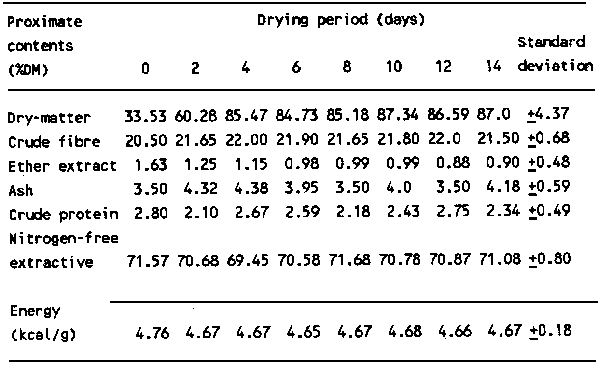
Table 3. Dry-matter intake an rate of gain of sheep after 12 weeks.
|
Diet |
Average rate of gain |
Average dry-matter intake (gm/animal/day) |
|
Gliricidia |
106.41a (3 87) |
1044.24d (28.70) |
|
80% dried cassava peel |
|
|
|
+ 20% Gliricidia |
59.20b (5.78) |
642.14e (47.07) |
|
80% ensiled cassava peel |
|
|
|
+ 20% Gliricidia |
80.89c (4.03) |
713.97f (47.75) |
Different low case superscripts in the same column, indicate significant differences (P< 0.05).
The daily rate of gain was 106 g/day for animals fed on Gliricidia alone while those on the Gliricidia fodder plus ensiled cassava peel gained 81 g/day, about 37% more than their counterparts fed on the dried cassava peels with Gliricidia which gained 59 g/day.
It was also observed that animals fed on the dried cassava peel plus Gliricidia diet consumed the diet in the proportion of 64:36, and not in the ratio of 80:20 offered. On the other hand, animals fed on the ensiled cassava peel plus Gliricidia consumed the diet in the proportion of 73:27, which is close to the ratio in which the feed was offered.
The observed higher intake recorded for animals on the ensiled cassava peel diet may be due to a lower content of prussic acid in the ensiled cassava peel compared with the dried peel. Analysis showed that while the fresh peel contained 956 mg HCN/kg DM, the dried peel contained 378 mg HCN/kg DM. The ensiled peel contained only 162 mg HCN/kg DM (Table 4). Thus, while drying reduced the HCN content of cassava peel by 60%, ensiling reduced it by 83%. The observed higher intake may also be due to the sweet and pleasant acid (lactic acid) smell of the cassava peel silage. Morrison (1959) had pointed out that silages, even from plants with coarse stalks such as corn and the sorghums, are eaten practically without waste. On the other hand, a considerable part of the dry corn or sorghum fodder is usually wasted, even if it is of good quality.
Table 4. HCN content of fresh cassava peels, dried cassava peels and ensiled cassava peels.
|
Cassava peels |
HCN content(mg HCN/kg DM) |
|
1. Fresh |
956 |
|
2. Ensiled |
162 |
|
3. Dried |
378 |
The high level of intake of Gliricidia septum as well as its high nutritive value (Carew, 1982; Mba et al, 1982) were responsible for the faster growth rates of the animals fed on Gliricidia alone.
The growth rates recorded for animals on the cassava peel based diets were significantly lower (P< 0.05) than those for animals on Gliricidia.
From the results so far obtained, it is suggested that ensiled cassava peel supplemented with Gliricidia septum can be fed in a production diet to West African Dwarf sheep with no adverse effects on animal performance.
Adebowale, E.A. 1981. The maize replacement value of fermented cassava peels (Manhihot utilissima Pohl) in rations for sheep. Tropical Animal Production 6: 54-69.
Adegbola, A.A. and Asaolu, V.O. 1986. Preparation of cassava peels for use in small ruminant production in western Nigeria. In: T.R. Preston and M.Y. Nuwanyakapa (eds), Towards optimal feeding of agricultural by-products to livestock in Africa. Proceedings of a workshop held at the University of Alexandria, Egypt, October 1985. ILCA, Addis Ababa, Ethiopia. pp. 109-115.
Carew, B.A.R. 1982. Uses of Gliricidia septum as a forage feed in small ruminant production - A progress report. ILCA, Ibadan.
Grace, M.R. 1977. Prussic (hydrocyanic) acid analysis. Quantitative determination by alkaline hydrolysis method. In: Cassava processing. Plant Production and Protection Series No. 3. Post Harvest Institute Information Centre, Rome.
Mba, A.U.; Mangui, S.A. and Awah, A.A. 1982. Influence of concentrate supplementation with browse plant (Gliricidia septum) on nutrient utilization and growth of the West African Dwarf (Fouta Djallon) kid. Nigerian Journal Animal Production 9 (2): 63-73.
Morrison, F.B. 1959. Feeds and feeding. Morrison Publishing Company, New York.
Obioha, F.C. and Anikwe, P.C.N. 1982. Utilization of ensiled and sun-dried cassava peels by growing swine. Nutrition and Reproduction International 26(6): 961-972.
Oyenuga, V.A. 1968. Nigeria's foods and feeding stuffs. Ibadan University Press, Ibadan, Nigeria.
Steel, R.G.D. and Torrie, J.H. 1960. Principles and procedures of statistics - a biometrical approach. McGraw-Hill Book Co. New York.
