E. Kabaija and D.A. Little
International Livestock Centre for Africa
P.O. Box 5689, Addis Ababa, Ethiopia
Abstract
Introduction
Materials and methods
Results and discussion
References
Several crop residues and agro-industrial by-products, available in Ethiopia as potential ruminant feeds, were examined in relation to their potential to supply essential dietary minerals. In absolute terms, cattle diets based on crop residues are unlikely to supply adequate Na, and are marginal to-deficient in P. Cu and possibly Zn, but these problems, except for Na, seem rectifiable by the inclusion of appropriate proportions of by-products in the ration. This however, takes no account of the possibility that mineral might be rendered to some degree unavailable through its association with e.g. indigestible fibre.
Thus the apparent availability of minerals was assessed, firstly following sequential extraction in vitro in neutral, acidic and alkaline solutions to simulate conditions respectively in the rumen, abomasum and small intestine, and secondly by analysis following intraruminal incubation in nylon bags for 48 h; there was in general good agreement between the two methods. However, it is notable that the in vitro method removed Ca from roughages much more efficiently, while the reverse was true for the oilseed cakes, due possibly to differing extents to which Ca is bound to fibre.
The apparent availabilities of Ca from wheat and teff straws In vivo when fed to sheep were very similar to the values obtained in sacco, much more so than for other minerals. It was noted that roughage diets with low apparent mineral availability had much of their intrinsic minerals in association with faecal fibre. These could not be removed by water. It may thus be useful to pay close attention to the balance of minerals in diets based on fibrous crop residues whose utilisation may have been improved through chemical treatment of NPN supplementation.
Feeding of agricultural by-products and crop residues to livestock in the tropics is a common practice especially during the dry season when the available pasture is of low quality. These by-products have been evaluated mainly for their potential as sources of energy and protein. Their role as sources of mineral nutrients has received little attention. Under most production systems in Africa, ruminant animals rarely receive mineral supplements with the occasional exception of common salt. Where multiple mineral supplements are available, it is common to find some of them with essential minerals either deficient or possibly in excess.
Strategies being proposed for future improvement in animal production in Africa include identification and specification of crop residues and agro-industrial by-products as livestock feeds (Cianci and Hashi, 1985) and definition of improved means of utilising them, since these materials have a potential role to play in improving future animal production in Africa. Thus these foodstuffs need to be fully assessed for their suitability as livestock feeds, and any constraints that may limit their utilisation identified. Samokhin (1981) suggested that large amounts of coarse feedstuffs of cereal straw may reduce the degree of utilisation of the minerals in the feedstuffs. This could be due to large amounts of plant cell wall materials that are resistant to digestion in the gastrointestinal tract and which may shield nutrients from being assimilated. This study was undertaken to characterise various agricultural by-products for content and utilisation of essential minerals.
Samples were obtained of several agro-industrial by products, mainly straws, brans and oilseed cakes, that are available in Ethiopia as potential ruminant feeds. They were dried at 80°C, ground through a 1 mm stainless steel sieve and digested using H2S04 and H202 for determination of K, Na, Ca, Mg, Mn, Fe, Zn and Cu by atomic absorption spectrophotometry (Perkin Elmer, 1982), and for N and P following Kjeldahl digestion using an autoanalyser (Chemlab Instruments, 1980).
Apparent availability of minerals in these materials was examined:
a) In vitro, using an adaption of the procedure described by Naga (1986), in which 2 g samples were successively extracted with neutral, acidic and alkaline solutions to simulate pH conditions respectively in the rumen, abomasum and small intestine. The solutions were respectively 900 ml distilled deionized water + 36 g NH4HCO3 (pH 6.8), 0.05M HCl + 0.09M KCl (2.1) and 0.1M NaHCO2 (8.3), and the samples were incubated at 37°C for 12 h in each of them. The residues were drained, dried and analysed as above, and the degree of disappearance of each mineral calculated by difference and expressed as a percentage.b) In vivo, by incubating 5 g samples of each material in nylon bags (120 x 80 mm, pore size 20 m m) in the rumen of a fistulated ox for 48 h. The ox was fed a ration of meadow grass hay ad lib, 600 g noug cake/day and free access to a multi-mineral block. After removal of the bags from the rumen they were washed under hot running distilled water until the washings were clear, dried at 100°C for 24 h, the residues analysed and calculations made as above.
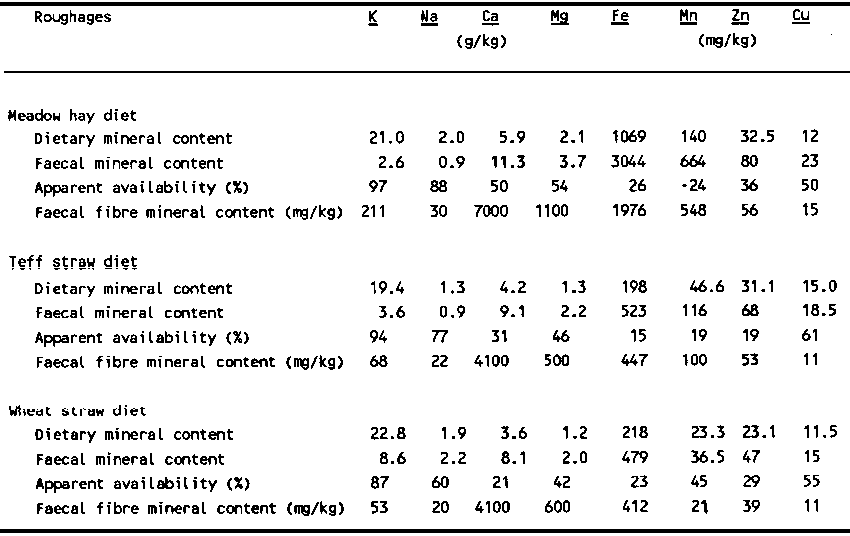
In order to estimate the proportions of mineral removed from a fibrous feed during complete In vivo digestion, three rations based respectively on meadow hay, teff and wheat straw were formulated (Table 1) and fed to rams in wooden metabolism cages. Each diet was fed to 4 randomly allocated sheep (approx. 8 months old and weighing 21 kg) for 21 days following which total faecal collections were made for 6 days, using canvas faecal bags fitted with plastic liners. The faeces were collected each morning, thoroughly mixed and 100 g samples taken for analysis. Total feed intake was also determined during this period, and the sheep had free access to distilled water throughout. Mineral determinations were made as described above, and neutral detergent fibre analysed using the method of Goering and Van Soest (1970). To quantify the amount of minerals associated with faecal fiber, 0.5 g faecal sample in 9.5 ml of distilled water at 36°C were centrifuged for 10 minutes at 2000 r.p.m, the residue drained of excess water, oven-dried and analysed for residual minerals as described above.
Table 1. Composition and digestibility of experimental diets (dry-matter basis).
|
|
Diet type |
||
|
Meadow hay |
Teff straw |
Wheat straw |
|
|
Meadow hay - chopped (g/kg) |
650 |
- |
- |
|
Teff straw - chopped (g/kg) |
-650 |
- |
|
|
Wheat straw - chopped (g/kg) |
- |
- |
650 |
|
Urea-molasses mixture 10% urea (g/kg) 350 |
350 |
350 |
|
|
Total nitrogen (g/kg) |
22.0 |
19.0 |
18.4 |
|
NDF (g/kg) |
468 |
463 |
461 |
|
Dry-matter intake (g/day) |
677 |
612 |
467 |
|
Faecal output (g/day) |
176 |
197 |
163 |
|
Faecal NDF (g/kg) |
615 |
627 |
688 |
|
Dry-matter digestibility (g/kg) |
740 |
680 |
650 |
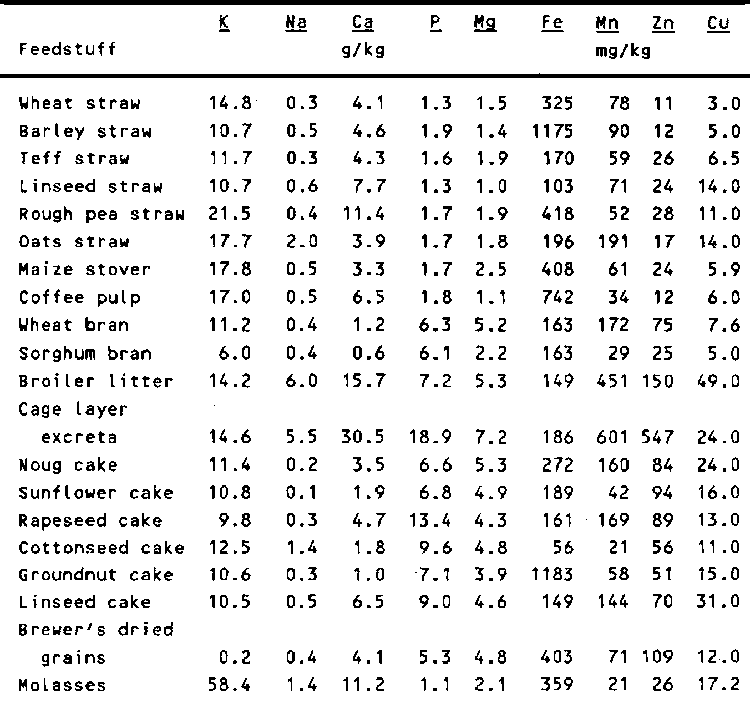
Mineral contents of the feedstuffs are shown in Table 2. All the feedstuffs had adequate quantities of K except for sorghum bran and brewer's dried grains (BDG) whose K content was below the dietary critical level of 6.5 g/kg given by NRC (1984) for beef cattle. Low K content in BDG has been reported by workers elsewhere (NAS, 1971), and could be a contributory factor in lowering the nutritional value of diets with BDG levels exceeding 40% (Couch, 1976). It may thus be necessary to undertake K supplementation if ruminant diets contain more than 40% BDG and especially if crop residue feeding is involved. Most of the feedstuffs were deficient in Na with the exception of oats straw, poultry wastes, molasses and cottonseed cake whose Na contents were above the levels of 0.7 to 1 g/kg considered by most workers (Morris, 1980; Underwood, 1981 and Little, 1987) to be the critical range for cattle. Based on the data shown, it would be beneficial to offer supplementary Na if most of the feedstuffs are fed to livestock especially the crop residues.
Levels of Ca below 3.0 g/kg were found in most oilseed cakes and cereal brans. Levels below 2 g/kg are likely to be inadequate by most standards (NRC, 1984, 1985; ARC, 1980). The very high P content relative to Ca in oilseed cakes could exacerbate the low Ca effect. Though ruminants have been found to tolerate very wide Ca to P ratios in instances where Ca is higher (Leuker and Lofgreen, 1961), there is little information on the effect of higher P content relative to Ca in diets of ruminants. In poultry, higher P in diets with adequate Ca resulted in leg bone abnormalities (Smith and Kabaija, 1985) which was probably due to the impairment observed in Mn metabolism. The case deserves investigation in ruminants.
Underwood (1981) considered a dietary P level of 1.7 g/kg to be marginal for grazing animals. Little (1980, 1985) indicated a figure of 1.4 g/kg to be the minimum required for growing cattle.
The present data show most cereal straws to be marginal to deficient in P and supplementation with P to such diets is likely to be beneficial. Animals on smallholder units which may receive concentrate feeds may have adequate P if offered high protein oil seed cakes or cereal brans.
Table 2. Mineral content of agricultural by-products used as ruminant feeds (dry-matter basis).
Levels of Mg, Fe and Mn in most feedstuffs were much higher than the levels of 1 g, 50 mg and 40 mg/kg respectively proposed as adequate for grazing animals (McDowell, 1985). The straws could however offer marginal Mg in case of high producing animals. Kemp (1960) proposed 0.20% Mg in herbage as the lowest safe level while Metson et al (1966) showed with beef cattle that a safe level of Mg in the forage may be even higher than 0.25%. McDowell et al (1978) considered 30 mg/kg to be a critical level of dietary Zn, although the ARC (1980) suggested that concentrations of 12-20 mg/kg are adequate for growing cattle. The cereal straws and coffee pulp may thus constitute a marginal supply of Zn. The necessity for supplementary Zn needs to be kept under review particularly for sheep which require some 35 mg Zn/kg diet (ARC, 1980).
The dietary requirement of cattle for Cu is considered to lie in the range of 8-14 mg/kg (ARC, 1980; NRC, 1978; NRC, 1984). The cereal straws and brans will provide deficient-to-marginal levels of this element. This situation may be exacerbated by high Fe levels in the straws (Standish et al, 1971) that may be both intrinsic to the feed as well as from soil contamination. It is thus necessary to consider Cu supplementation when straw-based diets are fed to cattle. This may, however, not be necessary for sheep, as this species' requirement is only about 5 mg/kg.
The in vitro availability of Ca, Mg, Fe, Mn, Zn and Cu from the feedstuffs is shown in Table 3. K and Na availabilities were not estimated because KCl and NaHCO3 were components of the extracting solutions. Availabilities of Ca, Mg and Mn were high in most feedstuffs especially straws. Availabilities of Fe, Zn and Cu were low. Low Fe availabilities have been reported before in non-ruminant diets (Underwood, 1977) but little is known of the physiological availability of iron from feeds to ruminants. Low Zn and Cu availabilities could exacerbate deficiencies of these elements particularly in straws where their concentrations were marginal-to-deficient. The method used in the present study does not accurately represent conditions in the digestive tract because factors involved in the kinetics of mineral elements are very complex and difficult to duplicate in vitro. The method is, however, an attempt at the characterisation of the nature of mineral forms found in the feedstuffs.
Table 3. In vitro mineral availability (%) from agricultural by-products.
|
|
Ca |
Mg |
Fe |
Mn |
Zn |
Cu |
|
Wheat straw |
73 |
86 |
31 |
67 |
11 |
57 |
|
Barley straw |
76 |
76 |
25 |
65 |
19 |
41 |
|
Teff straw |
80 |
89 |
38 |
77 |
28 |
49 |
|
Maize stover |
79 |
84 |
27 |
59 |
8 |
38 |
|
Oats straw |
72 |
83 |
49 |
74 |
24 |
55 |
|
Coffee pulp |
45 |
54 |
15 |
32 |
25 |
19 |
|
Wheat bran |
83 |
94 |
45 |
88 |
62 |
56 |
|
Sorghum bran |
100 |
77 |
8 |
55 |
32 |
28 |
|
Brewer's dried grains |
61 |
93 |
31 |
52 |
30 |
29 |
|
Noug cake |
11 |
55 |
22 |
32 |
27 |
21 |
|
Sunflower cake |
42 |
77 |
41 |
48 |
14 |
37 |
|
Rapeseed cake |
6 |
56 |
19 |
38 |
18 |
31 |
|
Cottonseed cake |
72 |
83 |
36 |
43 |
33 |
42 |
|
Groundnut cake |
50 |
87 |
51 |
45 |
41 |
49 |
|
Linseed cake |
60 |
43 |
34 |
26 |
33 |
27 |
|
Cage layer excrete |
37 |
35 |
5 |
8 |
22 |
38 |
|
Broiler litter |
24 |
55 |
11 |
13 |
15 |
31 |
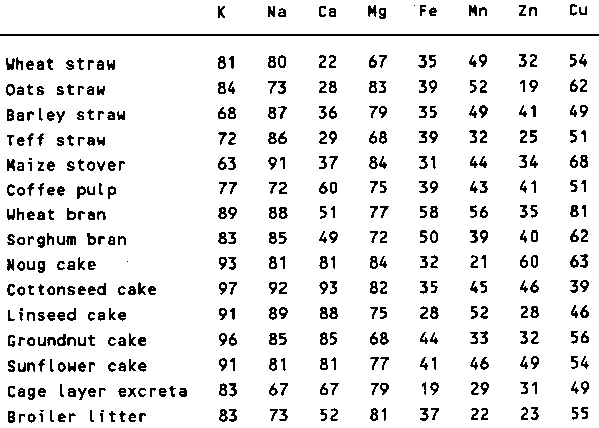
Percentage mineral disappearance from most feeds in sacco was high for K, Na and Mg (Table 4). Similar findings were reported by Rooke et al (1983) who observed high values for Na, Mg and K from silages incubated in nylon bags in rumen of cattle. This probably is due to these elements existing in readily soluble ionic forms. Lower values observed in this study for Mn, Fe, Zn and Cu are comparable to those reported in tropical forages by Kabaija and Smith (1988). It is likely that some bacteria remain in the bags after washing. The quantities of minerals introduced through such contamination has not been estimated for the trace elements, although Rooke et al (1983) did so for macro-elements. They did not, however, show how much of the introduced minerals were likely to be subsequently removed by washing of the bags after incubation.
Table 4. Mineral disappearance (%) from the feedstuffs incubated in sacco in ox rumen.
Results of the digestibilities of minerals in the hay and straws studied (Table 5) closely resembled those obtained with the in sacco study. High values were obtained for K, Na and Mg and low values for most micro-elements. Much of the minerals in the test diets were mainly from the hay or the straws except in the case of Cu where molasses may have contributed considerable quantities. Minerals such as K and Na whose residual content in faecal fibre was low, had high apparent availability while those such as Ca and Mg and all the micro-elements whose faecal fibre content was high had low-to-medium (<50%) apparent availabilities. Kabaija (1985) reported increased mineral secretion as the dietary NDF level was increased from 155 to 600 g/kg in the diets of sheep. Given the fact that most crop residues are marginal-to-deficient in several essential elements and that they contain high fibre which may lower utilisation of the minerals, it would be necessary to pay close attention to the mineral balance of ruminant diets based on fibrous crop residues whose utilisation may have been improved through chemical treatment of NPN supplementation.
Arc (Agricultural Research Council). 1980. The nutrient requirements of ruminant livestock. 2nd ed. Commonwealth Agricultural Bureau, Farnham Royal, U.K.
Chemlab. Instrument Ltd. 1980. Continuous flow analysis method sheet No. CW2-075-01, Hornchurch Essex.
Cianci, D. and Hashi, A. 1985. A strategy for animal production improvement in African countries. World Review of Animal Production 21: 77-79.
Couch, J.R. 1976. Brewers dried grains as an ingredient in formula feeds. Feedstuffs 48 (50): 11-12.
Goering, H.K. and Van Soest, P.J. 1970. Forage fibre analysis (apparatus, reagents, procedures and some applications). USDA Agriculture Handbook No. 379, U.S. Dep't of Agriculture, Washington, D.C.
Kabaija, E. 1985. Factors influencing mineral content and utilisation in tropical forages by ruminants. PhD thesis, University of Ife, Ile Ife, Nigeria.
Kabaija, E. and Smith, O.B. The effect of age of regrowth on content and release of manganese, iron, zinc and copper from four tropical forages incubated in-sacco in rumen of sheep. Animal Feed Science and Technology (accepted for publication).
Kemp, A. 1960. Hypomagnesaemia in milking cows: the response of serum magnesium to alterations in herbage composition resulting from potash and nitrogen dressings on pasture. Netherlands Journal of Agricultural Science 8: 281-304.
Leuker, C.E. and Lofgreen, G.P. 1961. Effects of intake and calcium to phosphorus ratio on absorption of these elements by sheep. Journal of Nutrition 74: 233-238.
Little, D.A. 1980. Observations on the phosphorus requirement of cattle for growth. Research in Veterinary Science 28: 258-260.
Little, D.A. 1984. The dietary mineral requirements of ruminants: implications for the utilisation of tropical fibrous agricultural residues. In: P.T. Doyle (ed), The utilisation of fibrous agricultural residues as animal feeds. Proceedings of the Third Annual Workshop of the Australian Asian Fibrous Agricultural Residues Research Network held in Peradeniya, Sri Lanka, 17-22 April 1983. IDP, Canberra, Australia. pp. 34-43.
Little, D.A. 1987. The influence of sodium supplementation on the voluntary intake and digestibility of low-sodium Setaria sphacelata cv Nandi by cattle. Journal of Agricultural Science, Cambridge 108: 231-236.
McDowell, L.R. 1985. Nutrition of grazing ruminants in warm climates. Animal Feeding and Nutrition (Monograph). Academic Press, Inc., London, U.K.
McDowell, L.R.; Houser, R.H. and Fick, K.R. 1978. Iron, zinc and manganese in ruminant nutrition. In: J.H. Conrad and L.R. McDowell (editors), Latin American symposium on mineral nutrition research with grazing ruminants. University of Florida, Gainesville, Florida, USA. pp. 108-116.
Metson, A.J.; Saunders, W.M.H.; Collie, T.W. and Graham, V.W. 1966. Chemical composition of pastures in relation to grass tetany in beef breeding cows. New Zealand Journal of Agricultural Research 9: 410-436.
Morris, J.G. 1980. Assessment of sodium requirements of grazing beef cattle: a review. Journal of Animal Science 50:145-152.
Naga, A.M. 1986. Required minerals for the improvement of poor quality roughages. In: T.R. Preston and M.Y. Nuwanyakpa (editors), Towards optimal feeding of agricultural byproducts to livestock in Africa. Proceedings of a workshop held at the University of Alexandria, Egypt, October 1985. ILCA, Addis Ababa, Ethiopia. pp. 68-71.
NAS (National Academy of Sciences). 1971. The atlas of nutritional data, United States and Canadian feeds. NAS, Washington, D.C.
NRC (National Research Council). 1978. Nutrient requirements of domestic animals, No. 3. Nutrient requirements of dairy cattle. 5th ed. National Academy of Sciences, Washington, D.C.
NAS (National Academy of Sciences). 1984. Nutrient requirements of beef cattle. 6th rev. ed. National Academy Press, Washington, D.C. 90 pp.
NAS (National Academy of Sciences). 1985. Nutrient requirements of sheep. 6th rev. ed. National Academy Press, Washington, D.C. 99 pp.
Perkin, E. 1982. Analytical methods for atomic absorption spectrophotometry. Perkin Elmer, Norwalk, Connecticut, U.S.A.
Rooke, J.A.; Akinsoyinu, A.W. and Armstrong, D.G. 1983. The release of mineral elements from grass silages incubated in sacco in the rumens of Jersey cattle. Grass and Forage Science 38: 311-316.
Samokhin, V.T. 1981. Methods of controlling the adequacy of the mineral diet of farm animals. In: V.I. Georgievskii; B.N. Annenkov and V.I. Samokhin (editors), Mineral nutrition of animals. Butterworths, London, U.K. pp. 433-466.
Smith, O.B. and Kabaija, E. 1985. Effect of high dietary calcium and wide calcium-phosphorus ratios in broiler diets. Poultry Science 64: 1713-1720.
Standish, J.F.; Ammerman, C.B.; Palmer, A.Z. and Simpson, C.F. 1971. Influence of dietary iron and phosphorus on performance, tissue mineral composition and mineral absorption in steers. Journal of Animal Science 33: 171-178.
Underwood, E.J. 1977. Trace elements in human and animal nutrition. Academic Press, New York.
Underwood, E.J. 1981. The mineral nutrition of livestock. 2nd ed. Commonwealth Agricultural Bureau, London.