Nouke and H.N. Endeley
C.R.Z. Wakwa, B.P. 65, Ngaoundere-Cameroon
Ministere de l'Enseignement Superieur et de la
Recherche Scientifique (M.E.S.R.E.S.)
Direction Generale, Yaounde, Cameroon
Abstract
Introduction
Materials and methods
Experimental Rations
Results and discussion
Conclusion and recommendations
References
A trial was carried out to investigate the effects of the incorporation of rubber seed meal supplemented with blood meal as sources of plant and animal protein on the performance, feed intake and the carcass of poultry birds from day-old chicks to 12 weeks under traditional system of management.
Unsexed 300 Jupiter chickens were randomly divided into 4 groups each of 75 birds. Four diets representing different levels of rubber seed meal (RSM) and blood meal (BM):- R0 with 0% RSM and 0% BM; R10 with 10% RSM and 8% BM; R20 with 20% RSM and 6% BM and R30 with 30% RSM and 4% BM were fed ad libitum throughout the experimental period. Results showed significant differences between treatments indicating the superiority of the diet supplemented with 30% RSM and 4% BM.
During the past years the world's population has greatly suffered from food problems, and more particularly from protein deficiency in the diet. According to the Food and Agriculture Organization (F.A.O., 1982) a third of humanity suffers from quantitative malnutrition. This is crucial in Africa where the daily ration of 11 grammes of protein is far from the physiological minimum of 30 grammes as recommended by the F.A.O. In order to solve this problem of animal protein deficiency, developing countries have to improve on their animal husbandry. This could be done by good managerial techniques, and by improving the plane of nutrition. Alternative sources of feed ingredients should be found which are not utilised by the human population and which, at present, might not have found wider use in animal feeding.
The objective of this study was to investigate the effects of the incorporation of rubber seed meal supplemented with blood meal as source of protein in broiler rations in replacement of cottonseed cake and groundnut cake under stimulated traditional management conditions on chicken growth, feed consumption, efficiency of feed utilisation, mortality rates and the characteristics of the carcass often slaughtered.
These studies were conducted in the teaching research farm of the National Advanced School of Agriculture (N.A.S.A) at Nkolbisson (Yaounde, Cameroon).
Animal material and lodging
Unsexed 300 Jupiter day-old chicks weighing an average of 36.24±4.01 g were used in this study.
These chicks were randomly divided into 4 groups each of 75 chicks corresponding to 3 levels of experimental rations and a control group. The groups were shared into identical lodges measuring 4x2 meters made of wood, the roof covered with zinc and a concrete floor covered with wood sharings. Around each lodge was a pasture surrounded with wire meeting. Heating during the starter period was done using two paraffin lamps per lodge.
Preparation of blood meal
The used blood was collected from the Central Abattoir in Yaounde immediately after cattle were slaughtered. After collection, the blood was boiled immediately in a cask for 45 or 60 minutes in order to let water evaporate and destroy any parasites. After boiling it was then dried in an oven at 6883°C for 5 to 6 days, and then ground into flour.
Preparation of rubber seed meal
The rubber seeds were bought from the local market. After manual decortication, the kernels were boiled for 45 min. to reduce the potential toxicity. They were then dried at 55°C for 72 hours and later ground into brown flour.
Diet formulation and chemical composition of these diets are presented in Table 1 and 2, respectively.
Table 1. Composition (%) of the experimentals diets.
|
Diet ingredients |
R0 |
R10 |
R20 |
R30 |
|
Maize |
60 |
50 |
36 |
24 |
|
Wheat bran |
8 |
20 |
26 |
30 |
|
Concentrate |
10 |
10 |
10 |
10 |
|
Cottonseed cake |
10 |
- |
- |
- |
|
Groundnut cake |
10 |
- |
- |
- |
|
Rubber seed meal |
- |
10 |
20 |
30 |
|
Blood meal |
- |
8 |
6 |
4 |
|
Phosphate dialcaline |
1.5 |
1.5 |
1.5 |
1.5 |
|
Salt |
0.5 |
0.5 |
0.5 |
0.5 |
|
Total |
100 |
100 |
100 |
100 |
Table 2. Chemical composition of the experimental rations (calculated).
|
Composition (%) |
Rations |
|||
|
R0 |
R10 |
R20 |
R30 |
|
|
Dry matter |
88.36 |
87.05 |
88.30 |
88.66 |
|
Crude protein |
20.70 |
21.20 |
21.00 |
20.00 |
|
Crude fiber |
3.70 |
2.34 |
2.47 |
2.58 |
|
E.M.A. |
4.72 |
7.20 |
10.74 |
14.32 |
|
Ash |
5.37 |
5.05 |
5.28 |
5.47 |
|
Ca |
1.25 |
1.28 |
1.28 |
1.21 |
|
P |
0.86 |
0.84 |
0.89 |
0.98 |
|
Energy (car) |
2846 |
2986 |
3030 |
3115 |
N.B. R0 ration with 0% of rubber seed cake and 0% of blood meal.R10 Ration with 10% of rubber seed meal (RSM) and 8% of blood meal (BM).
R20 Ration with 20% of RSM and 6% of BM.
R30 Ration with 30% of RSM and 4% of BM.
Management
Each experimental group was offered its corresponding diet ad libitum and they had free access to water. Hygienic conditions were followed to keep the drinkers and feeders always clean.
Feeds offered were weighed. At the end of the week the residues were weighed and deduced from the introduced amounts. The chickens were weighed weekly before being given food. All mortality cases were registered.
Carcass analysis
After the three-month experimental period, five chickens were taken from each group for carcass analysis. The following measurements were taken into account:
-Weight of blood-Weight of edible carcass
-Chemical composition.
Data collected were statistically analysed using the randomised complete design, while significantly different means were identified using the Duncan Multiple Range test (Steel and Torrie, 1960).
Chicken growth
a. Starter period
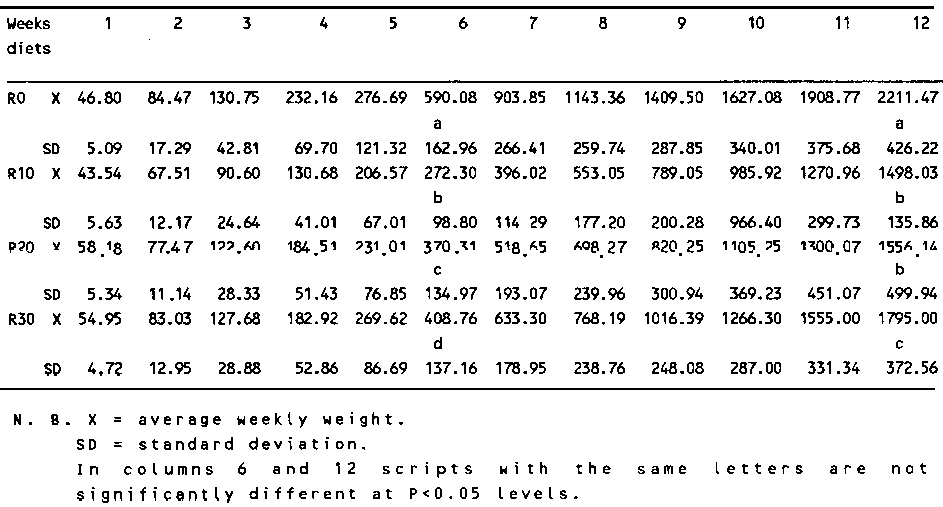
Table 3 presents the weekly weights of birds on each of the experimental diets. The highest growth was achieved on the control diet followed by diets R30, then R20 and R10. Statistical analysis revealed significant treatment effects on the growth performance of the birds (P<0.05).
It was observed that at the end of the experiment (12th week), the trend of growth noticed during the starter period persisted during this period with groups R0 and R30 having higher average weekly body weights. Statistical analysis revealed significant differences between the average weekly weights in each treatment (P<0.05) as shown in Table 3.
Results obtained in this study showed that average weekly body weight increased with increasing levels of RSM during the starter and grower periods. Statistical analysis indicated significant differences between treatments. Buvanendran and Siriwardence (1970) reported that as incorporation levels of RSM went up to 30%; growth decreased. Rajaguru et al (1971); Tchounken (1982) and Nzumo (1983) also reported that growth decreased as RSM incorporation levels increased in poultry rations.
Table 3. Average weekly weights (g/bird) over the experimental period.
In columns 6 and 12 scripts with the same letters are not significantly different at P < 0.05 levels.
Average weekly body weight gain
Table 4 showed that during the first 6 weeks the higher average weight gains were noticed in treatment R0 (control) followed by groups R30 and R20. No statistical differences (P<0.05) among treatments were observed, but the lowest average weight gain was recorded in treatment R10. During the second 6 weeks R0 continued as the superior treatment followed by R20 then R30. Statistical analysis showed that higher weight gains were obtained in treatment R0 and the lowest in R10 but these differences were not significant. (Table 4). The total weight gain over the whole period showed significant differences between treatments R0; R20 and R30 (P<0.05). The individual weekly weight gains showed no significant differences between the four treatments except in group R10. These results agree with those of capital et al (1971).
Table 4. Average weekly body weight gain (g/poulet/week).
|
|
Starter period |
Finition period |
Entire period |
|
Diets |
1st-6 th week |
7th-12 th week |
1st-12 th week |
|
R0 |
103.71±65.64a |
270.75±243.13a |
194.92±99.45a |
|
R10 |
33.87±21.45b |
180.45±47.55b |
121.82±81.84b |
|
R20 |
66.33±39.48a |
224.53±47.13a |
15262±12.84b |
|
R30 |
68.56±37.71a |
222.49±47.72a |
152.52±88.10b |
N.B. In column, numbers script with the same letter are not significantly different at P<0.05 level.
Feed consumption
Feed consumption increased when rate of blood meal decreased in the diets (Table 5). During the first period (1st-6th week) the group without seed meal recorded higher feed consumption. Statistical analysis revealed a difference between treatments R10 and R20 on the one hand and R30 and R20 on the other. In the 2nd six weeks the same trend of the 1st period continued but without significance.
Table 5. Average weekly feed consumed (kg).
|
Diets |
Starter period |
Finition period |
Entire period |
|
1st-12th week |
7th-12th week |
1st-12th week |
|
|
R0 |
289.94±16.47a |
980.51±14.17a |
622.98±34.01a |
|
R10 |
130.70±86.43b |
620.94±20.33b |
398.10±29.20b |
|
R20 |
189.00±81.88bc |
616.67±14.22b |
421.82±24.42bc |
|
R30 |
209.98±16.68c |
71619±1065c |
48609±2754c |
N.B. In column, numbers script with the same letter are not significantly different at P<0.05 level.
Over the whole experimental period, it was confirmed that the blood meal combined with rubber seed meal had a depressing effect on feed consumption; a finding that agrees with Spring and Day (1981).
Efficiency of feed utilisation
Table 6 summarises the average weekly feed utilisation efficiency during the trial period. The best feed conversion was noticed in R0 and the lower in R20 with no significant differences between treatments. The present results confirmed those of Rajaguru et al (1971), and Tchounken and Tchouboue (1982). The starter period got the highest mortality (1%, 1, 6%, 0% and 0%) respectively for R0, R10, R20 and R30.
Table 6. Average weekly feed utilisation efficiency.
|
|
Starter period |
Finition period |
Entire period |
|
Diets |
1st-6th week |
7th-12th week |
1st-12th week |
|
R0 |
2.90±0.66a |
3.42±0.86a |
3.19±0.82a |
|
R10 |
3.87±1.50a |
3.41±0.70a |
3.59±0.90a |
|
R20 |
3.32±0.92a |
3.47±0.85a |
3.40±0.90a |
|
R30 |
3.05±0.17a |
3.39±0.92a |
3.23±0.71a |
N.B. In column, numbers script with the same letter are significantly different at P£ 0.05 level.
Carcass analysis
a. Edible carcass
The highest average edible carcass weight was recorded on R0 while the lowest was on Diet R10 as shown in Table 7. Statistical analysis revealed significant differences between treatments from R20 on the one hand and R30 on the other (P<0.05). Birds from the control group had significantly higher weight than those of the treatments. These results agree well with those of Tadle et al (1955).
Table 7. Edible carcass (kg).
|
|
Replications | |||||
|
Diets |
A |
B |
C |
0 |
E |
Mean (g) |
|
R0 |
2462.70 |
2377.90 |
2178.00 |
2188.50 |
1996.20 |
2240.66a |
|
R10 |
1583.20 |
1602.30 |
1999.30 |
1762.60 |
1611.30 |
1631.74b |
|
R20 |
2128.70 |
1964.40 |
2317.80 |
1733.10 |
1991.80 |
2025.17a |
|
R30 |
2169.60 |
1653.10 |
2054.50 |
1617.80 |
1617.80 |
1819.02b |
N.B. In column, numbers script with the same letter are not significantly different at P<0.05 level
b. Chemical composition
Chemical analysis of carcass showed that R30 gave the best result in terms of protein content. Fat content varied from 25.36% for R30 to 34.40% for R10 group. It would appear from the results that as rubber seed meal increased in the diets, the protein content of the carcass increased.
From the results obtained in this investigation on the effects of incorporation of rubber seed meal (RSM) supplemented with blood meal (BM) as sources of protein in broiler rations under traditional management conditions, it appeared that the diet of 30% RSM supplemented with 4% BM gave the best results without any adverse effects on performance. It might be suggested from the present investigation that in future studies, it would be necessary to deal with the level of RSM supplemented with BM at levels less than 5%. This may provide more information on the effects of incorporation of these by-products in poultry rations.
Anon. 1964. The utilisation of pararubber seed. Bull. Imp. Inst. 2.551.
Bessilieve, J. 1975. L'elevage du poulet, Flam. Bredenann, G. 1931. Does the H.C.N. content of rubber seed adversely affect the use of rubber seed cake as animal feed. Der tropen I Flamzer.
Buvanendran, B. and Siriwardence, J. 1970. Rubber seed meal in poultry diets. Ceylon Vet. J. 18.
Delage, J. 1974. Adapte par Brankaest R. Memento sur l'alimentation des animaux domestiques. Edite par Offset par la division de pedagogic rurale, E.N.S.A., Yaounde.
Ellet, W.B. 1930. Feeding hevea rubber seed meal for milk production, Virginia, Agric, exp. Station Bull. 41.
F.A.O. (Food and Agriculture Organization). 1982. Population and food supply. FAO, Rome.
F.A.O. 1981. Revue mondiale de zootechnie. Vol. 40, Horizon 2000. FAO, Rome.
George, C.D.V.; Green Sheet, V.R. and Teik, G. 1932. Storage of rubber seeds. Malaysian Agric. J. 20: 164 - 176.
Gohl, Bo. 1961. Tropical feeds. F.A.O. Animal Production and Health series 12. FAO, Rome.
Kouba, C. 1981. Disponibilites en sous-produits des agro-industries et abattoirs et leur possibilities d'utilisation au Cameroun, Memoire de fin d'etude. E.N.S.A., Yaounde.
Malfiroy, F. 1960. Modernisation des abattoirs. Importance de l'organisation rationnelle de la recuperation de tous les sous-produits d'abattoirs. Vigot freres.
National Academy Science Research Council of U.S.A. 1966. Nutrient requirement of poultry. 5th revised ed. Publ. No. 1345.
Nzoum, E. 1983. Effet de substitution du tourteau de coton par le tourteau d'hevea dans la ration demarrage et finition du poulet de chair. Memoire de fin d'etudes. E.N.S.A., Yaounde.
Oluyemi, J.A. and Roberts, F.A. 1979. Poultry production in warm wet climates. Muthilan, Intem College Ed.
Rajaguru, A.S.B. 1973. Effects of rubber seed meal on the mature chickens. J. National Agric. Sc. of Ceylon. Vol. 8, No. 2. Rubber Research Institute of Sri Lanka.
Siriwardence, J. and Nugana, D. 1972. Metabolisable energy of rubber meal in poultry diets. Ceylon Vet. J. 20 (3): 6163.
Spring, F.G. and Day, F.W.F. 1981. The oil contents, keeping qualities and commercial possibilities of pararubber seed. Agric. Bull. F.M.S. 6 (5): 251-244.
Steel, R. and Torrie, J.H. 1960. Principles and procedures of statistics. McGraw-Hill Book Co., N.Y.
Stosic, D. and Kakay, M. 1981. Graines d'herea dans l'alimentation des animaux domestiques. Revue Mondiale 200, 39: 29-39.
Tchunken, D.M. 1982. Essai de substitution du tourteau de coton par le tourteau d'hevea dans l'alimentation des poulets de chair. Memoire de fin d'etudes, E.N.S.A, Yaounde.