D. Jotee
University of Mauritius, Reduit, Mauritius
Abstract
Livestock and fodder development
Basic forage resources
Cultivated forages
Forage evaluation studies
Conclusions
References
Background information on the climate, livestock production systems, constraints to increased animal production and the role and scope of pasture and cultivated folders in Mauritius to enable a proper understanding of the problem are highlighted. The results of some recent experiments on the evaluation of selected species of grasses for the different ecological zones are described. Particular emphasis is laid on the need for proper screening methods of pasture species and fodder crops and appropriate management techniques to improve productivity for the benefit of the livestock industry. Proposals for future research orientation are also outlined.
Mauritius spends a considerable amount of money on the import of ruminants. However, during the past years the Government has given priority to development programmes in animal production, with the objectives, inter alia, to improve human nutrition, to create employment and to conserve foreign exchange.
Significant constraints to improved animal production in Mauritius are the scarcity of land for fodder production and the low productivity of existing low potential pasture land. Historically, the establishment and management of improved pastures has not been given priority by ruminant owners for various reasons. In recent years, however, the need to consolidate the livestock industries has been appreciated, and this is reflected in the increased interest in pasture improvement. Moreover, the Government is currently setting up fodder units in various regions to provide incentives to smallscale cattle keepers, as well as stabilising the sugar production to about 600,000 tonnes/year so as to release land for food and feed production. A better utilisation of the Crown Lands, inter alia, through agroforestry is also being considered.
The basic feed resources can be classified into two main categories:
1. Grasses, legumes and tree fodder.2. Crop residues, wastes from animal production and residues from the processing of food for human consumption.
The forage/fodder species currently grown depend, inter alia, on the ecological conditions and the system of livestock management adopted. According to Naidu (1973), the most commonly used species in order of importance for the cut-and-carry system from sources other than pasture in the three agro-climatic regions of the island are shown in Table 1.
Table 1. Fodder species of importance in the various ecological zones.
|
Ecological zone |
Fodder species in order of importance |
|
Subhumid |
Stenotaphrum dimidiatum |
|
Humid |
Pennisetum purpureum |
|
Superhumid |
Ischaemum aristatum |
On the other hand, in the drier regions, where forage exploitation is to a large extent through grazing, the natural pastures exist mainly under the plantations of Casuarina equisetifolia. The pastures grazed consist essentially of Stenotaphrum dimidiatum, Cynodon dactylon and Panicum maximum. New species have been introduced of which Cynodon plectostachyus and Leucaena leucocephala have been the most promising
In order to increase animal production in Mauritius, the government is presently experimenting with the setting up of fodder plantations in selected villages. Forages are also increasingly being cultivated on government stations and to a lesser extent on private land; the main species involved are Pennisetum purpureum, Leucaena leucocephala, Setaria sphacelata and Cynodon plectostachyus.
Primarily due to the marginal role of pastures in meeting the feed requirements of animals, the evaluation of forage in Mauritius has been sporadic with little coordination and lack of continuity. However, more systematic studies in the evaluation of selected forages are presently being carried out. The main research activities in respect of past evaluation of common forages are highlighted to indicate the scope of past and present activities. Unfortunately, the evaluation has not been thorough; most of the data relate to agronomic and to a lesser extent some nutritive value criteria.
Grasses
The need to exploit the potential of grasslands as an important resource for extensive low-cost feeding (grazing) as well as for fodder cultivation used in the cut-and-carry system is increasingly being felt. Serious efforts to identify high yielding and high quality grasses for the different ecological zones, to assess the effects of fertilizer application and to assess the effect of cutting interval and cutting height have been made since the early 70s. These studies have been undertaken mainly by the FAO Milk and Meat Project and the Ministry of Agriculture and have concentrated mainly on the collection of agronomic data.
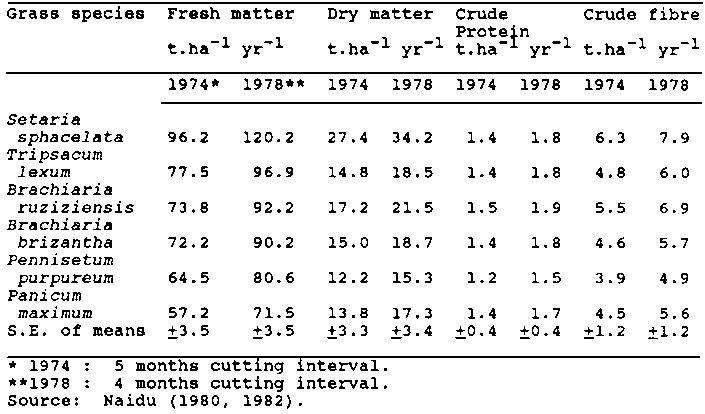
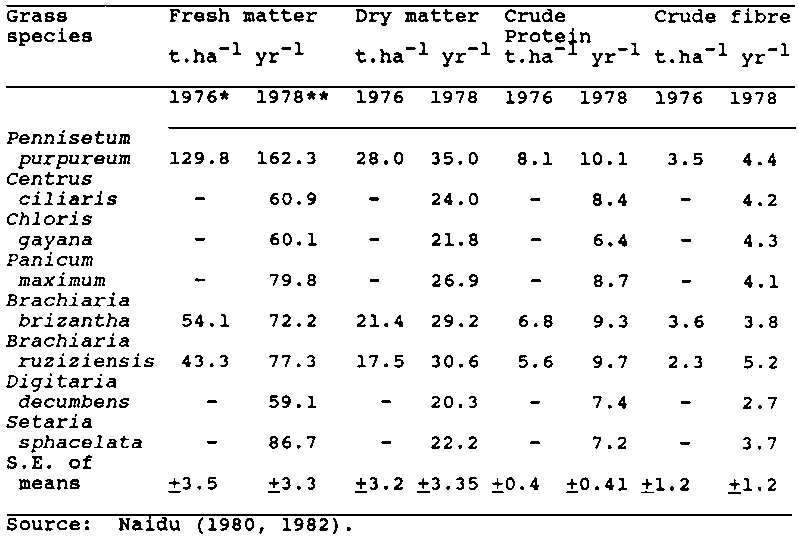
The productivity of eight selected grasses have been evaluated in two ecological zones (subhumid and superhumid) and the results are presented in Tables 2 and 3.
Data for the other two species of grasses namely Cenchrus ciliaris and Chloris gayana were not included in Table 2 due to abnormally low productivity and poor persistency. The parameters given for 1978 were consistently superior to those 1974, and although Setaria sphacelata outyielded the other species in some respects, the crude protein yield was not superior. Other studies conducted in the superhumid zone confirms the superiority of Setaria sphacelata (Jhundoo, 1986) in terms of fresh and dry matter production. However, bearing in mind the fact that protein is probably the most critical nutrient in Mauritian forages, this does not necessarily imply that Setaria sphacelata is the most suitable feedstuff.
Source: Naidu (1980, 1982).
The results of experiments carried out in the subhumid zone are given in Table 3. Generally it can be concluded that Pennisetum purpureum is the most vigorous, persistent and highly adapted species, and thus can be safely recommended for the subhumid regions especially for zero-grazing. Productivity data for the five species for 1976 have been omitted due to their poor performance probably resulting from unfavourable climatic conditions.
Table 3. Production parameters of 8 species of grasses in subhumid zone for 1976 and 1978 (3 cuts).
Source: Naidu (1980, 1982).
On the other hand, assessment of the potential of Stenotaphrum dimidiatum, the dominant species in the shaded and open pasture of the drier regions and Ischaemum aristatum, a common species of the superhumid zones have been virtually neglected. Published data of Blair and Peerun (1970) on the potential of these two forages, based on five cuts over a tenmonth period on the subhumid site at Wolmar show the superiority of Stenotaphrum dimidiatum, especially in respect of the crude protein content and yield (Table 4).
Table 4. Dry-matter and protein yield of Stenotaphrum dimidiatum and Ischaemum aristatum.
|
Species |
Dry matter t.ha-1 |
Crude protein % dry matter |
Crude protein t.ha-1 |
|
Ischaemum aristatum |
17.56 |
10.6 |
1.64 |
|
Stenotaphrum dimidiatum |
20.18 |
18.5 |
2.99 |
The production from Stenotaphrum dimidiatum is generally much lower in the wet areas than Ischaemum aristatum. An advantage of Stenotaphrum dimidiatum is its persistently high crude protein content at various cutting intervals (Blair and Peerun, 1970) (Table 5). Increasing the cutting interval from two to twelve weeks also increased productivity.
Table 5. Production and cutting interval of Stenotaphrum dimidiatum.
|
Cutting interval (weeks) |
Fresh weight t.ha-1 |
Dry weight t.ha-1 |
Crude protein % of DM |
Crude protein t.ha-1 |
|
2 |
12.50 |
1.87 |
11.6 |
0.22 |
|
4 |
21.25 |
2.76 |
17.6 |
0.49 |
|
6 |
30.25 |
4.39 |
13.3 |
0.48 |
|
8 |
38.75 |
5.43 |
15.3 |
0.83 |
|
10 |
40.00 |
5.48 |
15.7 |
0.86 |
|
12 |
47.50 |
6.41 |
14.8 |
0.95 |
Data on fertilizer responses of the grasses are only fragmentary. The need for properly fertilizing fodder plantations and pastures not only with nitrogen, but also with potassium, phosphorus and sulphur is not fully realised. As a consequence there is a decrease in production in subsequent cropping of these fodders.
The effects of different levels of nitrogen fertilizer on the yield of three species of grass has been reported by Heerasing (1986). His experiments showed that increasing levels of nitrogen application positively influenced yield in Pennisetum clandestinum and Brachiaria brizantha only (Table 6). However the results of an identical trial conducted earlier by the same author did not reveal any improvement in yield of the three grasses.
Table 6. Effect of fertilizer response of three species of grass.
|
Rate of N application (kg/ha) |
Yield (k/ha, 3 cuts) |
||
|
Setaria sphacelata |
Pennisetum clandestinum |
Brachiaria brizantha |
|
|
0 |
135 |
65 |
70 |
|
10 |
121 |
69 |
92 |
|
15 |
130 |
63 |
87 |
|
20 |
130 |
82 |
94 |
Legumes
Besides evaluation studies on grasses, the potential of legumes, mainly Leucaena leucocephala, has been assessed since the early 70s. It is naturalised legume and therefore offers considerable potential for exploitation not only as fodder but also in agroforestry programmes, alley farming, hedges and erosion control. Its major advantage is the high crude protein level, a nutrient which is deficient in tropical forages.
A series of agronomic trials on Leucaena leucocephala have been conducted by Osman (1979), Rojoa (1982) and Heerasing (1984) to assess the role of various management practices on the productivity of this legume. Notably inter-row spacing of the plants have been shown to exert an effect on yield (Osman, 1979; Naidu, 1980; Rojoa, 1982; Heerasing, 1984,). Most of the authors have come to the conclusion that an inter-row spacing of between 90-100 cm yielded the best results. Only Osman (1979) found the optimum spacing to be 180 cm. Experiments on the effect of cutting height on yields were also undertaken (Osman, 1979) who in a 40-month period noted that the best cutting height was 75 to 150 cm, while Heerasing reported the optimum cutting height to be 37.5 cm.
Other conclusions reached by Osman (1979) are:
1. Cutting frequency has an important bearing on productivity. A frequency of cutting of 90 to 150 days (depending on season) was the most appropriate.2. When properly inoculated with suitable Rhizobium strains, fertilization is not needed.
3. Overgrazing by animals, especially the goat and the deer is detrimental to Leucaena productivity.
4. A productivity of 13 tonnes/ha-1/yr-1 dry matter and a protein yield of 3.5 t/ha-1/yr-1 have been obtained without fertilization and irrigation in the humid zone.
Various nutritive value criteria have been assessed. Dry matter digestibility and various feeding trials have been undertaken during the past decade. Generally, the recorded data demonstrate that Leucaena leucocephala exerts positive effects on animal performance when used as a supplementary source of protein due to its ability to provide appreciable by-pass protein which is important especially for high performance animals feeding on low-quality fibrous feeds. Providing high levels of Leucaena leucocephala in the diet is not only economically unsound but influences certain parameters, inter alia, a reduction of milk fat in lactating animals (Mardamootoo, personal communication), depression in animal performance and the possibility of intoxication.
The problem of Leucaena toxicity, fortunately is a regional one. In some countries, including Mauritius, it is well established that there exist rumen micro-organisms capable of degrading the toxic goitrogenic metabolite of mimosine (Jones, 1981). Immunity against Leucaena toxicity can easily be imparted to animals via infusion of rumen fluid from immune animals or suitable inoculum. This no doubt offers scope for increased utilisation of this highly productive and persistent legume.
Other legumes which warrant further investigation to improve grassland quality (Osman, 1979) are:
1. For the very wet regions:Stylosanthes guianensis
Macroptilium atropurpureum
Neonotonia wightii
Vigna marina2. For dry regions: Stylosanthes humilis.
The establishment method advocated is that of oversowing the existing grass cover with the seed of these legumes.
Sugarcane
Another fodder plant of potential economic importance is sugarcane (Saccharum officinarum L.). The interest in the sugarcane plant lies primarily in its high potential to trap the sun's energy, which is in general superior to other commonly grown crops, because of its perenniality and its value as a dry season feed. Biomass production of up to 64 tonnes dry matter per hectare per annum has been recorded (Bachofen et al, 1981). The use of sugarcane as a feed for ruminants is particularly appropriate in times of low sugar prices, which makes the utilisation of land through production of sugarcane for conversion through animals an interesting proposition. The potential of the whole sugarcane plant for feeding animals has been given considerable research inputs in various sugar-producing countries since the early 1970s (Jotee, 1984).
An experiment was carried out in Mauritius to study the effect of monthly cutting intervals from four to twelve months (Rajkomar, 1977). The results reproduced in Table 7 show a slight increase in dry-matter yield but an appreciable decrease in protein yield with time. Further studies on the effect of fertilizer application of 100, 200 and 300 kg nitrogen per hectare (Rajkomar, 1977) did not reveal any positive response to increased nitrogen fertilization on the overall yield.
Table 7. Effect of cutting interval on yield of sugarcane.
|
Cutting interval (months) |
Fresh matter t/ha-1 |
Dry matter t/ha-1 |
% Crude protein on DM basis |
Crude fibre t/ha-1 |
|
4 |
149.3 |
35.8 |
3.8 |
8.51 |
|
5 |
135.2 |
27.4 |
4.8 |
7.46 |
|
6 |
145.8 |
37.5 |
4.2 |
8.85 |
|
7 |
129.2 |
25.2 |
5.8 |
7.74 |
|
8 |
141.5 |
34.5 |
4.1 |
8.06 |
|
9 |
180.3 |
32.5 |
3.9 |
8.23 |
|
10 |
177.1 |
40.6 |
3.0 |
9.61 |
|
11 |
164.4 |
40.9 |
2.7 |
7.88 |
|
12 |
140.3 |
36.0 |
2.1 |
6.98 |
Unlike most green forages in the tropics, sugarcane is characterised by an increase in organic-matter digestibility from six months to 24 months after planting (Rung and Stanley, 1982), and therefore can serve as a useful fodderbank during the dry season in certain countries. However, due to a decline in protein content with time, proper supplementation with by-pass protein in particular is desirable for satisfactory performance.
The success of any livestock development programme in Mauritius will partly depend on the research input in pasture and fodder crop production. Hitherto the resource persons involved in the agronomic studies, chemical analyses and in the animal production sector have always worked in isolation. This has resulted in a lack of coordination which has hampered development; therefore, a multi-disciplinary approach is essential, as well as the need for standardisation of methodology and the use of maximum criteria for assessment. However, before any new fodder and pasture improvement plans are made, it is of utmost importance to make a thorough assessment of existing data on available foodstuffs and future requirements.
The integration of fodder production into forest plantations has a good potential for the further development of the livestock sector. Therefore in the drier areas, where the stomoxys fly is not a problem, grazing by cattle/deer needs to be promoted. In the other areas, emphasis must be laid on the zero-grazing system mainly for the smallholders.
Future research programmes to increase forage production and efficiency of animal production should, inter alia, include:
1. More in-depth studies to assess the various management techniques used, viz. levels of cutting with respect to frequency and ageing, and fertilizer responses profiles for the main agro-climatic zones.2. Further investigation of naturalised/indigenous and exotic genotypes in relation to their persistency in long-term experiments.
3. Concurrent experiments to assess the nutritive value of various forage and mixtures through digestibility studies and feeding/grazing trials.
4. Further evaluation of other sources of feeds, namely the sugarcane tops, maize stover and cobs and other crop residues to enhance forage availability and hence production.
5. Establishment of on-farm demonstrations to highlight the benefits of improved fodder production techniques to smallholders.
6. Provision of more training facilities, research inputs and other logistic support.
7. Economic analyses of the various production systems.
Implementation of these proposals, no doubt, will contribute to improving the scope and efficiency of animal production in Mauritius.
Bachofen, R., Snozzi, M. and Zurrer, H. 1981. Biomasse. Udo Pfriemer Verlag, Munchen.
Blair, I. and Peerun, Z. 1970. Preliminary report on pasture. Milk and Meat Project, FAO, Rome.
Heerasing, J.M. 1984. Annual Report. Ministry of Agriculture, Natural Resources and Fisheries, Port Louis, Mauritius.
Heerasing, J.M. 1986. Annual Report. Ministry of Agriculture Natural Resources and Environment, Port Louis, Mauritius.
Jhundoo, C. 1986. Experimental work in progress on the development of fodder crops and pasture lands. In: Report of the Food and Agricultural Research Committee on Fodder Crops and Pasture Lands, Port Louis, Mauritius.
Jones, R.J. 1981. Does ruminant metabolism explain the absence of Leucaena toxicity in Hawaii? Australian Veterinary Journal 57(1):55-56.
Jotee, D. 1984. Investigations on the feeding of sugarcane products and their mode of presentation with Leucaena in two breeds of goats in Mauritius. Dissertation, University of Giessen, Federal Republic of Germany.
Kung, L. and Stanley, R.W. 1982. Effect of stage of maturity on the nutritive value of whole plant sugarcane preserved as silage. Journal of Animal Science 54(4):89-95.
Naidu, S. 1973. Fodder species used by small cowkeepers for cattle feeding in Mauritius. Dissertation, University of Mauritius, Reduit, Mauritius.
Naidu, S. 1980. Annual Report. Ministry of Agriculture, Natural Resources and Fisheries, Port Louis, Mauritius.
Naidu, S. 1982. Annual Report. Ministry of Agriculture, Natural Resources and Fisheries, Port Louis, Mauritius.
Osman, A.M. 1979. Protein from crops for cattle production in Mauritius with emphasis on Acacia, Leucaena leucocephala (LAM) de Wit. Proceedings of the National Agricultural Conference. University of Mauritius, Reduit, Mauritius pp. 387-406.
Rajkomar, I. 1977. Annual Report. Ministry of Agriculture, Natural Resources and Fisheries, Port Louis, Mauritius.
Rojoa, H. 1982. Annual Report. Ministry of Agriculture, Natural Resources and Fisheries, Port Louis, Mauritius.