H E C Nyirenda and T P E Makhambera
Department of Animal Science, Bunda College of Agriculture, P.O. Box 219, Lilongwe, Malawi.
Introduction
Materials and methods
Results
Discussion
Conclusion
References
Intensive poultry production in Malawi is increasing slowly, and major factors limiting growth of the poultry industry include shortages and high prices of balanced feed. At times such ingredients as groundnut cake and fish meal are not available in the country for compounding chicken feed, and meat and bone meal is not produced in sufficient quantities to replace fish meal in time of scarcity. There are no data on the effect of feeding local fish meal from Mangochi to chickens, and although groundnut cake has long been used in the country no research has been documented.
Studies have shown that groundnut meal of high protein value (54%) does not need di-methionine supplementation to improve the performance of layers (Davidson and Boyne 1962; Carpenter et al 1954). Reports on roasted soybean have shown this to be a suitable source of protein for layers (Arenas et al. 1971). When roasted or extruded soybean meal or soybean meal plus raw soybeans were fed to layers, all treatments gave similar egg production, but soybean meal with added fat gave the highest egg weight (Lalshaw and Clayton 1976). There is a need, though, to heat-treat soybeans to deactivate trypsin inhibitors (Rogler and Carrick 1964). Bray et al. (1971) found that heating soybeans to less than 120°C, resulted in pancreatic hypertropy in hens and that heating to 140°C increased the efficiency of utilization of the soybeans. Fish meal is one of the most used animal protein sources for poultry. In Malawi commercially used fish meat is imported and is the main animal protein source for mono-gastrics.
The objective of these experiments was to find locally available protein sources that could be used in broiler diets without adversely affecting performance.
Experiment 1: 270 two-week old mixed sex broiler chicks (shaver starbro) were used in this experiment on deep litter with wood shavings. There were two replicates per treatment (diets) with 27 birds per replicate.
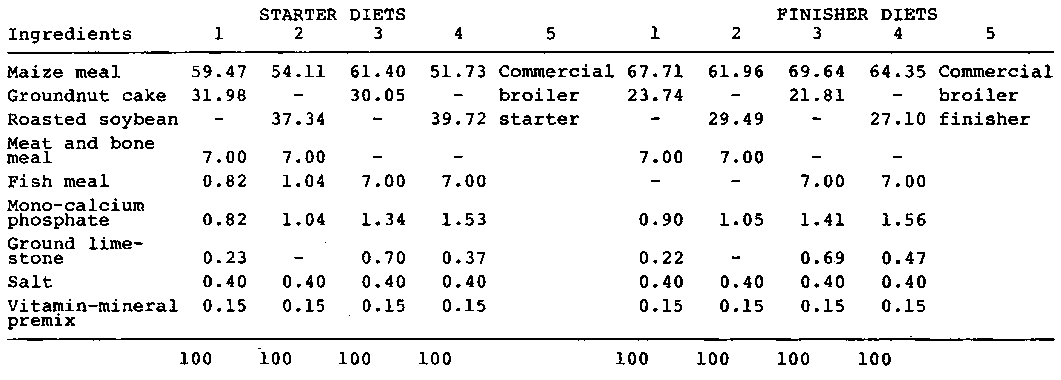
Five broiler starter and finisher diets were used (table 1). Diet 1 contained groundnut cake with meat and bone meal, diet 2 contained roasted soybean meal with meat and bone meal, diet 3 contained groundout cake with local fish meal (Mangochi fish meal), diet 4 contained roasted soybean meal with local fish meal and diet 5 was a commercial broiler feed. Fish meal or meat and bone meal were included at 7% in all diets.
Table 1. Composition of broiler diets in Trial One (%DM)
Experiment 2: 270 two-week old mixed sex broiler chicks (Shaver starbro) were used; also on deep litter. There were three replicates per treatment with 30 birds per replicate.
Three broiler starter and finisher diets were used in this experiment (Table 2). Diet 1 contained groundnut cake with 2.50% meat and bone meal and 5% local fish meal, diet 2 contained roasted soybean meal with 2.50% meat and bone meal and 5% local fish meal, and diet 3 contained roasted soybean meal with 10% cotton seed cake, 2.50% meat and bone meal and 5% local fish meal. The soybeans were roasted at 200°C for ten minutes and then ground. All the diets were drum mixed at the site of the experiments. Both trials were carried out in 5 weeks, 2 weeks for starter diets and 3 weeks for finisher diets. The birds were randomly assigned to diets. Weight and feed consumption data were collected weekly, and subjected to analysis of variance and Duncan's Multiple Range Test.
The results of experiment 1 (Table 3) indicate that birds fed on experimental diets 3 and 5 (both starter and finisher diets) gained significantly more than those fed on diets 2 and 4 which contained roasted soybean meal (P<0.05). Birds on starter diet 1 had statistically similar weight gains to those on starter diets 2 and 4, but finisher diet 1 did give significantly higher gain. The figures for feed conversion efficiency yielded the same picture as those for weight gain. There were no significant differences among diets in terms of feed consumption.
The results of experiment two are shown in table 4. Birds fed on starter and finisher diets 1 gained significantly more than those fed on diets 2 and 3 (P<0.05). There were no statistically significant differences in feed conversion efficiencies in the three finisher diets. Feed conversion efficiency for birds on diet 1 was better than those on starter diets 2 and 3 (P<0.05), and again no differences between diets in feed consumption occurred.
The findings of these two experiments indicate that groundnut cake is superior to roasted soybean meal, the poorer performance from the latter probably being due to the processing of the soybeans to deactivate trypsin inhibitors. Although soybeans were roasted at 200°C for ten minutes, it is probable that the time was not enough to inactivate trypsin inhibitors so as to increase utilization efficiency.
No differences in feed consumption were observed in these experiments. However, Arends et al (1971) and Lalshaw (1974) recommended that diets containing roasted full fat soybean meal must be balanced for energy/amino acid ratio because birds on high energy full fat roasted soybean meal will consume less feed. Dewan and Gleaves (1969) similarly reported that heated full fat soybean meal significantly reduced feed intake by layers. In this study, however, energy determinations of the experimented diets were not made.
Table 2. Composition of broiler diets in Trial 2 (%DM)
|
Ingredients |
STARTER DIETS |
FINISHER DIETS |
||||
|
1 |
2 |
3 |
1 |
2 |
3 |
|
|
Maize meal |
60.34 |
52.17 |
52.68 |
68.44 |
62.42 |
63.79 |
|
Groundnut cake |
29.56 |
- |
- |
22.03 |
- |
- |
|
Roasted soybeans |
- |
37.89 |
27.86 |
- |
28.24 |
16.83 |
|
Cottonseed cake |
- |
- |
10.00 |
- |
- |
10.00 |
|
Meat and bone meal |
2.50 |
2.50 |
2.50 |
2.50 |
2.50 |
2.50 |
|
Fish meal |
5.00 |
5.00 |
5.00 |
5.00 |
5.00 |
5.00 |
|
Mono-calcium phosphate |
0.87 |
0.83 |
1.05 |
0.87 |
0.70 |
0.71 |
|
Ground limestone |
1.18 |
1.06 |
0.86 |
0.61 |
0.59 |
0.62 |
|
Salt |
0.40 |
0.40 |
0.40 |
0.40 |
0.40 |
0.40 |
|
Vitamin-mineral premix |
0.15 |
0.15 |
0.15 |
0.15 |
0.15 |
0.15 |
|
|
100 |
100 |
100 |
100 |
100 |
100 |
Table 3. The effect of protein source on performance of broilers in Trial one
|
DIET |
LWT WEIGHT GAIN (g) |
FEED CONSUMPTION (g/bird) |
FEED/LOOT GAIN |
|||
|
STARTER (WK 2) |
FINISHER (WK 5) |
STARTER DIET (2 WKS) |
FINISHER DIET (5 WKS) |
STARTER (WK 2) |
FINISHER (WK 5) |
|
|
1 |
452ab |
712a |
1080 |
1883 |
2.6ab |
2.71b |
|
2 |
329b |
522b |
1096 |
1793 |
2.98a |
3.41a |
|
3 |
562a |
705a |
873 |
1878 |
2.34b |
2.89b |
|
4 |
335b |
546b |
929 |
1892 |
2.98a |
3.74a |
|
5 |
602a |
696a |
863 |
1965 |
2.27b |
2.93b |
ab Means not followed by a common letter, within a column, are significantly different at P<0.05.
Table 4. The effect of protein source on the performance of broilers in Trial two
|
|
LWT WEIGHT GAIN (g) |
FEED CONSUMPTION (g/bird) |
FEED/LOOT GAIN |
|||
|
DIET STARTER (WK 2) |
FINISHER (WK 5) |
STARTER DIET (2 WKS) |
FINISHER DIET (5 WKS) |
STARTER (WK 2) |
FINISHER (WK 5) |
|
|
1 |
474a |
1293a |
1029 |
2861 |
2.23b |
2.34a |
|
2 |
341b |
1002b |
1041 |
2702 |
3.08a |
2.83a |
|
3 |
370b |
1042b |
1065 |
2627 |
2.87a |
2.59a |
ab Means, not followed by a common letter, within a column, are significantly different at P<0.05.
Finisher diets 1 and 2 in experiment one containing meat and bone meal did not have adverse effect on the performance of the birds over the experimental period of 5 weeks. However, Anderson and Warnick (1971) stated that bone meal is a poorer source of essential amino acids than fish meal. Isabo and Trifunovic (1963) reported that groundnut cake is low in lysine and methionine. They also reported that broiler pullets fed 7% fish meal in their diets together with either soybean meal or groundnut meal performed equally well. In this study birds on groundnut cake performed better than those on roasted soybean meal. It is possible that the meal and bone meal and fish meal could have improved the lysine and methionine contents sufficiently in these diets.
It is concluded that groundnut cake in combination with either meat and bone meal or local fish meal can be used in broiler feeds without adverse effects. Importation of fish meal may be necessary only to add to the local sources. The use of roasted soybean meal needs to be studied further before recommending it to the smallholder farmers. There is a need to establish optimal roasting time and temperature and inclusion rate for optimum performance by poultry.
Anderson J.O. and Warnick R.E. 1971. Relative value of three animal protein supplements in chick rations. Poultry Science, 50.
Arends L.G., Brewer C.E. and Gehle M.H. 1971. Evaluation of heat processed soybeans for caged layers. Poultry Science, 50: 1546.
Bray D.J., Johnson H.S., Rowland R.D. and Ridles S.F. 1971. The degree of Infra-red heating and the nutritional value of whole soybeans for layers. Poultry Science 50: 1556.
Carpenter K.J., Duckworth J. and Ellinger E.M. 1954. Economics in the use of animal by-products in poultry rations. 2. Vitamins and amino acid provision for laying hens. Journal of Agricultural Science, 44: 340.
Davidson J. and Boyne A.W. 1962. Methionine and lysine supplementation of groundnut meal in experimental diets for laying hens. British Journal of Nutrition, 16: 541.
Dewan S. and Gleaves E.W. 1969. Influence of protein volume and energy upon feed intake regulation of laying hens. Poultry Science, 48: 1806.
Galal A. Gh., Baker D.H., Norton H.W. and Beker D.E. 1977. Evaluation of supplemental protein sources for broiler chicks. Poultry Science 56: 703.
Isako D. and Trifunovic D. 1963. Effect of different sources of protein in fattening young poultry. Nutrition Abstract and Reviews, 33: 893.
Lalshaw J.D. and Clayton P.C. 1976. Raw and heated full fat soybeans in laying diets. Poultry Science, 55: 1268.
Rogler J.C. and Carrick C.W. 1964. Studies on raw and heated unextracted soybeans for layers. Poultry Science, 43: 605.
Wadriys P.W., Van Wallenghen P., Fry J.L., Chicco C. and Harns R.H. 1965. Fish meal studies. 1. Effects of levels and sources on broiler growth rate and feed efficiency. Poultry Science, 44: 1012.
Willingham H.E. and Earles J.D. Jr. 1966. Influence of fish meal and amino acid balance in practical rations on broiler performance. Poultry Science, 45: 1138.