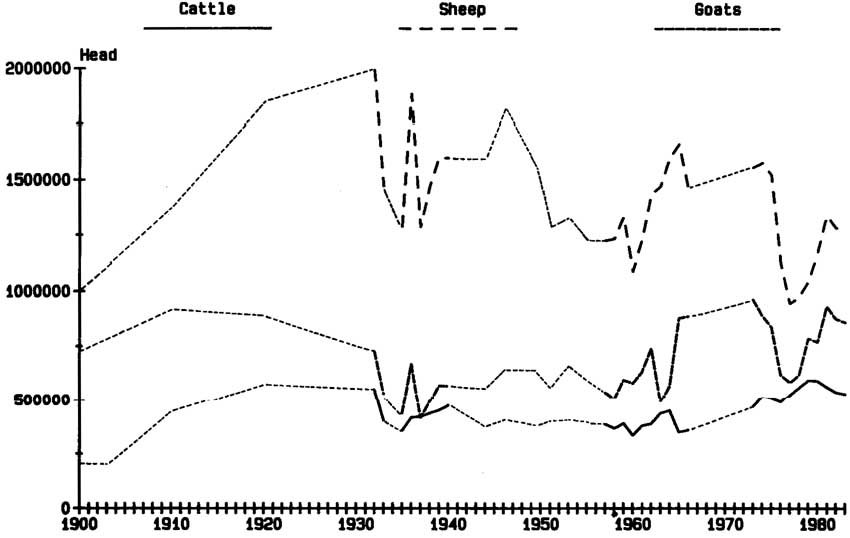
4. The end of the lifaqane 2 wars of circa 1818-1824 marked the beginning of the historical development of Lesotho under the guidance of Paramount Chief Moshoeshoe I. Basotho rapidly expanded their cultivation of the fertile lowlands area of the country and traded surplus food grain for-cattle and manufactured foods. Through trade, natural increase and cattle raids, Lesotho's cattle population expanded, reaching a peak in 1921. At the same time the sheep and goat populations also expanded; the goat population peaked in 1911, the sheep population in 1931. The 1930 to 1965 period was marked by large year-to-year fluctuations, but generally cattle and sheep herds declined while the goat herd increased. The early 1970s was a period herd construction, and the early 1980s another period of herd reduction (Figure 1).
Figure 1. Lesotho populations of cattle, sheep and goats, 1900 to 1983.
Source: Swallow, Mokitimi and Brokken (1986)
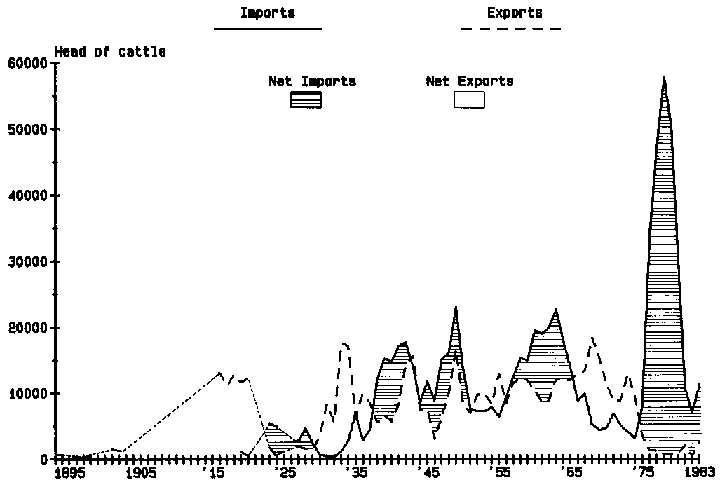
5. While Lesotho has historically been a net importer of cattle, there have been four periods since 1900 when significant net exports have been reported. 1916-1920, 1930-1937, 1952-1955, and 1966-1974. Even in those years when net imports have been reported, exports have often been significant. Between 1933 and 1973, the average number of cattle exported each year was 10,516. Since 1973 exports have been at their lowest since the turn of the century (Figure 2).
Figure 2. Lesotho exports and imports of cattle, 1883 to 1983
Source: Swallow, Mokitimi and Brokken (1986)
6. Prior to Lesotho's independence in 1966 private traders dominated formal marketing channels for cattle. From the 1890s to 1920s the principal marketing channels were private traders - either itinerant traders called hawkers or fixed trading stations. Cattle were exported by the traders to South Africa where they were primarily used for draught purposes. During the same period large numbers were marketed directly to South African farms and South African butchers. In the 1930s a number of speculators became involved in the trade. These speculators either paid cash, traded young animals called tollies (two-year olds) and cash for older oxen, or traded two tollies for each old ox.
7. Between the late 1930s and early 1950s the Department of Agriculture operated the Livestock Auction Sales Scheme. Under this scheme the Department of Agriculture arranged auction sales in various locations throughout the country. The main buyers at these sales were South African private traders and speculators who in turn sold to South African butchers. In 1956 the Department of agriculture attempted to expand the auction sales scheme to be a one-channel marketing system. Under this system all cattle leaving the lowland districts during the selling season of January to May were to pass through auction sales organized by the Department of Agriculture. By 1957 the system was terminated due to insufficient volume and low competition.
8. When the one-channel marketing system failed, private traders began organising auction sales on their own. Traders facilitated sales and provided the necessary infrastructure, but took no part in the actual buying and selling. The traders were paid flat commissions for their services. The cattle were exchanged for either cash alone or for young animals with a cash adjustment. Private traders palyed a major role in the marketing system until 1971.
9. Cooperative marketing societies first became involved in the marketing of cattle in 1956. Unlike the private traders, cooperative marketing societies weighed and graded the cattle, then sent them on a consignment basis to South African markets. Individual cooperative marketing societies operated under the umbrella of the Basutoland Cooperative Banking Union (BCBU).
10. Leading up to and especially since indepence, Lesotho has experienced a move from private trade in livestock towards more government involvement. In 1963 the registration of the BCBU was cancelled and the Finance and Marketing Cooperative Union of Basutoland (FMCUB) took over its assets and liabilities as a parastatal marketing agency. The FMCUB marketed modest numbers of cattle until 1971 when the Lesotho Farmers' Produce Marketing Corporation (LFPMC) was established. The LFPMC was a government controlled company under which frequent livestock auction sales were held at locations around the country. The LFPMC became the sole agency through which livestock could be exported or imported across Lesotho's borders.
11. The Livestock Marketing Corporation (LMC) was established in 1973. It took over the functions of the LFPMC in the marketing of live animals and also became involved in the marketing of wool and mohair. When the LMC ceased operations in 1980, most of its functions were transferred to the Livestock Products Marketing Service (LPMS). The LPMS was established as a result of the LMC not fulfilling the objectives set for it. Wool and mohair producers had lost confidence in the LMC and were selling their wool and mohair to private traders. The LPMS is now the government agency responsible for facilitating farmer marketing of Livestock and Livestock products.
12. The National Feedlot was opened in early 1983 and the National Abattoir in late 1985. Both are public corporations and operate under common management. The LPMS, the National Feedlot, and the National Abattoir now dominate the formal cattle marketing system in Lesotho.