Abstract
Résumé
Introduction
Materials and methods
Results
Discussion
Acknowledgements
References
P.R. Hatendi1, T. Smith1,
L. Ndlovu2 and C. Mutisi2
1Matopos Research Station
Private Bag K5137
Bulawayo, Zimbabwe
2University of Zimbabwe
P O Box MP167
Mount Pleasant, Zimbabwe
Complete cereal-based diets, containing either 50, 33, 22, or 10 veld hay (9. 7, 10.3, 11.6, and 12.1 MJ ME/kg DM, respectively) were fed to 40 wethers, to achieve a target body mass gain of 10 kg by 230 days. Ten animals were slaughtered at the start of the experiment to determine initial carcass mass and the body and carcass composition. for animals which attained the target, slaughter mass growth rate and feed intake were similar between diets. Animals fed the 22 per cent hay diet outperformed the others in terms of mean body mass gain feed conversion ratio. Means of performance traits had high coefficients of variation and it is suggested that the heterogeneity of the sample population may have masked treatment effects.
Compared to the preliminary slaughter group, carcass mass and yield was significantly (P<0.05) increased by feeding as was fat deposition in both visceral and carcass depots. The quantity of fat deposited appeared to be positively related to dietary energy concentration.
Des rations équilibrées à base de céréales contenant 50, 33, 22 ou 10% de foin (9, 7; 10, 3; 11, 6 et 12,1 MJ d'EM/kg de MS respectivement), ont été distribuées à 40 boucs castrés, l'objectif étant de réaliser un gain total de poids vif de 10 kg. Au début de l'expérience, 10 autres boucs ont été abattus afin de déterminer le poids et la composition initiaux de la carcasse. Pour les animaux qui ont atteint l'objectif de gain pondéral visé, le taux de croissance et la quantité d'aliment ingérée n'ont pas été significativement différents (P>0,05) selon les rations. Les meilleures performances ont été enregistrées pour la ration à 22% de foin, avec un gain pondéral de 92 g/jour et un taux de conversion de 9,5 kg de madère sèche par kg de poids vif. Les coefficients de variation des moyennes des paramètres étudiés étaient élevés, ce qui suggère que l'effet des traitements avait peut-être été masqué par l'hétérogénéité de l'échantillon.
Par rapport aux abattages témoins, le poids et le rendement de la carcasse ont augmenté significativement (P<0,05) de même que les quantités de matière grasse déposées aussi bien dans les viscères que dans la carcasse. Enfin, il y a une corrélation positive entre la quantité de graisse déposée et la teneur en énergie de la ration.
Peasant farmers in Zimbabwe own over two million goats (CSO, 1989). These goats, predominantly of the 'indigenous' type, are a heterogeneous population unselected for productive traits. Goats in Zimbabwe are reared primarily as meat animals (Hale, 1986), with little information on carcass attributes. Research in an extensive production system with the 'Matabele' goat of southern Zimbabwe, has suggested that a slaughter mass of about 38 kg will yield carcasses with desirable meat characteristics (Tawonezvi and Ward, n.d.).
The effects of fattening goats on complete cereal-based diets differing in energy content, on animal performance, body and carcass composition were investigated.
Fifty wethers (castrated goats) from the Matopos Research Station flock, aged either 18 or 24 months were used in the experiment. The goats were allocated into five groups of 10 animals each, balanced for body mass and age. One group (PS), was slaughtered at the beginning of the experiment to estimate the initial carcass mass and body and carcass composition.
The remaining groups were randomly allocated to one of four diets containing either 50 (H50), 33 (H33), 22 (H22) or 10 (H10) percent coarsely milled (<1.5 cm lengths) range hay. Chemical composition and digestibility of the diets (Table 1) were as reported by Hatendi et al (1990). Animals were individually penned and offered feed in two equal meals at 07.00 and 14.00h daily. The amount of feed offered daily was adjusted each morning to allow refusals of between 100 and 200 9. Water was available at all times. Animals were slaughtered after gaining 10 kg body mass. The experiment ended after 230 days due to lack of feed.
Table 1. Composition and apparent digestibility of diets offered to goats.
|
|
Hay level |
|||
|
50% |
33% |
22% |
10% |
|
|
Veld hay |
500 |
330 |
220 |
100 |
|
Cottonseed meal |
100 |
100 |
100 |
100 |
|
Maize meal |
320 |
495 |
608 |
731 |
|
Molasses |
50 |
50 |
50 |
50 |
|
Urea |
12 |
7 |
4 |
1 |
|
Salt |
7 |
7 |
7 |
7 |
|
Limestone flour |
5 |
5 |
5 |
s |
|
Gypsum |
5 |
5 |
5 |
5 |
|
Vit/min premix1 |
1 |
1 |
1 |
1 |
|
Dry matter (DM) (g/kg) |
910 |
910 |
910 |
900 |
|
Ash (g/kg DM) |
80 |
70 |
60 |
60 |
|
Crude fibre (g/kg DM) |
190 |
160 |
90 |
90 |
|
Crude protein (g/kg DM) |
200 |
190 |
150 |
160 |
|
Ether extract (g/kg DM) |
30 |
30 |
40 |
40 |
|
Dry-matter digestibility2 |
0.69 |
0.73 |
0.74 |
0 |
|
Estimated metabolisable energy2 MJ/KG DM |
9.67 |
10.33 |
11.60 |
12 |
1. 1 kg = 3X10⁶ i.u. retinol, 35 9 manganese, 35 9 zinc, 0.6 9 selenium and 0.12 9 iodine.
2. Hatendi et al (1990).
Animals were weighed before and after 30-hour fast to determine final body mass (FBM) and mass at slaughter (SM), respectively. The head, feet, pelt, full gut, omentum mesentery, liver and heart were removed and weighed. The mass of the empty gut was determined after washing-out the gut contents whose mass was estimated by difference (full gu-t empty gut).
Hot carcass mass was recorded within 30 minutes of slaughter and cold carcass mass after chilling at approximately 7°C for 48 hours. Chilled carcasses were visually scored for fat cover as described by Colomer-Rocher (1987).
Carcasses were cut into three sections. The fore section was removed from the carcass by cutting between the 6th and 7th ribs, and the rib section separated from the hind section at the penultimate rib. Eye-muscle depth, eye-muscle width and backfat depth were measured with callipers on the cut surface of the penultimate rib.
The carcass sections were split along the mid-line and the right sides sealed in plastic bags and frozen pending chemical analysis. Prior to analysis the frozen sections were ground twice through a cutter-grinder fined with a 9-mm screen (Jeffco Food and Fodder Cutter-grinder Model 262B). Ground carcasses were thoroughly mixed by hand and a representative sample analysed to determine dry matter, crude protein, ether extract and ash content (O'Donovan and Elliot, 1971).
Initially data from both the PS and fed treatment groups were analysed for treatment differences by ANOVA using age and initial body mass (IBM) as covariates. Where significant treatment effects were found orthogonal comparisons were made between the PS and the fed-treatment means. Subsequently, data from the fed treatments only were reanalysed by ANOVA using age and IBM as covariates and differences between diets evaluated using paired orthogonal contrasts. Differences (P <0.05) between means of fed animals are indicated in tables by use of superscripts.
Three animals died during the trial of unspecified causes (Table 2). These, in addition to the six animals which did not attain the targeted body mass, and had daily body mass gains of less than 35 g/d were excluded from the analysis.
Diet offered did not affect (P>-0.05) animal performance traits (Table 3) though performance generally tended to improve with decrease in dietary hay.
Slaughter mass and the carcass characteristics of all groups are shown in Table 4. Among the fed treatments, though gut fill at slaughter and the proportion of SM represented by gut fill were significantly higher (P<0.05) for the H50 than either the H33 or H22 groups, diet had no effect on empty body mass. Carcass masses of animals offered diet H50 were lower (P<0.05) than for those offered H33 and H22.
Table 2. Fate of fed goats offered diets containing different roughage levels.
|
|
Hay level |
|||
|
50% |
33% |
22% |
10% |
|
|
Body mass gain ³ 10kg |
10 |
8 |
7 |
4 |
|
Body mass gain < 10 kg |
- |
2 |
2 |
2 |
|
Fatalities |
- |
- |
1 |
2 |
|
Total |
10 |
10 |
10 |
10 |
Table 3. Performance characteristics of fed goats which gained 10 kg body mass.
|
|
Hay level |
||||
|
50% |
33% |
22% |
10% |
se |
|
|
Initial mass kg |
25.5 |
26 |
23.9 |
27.4 |
0.51 |
|
Final mass kg |
35.6 |
36.3 |
34.3 |
37.5 |
0.53 |
|
Daily gain 9 |
68 |
75 |
92 |
74 |
4.3 |
|
Total gain kg |
10.1 |
10.3 |
10.4 |
10.1 |
0.10 |
|
Total dry-matter intake kg |
130.5 |
118.3 |
97.8 |
113.9 |
4.76 |
|
Feed-conversion ratio (kg food/kg gain) |
11.4 |
9.5 |
11.3 |
0.60 |
12.9 |
Carcass fat score was lower (P<0.001) for the PS than the fed animals (Table 4). Among fed groups, though diet had no effect on fat score, it was highest for animals offered H10.
Body parts of fed animals were heavier than those of PS animals. In terms of proportion of EBM, however, they were lower, except for the omental and mesenteric (O+M) fat (Table 5). Amongst the fed treatments the weight of the O+M fat depots and their proportion of EBM were lowest (P>0.05) for animals offered H50 (Table 5).
As proportions of the cold carcass the fore and hind sections were lower (P<0.001) and the rib section higher (P<0.001) for the fed groups as compared the the PS group (Table 6). There were no differences (P>0.05) among the fed groups in carcass proportions.
Eye-muscle width and depth tended to be greater (though not significantly as for the fed animals) than the PS group (Table 7). Among the fed groups, there were no differences in eye-muscle dimensions and back fat. Weight and proportion in the carcass of the kidney knob and channel fat (KKCF) was lower (P<0.001) for the PS than the fed groups. Among the ted groups KKCF weight and its proportion of carcass mass tended to increase as the roughage level of the diet decreased and were significantly (P <0.05) lower for the H50 group as compared to the other fed groups (Table 7).
Table 4. Carcass characteristics of preliminary slaughter and of fed goats.
|
|
Hay level |
PS vs |
|||||
|
PS |
50% |
33% |
22% |
10% |
SE |
FED |
|
|
Slaughter mass (SM) kg |
26.1 |
34.1 |
33.6 |
33.2 |
36.5 |
0.53 |
*** |
|
Gut fill kg |
6.0 |
49a |
3.5b |
3.6b |
4.4ab |
0.14 |
*** |
|
GF/SM kg/kg |
0.23 |
0.15a |
0.10b |
0.11b |
0.12ab |
5.1 |
*** |
|
Empty body mass (EBM) kg |
20.1 |
29.2 |
30.1 |
29.6 |
32.1 |
0.49 |
*** |
|
Carcass mass |
|
|
|
|
|
|
|
|
Hot kg |
11.1 |
16.9a |
18.5b |
17.1b |
18.9ab |
0.27 |
*** |
|
Cold (CCM) kg |
10.6 |
16.4a |
18.1b |
16.6b |
18.3ab |
0.27 |
*** |
|
Killing-out ratios |
|
|
|
|
|
|
|
|
(CCM/SM) |
0.40 |
0.48a |
0.54b |
0.50ab |
0.50ab |
0.005 |
*** |
|
Carcass fat cover1 |
1.5 |
2.5 |
2.8 |
2.7 |
3.3 |
0.09 |
*** |
1where 1 = low cover, 2 = slight cover, 3 = average cover, 4 = high cover, 5 = very high cover (Colomer-Rocher et al, 1987).
Values in the same row with the same superscript are not significantly (P > 0.05) different.
Table 5. Pro portions (g/kg) of body parts in empty body of goats preliminary slaughtered (PS) and fed.
|
|
Hay level |
SE |
PS vs FED |
||||
|
PS |
50% |
33% |
22% |
10% |
|||
|
Head |
82 |
66 |
65 |
64 |
61 |
1.1 |
*** |
|
Feet |
38 |
30 |
28 |
27 |
28 |
0.6 |
*** |
|
Pelt |
110 |
70 |
70 |
69 |
66 |
1.7 |
*** |
|
Heart |
6 |
5 |
5 |
5 |
5 |
0.6 |
* |
|
Liver |
27 |
18 |
18 |
22 |
20 |
1.7 |
*** |
|
Empty gut |
162 |
121 |
120 |
117 |
99 |
0 2 |
*** |
|
Omentum+ mesentery |
15 |
29a |
42b |
38b |
50b |
2.7 |
*** |
Table 6. Proportions of carcass sections of preliminary slaughtered and fed goats.
|
|
Hay level |
PS vs FED |
|||||
|
PS |
50% |
33% |
22% |
10% |
SE |
||
|
Fore section |
0.47 |
0.45 |
0.45 |
0.46 |
0.46 |
0.002 |
*** |
|
Rib section |
0.09 |
0.13 |
0.13 |
0.13 |
0.12 |
0.003 |
*** |
|
Hind section |
0.45 |
0.42 |
0.42 |
0.42 |
0.43 |
0.002 |
*** |
Table 7. Eye muscle (Em) back fat and kidney measurements of the cold carcass of preliminary slaughtered and fed animals.
|
|
Hay level |
PS vs FED |
|||||
|
PS |
50% |
33% |
22% |
10% |
SE |
||
|
em width mm |
45 |
49 |
49 |
42 |
50 |
8 |
ns |
|
em depth mm |
18 |
23 |
25 |
22 |
23 |
5 |
*** |
|
Back fat depth mm |
0 |
0.9 |
0.9 |
0.8 |
1.3 |
0.1 |
*** |
|
KKCF kg |
0.14 |
0.55a |
0.99b |
0.84b |
1.01b |
0.03 |
*** |
|
KKCF/CCM g/kg |
13 |
348 |
55b |
50b |
54b |
1.4 |
*** |
Values in a row with the same superscript are not significantly (P < 0.05) different
KKCM = kidney knob and channel fat.
ns = not significant.
SE = standard error.
CCM = cold carcass mass.
Table 8 shows the chemical composition of the right carcass side (less kidneys and KKCF). Compared to PS group, feeding decreased carcass water (P<0.001), crude protein and ash content (P<0.001) and increased (P<0.0.01), carcass fat content. Among the fed groups carcass water, crude protein (CP) and ash were higher for the H50 group but differences were not significant. Carcass fat content was highest for the H10 group.
Table 8. Water content (9 kg) and chemical composition of the dry matter of the right carcass side of preliminary slaughtered and fed animals.
|
mmm
|
Hay level |
SE |
PS vs FED |
||||
|
PS |
50% |
33% |
22% |
10% |
|||
|
n =8 |
n= 10 |
n =8 |
n =7 |
n =4 |
|||
|
Water (g/kg) |
588 |
536 |
516 |
488 |
511 |
6.9 |
* |
|
Crude protein (%) |
438 |
347 |
314 |
325 |
265 |
11.2 |
*** |
|
Ether extract (%) |
384 |
542 |
590 |
579 |
654 |
14.4 |
*** |
|
Ash (%) |
178 |
111 |
96 |
98 |
81 |
3.6 |
*** |
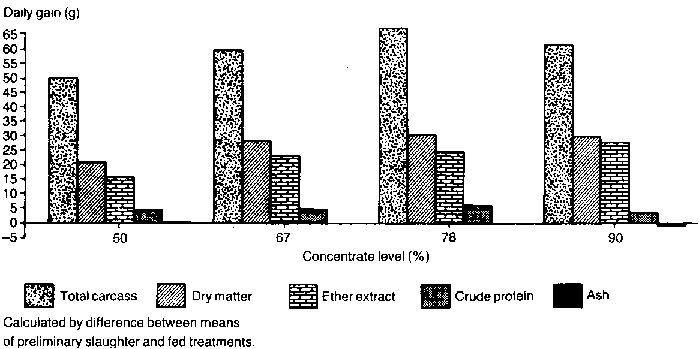
Daily carcass gain (less kidneys and KKCF) tended to have more fat as the concentrate proportion in the diet offered increased (Figure 1).
Figure 1. Mean chemical composition of carcass gain (less kidneys and KKCF).
Dry-matter intakes of the fed animals ranged from 2.4-2.9 per cent of their body weight and falls within the 1.9 to 3.8 per cent range suggested by Devendra and Burns (1983) for meat goats fed ad libitum. The observed inverse relationship between intake, diet energy content and is in agreement with work elsewhere (ARC, 1980; Forbes, 1986). Mean daily intakes of energy and protein (estimated by difference between the composition of feed offered and refused), were 8.8, 9.6, 9.8, and 10.4 MJ ME and 200, 190, 130, and 140G CP for diets H50 to H10, respectively. In this experiment, growth rates at these intake levels were lower then those suggested (>100 g/d) for growing goats by NRC (1981), Devendra and Burns (1983) or Wilkinson and Stark (1987). Animal performance was comparable to that reported for African breeds of goats reared intensively (Adebowale and Ademonsun, 1981; El Hag et al, 1984; El Hag et al, 1985). Growth rates in this trial were greater than the mean post-weaning gain between 5 and 18 months of 36 g/d reported at Matopos Research Station for extensively reared goats (Baffour-Awuah, 1987).
Means of performance traits in this study had high coefficients of variation. This suggests a lack of uniformity of the indigenous goat population and may have masked treatment effects.
Gut fill as a proportion of mass at slaughter was greater than the six to eight per cent reported for finished Sudan Desert goats (Gaali et al, 1972).
Carcass mass and yield of the fed animals in this study were greater than those previously reported at Matopos Research Station for animals of similar origin reared extensively (38 kg body mass yielding 16 kg hot carcass mass; Tawonezvi and Ward, n.d.), and are comparable to those reported elsewhere for finished goats of similar slaughter mass (Naude and Hofmeyr, 1981; Devendra and Bums, 1983).
Carcass tat cover increased appreciably in the fed groups. The observed large deposits of fat in the omentum + mesentery, and the kidney knob and channel fat depots, support reports which indicate minimal fat deposition in the subcutaneous fat depot of goats (Kirton, 1970; Gaali et al, 1972). The omental and mesenteric fat depots increased in weight by 3 to 5 times in the fed animals, representing between three and five per cent of the empty body weight. A large amount of fat was deposited in the carcass tissues of the fed animals.
Whilst some of the differences in carcass chemical composition between treatment groups can be explained by the relationship with carcass mass (Kirton, 1970; Naude and Hofmeyr, 1981), there was a tendency for the fat component of carcass gain to increase with dietary energy content and intake. The large amount of fat deposited in non-carcass and carcass fat depots may be indicative of the final body mass of animals in this study approaching their mature mass and thus a tendency towards 'fattening' rather than 'growing'. The increased fat deposition with dietary energy level may in part be attributable to the effects of reduced protein: energy ratio of the diets as the roughage content decreased (Beede et al, 1985; Mtenga and Kitaly, 1990).
Goats exhibit a centripetal growth pattern (Colomer-Rocher, 1987), with the proportion of the carcass represented by the forequarter and joints along the mid-line increasing with age and carcass mass (Kirton, 1970; Owen and Norman, 1977). The resultant improved carcass conformation of the fed groups becomes evident if the carcass mass to length ratio is used as an objective indicator of conformation (Colomer-Rocher, 1987). Calculated from the means of cold carcass weight and body length, with the ratio of the PS group used as a baseline, ratios for the fed treatment groups were 1.3, 1.6, 1.4, and 1.5 for treatments H50 to H10, respectively.
We thank the staff of Matopos Research Station, Grasslands Research Station, the University of Zimbabwe and Agrifoods (pvt.) Ltd. who contributed to this experiment. One of us (PRH) is in receipt of the RioTinto Foundation (Zimbabwe) postgraduate fellowship.
Adebowale E A and Ademosun A A. 1981. Studies on the utilization of brewers' dried grains by sheep and goats: 1. Growth studies. Bulletin of Animal Health and Production in Africa 29:365-370.
ARC (Agricultural Research Council). 1980. The nutrient requirements of ruminant livestock. Commonwealth Agricultural Bureaux, Slough, UK. 351 pp.
Baffour-Awush O. 1987. Environmental influences on growth of indigenous goats. In: Proceedings of the Zimbabwe Society for Animal Production Livestock Research Symposium.
Beede D K, Schelling GT, Mitchell GE and Tucker RE. 1985. Utilization by growing goats of diets that contain momensin and low or excess crude protein: Comparative slaughter experiment. Journal of Animal Science 61 (5):1230-1242.
Colomer-Rocher F. 1987. Factors influencing carcass quality. Carcass components and composition. In: Santana O P. Aliomar Gabriel da Silva and Foote W C (eds), Proceedings of the IV International Conference on Goats. Volume 1. International conference held in Brasilia, Brazil, 8-13 March 1987. Departamento de Difusao de Tecnologia - DDT, Brasilia, Brazil. pp. 181-194.
Colomer-Rocher F. Morand-Fehr P and Kirton A H. 1987. Standard methods and procedures for goat carcass evaluation, jointing and tissue separation. Livestock Production Science 17:149-159.
CSO (Central Statistical Office). 1989. Quarterly digest of statistics (March 1989). CSO, Harare, Zimbabwe.
Devendra C and Burns M. 1983. Goat production in the tropics. Commonwealth Agricultural Bureau, Slough, UK. 183 pp.
El Hag M O. El Hag G A and Gaali E. 1984. Sudan desert sheep and goats. Performance on high roughage and concentrate diets with monensis. International Goat end Sheep Research 2:274-282.
El Hag M O. Kurdi O I and Mahgoub S O. 1985. Performance and carcass characteristics of Sudan Desert sheep and goats on high roughage diets with added fat. Animal Feed Science and Technology 13:147-153.
Forbes J M. 1986. The voluntary food intake of farm animals. Butterworths, London, UK. 206 pp.
Gaali E S C, Ghanem Y S and Mukhtar A. 1972. A comparative study of some carcass characteristics of Sudan Desert sheep and goats. Animal Production 14:351 -357.
Hale D H. 1986. Systems of production and productivity of goats in three communal areas of Zimbabwe. In: Adeniji K O and Kategile J A (eds), Proceedings of the Workshop on the Improvement of Small Ruminants in Eastern and Southern Africa, Nairobi, Kenya, 18-22 August 1986. OAU/IDRC (Organization of African Unity/International Development Research Centre), Nairobi, Kenya. pp. 181-193.
Hatendi P R. Smith T. Ndlovu L and Mitisi C. 1990. Intensive finishing of indigenous meat goats: Diet utilization, growth and carcass weight changes of mature castrates. Paper presented at the Second Symposium on Science and Technology, the Scientific Council of Zimbabwe, Harare, Zimbabwe.
Kirton A H. 1970. Body and carcass composition and meat qualities of the New Zealand Feral Goat (Capra hiricus). New Zealand Journal of Agricultural Research 13: 167-181.
Mtenga L and Kitaly A J. 1990. Growth performance and carcass characteristics of Tanzanian goats fed Chloris gayana hay with different levels of protein supplement. Small Ruminant Research 3: 1-8.
Naude R T and Hofmeyr H S. 1981. Meat production. In: Gail C (ed), Goat production. Academic Press, New York, USA. pp. 285 307.
NRC (National Research Council). 1981. Nutrient requirements of goats: Angora, dairy and milk goats in temperate and tropical countries. Nutrient Requirements of Domestic Animals 15. National Academy of Science, National Research Council, Washington, DC, USA. 91 pp.
O'Donovan W M and Elliot R C. 1971. Developmental changes in the bodies of Dorper sheep.1. Changes in live body-weight, body proportions and composition of weaned Dorper lambs given different amounts of food. Rhodesia Journal of Agricultural Research 9:65 75.
Owen J E and Norman G A. 1977. Studies on the meat production characteristics of Botswana goats and sheep. Part lilt General body composition, carcass measurement and joint composition. Meat Science 1:283.
Tawonezvi H P R and Ward H K. (n.d.). Indigenous sheep selection programme and productivity of indigenous sheep and goats. In: Annual report 1981/82. Division of Livestock and Pastures, Department of Research and Specialist Services, Harare, Zimbabwe. pp. 92-95.
Wilkinson J M and Stark B A. 1987. The nutrition of goats. In: Haresign W and Cole D J A (eds), Recent advances in animal nutrition. Butterworths, London, UK. pp.91-106.