


Summary
Résumé
Introduction
Materials and methods
Results
Discussion
References
W.D. Mafwere and L.A. Mtenga
Department of Animal Science
Faculty of Agriculture
Sokoine University of Agriculture
P O Box 3004, Chuo Kikuu, Morogoro, Tanzania
A study was conducted to investigate the effect of inclusion of Lablab meal on growth rate, feed intake and carcass composition of Black Head Persian (BHP) lambs. Twenty-four BHP castrate sheep with average weight of 14.1 +2.7 kg were allotted randomly to four dietary treatments. Lambs were individually maintained in metabolic crates. All animals were offered hay ad libitum. Lambs on control treatment (A) were given in addition 380 g of maize bran per day. Animals on treatments B. C, and D were given daily 380 g of concentrate based on maize bran with 25,50 and 75% lablab meal, respectively.
Growth rate, dry-matter intake and feed conversion ratio were 34,66, 68, 71 g/day; 58.7,69.5, 74.0 g/kgW0.75/day and 15.2,11.3,9.3,9.1 g/DMI/g gain, respectively, of treatments A, B. C and D. The level of inclusion of lablab meal had no significant (P>0.05) effect on killing-out characteristics. Hot carcass weight as percentages of slaughter weight and empty body weight were 41.3,41.0,40.5,42.5 and 52.0,52.3,53.5, respectively, for animals on treatments A, B. C and D. Carcass composition expressed as percentage of carcass weight showed no significant treatment effects and value of 60.91, 61.29, 61.11 and 62.97% for carcass lean, 19.06,20.24, 18.42 and 17.54% carcass fat and 17.86,16.70,17.91 and 16.67% for carcass bone were obtained for treatments A, B. C and D. It is concluded that inclusion of lablab meal in maize bran above 25% has no beneficial effect in terms of growth rate and carcass composition.
Une étude a été effectuée en vue de mettre en évidence l'effet d'une complémentation alimentaire de dolique sur la croissance, la consommation et la composition de la carcasse d'agneaux de race Somali à tête noire (BHP). Vingt-quatre moutons BHP castrés, pesant en moyenne 14,1 +2, 7 kg et gardés individuellement dans des cages métaboliques, ont été répartis au hasard en quatre groupes (A, B. C et D) de traitement recevant chacun une ration déterminée. Du foin leur était servi ad libitum.
Les animaux du groupe témoin (A) ont en outre reçu chacun 380 g de son de maïes par jour tandis que ceux des groupes B. C et D ont eu en remplacement la même quantité d'un concentré à base de son de mais et contenant 25,50 et 75% de farine de dolique
Pour les groupes A, B. C et D, le gain de poids, la consommation de matière sèche et le taux de conversion des aliments furent de 34,66, 68 et 71 g/jour; 58.7, 64.7, 69,5, 74,0 g/kg de poids vif0.75 et 15,2, 11,3,9,3, 9,1 g MS/g de poids vif.
La teneur du concentré en dolique n'a pas eu d'effet significatif (P>0,05) sur les caractéristiques à l'abattage. Le poids de la carcasse chaude exprimé en proportion du poids à l'abattage et en outre, le traitement n'avaient pas d'effet significatif sur la composition de la carcasse exprimée en proportion du poids de celle-ci: pour les animaux des groupes A, B. C et D respectivement, les chiffres obtenus étaient de 60,91,61,29,61,11 et 62,97% pour la carcasse maigre, de 19,06,20,24,18,42 et 1 7,54% pour la matière grasse de la carcasse et de 17,86,16,70, 17,91 et 16,67% pour les os de la carcasse. Au vu de ces résultats, il apparaît qu'en ce qui concerne la croissance et la composition de la carcasse, il n'y a aucun avantage à donner à des agneaux un concentré à base de son de mais contenant plus de 25% de dolique.
Most of the four million sheep found in Tanzania are kept under extensive management systems and depend almost exclusively on natural pastures for their nutrient requirements. The availability of these feeds is mainly determined by the amount of rainfall and length of the dry season. Sheep find adequate quantities of a fair- to good-quality herbage during the initial months of the wet season and consequently gain weight. However, they start losing weight as soon as the grasses approach maturity and their condition deteriorates progressively through the dry season.
Several experiments with sheep and goats have shown that performance can be improved by protein supplementation (Mtenga and Nyaky, 1985; Mtenga and Kitaly, 1990). However, most of the supplements used such as soyabeans, cottonseed cake and cashewnut cake are expensive and are not readily available in sheep-rearing areas. Leguminous multipurpose trees and forages such as lablab niger offer the best alternative cheap source of protein supplement. Lablab can be easily cultivated and is drought resistant. It can be successfully grown in dry areas with rainfall as low as 400 mm (Luck, 1965). It can also be intercropped with maize or sorghum. The beans as meal and the forage as hay or silage, can form a good source of supplement to ruminants.
A detailed study is underway at Mpwapwa in Tanzania to evaluate the yield and effect of supplementing low-quality maize and sorghum stover with lablab to provide further information on the effect of supplementing low-quality Rhodes grass hay with different levels of lablab bean meal on performance of lambs.
Animals and dietary treatments
A completely randomised design was undertaken with 24 castrated Black Head Persian (BHP) lambs. The age of the lambs was between 4 and 7 months and initial weight was 14.1 ± 2.7 kg. Animals were randomly allocated to four dietary treatments. Chloris gayana hay was harvested from the University farm and was offered ad libitum to animals in all treatments. In addition to hay, animals in treatments A, B. C and D were offered 380 g of supplements containing maize bran, lablab seed meal and mineral mixture in ratios of 95:0:5, 70:25:5, 45:50:5 and 20:75:5, respectively. The supplements were formulated to contain 100.7, 141.7, 182.7 and 223.7 9 CP/kg DM for treatments A, B. C and D, respectively. The mineral mixture contained Ca 186, P 35, Na 130, Cl 200, Co 0.3, Cu 1.2, Fe 3.1, Mg 4.4 and SD 1.8 g/kg.
Lambs were penned in 150 x 90 cm wooden pens and fed individually. Hay was chopped into 4-6 cm length and was offered twice a day at 09.00 and 14.30 hrs while supplements were given once a day at 08.00 hr. Water was available at all times. Animals were weighed weekly. Samples of hay and supplement offered and refusals were collected for chemical analysis.
Slaughter and carcass evaluation
At the end of the feeding period which lasted for 100 days, four animals per treatment were slaughtered, skinned and eviscerated. The head was removed at the OS occipitate-first cervical junction, while the hind and forefeet were separated at the tarso-metatersal and carpo-metacarpal junctions. Carcass was weighed after the kidney and pelvic fat was removed. The carcass was split into two halves and the left side was dissected into lean, fat and bone (Cuthbertson et al, 1972).
Chemical analysis
All dried feeds were ground to pass through a 1-mm screen in a Christy and Norris 20-cm laboratory hammer mill. Chemical components of the feeds and meal samples (Table 1) were determined by standard methods (AOAC, 1975).
Table 1. Composition of hay, feed ingredients and supplements.
|
|
Hay |
Hay refusal |
Maize bran |
lablab meal |
Supplements |
|||
|
A |
B |
C |
D |
|||||
|
No. of samples |
8 |
8 |
6 |
6 |
6 |
6 |
6 |
6 |
|
DM (g/kg ADW) |
850 |
860 |
898 |
876 |
894 |
892 |
885 |
882 |
|
Composition of DM (g/kg) |
||||||||
|
Crude protein |
52 |
24 |
134 |
254 |
132 |
169 |
206 |
227 |
|
Crude fibre |
380 |
437 |
57 |
921 |
56 |
67 |
78 |
86 |
|
Ether extract |
7 |
9 |
49 |
6 |
49 |
32 |
24 |
14 |
|
Ash |
60 |
126 |
46 |
47 |
46 |
46 |
48 |
47 |
|
Organic matter |
940 |
874 |
954 |
953 |
954 |
954 |
952 |
953 |
DM = Dry matter;
Statistical analysis
Data were analysed by standard analysis of variance procedure for a completely randomised design (Steel and Torrie, 1980). If the treatment mean square was significantly greater than error mean square, treatment means were compared by the New Multiple Range Test of Duncan, using standard error of difference (s.e.d.) at P<0.05.
Chemical composition of Chloris gayana hay, individual feed ingredients and the supplement are shown in Table 1. The supplements in B. C and D had crude protein content of 169, 206 and 227 g/kg DM. These values are higher than the initially intended values of 141,183 and 224 g/kg DM, respectively, derived from published figures. Hay refusals were lower in crude protein than hay offered.
Total dry-matter intake (g/day and g/kgW0.75) increased with increasing level of dietary lablab meal in the supplements as a result of increased intake of hay (Table 2). Lambs on treatments B. C and D consumed 18,43 and 50% more hay than lambs on treatment A (without lablab supplement). A similar trend was also observed in protein intake and animals on treatments B. C and D consumed 27, 58,86% and 28, 56, 90% more protein per day and per kgW0.75 than animals on treatment A. The estimated concentrations of protein of diets consumed were 7.8, 8.8,10.9 and 12.2 9 digestible crude protein per MJ ME.
Table 2. Effect of level of lablab meal in supplements on feed intake and growth rate.
|
|
Treatments |
SED and significance |
|||
|
A |
B |
C |
D |
||
|
Initial weight (kg) |
14.88 |
13.97 |
14.97 |
13.14 |
1.253 NS |
|
Final weight (kg) |
17 76a |
20.47b |
21.10b |
20.62b |
8.971*** |
|
Growth rate (g/day) |
34a |
66a |
68b |
71b |
9 7*** |
|
Intake (g/day) |
|
|
|
|
|
|
Hay |
194a |
228ab |
276b |
291b |
4 3** |
|
Total DM |
498a |
547ab |
596b |
630 |
5.35** |
|
Crude protein |
56.6a |
72.4b |
89.5c |
105.4d |
1.08*** |
|
intake (g/kgW0.75) |
|
|
|
|
|
|
DM |
58.7a |
64.8b |
69.5c |
72.0c |
1.71*** |
|
Crude protein |
6.7a |
8.6b |
10.5c |
12.8d |
0.49*** |
|
gDMI/g gain |
7.8 |
8.8 |
10.9 |
12.2 |
- |
|
DMI/g gain |
15.2a |
11.3b |
9.3b |
9.2b |
1.13*** |
DM = dry matter; DMI = dry-matter intake; SED = standard error of difference;
NS = not significant.
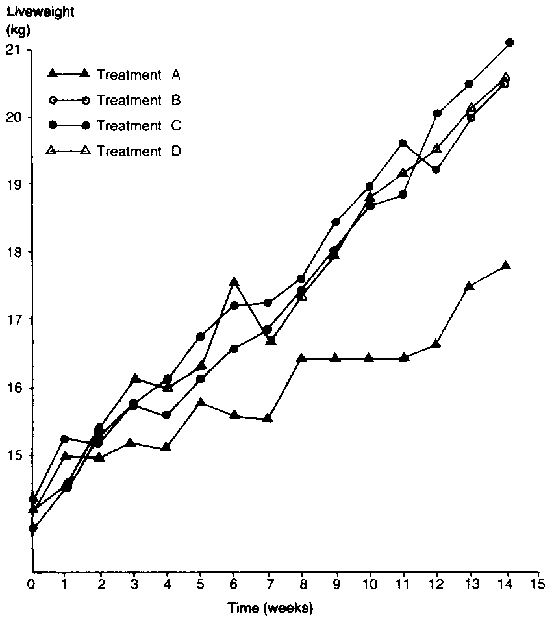
Mean weekly liveweight changes as influenced by treatment are shown in Figure 1. Animals without lablab meal supplement (treatment A) were inferior in growth rate throughout the period of study. However, treatment differences in growth trends of animals with lablab supplements (treatments B. C, and D) were not apparent. Table 2 shows that animals on treatment A had significantly (P<0.05) slower growth rate than animals on treatment B. C, and D. However, the difference in food conversion ratio among animals offered different levels of lablab supplement were small and insignificant (Table 2), but animals that received 25% lablab did not gain as fast as those fed which had higher levels of lablab (P<0.05).
Figure 1. Mean weekly liveweight as influenced by level of lablab supplementation.
The level of inclusion of lablab in the ration had no significant effect on killing-out characteristics (Table 3). Dressing percentage showed no defined pattern. Animals on treatments A and B had significantly higher proportion of kidney fat than animals on treatment D. The weights of lean, fat and bone as percentages of carcass weight and tissue ratios were also not affected by treatment.
Table 3. Effect of levels of lablab meal in supplements on slaughter.
|
Characteristics and carcass composition |
SED and significance |
|||||
|
|
Treatments |
|||||
|
A |
B |
C |
D |
|||
|
Carcass weight |
|
|
|
|
|
|
|
|
% SW |
41.3 |
41.0 |
40.3 |
42.5 |
0.83 NS |
|
|
% EBW |
52.5 |
52.0 |
52.3 |
53.5 |
1.11 NS |
|
Components (% EBW) |
|
|
|
|
|
|
|
|
Gut fat |
2.7 |
2.3 |
1.7 |
1.3 |
0.38 NS |
|
|
Head |
85 |
8.0 |
8.0 |
7.4 |
0.29 NS |
|
|
Skin |
9.6 |
9.5 |
10.2 |
9.0 |
0.40 NS |
|
Alimentary tract |
8.4 |
8.6 |
7.8 |
7.9 |
0.31 NS |
|
|
|
Liver |
1.7 |
1.8 |
1.8 |
1.7 |
0.09 NS |
|
Kidney and pelvic fat |
1.4a |
1 49a |
0.9b |
0.7b |
0.14* |
|
|
|
Heart |
0.8 |
0.8 |
0.8 |
0.7 |
0.334 NS |
|
Tissue in carcass (%) |
|
|
|
|
|
|
|
|
Lean |
60.9 |
61.3 |
61.1 |
63.0 |
1.19 NS |
|
|
Fat |
19.1 |
20.2 |
18.4 |
17.5 |
0.86 NS |
|
|
Bone |
17.9 |
16.7 |
17.9 |
16.7 |
0.47 |
|
Tissue ratios in carcass |
|
|
|
|
|
|
|
|
Lean:fat |
3.2 |
3.1 |
3.3 |
3.6 |
0.20 NS |
|
|
Lean:bone |
3.4 |
3.7 |
3.4 |
3.8 |
0.14 NS |
|
|
Lean + fat:bone |
4.1 |
3.9 |
4.3 |
4.5 |
0.23 NS |
SW = slaughter weight; EBW = empty body weight;
NS = not significant; SED = ?????
No correction was made for losses during dissection which ranged from 1.8 to 2.7%.
Crude protein content of 59 g/kg DM of Chloris gayana hay used in this study is lower than that of 86 g/kg DM reported by Mtenga and Nyaky (1985) and of 143 in/kg DM reported by Mtenga and Shoo (1990) but higher than the value of 44 to 54 g/kg DM found by Mtenga and Massae (1988) from hay harvested in the same University farm. This variability is mainly associated with season of cutting and stage of growth at the time of harvest. The protein content of lablab bean meal of 254 9 CP/kg DM found in the present study compares well with values reported elsewhere. Gohl (1981) found values of 242 and 280 9 CP/kg DM for seeds from Uganda and Zimbabwe, respectively, while Santos (1976) reported a value of 270 g/kg DM for seeds from Mozambique.
Protein supplementation may affect DM intake through its effect on digestion in the rumen (Adeneye and Oyenuga, 1976; Egan, 1977) and this may be the case in the present study. In our earlier studies on protein supplementation, voluntary intake of dry matter was reduced by protein supplementation containing high energy in diets and this was due to the animals receiving sufficient energy from the supplement to satisfy its requirements. Thus total DMI and hay intake will depend on the hay quality, amount of concentrate offered and the energy:protein ratio of the supplements.
Response to nitrogen supplementation on growth rate has been reported by several workers. A crude-protein content of 11% in DM is considered ideal for normal liveweight gains in sheep and goats (Kay et al, 1968; Kay and MacDearmid, 1973). A similar trend in growth rate (34.14,65.65,68.01 and 70.5 g/day for treatments A, B. C and D, respectively) was also observed in the present study as the protein content of the diet consumed increased in the order of 11.36%, 13.22%, 15% and 16.73% CP, DM. The growth rate observed in lambs on a low level of protein intake in this study (treatment A) was lower than that 50.0 g/day reported by Mtenga and Nyaky (1985) for similar sheep under grazing conditions. Similarly Mtenga and Nyaky (1985) reported higher values of growth rate ranging from 73.4 to 94.6 g/day in BHP sheep under grazing conditions. The higher growth rates in these studies were perhaps due to ability of the lambs under grazing condition to select the more nutritious parts of browse during grazing. The findings are, however, in agreement with that 25.19 g/day reported by Shoo (1986) and that 33.9 g/day reported by Mtenga and Massae (1988) in BHP lambs under confinement which was the case in this study. Growth rate for lambs under high levels of protein intake (16.73% CP) were also lower than that of the 98.5 g/day reported by Mtenga and Massae (1988) and that of 120.27 g/day reported by Mtenga and Nyaky (1985) for similar type of sheep under grazing plus concentrate supplementation.
The tendency for lower growth rate at each level of protein supplementation observed in the present study could partly be due to the low intake of energy (Batch, 1976). The level of energy supplied to sheep has been considered to be of importance as the level of protein intake increases (ARC, 1980). In the present study increasing the level of lablab meal in the diet increased the protein: energy ratio, whose values were 26.59, 29.08, 36.84 and 43.44 g/DP/Mcal DE for treatments A, B. C and D, respectively. The importance of the protein: calorie ratio of diets has been reported by Preston et al (1965) who found that daily intake of 22 9 pop per Mcal of DE resulted in the maximum body gain of 251 g/day with wether lambs. Similarly, Adeneye and Oyenuga, (1976) recorded best performance (302 g/day) for sheep with high energy intake (7.68 MJ ME/day) and medium but adequate protein (82.8 g/CP/day). In another experiment where energy was held constant and protein level was varied, highest daily gain (176 g/day) was attained by sheep on a crude-protein intake of 147.7 g/day and digestible energy intake of 9.9 MJ/day (Adeneye and Oyenuga, 1976). The lowest and highest protein intakes (100.4 9 and 151.4 9 CP/day) produced the lowest daily gains (24 9 and 54 g/day, respectively).
The dressing percentages of 41.3 to 42.5% on liveweight basis observed in this study compare well with the result (40-50%) reported by Devendra and McLeroy (1982). Increasing level of protein in the diet had little and insignificant influence on dressing percentage. These results are in agreement with the results reported by Kemp et al (1976) with lambs given diets varying in protein level from 10 to 16% CP. The findings are, however, at variance with those of Robinson and Forbes (1970) and Levy et al (1980) who observed an increase in the dressing percentage with increasing level of dietary protein in the supplement concentrate. Dressing percentage of 52.5% based on EBW observed in the present study compares well with the value of 52% reported by Owen and Norman (1977) for indigenous Botswana sheep. The importance of dressing percentage in the tropics, however, remains to be questionable since practically all of the by- products are consumed as food. Other components of the body even sell at higher prices than carcass meat (Mtenga, 1979; Devendra and McLeroy, 1982).
The small and insignificant effect of protein level on the proportion of non-carcass components observed in this study is in agreement with past findings at Sokoine University. This was expected because these organs are early-maturing (Palsoon and Verges, 1952; Mtenga, 1979). Gut fat, however, showed a tendency to decrease from 2.7% at low-protein level in treatment A to 1.3% at high-protein level in treatment D. Similar trend has been reported elsewhere by Mtenga (1979).
The overall mean percentage carcass composition data obtained in the present study are in line with few published data on sheep in Tanzania (Mtenga and Nyaky, 1985). French (1938), however, reported relatively lower values for lean and bone tissues and higher values for fat tissues for Black Head Persian lambs in Tanzania ranging from 49.9-57.5% and 8.9 11.1%, respectively, but the composition (as percentage lean, bone and fat) observed in the present study is in agreement with the findings reported elsewhere (Owen, 1976). Contradictory results were, however, reported by other workers (Andrew and Orskov, 1970; Fattet et al, 1984; Vipond et al, 1989). In their studies they reported increase in percentage carcass nitrogen and decrease in ether extract in lambs as the level of dietary protein increased. Factors such as age and weight at slaughter, sex and breed singly or in combination may cause disparity of results between workers.
The profit margin per animal for raising animals under treatment B diet was greater (30 TSh per animal) than that of control treatment (maize bran plus hay). The lowest margin of profit was, however, obtained for animals on treatment D (Table 4). At higher levels of energy intake, high level of lablab inclusion may be more profitable. The difference in marginal profit between animals given maize bran alone (treatment A) and those supplemented with lablab bean meal is too small to justify the practice of rearing lambs on lablab bean meal supplementation. The marginal profit, however, may vary from one place to another depending on the price of lablab bean.
Table 4. Effect of level of lablab supplementation on economic returns from sheep.
|
Input data: |
Treatments |
+ |
||
|
A |
B |
C |
D |
|
|
Total concentrate consumed (kg/animal) |
30.15 |
31.68 |
33.26 |
33.44 |
|
Cost of concentrate (TSh/kg)¹ |
10.00 |
12.80 |
15.55 |
18.30 |
|
Total cost of concentrate (TSh/animal) |
301.50 |
405.50 |
517.20 |
614.15 |
|
Marginal cost |
- |
104.50 |
215.7 |
312.65 |
|
Output data: |
|
|
|
|
|
Carcass weight (kg) |
8.03 |
8.80 |
9.23 |
9.68 |
|
Non-carcass component (kg) |
1.92 |
2.23 |
2.28 |
2.16 |
|
Revenues from sales of carcass |
1204.50 |
1320.00 |
1384.50 |
1452.00 |
|
Revenues from sales of edible non-carcass³ |
115.20 |
13380 |
136.80 |
129.60 |
|
Total revenues (TSh/animal) |
1319.70 |
1453.80 |
1521.30 |
1581.60 |
|
Margin profit (TSh/animal) |
1018.21 |
1048.30 |
1004.10 |
967.45 |
|
Marginal returns |
- |
30.09 |
-14.11 |
-50.76 |
1 Price of lablab seed meal was 21.10 TSh/kg while price of maize bran was 10.00
TSh/kg.
2. Price of 1 kg of meat was 150 TSh.
3. Price of 1 kg of edible non-carcass was 60 TSh.
TSh = Tanzanian shilling.
Adeneye J A and Oyenuga V A. 1976. Energy and protein requirements of West African Dwarf sheep. 2. Increasing the levels of dietary protein to sheep. East African Agricultural and Forestry Journal 42:98-106.
Andrew R P and Orskov E R. 1970. The influence of protein concentration and feeding levels on rate of gain in body weight. Journal of Agricultural Science (Cambridge) 75:11-26.
AOAC (Association of Official Analytical Chemists). 1975. Official methods of analysis. 12th edition. AOAC, Washington DC, USA.
ARC (Agricultural Research Council). 1980. The nutrient requirements of ruminant livestock. Commonwealth Agricultural Bureaux, Slough, UK. 351 pp.
Balch C C. 1977. Ruminant digestion and nutritive value: In: Fonnesbeck P V, Harris L E and Kearl L C (eds), Proceedings of the First International Symposium on Feed Composition, Animal Nutrient Requirements and Computerization of Diets. International symposium held in Logan, Utah, 11-16 July 1976. International Feedstuffs Institute, Logan, Utah, USA. pp. 214-218.
Cuthbertson A, Harrington G and Smith R J. 1972. Tissue separation to assess beef and lamb variation. Proceedings of the British Society of Animal Production 1:113-122.
Devendra C and McLeroy G B. 1982. Goat and sheep production in the tropics. Intermediate Tropical Agricultural Series. Longman Group Ltd. Harlow, Essex, UK. 271 pp.
Egan A R. 1977. Nutritional status and intake regulation in sheep. Australian Journal of Agricultural Research 28:907- 915.
Fattet I, Hovell F D, Orskov E R. Kyle D J. Pennie K and Smart R I. 1984. The effect of supplementation with protein on protein accretion. British Journal of Nutrition 52:561 -574.
French M H. 1938. Development of livestock in Tanganyika territory. Tanganyika breeds of sheep and mutton qualities of long tailed type and its crosses with Black Head Persian sheep. Empire Journal of Experimental Agriculture 12:112- 124.
Gohl B. 1981. Tropical feeds - feed information summaries and nutritive values. FAO Animal Production and Health Series 12. FAO (Food and Agricultural Organization of the United Nations), Rome, Italy. 529 pp.
Kay M, Bowers H B and McKiddie G. 1968. The protein requirements of rapidly growing steers. Animal Production 10:37 42.
Kay M and MacDear mid E. 1973. A note on the effects of changing the concentration of protein in the diet offered to fattening beef cattle. Animal Production 16:205-207.
Kemp D J. Johnson A E, Stewart D F. Ely D G and Fox J D. 1976. Effect of dietary protein slaughter weight and sex on carcass composition, orgonoleptic properties and cooking losses of lambs. Journal of Chemical Science 42:575-583.
Levy D, Holzer Z. Folman Y and Bleiberg M. 1980. Protein requirements of male cattle fattened on diets differing in energy concentration. Animal Production 30: 189-197.
Luck P E. 1965. Dolichos lablab available grazing crop. Queensland Agricultural Journal 91 :308309.
Mtenga L A. 1979. Meat production from Saanen goats: Growth and development. PhD thesis, University of Reading, Reading, UK.
Mtenga L A and Kitaly A J. 1990. Growth performance and carcass characteristics of Tanzania goats fed Chloris gayana hay with different levels of protein supplement. Small Ruminant Research 3:1 8.
Mtenga L A and Massae E E. 1988. Effect of underfeeding, refeeding on growth performance and carcass composition of lambs in Tanzania. Proceedings of Tanzania Veterinary Association Scientific Conference 7: 112-128.
Mtenga L A and Nyaky FP. 1985. Effect of supplementation on performance of Black Head Persian and Red Masai lambs. Buletin of Animal Health and Production in Africa 33(1):43- 49.
Mtenga L A and Shoo R. 1990. Growth rate, feed intake and feed utilization of Small East African goats supplemented with Leucaena leucocephala. Small Ruminant Research 3:9-18.
Owen J B. 1976. Sheep production. Bailliere Trindall, London, UK. 436 pp.
Owen J E and Norman G A. 1977. Studies on the meat production characteristics of Botswana goats and sheep. Meat Science 1:283-306.
Palsoon A and Verges J B. 1952. The effects of high and low nutrition at different ages. Journal of Agricultural Science (Cambridge) 42: 1-149.
Preston T R. 1965. Protein requirements of growing-finishing cattle and lambs. Journal of Nutrition 90:157-160.
Robinson J J and Forbes T J. 1970. Astudy of protein utilisation by weaned lambs. Animal Production 12:95-105.
Santos J O. 1976. Grain legumes in Mozambique. Tropical Grain Legume Bulletin 3:13-15.
Shoo R A 1986. A comparative study of roughage utilisation and growth performance between sheep and goats supplemented with different levels of Leucaena leucocephala. MSc thesis, Sokoine University of Agriculture, Morogoro, Tanzania.
Steel R G D and Torrie J H. 1980. Principles and procedures of statistics - a biometrical approach. Second edition. McGraw-Hill Book Company, New York, USA. 633 pp.
Vipond J E, Margaret E K, Orskov E R and Wetherill G Z. 1989. Effect of fishmeal supplementation on performance over fat lambs fed on barley straw to reduce carcass fatness Animal Production 48:131-138.
