Abstract
Résumé
Introduction
Materials and methods
Measurements
Results and discussion
Commercial implications
Acknowledgement
References
O. Matika, R. Sibanda and M.L.Beffa
Matopos Research Station
P O Box 5137, Bulawayo, Zimbabwe
Ages at eruption of permanent incisor teeth of 292 goats and 392 sheep of known dates of birth, born in October and November 1984, 1985 and 1986, were established. The animals were mouthed at 14-day intervals between October 1985 and September 1989 at approximately one year of age to full mouth for females. Data for males were for the eruption of the first pair of permanent incisors only since most males were slaughtered at 18 months.
Average age of eruption of permanent incisors in goats was at 14.1, 19.4, 23.0 and 30.6 months for the first, second, third and fourth pairs, respectively. Sheep, except for the first pair of incisors, erupted their respective permanent incisors at slightly older ages: 13.9, 20.2, 26.6 and 32.7 months for the first to the fourth pair.
En l'absence de relevés précis, l'âge des bovins et des ovins est généralement déterminé grâce à l'examen de la dentition. La date de naissance des animaux est rarement connue en élevage traditionnel; une connaissance appropriée de la dentition peut permettre de mettre au point un système de classement des carcasses qui permettrait à l'éleveur de vendre ses animaux pendant que ceux-ci sont encore en condition optimum.
L'âge des animaux au moment de l'éruption des incisives permanentes a été déterminé pour 292 caprins et 392 ovins de dates de naissance connues. Leur dentition fut examinée tous les 14 jours entre octobre 1985 et septembre 1989, à partir de l'âge de 1 an. L'observation fut poursuivie jusqu'à la dentition complète pour les femelles, et à l'apparition de la première paire d'incisives permanentes seulement pour les mâles, dans la mesure où la plupart d'entre eux furent abattus à l'âge de 18 mois. L'âge moyen à l'apparition de la première, de la deuxième, de la troisième et de la quatrième paires d'incisives permanentes fut de 14,1, 19,4, 23,0 et 30,6 mois chez les caprins. Chez les ovins, exception faite de la première paire, les autres paires d'incisives apparaissaient à un âge légèrement plus avancé: de 13,9, 20,2, 26,6 et 32,7 de la première à la quatrième paire d'incisives permanentes.
Where records are absent, the ages of cattle and sheep are commonly estimated by examining their teeth. However, there are very few published reports on permanent incisor eruption in small ruminants, especially on goats (Wilson and Durkin, 1984). Since date of birth is rarely known in traditional management systems, estimating age by means of dentition offers an opportunity method for establishing population structure. Furthermore, carcass-grading systems for sheep in Zimbabwe entail classification into categories by age, as well as fleshing and fat cover, while that of goats only takes fleshing into consideration. It is suggested that inclusion of age in the grading and pricing of goat carcasses could encourage farmers to sell their stock when in prime condition. Therefore, knowledge of dentition in relation to age in goats would be a useful management tool. This study was designed to examine the relation between age and dentition among indigenous goats and sheep. Influence of year and type of birth, sex and species differences were investigated.
Ages at eruption of permanent incisor teeth of 292 goats and 392 sheep of known dates of birth were determined. The animals were born in October and November in 1984, 1985 and 1986. Indigenous sheep (Sabi) and the large Matebele goat (Sibanda, 1990) were used. These animals were grazed on semi-arid thorn veld (Ward et al, 1979) for 8 hours a day and were penned at night. Dipping was carried out weekly in the wet season (November to April) and once every two weeks during the dry season. Vaccination against pulpy kidney and strategic deworming were practiced.
A tooth was considered to have erupted when it had broken through the gum and the age at which animals attained a particular pair of permanent incisors was defined as the number of days from birth to the time when both incisors making up a pair had cut the gum. Animals were mouthed at 14-day intervals between October 1985 and September 1989, starting when they were approximately a year old with milk teeth still present (except in 1986 when sheep data on age of first eruption were discarded) continuing to full mouth in females. Data from males were available for the eruption of the first pair of permanent incisors only because males were slaughtered at 18 months of age.
Data analysis
Data were analysed by analysis of variance using a General Linear Model (SAS, 1987). Within each species the effects of year and type of birth, sex, birthweight, daily weight gain and weight at eruption of permanent incisors on age at teeth eruption were examined. Correlations between age at eruption of first pair and those of subsequent pairs of permanent incisors were determined, in addition to examining the correlations between ages and weights at eruption. A comparison between species was also made.
Age at eruption of permanent incisors was indicated by a 95% range (mean plus or minus two standard deviations).
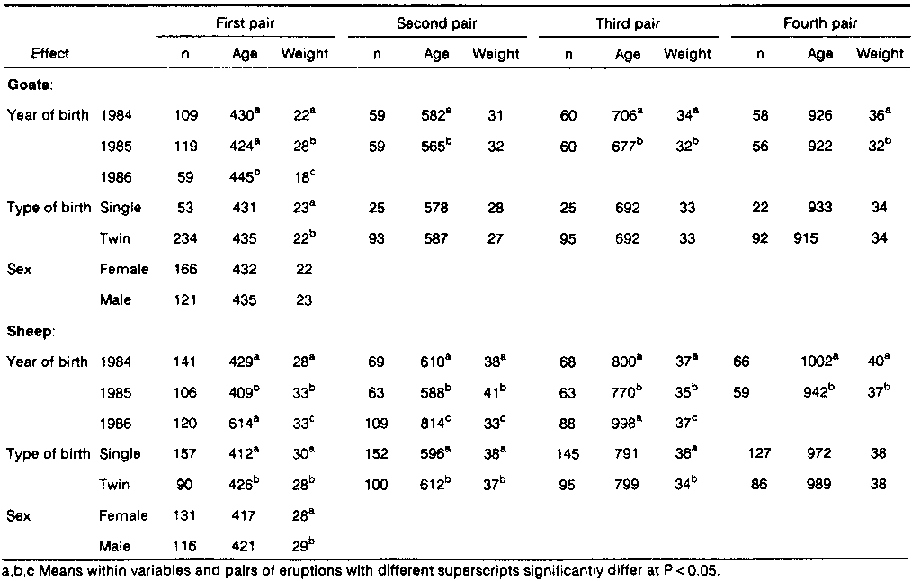
The mean ages for permanent incisor eruption for goats (Table 1) were similar to those reported by Wilson and Durkin (1984) and Otesile and Obasaju (1982). However, the second to the fourth eruptions tended to occur relatively earlier than those reported by Wilson and Durkin (1984). Age at first permanent incisor eruption was correlated (P<0.01) to age at subsequent eruptions.
The effects of sex and type of birth were not significant in goats, though the effect of year of birth was marked (P <0.01). Eruption of first and second pairs occurred later in twins which were also lighter in bodyweight than singles. Although weight tended to exert an influence on age of eruption, there were no significant correlations. Daily weight gain between birth and age at first eruption was correlated to age at eruption of first, second and third pairs of permanent incisors (P<0.01). The effects of year of birth could have been manifested through daily weight gain as influenced by nutrition.
Ages at which the first to fourth pairs of permanent incisors erupted in sheep (Table 1) are similar to those reported by Starke and Pretorius (1955). The variables affecting age at eruption were year of birth and to a lesser extent type of birth.
Daily weight gain from birth and age at first eruption was correlated (P<0.01). Gain between successive eruptions were also correlated (P<0.01) with their respective ages at eruption. This, as in goats, may have been a reflection of nutrition from birth to first eruption. Since only breeding females were available from second to fourth eruption, the effects of year of birth on weight and weight change were confounded by physiological status of animals which was not taken into account in the present analysis.
Sheep and goats differed (P<0.01) in age of eruption of their second to fourth pairs of permanent incisors, the magnitude of the difference increasing between each pair (Table 2). The mean interval between first and second, second and third and third and fourth was 151, 1 14 and 227 days for goats and 184, 192 and 183 days, respectively, for sheep. Overall, goats attained full mouth at a significantly (P<0.01) younger age than sheep (Table 2). Goats were lighter (P<0.01) than sheep by 6, 8, 3 and 4 kg for first to fourth eruptions, respectively. Daily weight gain from birth to first eruption differed (P<0.01) between species with sheep gaining 14 9 per day more than goats.
Table 2. Mean age and 95% range (days) at eruption of permanent incisors for goats and sheep.
|
Definition |
Species |
n |
Age |
Least squares contrast (goat minus sheep) |
Range |
|
First pair |
Goats |
287 |
423 |
|
377-487 |
|
|
|
|
7 |
|
|
|
Sheep |
247 |
418 |
|
367-469 |
|
|
Second pair |
Goats |
145 |
581 |
|
509-653 |
|
|
|
|
- 24** |
|
|
|
Sheep |
252 |
605 |
|
525-685 |
|
|
Third pair
|
Goats |
120 |
691 |
|
597-786 |
|
|
|
|
-96** |
|
|
|
Sheep |
240 |
798 |
|
700-896 |
|
|
Goats |
114 |
918 |
|
773-1064 |
|
|
Fourth pair |
|
|
|
-55** |
|
|
Sheep |
213 |
982 |
|
823-1141 |
** Significant at P<0.01.
Though other studies have found no direct correlation between normal skeletal development and incisor development (Tagle and Helman, 1943), age determination facilitates market transactions and identification of carcasses of possible superior eating quality-. A goat grading system, taking age classification of carcasses (which are different from sheep) into account is proposed. The large variation in ages at eruption of incisor teeth recorded here resulted in some overlapping of the distributions for successive pairs (Table 2). This limitation should be considered when using dentition to determine age.
We would like to thank all members of staff of the Small Stock Section for care of the animals and data collection. We also thank Dr. T. Smith for helpful discussions.
Otesile E B and Obasaju M F. 1982. Relationship between age and rostral teeth development in Nigerian goats. In: Proceedings of the Third International Conference on Goat Production and Disease, University of Arizona, Tucson, Arizona, USA, 10-15 January 1982. Dairy Goat Publishing Company, Scottsdale, Arizona, USA. p. 349.
SAS (Statistical Analysis System) Institute. 1987. SAS/STAT guide e for personal computers. 6th edition. SAS Institute Inc., Cary, North Carolina, USA.
Sibanda R. 1990. Productivity of indigenous goats under an accelerated kidding management system. MPhil thesis, University of Zimbabwe, Zimbabwe
Starke J S and Pretorius A G. 1955. Definition of sheep as an indication of age. Farming, South Africa 30:53-56.
Tagle E L and Helman M B. 1943. Condideraciones sobre la edad del ovino. Animal Breeding Abstracts 15:34.
Ward H K, Richardson F D, Denny R P and Dye P J. 1979. Matopos Research Station: A perspective. Rhodesia Agricultural Journal 76:1-18.
Wilson R T and Durkin J W. 1984. Age at permanent incisor eruption in indigenous goats and sheep in semi-arid Africa. Livestock Production Science 11:451-455.