


To estimate the age effect on mortality rates from a minimum of field data, a procedure is used similar to that used to estimate age effect on fertility. Average natural mortality rate  at age t can he represented by a functional form:
... (E.1)
where: t = age (years),
Mortality tends to be lowest for animals in the middle age group, as shown in Figure E.1. This function can be approximated by two curvilinear segments (AB) and (CD) tangent to a horizontal line (BC).
Figure E.1 Average annual mortality rate (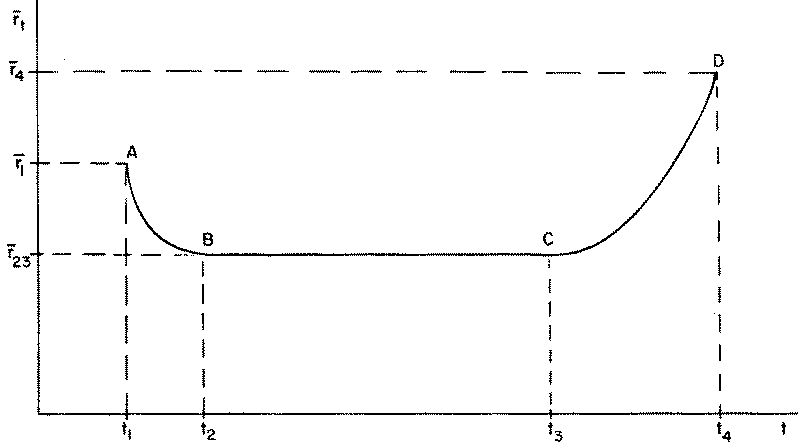 ) as a function of age in years (t)
The minimum data necessary to estimate segments (AB) and (CD) of the mortality curve are the average annual mortality rate ( ) of animals at a young age (t1), the minimum annual mortality rate (
 ) of animals between ages t2 and t3, and the average annual mortality rate (
 ) of animals at an old age (t4). Assuming that quadratic functions can be used to represent segments (AB) and (CD), the estimated functional forms are given by relationships (D.2), (D.3) and (D.4) of Appendix D.
Consider for example a production system in which 2-year-old animals have an 8% annual mortality rate (t1 = 2 and  ), 4- to 9-year-old animals have a 5% annual mortality rate (t2 = 4, t3 = 9 and
  ), and 13-year-old animals have a 10% annual mortality rate (t4 = 13 and r4 = 0.10). Substituting these values into formulae (D.2), (D.3) and (D.4) yields:
for 2 £ t £ 4
for 4< t £ 9
for 9 < t £ 13.
