Introduction
Age at first calving
Conception rate by month
Calving interval
Length of cow productive life
Reproductive performance is the trait of outstanding importance in beef cattle enterprises, where if there is no calf, then there is no economic return. The best cows are clearly those that have their first calf at an early age, have minimum calving intervals, and live a long time. Thus the most important measures of reproductive performance in the female are age at first calving, length of calving interval, and length of cow productive life.
The mean age at first calving for 101 females born on the station from 1973 to 1978 was 39.8 ± 0.8 months with a coefficient of variation of 14.1%.
The significance of environmental influences on age at first calving are indicated in Table 29, where year of birth had a major effect.
Table 29. Analysis of variance of age at first calving
|
Source |
d.f. |
Mean squares |
|
Year of birth |
5 |
356804** |
|
Month of birth |
11 |
12045 |
|
Remainder |
84 |
28987 |
** = P< 0.01.
The estimated least squares means in Table 30 show that age at first calving ranged from 47.76 months for animals born in 1974 to 33.19 months for those born in 1978.
Table 30. Estimated least squares means for age at first calving (months)
|
Variable |
Number |
Age at first calving |
|
Overall mean |
101 |
39.78 |
|
Year of birth | ||
|
1973 |
5 |
40.42 |
|
1974 |
25 |
47.76 |
|
1975 |
11 |
40.30 |
|
1976 |
16 |
41.73 |
|
1977 |
16 |
35.31 |
|
1978 |
28 |
33.19 |
|
Month of birth | ||
|
January |
2 |
41.26 |
|
February |
4 |
40.99 |
|
March |
6 |
42.53 |
|
April |
11 |
39.01 |
|
May |
17 |
39.83 |
|
June |
10 |
38.55 |
|
July |
10 |
40.22 |
|
August |
12 |
41.42 |
|
September |
6 |
37.37 |
|
October |
9 |
38.68 |
|
November |
10 |
39.60 |
|
December |
4 |
37.95 |
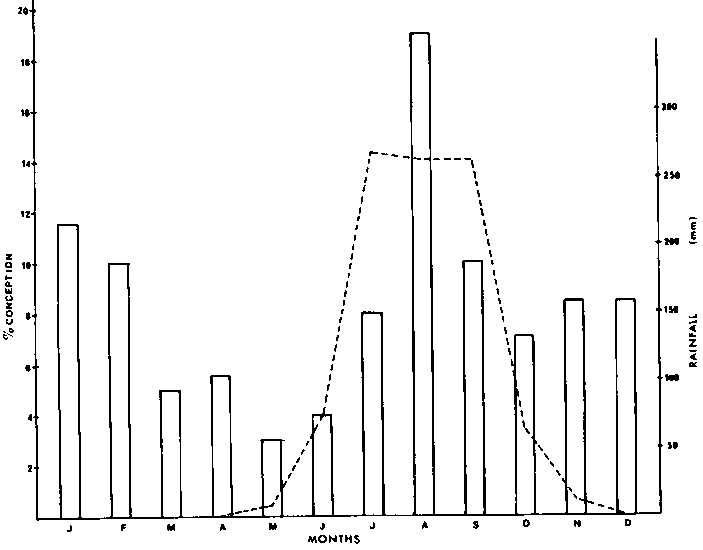
The distribution of 357 conceptions calculated from the recorded calving dates from 1974 to 1979 are indicated in Figure 6. The mean monthly rainfall over the 6 years is also shown.
48% of conceptions, or 9.6% per month, occurred during the major five month wet season from June to October, the remaining 52% or 7.4% per month during the other 7 months of the year.
Figure 6. Effect of month on conception rate.
The mean calving interval for 357 records from 1974 to 1979 was 495 ± 16 days, with a coefficient of variation of 26%. The significance of environmental and genetic influences on calving interval are indicated in Table 31.
Table 31. Analysis of variance of calving interval
|
Source |
d.f. |
Mean squares ×10- 2 |
|
Origin |
1 |
1820** |
|
Year of calving |
5 |
1732** |
|
Month of calving |
11 |
331 |
|
Parturition number |
3 |
938** |
|
Remainder |
336 |
189 |
** = P< 0.01
The effects of origin of cow, year of calving and the parturition number were significant. The estimated least squares means for calving interval are laid out in Table 32.
Table 32. Estimated least squares means for calving interval (days)
|
Variable |
Number |
Calving interval |
|
Overall mean |
357 |
495.0 |
|
Origin | ||
|
Foundation |
286 |
539.7 |
|
Born on centre |
72 |
450.2 |
|
Year of calving | ||
|
1974 |
67 |
451.1 |
|
1975 |
36 |
538.8 |
|
1976 |
52 |
582.8 |
|
1977 |
44 |
419.2 |
|
1978 |
83 |
513.5 |
|
1979 |
75 |
464.5 |
|
Month of calving | ||
|
January |
20 |
518.7 |
|
February |
11 |
502.1 |
|
March |
14 |
465.4 |
|
April |
28 |
510.0 |
|
May |
68 |
462.5 |
|
June |
36 |
489.1 |
|
July |
26 |
552.0 |
|
August |
30 |
555.5 |
|
September |
30 |
487.7 |
|
October |
41 |
458.5 |
|
November |
35 |
482.3 |
|
December |
18 |
455.8 |
|
Parturition number | ||
|
1 |
135 |
547.1 |
|
2 |
97 |
525.1 |
|
3 |
67 |
449.4 |
|
4+ |
58 |
458.3 |
Year of calving had a significant effect on calving interval. Cows calving in 1974, 1977 and 1979 had a shorter-than-average calving interval, those calving in 1975, 1976 and 1978 had a longer-than-average. There was a positive correlation of 0.56 between calving interval and annual rainfall, with calving interval increasing by 0.2 days for each 1 mm increase in annual rainfall.
Parturition number had an important effect on calving interval. Calving interval decreased from 547 days between the first and second parturitions to 449 between the third and fourth and then increased slightly to 458 days for subsequent parturitions.
Overall, foundation purchased heifers had a significantly longer calving interval (540 days) than those born on the centre (450 days).
As the oldest records refer to heifers purchased in 1972-73, it is too early to completely assess this trait. However in August 1981, the first 40 heifers purchased had averaged 4.3 parturitions, with 23 or 57% still in production. The remaining 17 or 43% had died or been culled. Thus until more information is available it is tentatively suggested that an average of 5.5 parturitions would be achieved per cow. Using the mean calving interval of 495 days, cows would thus remain for an average of 7.5 years in productive life. This complete replacement of the cow herd each 7.5 years would represent a turnover of 13.4%. When age at first calving is added to the productive life, the average cow age on completion of productive life would be 10.8 years.