Introduction
Cattle breeding
Data preparation
Data analyses
Management of smallholder dairy farms
Results and discussion of analyses
The data used in the analyses were collected from smallholder operations in the Southern Region of Malawi. The region consists of six agricultural development areas, namely Blantyre North, Blantyre South, Mulanje West, Thyolo North, Chiradzulu and Zomba.
The amount of rainfall received differs greatly among the six areas. Blantyre North and Mulanje West are relatively dry compared with the other areas, and maize is the most important crop in these two areas. In the drier parts of the region, the maize crop is usually sufficient to last the farmer and his family for 3-4 months. Cattle sales supplement farm income.
Dairying has become a popular enterprise, as it provides a source of regular income. In order to receive crossbred dairy cattle under the dairy development scheme, the farmer must provide 0.8 ha of pasture for each two cows. The farmer must also attend a 2-week course in dairy management and construction of a dairy parlour and housing facilities for the cows and calves.
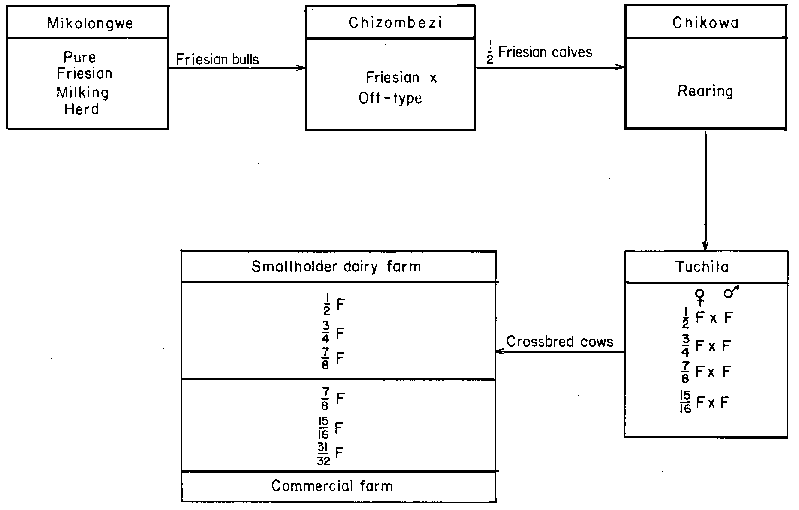
The development of crossbred heifers (1/2 Friesian) in the Southern Region of Malawi is based on exotic Friesian bulls and 'off-type' cows, which are a composite of Sussex, Brahman-type and Africander-cross cattle. Figure 2 shows the movement of crossbred cattle from the point of origin at Chizombezi to the smallholder's farm.
In Chizombezi, where the 1/2-Friesian calves are produced, three lines of cattle are kept:
1. Single and multiple sire Sussex;
2. Single and multiple sire Brahman-type; and
3. 'Off-type' Sussex-Brahman-type-Africander-crosses.
The 'off-type' cross animals originate from an intermixing of surplus cows from the pure lines (Sussex and Brahman-type) and Africander crosses. The composition of 'off-type' cattle at Chizombezi is, therefore, not exactly known. The 'off-type' female cattle are mated to Friesian bulls supplied from Mikolongwe to produce the 1/2 Friesian calves at Chizombezi. The 1/2-Friesian calves are sent to nearby Chikowa at 6 months of age, where female calves and castrated males are reared. Female yearlings are sent to Tuchila where they are inseminated with imported Friesian semen. Calving takes place at Tuchila. Cows are sold to smallholder dairy farmers 3 to 4 weeks after calving. The 3/4-Friesian calves are reared at Tuchila. Male calves are castrated when 6 weeks old. Heifers are inseminated at 21/2 years of age to produce 7/8 Friesian calves, after which the 3/4-Friesian cows are sold to smallholders. Similarly, some 7/8-Friesian cows are sold to smallholders after producing 15/16-Friesian calves. The 15/16, 31/32 and higher-grade Friesians are retained at Tuchila for milking or sold to commercial dairy farmers.
Problems encountered and bases for exclusions
Cow performance traits
Some management practices at Chizombezi, Chikowa and Tuchila and on smallholder farms lead to difficulty in identification of the cows and their sires, both of which are vital to genetic analysis of production records. Some of these management practices are described below.
· Records were not kept on which breeds went into the formation of the 'off-type' line. As a result the exact composition of the 'off-type' females used in producing 1/2-Friesian crosses was not known.· Because several Friesian bulls were put in with a herd of 'off-type' females (multiple breeding), the sires of the 1/2-Friesian crosses were not known.
· New identification or tag numbers were assigned to animals that lost their original identification or tag numbers while in transit in Chikowa and Tuchila and when on smallholder farms. In most cases no reference was made to the original identification and the animals received entirely different identification numbers. As a result, where information on a cow was missing at the smallholder level, the cow could not be traced to any of the transit stations.
· Accurate and easily verifiable production information was not kept for all crossbred cows that were milked while in transit at Tuchila. Thus some smallholders did not know the calving date of the cow, the breed of the cow, its parity or its partial production while at Tuchila.
· Extension specialists who visited smallholders did not record production each month but waited for several months and tried to record several months' information at one time. This led to inconsistent recording of information, gaps in information, wrong calving dates and failure to record dry-off dates.
Figure 2. Movement of crossbred cattle from government units to small farms in Malawi.
Given these problems, only records that pro vided information that could be used to obtain re productive or productive performance or both were included for analysis. To this end the following actions were taken:
1. The identification or tag number on the 'Life History and Lactation Sheet' was checked against calf registers from Chizombezi and Tuchila. The breed of the cow could be determined from the register, and its date of birth used to confirm the reported parity number. Where the parity number was missing, a 'most likely' parity number was assigned according to the age of the cow.2. Effort was made to determine the partial milk yield of the cow while it was awaiting sale at Tuchila, so as to credit the cow with its full yield.
3. Where most of the relevant information, such as birth date of cow, calving date, parity number, total yield and drying-off date, were available but cow identification was missing, an arbitrary but unique four-number identification was assigned to the cow.
4. Where there was no indication that the cow was dried-off but the cow had been milked for more than 5 months, both the cumulative yield and the last milking date were recorded.
Records were rejected if:
· The breed of the cow was not indicated or found.· The date of birth of the cow, date of calving and parity were all missing.
· Information was available for only one lactation and the birth date of the cow was missing and where only partial lactation yield was available (no drying-off date) covering less than 5 months.
· Information was available for only one lactation with no date of birth and where data on more than 30 days of milk yield while in transit at Tuchila were not found.
A total of 350 records were excluded from the data following this process. The data set used in these analyses therefore represent a subset of all data that were recorded. The authors believe that the final subset of data used in the analyses represents a random sample of the population and that the results from the analyses will not be biased as a result of the editing procedure. All subsequent analyses are subject to the constraints and assumptions listed above.
Individual records were built up for each cow for each parturition and for each trait to enable differential, as opposed to joint, editing of records. Thus for example, cows with no information on number of days open were excluded from the analysis of days open but were included in the analysis of milk production or lactation length. This gave rise to unequal numbers of records for the various traits. Basic information for each cow for a given trait included parturition number, breed, date of birth (when known), current and previous calving dates, lactation milk yield and drying-off date.
The individual traits analysed in this study were age at first calving, calving interval, days open to conception, lactation length, milk yield per day of lactation, length of dry period and annual milk yield.
All characters were analysed by least squares procedures (Harvey 1977) using
fixed effects models. The Harvey's Least Squares program sets up the normal
least squares equations after imposing sigma ( )
restrictions on the parameters such that, within a given effect, the solutions
to the various levels of that effect sum to zero. Typical models used included
fixed effects of breed group, area, year of birth or parturition, parity number
(a proxy for age of cow) and interaction between breed group and area. Due to
the limitations of the Harvey's Least Squares program in terms of the number
of effects or levels of effects that can be fitted at one run, herd effects
were not included in the models used when considering all smallholder records
from all six agricultural areas. In order to study the influence that herds
may have exerted on the various traits, the two areas with the largest number
of records were selected and data analysed with models that included herd effects.
)
restrictions on the parameters such that, within a given effect, the solutions
to the various levels of that effect sum to zero. Typical models used included
fixed effects of breed group, area, year of birth or parturition, parity number
(a proxy for age of cow) and interaction between breed group and area. Due to
the limitations of the Harvey's Least Squares program in terms of the number
of effects or levels of effects that can be fitted at one run, herd effects
were not included in the models used when considering all smallholder records
from all six agricultural areas. In order to study the influence that herds
may have exerted on the various traits, the two areas with the largest number
of records were selected and data analysed with models that included herd effects.
The residual mean square was used as the error term to test the significance for each character analysed. Linear contrasts of least squares means were computed to determine the significance of differences between two groups. More comparisons were made than the number of degrees of freedom. Therefore, not all comparisons are independent, and the error rate over the entire set of comparisons may be different from that indicated by the level of probability. Tests of significance associated with linear contrasts, although not independent, can be taken as guides as to whether the observed values could have occurred by chance.
In this report the term 'least squares mean' refers to a linear function of least squares solutions to certain effects in the statistical model used for the analysis. Specifically, the least squares mean for row i (or level i of an effect) is defined as the arithmetic average of the cell means (solutions) for all cells in row i. Since the Harvey's Least Squares program imposes the restriction that the solutions of all levels of a given effect sum to zero, the least squares mean of a level of an effect is the sum of the least squares solution to the overall mean effect and that of the particular level of an effect.
The manner in which the various sums of squares are computed means that the hypothesis being tested in the Analysis of Variance table is that of 'equality among means for levels of an effect, after accounting for all other effects in the model', so that the significance or non-significance of differences among levels of a main effect is independent of other main effects and interactions in the model.
Where a mean square (MS) generated for the Analysis of Variance table is exceptionally large or small, the figure is truncated or magnified and multiplied by the appropriate power of 10 which is indicated in the column under which the mean squares are presented. Thus a mean square of 10 464 may be presented as 1046 in a column headed by MS x 10-1. All other figures appearing under the same column are modified to conform to this pattern. Similarly a mean square of 0,173 may be presented as 173 in a column headed by MS x 103. Thus all figures recorded as mean squares in the various Analysis of Variance tables should be read as 'derived mean squares after the original mean square has been modified by the operation indicated at the top of the column under which the figure appears'.
Unadjusted or raw means and standard deviations for the various traits considered in this study are presented in this report as X ± SD and must be differentiated from the 'overall mean' reported in the tables showing least squares means.
Each farmer established a pure stand of leucaena, and a mixed stand of Napier grass and Silverleaf desmodium (Desmodium uncinatum). In the drier areas Rhodes grass (Chloris gayana) was also planted. A minimum area of 0.8 ha per two-cow unit was required. Cattle were zero-grazed on ad libitum basis. During the dry season hay was fed to cattle in the drier areas while silage was fed in the wetter areas. Liberal amounts of a mixture of maize bran (medeya) and dried leucaena leaves were fed when available. Dry cows received this mixture once every day. All cows were confined to stalls as a means of conserving energy, for easy detection of heat and to avoid contact with local Malawi Zebu bulls.
After parturition calves stayed with their dams for 5 days, after which they were separated. Hand milking started on the fifth day. The calf suckled for 30 minutes twice a day, after the morning and evening milking. Calves were weaned at 12 to 15 weeks old, depending on the physical condition of the calf. Male calves were castrated 3 weeks after weaning and reared for fattening. Cows were sprayed once a week. Deworming was done twice a year, before and after the rains. Each farmer kept daily records on milk yields, breeding and calf birth dates.
Reproductive performance
Productive performance
Dairy productivity
Analyses of productive performance traits in Blantyre North and Thyolo North
Three measures of female reproductive performance, namely age at first calving, calving interval and days open, were analysed with the aim of identifying environmental factors that might have influenced these characters and to obtain unbiased linear estimates of the differences in the relevant environmental factors. Reproduction in dairy cattle contributes to herd replacement and is the precursor of milk production. Reproductive traits are more important to the smallholder dairy farmer who has one or two cows than to the owner of a large herd, since failure to reproduce means a complete loss of income. Also, culling a barren cow is more difficult for a smallholder than for the owner of a large herd.
Age at first calving: The mean age at first calving for 165 heifers (110 half-Friesian and 55 three-quarter-Friesian crosses) was 37.7 ± 6.8 months with a coefficient of variation (CV) of 18%. Birth dates of cows were grouped into four seasons; April-May, June-August, September-October and November-March.
The analysis of variance for age at first calving is shown in Table 3. Only breed group and year of birth of the cows had significant effects (P < 0.05) on age at first calving. The estimated least squares means for age at first calving are given in Table 4
Table 3. Analysis of variance of age at first calving for smallholder herds, 1970-83
|
|
d.f. |
MS x 10-1 |
|
Area |
5 |
2 248 |
|
Breed |
1 |
21553* |
|
Year of birth |
7 |
10 358* |
|
Season of birth |
3 |
10 125 |
|
Breed x season |
3 |
9 606 |
|
Breed x area |
5 |
6 487 |
|
Remainder |
140 |
4 359 |
* P<0.05
Heifers born prior to 1974 calved later than those born after 1974 but the downward trend seems to have changed since 1977. A regression of the estimated least squares means on years (coded 1 to 9) showed that age at first calving has been decreasing by 8 days per year.
The mean age at first calving of 38.4 months obtained in this study is comparable to that of 36 months for F1 crosses between US Friesian and native Indian cattle reported by McDowell and Schermerhorn (1978) but higher than that of 34.2 months reported by Kiwuwa et al (1983) for 1/2 Friesian-1/2 Zebu and 3/4 Friesian-1/4 Zebu crosses in the highlands of Ethiopia.
Table 4. Estimated least squares means for age at first calving for smallholder herds, 1970-83.
|
Variable |
Number |
Age at first calving (months) |
|
Overall |
165 |
38.4 |
|
Area |
||
|
Blantyre South |
19 |
38.1 |
|
Blantyre North |
24 |
40.1 |
|
Chiradzulu |
27 |
36.6 |
|
Thyolo North |
50 |
38.5 |
|
Mulanje West |
22 |
38.2 |
|
Zomba |
23 |
38.8 |
|
Breed group |
||
|
1/2 Friesian |
110 |
36.7a |
|
3/4 Friesian |
55 |
40.1b |
|
Year of birth |
||
|
1970 |
18 |
37.6 a |
|
1971 |
24 |
37.2 a |
|
1972 |
20 |
41.8 bd |
|
1973 |
33 |
42.2 bc |
|
1974 |
20 |
39.5 acd |
|
1975 |
18 |
36.8 a |
|
1976 |
16 |
34.5 a |
|
1977/78 |
16 |
37.9 acd |
|
Season of birth |
||
|
Nov-March |
38 |
37.0 |
|
April-May |
42 |
41.9 |
|
June-August |
43 |
37.3 |
|
Sept-October |
42 |
37.5 |
Within variable groups, row means followed by the same letter do not differ significantly (P < 0.05). No letter following indicates that the variable group did not show a significant difference in the analysis of variance.
There was a significant difference in age at first calving (P < 0.05) between breeds, heifers with 50% Friesian inheritance calving for the first time 3 months earlier than cows with 75% Friesian inheritance (Table 4). This apparent inconsistency was also observed by Kiwuwa et al (1983), who found that heifers with 87.5% Friesian blood calved for the first time later than heifers with a lower percentage of Friesian inheritance. The significant differences in age at first calving among years of birth of the cows appear to have followed the rainfall pattern over the years. Rainfall in 1972/73 amounted to 559 mm in Chileka and 948 mm in Chichiri, while the corresponding figures for 1975/76 were 856 mm and 1336 mm (Table 1). Age at first calving of heifers born in these years were 42 months and 35 months, respectively. This effect may be related to the availability of maize for supplementary feed. In years of poor rainfall yields of maize are low, and all the maize is used for human consumption. Thus the mean age at first calving of 38.0 months obtained on smallholder farms was achieved probably without much feed supplementation. This suggests that modest levels of feed supplementation with maize bran and rice bran could further reduce age at first calving.
Calving interval and days open: Calving interval refers to the period between consecutive calvings and is a function of days open (period from calving to next conception) and gestation length. Since gestation length is more or less constant for a given breed, the number of days open to conception becomes the sole variable of calving interval. Long open periods, and hence long calving intervals, generally reflect problems associated with management but may also give some indication of the condition of the cow's reproductive apparatus. Thus, reasonably short calving intervals of 12-13 months indicate an optimum combination of good management and sound physiological condition of the cow. The analyses of variance for days open to conception and calving interval, based on 591 and 577 records, respectively, showed that none of the factors tested (area, breed group, year and month of previous calving) had a significant effect at the 5% level of probability. The mean calving interval was 510 ± 168 days with a CV of 32%. The corresponding figures for days open were 231 ± 170 (CV = 70%). The least squares means for calving interval and days open are presented in Table 5.
The long calving interval of almost 16.7 months observed in this study is attributable to the long days-open period of almost 7.5 months. The period of 7.8 months from calving to conception observed in Zomba was possibly the result of deficiency of phosphorus in the soil and hence phosphorus deficiency in the animals' diet. The smallholders' reluctance to allow artificial insemination of their cows in the early phase of the project, failure of the farmers to detect heat and inefficiency in the artificial insemination service all tended to extend the days-open period. Although lactation number did not have a significant effect on calving interval and days open, these characters appeared to decrease with increasing lactation number (Table 5).
Milk production traits considered in this study were total lactation yield, lactation length, milk yield per lactation day and dry period.
Analyses of variance for total lactation yield, lactation length, milk yield per lactation day and dry period are shown in Table 6 and estimated least square means are given in Table 7.
Total lactation milk yield: The mean total lactation milk yield was 2225 ± 1040 kg (CV = 46%). Agricultural area, breed group, year and month of calving, and area by breed interaction each had a significant effect on total lactation milk yield (Table 6). Total milk yield was highest in Zomba and Thyolo North where feed resources are more uniform throughout the year and where the majority of smallholders were new to livestock enterprise. Farmers in these two areas were prepared to accept innovations from extension agents more readily than their counterparts elsewhere who had previous experience in raising the Malawi Zebu and who resisted the idea that crossbred cows should be managed differently. Also, smallholder dairy operations were first started in Thyolo North and hence farmers in that area had gained more experience in handling crossbred dairy cows than farmers elsewhere. Cows with 75% Friesian inheritance produced significantly more milk than cows with 50% Friesian inheritance (2424 kg vs 1953 kg). A separate analysis that included 18 COWS with 87.5% Friesian blood showed that the mean total lactation yield for the 7/8 Friesians was 3206 kg. These levels of production were achieved on smallholder farms with the same management regime for all breed groups. Ignoring differences in lactation length (401 vs 391 days), milk yield of cows with 75% Friesian inheritance on smallholdings in Malawi was similar to cows with 75% Friesian inheritance on smallholder farms in Ethiopia (2424 kg vs 2317 kg) (Kiwuwa et al, 1983).
A regression of lactation yield on years showed that total lactation yield decreased by 90 kg per cow per year. However, fewer records were available after 1979, which may, in part, account for the lower estimates of milk yield in later years. As the herd size increased beyond the limit of 2 milking cows set by the extension agency there was no corresponding increase in land allocated to pasture, with the result that the amount of feed available for each cow has decreased over the years.
Table 5. Estimated least squares means for calving interval and days open for smallholder dairy herds, 1973-83.
|
Variable |
Number |
Calving interval (days) |
Number |
Days open |
|
Overall |
577 |
485 |
591 |
213 |
|
Area |
||||
|
Blantyre South |
54 |
461 |
54 |
188 |
|
Blantyre North |
147 |
512 |
160 |
233 |
|
Chiradzulu |
87 |
463 |
87 |
193 |
|
Thyolo North |
165 |
498 |
165 |
229 |
|
Mulanje West |
87 |
477 |
88 |
201 |
|
Zomba |
37 |
501 |
37 |
238 |
|
Breed Group |
||||
|
1/2 Friesian |
432 |
488 |
441 |
216 |
|
3/4 Friesian |
145 |
482 |
150 |
211 |
|
Lactation Number |
||||
|
1 |
241 |
527 |
242 |
242 |
|
2 |
176 |
509 |
179 |
227 |
|
3 |
91 |
483 |
93 |
214 |
|
4 |
34 |
466 |
39 |
208 |
|
5 |
19 |
471 |
20 |
203 |
|
6+ |
16 |
455 |
18 |
188 |
|
Year of Calving |
||||
|
1973 |
16 |
471 |
16 |
210 |
|
1974 |
32 |
434 |
32 |
171 |
|
1975 |
53 |
544 |
53 |
277 |
|
1976 |
72 |
488 |
72 |
216 |
|
1977 |
101 |
494 |
101 |
221 |
|
1978 |
118 |
473 |
119 |
203 |
|
1979 |
96 |
471 |
96 |
202 |
|
1980 |
61 |
519 |
59 |
252 |
|
1981 |
28 |
472 |
29 |
204 |
|
1982 |
- |
- |
14 |
179 |
|
Month of calving |
||||
|
January |
46 |
503 |
50 |
231 |
|
February |
57 |
465 |
57 |
194 |
|
March |
39 |
563 |
41 |
280 |
|
April |
47 |
459 |
47 |
188 |
|
May |
47 |
463 |
47 |
189 |
|
June |
45 |
486 |
48 |
219 |
|
July |
54 |
474 |
56 |
208 |
|
August |
51 |
460 |
51 |
190 |
|
September |
49 |
540 |
50 |
271 |
|
October |
50 |
458 |
50 |
186 |
|
November |
58 |
481 |
60 |
206 |
|
December |
34 |
467 |
34 |
200 |
Month of calving also had a significant influence on milk production (Table 6). Cows that calved in November through April produced more milk than those that calved in May through October (2308 vs 2075 kg). These differences followed closely the monthly rainfall distribution, which determines the availability of feed. One could, therefore, adopt breeding management strategies that would result in cows calving in November through April, but the need for a continuous supply of milk to the urban centres and the small herd size per smallholder do not justify seasonal breeding to take advantage of the abundant feed supply in the rainy season.
Table 6. Analyses of variance of total lactation milk yield, lactation length, milk yield per day of lactation and dry period for smallholder dairy herds in Malawi, 1973-83.
|
Source |
d.f. |
Lact. yield |
Lact. length |
Yield/day |
d.f. |
Dry period |
|
MS x 10-4 |
MS x 10-1 |
MS x 10 |
MS x 10-1 |
|||
|
Area |
5 |
1 181** |
4 428 |
789** |
5 |
533 |
|
Breed group |
1 |
2 327** |
3 792 |
798** |
1 |
2 033 |
|
Lactation number |
5 |
102 |
3 761 |
107 |
5 |
1 034 |
|
Year of calving |
9 |
445** |
5 281* |
255** |
9 |
1 624 |
|
Month of calving |
11 |
208* |
4 148* |
41 |
11 |
1 955 |
|
Breed group x month |
11 |
105 |
3 709 |
32 |
11 |
2 405 |
|
Area x breed |
5 |
253* |
1 871 |
270** |
5 |
1 598 |
|
Remainder |
733 |
108 |
2 254 |
60 |
496 |
1 458 |
* = P<0.05 *
** = P<0.01
There was a significant effect of area of operation by breed interaction on milk production. In Blantyre North and Mulanje West, where rainfall is poor and feed supply is inadequate, cows with 50% Friesian inheritance and those with 75% Friesian inheritance gave similar milk yields. However, in areas with adequate feed supply, such as Zomba, Thyolo and Blantyre South the 3/4 Friesians produced about 1000 kg of milk more than the 1/2-Friesian crosses. Rhodes grass for hay and cottonseed hulls are being introduced into the dry areas of Blantyre North and Mulanje to increase feed supplies.
Lactation length: The mean lactation length was 390 ± 150 days with a CV of 38%. Analyses of variance in Table 6 show that year and month of calving had significant effects (P < 0.05) on lactation length. Regression analysis of the estimated least squares means on years, coded one through 10, shows that lactation length decreased by 14 days per lactation. The effect of month of calving on lactation length closely followed that on total lactation yield. The figures indicate that where farmers realised that cows that calved in a favourable month were capable of producing more milk there was a tendency to milk those cows longer. In general the long lactation periods found in this study reflect the problems encountered by farmers in getting their cows pregnant by artificial insemination. This observation is supported by the long lactation periods during the first 4 to 5 years of the smallholder dairy scheme, when heat detection was difficult for smallholders.
Milk yield per day of lactation: The mean milk yield per day of lactation was 5.9 ± 2.4 kg with a CV of 41%. Area of operation, breed group and year of calving had significant effects (P < 0.01) on milk yield per day of lactation. The effect of breed group on milk yield per day of lactation was similar to the effect of breed on total lactation yield. Cows with 50% Friesian inheritance produced an average of 5.3 kg of milk/day, compared with 6.2 kg/day for cows with 75% Friesian inheritance. In a separate analysis, 7/8 Friesians gave an average of 7.3 kg of milk per day of lactation.
Dry period: The mean dry period observed in this study was 128 ± 120 days with a CV of 94%. Analysis of variance showed that none of the factors tested had a significant effect on this trait. However, the data show a trend that dry period increased as lactation length decreased. This suggests that the shortening of the lactation period was not due to an improvement in the lactation cycle by the smallholder farmer but was a result of constraints, most likely feed availability, that forced cows to dry up while the foetuses they were carrying were still young.
As stated by Kiwuwa et al (1983), varying milk output over different lactation lengths makes it difficult to compare animal performance directly using the individual traits of lactation milk yield, lactation length, dry period and calving interval. To overcome this problem, we studied annual milk yield per cow, which combines reproductive and productive performance.
Table 7. Estimated least squares means for total lactation milk yield, lactation length, milk yield per lactation day and dry period for smallholder dairy herds in Malawi, 1973-83.
|
Variable |
No. |
Lact. Yield (kg) |
Lact. length (days) |
Milk yield /day (kg) |
No. |
Dry period (days) |
|
Overall |
781 |
2 188 |
392 |
5.7 |
544 |
107 |
|
Area |
||||||
|
Blantyre South |
59 |
2 147 ad |
391a |
5.4a |
49 |
107 |
|
Blantyre North |
189 |
1 761 a |
417a |
4.3b |
144 |
113 |
|
Chiradzulu |
114 |
2 085 de |
376 ab |
5.7a |
74 |
106 |
|
Thyolo North |
225 |
2 513b |
390 ab |
6.6c |
156 |
116 |
|
Mulanje West |
126 |
1 851 ae |
361 bc |
5.2a |
87 |
117 |
|
Zomba |
68 |
2 772 b |
417a |
7.1c |
34 |
83 |
|
Breed group |
||||||
|
1/2 Friesian |
554 |
1 953a |
382 |
5.3a |
403 |
116 |
|
3/4 Friesian |
227 |
2 424 b |
401 |
6.2b |
141 |
98 |
|
Lactation number |
||||||
|
1 |
286 |
2 089 |
392 |
5.4 |
227 |
115 |
|
2 |
254 |
2 139 |
368 |
5.9 |
166 |
121 |
|
3 |
127 |
2 078 |
384 |
5.5 |
85 |
106 |
|
4 |
61 |
2 376 |
402 |
5.9 |
31 |
132 |
|
5 |
29 |
2 340 |
364 |
6.5 |
18 |
99 |
|
6+ |
24 |
2 106 |
443 |
5.3 |
17 |
71 |
|
Year of calving |
||||||
|
1973 |
- |
- |
- |
- |
7 |
44 |
|
1974 |
29 |
2 061 ad |
437 ade |
5.0 ae |
28 |
81 |
|
1975 |
49 |
2 510 ab |
443 ae |
5.8 ace |
49 |
107 |
|
1976 |
74 |
2 463 ae |
414 ade |
6.0 ac |
71 |
107 |
|
1977 |
122 |
2 523 bef |
440a |
5.9 adf |
77 |
120 |
|
1978 |
160 |
2 580 cbe |
402 ef |
6.8b |
78 |
102 |
|
1979 |
149 |
2 444 ab |
386 ef |
6.6 cb |
79 |
134 |
|
1980 |
106 |
2 285 abf |
384 cdf |
6.3 bcd |
53 |
144 |
|
1981 |
45 |
1 864 d |
373 bdf |
5.0 ef |
26 |
132 |
|
1982 |
36 |
1 701 d |
352 bdf |
5.0 ae |
12 |
103 |
|
1983 |
11 |
1 451 d |
289 bc |
4.8 ad |
|
|
|
Month of calving |
||||||
|
January |
74 |
2 144a |
402 ab |
5.5 |
46 |
84 |
|
February |
78 |
2 240a |
409 ab |
5.6 |
56 |
89 |
|
March |
50 |
2 764 b |
454a |
6.0 |
34 |
125 |
|
April |
65 |
2 352b |
402 ac |
6.1 |
41 |
101 |
|
May |
52 |
2 113a |
438 ad |
5.4 |
42 |
88 |
|
June |
62 |
2 167a |
357 bc |
6.0 |
42 |
99 |
|
July |
72 |
2 176a |
375 bcd |
6.0 |
48 |
119 |
|
August |
67 |
1 954a |
374 bcd |
5.2 |
44 |
121 |
|
September |
71 |
2 061 a |
369 bc |
6.0 |
47 |
170 |
|
October |
63 |
1 982a |
348 bcd |
5.7 |
51 |
114 |
|
November |
73 |
2 304a |
394 ac |
5.9 |
58 |
89 |
|
December |
54 |
2 045 a |
381 bcd |
5.4 |
35 |
89 |
Within variable groups, row means followed by the same letter do not differ significantly (P < 0.05). No letter following indicates that the variable group did not show a significant difference in the analysis of variance.
Annual milk yield per cow: Annual milk yield per cow was calculated as total lactation milk yield divided by calving interval (days) x 365. The mean annual milk yield for 516 records was 1721 ± 706 kg with a CV of 41%.
Area of operation and breed group had significant effects (P < 0.01) on annual milk yield per cow (Table 8).
Table 8. Analysis of variance of annual milk yield per cow for smallholder dairy herds in Malawi, 1974-83.
|
Source |
d.f. |
MS x 10-3 |
|
Area |
5 |
3 228** |
|
Breed group |
1 |
8 235** |
|
Lactation number |
5 |
1 059 |
|
Year of calving |
7 |
900 |
|
Month of calving |
11 |
347 |
|
Breed group x month |
8 |
425 |
|
Area x breed |
5 |
823 |
|
Remainder |
473 |
499 |
** = P<0.01
Estimated least squares means for annual milk yield per cow are laid out in Table 9. The differences in annual milk production and total lactation yield between 1/2 Friesians and 3/4 Friesians were 471 and 364 kg, respectively. The larger difference in annual yield reflects the superior reproductive performance of the 3/4 Friesians. A similar analysis of the performance of cows in the most productive area, Zomba, and the least productive area, Blantyre North, gave differences of 1010 kg for total lactation yield and 730 kg for annual milk yield. The smaller difference in annual milk yield reflects the longer calving interval of cows in Zomba, and hence their poorer reproductive performance.
The limitation on the Harvey's Least Squares program as to the number of classes of fixed effects that could be analysed at one time made it impossible to study the effects that herd management might have had on reproductive and productive traits on the entire set of smallholder dairy records. As a compromise, Blantyre North and Thyolo North were chosen for the study of herd effects on milk production traits. The two areas were chosen because they had the largest number of records and also represent two extreme environments. Blantyre North lies in a low-rainfall area and thus has limited feed resources, while- Thyolo North has adequate rainfall and feed resources. A further restriction imposed on the data from these two areas was that herds with only one record were excluded from the data before analysis.
Table 9. Estimated least squares means for annual milk yield per cow for smallholder dairy herds in Malawi, 1974-83.
|
Variable |
No. |
Annual milk yield (kg) |
|
Overall |
516 |
1 872 |
|
Area |
||
|
Blantyre South |
44 |
1 828 ac |
|
Blantyre North |
129 |
1 557a |
|
Chiradzulu |
70 |
1 826a |
|
Thyolo North |
152 |
2 100 cd |
|
Mulanje West |
84 |
1 632a |
|
Zomba |
37 |
2 288 bd |
|
Breed group |
||
|
1/2 Friesian |
384 |
1 689 a |
|
3/4 Friesian |
132 |
2 054 b |
|
Lactation number |
||
|
1 |
213 |
1 653 |
|
2 |
162 |
1 770 |
|
3 |
83 |
1 804 |
|
4 |
28 |
1 877 |
|
5 |
16 |
2 223 |
|
6+ |
14 |
1 903 |
|
Year of calving |
||
|
1974 |
27 |
1 729 |
|
1975 |
So |
1 811 |
|
1976 |
71 |
1 933 |
|
1977 |
99 |
1 944 |
|
1978 |
107 |
2 082 |
|
1979 |
87 |
2 007 |
|
1980 |
51 |
1 803 |
|
1981 |
24 |
1 665 |
|
Month of calving |
||
|
January |
43 |
1 749 |
|
February |
56 |
1 802 |
|
March |
31 |
1 930 |
|
April |
40 |
1 936 |
|
May |
41 |
1 896 |
|
June |
39 |
2 043 |
|
July |
47 |
1 944 |
|
August |
44 |
1 816 |
|
September |
45 |
1 722 |
|
October |
44 |
1 750 |
|
November |
54 |
1 975 |
|
December |
32 |
1 899 |
Within variable groups, row means followed by the same letter do not differ significantly (P < 0.05). No letter following indicates that the variable group did not show a significant difference in the analysis of variance.
Whether or not concentrate (maize bran) is fed and differences in the levels of concentrate fed are among the most-readily recognised management practices that could be expected to influence animal productivity. However, information was not available in the data used for this study to distinguish between farmers who fed or did not feed concentrate to their dairy animals. Thus, statistically significant differences among herds found in this study were assumed to be partly due to differences in health care, watering and feeding in general, without distinguishing between concentrate and non-concentrate feedstuffs.
Total lactation milk yield, lactation length and yield per lactation day: The means for total lactation milk yield, lactation length and milk yield per lactation day were 1742 ± 600 kg, 386 ± 125 days and 4.7 ± 1.5 kg, respectively, for Blantyre North with CVs of 34, 33 and 32%. The corresponding figures for Thyolo North were 2722 ± 1197 kg, 397 ± 147 days and 7.0 ± 2.2 kg, with CVs of 44,37 and 31%.
Analyses of variance for the three traits in the two areas are presented in Table 10.
There were highly significant differences (P < 0.01) between herds for all three traits in Blantyre North but differences were significant only for yield per lactation day in Thyolo North (P < 0.01). This indicates that management practices have a greater effect on production parameters where resources (e.g. feed) are insufficient. Breed did not have a significant effect on any of the three traits in Blantyre North but had a significant effect (P < 0.05) on total lactation yield in Thyolo North. This reinforces the observation that breed groups are likely to express their full potential only when resources are optimal. Year of calving influenced total lactation yield and milk yield per day of lactation in Blantyre North and total lactation yield and lactation length in Thyolo North, while month of calving influenced only total milk yield in Blantyre North, indicating that month to month variation in the availability of resources is more critical in resource-deficient areas.
Annual milk yield per cow: The mean annual milk yield per cow was 1527 ± 363 kg with a CV of 24% in Blantyre North. The corresponding figure for Thyolo North was 2039 ± 746 kg with a CV of 37%.
Analysis of variance of annual milk yield is laid out in Table 11.
Herd effects were highly significant in Blantyre North (P < 0.01) and were also significant in Thyolo North (P < 0.05) (Table 11), emphasizing that differences in management practices have a greater effect in resource-deficient areas. Year of calving had a highly significant effect (P< 0.01) on annual milk yield in Blantyre North but not in Thyolo North. Breed group, month of calving, lactation number and breed by month interaction had no significant effect on annual milk yield per cow in either Blantyre North or Thyolo North.
Table 10. Analyses of variance of total lactation milk yield, lactation length and milk yield per day of lactation for Blantyre North and Thyolo North.
|
|
|
Blantyre North |
|
Thyolo North |
||||
|
Lact. yield |
Lact. length |
Yield/day |
Lact. yield |
Lact. length |
Yield/day |
|||
|
Source |
d.f. |
MS x10-2 |
MS x 10-1 |
MS x 102 |
d.f. |
MS x 102 |
MS x 101 |
MS x |
|
Herd |
34 |
7 289** |
2 499** |
608** |
49 |
17 112 |
1 819 |
833 |
|
Breed group |
1 |
3 158 |
5 376 |
6 |
1 |
86 464* |
6 992 |
1 270 |
|
Lactation number |
5 |
1853 |
540 |
121 |
4 |
25 469 |
3 742 |
660 |
|
Year of calving |
9 |
16 418** |
1 065 |
1 612** |
6 |
55 552** |
8 127** |
692 |
|
Month of calving |
11 |
6 323** |
2 292 |
258 |
11 |
12 340 |
3 530 |
671 |
|
Breed group x month |
10 |
5 191 |
1821 |
301 |
11 |
16 842 |
2 394 |
1 138 |
|
Remainder |
112 |
3 598 |
1 597 |
228 |
129 |
14 257 |
2 148 |
488 |
* = P<0.05
** = P<0.01
Table 11. Analysis of variance of annual milk yield per cow for Blantyre North and Thyolo North.
|
Source |
Blantyre North |
Thyolo North |
||
|
d.f. |
MS x 10-2 |
d.f. |
MS x 10-2 |
|
|
Herd |
26 |
4 892** |
32 |
9 676* |
|
Breed group |
1 |
320 |
1 |
2 449 |
|
Lactation number |
5 |
1 812 |
3 |
4 340 |
|
Year of calving |
7 |
6 240** |
5 |
1 556 |
|
Month of calving |
11 |
1 915 |
11 |
3 889 |
|
Breed group x month |
9 |
1 817 |
11 |
3 663 |
|
Remainder |
60 |
1 319 |
66 |
5 579 |
* = P<0.05
** = P<0.01