Introduction
Chitedze agricultural research station
Bwemba livestock multiplication centre
Reproductive performance of cows at Chitedze
Productive performance of cows at Chitedze
Reproductive performance of cows at Bwemba
Productive performance of cows at Bwemba
The Chitedze Agricultural Research Station and the Bwemba Livestock Multiplication Centre are both in the Central Region of Malawi, located about 10 km apart and are within 16 km of Lilongwe. Most of the innovations in dairy-herd management practiced on smallholder dairy farms in Malawi were tested first at the Chitedze Research Station, which thus has close links with smallholder dairy operations. Bwemba Livestock Multiplication Centre has served as the main station from which crossbred heifers are issued to smallholder dairy farmers in the Central and Northern Regions. The analyses of dairy production records from these two centres are therefore integral to the overall evaluation of the productivity of crossbred cattle in Malawi and also provide background information to which the productivity of the smallholders' dairy cattle could be related.
Chitedze Agricultural Research Station is situated about 16 kilometers west of Lilongwe, at 14° S. 33° 45'E and 1050 metres a.s.l. It was established in 1959 primarily to conduct research on crops. Research on beef and dairy cattle started much later. The objectives of the livestock research at Chitedze are to:
1. Improve the indigenous Malawi Zebu cattle by selection within the breed;2. Improve milk production through crossbreeding Malawi Zebus with imported Friesian semen;
3. Improve beef production through crossbreeding Malawi Zebus with exotic breeds, e.g. Brahman cattle; and to
4. Study the utilization of local forages and crop residues by livestock.
Breeding and milking cows: Heifers were mated for the first time when they attained a minimum weight of 340 kg at about 29 months of age. Until November 1983 seasonal breeding was practiced, the breeding season being December to February. Pregnant heifers were separated from the other heifers and were placed in a semi-intensive feeding facility and then brought to the main cow herd to await calving. Cows and heifers were 'steamed up' from the seventh month of pregnancy until calving. Cows and heifers in their last month of pregnancy were separated from the main herd for parturition. Calves stayed with their dams for 2 days, during which the dams were not milked. From the 3rd to the 7th day postpartum the cows were milked once a day in the morning, after which the calves were suckled. From the 5th day the cows were milked twice a day. Milk from each cow was weighed at each milking. The calves were suckled by the dams for 30 minutes after morning and evening milkings. Calves were weaned at 12 weeks old, and male calves were castrated about 3 weeks after weaning. Since 1981 calves have been weighed every 2 weeks until weaning.
Weaner calves: Weaners were kept at the station for a year, during which they were allowed to graze during the day but were penned at night. Each weaner received 1.5 to 2.0 kg of maize bran per day. After one year, female yearlings were put in a semi-intensive facility where they grazed day and night and received maize-bran supplements. The yearlings were kept under this system until they reached a minimum weight of 340 kg, at about 2 1/4 years old, and were then served.
Yearling steers were put on feeding trials or were fattened for slaughter.
Health management: The cattle were drenched against worms and flukes every 3 months, and were sprayed once a week. The most common health problems on the station were diarrhoea among calves and weaners, and footrot and mastitis among cows. Mortality among both old and young stock was minimal.
The Bwemba centre was established in 1973 as one of several livestock centres set up to facilitate the livestock activities of the Ministry of Agriculture, which were concentrated in Mikolongwe in the Southern Region.
The functions of the Bwemba Centre are to:
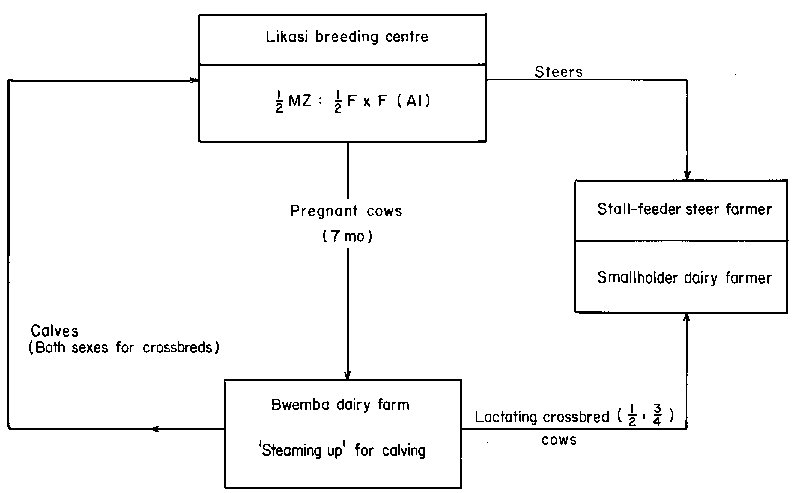
1. Maintain pure-bred Friesians to supply raw milk to Malawi Milk Marketing in Lilongwe;2. Serve as a steaming-up centre for pregnant crossbred heifers from the Likasi Livestock Breeding Station; which are released to smallholder dairy farmers after calving;
3. Produce pure-Friesian steers and to raise crossbred steers for the Likasi breeding station, from where the steers are released to stall-feeder farmers; and to
4. Serve as a demonstration centre for smallholder dairy farmers in all aspects of management.
The movements of cattle between Bwemba and Likasi are depicted in Figure 3.
Pregnant crossbred cows from Likasi were put together with pregnant and non-pregnant pure Friesians on their arrival at Bwemba. Cows in the final month of pregnancy were isolated in a partly-roofed pen, where calving took place. Cows were fed concentrate during milking at a rate of I kg concentrate per 2 kg of milk produced. Silage (Rhodes grass/maize/Napier grass) and Rhodes grass hay were fed ad libitum.
Most cows were machine-milked twice daily, but those going to farmers were hand milked. The milk produced by each cow was weighed at each milking.
Calves were suckled by their dams for 48 hours after birth and then separated from their dams. Calves were sent to a calf pen where each received 6 litres of milk per day, 3 litres in the morning and 3 in the afternoon, for a period of 3 to 4 weeks. Calf-ration concentrate was also fed ad libitum. At 20 weeks of age calves that met health standards and body conformation criteria were sent to Likasi where females were reared to join the breeding herd and steers were sold to stall-feeder farmers. Calves that failed to meet the selection criteria were treated for worm infestation and fed to a standard condition before being sent to Likasi for rearing.
Analysis of variance of age at first calving of Friesian-Malawi Zebu crossbred cows and Friesian cows at Chitedze is shown in Table 16.
Table 16. Analysis of variance of age at first calving at Chitedze, 1969-83.
|
Source |
d.f. |
MS x 10-2 |
|
Breed group |
3 |
715 |
|
Year of birth |
9 |
2 118* * |
|
Season of birth |
1 |
418 |
|
Breed x season |
3 |
444 |
|
Remainder |
63 |
371 |
** = P<0.01
Only year of birth of the heifer had a significant effect (P < 0.01) on the age at which the heifer calved for the first time (Table 16).
The mean age at first calving was 42.0 l 6.3 months (CV 15%). The means of age at first calving for heifers born between 1970 and 1974 and between 1975 and 1978 were 40 and 45.5 months, respectively, with a peak of 54.5 months for heifers born in 1977 (Table 17). There was no apparent reason for the observed increase in age at first calving.
Although the effect of breed group on age at first calving was not significant, there was a trend for heifers with a larger proportion of Friesian inheritance to be older at first calving. This suggests that feeding levels at the station were inadequate for both the crossbreds and the pure Friesians.
Figure 3. Movement of crossbred cattle between Likasi and Bwemba.
Table 17. Estimated least squares means for age at first calving at Chitedze, 1969-83.
|
Variable |
Number |
Age at first calving (months) |
|
Overall |
80 |
41.7 |
|
Breed group |
||
|
1/2 Friesian |
7 |
33.1 |
|
3/4 Friesian |
39 |
42.7 |
|
7/8 Friesian |
24 |
45.8 |
|
Friesian |
10 |
45.5 |
|
Year of birth |
||
|
1969 |
5 |
52.6 a |
|
1970 |
5 |
39.7 bjh |
|
1972 |
7 |
35.6 cbh |
|
1973 |
11 |
38.5 bdg |
|
1974 |
12 |
34.9 be |
|
1975 |
11 |
42.2 dfj |
|
1976 |
7 |
43.1 cgj |
|
1977 |
4 |
54.5 a |
|
1978 |
12 |
42.2 dhj |
|
1979 |
6 |
34.0 b |
|
Season of birth |
|
|
|
January-June |
37 |
43.0 |
|
July-December |
43 |
40.4 |
Within variable groups, row means followed by the same letter do not differ significantly (P < 0.05). No letter following indicates that the variable group did not show a significant difference in the analysis of variance.
The mean calving interval and days open for 208 carvings at Chitedze were 468 ± 131 days and 190 ± 129 days, respectively, with CVs of 28 and 68% .
Analyses of variance of calving interval and days open are shown in Table 18.
Year of previous calving and breed group by season of previous calving interaction had significant effects on both calving interval and days open (Table 18). Calving interval was significantly longer in 1977 (543 days) and 1980 (598 days) than in other years (Table 19). The corresponding figures for days open were 268 and 316, respectively. These differences may have been due to residual effects of experimental treatments imposed on the cows, but the possibility of nutritional stress due to climatic effects in these years cannot be ruled out.
The breed group by season of calving interaction indicates that Friesians that had calved previously between January and June calved again 143 days later than those that calved previously between July and December. This trend was also observed for the 1/2-Friesian-1/2-Zebu crosses, but the difference was only 42 days. Cows that calved in January through June were exposed longer to the period of feed shortage (May through October) after calving than were cows that calved in July through December. The magnitudes of the differences also indicate that cows with more Friesian inheritance were more vulnerable than those with less Friesian blood. This is also supported by the estimated least squares means of 407, 484 and 513 days calving interval for the 1/2-, 3/4- and 7/8-Friesian cows, respectively, though the differences were not statistically significant.
Table 18. Analyses of variance of calving interval and days open at Chitedze, 1972-83.
|
Source |
Calving interval |
Days open |
|
|
d.f. |
MS x 10-1 |
MS x 10-1 |
|
|
Breed group |
3 |
2 672 |
3 524 |
|
Lactation number |
5 |
2 644 |
2 711 |
|
Year of calving |
9 |
5 717** |
5 464** |
|
Season |
1 |
2 168 |
1 313 |
|
Breed group x season |
3 |
4 268* |
4 552* |
|
Remainder |
186 |
1 679 |
1 669 |
* = P<0.05
** = P<0.01
Total lactation yield, lactation length, milk yield per lactation day and dry period
Annual milk yield
The means for total lactation yield, lactation length, milk yield per day and dry period were 2116 ± 602 kg, 330 ± 84 days, 6.5 ± 1.7 kg and 141 ± 114 days, respectively, with corresponding CVs of 28, 25, 26 and 81%.
Analyses of variance of total lactation yield, lactation length, milk yield per lactation day and dry period are presented in Table 20.
Breed group and year of calving had significant effects (P < 0.01) on total lactation yield and yield per lactation day but not on lactation length. Lactation number also had a significant effect (P < 0.05) on yield per lactation day (Table 20).
Table 19. Estimated least squares means for calving interval and days open at Chitedze, 1972-83.
|
Variable |
No. |
Calving interval (days) |
No. |
Days open |
|
Overall |
208 |
476 |
208 |
198 |
|
Breed group | ||||
|
1/2 Friesian |
49 |
407 |
49 |
130 |
|
3/4 Friesian |
116 |
484 |
116 |
205 |
|
7/8 Friesian |
17 |
513 |
17 |
235 |
|
Friesian |
26 |
498 |
26 |
219 |
|
Lactation number | ||||
|
1 |
58 |
467 |
59 |
189 |
|
2 |
54 |
438 |
54 |
166 |
|
3 |
42 |
465 |
40 |
164 |
|
4 |
31 |
494 |
32 |
235 |
|
5 |
15 |
432 |
17 |
176 |
|
6+ |
8 |
556 |
6 |
258 |
|
Year of calving | ||||
|
1972 |
6 |
434 ab |
6 |
145 a |
|
1973 |
14 |
422 a |
14 |
147 a |
|
1974 |
14 |
462 ac |
14 |
181 ac |
|
1975 |
20 |
489 ac |
20 |
213 ac |
|
1976 |
19 |
442 a |
22 |
-181 a |
|
1977 |
37 |
543 bc |
37 |
268 bc |
|
1978 |
23 |
471 ac |
22 |
188 a |
|
1979 |
37 |
475 a |
35 |
194 a |
|
1980 |
27 |
598 b |
27 |
316 b |
|
1981 |
11 |
419a |
11 |
144a |
|
Season of calving | ||||
|
January-June |
79 |
490 |
78 |
209 |
|
July - December |
129 |
461 |
130 |
186 |
Within variable groups row means followed by the same letter do not differ significantly (P < 0.05) No letter following indicates that the variable group did not show a significant difference in the analysis of variance.
The total milk yield and yield per lactation day were similar for the 3/4, 7/8 and pure Friesians, and were greater than those of the 1/2 Friesians. Total lactation yield peaked at the fifth lactation, though the yield at this lactation was not significantly different from those of the other lactations except for the first (Table 21).
The significant effect of year of calving on total lactation yield and yield per lactation day was due to the very poor yields in 1977 and 1980, which were about 30% lower than overall mean yields. The significant effect of year on dry period (P < 0.01) also resulted from the unusually long dry periods in 1977 and 1980, which were 59% and 77% longer than the overall mean. There was letter do not differ significantly (P < 0.05). No letter following indicates that the variable group did not show a significant difference in the analysis of variance. no obvious difference in the rainfall patterns in 1977 and 1980 that would explain the deviations from average performance in those years.
The mean annual milk yield per cow was 1671 592 kg, with a CV of 35%.
Analysis of variance of annual milk yield per cow is presented in Table 22.
Breed group, lactation number or parity and year of calving had significant effects (P < 0.01) on annual milk yield (Table 22). The estimated least squares means are laid out in Table 23.
Table 20. Analyses of variance of total lactation milk yield, lactation length, milk yield per day of lactation and dry period at Chitedze, 1972-83.
|
Source |
d.f. |
Lact. yield |
Lact. length |
Yield/day |
d.f. |
Dry period |
|
MS x 103 |
MS x 10-2 |
MS x 10-2 |
MS x 10-2 |
|||
|
Breed group |
3 |
2 834** |
136 |
1 539** |
3 |
112 |
|
Lactation number |
5 |
381 |
128 |
725* |
5 |
182 |
|
Year of calving |
10 |
3 003** |
56 |
3 019** |
9 |
546** |
|
Season of calving |
1 |
314 |
21 |
5.4 |
1 |
83 |
|
Breed x season |
3 |
341 |
167 |
672 |
3 |
252** |
|
Remainder |
257 |
354 |
70 |
297 |
182 |
126 |
* = P<0.05
** = P<0.01
Table 21. Estimated least squares means for total lactation milk yield, lactation length, milk yield per day of lactation and dry period at Chitedze, 1972-83.
|
Variable |
No. |
Lact. Yield (kg) |
Lact. Length (days) |
Milk yield/day(kg) |
No. |
Dry period (days) |
|
Overall |
280 |
2 221 |
331 |
6.9 |
204 |
149 |
|
Breed group | ||||||
|
1/2 Friesian |
52 |
1 677a |
307 |
5.6a |
47 |
116 |
|
3/4 Friesian |
151 |
2 345 b |
331 |
7.1b |
115 |
145 |
|
7/8 Friesian |
42 |
2 495 b |
365 |
7.3b |
17 |
157 |
|
Friesian |
35 |
2 366 b |
321 |
7.4b |
25 |
179 |
|
Lactation number | ||||||
|
1 |
84 |
2 075 a |
356 |
6.1 a |
59 |
132 |
|
2 |
60 |
2 157 ab |
324 |
6.7b |
53 |
127 |
|
3 |
50 |
2 212 ab |
318 |
7.0b |
39 |
131 |
|
4 |
40 |
2 168 ab |
316 |
6.9b |
30 |
176 |
|
5 |
29 |
2 398 b |
348 |
7.1b |
17 |
113 |
|
6+ |
17 |
2 315 ab |
325 |
7.4b |
6 |
217 |
|
Year of calving | ||||||
|
1972 |
6 |
2 511 ae |
324 |
7.9 ae |
6 |
99a |
|
1973 |
14 |
2 383 ae |
336 |
7.4 ae |
14 |
107 a |
|
1974 |
14 |
2 497 ae |
345 |
7.5 ae |
14 |
132a |
|
1975 |
19 |
2 449 ae |
349 |
7.2 ae |
19 |
146 ae |
|
1976 |
23 |
2 145 ae |
341 |
6.4a |
20 |
124 ae |
|
1977 |
38 |
1 544 bc |
321 |
5.1 bc |
37 |
228 b |
|
1978 |
26 |
2 093 e |
326 |
6.6a |
22 |
133 ad |
|
1979 |
38 |
2 165 ef |
345 |
6.7a |
34 |
142 ad |
|
1980 |
37 |
1 681 c |
388 |
5.1c |
27 |
265 c |
|
1981 |
20 |
2 489 af |
317 |
7.8e |
11 |
117 ade |
|
1982 |
45 |
2 470a |
300 |
8.1e |
- |
- |
|
Season of calving | ||||||
|
January-June |
98 |
2 264 |
335 |
- 6.9 |
76 |
158 |
|
July-December |
182 |
2 177 |
327 |
6.8 |
128 |
140 |
Within variable groups, row means followed by the same letter do not differ significantly (P < 0.05). No letter following indicates that the variable group did not show a significant difference in the analysis of variance.
Table 22. Analysis of variance of annual milk yield per cow at Chitedze, 1972-83.
|
Source |
d.f. |
MS x10-3 |
|
Breed group |
3 |
2 131 * * |
|
Lactation number |
5 |
1 104** |
|
Year of calving |
9 |
3 393** |
|
Season of calving |
1 |
32 |
|
Season x breed |
3 |
169 |
|
Remainder |
189 |
350 |
** = P<0.01
Table 23. Estimated least squares means for annual milk yield per cow at Chitedze, 1972-83.
|
Variable |
No. |
Annual milk yield (kg) |
|
Overall |
211 |
1 852 |
|
Breed group | ||
|
1/2 Friesian |
51 |
1 383a |
|
3/4 Friesian |
117 |
1 995 b |
|
7/8 Friesian |
17 |
1 959 b |
|
Friesian |
26 |
2 071 b |
|
Lactation number | ||
|
1 |
59 |
1 582a |
|
2 |
54 |
1 870 bf |
|
3 |
42 |
1 952 bf |
|
4 |
31 |
1 949 bf |
|
5 |
17 |
2 148 ef |
|
6+ |
8 |
1 610 ab |
|
Year of calving | ||
|
1972 |
6 |
2 534a |
|
1973 |
14 |
2 375 a |
|
1974 |
14 |
2 221 ag |
|
1975 |
20 |
2 126 ahj |
|
1976 |
22 |
1 804 dgh |
|
1977 |
37 |
1 092 c |
|
1978 |
23 |
1 743 dj |
|
1979 |
37 |
1 689 d |
|
1980 |
27 |
1 001 f |
|
1981 |
11 |
1 935 adh |
|
Season of calving | ||
|
January-June |
80 |
1 834 |
|
July-December |
131 |
1 870 |
Within variable groups, row means followed by the same letter do not differ significantly (P < 0.05). No letter following indicates that the variable group did not show a significant difference in the analysis of variance.
The pattern of influence exerted by breed group, lactation number and year of calving on annual milk yield per cow was similar to that observed for total lactation yield and yield per lactation day. Productivity was again lowest in 1977 and 1980.
The mean age at first calving for 145 crossbred heifers born at Bwemba was 36.8 ± 6.6 months, with a CV of 18%. None of the factors studied (breed group, year and month of birth and breed group x month of birth interaction) had a significant effect on age at first calving. The estimated least squares means for age at first calving are laid out in Table 24.
The mean calving interval and days open for 338 carvings at Bwemba were 407 ± 90 days and 129 ± 93 days, respectively.
Breed group, month of previous calving and breed group by month interaction showed significant effects (P < 0.01) on calving interval (Table 25) and breed group (P < 0.01) and breed by month of calving had significant effects (P<0.05) on days open. Lactation number or parity and year of calving did not show any significant effect on days open and calving interval. The estimated least squares means for calving interval and days open are laid out in Table 26.
There is an apparent pattern in the length of calving interval (Table 26), in which cows that calved previously in December through March had the longest calving intervals and those that calved previously in April through July had the shortest calving intervals: the calving intervals of cows that calved previously in September through November were of intermediate duration. This pattern appears to be contrary to that which would be expected from the rainfall pattern, and hence the availability of green feed, but follows the pattern of availability of supplementary feed.
Table 24. Estimated least squares means for age at first calving at Bwemba, 1971-83.
|
Variable |
Number |
Age at first calving (months) |
|
Overall |
145 |
37.7 |
|
Breed group | ||
|
7/8 Friesian |
3° |
37 0 |
|
15/16 Friesian |
47 |
37.2 |
|
31/32 Friesian |
29 |
39.5 |
|
Friesian |
30 |
36.9 |
|
Year of birth | ||
|
1971 |
5 |
38.5 |
|
1972 |
6 |
40.1 |
|
1973 |
15 |
40.2 |
|
1974 |
13 |
36.6 |
|
1975 |
17 |
33.9 |
|
1976 |
15 |
37.6 |
|
1977 |
18 |
38.2 |
|
1978 |
30 |
32.7 |
|
1979 |
18 |
38.5 |
|
1980 |
8 |
40.3 |
|
Month of birth | ||
|
January |
7 |
39.3 |
|
February |
14 |
41.4 |
|
March |
21 |
41.5 |
|
April |
16 |
38.5 |
|
May |
9 |
38.5 |
|
June |
7 |
40.1 |
|
July |
7 |
35.8 |
|
August |
13 |
35.5 |
|
September |
15 |
36.5 |
|
October |
19 |
35.9 |
|
November |
5 |
37.2 |
|
December |
12 |
32.0 |
Total lactation yield, lactation length, milk yield per lactation day and dry period
The means for total lactation yield, lactation length, milk yield per lactation day and dry period were 2492 ± 772 kg, 294 ± 103 days, 8.8 ± 2.6 kg and 116 ± 136 days, respectively, with corresponding CVs of 31,35,30 and 118%.
Analyses of variance of the four traits are presented in Table 27.
Year of calving had significant effects (P < 0.01) on total lactation yield, lactation length and yield per lactation day, and lactation number had a significant effect (P < 0.01) on lactation yield (Table 27). None of the factors studied had a significant effect on dry period.
The estimated least squares means for the four traits are laid out in Table 28.
Total milk yield increased from lactation one through five after which it fell. Total lactation yield and yield per lactation day were highest in 1977 and 1979 and were lowest in 1981.
Dairy productivity: The mean annual milk yield per cow was 2405 ± 802 kg, with a CV of 33%.
Analysis of variance of annual milk yield per cow is shown in Table 29.
Lactation number or parity and year of calving showed highly significant effects (P < 0.01) on annual milk yield per cow. Month of calving and breed group were not significant.
The estimated least squares means for annual milk yield are presented in Table 30.
Table 25. Analyses of variance of calving interval and days open at Bwemba, 1974-83.
|
Source |
Calving interval |
Days open |
||
|
d.f. |
MS x 10-1 |
d.f. |
MS x 10-1 |
|
|
Breed group |
3 |
5 786** |
3 |
2 744** |
|
Lactation number |
5 |
325 |
5 |
384 |
|
Year of calving |
8 |
1 197 |
8 |
1 424 |
|
Month of calving |
11 |
2 580** |
11 |
1 435 |
|
Breed x month |
27 |
1 673** |
28 |
1 319* |
|
Remainder |
283 |
826 |
283 |
860 |
* = P<0.05
** = P<0.01
Table 26. Estimated least squares means for calving interval and days open at Bwemba, 1974-83.
|
Variable |
No. |
Calving interval (days) |
No. |
Days open |
|
Overall |
338 |
431 |
339 |
146 |
|
Breed group | ||||
|
7/8 Friesian |
45 |
414 a |
45 |
124 a |
|
15/16 Friesian |
200 |
392a |
200 |
116a |
|
31/32 Friesian |
30 |
502 b |
30 |
203 b |
|
Friesian |
63 |
419 a |
64 |
140 a |
|
Lactation number | ||||
|
1 |
109 |
438 |
109 |
155 |
|
2 |
81 |
436 |
79 |
151 |
|
54 |
443 |
57 |
152 |
|
|
4 |
40 |
429 |
39 |
153 |
|
5 |
25 |
412 |
26 |
124 |
|
6 + |
29 |
430 |
29 |
138 |
|
Year of calving | ||||
|
1974 |
11 |
456 |
11 |
168 |
|
1975 |
21 |
466 |
21 |
180 |
|
1976 |
29 |
419 |
29 |
132 |
|
1977 |
54 |
421 |
53 |
136 |
|
1978 |
49 |
398 |
49 |
110 |
|
1979 |
37 |
417 |
38 |
129 |
|
1980 |
48 |
446 |
47 |
155 |
|
1981 |
43 |
439 |
44 |
166 |
|
1982 |
46 |
423 |
46 |
135 |
|
Month of calving | ||||
|
January |
26 |
488 acd |
26 |
174 |
|
February |
44 |
454 ad |
.44 |
175 |
|
March |
39 |
519 a |
41 |
198 |
|
April |
31 |
375 be |
32 |
98 |
|
May |
25 |
393 bc |
25 |
117 |
|
June |
20 |
434 abc |
20 |
150 |
|
July |
12 |
386 ce |
12 |
102 |
|
August |
35 |
434 cd |
35 |
154 |
|
September |
36 |
407 ce |
36 |
126 |
|
October |
32 |
445 cd |
31 |
168 |
|
November |
19 |
395 cd |
18 |
116 |
|
December |
19 |
447 ce |
19 |
167 |
Within variable groups, row means followed by the same letter do not differ significantly (P < 0.05). No letter following indicates that the variable group did not show a significant difference in the analysis of variance.
Table 27. Analyses of variance of total lactation milk yield, lactation length, milk yield per day of lactation and dry period at Bwemba, 1977-83.
|
Source |
d.f. |
Lact. yield |
Lact. length |
Yield/day |
d.f. |
Dry period |
|
MS x 10-3 |
MS x 10-1 |
MS x 10² |
MS x 1-1 |
|||
|
Breed group |
3 |
1 006 |
839 |
152 |
3 |
1 638 |
|
Lactation number |
5 |
3 651** |
1 240 |
5 625 |
5 |
1 983 |
|
Year of calving |
5 |
6 502** |
3 105** |
5 068** |
5 |
4 041 |
|
Month of calving |
11 |
588 |
1 659 |
754 |
11 |
1 247 |
|
Breed x month |
31 |
625 |
1 305 |
485 |
29 |
2 027 |
|
Remainder |
265 |
594 |
1 052 |
674 |
209 |
1 906 |
** = P<0.01
Table 28. Estimated least squares means for total lactation milk yield, lactation length, milk yield per day of lactation and dry period at Bwemba, 1977-83.
|
Variable |
No. |
Lact. Yield (kg) |
Lact. Length (days) |
Milk yield/day (kg) |
No. |
Dry period (days) |
|
Overall |
321 |
2 659 |
293 |
9.3 |
263 |
112 |
|
Breed group | ||||||
|
7/8 Friesian |
44 |
2 641 |
280 |
9.4 |
35 |
79 |
|
15/16 Friesian |
187 |
2 484 |
283 |
9.1 |
151 |
105 |
|
31/32 Friesian |
33 |
2 720 |
320 |
9.4 |
27 |
132 |
|
Friesian |
62 |
2 790 |
290 |
9.5 |
50 |
133 |
|
Lactation number | ||||||
|
1 |
95 |
2 174a |
317a |
7.4a |
78 |
149 |
|
2 |
72 |
2 443 b |
276b |
8.8b |
59 |
113 |
|
3 |
49 |
2 838 cd |
282 ab |
10.2 cd |
45 |
108 |
|
4 |
39 |
2 833 df |
301 ab |
9.8 cd |
34 |
131 |
|
5 |
27 |
2 872 de |
291 ab |
10.3 ed |
20 |
78 |
|
6+ |
39 |
2 791 cfe |
294 ab |
9.5 ce |
27 |
95 |
|
Year of calving | ||||||
|
1977 |
56 |
3 290a |
331a |
10.2a |
48 |
66 |
|
1978 |
56 |
2 413 be |
283 bc |
8.6 bc |
47 |
75 |
|
1979 |
47 |
2 956 c |
288 abd |
10.7 a |
38 |
102 |
|
1980 |
80 |
2 617 bd |
255 cd |
10.1a |
47 |
144 |
|
1981 |
46 |
2 202 e |
302 ab |
7.9c |
39 |
152 |
|
1982 |
55 |
2 474 de |
302 ab |
8.4 cd |
44 |
134 |
|
Month of calving | ||||||
|
January |
30 |
2 755 |
271 |
10.1 |
19 |
96 |
|
February |
38 |
2 908 |
298 |
9.8 |
36 |
121 |
|
March |
36 |
2 671 |
355 |
8.4 |
32 |
61 |
|
April |
30 |
2 689 |
280 |
9.6 |
27 |
91 |
|
May |
16 |
2 758 |
285 |
9.8 |
15 |
121 |
|
June |
19 |
2 300 |
254 |
9.4 |
13 |
144 |
|
July |
11 |
2 741 |
291 |
9.3 |
9 |
83 |
|
August |
30 |
2 609 |
313 |
8.4 |
28 |
105 |
|
September |
34 |
2 394 |
349 |
8.2 |
26 |
179 |
|
October |
31 |
2 972 |
307 |
9.7 |
25 |
123 |
|
November |
22 |
2 630 |
266 |
9.4 |
16 |
101 |
|
December |
24 |
2 478 |
253 |
9.5 |
17 |
122 |
Within variable groups, row means followed by the same letter do not differ significantly (P < 0.05). No letter following indicates that the variable group did not show a significant difference in the analysis of variance.
Table 29. Analysis of variance of annual milk yield per cow at Bwemba, 1974-83.
|
Source |
d.f. |
MS x 10-3 |
|
Breed group |
3 |
1 304 |
|
Lactation number |
5 |
3 634** |
|
Year of calving |
8 |
3 906** |
|
Month of calving |
11 |
698 |
|
Breed x month |
28 |
737 |
|
Remainder |
251 |
644 |
** = P<0.01
Table 30. Estimated least squares means for annual milk yield per cow at Bwemba, 1974-83.
|
Variable |
No. |
Annual milk yield (kg) |
|
Overall |
307 |
2 580 |
|
Breed group | ||
|
7/8 Friesian |
43 |
2 581 |
|
15/16 Friesian |
176 |
2 647 |
|
31/32 Friesian |
26 |
2 471 |
|
Friesian |
62 |
2 620 |
|
Lactation number | ||
|
1 |
94 |
2 142a |
|
2 |
66 |
2 404a |
|
3 |
51 |
2 742 be |
|
4 |
37 |
2 787 cde |
|
5 |
26 |
2 983 bd |
|
6+ |
33 |
2 419 ae |
|
Year of calving | ||
|
1974 |
7 |
2 884 ace |
|
1975 |
9 |
2 905 ae |
|
1976 |
14 |
2 708 ace |
|
1977 |
51 |
2 950 ad |
|
1978 |
53 |
2 207 cf |
|
1979 |
38 |
2 930a |
|
1980 |
49 |
2 410 def |
|
1981 |
41 |
1 945 bc |
|
1982 |
45 |
2 276 bef |
|
Month of calving | ||
|
January |
25 |
2 653 |
|
February |
40 |
2 536 |
|
March |
34 |
2 279 |
|
April |
32 |
2 782 |
|
May |
19 |
2 851 |
|
June |
16 |
2 324 |
|
July |
11 |
2 782 |
|
August |
30 |
2 313 |
|
September |
30 |
2 371 |
|
October |
29 |
2 835 |
|
November |
20 |
2 789 |
|
December |
21 |
2 439 |
Within variable groups row means followed by the same letter do not differ significantly (P < 0.05). No letter following indicates that the variable group did not show a significant difference in the analysis of variance.