


Few data were obtained on this characteristic. For Macina sheep under delta-type conditions at Niono, a lactation curve was established by an application of the rectangle formula for evaluating definite integrals. Data on milk yields were collected on average once per month. Lambs were penned away from their dams for a 24-hour period and allowed to suckle after 12 and 24 hours. They were weighed immediately before and immediately after suckling, and any remaining milk was hand pulled. While this method will not allow total milk production to be ascertained, it is probable that most is accounted for. All records relating to 10-day periods from parturition (1 to 10, 11 to 20 etc.) were pooled and the mean figure was assumed to be the yield at 5, 15... n days. Each rectangle in the lactation curve thus covered a 10-day period. The mean lactation curve and some individual yields are shown in Figure 51. Total lactation yield is of the order of 50 kg with lactation length varying from 85 to 165 days. The lactation was assumed to be completed on the day of the visit when a ewe was dry although she may well have stopped suckling up to 1 month previously: lactation lengths are therefore probably about 15 days less than shown in Figure 51 with a true mean length in the region of 130 to 140 days.
Wool was shorn twice a year to give two periods corresponding to 'wet' and 'dry' seasons. Wool production over a 3-year period is shown in Table 53. Annual yields of greasy wool at 684 g are equivalent to growth of 1.87 g/day. As might be expected, daily wool production in the dry season (1.70 g) was very much less than in the wet season (2.22 g). Males and castrates yielded more wool than females although female yields were closer to those of males in the wet season when energy and protein requirements are obviously in excess of those needed for maintenance, pregnancy and lactation.
Productivity indices were constructed in the same manner as for cattle, except that weight of the litter at presumed weaning at 150 days was used as the measure of production.
The mean squares from the analysis of variance are shown in Table 54 for both goats and sheep. In general the sources of variation which exerted significant effects on the indices were the same for both species and had similar levels of significance. The sex of the young did not affect the productivity of female goats. Year effects on sheep were not significant and were relatively weak on goats.
The least-squares means for the productivity indices are laid out in Table 55. The rice subsystem had superior indices for both species. The effects of season were such that goats giving birth in the hot dry or rainy seasons were more productive than those kidding in the post-rains season, while births in the cold dry season resulted in lowest productivity. In sheep, births in the rainy season were superior in terms of productivity to those in the hot dry season which in turn were superior to both post-rains and cold-dry season births.
Productivity indices of first-parity ewes were clearly inferior to the indices of all other parities but in goats, this distinction was only evident on Index I, and when the resource-based indices II and III were calculated, the productivity of primiparous does did not differ significantly from that of second-parity females and most of those from the sixth parity upwards.
Ewes giving birth to males and twins had better indices than those giving birth to females and singles. There were no differences in goat productivity arising from sex of young, this being most probably due to the relative lack of precocious sexual dimorphism in goats at weaning. Although twin-bearing does had indices superior to those giving birth to singles, the productivity of dams giving birth to triplets was inferior to those having twins and equal only to those giving birth to singles: this was due largely to the high death rate in triplets.
Figure 51. Mean lactation curve and representative yields for Macina sheep.
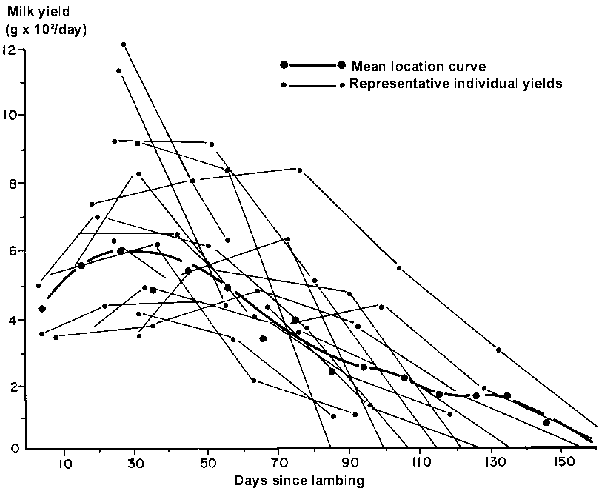
Table 53. Mean wool productiona by Macina sheep.
|
Sex and variables |
Dry season |
Wet season |
Year |
|||
|
|
|
|
||||
|
Males + castrates |
||||||
|
|
No. in sample |
11.3 ± 4.51 |
16.3 ± 6.11 |
13.8 ± 5.30 |
||
|
|
Total yield (g) |
468.3 ± 72.86 |
377.4 ± 33.68 |
835.7 ± 52.54 |
||
|
|
Growth per day(g) |
2.20 ± 0.412 |
2.53 ± 0.300 |
2.29 ± 0.245 |
||
|
Females |
||||||
|
|
No. in sample |
27.3 ± 7.02 |
28.0 ± 5.29 |
27.7 ± 5.69 |
||
|
|
Total yield (g) |
263.2 ± 73.54 |
281.1 ± 25.72 |
534.1 ± 64.98 |
||
|
|
Growth per day(g) |
1.21 ± 0.107 |
1.92 ± 0.932 |
1.46 ± 0.181 |
||
|
Overall mean |
||||||
|
|
Total yield (g) |
365.7 ± 67.86 |
392.2 ± 5.19 |
684.9 ± 42.83 |
||
|
|
Growth per day(g) |
1.70 ± 0.200 |
2.22 ± 0.393 |
1.87 ± 0.119 |
||
|
Interval between shearings (days)b |
216 |
43 |
151 |
27 |
365 |
|
a Based on 3 years' data.
b When shearing intervals totalled more or less than 1 year, an equal number of days was added to or subtracted from each season.
Table 54. Analysis of variance of productivity indices for goats and sheep in central Mali.
|
Source of variation |
Goats |
Sheep |
||||||
|
d.f. |
Index I |
Index II |
Index III |
d.f. |
Index I |
Index II |
Index III |
|
|
System |
1 |
2 619*** |
2.37*** |
15.82*** |
1 |
6 050*** |
4.98*** |
32.66*** |
|
Season |
3 |
759*** |
1.33*** |
7.21*** |
3 |
1 660*** |
2.35*** |
13.84*** |
|
Year |
5 |
211* |
0.28* |
1.63* |
5 |
229 |
0.18 |
1.30 |
|
Parity |
8 |
1 083*** |
0.55*** |
4.51*** |
7 |
1 848*** |
0.90*** |
7.15*** |
|
Sex |
1 |
4 |
0.00 |
0.00 |
1 |
2 304*** |
1.89** |
12.86*** |
|
Type of birth |
2 |
4 308*** |
4.22*** |
27.82*** |
1 |
5 208*** |
3.42*** |
24.74*** |
|
Flock/millet |
13 |
351*** |
0.36*** |
2.21*** |
13 |
362** |
0.44** |
2.54** |
|
Flock/rice |
5 |
1 156*** |
1.16*** |
7.42*** |
7 |
849*** |
0.59** |
4.05*** |
|
Error |
1 152 |
93 |
0.13 |
0.73 |
934 |
163 |
0.17 |
1.08 |
***P<0.001; **P<0.01; *P<0.05
The variables acting on the productivity indices (litter weight at 150 days, mortality, parturition interval and dam postpartum weight) were correlated to the productivity indices themselves in order that comparative advantages could be calculated and improvement pathways designed.
Correlations between weaning weight and the three indices were the highest of all the characters considered (about 0.90 for both goats and sheep). Higher weaning weights would obviously lead to increased output as reflected by the indices. The figures presented are weights weaned per female, and for individual surviving young these are biased downwards by the inclusion of the zero weights of their dead counterparts. Actual weaning weights of surviving animals were in the region of 18.2 kg for kids and 24.7 for lambs. Weights of young weaned per female would therefore be increased not only by acting directly on this character but also by attempting improvement through a reduction in mortality.
Correlations between viability and the indices were high (0.72) and significant (P<0.001). Reducing mortality would greatly improve the indices not only directly but indirectly through higher weaning weights. Although the viability rates in this study appear to be low, they are comparable to those encountered in many other traditionally managed flocks throughout Africa (Wilson et al, 1984; 1985). Clear identification of the causes of mortality in small ruminants and reduction or elimination of these would enable increased output to be achieved over much of Africa.
There were highly significant (P<0.001) negative correlations between parturition interval and all three indices for both goats (r = -0.26) and sheep (r = -0.36). A shortened parturition would at first sight, therefore, appear to offer possibilities for improving total productivity. It has however been shown (Wilson et al, 1983) that in this environment intervals of less than 240 days result in a much higher mortality than intervals longer than this. Attempting to reduce the parturition interval in sheep would, then, increase productivity very little but there appears to be scope for reducing that of goats.
Correlations between postpartum weight and all three indices were positive for both goats (weight/index I = 0.36, II = 0.18, III = 0.24) and sheep (0.37, 0.14 and 0.20 respectively) and significant (P<0.01). Increasing breeding female weight either permanently through genetic improvement leading to greater body size or temporarily by means of strategic feeding would lead to higher indices. The correlations are the lowest of all the characters considered and more rapid improvement may arise from concentrating on improving other characters first.
The effects due to flock - considered here to be the basic management unit - have not yet been discussed. There were usually highly significant differences among flocks for all the characters and for the three indices. The causes of these differences have not been determined although it is probable that they are related to the owner's or herder's management abilities and strategies or to his preference for one or the other species. The greatest differences in productivity are, in fact, encountered in this source of variation. If the differences are indeed related to management and the practices relating to improved productivity can be indentified and extended to other management units, overall productivity might be increased considerably. Such an improvement strategy would be appropriate to a majority of owners as it is already being practiced by some with similar means of access to virtually the same resources.
Table 55. Least-squares means of productivity indices for goats and sheep in central Mali.
|
Variable
|
Goats |
Sheep |
|||||||
|
n |
Index I (kg) |
Index II (g) |
Index III (kg) |
n |
Index I (kg) |
Index II (g) |
Index III (kg) |
||
|
Overall |
1 191 |
14.6 |
494 |
1.23 |
973 |
28.4 |
867 |
2.22 |
|
|
System |
|||||||||
|
|
Millet |
934 |
12.1a |
419a |
1.04a |
672 |
24.7a |
761a |
1.95a |
|
|
Rice |
257 |
17.1b |
569b |
1.42b |
301 |
32.1b |
973b |
2.01a |
|
Season |
|||||||||
|
|
Cold dry |
270 |
12.3a |
406a |
1.02a |
245 |
26.2a |
784a |
2.01a |
|
|
Hot dry |
309 |
15.8b |
560b |
1.37b |
267 |
28.9b |
904b |
2.30b |
|
|
Rains |
246 |
15.9b |
540b |
1.34b |
239 |
32.1c |
997c |
2.54c |
|
|
Post-rains |
366 |
14.2c |
470c |
1.18c |
222 |
26.4a |
785a |
2.02a |
|
Year
|
|||||||||
|
|
1978 |
77 |
11.5a |
392a |
0.98a |
95 |
27.9 |
849 |
2.17 |
|
|
1979 |
141 |
15.8b |
536b |
1.33b |
121 |
29.7 |
900 |
2.30 |
|
|
1980 |
252 |
15.0b |
500b |
1.25b |
204 |
27.4 |
845 |
2.15 |
|
|
1981 |
283 |
14.6b |
484b |
1.21b |
205 |
29.9 |
911 |
2.34 |
|
|
1982 |
252 |
14.7b |
506b |
1.25b |
203 |
27.2 |
830 |
2.12 |
|
|
1983 |
186 |
15.8b |
546b |
1.35b |
145 |
28.1 |
870 |
2.23 |
|
Parity |
|||||||||
|
|
'0' |
357 |
15.5ad |
522ad |
1.30ac |
149 |
30.0ab |
900a |
2.32a |
|
|
1 |
274 |
9.3b |
398b |
0.93b |
253 |
21.0c |
713b |
1.78b |
|
|
2 |
215 |
11.3c |
430bc |
1.04b |
194 |
27.7a |
878a |
2.23a |
|
|
3 |
151 |
14.0ae |
495acd |
1.22a |
146 |
30.6b |
939a |
2.40a |
|
|
4 |
96 |
15.8ad |
552d |
1.36c |
92 |
29.6ab |
891a |
2.30a |
|
|
5 |
54 |
17.4d |
581d |
1.46c |
57 |
29.7ab |
857a |
2.21a |
|
|
6 |
21 |
17.8de |
548abd |
1.40abc |
34 |
29.8ab |
889a |
2.27a |
|
|
7a |
14 |
20.4d |
633d |
1.61c |
48 |
29.1ab |
872a |
2.23a |
|
|
³ 8 |
9 |
9.6abc |
289ab |
0.74ab |
- |
- |
- |
- |
|
Sex |
|||||||||
|
|
Female |
601 |
14.5 |
495 |
1.23 |
514 |
26.8a |
823a |
2.10a |
|
|
Male |
590 |
14.6 |
494 |
1.23 |
459 |
29.9b |
912b |
2.33b |
|
Type of birth |
|||||||||
|
|
Single |
970 |
12.9a |
451a |
1.11a |
930 |
22.2a |
709a |
1.79a |
|
|
Tvvin |
214 |
20.4b |
685b |
1.71b |
43 |
34.6b |
1 026b |
2.64b |
|
|
Triplet |
7 |
10.4a |
345a |
0.86a |
- |
- |
- |
- |
a '0' are unknown parities considered ³ 4; for sheep parity 7 is all parities ³ 7.Within variable groups, means followed by different letters differ significantly (P<0.05). Variable groups without any letters did not show a significant difference in the analysis of variance.
The incorporation of other measures, deduced from the analyses discussed here, into an overall plan would provide an effective, integrated and cost-efficient first step in improving total productivity from small ruminants. Some comparative advantages accruing to Index II for within-variable differences are shown in Table 56. By inserting these, along with some other measures, into a sequential improvement scheme in roughly ranked order, a practical, technologically adapted programme for development can be designed.
As can be seen from Table 56, apart from overall management practices, the best results will most probably come from selecting for twinning and by attempting to manipulate demographic structure so that as many females aged 4 to 5 years as possible are in the flocks. Creating some of the conditions of the rice subsystem in the rainfed millet subsystem would also improve productivity. Controlling the breeding season so that young are dropped during the hot and dry or rainy seasons also confers considerable advantages but these would have to be carefully assessed in relation to the potential loss of productivity if births were to be limited to only one per year. The two factors over which least control can be exerted, sex of young and year, fortunately do not greatly influence productivity.
Table 56. Ratios of comparative advantages for variables on Index II, to be used in designing improvement pathways.
|
Variable |
Goats |
Sheep |
|
|
Flock |
|||
|
|
Best to worst millet |
1.83 |
1.55 |
|
|
Best to worst rice |
2.97 |
1.73 |
|
System |
|||
|
|
Rice to millet |
1.35 |
1.29 |
|
Season |
|||
|
|
Hot dry/rains to cold dry |
1.45 |
1.28 |
|
Year |
|||
|
|
Best to worst |
1.20 |
1.09 |
|
Parity |
|||
|
|
Sixth to first |
1.45 |
1.29 |
|
Type of birth |
|||
|
|
Twin to single |
1.54 |
1.44 |
|
Sex |
|||
|
|
Male to female |
1.00 |
1.10 |

 ± s.d.
 ± s.d.
 ± s.d.