Um Banein livestock research station
Climate
Soils and vegetation
Kenana cattle
The station herd
Data collection and initial preparation
Data analysis
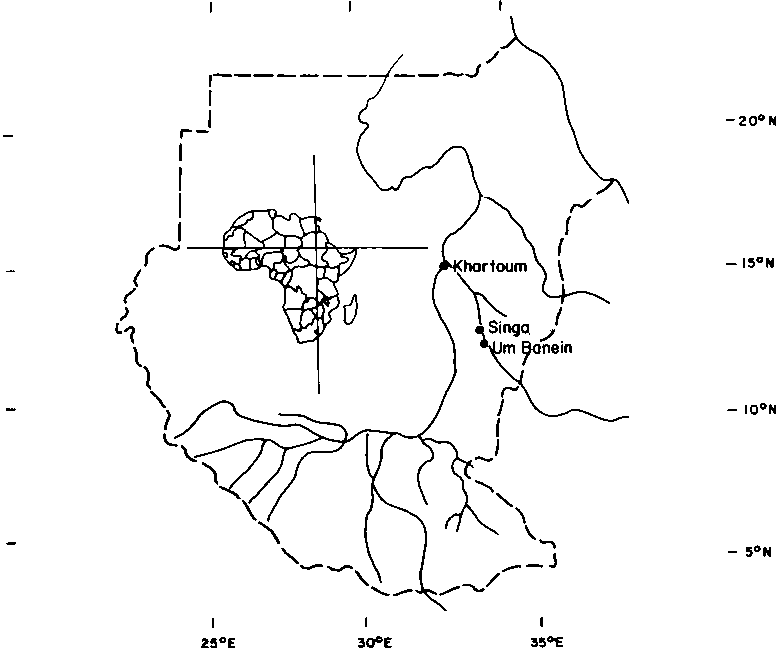
Um Banein Livestock Research Station was established in 1957 in Blue Nile Province (Figure 1). It is situated on the western bank of the Blue Nile river, about 360 km south of Khartoum and 9 km south of Singa, approximately latitude 13°04' N and longitude 33°57' E and at 435 meters above sea level.
The station has a total area of 945 ha, of which 190 ha are potentially irrigable, although Only about half of this is currently being irrigated. The non-irrigable area provides natural grazing.
The station was established in order to:
· improve the Kenana breed of cattle for milk and beef production by continuous selective breeding so as to evolve a Sudanese dairy cow;· produce elite Kenana bulls and to distribute them to farmers near the station and in other districts; and
· carry out research on forage production and animal nutrition.
Figure 1. Location of Um Banein in Sudan and Africa.
Climate has an important influence on the nature of the natural vegetation, the characteristics of the soils, the crops that can be grown and hence the type of farming that can be practiced. At Um Banein there are three marked seasons: winter (November - February); hot summer (March - June); and wet summer (July - October).
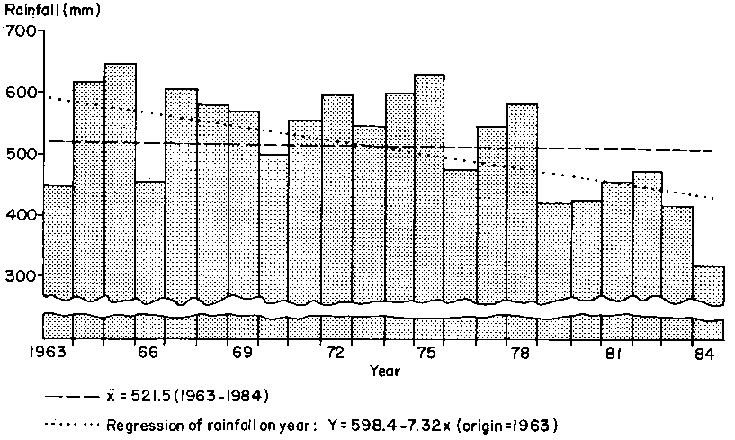
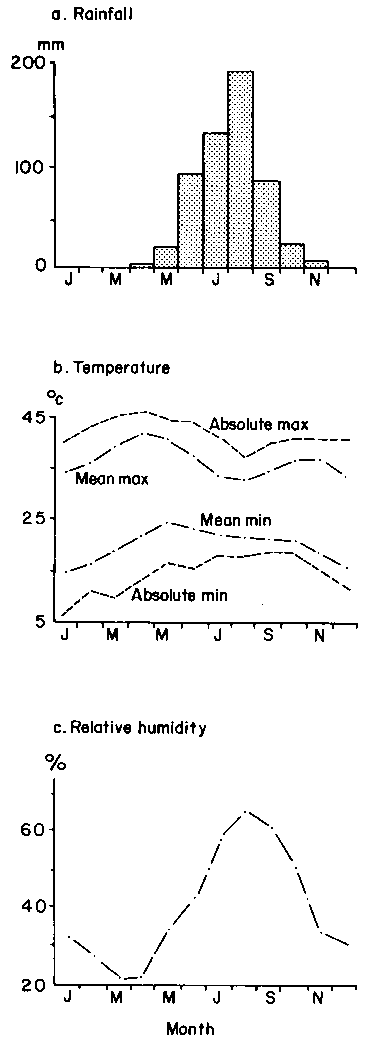
In tropical areas the rainfall regime is the most important climatic factor influencing agriculture and vegetation. In the Um Banein area there is a clearly defined rainy season from July to October, with some showers in May and June. The annual rainfall at the station in the period 1963-84 ranged from 323 to 649 mm, with an overall mean of 521.5 mm (Figure 2).
The highest daily maximum temperature of 45.5°C occurred in April, while the lowest minimum of 6.0°C was registered in January. Mean maxima and mean minima were also recorded in these months.
Humidity is uniformly high in the wet season (July - October) and relatively low in the dry season (November-June).
The annual cycle of these climatic parameters is shown in Figure 3.
Figure 2. Annual rainfall at Um Banein, 1963-1984.
The soil of Blue Nile Province results from the alluvial action of the Nile, and is a heavy cracking clay of the Vertisol type.
The irrigable area of the station is fed by a main canal from the Blue Nile using two 12" Ruston Diesel pumps. Fodder grown on this area includes varieties of Sorghum bicolor (Abu Sabain, Feterita, Um Banein and Tozi), Sorghum sudanense, an S. bicolor x S. sudanense hybrid (Pioneer 988), Dicanthium annulatum, Brachiaria mutica (Pare grass) and Chloris gayana (Rhodes grass). Legume fodders include Clitoria ternata, Lablab purpurea and Vigna aconitifolia (Phillipesara).
The rainfed area has a variety of natural grasses including Shoenefeldia gracilis, Chloris virgata, Dactyloctenium aegyptiacum, Cynodon dactylon, Brachiaria spp. and Oryza spp.
Kenana cattle are a sub-type of the Northern Sudan Shorthorned Zebu (Mason and Maule, 1960). They are generally considered to have resulted from interbreeding Sanga cattle with shorthorn zebu during tribal migrations before recorded history (Rouse, 1972).
The characteristic color of the Kenana is light blue-gray, with gradations from nearly white to steel-gray, shading to nearly black on head, neck, hump, hindquarters and legs. Points (muzzle, horns, tail tip, hooves) are black. The individual hairs are black at the base and white (or occasionally red) at the tip. Darker coat colors, and darker areas, are due to the hairs having a broader black band. In calves some of the hairs have a red tip; this may apply to the hairs on the poll only or to the whole body. Thus calves are frequently born red and change to grey after 3 or 4 months. Exceptionally, the red tip remains in the adult.
Figure 3. Climatic normals at Um Banein Livestock Research Station.
Horns are short, 15 to 20 cm in length with a maximum of 30 to 35 cm, and measure 5 x 6 cm at the base in females and 6 x 7.5 cm in males. Loose horns are common. The face is thin, with a convex (but sometimes straight) profile. The hump, which is cervico-thoracic, is large in the male and has a tendency to hang over at the rear: it is much less well developed in females and castrates; The dewlap is large, as is the sheath in males. The sacrum is higher than the withers. The udder is of good shape and size with large, well placed teats.
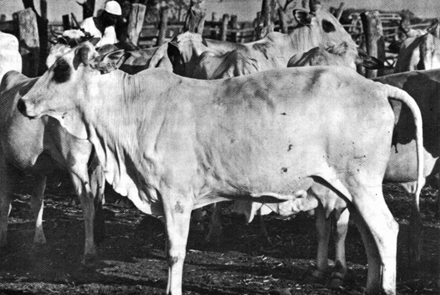
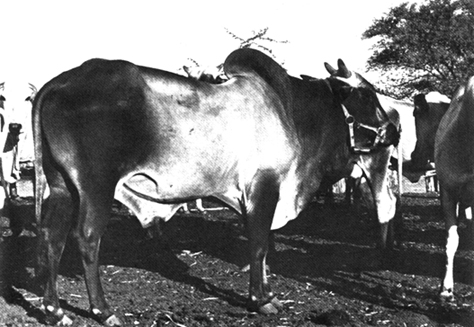
Mature cows (Figure 4) may be 130 cm tall at the shoulder and weigh up to 450 kg. Bulls (Figure 5) can be 141 cm tall and weigh 550 kg.
The Kenana is found east of the confluence of the Blue and White Niles at Khartoum and south to the Ethiopian border. It is commonest in the Blue Nile (Fung area), White Nile and Gezira provinces. This is a roughly triangular area bounded by Sennar, Singa, Roseires and Kosti and lying approximately between latitudes 10° and 13° north and longitudes 32° and 34° east. The total population of Kenana cattle has been estimated at 2 million head, owned mainly by nomadic and semi-nomadic tribes including the Kenana, the Rufaa El Hoy and the Bent Meharib. Traditionally, they are used as dairy, beef and draught animals.
The herd was established in 1957 by the purchase from local nomadic and semi-nomadic herds of 120 cows with calves at foot. Foundation bulls were selected from the former Gezira Research Farm herd. The herd subsequently remained closed until 1981 when additional bulls were purchased from traditional herds.
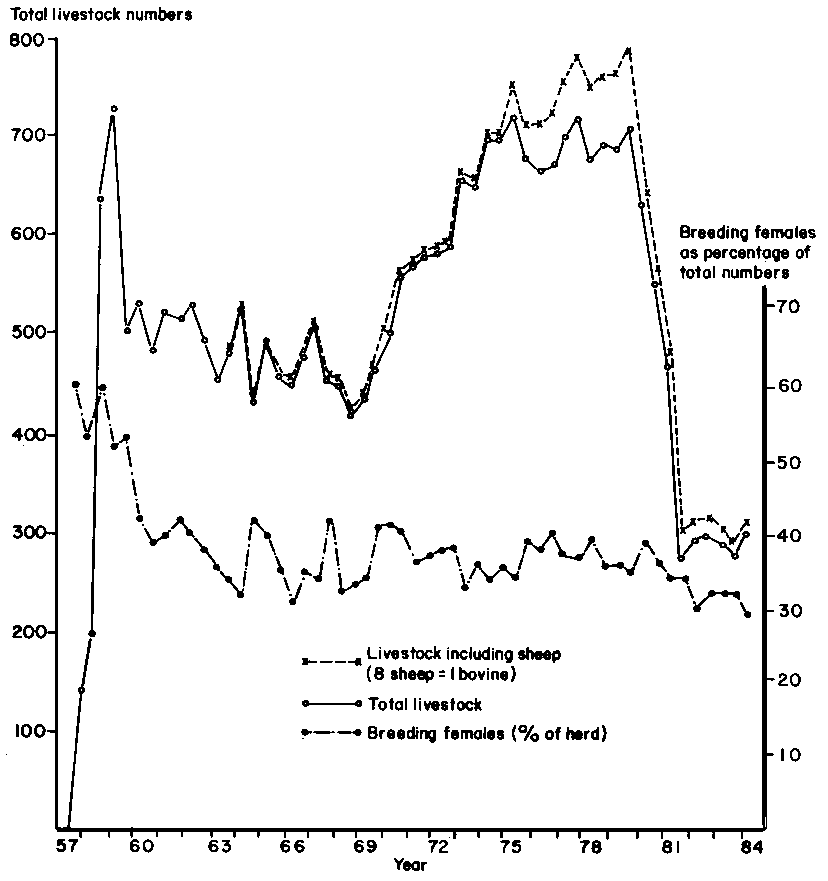
The changes in livestock numbers from the establishment of the station to 1984 are shown in Figure 6. As can be seen, sheep contributed considerably to the total stocking rate at a time when this was already very high.
Figure 4. An elite Kenana cow in the Um Banein herd.
Figure 5. A stud bull of the Kenana breed at Um Banein.
The data used in this study were extracted from the station records, which have been collected since the herd was established in 1957. These records were kept in a series of field books and on individual animal record cards. From these sources computer coding sheets were established, which included:
· a "Base record", comprising information on calving date (or date of entry for purchased animals), identification number, sex, date of exit and reason for exit;· a "Weight record" containing calving date, calf number, dam and sire numbers, birth weight, and (where available) monthly weights to 6 months of age and weaning weight and date; and
· a "Lactation record" with cow number, calving date, calf number, monthly milk yield, days in lactation, lactation number, number of services, conception date and date of next calving.
Other information used for the purposes of analysis and interpretation were: adult cow weights for 1984-85; meteorological data; and notes on herd management.
The major analyses were carried out using least-squares fixed-and mixed-model procedures (Harvey, 1977). Unequal and disproportionate subclass numbers gave unbalanced factorial designs for which conventional analysis of variance techniques would not have been applicable.
None of the foundation animals had sire or dam records. In addition, the use of individual sires was often confounded with month and year of use and with dam, so sire groups could not be used in analyses except for the single trait of birth weight.
Figure 6. Fluctuations in livestock numbers at Um Banein from 1957 to 1984.
The models used included: the random effects of the dam (where she appeared in the analytical matrix more than once) and fixed effects of origin (purchased or born on station); parturition number or age of cow; year of birth or parturition (or groups of years where preliminary analyses showed these to be more appropriate); month of birth or parturition; and sex of calf. The specific factors included in the models will be evident when results are presented for each character analyzed, although it should be noted that, after initial analyses, origin was removed from the matrix and only records for station-born cows were taken into account. Where considered relevant, some of these initial analyses are referred to in the results sections.
The residual mean square was used as the error term to test the significance of all differences evaluated among groups. Linear contrasts of least-squares means were computed to determine the significance of differences within groups for all characters where the difference was significant in the analysis of variance. More comparisons were made using the least-squares means than there were independent degrees of freedom. Therefore, not all of the comparisons are independent and the error rate over the entire set of comparisons may be different from that indicated by the level of probability. Tests of significance associated with the linear contrasts, although not independent, can be taken as guides as to whether the observed values could have occurred by chance.
Repeatability were calculated using the variance components among and within cows.