These results (which would otherwise not be widely available) are presented in order to show the type of experimental work carried out at Um Banein and elsewhere on Kenana cows. The original copyright owners are thanked for permission to publish.
Effects of dietary protein levels on early growth of calves
Improving growth of pre-pubertal heifers
Growth from weaning to maturity
In 1977, an experiment was carried out at Um Banein to determine the effects of different levels of dietary protein on growth of calves aged approximately 8 months at the start of the experiment. This section is taken in its entirety from Ahmed and Pollot (1978).
Forty-five weaned calves (20 males and 25 females) were allocated to three groups in such a manner that mean weights and sexual composition of each group were as similar as possible. Prior to the experiment, calves were weaned at 4 months old and had subsequently been kept on rainfed grazing. The groups were penned separately and fed on groundnut hay for an adaptation period of 3 weeks. The concentrate ration was introduced gradually and at the end of the adaptation period all animals were weighed after an overnight fast. The experimental period was 112 days, animals being weighed every 2 weeks during this time, again after an overnight fast.
The concentrate supplements (Table A.1) were formulated to contain 100, 150 and 200 g digestible protein/kg DM but all rations had a similar concentration of metabolisable energy (ME). Concentrate was provided at 2 kg/head per day until day 35 when it was increased to 3 kg/head per day: groundnut hay was provided ad lib throughout. The total ration was provided on a group basis and all refusals were weighed to the nearest 100 g. Clean water was provided ad lib and a mineral premix in the form of a block was also available. Each animal was de-wormed at the start of the experiment and sprayed against external parasites: each animal was injected with 1.000.000 I.U. of Vitamin A on two occasions during the experiment.
Liveweight and growth performance data for the groups assigned to the three diets, and for males and females across the groups, are given in Table A.2. Males were significantly lighter (P<0.05) at the start of the experiment than females but there was no difference among groups. There were no differences in ages among the groups or between the sexes.
Groups B and C on the medium- and high-protein rations did not differ significantly (P>0.05) either in their final liveweights or in ADG. Both these groups, however, were significantly (P<0.01) heavier at the end of the trial and grew faster than Group A, which was on the low-protein diet.
Group A had a significantly lower (P<0.05) total DM intake than either Group B or Group C, there being no difference between the last two (Table A.3). Crude-protein intake increased from Group A to Group C as expected but Group A had a lower ME intake than the two higher protein groups due to its lower total DM intake. The efficiency of both feed and concentrate utilization increased with the protein content of the diet. Within-group regressions, compared by the pooled deviation method (Snedecor and Cochran, 1967), showed that the regression coefficient of ADG on initial weight did not differ significantly (P>0.05) between Groups A (r = 0.0069) and B (r = 0.0075) but both differed significantly (P<0.01) from Group C (r = 0.0006). There were, in fact, strong positive relationships (P<0.01) between ADG and initial weight for Groups A and B but not (P>0.05) for Group C.
Table A.1. Percentage composition of rations used to determine effects of dietary protein levels on growth of Kenana calves.
|
Diet composition |
Ration and dietary protein level a |
||||
|
A |
B |
C |
|||
|
Raw ingredients (%) |
|||||
|
|
Sesame cake |
3 |
17 |
34 |
|
|
|
Sorghum grain |
81 |
67 |
50 |
|
|
|
Molasses |
15 |
15 |
15 |
|
|
|
Salt |
1 |
1 |
1 |
|
|
Chemical analysis (g/kg)b |
|||||
|
|
Dry matter |
871 |
874 |
878 |
|
|
|
Crude protein |
117 |
155 |
201 |
|
|
|
Crude fibre |
38 |
119 |
62 |
|
|
|
Ether extract |
23 |
25 |
27 |
|
|
|
NFE |
770 |
703 |
622 |
|
|
|
Total ash |
42 |
58 |
78 |
|
|
|
Metabolisable energy |
13.1 |
12.9 |
12.6 |
|
a Group composition: A and B = 7 males and 8 females each, C = 6 males and 9 females.
b Except metabolisable energy, which is expressed in MJ/kg.
Table A.2. Weight data and growth performance for three groups and two sexes of Kenana calves on different dietary protein levels.
|
|
Group identity a |
Sex |
|||
|
A |
B |
C |
Male |
Female |
|
|
Number of animals |
15 |
15 |
15 |
20 |
25 |
|
Initial age (months) |
8.1 |
7.3 |
7.3 |
7.9 |
7.7 |
|
Initial weight (kg) |
73 |
74 |
70 |
68 |
77 |
|
Final weight (kg) |
135 |
158 |
166 |
147 |
158 |
|
ADG (g) |
550 |
750 |
850 |
710 |
720 |
a For diet composition see Table A.1.
Table A.3. Feed intake and utilisation by three groups of Kenana calves on different dietary protein levels.
|
|
|
|
Group identity a |
||
|
A |
B |
C |
|||
|
Intake:
|
total DM |
(kg) |
4.3 |
5.0 |
5.0 |
|
roughage DM |
(kg) |
2.0 |
2.5 |
2.7 |
|
|
concentrate DM |
(kg) |
2.3 |
2.5 |
2.3 |
|
|
crude protein |
(g) |
443 |
605 |
700 |
|
|
ME |
(MJ) |
46 |
52 |
51 |
|
|
Utilisation efficiency (kg DM/kg gain): |
|||||
|
|
total feed |
7.8 |
6.6 |
5.8 |
|
|
concentrate |
4.2 |
3.3 |
2.7 |
||
a For diet composition see Table A.1.
Crude-protein levels of the three diets considered as a whole (i.e. including the roughage) were 10.3, 12.1 and 14.0% for Groups A, B and C respectively. These levels were adequate to support growth in Kenana calves, which responded to increased protein content with increased weight gains, although at the two higher levels there were no significant differences between the groups. Lighter animals grew more quickly at the highest protein level, which suggests that heavier calves can be fed lower protein diets without reducing their weight gain. Further work is required to determine if response to protein is related to age or to weight per se.
The efficiency of food conversion also in creased with protein level but between Groups B and C this was due to increased ADG as intake was similar. The lack of differences in ADG and total gain between males and females indicates that, in a dairy enterprise, highest economic returns would be obtained by feeding heifers high-quality rations to encourage early puberty and reduced age at first calving. Protein levels to be fed to beef cattle would depend on the balance among feed cost, gain and the value of the finished animal.
Greater weight gains of 970 g/head per day have been achieved with Kenana cattle fed rations consisting of 75% concentrate instead of the 50% concentrate ration used in this experiment. Greater proportions of roughages thus probably contribute to low ADGs but the need to make best possible use of locally available feed needs to be taken into account when formulating rations. Such locally available resources include molasses, oil-seed cake and wheat bran: further experimentation should incorporate these feeds into the rations to reduce the levels of grain sorghum, savings on which could then be used directly as human food.
Two separate experiments were carried out, both of which were designed to increase the growth rates of heifers in order to reduce age at puberty and, as a consequence, at first calving. One experiment was carried out at Um Banein (Pollot and Ahmed, 1979a) and the other at the University of Khartoum using heifers obtained from Um Banein (El-Khidir et al, 1979).
Materials and methods
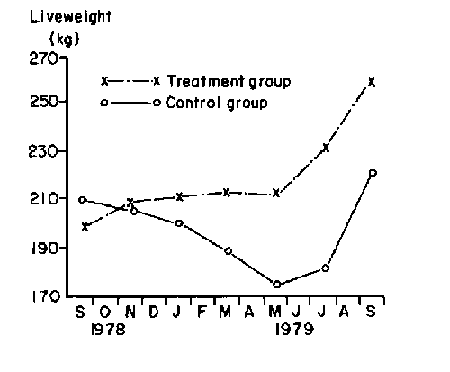
The experiment was essentially a continuation of the trial on the effects of dietary protein levels on early growth. After the completion of that experiment, 27 heifers were returned to rainfed grazing and in addition received 1 kg/head/day of a concentrate mix. These heifers averaged 200 kg at an age of 1.5 years in September 1978 and were compared during the 12 month experimental period with 22 heifers aged 3.5 to 4.0 years in the main herd weighing 209 kg at the start of the period. The latter group was allowed range grazing only during the experimental period. Both groups of animals were weighed seven times, once at the beginning of the experiment and subsequently at intervals of 2 months.
Results
Patterns of the weight changes of the two groups are shown in Figure A. 1. Animals in the control group started to lose weight in the early dry season, while heifers that were fed concentrates not only maintained weight throughout the cold winter and hot summer periods but also increased on average by 13 kg from September to May. The treatment group also started to gain weight earlier following the onset of rain. During the main part of the rainy season, the control group gained 46 kg compared with 28 kg by the treatment group but control animals were 35 kg lighter than the treatment animals at the end of the experiment in spite of being 9 kg heavier at the start.
Figure A.1. Seasonal changes in weight in two groups of Kenana cattle on range grazing with the treatment group fed 1 kg concentrate per day as a supplement.
Discussion
It was considered that continuous feeding of 1 kg of concentrate was too expensive to be of value but the experiment demonstrates that, under adequate levels of feeding, Kenana heifers could achieve growth rates which induced puberty at an early age. It was suggested that molasses and urea supplements fed at night during the dry season might promote similar growth and enable most heifers to be mated at 3 years old.
Materials and methods
Seventeen heifers from Um Banein were divided into two groups. One (the control group) was managed in accordance with the normal practices of the University farm, comprising ad lib roughage (lucerne, groundnut hulls or sorghum straw) and an irregular supply of an 18% protein concentrate, depending on availability. Daily allowances of both roughage and concentrate were very variable for the control animals, which were group fed. Animals in the treatment group were fed individually on groundnut hulls and a 17% protein concentrate, both fed separately ad lib. Amounts available for the control group were regulated by the management of the University farm, those for the treatment group by the research staff. Both groups were weighed twice weekly after an overnight fast.
Results
There were no significant differences (P>0.05) in roughage intake between the groups. The treatment group, however, had significantly higher (P<0.001) intakes of concentrates, DM, digestible CP and ME (Table A.4). Heifers in the treatment group gained weight more rapidly than the controls and were heavier throughout the trial period. Control heifers had a food conversion efficiency of 12.4 (kg DM consumed/kg gain) compared with 10.8 for the treatment group. Treated heifers achieved puberty (being considered as age at first oestrus) 68 weeks earlier than the controls (P<0.001) and were first served 67 weeks earlier (P<0.001).
Discussion
The treatment heifers, although younger, were heavier at first oestrus than the controls. It is possible that the diet was deficient in Vitamin A and thus delayed oestrus (or at least reduced the external symptoms of heat such that oestrus was not detected) until the animals were considerably heavier than might be expected. Some support for this hypothesis is provided by the fact that most treatment heifers came into heat on being fed 2 kg of green lucerne per day, which was estimated to contain 150 000 to 200 000 I.U. of Vitamin A. The experiment showed that adequate nutritional levels can lead to earlier maturity in Kenana heifers, thus shortening the unproductive life of the animals. Other benefits include shortening the generation interval, reducing rearing costs (mainly through less requirement for labour) and increasing overall lifetime reproductive performance. These benefits lead to greater meat production from surplus male animals as well as maximising total lifetime milk production.
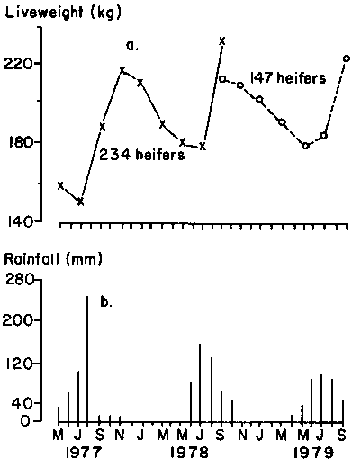
Data are available for a number of heifers whose weights were followed from May 1977 to September 1979. Animals were weighed at intervals of 2 months during this period. Weights were assigned to groups of animals in age classes covering 6 months. Records for 234 heifers, ranging from 6 months to 5 ½ years in May 1977, were available and this group was used until September 1978, when their ages ranged from 1 ½ to more than 6 ½ years. A smaller group of 147 animals was weighed from September 1978 to September 1979. All animals were kept on the natural range area of the station but occasionally had access to crop residues from adjacent areas.
Table A.4. Feed intake, liveweight changes and reproductive performance of two groups of Kenana heifers at Khartoum University Demonstration Unit.
|
|
|
|
Control group |
Treatment group |
|
|
Daily feed intake:
|
roughage |
(kg) |
2.095 |
2.150 |
|
|
concentrate |
(kg) |
0.919a |
2.990b |
||
|
total DM |
(kg) |
3.014a |
5.140b |
||
|
digestible CP |
(g) |
290a |
455b |
||
|
ME |
(MJ) |
26.8a |
38.9b |
||
|
Weight:
|
at start of experiment |
(kg) |
83 |
83 |
|
|
at first oestrus |
(kg) |
243a |
308b |
||
|
at first service |
(kg) |
245a |
314b |
||
|
ADG |
(g) |
138a |
470b |
||
|
Age:
|
at start of experiment |
(weeks) |
28 |
26 |
|
|
at first oestrus |
(weeks) |
161a |
93b |
||
|
at first service |
(weeks) |
163a |
96b |
||
Along rows, means without a common superscript differ significantly (P<0.001).
Figure A.2. Average growth curve for Kenana heifers up to about 6 years old at Um Banein.
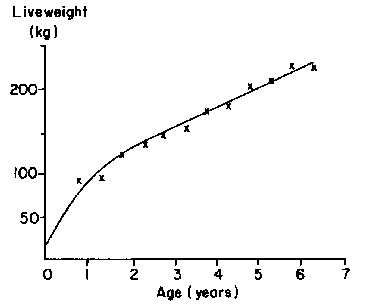
The growth pattern established for animals from within specified age groups is shown as Figure A.2, the weights in the Figure being averages for groups within age sets over a 2-year period. Overall growth rates from 9 months to 5 years and 3 months of age were very slow, averaging about 70 g/day. Due to the high stocking rates prevailing at Um Banein during the 1970s, post-weaning growth was confined essentially to a 4-month period beginning just after the onset of the rains and ending in November. Compensatory gains during this period of adequate fodder availability were quite good although they varied with the age of the animal. For example, in the age range of 1 to 2 years, the average daily gain was 450 g over a 120-day period: for animals aged 4.5 to 5.5 years, the ADG was about 690 g. Corresponding weight losses during the dry season resulted in net gains of 33 kg in the youngest group and of 19 kg in the oldest group over a 12-month period. The seasonal patterns of fluctuation in relation to rainfall are shown in Figure A.3.
Figure A.3. Effects of season on (a) weights of growing Kenana heifers in relation to (b) patterns of rainfall at Um Banein.