B.H. Ogwang and M.S. Mkhabela
Faculty of Agriculture
University of Swaziland
P. O. Luyengo, Swaziland
Abstract
Introduction
Cropping patterns
Animal performance on natural pastures in Swaziland
The pattern of crop residue utilisation on SNL
The nutritive value of maize stover
References
The problem of feed shortage for grazing livestock in the communal areas of Swaziland has been widely recognised and many attempts have been made to rectify the problem. This paper highlights some of the research results that have been obtained relating to the potential contribution of maize stover to the feed budget of the livestock. Hybrid maize varieties produce higher stover yields than traditional varieties but have comparable quality constraints to their adoption in the farming system and strategies to improve their quality are discussed.
Crop residues are a useful source of supplementary feed for ruminant livestock in the tropics and sub-tropics. Topps (1977) reported that in the southern Africa region, animals grazing natural pastures without supplementary fodder may lose up to 30% of their maximum summer body weight in winter which obviously has an adverse effect on their reproductive rate and general performance.
In Swaziland, crop residues are used extensively in winter by smallholder farmers. These farmers live on what is known as Swazi Nation Land (SNL), rearing some 80% of the national herd under a strongly traditional system of management characterized by communal grazing. Because stock numbers are not controlled in this sector, most of the communal grazing areas are overstocked and annual losses of livestock due to malnutrition are believed to be generally high. The remaining 20% of the ruminant animals are raised under more favourable conditions on private and parastatal farms or on government ranches.
Although crop residues should and probably do play a critical role in meeting the winter feed deficit on SNL, their use tends to be somewhat haphazard and their contribution to the annual feed budget of grazing livestock have not been studied. The data presented in this paper is drawn mainly from a survey of rural homesteads which was conducted between 1985 and 1987 in the middleveld. The middleveld is one of the four major topographical regions of Swaziland. It has an environment which is ideal far mixed farming and a wide variety of crops are grown in association with over 1/3 of the national cattle population (Anonymous, 1987). Some data from current on-station studies of crop residue yield and quality are also included.
Almost all small-scale farmers on SNL grow crops mainly for domestic consumption. The major crops grown are presented in Table 1. The table shows that maize, which is the staple food in Swaziland, occupies the bulk of the total cropped area (currently estimated at some 58,362 ha) compared to the next important crop, cotton, which occupies a relatively small fraction (13%) and is confined almost exclusively to the lowveld.
Table 1: The percentage of cropped areas by region for major crops on SNL
|
|
High veld |
Middle veld |
Low veld |
Lubombo |
Swaziland |
|
Maize |
85 |
85 |
56 |
84 |
76 |
|
Cotton |
1 |
2 |
34 |
2 |
13 |
|
Beans |
5 |
2 |
- |
6 |
2 |
|
Cowpeas |
1 |
3 |
3 |
1 |
2 |
|
Groundnuts |
1 |
4 |
2 |
3 |
2 |
|
Sorghum |
2 |
1 |
3 |
1 |
2 |
|
Jugo beans |
1 |
1 |
1 |
1 |
1 |
|
Sweet potatoes |
2 |
1 |
- |
1 |
1 |
Source: Survey of SNL during 1982/83 cropping season, Central Statistics Office, Mbabane. Swaziland
The current survey which covered 350 homesteads in the middleveld revealed a similar trend (Table 2). Maize, often intercropped with pumpkins, was the dominant crop, taking as much as 88% of the total arable land in comparison to the next crop, beans, which occupied only 4% of the land.
Table 2: The proportion of homesteads growing each crop and the area allocated to the crop per homestead.
|
Crop |
% of homesteads growing crop |
% of total area occupied by crop |
|
Maize |
99 |
88 |
|
Beans |
29 |
4 |
|
Groundnuts |
20 |
3 |
|
Sweet potatoes |
20 |
2 |
|
Others |
13 |
3 |
The dominant position of maize in the farming system constitutes the basis for the current research thrust on maize stover as a feed resource on SNL.
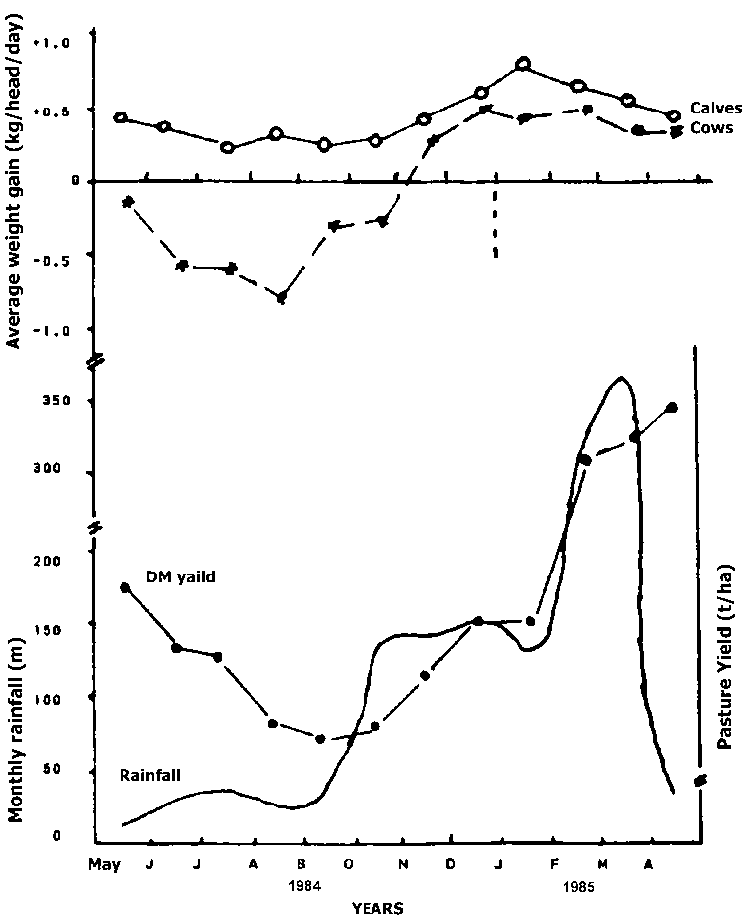
The performance of animals grazing natural pastures is usually affected by rainfall patterns and available vegetation. The body weight changes of beef cattle presented in Figure 1 is typical of the trend to be expected from livestock grazing natural pastures in Swaziland. Maximum weight gains occur in summer (December to February): much of this weight being lost in winter (June to September) when there is insufficient amount of good quality forage. The weight changes in Figure 1 were monitored on Nguni cattle, the common breed, which is of the Sanga Zebu type. However, due to understocking at Luyengo University farm, the performance of the cattle was probably much better than that of livestock grazing on SNL.
The pattern of crop residue utilisation was examined by monitoring cattle grazing activities in 20 homesteads in the middleveld over a period of 8 months. It was observed that during summer (October to March), the cattle spend almost all the grazing hours on the the veld (natural) pasture in the communal grazing areas). For the rest of the year, the animals graze partly on the veld and partly on maize stover (Table 3).
Table 3: Total and crop residue grazing times (N=20).
|
Month |
Total grazing time (hours/day) |
Crop residue grazing time (hours/day) |
% of total time spent on crop residues | ||
|
|
Mean |
SD |
Mean |
SD |
|
|
March |
9.1 |
0.91 |
0 |
- |
0 |
|
April |
8.8 |
1.09 |
0.2 |
0.04 |
2 |
|
May |
9.3 |
0.84 |
3.1 |
0.27 |
33 |
|
June |
9.2 |
0.92 |
6.5 |
0.55 |
71 |
|
July |
8.4 |
0.96 |
4.6 |
0.39 |
55 |
|
August |
8.7 |
0.97 |
1.7 |
0.33 |
19 |
|
September |
9.2 |
0.93 |
0.5 |
0.03 |
5 |
|
October |
9.4 |
0.89 |
0 |
- |
0 |
The period of intensive stover utilisation is between May and July. When most of the stover has been consumed, the animals will normally be left to graze on weeds, on fallow land and in river valleys until they become completely dependent on natural pasture in the communal grazing areas.
These results indicate that maximum utilisation of maize stover takes place during the critical winter months although the stover does not provide adequate grazing for the entire period. That livestock continue to lose weight even while grazing on the stover is probably a reflection of the quantity produced, its quality as well as the form in which it is consumed.
Figure 1. Some pasture parameters affecting the livestock gain of cattle at Luyengo.
SNL farmers use many modern production practices and cash inputs such as tractor hire for ploughing, on-drawn planters, hybrid seed, pesticides and chemical fertilizers. Table 4 shows the percentages of crop fields that receive some of these inputs.
Table 4: The use of modern inputs on SNL farmers' fields (includes only RDA's).
|
Season |
Use of ox-drawn planter |
Use of hybrid maize seed |
Use of fertilizer basal application |
|
1980/81 |
46.9 |
61.4 |
72.6 |
|
1981/82 |
54.1 |
63.8 |
72.9 |
|
1982/83 |
50.9 |
69.5 |
70.2 |
|
1983/84 |
48.6 |
74.0 |
77.0 |
Source: RDA Management Unit (1984)
It is clear from Table 4 that the use of modern inputs for maize production in rural Swaziland is relatively high compared to other countries in the southern Africa region. The increasing trend in the use of hybrid maize, which yields higher than traditional varieties, prompted the current investigation on stover yield potential as well as its quality. During the 1987/88 cropping season, stover yields of 15 high ranking maize hybrids currently grown in a trial by Malkerns Research Station were measured. The trials were carried out at two locations; one in the highveld (Mangcongco) and the other in the middleveld (Malkerns Research Station). The means for these two locations are presented in Table 5.
Table 5: Grain yield, stover yield, stover/grain ratio and leaf yield of 15 hybrid maize varieties (means for Malkerns and mangcongco during 1987/88 cropping season).
|
Variety |
Grain yield t/ha |
Stover yield t/ha |
Stover/grain ratio |
Leaf yield t/ha |
|
PNR 6549 |
6.3 |
7.1 |
1.1 |
2.9 |
|
**PNR 6429 |
5.7 |
5.8 |
1.0 |
2.3 |
|
CG 4305 |
5.7 |
5.7 |
1.0 |
2.1 |
|
*CG 4403 |
5.4 |
5.1 |
0.9 |
1.7 |
|
*SNK 2147 |
5.3 |
7.7 |
1.4 |
3.1 |
|
*RO 415 |
5.3 |
6.9 |
1.3 |
2.6 |
|
CG 4609 |
5.2 |
6.2 |
1.2 |
2.4 |
|
*TX 379 |
4.9 |
10.1 |
2.1 |
4.2 |
|
*PNR 473 |
4.8 |
6.7 |
1.4 |
2.7 |
|
*A 323W |
4.8 |
6.5 |
1.4 |
2.9 |
|
*AX 305W |
4.5 |
4.7 |
1.0 |
2.1 |
|
*SR 52 |
4.3 |
11.8 |
2.7 |
3.7 |
|
*SSM 2039 |
4.3 |
6.3 |
1.5 |
2.6 |
|
*S 201 |
4.3 |
5.9 |
1.4 |
1.2 |
|
SAM83 TZRW |
3.5 |
7.8 |
2.2 |
3.6 |
|
MEAN |
5.0 |
7.0 |
1.4 |
2.7 |
* Recommended varieties for 1988/89 cropping season by Malkerns Research Station, Ministry of Agriculture and Cooperatives.
When the proportion of hybrid maize seed used by small-scale farmers is ignored, the average maize grain yield on SNL is around 1.4 t/ha (FAO, 1984) with a stover yield of 5.0 t/ha (Ogwang, 1988). By using hybrid seed, the farmer can almost quadruple his grain yield and at the same time significantly increase his stover yield (Table 5). The stover/grain ratio for the hybrids average 1.4:1 while traditional varieties have ratios in the region of 2.5:1 (Ogwang, 1986, unpublished data). It appears that as selection progresses towards maximum grain yield, there is a reduction in the quantity of stover produced. This would seem to suggest the need to encourage the use of hybrids such as SNK 2147 and TX 379 which have superior leaf yields since this component has a higher quality compared to the stem fraction in crop-livestock production systems.
Malkerns Agriculture Research Station is responsible for the conduct of national maize performance trials and subsequent variety release recommendations. Selected varieties are multiplied by the Seed Multiplication Project of the Ministry of Agriculture and Co-operatives for distribution to growers. An efficient, mainly private sector distribution network exists in the country which allows the maize to get close to the farming communities. Once the stover component becomes an important selection criterion at the Research Station, it should be possible to get high stover yielding varieties to farmers within a reasonably short time through this distribution network.
One of the major drawbacks in the use of hybrid maize has so far been inability of SNL farmers to obtain yields close to those presented in Table 5. Although the rate of fertilizer use is increasing (Table 4), it appears as if many farmers apply it at sub-optimal levels (de Vletter, 1983). The situation is probably similar with other inputs. Factors contributing to these practices need to be investigated.
A large number of researchers have evaluated untreated cereal stovers and have concluded that they cannot maintain an animal when fed alone. Although chemical analyses are still in progress in this study the crude protein figures given in Table 6 indicate that the quality of our hybrid stovers is likely to be comparable to that of others reported elsewhere.
Table 6: The CP content of hybrid maize varieties (means for Malkerns and Mangcongco during 1987/88 cropping season)
|
Variety |
CP (DM basis) |
|
PNR 6549 |
3.5 |
|
PNR 6429 |
3.2 |
|
CG 4305 |
3.2 |
|
CG 4403 |
3.4 |
|
SNK 2147 |
3.7 |
|
Ro 415 |
3.3 |
|
CG 4609 |
4.0 |
|
TX 379 |
3.6 |
|
PNR 473 |
3.3 |
|
A 323W |
3.6 |
|
AX 305 |
3.4 |
|
SR 52 |
3.4 |
|
SSM 2039 |
3.3 |
|
R 201 |
3.4 |
|
SAM83 TZRW |
3.7 |
|
*CHECK |
3.8 |
*Average CP content of maize stover sampled from 20 homesteads on SNL.
The low crude protein levels raise the question of stover treatment and supplementation, a subject which has received wide coverage in recent years. These preliminary studies have indicated positive results when the stover is treated with NaOH (Table 7) or when supplemented with urea, molasses and maize grain (Table 8).
Table 7 shows that the addition of NaOH to maize cobs improves their in vitro organic matter digestibility and Table 8 shows that supplementing maize cobs with urea, molasses and maize grain has a similar effect.
Table 7: The effect of varying concentrations of NaOH on the in vitro organic matter digestibility of maize cobs (Zwane 1988)
|
Concentration of NaOH (g/100 ml water) |
maize cob organic matter Digestibility (%) |
|
0 |
18.4 |
|
5 |
31.2 |
|
7 |
36.1 |
|
10 |
51.9 |
|
20 |
55.0 |
Table 8: The effect of supplementation with various ingredients on the in vitro dry matter digestibility of maize cobs (Adapted from Hlophe, 1987)
|
|
Proportion of |
|
| |
|
Maize cobs |
Urea |
Molasses |
Yellow maize |
% digestibility |
|
100% |
- |
- |
- |
6.3 |
|
98% |
2% |
- |
- |
29.2 |
|
90.5% |
2% |
7.5% |
- |
34.2 |
|
83% |
2% |
- |
15% |
30.3 |
|
75.5% |
2% |
7.5% |
15% |
50.5 |
It remains to be seen if these trends will hold true in actual feeding trials. A lot of emphasis will be put on molasses in particular since it is a by-product of Swaziland's number one export crop, sugar- During 1985, 127,200 metric tonnes of molasses were produced and 72,400 tonnes were exported (Lebbie, 1988) leaving a very generous balance which, at the current factory price of 7 US dollars equivalent per metric tonne, could be very attractive for livestock feeding.
Moving to the feeding phase, will be met with numerous constraints to the adoption of any subsequent stover technology. Some of these constraints were identified from the 1986/87 survey of rural homesteads in the middleveld and are presented in Table 9.
Table 9: Summary of constraints identified in a survey of rural homesteads in the middleveld.
|
Technical: | |
|
|
Inadequate use of hybrid maize seed |
|
|
Improper agronomic practices |
|
|
Site specific problems |
|
|
Very few farmers store the stover (15%) |
|
Economic: | |
|
|
No money for inputs |
|
|
Credit hard to get |
|
|
Inputs not available |
|
|
Seeds not easily available |
|
Social: | |
|
|
Inadequate labour for harvest' transport and storage |
|
|
Lack of farming orientation |
|
|
Livestock reared for economic and intangible values |
|
|
Communal grazing of stover |
Although the constraints are divided into 3 distinct categories it should be pointed out that there are few problems that will fall in only one category. But these constraint groups should provide a guideline on the research direction needed to improve the utilisation of crop residues by grazing livestock on SNL. A practical and systematic feeding package needs to be developed based particularly on hybrid maize varieties.
Anonymous, 1987. Livestock census for 1986. Ministry of Agriculture and Cooperatives, Mbabane, Swaziland.
Food and Agriculture Organisation of the United Nations (FAO), 1984. The maize industry of Swaziland. A Mission Report TCP/SWA/4401, Vol. 2, Technical Annexes. FAO, Rome.
Hlophe, R.H. 1987. Investigation on the effect of adding urea, yellow maize and molasses on the in vitro dry matter digestibility of corncobs. B.Sc. dissertation, Faculty of Agriculture, University of Swaziland, Kwaluseni, Swaziland.
Rural Development Areas (RDA) Management Unit, 1984. Estimation of output: 1983/84. Ministry of Agriculture and Cooperatives, Mbabane, Swaziland.
Lebbie, S.H.B. 1988. The potential of agro-products as livestock feed resources in Swaziland - an overview. University of Swaziland Research Journal Vol. 1: 1-13.
Topps, J.H. 1971. The use of non-protein nitrogen for ruminants grazing low protein pasture in Africa. FAO report on an ad hoc consultation on the value of non-protein nitrogen for ruminants consuming poor herbages. Kampala, Uganda.
de Vletter, F. 1983. The Swazi rural homestead. Social Science Research Unit, University of Swaziland, Kwaluseni, Swaziland.
Zwane, M.D. 1988. An investigation on the effect of sodium hydroxide treatment on the in vitro organic matter digestibility of corncobs. B.Sc. dissertation, Faculty of Agriculture, University of Swaziland, Kwaluseni, Swaziland.