Jonathan Timberlake
Instituto Nacional de Investigacao Agronomica, Maputo c/o UNDP, C.P. 4595, Maputo, Mozambique
Celia Jordao
Unidade de Direccao de Carnes, Maputo
UDC., C.P. 1863, Maputo, Mozambique
Introduction
A brief description of Mozambique
Livestock and livestock-production systems
Natural pastures
Improved pastures and forages
Crop by-products and crop residues
Present strategies and constraints
Research priorities
References
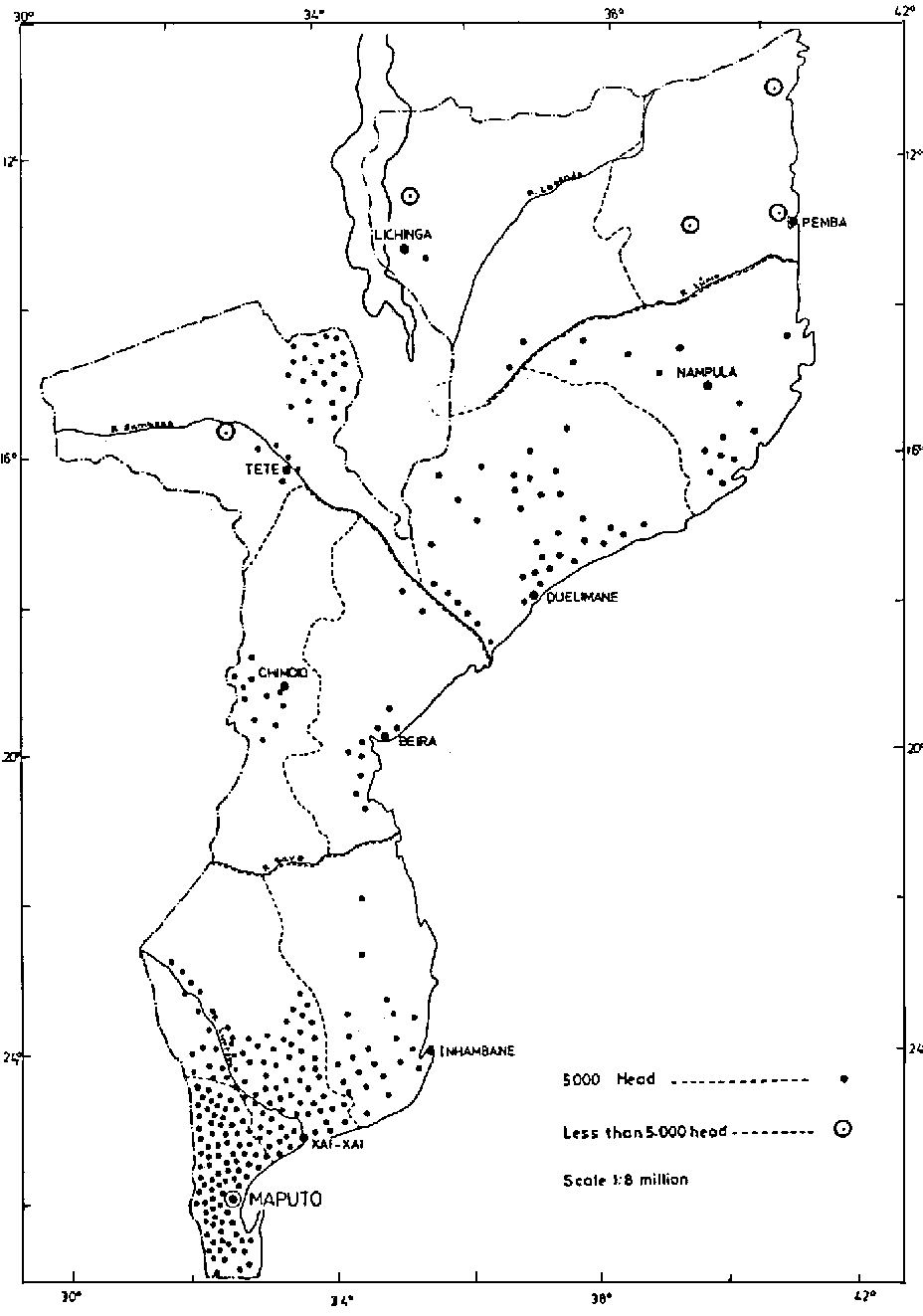
The principal form of livestock in Mozambique is cattle, which are raised traditionally in an extensive manner on natural pastures. Most of the national herd is concentrated in the relatively tsetse-free southern fifth of the country south of the Rio Save (Figure 1). Although concentrated, the cattle numbers are not so high as to cause large areas to be overgrazed. This is partly due to the reasonable rainfall and productive pastures of much of the zone.
Mozambique has a low cattle population considering its size (1.77 cattle/km² and population (0.1 cattle/habitation (UDC 1981)). Indeed, it is one of the lowest in Africa. This can be explained by the presence of tsetse, large areas of woodland unsuitable for grazing, and no tradition of livestock raising among much of the population.
Other important livestock for small-scale producers are goats, sheep, pigs, ducks, chickens and, increasingly, rabbits.
The principal activity of the estimated 1984 population of 13.3 million is agriculture, which employs 3.5 million economically-active people, mostly in the form of crop raising for subsistence. This is done on small plots, which are nearly all on light soils and cultivated by hand.
Agricultural activity is commonly divided into four sectors: state farms, private farms, co-operatives and the family sector. The family sector can be further divided into those practicing traditional methods of agriculture (hereafter termed traditional farmers), and smallholders. Smallholders are mostly concentrated in areas close to the major towns (the "Zones Verdes") and practice improved forms of management with higher inputs. Their attitude is somewhat or wholly commercial, hut the area cultivated and number of animals kept remains small. The family sector possesses 76% of the national cattle herd (Table 2) but in terms of commercialized offtake provides only 23% of the national total (Dionisio 1985). The co-operative sector is of little significance with regard to cattle.
Table 1. Agricultural areas in use by sector (1980 data)
|
Sector |
Area of land utilized (ha) |
% |
|
State farms |
250,000 |
10.5 |
|
Co-operatives |
75,000 |
3.1 |
|
Private farms |
65,000 |
2.7 |
|
Family farms |
2,000,000 |
83.7 |
|
Total |
2,390,000 |
100 |
Table 2. Livestock population by sector, 1980
|
Animal |
Sector |
No. of Head |
|
Cattle
|
Familya |
1,001,813 |
|
Commercialb |
383,155 |
|
|
Total |
1,384,968 |
|
|
Goats and sheepc
|
Family |
413,280 |
|
Commercial |
12,558 |
|
|
Total |
425,838 |
|
|
Pigs |
Family |
176,599 |
|
|
Commercial |
41,240 |
|
Total |
217,839 |
|
|
Rabbitsd
|
Family |
1,800e |
|
Commercial |
18,000 |
|
|
Total |
19,800 |
|
a. Peasant owned.
b. State farms and private.
c. Not recorded separately, but in 1974 16% of total in family sector were sheep.
d. Pavesi 1985.
e. Estimated minimum
Source: FAO 1982a and others
Due to reasonable climatic and soil conditions over much of the country the natural potential for pasture and feed production is high. But there is still no tradition of provision of feed to small ruminants and cattle in the traditional sector; all grazing is from natural pastures and, locally, crop residues. The necessity to cultivate feeds for pigs, chickens and rabbits, when feed requirements exceed the feed and scraps that can be collected locally, is a severe limitation to future expansion of production.
Fig. 1 - Cattle distribution in Mozambique in 1975
Des: Maciel/PED/8418
Mozambique covers an area of 799,380 km² between 11° and 27°S latitude, and ranges in altitude from 1,600 m to sea level, with an extensive (2,800 km) coastline along the Indian Ocean. Much of this area is under 200 m and consists of coastal plains of sedimentary deposits between the Zambezi and Limpopo Rivers. Three major rivers cross the country - the Zambezi, the Sare and the Limpopo. The valleys and flood plains of the Zambezi, Limpopo and Incomati rivers provide fertile soils, and it is here that a large proportion of the country's cattle are found.
Mean annual rainfall ranges - from 350 mm near the Mozambique/Zimbabwe/South Africa border to 2,000 mm in the highlands of Zambezia. North of the Rio Save the rainfall is more concentrated with a long dry season, except in parts of the coast. South of this, rainfall is less concentrated in distribution and winter rains can be encountered in areas closer to the coast. The range of climate, topography, geology and vegetation gives a very diversified environment.
Livestock numbers in the country and in the family sector are shown in Table 2.
Cattle
Until Independence in 1975 cattle numbers had been growing at about 2% per annum (Dionisio 1985). At Independence many of the colonial farms were abandoned and many cattle found their way into the family sector. Following the decrease in total numbers after independence there was an increase of about 2.3% per annum until 1981. In the last few years the cattle population has been decreasing substantially in all sectors due to drought and problems associated with reduced security in rural areas.
Cattle in the family sector are almost exclusively of the Nguni type (called Landim in Mozambique) in the south, and of the Angoni type (the same as the Malawi Zebu) in Angonia close to Malawi. A few improved crossbred dairy cattle are raised by smallholders in some areas.
Cattle are kept in a traditional manner and for the traditional reasons of status, brideprice, as a means of storing and acquiring capital, risk-reduction in mixed-farming systems, draught power, for home consumption, for meat production and milk production. Draught power is very important on the heavier soils of the Limpopo and Incomati river basins and on the sandy soils of coastal Inhambane. Less than 100,000 ha is ploughed by animals out of a total of 2 million ha cultivated by smallholders throughout the country (FAO 1982b). Average herd size is around 10 head, and the herd is usually grazed on communal pastures or fallows during the day and gathered in kraals at night.
There is no supplementary feeding and by the end of the dry season in some places cattle have to walk 20-30 km to drink and only drink every two days.
In 1979 the average commercial offtake from the national herd was 4% with a family-sector offtake of 2.2%. However, this does not consider local slaughter, and a more realistic estimate of family-sector offtake would be 5% per annum (FAO 1982b).
Goats
Goats and sheep are more evenly distributed over the country and appear to be the principal form of livestock in drier parts of the north. Virtually all are of the local Landim breed (southern African small-eared type) and are kept close to the villages. Many are tethered in semi-urban areas. Normally no supplements are given. Postnatal is an important factor, but otherwise disease mortality incidence is unknown. Given their size and reproductive rate goats represent a valuable form of livestock production for smallholders.
Pigs
Pig numbers in the smallholder sector increased substantially after Independence. In the traditional sector pigs are mostly left to forage, but smallholders tend to raise them in enclosures and provide feed. Generally only one or two pigs are kept per family due to problems with provision of feed. Many fruit are used, e.g. pawpaws and mangoes, along with locally-collected green feed.
Poultry
Chickens are commonly kept around homesteads and fed on scraps and winnowings, but there is as yet no commercialization of smallholder production. Attempts are being made to encourage production in cooperatives using locally-mixed rations, and to encourage the use of local plants. Ducks are quite common too, and are fed on locally-collected fresh green feeds.
Rabbits
Production of rabbits in the smallholder sector, particularly those around urban centres ("Zones Verdes"), has been actively encouraged in recent years. Pregnant females are provided by state breeding farms and raised in housing constructed from local materials. At this level of production feeding can be adequate using locally collected grasses and other plants. But beyond a population of 10-15 animals this becomes too difficult. This form of livestock production has shown some success in the smallholdings surrounding the major towns, particularly Maputo, where sufficient extension services are available.
Practically all of the cattle and goats in the smallholder sector are raised on natural pastures. Average stocking rates in the two main livestock raising-provinces of Maputo and Gaza are around 9 ha/LU* and 26 ha/LU respectively (1981 data). Overgrazing is not generally a problem, although it can be quite marked and severe around water sources. There is thought to be still room for expansion in cattle numbers, perhaps of the order of 20%, in these provinces.
Pastures in Mozambique can be divided into sweet and sour types. Sweet pastures are those found in the drier or more variable climatic zones, particularly on heavier soils, and are usually dominated by Themeda triandra, Panicum maximum, P. coloratum, Digitaria eriantha and Eragrostis spp. They can support grazing throughout the year. Sour pastures are found in the higher rainfall areas and are usually dominated by Hyparrhenia spp., Hyperthelia dissoluta, Andropogon spp. and Heteropogon contortus. They show high levels of plant production, but protein content falls rapidly on flowering and cannot support cattle production through the year without supplementary feeding. Most of the smallholder cattle are concentrated in areas of sweet or semisweet pastures. Browse is an important dry-season feeding resource in these areas (Walker 1980). The major species are Colophospermum mopane (xanate or mopane), Acacia spp. and some species of Combretum.
Very few data exist on actual or potential carrying capacities on the different pasture types. However, accepted estimates for ranching are of the order of 3-4 ha/LU on Themeda pastures on fertile soils in the 700 mm rainfall zone with some winter rains, to 8 ha/LU on the mixed Themeda pastures on seasonally flooded soils of the Limpopo Valley in the same rainfall zone. In mopane bushland or open woodland in the 400 mm rainfall zone estimates for the family sector in the major cattle-raising district of Magude, have been put at between 4 and 6 ha/LU (FAO 1983). A comparison of the available natural resources, e.g. climate, soil, fertility, pasture species, distribution of water, and accepted carrying capacities in different parts of Maputo Province would suggest that accepted values for the family sector are higher than those for commercial ranching in similar areas. This requires further investigation and would be of great importance in livestock planning in Mozambique.
Shortage of dry-season grazing is an important constraint to improved cattle production, although the major constraint is thought to be the limited distribution of dry-season water sources. The provision of water by the use of small dams, greater use of strategic family fodder banks, and improvement in the cultivation of crops and use of crop residues, are seen as ways of ameliorating dry-season feeding problems.
A model of potential pasture productivity is presently being developed by Reddy and Timberlake (1985), based on models developed in Australia and on productivity data from Zimbabwe. The model uses potential evapotranspiration, annual rainfall and soil-moisture holding capacity to give the potential productivity of natural pastures with no tree or bush cover. The annual variations in production are also being calculated for a range of sites. The order of the results (see Table 3) seems to be reasonable, but no experimental data are available to support any conclusions. In addition, attempts are being made to link geological and soil-survey data, particularly regarding soil fertility and calcium levels, to pasture quality and species composition Again few supporting experimental data are available but it is hoped that this work will help in formulating guidelines for more rational pasture utilization.
Table 3. Potential pasture primary-productivity estimates for four locations in Mozambique on different unfertilized soil types at various probability levels
|
Location
|
Mean Annual rainfall (mm)
|
Potential evaporation (mm/year)
|
% probabilitya
|
Total dry-matter production (tonnes/ha/year)b |
|
|
100 mm AWC |
200 mm AWC |
||||
|
Pafuri
|
357
|
2,024
|
75 |
0.72 |
0.73 |
|
50 |
1.06 |
1.09 |
|||
|
25 |
1.42 |
1.47 |
|||
|
Catuane
|
577
|
1,622
|
75 |
1.92 |
2.02 |
|
50 |
2.51 |
2.77 |
|||
|
25 |
2.91 |
3.40 |
|||
|
Tete
|
627
|
1,911
|
75 |
1.90 |
2.01 |
|
50 |
2.34 |
2.55 |
|||
|
25 |
2.68 |
3.02 |
|||
|
Ilha de Mocambique
|
814
|
1,536
|
75 |
2.95 |
3.49 |
|
50 |
3.04 |
3.91 |
|||
|
25 |
3.04 |
4.17 |
|||
Source: Adapted from Reddy and Timberlake 1985.a. Percentage of total years at which value can be expected.
b. Potential total dry matter production of natural grassland assuming no bush cover, negligible slope, and soil fertility not limiting.
c. 100 mm available water capacity soils represent sandy soils and 200 mm AWC soils represent clay soils.
There exists much potential in Mozambique for the cultivation and use of forage crops as the country has adequate rainfall and good potential for irrigation in many of the larger river valleys.
Traditional farmers do not normally feed their cattle or goats, relying on natural pastures or what the animals can find for themselves. With the increased use of animal draught power in certain areas, and the gradual intensification of production by some of the subsistence farmers, much effort will have to be put into determining suitable forage species and practices, and the productivity levels possible.
Forages grown under irrigation or dry land are commonly used for dairy cattle on State farms. The major species used for green feed is elephant grass (Pennisetum purpureum) and, more locally, lucerne, siratro, Cenchrus ciliaris and Leucaena (Timberlake and Dionisio 1984). No surveys have been made of smallholder usage but elephant grass is grown widely and successfully in moister locations. Leucaena leucocephala has shown promise in some areas (Ludemann 1984) and could prove well suited to traditional farmers' requirements and abilities, particularly for goat production.
One crop occasionally grown by smallholders for its edible seed is Dolichos lablab (= Lablab purpureus). This grows very well on better drained fertile soils in southern Mozambique with 600-800 mm rainfall, and remains green through the dry season. It would seem to have good potential as a dual-purpose crop being already well known and accepted. Sweet-potato leaves are often used as animal feed, and Amaranthus retroflexus is used as pig feed as well as a vegetable in some areas (Basto 1984).
Investigations are being carried out on urea treatment of rice straw (de Vries, personal communication). The technique is promising as large amounts of rice are grown by smallholders in parts of the Limpopo Valley and the straw is presently unutilized. In this area animal traction is extensively used and there is an increasing shortage of feed for the oxen. Large amounts of molasses are also available not too far away and it has been suggested that some of this could be sold to ox-owners for supplementary feeding, particularly at the times of the year when ploughing is in progress.
Some work has been carried out in recent years (Morgado 1985; Caulton and Wetlhii 1984; Pavesi 1985) into the identification of various native plants of value in the feeding of rabbits, ducks and chickens. Some of more widespread occurrence and use are shown in Table 4.
This work is continuing and it is hoped to obtain better data on their nutritive values, productivity and distribution in view of the potential and increasing raising of rabbits and ducks by smallholders. One result of this study is that, except on a very small scale, smallholders will have to devote some of their energies to the cultivation of suitable forages if they wish to raise larger numbers of these types of animals.
The areas of Mozambique climatically suited to the establishment of improved pastures under relatively low inputs and management (that is, those areas with a higher and more reliable rainfall) do not generally have a tradition of ruminant livestock raising. There is not thought to be much potential in the short and medium term for the use of any type of improved pasture in the smallholder sector.
Mozambique is a country with good agricultural potential and a range of crops can be grown. Many crops such as sugar, coconuts, cotton, maize, rice and sunflower are grown on a commercial scale and their byproducts can be used for animal feeds. Estimated or recorded quantities of these crops are shown in Table 5. Those used for animal feeds in the commercial sector at present are molasses, copra cake, cotton-seed cake and sunflower seed cake. Rice and maize bran are also used locally, but not sugarcane tops. The major problem with these byproducts is distribution as most of the large-scale agricultural production is in the centre and north of the country while the animal populations are in the south, which is less suited to crop production. Present levels of commercialized crop production are quite low and supplies are not always reliable. With all of these crops, except sunflower, the majority is produced by the State sector or by the larger private farms. Crop by-products are primarily used in the manufacture of feedstuffs for State livestock enterprises. Ration production in 1983 was running at 28,500 tonnes, of which 17,700 tonnes was for pigs.
Table 4. Some local plants as forage for small livestock species
|
Species |
Goats |
Pigs |
Rabbits |
Chickens |
Ducks |
|
Amaranthus deflexus |
x |
x |
x |
x |
x |
|
Psilotrichum boivinianum |
|
|
x |
x |
|
|
Commelina benghalensis |
|
x |
|
|
x |
|
Bidens pilosa |
|
|
x |
x |
x |
|
Parthenium hysterophorus |
x |
x |
|
x |
|
|
Sonchus cleraceus |
|
|
x |
x |
x |
|
Tridax procumbrens |
|
|
x |
|
|
|
Ipomoea plebia |
|
x |
x |
x |
|
|
Merremia tuberosa |
|
x |
x |
x |
x |
|
Cassia petersiana |
|
|
x |
|
|
|
Crotalaria monteiroi |
x |
|
x |
x |
|
|
Glycine wightii |
x |
x |
x |
x |
x |
|
Leucaena leucocephala |
x |
x |
x |
x |
x |
|
Stylosanthes mucronata |
x |
x |
x |
x |
x |
|
Boerhavia erecta |
|
x |
x |
|
|
|
Giesekia africana |
|
x |
x |
|
|
|
Oxygonum delagoense |
|
x |
x |
|
|
|
Portulaca cleracea |
|
x |
|
|
x |
|
Richardia brasiliensis |
|
|
x |
x |
x |
|
Solanum panduraeforme |
x |
|
x |
|
|
|
Lantana camera |
|
|
x |
|
|
|
Priva cordifolia |
|
|
x |
|
|
|
Ficus elasticus |
|
|
x |
|
|
|
Morus alba |
|
|
x |
|
|
|
Ipomoea equatica |
|
x |
|
|
|
|
Eichornia crassipes |
|
x |
|
|
|
Source: Caulton and Wetlhii 1984, and others
Presently small farmers do not make much use of crop by-products as the distance from the processing plants can be large, and little village-level processing takes place. Efforts are being made, particularly with chickens, to encourage use of rations in the cooperative sector using locally available products. Work has been carried out on the use of by-products (Wetlhii 1985), principally maize bran, for chicken and duck feed formulation in an attempt to reduce the imported component in feed formulations. The use of maize husks for feeding goats, and rice and maize bran for chickens and pigs, is often observed.
Few data exist on the importance or amounts of crop residues, but general observation shows that many fields are heavily grazed in the dry season or when fallow. It would seem that crop residues are an important source of cattle feed in the mixed-farming systems in southern Mozambique and in Angonia.
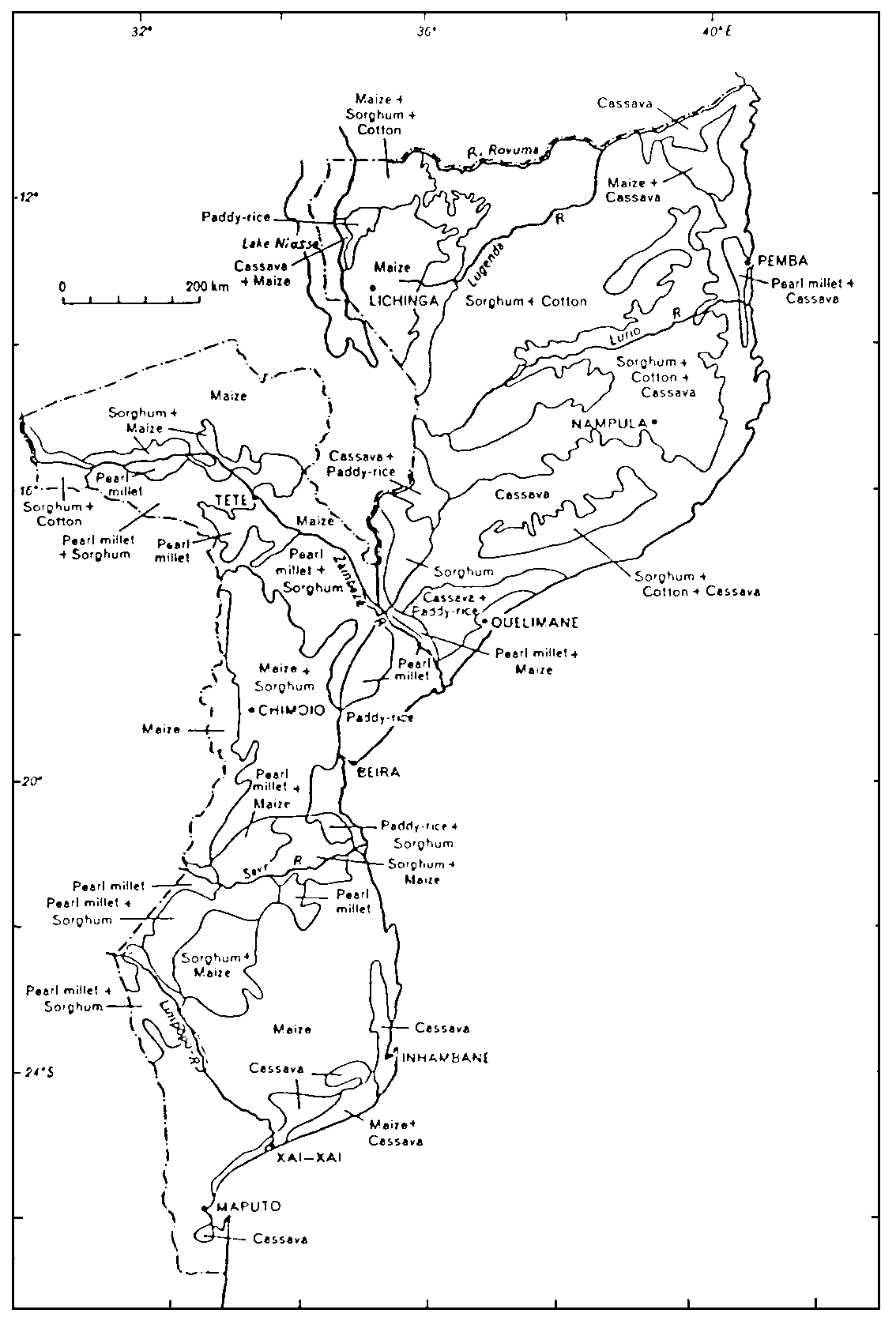
The areas where the major traditional-sector crops are grown are shown in Figure 2. In the cattle raising areas the main grain crops are maize, sorghum, and locally, rice. Groundnuts, pigeon pea (Cajanus cajan), and cowpea (Vigna unguiculata), are grown on lighter soils and common bean (Phaseolus vulgaris) on heavier soils, along with small areas of Lablab purpureus, mung bean (Vigna mungo) and chickpea (Cicer arietinum) (Heemskerk, personal communication). On lighter soils cassava is extensively grown, sometimes for sale by smallholder producers to commercial pig farms. Other crops are cotton, cashew, coconut, banana, sugarcane, pearl millet, finger millet, sweet potato and sesame. Fruits such as guava, pawpaw and mango are often used for pig feed.
The most important limiting factor in commercial livestock production is shortage of trained manpower for management. In recent years attention has been increasingly directed toward support of smallholder production and lower-capital inputs.
The feed resources used by smallholders for livestock production at present are predominantly natural pastures for cattle, sheep and goats. Even the few small farmers who possess genetically improved stock suitable for milk production do not practice supplementary feeding. Pigs are raised predominantly on what they find for themselves or on locally collected plant materials and scraps, while chickens mostly forage for themselves. Ducks and rabbits are fed locally-collected plant materials which are not usually systematically cultivated.
In the commercial sector a certain amount of deferred grazing is practiced on beef ranches and hay is sometimes made. Commercial dairy herds are raised on natural pastures with a certain proportion of silage, which is grown on the farm, freshly-cut feeds (in particular elephant grass), and some rations. Pig production, which is mostly in the State sector, is based on the use of rations, either mixed inside the country using what byproducts are available (copra, cotton-seed cake, bran), or imported premixed. Some rabbit-breeding enterprises grow lucerne or siratro under irrigation.
Present Government strategy regarding the use of feed resources is still in the process of formulation. The increasing use of natural pastures and other locally available feed resources is being encouraged. In the smallholder sector, particularly around the urban areas, the raising of small livestock species is being encouraged as much as possible using feeds that can be collected locally.
Fig 2. - Spatial distribution of traditional crop zones - Mozambique
by S.J. REDDY
|
Crop |
Condition (area %) |
|
Paddy-rice |
> 0 |
|
Maize |
³ 35* |
|
Sorghum + Cotton |
³ 35** |
|
Pearl millet |
> 0 |
|
Cassava |
³ 20 |
* South of 20°S latitude the maize area also includes beans and groundnuts
** In the sorghum + cotton zone, cotton is grown only in the north-western regions
Source: CARVALHO, M. (1969)
FAO/UNDP (MOZ/81/015)
Within the smallholder sector, particularly regarding cattle, it seems that a major constraint is marketing not feed availability. But the availability of dry-season feed is a limiting factor to increased production. This limitation could be overcome, most importantly (a) by better distribution of water sources, and also (b) by deferred grazing, which implies a degree of fencing or more rigid herding practices, (c) by control of wild fires, and (d) by the use of hay, silage or small areas of improved forages. Point (d), however, requires a certain input of energy and mechanization which limits its suitability at present. Small areas of improved forage under low-cost irrigation on suitable soils, possibly associated with small dam spillovers, show much potential in certain areas if inputs can be kept low. However, conflicts with the growing of human foods will arise. The relatively high carrying capacities and smaller herd sizes than found in some surrounding countries mean cattle are kept closer to the village and often under reasonable control, and so controlled regular access to supplementary feed is perhaps easier.
Constraints in smallholder pig, chicken, duck and rabbit production primarily revolve around quantity of feed, followed by quality. The increasing use of small areas of cultivated forages, especially indigenous ones not requiring imported seed, is the only way to overcome this.
Tsetse are a major limiting factor on livestock distribution but can also produce productivity substantially in some localized areas. The presence of the Amblyomma tick which destroys quarters of the udder can be a serious limitation to milk production and increase calf mortality. Otherwise health problems are less important than those associated with poor feeding.
Not much research has been carried out in Mozambique on pastures and animal feeds. Perhaps our biggest gap is in knowledge and understanding of the predominantly mixed farming systems in which so much of our livestock production takes place. In view of the low effective numbers of livestock of all types in the country, their present distribution, and the relatively rich and varied agricultural resources available, the following are thought to be the major areas for applied investigation in the next few years:
1. Inventory of existing farming systems involving livestock, including determination of herd size, grazing patterns, feeds utilized, distribution and use of water, strategies for overcoming dry-season feed shortages, importance of draught power, and use of crop residues;2. Inventory of productivity and quality of natural pastures;
3. Productivity levels and quality of crop residues and crop by-products and ways of utilizing them better urea-treated straw, etc.;
4. Determination of appropriate methods of grazing control allowing for reduction in or control of bush encroachment;
5. Determination of intermediate farming systems for goats, pigs, chickens, ducks and rabbits.
Basto, X. (1984). Estudos sobre o Amarantho (Studies on Amaranthus spp.). Mimeo report, EMOCHA, Gurue, Mozambique.
Dionisio, A.C. (1985). Evolucao da producao pecuaria na Republica Popular de Mocambique com especial enfase pare bovinos de corte. (Evolution of animal production in RPM with especial reference to beef cattle.) Report of IREMA, Min. of Agriculture, Maputo.
Caulton, E. and Wetlhii, E. (1984). Algumas plantas silvestres com importancia pare a alimentacao dos animais domesticos. (Some wild plants of importance for feeding of domestic animals.) Direccao Nacional Tecnica Agraria, Ministerio da Agricultura, Maputo.
Comissao Nacional do Plano. (1985). Informacao estatistica 1975-1984. Direccao Nacional de Estatistica, Maputo.
FAO, (1982a). Mozambique: livestock production and health. Project findings and recommendations. Terminal report of FAO MOZ/75/008. FAO, Rome.
FAO, (1982b). Animal disease control and eradication. Report to Veterinary Research Institute, Mozambique. Consultants' report GCP/MOZ/018/SW. FAO, Rome.
FAO, (1983). Preparation of livestock development project in Mugada, Mozambique. Report of TCP/MOZ/2202. FAO, Rome.
Ludemann, R. (1984). Pastos amelhorados e Leucaena. (Improved pastures and Leucaena.) Centro Rural de Desenvolvimento M'tengo Umodzi, Angonia. Internal report to Department of Rural Development, Min. Of Agriculture, Maputo.
Morgado, F.P. (1985). A necessidade dum melhor conhecimento e aproveitamento dos recursos espontaneos na producao animal. (The necessity for a better knowledge and use of natural resources in animal production.) Agricultura Boletim Tecnico 1 (1): 9-12. CEDASPE, Maputo.
Pavesi, M. (1985). Potencialidades sobre a cunicultura em Mozambique. (The potential for rabbit raising in Mozambique.) Report for Livestock Production Seminar, Maputo (in prep.).
Reddy, S.J. and Timberlake, J. (1985). A simple method for the estimation of primary pasture productivity over Mozambique. Unpublished report.
Timberlake, J.R. & Dionisio, A.C. (1984). Country paper for Mozambique. Presented at IDRC/SADCC workshop on African pastures, Harare, September 1984.
UDC. (1981). Arrolamento de gado bovino em Mocambique, Dezembro de 1981 (cattle census). Mimeo., Ministry of Agriculture, Maputo.