


*This paper is based on a presentation to the Grassland Society of Zimbabwe Symposium on Forage Legumes in Zimbabwe, 26 September 1985.
A.R. MacLaurin
Department of Crop Science, University of Zimbabwe
P.O. Box MP 167, Mount Pleasant Harare, Zimbabwe
P.J. Grant
Grasslands Research Station, P. Bag 3701, Marondera, Zimbabwe
Abstract
Introduction
Productivity of reinforced veld
Discussion and conclusions
Acknowledgement
References
Better management of veld (rangeland) has led to an improvement of veld condition which has led to sustained economic production of beef off veld, although overall production has not increased dramatically. Research in Zimbabwe has shown that reinforcing veld with legumes can increase body-mass gains per hectare by over 60% compared to natural veld. The forage legumes with potential under Zimbabwean conditions are listed, and investigations into planting procedures and nutritional requirements for their successful establishment are outlined. Required management practices for veld reinforced with legumes have been shown not to differ significantly from those for natural veldt The applicability of veld reinforcement with legumes by small-scale livestock producers in Zimbabwe is discussed.
For a number of decades there has been an increasing need to improve the production of veld in Zimbabwe. Much research into better methods of veld management continues to take place. Whilst this has led to a better understanding of the veld, the results in real terms have been for an improvement in veld condition which has led to sustained economic production of beef off veldt However, overall production has not increased dramatically. Applications of fertilizer to the veld have certainly improved production, but at tremendous cost. At the same time, the poor performance of cattle which over-winter in the highveld persists if they are not fed expensive protein-rich supplements at this time. Thus, interest in reinforcing veld with legumes grew, particularly as it had been shown in other parts of the world that native grassland reinforced with legumes resulted in marked improvements in the performance of individual animals and in overall carrying capacity. This paper sets out to review some of the research on veld reinforcement with legumes that has been carried out in Zimbabwe.
Plant Screening and Introduction
In the early 1960s, from 124 legume introductions a short-list was drawn up of a number of species which showed promise of being adapted to conditions in the high-rainfall sandveld of Zimbabwe, including Desmodium intortum (greenleaf desmodium) Lotononis bainesii (Beit lotonosis), Stylosanthes fruticosa, S. guianensis, and Trifolium semipilosum (Kenya white clover) (Barnes 1966). These species were further evaluated in disced sandveld plots and only Stylosanthes guianensis established and persisted well (Clatworthy and Thomas 1972). Further introductions and screening of legumes took place, and by 1973 almost 300 additional legume strains had been grown at the Grasslands Research Station in Marondera (Clatworthy 1975). It was found to be important that the screening procedure be carried out under grazing conditions (Clatworthy 1980), and this is now done routinely (Clatworthy 1985).
The legumes which have promise under Zimbabwean conditions are given in Table 1. This list is not exhaustive and not all the legumes do well in reinforced veld.
Table 1. Legume With Promise under Zimbabwean Conditions
|
Cajanus cajan |
Pigeon pea |
|
Cassia rotundifolia |
Roundleafed cassia |
|
Desmodium discolor |
Horse marmalade |
|
D. intortum |
Greenleaf Desmodium |
|
D. uncinatum |
Silverleaf desmodium |
|
Leucaena leucocephala |
Leucaena |
|
Lotononis bainesii |
Beit lotononis |
|
Macroptilium atropurpureum |
Siratro |
|
Macrotyloma axillare |
Archer |
|
Neonotonia wightii |
Cooper glycine |
|
Stylosanthes guianensis var. guianensis |
Graham stylo |
|
S. guianensis var. intermedia |
Oxley fine-stem stylo |
|
S. hamata |
Verano stylo |
|
S. humilis |
Townsville stylo |
|
S. Scabra |
Shrubby stylo |
|
Trifolium semipilosum |
Kenya white clover |
Establishment and Nutrition
It has been shown that for successful establishment to occur it is necessary to disturb the soil surface and to set back grass growth (Clatworthy and Thomas 1972). Subsequently, the achievement of successful establishment of legumes in veld has been investigated.
With the small-seeded legumes Desmodium intortum (greenleaf desmodium), D. uncinatum (silverleaf desmodium), Macroptilium atropurpureum (siratro), Neonotonia wightii (Cooper glycine), Stylosanthes guianensis var. intermedia (Oxley fine-stem stylo) and Trifolium semipilosum (Kenya white clover), the ideal depth of planting was found to be between 5 and 10 mm; below 10 mm there is a marked fall-off of emergence. Under conditions of water-stress, covering the soil surface with a mulch increases emergence, but has the opposite effect if the soil is moist (Grant 1975). Burning-off of top hamper before discing the strips also improves emergence, possibly because there is greater soil-surface disturbance. Rolling with a Cambridge roller or with a tractor wheel after seeding, and where the seed is covered either with a flat roller (if Cambridge roller is used before seeding) or-by lightly brushing or raking, has also been shown to be advantageous (Grant 1976).
Desmodium discolor (horse marmalade), a woody legume, can be established in veld after burning in disced strips (Boultwood 1964). In further investigations, cultivation was found to be more important than burning for good establishment of this species.
Many pasture legumes have hard seeds and scarification needs to be carried out by use of hot water, dry heat, mechanical means of treatment with concentrated sulphuric acid (Grant and Clatworthy 1978; Grant 1979). Some legumes are specific in their Rhizobium requirements and need to be inoculated, in particular Beit lotononis, Kenya white clover and Oxley fine-stem stylo, and greenlead desmodium and silverlead desmodium on sandy soils.
Some confusing responses to the application of fertilizer have been obtained. With increasing applications of single superphosphate (SSP), there have been increases of herbage yields on both sandy and clay soils with Cooper glycine, Oxley stylo, silverlead desmodium and siratro. However, with Oxley stylo there have been marked decreases in yield by the second year when high levels of SSP have been applied (Anon. 1973; Grant and Tanner 1984a). Thus, although with silverlead desmodium and siratro 100 kg SSP/ha can be used, with Oxley stylo it may be advisable to use no more than 50 kg SSP/ha. Since the possible cause for this response may be an inherent low level of zinc in the soil or that the zinc is bound up in non-available from by the phosphate (Grant 1985), this problem could also be overcome by keeping the applications of phosphate to 100 kg SSP/ha and applying a zinc compound or trace-element cocktail. This would ensure that the full potential response to applications of phosphate is realized.
Legumes appear to have a more critical need for trace elements than grasses and if there is a known deficiency a mineral cocktail should be applied. The use of these mixtures is most beneficial when legumes are used to reinforce sandveld vleis (Penny Grant, Soil Productivity Research Laboratory, Marondera, personal communication).
Dolomitic limestone has also been shown to enhance establishment and herbage yields (Grant and Tanner 1984b) and should be applied at approximately twice the rate at which SSP is applied. Single superphosphate contains magnesium, both of which are important in the process of nitrogen fixation.
Management
There has been little research into whether legume-reinforced veld would require different management from unimproved veldt In one trial, Oxley stylo was shown to thrive under conditions of frequent and short defoliation (Mufandaedza 1976 a, b). Three cutting frequencies (2, 4 and 8 weeks) and three harvesting heights (4 cm, and progressively increasing to 10 cm and 12 cm above ground level) were used. Total yields of dry matter, crude protein and digestible dry matter in the herbage increased as the interval between harvests increased (Table 2). Height of cutting had relatively little effect on the yields of herbage, although close cutting tended to reduce the amount of crown and root yields.
Table 2. Yields (G/POT) of Dry Matter (DM), Crude Protein (CP) and Digestible Dry Matter (DDM) of Stylosanthes Guianensis var. Intermedia (Oxley fine-stem stylo) grown in pots and Harvested at 2, 4 or 8 Week Intervals
|
|
Harvest interval (weeks) |
|||
|
2 |
4 |
8 |
||
|
DM |
||||
|
|
- leaf |
8.8 |
13.4 |
16.2 |
|
|
- stem |
5.6 |
7.1 |
18.5 |
|
|
- total |
14.4 |
20.5 |
43.7 |
|
CP |
3.6 |
4.8 |
6.8 |
|
|
DDM |
10.6 |
14.3 |
21.0 |
|
Source: Mufandaedza 1976b.
In a later trial Hyparrhenia filipendula tufts were planted into plots (Mufandaedza 1978). One-third of the area was left as a pure grass stand, one-third was oversown with siratro and the remaining third with Oxley stylo. Different intervals (2, 4, 8 and 16 weeks) and heights (4 and 12 cm) of cutting were used over a four-year period. Reinforcing with the legume increased the dry-matter yields. In addition, not only were the total yields of crude protein and digestible dry matter contents of the grass increased by up to 130% (Table 3), but also the crude protein and digestible dry-matter contents of the grass were increased by up to 40%. Thus, clearly, it is mainly the legume which is providing the additional protein. Increasing the interval and height of cutting increased the yields of siratro, but with Oxley stylo this was not so, and in fact, with the longest interval (16 weeks), yields were decreased. Overall, the responses to cutting treatments were similar, which showed that all three species can be grown together.
In a trial in which Oxley stylo under Hyparrhenia veld was bulked-up for winter use by resting from January to April, the legume was shaded out as the Hyparrhenia grew too fast for the legume during this period (Clatworthy, undated). Thus, if stylo is grown with tall grasses, the rest period should not be too long as the stylo is intolerant of shading. If long rest periods are necessary, then it would be better to use siratro as it is able to twine up the grass. However, siratro does not yield well under frequent close grazing and will not persist, and under these conditions stylo gives better yields.
In a grazing trial with steers grazing Oxley stylo-reinforced veld, it was observed that at the start of the season, grasses (in particular Hyparrhenia filipendula) constituted the major portion of the diet. By mid-February, legumes (in particular Oxley stylo) were the major constituent and this increased as the dry season was approached (Mufandaedza 1976c, 1977) (Figure 1). Later work on a grass-legume pasture showed that cattle were able to select their diet very effectively in terms of crude protein and digestible dry-matter content, keeping both these reasonably constant throughout the growing season, although they did progressively decline (Mufandaedza 1981) (Table 4).
Table 3. Effects of frequency of harvesting and addition of the legumes Stylosanthes guianensis var. Intermedia (Oxley stylo) or Macroptilium atropurpureum (Siratro) to plots of Hyparrhenia filipendula on dry matter (DM), crude protein (CP) and digestible dry matter (DDM) total yields (kg/ha). Crude protein and digestible dry matter contents as percentage of dry matter in brackets
|
|
Frequency of harvesting (weeks) |
|||
|
2 |
4 |
8 |
16 |
|
|
Grass alone |
2,450 |
3,300 |
4,000 |
5,040 |
|
Grass + stylo |
3,800 |
4,720 |
5,440 |
7,940 |
|
Grass + siratro |
3,110 |
4,080 |
5,160 |
7,510 |
|
CP |
||||
|
Grass alone |
260 (10.6) |
290 (8.8) |
210(5.3) |
160 (3.2) |
|
Grass + stylo |
660 (17.4) |
740 (15.7) |
660 (12.1) |
440 (5.5) |
|
Grass + siratro |
410 (13.2) |
460 (11.3) |
430 (8.3) |
510 (6.8) |
|
DDM |
||||
|
Grass alone |
1,460 (59.6) |
1,900 (57.6) |
2,080 (52.0) |
2,170 (43.1) |
|
Grass + stylo |
2,420 (63.7) |
2,910 (61.7) |
3,050 (56.1) |
3,400 (42.8) |
|
Grass + siratro |
1,710 (55.0) |
2,270 (55.6) |
2,660 (51.6) |
3,350 (44.6) |
Source: Mufandaedza 1978
Table 4. Changes in crude protein (CP) and dry-matter digestibility (DMD) of available grass-legume pasture and the diet selected by cattle during the growing season
|
|
Sampling period
|
Sample |
Difference |
|
|
Pasture |
Diet |
|||
|
CP (%)
|
19/12 - 21/1 |
16.6 |
15.1 |
-1.5 |
|
22/2 - 22/3 |
11.9 |
14.4 |
+2.5 |
|
|
28/4 - 8/6 |
10.5 |
12.8 |
+2.3 |
|
|
DMD (%)
|
19/12 - 25/1 |
58.7 |
54.5 |
-4.2 |
|
22/2 - 22/3 |
53.8 |
63.5 |
+9.7 |
|
|
28/4 - 8/6 |
46.0 |
56.5 |
+10.5 |
|
Source: Mufandaedza 1981
Bearing these points in mind, it would appear that the main value of the legume in reinforced veld lies in its contribution to the animals' diet in the late growing and early dry seasons. Thus, a farmer should aim to ensure a high proportion of legume during these periods. Management should favour high nutrient yields of the grasses in the early part of the growing season, and in the latter part high yields of legume. This can be achieved through rotational grazing without excessive defoliation using a rest of four to five weeks between grazings in the early to mid-growing season and a rest of from six to eight weeks in the latter part (Mufandaedza 1976b). This procedure also allows some sort of late-season rest for the grasses which helps to ensure their vigour.
While cutting trials are useful in helping to understand how the legumes grow, ultimately the legumes should be tested in a full production trial. One system which has been recommended for producing finished beef steers is to buy weaners in May or June, carry them on veld with a protein supplement during the dry season, and then on heavily fertilized star grass (Cynodon nlemfluensis) pastures during summer, and finally pen-finishing them on a high-energy diet between June and August. With rapidly rising costs of winter protein supplements and nitrogenous fertilizers, the use of legumes would be a decided advantage.
In a trial to test this system at Henderson Research Station, Mazowe, Hyparrhenia veld was reinforced with different amounts of silverleaf desmodium (zero, one-third, two-thirds and whole area) for use by steers during winter (Clatworthy 1984). Two stocking rates were used, one 50% greater than the other. Stocking rate had no effect on amount of herbage on offer at the start of the grazing each year However, the addition of the silverleaf desmodium significantly increased herbage yields above those of the veld alone, particularly in the later years (Table 5). There were also obvious changes in species composition in the reinforced plots which lodged badly, became moribund and led to invasion of the reinforced plots by weeds. By contrast, the control plots remained dominated by lower-growing Hyparrhenia filipendula and Sporobolus pyramidalis. By the end of the trial there were larger weed yields in the reinforced plots. Although the silverleaf desmodium grew well, it was not ideally suited to a system of winter grazing only as it formed a tangled mass which was largely trodden underfoot and wasted by the cattle. Also, frost caused the legume to shed its leaves so that only bare stems were left. Grazing during the growing season may have prevented some of the lodging that occurred.
A fire in 1982 did not damage the silverleaf desmodium unduly, and it seemed to rejuvenate the Hyparrhenia spp. so that periodic burning could be beneficial. Observations with Oxley stylo in veld which has been burnt have indicated that it will withstand fire.
From the little knowledge that we have, it is generally recommended that veld reinforced with legume (in particular Oxley stylo) be managed the same way as unimproved veld, that is, by rotational grazing with a grazing period of not more than two weeks and a rest period of at least five weeks (Clatworthy 1985).
There has been little research on the management of reinforced veld in communal grazing areas, although screening trials in Masvingo Province have shown that round-leafed cassia (Cassia rotundifolia), Townsville stylo (Stylosanthes humilis) and Oxley stylo can be established and will spread under these conditions (Clatworthy, Maclaurin and Avila 1985).
Figure 1. The selection of grasses and legumes by steers at different times of year (after Mufandaedza 1976c, 1977)
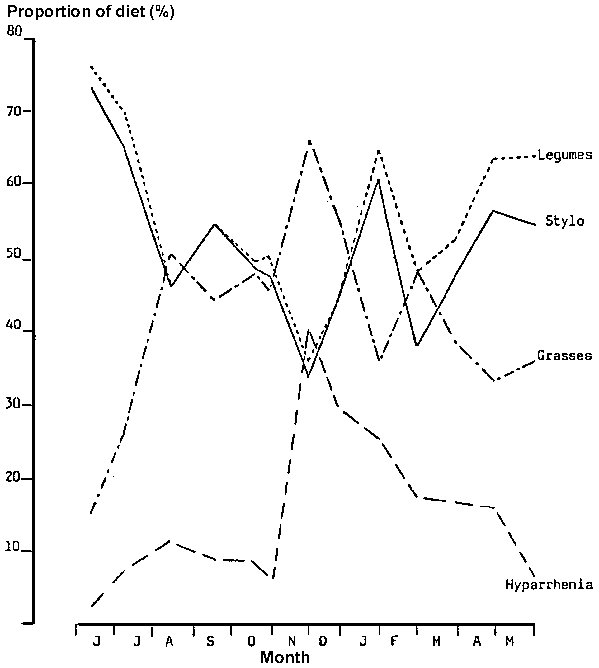
Table 5. Amounts of total Desmodium uncinatum (Silverleaf desmodium) herbage (kg DM/ha) on offer at the start of grazing each year on reinforced Hyparrhenia veld seeded with different proportions of legumes
|
Proportion of legume
|
Year |
|||||
|
1978 |
1979 |
1980 |
1981 |
1982 |
||
|
0 |
||||||
|
|
Silverleaf |
- |
- |
- |
- |
- |
|
|
Total |
4,720 |
3,260 |
3,010 |
2,920 |
1,890 |
|
1/3 |
||||||
|
|
Silverleaf |
140 |
580 |
1,180 |
1,280 |
960 |
|
|
Total |
4,780 |
3,240 |
4,130 |
4,810 |
2,730 |
|
2/3 |
||||||
|
|
Silverleaf |
480 |
1,170 |
2,080 |
1,270 |
1,060 |
|
|
Total |
5,480 |
3,660 |
4,530 |
4,350 |
2,760 |
|
All |
||||||
|
|
Silverleaf |
1,140 |
1,780 |
2,110 |
1,380 |
1,120 |
|
|
Total |
5,590 |
3,980 |
4,690 |
5,010 |
2,640 |
Source: Clatworthy 1984
The first major trial to determine the effect of legume reinforcement of veld was carried out at the Grasslands Research Station. Stylo was sown in a 12-ha block of reverted veld whilst another 12 ha was used as a control. For a number of years, weaner steers bought in June were run on these plots for 12 months and then removed for pen-fattening. A four-paddock rotational grazing procedure was used (Clatworthy and Holland 1979). Steers on veld lost, on average, 20 kg body mass over the dry season whilst those on reinforced veld maintained their body mass. Animal performance between November and February was similar for both treatments. However, between February and June, steers on reinforced veld gained 20 kg more than the control group (Figure 2). Thus, there was a 40 kg greater gain by animals on reinforced veld than those on veld only. As the stocking rate was 20% greater on the reinforced veld, this represents a 61% increase in terms of body-mass gains per hectare (Table 6).
As a follow-on to this trial, the whole area was seeded to Oxley stylo and stocked with weaner steers at four different stocking rates. A four-paddock rotational grazing procedure was used. In order to assess the feasibility of finishing steers off on reinforced veld they were partially destocked at the end of their first year so that similar stocking rates were maintained over the two years. The trial has run for five years now (Maclaurin, Clatworthy and Muyotcha 1985). Seven Hereford steers were used for the first two years, nine Afrikaner steers for the next two, and over the last years, (1984/85) eleven communal-farming-area-type steers and heifers. The steers all lost body-mass during the dry season, especially those at the heaviest stocking rate. During the wet season all groups gained well, although the heaviest stocked group gained significantly less. There was little difference between the performance of the animals at the three lightest stocking rates which consistently gave well-finished steers with excellent carcasses fleshing indices. The steers at the heaviest stocking rate did not perform so well. A short summary of the results is given in Table 7. Stocking rate had a significant effect on animal performance.
Table 6. Live-mass gains of steers on reverted veld and on similar veld reinforced with Stylosanthes guianensis var. intermedia (Oxley stylo) over 12 months without winter protein supplement
|
|
Gains/steer (kg) |
Gains/ha (kg) |
||
|
No stylo |
With stylo |
No stylo |
With stylo |
|
|
1973-74 |
123 |
152 |
107 |
135 |
|
1974-75 |
115 |
165 |
103 |
191 |
|
1975-76 |
139 |
164 |
139 |
205 |
Source: Clatworthy and Holland 1979
Table 7. The effect of stocking rate on weaner steer performance when grown out over two years on reverted veld reinforced with Stylosanthes guianensis var. Intermedia (Oxley fine-stem stylo)
|
|
Treatment (ha) |
|||
|
8.4 |
6.3 |
5.04 |
4.2 |
|
|
1980-1982 |
||||
|
Initial no. head (1st year) |
7 Hereford weaners |
|||
|
Initial body-mass (kg) |
205 |
|||
|
Gains/head (kg) |
141 |
133 |
136 |
113 |
|
Gains/ha (kg) |
118 |
148 |
189 |
189 |
|
No. head (2nd year) |
4 Hereford yearlings |
|||
|
Gains/head (kg) |
151 |
171 |
150 |
130 |
|
Gains/ha (kg) |
72 |
109 |
126 |
124 |
|
Mean gain/head (2 years) |
146 |
152 |
148 |
122 |
|
Mean gain/ha (2 years) |
95 |
128 |
158 |
156 |
|
CDM (kg) |
264 |
272 |
255 |
236 |
|
1982-1984 |
||||
|
Initial no. head (3rd year) |
9 Afrikaner weaners |
|||
|
Initial body-mass (kg) |
212 |
|||
|
Gains/head (kg) |
151 |
142 |
123 |
115 |
|
Gains/ha (kg) |
162 |
203 |
220 |
246 |
|
No. head (4th year) |
5 Afrikaner yearlings |
|||
|
Gains/head (kg) |
152 |
157 |
161 |
136 |
|
Gains/ha (kg) |
90 |
124 |
160 |
162 |
|
Mean gain/head (2 years) |
152 |
150 |
142 |
126 |
|
Mean gain/ha (2 years) |
126 |
164 |
190 |
204 |
|
CDM (kg) |
264 |
256 |
250 |
231 |
Source: Maclaurin, Clatworthy and Muyotcha, 1985
At Makaholi Experiment Station, Masvingo, veld reinforced with either siratro or Oxley stylo has been compared with natural veldt Although there have been some soil-nutrient problems in the legume establishment, steers on reinforced veld gained more than those on unimproved veld (Kelly and Tiffin 1984). Gains were not as good as at the Grasslands Research Station, but considering the marginal rainfall, this does show that even under these circumstances there are benefits to be gained from veld reinforcement.
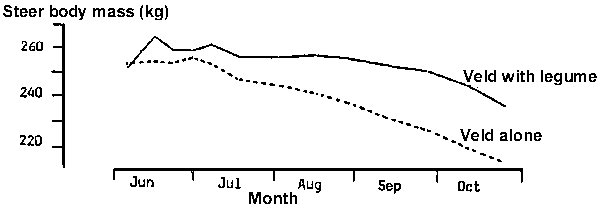
In the trial at Henderson Research Station, where steers were given access to silverleaf desmodium-reinforced veld during winter, they lost body-mass, although not as quickly as in the case of the steers on veld alone. There were no consistent differences-due to stocking rate. The main differences were due to whether the veld had been reinforced with legume or not (Clatworthy 1984) (Figure 3).
Most of the trials involving reinforced veld have been on reverted veld using steers. At the Grasslands Research Station, a breeding herd and their progeny on reinforced veld are being compared with other systems of beef production (Grasslands Research Station 1985). This is the first major trial of reinforcing virgin veld with legumes. Unfortunately, there was poor establishment of the Oxley stylo, possibly due to soil-fertility problems. In addition, due to a lack of appreciation that stocking rates Figure 3 should be reduced by up to a third in the establishment year in proportion to the loss of veld grazing in the disced strips, the early results for reinforced veld in this trial have not been conclusive (Table 8).
Table 8. Calving rate (%) and weaning mass (kg) of cows and calves run under different beef production systems at Grasslands Research Station
|
|
Veld alone |
Veld + legume |
Veld + protein supplement |
|
|
Calving rate |
||||
|
|
1980 |
91.5 |
88.1 |
88.1 |
|
|
1981 |
71.4 |
64.4 |
84.5 |
|
|
1982 |
58.2 |
59.6 |
79.3 |
|
|
1983 |
69.0 |
64.9 |
87.7 |
|
|
1984 |
85.2 |
86.8 |
87.3 |
|
|
Mean |
75.1 |
72.8 |
85.4 |
|
Weaning mass |
||||
|
|
1981 |
165.3 |
167.8 |
174.9 |
|
|
1982 |
168.7 |
171.7 |
193.2 |
|
|
1983 |
185.0 |
195.7 |
210.9 |
|
|
1984 |
198.5 |
207.0 |
230.0 |
|
|
Mean |
179.3 |
185.5 |
202.2 |
Source: Grassland Research Station 1985
Figure 2. Body mass changes of steers grazing legume reinforced or unimproved reverted veld 1975/76 (Clatworthy and Holland 1979)
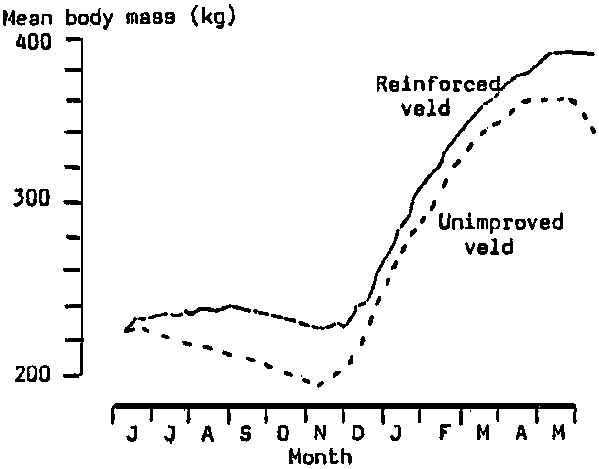
Figure 3. Body mass changes of weaners on veld alone or silverleaf desmodium-reinforced veld during the dry season (Clatworthy 1984)
Research experience with legume-reinforced veld has shown that it can be a successful means of improving the productivity of veldt In terms of individual animal performance, body-mass gains of up to 40 kg above those on unimproved veld have been achieved using 20% higher stocking rates. This has resulted in over 60% increases in livestock production per hectare over veld alone. These improvements are important because they allow a beef farmer to grow out his weaners and steers faster and so get them into pens for fattening more quickly. In addition, the dairy farmer is able to grow out his replacement heifers either faster or by using less supplementary feeding.
Whilst there may be fairly substantial improvements in terms of animal production, to a large extent these are made possible only if management standards of the reinforced veld are high. Careful attention needs to be paid to stocking rates and the way in which the veld is grazed and rested. Unless the establishment of the legumes is successful, the improvements are not likely to occur.
Small-scale livestock producers in Zimbabwe generally make use of communal grazing areas. There is little or no control of stocking rates and grazing tends to occur where the herdsman feel there is most forage for their livestock. No form of grazing management is practiced. Many of the communal grazing areas are severely degraded and of poor fertility. Before successful reinforcement of these areas with legumes can occur, it will be necessary to improve grazing management in order to restore the condition of the veldt For continued high production of the legume-reinforced veld, good management would be necessary. The only way that veld could be successfully reinforced and used in the communal grazing areas, therefore, would be if the farmers who have communal tenure in these areas were to be able to group themselves together and apply suitable grazing management. Due to the low fertility of much of the degraded veld, some fertilizer inputs would be necessary during reinforcement, but these costs could be shared equitably amongst all the farmers using the grazing area. Seed of suitable legumes could be made readily available for quite large areas of communal veld grazing to be reinforced.
The advantages of reinforcing veld in the communal grazing areas are numerous. The quality and quantity of the grazing would be enhanced and this would improve the performance and condition of the animals. However, unless stocking rates are controlled these benefits will not be realized. In many areas it is unlikely that stocking rates will be controlled as there is a critical shortage of draught power and farmers would not willingly maintain this situation. Thus, it does not appear that there would be much success with legume reinforcement of communal grazing areas. In these areas the main emphasis should be on improving veld management in the first instance.
Whilst attempting to reinforce communal grazing areas may be a doubtful starter, there is no reason why the larger areas of reverted cultivated land that often exist in the cropping areas should not be reinforced with legumes. Groups of farmers could "pool" their reverted veld and allow access to these areas for selected animals, for example their draught oxen, cows in milk or steers that they wish to fatten for slaughter. They could share the costs of fencing, which would be necessary to protect their crops, and of fertilizers and seed. These groups of farmers would be small and so consensus with regard to management could be reached more easily.
There are areas which require further research work. There is a need for a broader selection of legumes for use in reinforcing veld, particularly in the drier areas both in the large-scale and small-scale communal farming areas. The legumes need to be screened under grazing, particularly in the communal farming areas. There is a need for trials to be carried out under the conditions found in communal farming areas so that an accurate evaluation of benefits can be made and thereafter used for planning purposes. The nutrient requirements (especially micro-nutrients) of the legumes in reinforced veld, and in particular virgin veld, need to be determined for the different soil types found in Zimbabwe.
With the present state of knowledge of reinforced veld, it should be possible for farmers to successfully reinforce their veld and make use of its greater productivity. It has been shown to be an economically justifiable method of improving veld provided there is successful establishment of the legumes and attention is paid to management. For the small-scale livestock producer this would most likely be in reverted veld in the cropping areas rather than in the communal grazing areas.
Extensive reference has been made to J.N. Clatworthy (1985) in the preparation of this article.
Anon (1973). Fertilizer studies. Annual Report 1972-73. Grasslands Research Station, Marondera: 27-28.
Barnes, D.L. (1966). The preliminary evaluation of grasses and legumes for use in the high rainfall sandveld of Rhodesia. Proceedings of the Grassland Society of Southern Africa 1: 69-74.
Boultwood, J.N. (1964). Two valuable legumes: Horse marmalade and Kuru vine. Rhodesia Agricultural Journal 61: 70-72.
Clatworthy, J.N. (1975). Introduction and preliminary screening of pasture legumes at Marondella, Rhodesia: 1967-1973. Proceedings of the Grassland Society of Southern Africa 10: 57-63.
Clatworthy, J.N. (1980). Screening of legumes for veld reinforcement. Proceedings of the Grassland Society of Southern Africa 15: 111-116.
Clatworthy, J.N. (1984). Effect of reinforcement of native grazing with Silverleaf desmodium (Desmodium uncinatum) on dry season performance of beef steers in Zimbabwe. Tropical Grasslands 198-205.
Clatworthy, J.N. (1985). Pasture research in Zimbabwe: 1964-1984. In Kategile, J.A. (ed.). Pasture improvement research in eastern and southern Africa. IDRC, Ottawa, Canada pp. 25-58.
Clatworthy, J.N. (1985). Livestock productivity of legume-based grazing. Grasslands Research Station, Marondera. (Mimeo.).
Clatworthy, J.N. and Holland, D.G.E. (1979). Effects of legume reinforcement of veld on the performance of beef steers. Proceedings of the Grassland Society of Southern Africa 14: 111-114.
Clatworthy, J.N., Maclaurin, A.R. and Avila, M. (1985). The possible role of forage legumes in communal area farming systems in Zimbabwe. ILCA Workshop on Potentials of Forage Legumes in Farming Systems of Sub-Saharan Africa, Addis Ababa, Ethiopia, 16-19 September 1985.
Clatworthy, J.N. and Thomas, P.I. (1972). Establishment of Stylosanthes guianensis in Marandellas sandveld. Proceedings of the Grassland Society of Southern Africa 7: 76-83.
Grant, P.J. (1975). Some factors affecting germination and emergence of sub-tropical pasture legumes in Rhodesia. Proceedings of the Grassland Society of Southern Africa 10: 65-71.
Grant, P.J. (1976). Some factors affecting the field establishment of subtropical pasture legumes in Rhodesia. Proceedings of the Grasslands Society of Southern Africa 11: 97-102.
Grant, P.J. (1979). Mechanical scarification of Stylosanthes guianensis cv Oxley seed. Proceedings of the Grassland Society of Southern Africa 14: 137-141.
Grant, P.J. (1985). Phosphate-induced zinc deficiency in Stylosanthes guianensis Oxley fine-stem stylo in Zimbabwe. ILCA Workshop on Potentials of Forage Legumes in Farming Systems in Sub-Saharan Africa, Addis Ababa, Ethiopia, 16-19 September 1985.
Grant, P.J. and Clatworthy, J.N. (1978). How to establish pasture legumes. Rhodesian Farmer 48 (26) 13-19.
Grant, P.J. and Tanner, P.D. (1984a). Superphosphate requirements of pasture legumes in different soil types. Annual Report, 1981-1982. Division of Livestock and Pastures, Research and Specialist Services, Zimbabwe, pp. 166-171.
Grasslands Research Station. (1985). Unpublished mimeo. for a field day, 28 February: B.
Kelly, R.D. and Tiffin, J. de W. 1984. Effect on animal production of veld reinforced with Siratro or fine-stem stylo in a medium-rainfall area. Annual Report 1981/82. Division of Livestock and Pastures, Research and Specialist Services, Zimbabwe; pp. 163-164.
MacLaurin, A.R., Clatworthy, J.N. and Muyotcha, N. 1985. Body mass gains of steers grazing at four stocking rates on reverted veld reinforced with fine-stem stylo. Annual Report 1983/84, Division of Livestock and Pastures, Department of Research and Specialist Services, Zimbabwe (in press).
Mufandeadza, O.T. (1976a). Effect of frequency and height of cutting on some tropical grasses and legumes. I. Hyparrhenia filipendula (Hochst) Stapf and Heteropogon contortus (L) Beauv. ex Roem. & Schult. Rhodesian Journal of Agricultural Research 14: pp. 21-38.
Mufandeadza, O.T. (1976b). Effects of frequency and height of cutting on some tropical grasses and legumes. II. Stylosanthes guianensis (Aubl.) Sw. Rhodesian Journal of Agricultural Research, pp. 149-151.
Mufandeadza, O.T. (1976c). Diet preferences of cattle and defoliation patterns under grazing on legume-improved veldt Annual Report 1974/75, Division of Livestock and Pastures, Department of Research and Specialist Services, Zimbabwe, pp. 149-151.
Mufandeadza, O.T. (1977). Diet preferences of cattle and defoliation patterns under grazing on legume-improved veldt Annual Report 1975/76, Division of Livestock Pastures, Department of Research and Specialist Services, Zimbabwe, pp. 175-180.
Mufandeadza, O.T. (1978). Effect of frequency and height of cutting on the yield, composition and quality of the herbage of grass grown alone or in mixture with legumes. Annual Report 1976/77. Division of Livestock and Pastures, Department of Research and Specialist Services, Zimbabwe: 173-176.
Mufandeadza, O.T. (1981). Diet selection by cattle grazing on a high quality legume pasture. Zimbabwe Journal of Agricultural Research 19: 127-128.
