3.1.1 Response to Terms of Reference 1
3.1.2 Response to Terms of Reference 2
In the process of developing its formal response, the Panel went beyond the strict guidelines of the Terms of Reference, to explore broader issues which are mostly reflected in Section 3.2 and Chapter 4. The Panel also highlights the particular difficulties it encountered in addressing the second term of reference (Systemwide vs. Centre-based) given the nature of the value added so far by the ecoregional programmes and the lack of hard data.
3.1.1.1 Sustainable improvement of productivity
3.1.1.2 Linking research on natural resource conservation and management with that on production systems
How the Programme performed in addressing the objective of sustainable improvement of productivity, especially how well the ecoregional approach had performed in linking strategic and applied research on natural resource conservation and management with that on production systems, including location-specific aspects of global commodity/subject matter research activities.
As might be expected, the activities that were already using the ecoregional approach to at least some degree, when the CGIAR decided at ICW'93 to initiate ecoregional programmes - ASB, CONDESAN, RWC and CIAT - have more research to show than those initiated from 1994 onwards. It seems to have taken two or three years to establish new research in every case. Very significant ecoregional research has been carried out since 1994 by CIAT and ASB (notably in Indonesia). RWC has continued its valuable work on declining factor productivity in high-yielding rice-wheat systems, with additional research on tillage and weed control. The humid forest consortium of EPHTA has also studied weed control. CONDESAN's development of mesas de concertación for collaborative R&D at the watershed level should also be mentioned.
Much of the new research has been on the characterization of regions and sites. Significant examples include all three consortia of EPHTA, with IVC leading the way, and the SysNet project of Ecor(I)Asia. The Ecoregional Fund to Support Methodological Initiatives has played a praiseworthy part in fostering such research. Without this fund there is no doubt that much less ecoregional research would have been carried out. The ASB has gone further than the others in relating its research sites to its whole problem domain and in scaling up to the global level its findings on the trade-offs between carbon sequestration and biodiversity on the one hand, and agricultural productivity on the other. Less tangible achievements of the ecoregional programmes include their influence on research priorities and practices outside the CGIAR. In some cases, practical benefits have been gained from enhanced technology transfer and adaptation.
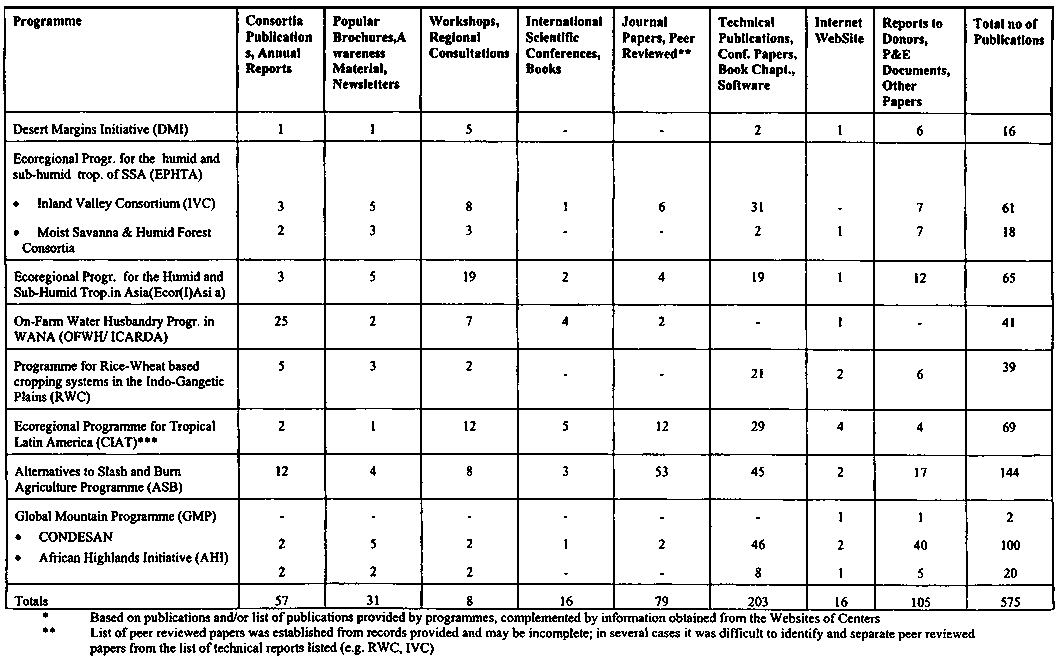
Another of the achievements of ecoregional programmes has been their publications (Table 3.1), particularly: conference/workshop proceedings, annual reports, reports to donors and public information material. In several cases (e.g. CIAT, Ecor(I)Asia), it proved difficult to separate programme publications from the rest of the Centre's output. Also, with the exception of ASB and CIAT, it was difficult to judge the adequacy of contributions to peer-reviewed journals.
A key question is the extent to which the potential of the holistic ecoregional approach has been explored by the ecoregional programmes. Particular interest attached to work that has been initiated or planned during the five years since they were first established. In fact, it is hard to find any case yet where the whole approach has been followed systematically, that is, an NRM problem of high importance for the sustainability of developing-country agriculture in a priority ecoregion, has been defined, analysed for all its researchable problems/opportunities in both the human and technical (biophysical) dimensions, and which has led to the design of significant new research. The ASB and CIAT's programmes, in their formative stages, probably came closer to the ideal than some of the more recent ones and the RWC has always focused on the sustainable improvement of productivity.
More commonly, what has happened is that a Centre's existing NRM activities have been broadened to include some features of the ecoregional approach, with much of the new research to date being on site and regional characterization, and only to a limited extent in the human (particularly policy) dimension. Clearly, the need identified during the 1980s to strengthen research on NRM and agricultural sustainability, to complement the System's strengths in commodity improvement research, has been met incompletely. Lack of clarity in the meaning of the ecoregional approach (Section 3.2.1), and shortage of funds, provide only partial explanations in the Panel's opinion. The case for new NRM research, in the context of the sustainable improvement of productivity, has yet to be presented as effectively as it could be.
There appear to be few precedents in industrialized countries of agricultural/NRM research programmes that have attempted as broad holistic coverage as the CGIAR's ecoregional approach (Chapter 1). The Panel sees it as highly commendable that the CGIAR seeks global leadership in this field. Certainly the need for efficient use of agricultural research resources is more urgent in developing countries than in more affluent industrialized ones. But it is a very ambitious undertaking and this needs to be kept in mind.
Table 3.1: Publications and Documentation produced
by the Ecoregional - Programmes*
The Panel found good evidence of effective NRM and productivity linkages in several of the reviewed programmes, particularly at the applied level. Some examples are the integrated work of ASB in Sumatra, CIAT's savanna programme, CONDESAN's research on fragile watersheds, the tillage and weed control activities of RWC in Asia, and the rice production and water management research of IVC. The Panel's findings also indicate that commodity research has provided useful inputs to the ecoregional programmes. However, it is much harder to find evidence that the ecoregional programmes have exerted any significant influence on the global commodity improvement programmes. There is strong potential to change this, one means being the wider application of GIS tools to commodity research in order to sharpen the focus of germplasm-enhancement activities. There are also exceptions to the general criticism, e.g. CIMMYT's wheat-improvement programme has responded to some of the lessons learned in the RWC.
While ecoregional programmes have been hardly more than add-ons for several Centres, and so have had little influence on the rest of their research, this may not be an accurate indication of what has occurred more generally with the CGIAR's NRM-productivity linkages. Experienced observers believe that the integration of NRM concerns with productivity has advanced significantly at the Centre level in recent years. But only a third of survey respondents said that they included ecoregional criteria in planning their own programmes.
3.1.2.1 The degree of effectiveness of collaboration among Centres and between them and their partners (linking, openness, involvement with NARS and other research partners)
3.1.2.2 Cost-effectiveness/value-added of the implementation option
3.1.2.3 The participation of potential beneficiaries and other stakeholders in the definition of the research problems and priorities
3.1.2.4 Clarity in communicating the importance of the research to the CGIAR members and other actors
3.1.2.5 Continuity of funding support
3.1.2.6 Ease of accountability
3.1.2.7 The standards of planning, monitoring and evaluation
Evaluate, using the following seven criteria, how the value added by making the activities Systemwide, rather than leaving them as a series of Centre-based components, outweighed the additional transaction and management costs.
The seven criteria are used as headings under which the Panel's findings are
presented.
One very positive outcome has been the excellent progress made by the consortia in developing synergies mainly with NARS but also with NGOs, Advanced Research Organizations and regional organizations. The Panel considers this to have been a major achievement, fully in line with the vision articulated at Lucerne and in the Declaration of Global Partnership in Agricultural Research in 1996, and with considerable future potential for the CGIAR generally. However, interaction has been much more limited with the private sector and national agencies dealing with environment, water, forest and land issues.
The Panel was especially sensitive to the harmonization of the roles of the CGIAR Centres and NARS. In general, NARS have been closely involved from the beginning and in some cases, their sense of ownership of the activity is already high. Experience to date strongly highlights that a high level of commitment and leadership from both Centres and NARS is a necessary ingredient for success. Generally, the disjointed, even competitive approach of Centres in their dealings with NARS, which was identified as a weakness of the CGIAR a decade ago, seems to have been fixed.
Despite the good progress that has been made in collaborating with NARS, in some cases there have been difficulties in resolving technical roles and responsibilities and in allocating funds. These difficulties have also frustrated inter-Centre cooperation at times. The issue warrants further attention (Section 4.3.2).
The ecoregional programmes have helped to strengthen NARS through such important activities as the standardization of methodologies (e.g. ASB's soil analyses) and the provision of new scientific and technological information (EPHTA's short course on integrated weed management; RWC's technology transfer with tillage machinery). At various places in this report, attention is drawn to instances where more should be done in: understanding the importance of natural-resource degradation (below); devising robust techniques for scaling and extrapolation using minimum data sets (Recommendation 10); and developing the special skills needed to conduct research on NRM (Recommendation 11).
Ecoregional programmes have a less satisfactory record of achievement in promoting collaboration among Centres. Even in the more successful programmes such as those of ASB, RWC and CIAT, there have been frustrations in reaching agreement on the allocation of research responsibilities among Centres. There are still too many examples of Centres doing pertinent research in the same region as an ecoregional programme without formally collaborating. The allocation of international funds to participants in collaborative research consortia is always a sensitive issue.
As mentioned in the previous chapter, the facilitation units of consortia have
played a vital role in developing partnerships in several of the programmes.
They represent the culmination of the CGIAR's long experience in developing
networks for collaborative research. The key functions performed by the facilitators,
and the exceptional personal qualities needed to do this very demanding job
well, deserve to be better understood and supported by the System.
The Review Panel was unable to address this part of the Terms of Reference satisfactorily due to the lack of hard data on both costs and benefits. In most ecoregional programmes, the chosen implementation option has been the collaborative research consortium. Consortia should be judged mainly on the value that their facilitation units have added to the research and related activities being carried out on a continuing basis by the participating organizations. However, it is hard to find objective indicators for value added by developing new relationships with and among national systems, harmonizing Centre activities or the use of farmer and community oriented participatory methods to help identify problems, opportunities, priorities and so on.
The Panel's collective judgement is that the cost effectiveness of implementation has been increased significantly by the participation of other CGIAR Centres and outside partners as it has brought with it complementary resources, capabilities and expertise. This is particularly true when the R&D continuum moves up to more complex scales, e.g., from the plot and farm levels to the watershed or the region. Often a small CGIAR investment in given consortia can be multiplied several fold (four to ten times according to some of the people interviewed) by the contribution and participation of outside partners with complementary skills. One mechanism that has proved effective in achieving this is the use of small competitive grants to fund R&D activities on agreed priorities. The Panel supports the wider use of this model.
Centres have expressed concern about the high transaction costs of collaborative research consortia, particularly in the establishment phase, and the Panel is sure that the costs to national agencies have also been substantial. Several donors have questioned the levels of funding being sought for the ongoing operation of the facilitation units in research consortia. It should be possible to establish financial benchmarks for the efficient operation of facilitation units, and to quantify the total amount of research being conducted under the aegis of a collaborative consortium. Guidelines are needed to distinguish consistently between the costs of coordination and those of various R&D activities. Lack of such information precludes the estimation of transaction costs and full costing of programmes.
Recommendation 2: That the CGIAR Secretariat, in consultation with TAC and Centre Directors, provides clear rules to Centres for accounting for all financial and other resources committed by Centres and their partners in collaborative programmes, and for the allocation of costs between coordination and R&D activities.
The issue of 'ownership' also requires careful consideration. By definition
a consortium belongs to all partners, independently of the level of their contribution
and participation There is a strong feeling among the Panel members that clarification
of the evolving role of Centres in established ecoregional consortia is now
in order. This need was identified in earlier external reviews of AHI and CONDESAN
and it still exists. It does not mean that Centres should no longer host facilitation
units.
Participatory approaches and gender sensitivity fit well with the requirements
of the ecoregional approach. The Review Panel found good evidence that the tools
and mechanisms to enable potential beneficiaries to take part in the definition
of research opportunities and priorities have been used in most cases. Relevant
examples include Local Agricultural Research Committees (CIALS) at CIAT, and
the active participation of district stakeholders in the AHI in eastern Africa.
However, strong cultural barriers sometimes impede the involvement of particular
classes of society in decision making.
There have been major problems in communicating to the CGIAR and other stakeholders the nature of the research being done by ecoregional programmes. It is doubtful that much of the literature listed in Table 3.1 has been seen by key decision-makers in the CGIAR. The role of central facilitation units, as distinct from the research that the Centres do under the aegis of the consortia in which they participate, is rarely publicized by host Centres in their Annual Reports or other material seen by most members of the CGIAR. Apart from a conference organized by the Centre Directors at ISNAR in 1996, there has been no venue at which the central facilitation units could exchange and record their experiences.1 Neither has there been a direct channel of communication between the ecoregional programmes, TAC and the CGIAR Secretariat, other than through funding requests.
1 However, both ASB and CIAT have documented aspects of their experiences with the ecoregional approach, and the USAID Africa link project has improved communication among ecoregional programmes in Africa.
Funding has been a problem for all the established ecoregional programmes, even the most successful ones. Expectations of access to 'new' money were high in Centres and even higher outside the CGIAR, but increased long-term support has not materialized. The current piecemeal and opportunistic approach to programme funding leads to fragmentation of the research effort and the lack of a long-term strategic focus. It has been particularly difficult to obtain continuing support for the facilitation units, for which short-term project funding is not very suitable. These should be funded from core resources to provide long-term stability.
The Panel argues in Chapter 4 that the greater part of the NRM research in the System can be managed at the Centre level. It recommends that the System be very selective in future in its choice of NRM activities to be funded at System level, and more proactive in requesting funding from donors for those activities. Their funding requirements should be identified separately during the CGIAR financing process.
Recommendation 3: That financial estimates for selected Systemwide natural
resource management activities be included as additional columns in the budget
matrices of the CGIAR, as part of a co-ordinated approach to donors.
Accountability, meaning transparency in the cost of coordination by the lead
Centre and resources committed by all partners, has already been dealt with
in 3.1.2.2. With regard to accountability in the narrower sense of correct use
of money, financial control and auditing do not seem to have been a problem
for the ecoregional consortia hosted by Centres. Experienced managers in the
Centres have stressed the importance of allocating any supplementary research
grants through a transparent competitive process in order to avoid conflicts
of interest. Accountability, in the broader sense of monitoring and evaluation
of performance, is addressed in the next section.
Generally, planning has been very competent. Research consortia that have a two-level structure with a regional policy committee dominated by national leaders and supported by a technical committee, on which scientists from Centres and advanced research institutes are strongly represented, appear to have worked well in policy making and planning. However, there have been tensions because, in general, NARS do not see the longer-term, less-obvious forms of natural-resource degradation as being of as high a priority as the CGIAR does. The Panel suggests that the evidence for the CGIAR view needs to be presented better.
In contrast to the planning situation, the standards of monitoring and evaluation in the ecoregional programmes often leave a good deal to be desired. Briefly, most programmes spend considerable resources and time in characterization and planning, less in monitoring and practically none in evaluation. So they neglect the possibilities of saving money on investigations that are clearly going nowhere and of improving efficiency by learning from case studies of success and failure. Nor have there been ex ante assessments of the likely costs and benefits of expected R&D investments, although this work is planned in one or two Centres. Amongst the things that should be evaluated better in future is the contribution by programmes to peer-reviewed scientific literature.
The desk study found that few EPMRs carried out over the past 4-5 years have examined ecoregional programmes in any detail. Reviewing has been left largely to the agencies that have helped to fund the research, such as the Asian Development Bank, the Global Environment Facility and IDRC. The Panel returns to the issue of monitoring and reviewing in Section 4.2.
3.2.1 Misunderstanding of the Ecoregional Approach
3.2.2 Consequences
3.2.3 Strong Support for the Principles
3.2.1.1 Means confused with ends
3.2.1.2 Other agendas attached
3.2.1.3 NRM priorities not specified in detail
A number of useful lessons can be learned from the experience of the first
five years of implementing ecoregional programmes. Many of the deficiencies
seem to have stemmed from the lack of a clear general understanding of the meaning
of the ecoregional approach. Approximately three-quarters of those who responded
to the survey recorded a lack of clarity in the approach, even for those involved
in programmes. Some people had not understood, or had forgotten, or had mixed
up with other things, the fact that research on NRM was a central component
of the approach (Section 1.2). The simultaneous pursuit of the two objectives
of sustainability and improved partnership and collaboration with NARS probably
confused the concepts. Inclusion of sustainability in the wording did
not help, as that term has accumulated its own philosophy, and the CGIAR is
really interested only in forestalling agricultural unsustainability. Other
reasons that can be suggested for the misunderstanding are given below.
Firstly, there has been some confusion between means and ends. Research on
an NRM problem requires a definition of its spatial occurrence. So, for some
people the characterisation of regions became an end itself rather than a necessary
step in addressing the NRM problem. Similarly, the fact that there are very
complex interactions in NRM, which require a system perspective for their effective
study, led some to think that the system approach (often with a heavy emphasis
on computer-based modelling) was the primary purpose of the ecoregional approach.
Again, the human dimension of NRM, with landholders, and various community and
government institutions exerting a strong influence over any changes in NRM
practices, requires the participation of a much wider range of stakeholders
than say the introduction of a new cultivar/breed or macro food policy. Hence,
participatory methods became the essence of the ecoregional approach for a group
of people.
From 1994 onwards, as the CGIAR developed new agendas on such things as participatory approaches in research and sensitivity to the role of women in agriculture, their implementation tended to be attached to the ecoregional approach. Use of 'eco' in front of regional may also have been a source of confusion, especially among donor constituencies. 'Eco' is used by special interest groups in a variety of value-laden arguments (often anti-industrial) that have little to do with strengthening NRM in pursuit of the CGIAR's goals.
The designation of Programmes as Systemwide was itself confusing. Some people
expected all Centres to participate in Systemwide Programmes and the role of
research partners outside the CGIAR was unclear. The Panel prefers the term
System level, specifying exactly what functions are being performed at
that level (e.g. presentation at Mid-Term Meetings and International Centres'
Weeks, identification in the System's budget matrices and in deliberations of
the Finance Committee).
The Panel ascribes particular importance to the fact that priorities for carrying out NRM research using the ecoregional approach were never specified in detail. The Panel was told that the possibility of assigning NRM mandates to avoid problems of fragmentation and duplication was discussed at a CGIAR meeting in 1991, but never followed through. The subsequent creation of many of the other set of Systemwide Programmes (Section 2.1.2.3) can be interpreted as an attempt by Centres and donors to fill the gap left by the absence of precisely-defined, researchable NRM priorities. Recommendation 8 in the next chapter addresses this issue.
There were other problems in communicating the nature of the ecoregional approach. The fact that NRM research, particularly its application, required links to a much wider range of activities than the CGIAR had been involved in before, led some observers to assume wrongly that the CGIAR was entering into new areas such as extension and development. Even one or two Centres misinterpreted the ecoregional approach as a rebalancing towards applied research. It is true that the ecoregional approach involves an R&D continuum from strategic research to applied and adaptive research, and developmental activities. But the Panel found no evidence of an intended change in the role of Centres versus that of others, or as it is often expressed in the CGIAR, of the 4% versus the 96%. The Centres' niche (competitive position) within the R&D continuum remains mostly in strategic, public-goods research with very selective incursions into applied and adaptive work (Annex V). This is especially important in view of the rapid growth of alternative sources of R&D supply, particularly from the private sector, and particularly in Latin America.
Perhaps the most important consequence of this lack of clarity was that the opportunity was not fully taken to mobilize support for new research on major agricultural sustainability issues likely to impact on the achievement of CGIAR goals. A number of donors commented that proposals for ecoregional initiatives were often unconvincing as to the importance and researchability of the problem, and if the research were successful, the potential impact on sustainability and poverty alleviation.
NRM research is open to a wide range of interpretations, ranging from agronomic studies of the kind that have always been part of commodity improvement programmes, to research on those forms of natural resource degradation that pose the greatest threats to the sustainability of agriculture. Again, the full disciplinary diversity of the ecoregional approach, from biophysical research on natural resources through to social science research on human factors important in implementing improved management practices, is applicable in NRM research. The lack of precisely-defined, researchable NRM priorities led to a diffusion of effort in the ecoregional programmes.
Despite this, the almost unanimous view of those consulted during this Review is that the broad principles embodied in the ecoregional approach should continue to be applied. These principles have taken a firm hold in the CGIAR community. This is extremely positive and the Panel strongly supports the continued implementation of the ecoregional principles, even though it is a very ambitious undertaking. Recommendations for updating the conceptual framework, without spending too much time on definitions, and for giving a more pragmatic problem/opportunity focus to the System's NRM research, are presented in the next chapter.