


2.1. Links between NRM and Sustainable Alleviation of Poverty
2.2. Lessons from Successes and Failures
2.3. The Role of International Public Sector Research in NRM
As mentioned in the introduction, the state of the world's natural resources in many areas appears to be declining, particularly in the case of those associated with agricultural production. Hence a need is seen for a much more intensive effort to improve natural resources management, both through intensified research and through policy action to make sure that the best management practices are being utilized in practice. This need is driven by an overriding concern for the health of the planet for future generations (long-term perspective) and by a concern with the sustainability of production of goods and services for the present generation. Basic goals of the CGIAR relate to these needs. Thus, the CGIAR focuses on poverty alleviation through creation of food security and protection of the environment. The latter should include an overriding concern with water security as well as food security.
Improvements in NRM depend, to a greater or lesser degree, on inputs from research. As implied in Figure 1, there is continuum of research levels - from basic or strategic research, through applied research and on to adaptive research. We also can think of the actors in the research system as ranging from major developed country or international research institutions and advanced research institutions in developing countries all the way across to the farmer and village groups carrying out highly adaptive research. The CGIAR Centres obviously fall into the former category. In the present section, we look at the role of different types of research in improving NRM and at the different actors in this field, and where they fit into the picture in terms of types of research on which they should be focusing.
Figure 1: Land Use Production Units (the field or farm) in the Context of a Watershed Management Framework
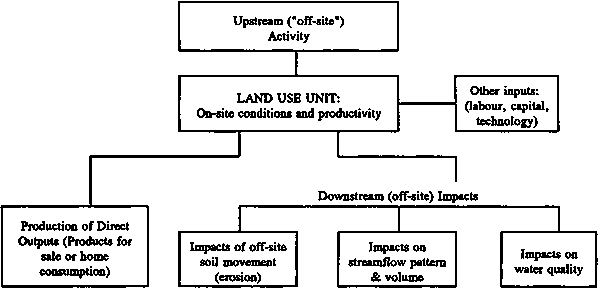
Sustainable alleviation of poverty involves a complex process of economic growth, development of food and water security, protection of the environment and natural resources, and, in most cases, changes in the distribution of benefits from economic development to favour the poor. Natural resources management relates to all these aspects of poverty alleviation.
Expanding economic growth related to agriculture involves enhancement of productivity and prevention of productivity losses. Both relate to the ingredients of productivity growth:
· increased biological potential of the agricultural plants and animals involved; and
· better management and use of the natural and human resources on which realization of the biological potential depends.
Thus, environmental protection through NRM helps to insure the sustainability of development, and in the process, of poverty alleviation.
Sustainability requires that the concerns in NRM focus not only on short-term, on-site gains, but also on the externalities associated with NRM - both in terms of temporal and spatial externalities. Thus, concern has to focus on downstream impacts of NRM and the impacts that are longer term in nature. These perspectives need to become key elements in the CGIAR's future work in the area of NRM.
TAC notes that the main operational means for dealing with sustainability issues are limited to research that looks for opportunities to avoid unsustainable development. That provides the only means to realistically move towards sustainability, since the latter cannot be identified in practice, other than in the context of the conditions that lead to unsustainable development.
A main lesson learned is that there are relatively few well-documented instances of successful improvement of NRM in LDCs that can be directly related to strategic or applied research. There have been a number of failures and perhaps even more cases in which no strong attempt was made to use existing knowledge (often old research results on the shelf) to overcome recognized NRM problems. Generally, the reasons for failure or lack of action have not been investigated systematically, although in some instances the causes are obvious, and mainly relate to policy failures and lack of appropriate incentives for landowners or users.
A further lesson is that, where there have been successes, effective local, participatory organizations are a common feature. All worked in a learning mode to develop and adapt solutions to problems. Many involved outstanding local leadership. Special attention was given to the development of locally appropriate technologies, while diffusion of innovations was more horizontal than vertical ('seeing is believing').
Where government organizations were involved in the successes, a change of thinking through the process of bureaucratic reorientation (Korten and Uphoff 1982) 12 was important. The outside agencies took a firm interdisciplinary approach and stressed interdepartmental coordination and cooperation.
12 See Korten, D.C. and N. Uphoff (1982). Bureaucratic Reorientation for Participatory Rural Development. NASPAA Paper No. 1. Washington: National Association of Schools of Public Affairs and Administration.
The lessons learned from examples of success in NRM seem to indicate that knowledge and practices derived from past research may have played an important role in the adaptive process and learning that was critical to success. However, it appears that in few cases was specifically targeted strategic or applied research in either the natural or social sciences required as a key factor in success. In practice, the distinction may not be so clear-cut. Access to existing knowledge and informed interpretation of the literature are embodied in competent researchers, technology and institutions, which for effective communication must be readily accessible to those working to improve NRM.
Thus, although past research results did in some cases play a role in success, it appears that it often was generated for purposes other than achieving the successes it contributed to over time. The implication is that it was technical and policy information on hand from experience or research results on the shelf that were put to use in generating successes, in those cases when the human and institutional constraints could be overcome through community action or extension, policy or other intervention. Moreover, research alone appears to have had little direct influence on the removal of the human and policy constraints, though it certainly has been used to identify and draw attention to them.
Obviously, there are many exceptions to this general conclusion. However, to the extent that it holds, the implication is that the research community should focus some additional research effort on studying the processes by which adoption and adaption of existing research based knowledge is translated into practice. This research should examine the fundamental assumptions on which the CGIAR Centres are working, and be complemented by additional efforts to bridge the gap between research and implementation (see section 3.2 for a recommendation). Indeed, this objective is one of the central themes behind the ecoregional approach being developed and adopted within the System and behind the push to increase the effectiveness of work with NARS.
2.3.1. The Role of the CGIAR
2.3.2. A Synthesis of Current Activities in Soil and Water Research in the CGIAR
2.3.3. CGIAR Links to Other Suppliers in NRM Research
The CGIAR System should be doing research only in those areas in which it has a special advantage, i.e., ones that relate to the international character of its Centres and its mission and goals. The CGIAR Members have agreed that the System should be working mainly with research that produces "international public goods," and that it should only be investing in research if it has a clear advantage over other potential suppliers in terms of "cost-effectiveness."
"Public goods" are the extreme case of market failure involving positive "externalities." Externalities arise when the total benefit from producing the good (or service) cannot be appropriated by the buyer or by the producer of the good or service. In the more moderate cases of externalities, the person or country producing and/or purchasing the good or service may still have the incentive to produce and/or consume it. Traditionally, public goods are defined as the extreme of this case, i.e., where so many of the benefits are not appropriable by the producer or purchaser that private costs significantly exceed private benefits or returns to the extent that the good (service) is not produced or consumed without some external interference or organization of the good or service. 13
13 Economists say that the "non-exclusionary" principle applies, i.e., it is impossible to exclude from receiving benefits, those who do not contribute to the costs of production. Obvious examples are military defence and flood control. A further attribute of public goods is the existence of "non-rivalrous consumption," i.e., consumption by one individual/group does not affect the consumption by others (e.g., as in the case of watching the sunset, or a weather forecast).
Taking this argument one step further, one can identify those goods and services that are international public goods, i.e., no one country receives sufficient benefits from the production and consumption to provide incentive for production by that country, even though if produced the benefits to two or more countries would clearly exceed the costs involved in production. Thus, some mechanism whereby more than one country/international entity organizes and finances production is called for to remove this international "market" failure.
Given the above, it is clear that the CGIAR - having the attributes of a public entity - should primarily be involved in production of research that fits in the international public good category. However, there also are more moderate cases of externalities where CGIAR production or activity still is justified, so long as the benefits from such activity accrue to more than one country, i.e., so long as the internationality condition holds. In such cases, the System brings in a number of other criteria to meet the sufficiency conditions for CGIAR involvement. Thus, there are criteria related to:
· cost-effectiveness of CGIAR activity in relation to that of other potential suppliers; 1414 Note that the term "comparative advantage" is no longer used to justify research in the System, mainly because it has a very strict meaning in economics, and it has traditionally been used incorrectly in the CGIAR discussions, creating misunderstandings and confusion.One can think of at least two sub-categories of criteria helping to explain cost-effectiveness. Thus there are:
· reliability in production of results; i.e., another potential source might appear to be more cost-effective, but the reliability of results is much less certain, or the time delay would be such that there is clear advantage in the CGIAR producing earlier results; and· lumpiness or economies of scale in production; i.e., a country or other potential producer might have the incentive to produce the results, but due to lumpiness in research requirements (or economies of scale in production of results) the CGIAR can produce it in a more efficient fashion.
· externalities from the CGIAR Centres' activities, e.g., in terms of informal on-the-job training of local scientists and provision of ideas for local NARS and other groups, and in terms of inputs and benefits to advanced research institutions.
In sum, as TAC has emphasized previously, international research initiatives - including particularly ones in the natural resources management area - should:
· Produce research results of an international public goods nature, i.e., they provide benefits (either directly or through externalities) across national borders. Public goods are difficult and/or undesirable to make proprietary and are characterized by non-rivalrous consumption, i.e., one individual consuming them will not reduce the amount available for others to consume (typical of knowledge outputs).· Globalize (or standardize) methodologies used in local studies to ensure comparability of results across ecoregions, and for use in researching common themes or problems within ecosystems; this should include methodologies that integrate biophysical and socioeconomic research.
· Involve locally relevant and responsive research within ecoregions (or watersheds), but with a global perspective to (1) take advantage of economies of scale in research, (2) maximize use of spillovers from research, (3) reduce transactions costs in doing research, and (4) allow efficient movement up the learning curve. (Hence a key issue for the CGIAR is to balance its allocation of resources to natural resources management research between ecoregional and global perspectives. A similar balance is required in public policy and public management aspects of natural resources management research.)
· Be multisectoral and multidisciplinary in nature and scope, recognizing the different sectors and disciplines dealt with across the CGIAR System. (Thus, for example, the CGIAR Systemwide SWNM Programme, or the proposed Water Programme should be explicitly linked to ecoregional activities, to germplasm improvement and commodity research activities of selected Centres, and to various policy related research issues pursued by such Centres as IFPRI, e.g., in the area of water policy and common property resource management).
· Take advantage of complementary activities of different suppliers of research, both within and outside the CGIAR System and contribute to the work of others, both NARS and advanced institutions.
Strategic international research should be process-oriented, both biophysical and socioeconomic research, i.e., focused on researching the processes by which positive changes can be made, or negative ones avoided (e.g., maintenance research). It should be looking at the issues of dynamics of natural resources systems, where each component depends on the others. Despite these needs, Figure 1 presents only a static view of the world. We recognize that we need to introduce a more dynamic dimension in order to address the issues associated with process-oriented research.
In other words, international institutions have a special advantage in ensuring the development of the research on processes for management, use and conservation of natural resources, and for designing technologies to create more sustainable soil and water conservation and use situations.
Such process research (strategic or applied) involves consideration of changes over time, comparability of results across ecoregional production systems, and mechanisms for translating results through adaptive research done by NARS. Such considerations need to be introduced into the framework when looking at research priorities for the CGIAR System.
The CGIAR is one of the premier international research systems involved in NRM research. As such, the considerations in the previous section apply to it. The CGIAR System is distinguished from most other international NRM research entities by the fact that it has a proven, long-term track record of actual research in developing countries. Most other international entities either provide only funds for international research, or, like many universities have fixed-term projects that typically last no more than five to ten years. The CGIAR System has permanent Centres. As such, the CGIAR Centres can attract high quality scientists who are interested in careers, not just short-term project employment, and undertake long-term experimentation and develop strategic reference databases. This can lead to more effective and productive relationships with local researchers. Because of their established, long-term reputation and stability, they also often can act as the best convenors of research consortia and other groups that build on each other's strengths to gain research advantages.
In an overall context, TAC reconfirms that the CGIAR has an increased role to play in research on natural resources management (NRM) and environmental issues. It is not necessarily so that new and expanded funding is needed. Rather, resources need to be redirected so they cover critical topics; and some of the work currently done by the CGIAR centres might logically be transferred to NARS partners and others.
The work in natural resources and environment needs to be linked more explicitly to sustainable poverty alleviation and food security for the poor, if the new vision for the CGIAR developed at the Lucerne meeting is to be realized. This explicit recognition of the Lucerne Declaration carries with it certain implications for the scope and orientation of natural resources management research in the System. They are as follows:
1) Sustainable poverty alleviation and food security depend directly on the health of the environment and the natural resources base on which all food production depends. Thus, conservation and enhancement of the environment in that context serve as central and legitimate themes for CGIAR research.2) TAC reaffirms and emphasizes the point made above: The System should with few exceptions only be doing environmental and NRM related research that is clearly identified with the impacts of agriculture, forestry and fisheries on sustainable poverty alleviation and food security. In other words, that should be a necessary condition for undertaking natural resources management and environmental research in the System. Quite logically, priority should be given to research directly related to the mission and goals of the System. This implies nothing about the importance of other priorities, other missions and goals, and other organizations and their focus on the environment.
3) Agriculture, forestry and fisheries interact with the environment in a dynamic context, where the impacts of agriculture, forestry, and fisheries on the environment, are just as important as the impacts of environmental conditions and changes on agriculture, forestry and fisheries (see Figure 1, p. 8). In fact, sustainable agriculture requires consideration of both these perspectives, i.e., a consideration that all except the extreme upstream and downstream land use units in a watershed are both the receivers of impacts from upstream and the creators of impacts downstream. TAC confirms that research on both aspects of land use impacts - on-site and off-site - are priority areas for research in an integrated natural resources management (INRM) research framework such as is needed in the System. 15
15 Note the point that the downstream impacts of agriculture may lead to significant impacts on upstream agriculture as well as downstream agriculture, e.g., when the downstream effects on people are such that action is taken to curb certain agricultural practices upstream.4) TAC recognizes and emphasizes that there are significant non-traditional alternative suppliers with comparative advantages when it comes to research focused on other goals associated with natural resources and the environment, such as ecosystem health and services for broader purposes, recreation, aesthetics, global change, and wildlife management.
5) TAC concludes that once the necessary condition has been met, i.e., the proposed research is identified in a positive way with impacts on sustainable poverty alleviation and food security, then adjustments in specific research may logically be made to take into account potential benefits in terms of other aspects of environmental improvement and health. Such adjustments should, of course, consider the cost implications. In fact, much of the research undertaken by the System does contribute to these other goals (even though such research was initiated in the System only because of its links to sustainable poverty alleviation and food security through agriculture, forestry and fisheries). 16
16 Examples include: biological control undertaken primarily because of the rising costs of chemical control with increasing resistance, but benefiting also farmer health and the environment; trees grown on farms for food, wood, and forage, but helping to control erosion and, if native species, helping also to conserve biodiversity.
As part of this study, a background analysis of the current and planned research work of the CGIAR Centres on soil and water (S&W) was undertaken by the TAC Secretariat (TAC 1995b, op. cit). This desk study attempted to answer three questions concerning the current S&W-related research:
1. Which types of agricultural lands are the main targets of CGIAR research?
2. Where in the systems scale are the Centres concentrating their research efforts?
3. What research strategy are the Centres pursuing?
The results of the desk study indicated that:
1. The CGIAR System is allocating a substantive proportion of its total resources to soils and water research (17 percent, or US$ 49 million), which is equivalent to funding two large Centres the size of IITA.2. The average proportion of funds allocated by Centres to S&W research is around 14 percent of their budgets, but differences among them range from 5 to 40 percent.
3. Thirty-five to forty percent (35-40%) of the total CGIAR investments in S&W research are directed towards irrigated lands and rainfed lowlands, which could be seen as proxies for well-endowed lands. Among so-called "fragile" or "marginal" lands, the warm semi-arid, savannas and forest margins each account for around 15 percent of the resources, while the cool semi-arid, highlands and hillsides each account for 5 percent.
4. On average Centres focus about 75 percent of their S&W efforts to research on-site, ranging from 30 to 90 percent. This may be seen as an expression of weak attention to the spatial or landscape linkages, an important component of the framework for integrated natural resources management research advocated by TAC.
5. Judging from the share of resources allocated to activities at the field and farm scales, there appear to be good linkages between productivity-enhancing and resource-conserving perspectives, a major set of linkages mentioned in TAC's framework for integrated research.
6. On average Centres allocate some two-thirds of their S&W budget to research of an applied nature, ranging from 50 to 90 percent. This allocation, taken together with that of three-quarters to on-site research, suggests a strong concentration of research efforts on location-specific activities, rather than on the strategic research required to focus on issues of an international public good nature.
The CGIAR accounts for a small part of the total global research on NRM, even if one only looks at that associated with agriculture, forestry and fisheries. TAC's earlier studies used as background for assessing the expansion of the System (and the entry of additional, natural resources focused Centres) indicated at least qualitatively the great number of entities, both public and private, that are alternative suppliers of research results in the NRM area. Such entities range all the way from small NGOs focusing on highly adaptive research to major corporations and large government agencies and universities. Many of them are quite different from the agencies and groups with which the CGIAR traditionally has interacted in the agricultural sector. In order to ensure effectiveness and efficiency, the CGIAR System needs to link with selected research groups, including those working on traditional NRM practices, that can complement the work of the CGIAR Centres.
