


1.1. Scope
1.2. Objectives and Focus
1.3. Sustainability and Productivity
1.4. Land Use
1.5. Global Change
1.6. A Watershed Approach
The underlying thrust of CGIAR research has always been towards the improvement in agricultural productivity. Productivity requires the economically appropriate use of germplasm, crop protection techniques, and also the careful management of soil, water and nutrient inputs. For best results, this necessarily includes protection of the on-site natural resources, so productivity and on-site short-term sustainability have always run in parallel where a farmer has a long-term interest in his land. However, the concept of sustainability has now expanded in terms of both space and time. All consequential environmental damage, including off-site or even global effects, is to be controlled, and the maintenance of the resources must be considered over long timespans, certainly into the next generation. There is a recognition that all these conditions must be in place to allow truly productive and sustainable agriculture to be carried out, whilst bearing in mind that the underlying purpose is to improve food security for the poor, at a time when the population of the less-developed countries is increasing at the rate of about 1 billion per decade.
TAC has now decided to mount a review of research needs in the management of soils and water, including within its scope the broader issues mentioned above. The field of review is therefore complex, and a number of issues are involved that have varying interpretations and definitions. For this reason several of these issues have been identified and discussed as part of this Introduction, in order to set the review in context.
Degradation of natural resources, in particular of the soil, is proceeding at an increasing rate (James et al., 1992). There are several causes leading to different types of degradation (Oldeman et el., 1990), but a particularly pervasive underlying cause is poverty (Shaikh et al., 1995). The poor are to be found in many parts of the world but, overwhelmingly, they are still located in rural areas of the less-developed world. These people are directly dependent on rural natural resources, of which they themselves are the key managers-users, custodians and exploiters. Their poverty, aided and abetted by their insecure tenure, frequently obliges them to take an extremely short-run view of their custodial responsibilities, and their decisions individually and collectively often result in their resources becoming degraded, sometimes in dramatic and socially unacceptable ways. Land and water (as well as forest and fishery) degradation is thus importantly driven by rural poverty, in turn determined by many factors, ranging from population growth and rural-urban migration, to rural-industry diversification, infrastructural development and employment, as well as resource degradation itself. Understanding better the nature of these poverty-resource management links is thus a central element of any NRM research portfolio, including that of the CGIAR Centres working with their local and national research partners. Interventions, including research-based technology and policy improvements, that assist in alleviating poverty or increasing sustainability will thus have strongly synergetic effects and are best seen as necessarily complementary approaches.
For environmentally sustainable agriculture, the whole resource base has to be protected and enhanced. Within this, the CGIAR paper "A Research Agenda for the Future" of 6/10/94 noted the increasing importance of efficient water use, and stated five major research thrusts for the CGIAR System: water and irrigation management; "ecosystem (including watershed and river basins) management; ecological foundations of sustainable production (including soil/water/nutrient/plant/animal relations); ecosystem conservation and restoration; and common property resources." More recently, the February 1995 Lucerne Action Plan requests CGIAR to "Address more forcefully the international issues of water scarcity, soil and nutrient management, and aquatic resources." The main report of this study (Document No: SDR/TAC:IAR/96/2.1) has set out in more detail the background to NRM research within the CGIAR.
Various recent initiatives are in progress or in planning within the CGIAR System that contain an emphasis upon soil and water. This includes work under most of the Ecoregional and Systemwide programmes which have started in the last few years. The Soil-Water-Nutrient (SWNM) Programme is now being planned by a group from CGIAR and other institutions, and was printed as the - "Zschortau Plan" (DES/IBSRAM, 1995). These initiatives are very relevant to the subject of this paper. However, the review prepared by the TAC Secretariat (Document No: SDR/TAC:IAR/96/10), specifically reviews all ongoing CGIAR work in this subject. The references to ongoing work in this paper will therefore be mainly in relation to new developments in research, and are not intended to be comprehensive.
The sustainability of natural resources includes many environmental issues, in which CGIAR will have an interest. However, it is essential that this review should maintain a clear focus, and TAC has specified that this study should concentrate most on soil and water as explained in the main report; to quote the Framework paper TAC (1995) which was prepared to guide the study: "TAC decided to limit the present study to terrestrial ecosystems, and more specifically focus on the use and conservation of soil and water resources for the sustainable benefit of humans, particularly through the contribution of these resources to sustainable agriculture and livestock production." In practice, this requires the inclusion of plant nutrients, because of the role of the soil in supplying them.
This requires consideration both of the practical use of these resources in the production of food and fibre, and the consequences of that use for the quality of the resources. Any damage to the resources then impacts upon both the further production of food, and on other environmental and sustainability issues. Some of these are directly relevant to the CGIAR, such as water quantity and quality for water supply, fish farming, agricultural biodiversity, forestry and marine impacts, though they are not main subjects of the study. A number of other issues may also be touched upon, which are not close to the interests of the CGIAR, but which are regarded as important in that they were identified in Agenda 21 as related to natural resources management (NRM). This includes general biodiversity, biogeochemical cycling processes, landscape value, leisure uses and processes that are important for global change. As noted in the main report, NRM with a strong emphasis on sustainability can appropriately be defined as Integrated Natural Resource Management (INRM).
The intention is therefore that this study should be holistic, not in a philosophical sense, but on the practical grounds that soil and water problems are so closely interwoven and so pervasive that any single-issue solution may cause more harm than good by unforeseen interactions and impacts, unless these linkages are taken into account. The solutions must therefore contribute to the overall sustainability of agriculture. In particular, the study will include detailed consideration of off-site problems, which have sometimes been neglected in favour of excessive concentration upon on-site productivity.
The many interlinked aspects of NRM make it difficult to prioritise research. However, this is an essential part of this study, and the paper concludes with a list of research subjects which need expansion if better resource management is to become possible.
Sustainability is a central issue for this study, but it is by no means a clear or generally agreed concept. In "A Research Agenda for the Future" the CGIAR stated that agricultural outputs would have to be doubled in the next 30 years, and that this has to be done without damage to the environment. Following this, the CGIAR appointed a Task Force to study Sustainable Agriculture (Report of 14 April 1995). There are many definitions of sustainability (Pearce et al., 1991; Munasinghe and Shearer, 1995; Crosson and Anderson, 1993), but the following definition (Tinker, 1993) is used here, as it agrees well with that used by the Task Force. It is also close to that adopted by Smyth and Dumanski (1993) in considering the evaluation of sustainable land management. A sustainable agriculture must be:
(a) economically viable;
(b) must aim to protect its supporting natural resources;
(c) must be broadly acceptable to the population at large, including all off-site problems.
Economic viability is obviously essential, but it is difficult to generalise about because it is so open to change through market instability and government policy, sometimes on a very short-term basis. The protection of natural resources is most relevant to this study. Even this is not absolute: soil salinity is generally accepted as being highly damaging, but it becomes much less so if it were intended to grow only a fully salt-tolerant crop variety. Acceptability to the population covers a great range of factors, from religious beliefs to health concerns, animal welfare and popular environmental issues, all of which are often country- or region-specific.
It is obvious from the above definition that all socioeconomic and biophysical factors must be of critical importance for Natural Resource Management (NRM) research. Interference with the world's biogeochemical cycles, such as net carbon flow to the atmosphere or nitrogen flow to the sea must be controlled. Impacts on biodiversity, measured on both regional and global scales of importance, must be minimised. Decisions about how strict these standards must be is very difficult to take, but progress is being made.
"Sustainable development" was made popular by the Brundtland Commission. It did not, however, define how much development is sustainable, or for how long. No one can foresee what will be considered essential after a long time span. Sustainability is not an absolute, but varies with time and place, and each case needs careful analysis. For example, improving agricultural productivity has a general value in preventing environmental damage, in that it lessens the pressure for the development of more fragile land and water resources. In this way intensification can actually improve over-all sustainability.
An appropriate precautionary approach in natural resource management is, where possible, to prevent degradation and pollution rather than to remedy it (Lal and Stewart, 1992). It is unavoidable that damage will occur in some cases, and much attention must be given to the linked questions of reversibility and resilience. If any environmental damage that is caused can be reversed relatively easily by stopping or reversing the action causing it, then some degree of damage may be acceptable for a period. But if the damage is irreversible, such as the total extinction of a species, or massive erosion of a mountainside, then all efforts should be directed towards immediate prevention. Reversibility will depend upon the type of action, its intensity and duration, and the resilience of the natural resource acted upon. Resilience implies the ability to return to its initial state after being stressed (Lal, 1994). The concept is more complex than appears at first, because resilience is not a single value. For example, the water quality of a river may show high resilience, because as soon as the pollutant source is removed, the river water returns to a pure state. However, the physicochemical resilience may not be matched by the biological resilience, because the river biota may have been destroyed during the pollutant incident. These various forms and degrees of complexity in the concepts of reversibility and resilience (Conway and Barbier, 1990; Conway et al., 1994) require a careful and critical approach, because many subjective judgements are involved.
There is a rather widespread belief that high productivity and sustainability are in some way incompatible. However, it is easy to find examples to show that this is not so: both low and high productivity systems can be both sustainable and non-sustainable. Thus over-grazing of hillsides is both unproductive and unsustainable; traditional long-fallow shifting cultivation is unproductive but sustainable; high intensity rice or wheat with careful agronomy is both productive and sustainable, whereas careless use of irrigated land is productive but unsustainable. Sustainability always demands care, and the higher the productivity needed, the greater the care demanded, and this is a problem that research has to solve.
A holistic approach to natural resource use, such as is involved in a combined demand for productivity and sustainability, must involve the concept of land use and its allocation. The mosaic of topography, soil and water within a landscape, watershed or region can be used in many ways. These will have a scale of priorities in socioeconomic terms, by being in greater demand or producing a greater profit, but they also have to be tested against biophysical principles. The problems that can arise are best seen in the pressing demand for farm land in some less-developed countries, which leads to the use of almost any land, however unsuitable. Some 250 million people in the tropics still depend on some form of shifting cultivation, which is gradually becoming less and less sustainable as the fallow periods decrease (Crosson and Anderson, 1994). The question of which form of land use will succeed this is of extreme importance (as studied in the Alternatives to Slash and Burn Programme of the CGIAR). A detailed study should be able to generate a set of recommended or ideal land uses, which may be different from those in place at that time. Unsuitable land uses will in the medium to long term prove to be unsustainable, and the sooner this can be determined, the less damage is likely to be done.
It is a relevant question how much work on land capability research that the CGIAR Centres should do. There is still a strong need for better biophysical research underpinning of the physical classification of land and water resources, especially exploiting the rapidly growing synthesis opportunities afforded by GIS methods and cheapened microcomputer databases. Demographic and socioeconomic information is also critical to such work, and the data and trends that drive them are rather local and national in scope and nature. Indeed, the responsibilities for such knowledge assembly and interpretation normally lie within national planning agencies, and execution within local and national governments.
Most medium- and long-term planning of agricultural research in the past has tacitly assumed that the state of the atmosphere and the climate will remain constant, and most of our assumptions about agricultural sustainability depend upon this. This can no longer be taken for granted, because of the anthropogenically caused global change, the three drivers for which are land use change, atmospheric change and climatic change. The increase in concentration of carbon dioxide in the atmosphere is a proven fact, and it will continue to increase for many years, even on optimistic assumptions (IPCC 1990). The direct effects are likely to be benign, with increased growth rates likely in many plant species, but there are many uncertainties about the impacts.
The main dangers lie in climatic changes, in mean values or in variability (Parry, 1990). Such changes could well start to occur within the next 20 years, and even small changes could cause serious agricultural problems, at a time when the rate of population increase is maximal. No specific actions are possible at present, but precautionary planning should include these possibilities (Tinker and Ingram, 1995). CGIAR would have a vital role in regard to climate change impacts in the tropics if and when it happens.
Several mathematical models have already been constructed to predict the effects of climatic and atmospheric change (Rosenzweig and Parry, 1994; Darwin et al., 1994; Mendelsohn et al., 1995?). These have generally concluded that the less developed countries in the tropics would have the greatest problems in dealing with these changes.
This study places considerable emphasis upon the concept of the watershed, and its use in NRM research. We stress that the watershed approach is not relevant in all situations, and good research may be done without invoking it. Nevertheless, most land is part of an identifiable watershed and, depending on the size of the watershed, the concept can give a deeper and clearer perspective on sustainable agriculture, and soil, water and land use. For our purposes we define a water shed as the land area from which drainage runs to a single defined river and its tributaries.
The basic natural resources for agriculture are climate, geology, landform (topography) and the soils that develop from them, together with the biota that contributed to soils formation, and those (and their genetic resources) that are used for agricultural purposes. Soils and landform develop together, and in many parts of the tropics both are very old. A watershed is a very appropriate way of looking at these resources within ecoregions, because it shows the spatial linkages very clearly. It is the logical unit for consideration of hydrological questions, including water demand and supply, irrigation, water quality and quantity, because the total size of the water resource initially available in the watershed can be precisely defined. A watershed will in effect be a cross-section or sample of the whole landscape. It will therefore include examples of all major landforms, apart from the overall constraint of the total altitudinal range within the watershed. For similar reasons, it will include examples of most major soil types found in that climate, subject to the distribution of rainfall across the watershed.
In terms of landform and soils, a watershed is therefore likely to be a very heterogeneous unit. Its value lies precisely in providing a sample of the total landscape, rather than a homogeneous block, when the interactions between various parts of that landscape are to be investigated. For similar reasons Greenland et al. (1994) classify the spatial dimension for cropping system research as the field plot, for farming system research as the field-village, but for NRM research as the watershed-region.
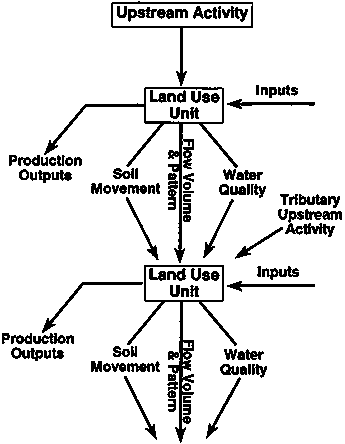
The further subdivision of a watershed is therefore a very important step in the planning of research, in which topography, climate, geology, soil type and farming systems will all be taken into account. It is therefore necessary to define the "land use unit": an area within which the climate, soil, farming systems, land cover and socioeconomic conditions are so homogeneous that any solution to a land use problem is probably applicable over the whole unit, and similarly defined units elsewhere (Figure 1). A typical very large watershed would include many different land use units, and indeed components of several ecoregions, whereas a small (sub)- watershed might lie wholly within one ecoregion and have only a very few land use units.
The transferability of results from watershed to watershed is possible, between a set of homogeneous and comparable watershed subdivisions. The "catenary" concept is particularly important, because this states that certain soil types (and by implication land use units and farming systems) will recur across the landscape in topographically equivalent positions (Sanchez, 1976, 1994). Where this applies, the results obtained in one watershed should be applicable in others.
The watershed approach allows an overall view of the water resource in a systems approach. The land use in a given part of the watershed affects the partition of water between run-off and infiltration, and between evapotranspiration and recharge. The physical reasons for this are well understood (see below). It is therefore possible to compare the advantages of using a finite amount of water in different ways, for trees, irrigated crops or for industrial or domestic purposes. The quality of the water in different parts of the watershed can also be monitored and to some extent controlled. This is important for health reasons, e.g., it is believed that up to 3.5 million children die each year from water-borne diseases.
Fig. 1: Land Use Units - Linkages in a Watershed
The focus on watersheds in relation to land use is by no means new, though few if any earlier projects have attempted the wide scope of the work discussed here. Recent studies have included Lal and Russell (1981), Pereira (1989) and Gregersen et al., (1987). The earlier East African work is particularly relevant. Pereira (1989) suggested that CGIAR should strongly emphasise this approach. The interest in water supply and use within the CGIAR System at that time ultimately led to the setting up of IIMI by a group of donors, but the focus on the watershed did not materialise. There appears to be only one significant watershed experiment in the CGIAR System at the moment, namely the relatively small SCOR project run by IIMI in Sri Lanka.
One task of this study is to determine whether the CGIAR System could use a watershed approach with advantage, how it would strengthen the ecoregional approach, and whether the new developments and techniques in such an approach will allow research to advance beyond what has been done before. It would be very easy for an NRM study to lose its way in masses of detail, due to the inherently site-specific nature of soil/water research. An emphasis on the watershed is only of value if it can act as an organising and simplifying tool for marshalling such diverse soil/water problems, i.e. if it can act as a framework.
The main discussion in the paper is therefore organised according to Figure 1 and Figure 2 (see later), and includes a series of the main soil/water problems in an idealised catchment containing examples of major topographies and climates. Conceptually, the study considers four outputs or impacts (Figure I):
(i) Production of direct outputs from the land use unit;
(ii) Off-site impacts in erosion and soil movement;
(iii) Impacts on stream flow volumes and patterns;
(iv) Impact upon downstream water quality.
It must make sense to work at the watershed integration level for many projects involving both movement of soil and water, and their efficient utilisation and stability, within the watershed landscape. It is quite likely, however, that even in some countries that lie within a large watershed, there may be other elements of integration, such as social, ethnic and political organisational arrangements, that deserve more explicit consideration than the fact that everyone is in the same watershed. This will apply, for instance, to policies that cross sectoral boundaries, and macroeconomic policies that have direct impact on the rural sector, in which case a type of rural area management paradigm would be more applicable, such as has been adopted in some of the Collective Action programmes discussed in chapter 3.
With situations involving different nation states that share (perhaps just parts) of a watershed, aspects of international cooperation and dialogue on understandings may form a critical element of policy dialogue together with the biophysical aspects of watershed management. In some cases, nations states that share parts of a watershed may not even be contiguous in geographical boundaries, and yet are linked by important physical flows of water and soil, the classic case being Nepal and Bangladesh. The degree of achievable policy dialogue within a watershed of this geopolitical distance is thus something of an issue that transcends most boundaries of ordinary policy dialogue and poses worthy challenges for international agencies to explore potential interventions, hopefully from a research-informed knowledge base such as can only be enhanced through international effort blended with national counterpart knowledge and experience. The Nepal-Bangladesh case provides an excellent reason to work with the watershed framework for all the countries involved to be linked.
