


A. WHAT IS MEANT BY "STRENGTHENING" OF NARS
B. WHAT IS BEING DONE TO STRENGTHEN NARS
19. The conceptual framework used for this study is to view the various strengthening efforts as "inputs". Before reviewing the current and past inputs, and considering what the future role of the CGIAR might be in this arena, it is essential to define what should be the "output" of such efforts. This means addressing first the questions of what "strong" means, and which elements of such strength are most important for NARS to be most effective.
20. Throughout the history of the CGIAR there has been a strong emphasis on the need to strengthen NARS. Indeed, in the broader field of agricultural development, there have been numerous projects fostering institutional development. Many bilateral and multilateral development organizations, and international NGOs (e.g. the World Bank, FAO, UNDP, CIDA, ODA, USAID, EEC, and the Ford and Rockefeller foundations) have provided assistance in institutional development, especially in the areas of infrastructure and human resources development. These concerns and efforts implied that NARS were "weak" and needed "strengthening". Obviously some NARS, as well as individual components of each, are stronger than others. Thus, as a strategy is developed for the inputs that the CGIAR as whole, and each Centre, should provide, it will be necessary to identify those areas in which NARS, in general, and those NARS with which the individual Centres are partners, to achieve the desired outputs. In order to do this, the broad subject of "strengthening" needs to be clarified and de-aggregated. First, a broad description of the processes involved in development and execution of national research programmes will be described, then indicators of strength and weakness for each of the factors involved in this process will be defined.
21. For purposes of this study, a strong research system is one that has the sustained capability to effectively and efficiently execute that is of the highest priority in relation to national policies and farmers' needs, and respond dynamically to changing internal and external information. In the context of the stated goals of the CGIAR System, such research should specifically address the issues of poverty alleviation and the protection of the environment.
22. The formulation of a strategy of assistance to strengthen NARS of developing countries can best be viewed from the standpoint of processes involved in the development and execution of national research programmes and the delivery of research results to stakeholders. A summary of the various steps in such a process can be schematically represented as shown in Figure 1.
23. The development of national research programmes aimed at meeting technological needs must start with a well formulated national agricultural research policy. Such a policy must ideally be a product of a properly targeted national development plan, which should also include agricultural development as an integral component. Ideally, such a plan should include a clear ranking of priorities for various commodities and regions.
24. The availability of a national agricultural research policy should enhance the identification and prioritization of potentials/constraints to agricultural production/productivity. This should follow a holistic approach by dealing not only with production but also with conserving, and possibly enhancing, the natural resources base of the country. The translation of an agricultural research policy into a prioritized research plan should take into account whether or not the potentials/constraints are amenable to solution by research, and what technology is available elsewhere. The priorities should not only be with respect to commodities, but also with non-commodity specific research areas, such as soils and water research.
Figure 1: A Schematic Representation of the Steps Involved in the Development and Execution of Agricultural Research in National Agricultural Research Systems (NARS)
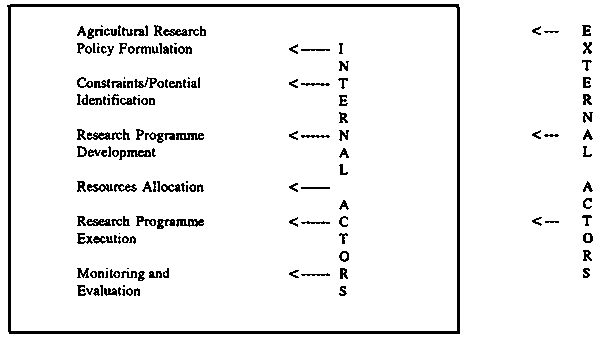
25. The identification and prioritization of potentials/constraints in agricultural production/productivity should lead to the formulation of national research programmes, which are made up of specific research projects aimed at identifying solutions to specific limiting factors to production and dissemination.
26. The next step in the process deals with resource allocation. The crucial issues in this step relate to the amount, quality and timely availability of the necessary human, material and financial resources for research. Meeting these preconditions leads to the next step in the process, i.e. the execution of research projects, the end result of which are technologies and production systems custom-tailored to the needs of farmers and agroindustries. This requires a strong socio-economics capability.
27. Finally, the logical concluding step in the process is the monitoring and evaluation of the research effort. The two crucial issues in this regard are: 1) the assessment of performance of the national research system per se in relation to the quantity and quality of products it generated as per its plan of action and, 2) the evaluation of impact of its research productions on the national agricultural output, both from quantity and quality perspectives. The former issue (i.e., performance) measures the efficiency and effectiveness of the research system itself, while the latter issue (i.e., impact) is influenced by a myriad of factors, many of which are beyond the direct control of the research system. Both are difficult to assess.
28. The implementation of the various steps in the process described should follow a "participatory" approach in which major stakeholders play an appropriate role. This calls for linkages with various actors, both from within (internal) and outside (external) the country (see Table 1).
Table 1: Objectives and Major Players in the Various States of the Research Development and Execution Process in NARS
|
STEPS |
OBJECTIVES |
MAJOR INTERNAL ACTORS |
MAJOR EXTERNAL ACTORS |
|
Agricultural Research Policy an Strategy Formulation |
To align research objectives with national development policies |
High level policymakers, extension leaders, NGOs, farmer organizations Agroindustries |
Bilateral & multilateral scientific & development agencies; CGIAR Centres; NGOs; Transnational companies, WTO |
|
Identification of Constraints and Potentials |
To identify and prioritize researchable issues |
Researchers, farmers, extension workers, NGOs, agroindustries |
CGIAR Centres, Non-CGIAR Research and Technology Institutions |
|
Research Programme Development |
To define research protocols & identify resource requirements |
Researchers, extension workers, farmers, NGOs, agroindustries |
CGIAR Centres, Non-CGIAR Research and Technology Institutions |
|
Resources Allocation |
To ensure adequate and timely availability resources |
High level decision makers, Research managers, researchers |
Bilateral & multilateral scientific & development agencies; |
|
Research Programme Execution |
To generate technology and management systems |
Researchers, farmers, NGOs |
CGIAR Centres, Non-CGIAR Research and Technology Institutions |
|
Monitoring and Evaluation |
To assess performance and impact |
Research leaders, researchers, Extension leaders |
Bilateral & multilateral scientific & development agencies; CGIAR Centres |
29. The main internal actors include policymakers at various levels (including research institute managers and university authorities), researchers, extension workers, farmers, non-government organizations (NGOs) engaged in agricultural research and/or development (including private sector research) activities, and industries dealing with seed production, food/feed processing and agricultural inputs supply. On the external side, the major elements in the linkage matrix include bilateral organizations, multilateral organizations, CGIAR Centres, non-CGIAR research Centres and other organizations such as universities and private sector research and development organizations (e.g. seed and agrochemical companies).
30. Tables 2-4, below, break these processes down into various factors for each of three organizational levels (national system, national institution, and individual research station or centre). A number of factors are listed at each level, with indications of the characteristics of strength and the related indicators of weakness described for each function. It should be noted that many of the blocks are inter-related, in that the consequences of weakness in one block often become the source of weakness in another. Analyzed in this way, few, if any, NARS, whether in developed or developing nations, would be able to assert that they are strong in all areas.
31. While this analysis is helpful in assessing strengths and weaknesses of various factors in the components of the NARS, it must be kept in mind that the breakdown of components relates chiefly to the classical structure of public institutions. A more current analysis would also take into account the broader definition of NARS as incorporating universities, private sector research entities, and institutions dealing with natural resource management. It must also be recognized that this, somewhat simplified, model for purpose of this analysis should not be taken as a prescription of a "one size fits all" model. When applying it to individual NARS, a more flexible approach must be taken, in which the cultural and institutional history and environment are taken into account. It is also understood that the decision-making levels vary from NARS to NARs, and are often not exactly as indicated in the tables. Thus, the chief value of this analysis should be seen as illustrative; not as a rigid template against which the strength or weakness of a specific NARS or agricultural research organization can be measured.
Table 2: Characteristics of Strength and Indicators of Weakness of Various Factors in National Agricultural Research Systems (NARS)
|
FACTOR |
CHARACTERISTICS OF STRENGTH |
INDICATORS OF WEAKNESS |
|
Policy and Infrastructure Environment |
Food and input price policies, rural development policies, and marketing and input infrastructure create an enabling environment for uptake of improved technology |
Low rates of adoption of technological innovations |
|
Linkages Between Research Leaders and High-level Decision Makers |
Good two-way communication on national policies and benefits and needs of research enable mobilization of financial and political support for agricultural research |
Inappropriate policies and lack of sustained support for agricultural research |
|
Funding of Agricultural Research |
Agricultural research seen as a good investment of public and private funds, with long-term stability of funding at levels commensurate with accepted standards and proportionate to development budgets |
Agricultural research institutions underfunded and vulnerable to extreme funding fluctuations; development projects fail to achieve goals for lack of adequate production technology |
|
Agricultural Research Priorities |
Priorities for agricultural research clear, ranked, established on sound methods and related to national development policies |
Research activities dispersed over too many commodities and not related to national policies, resulting in low pay-off to research investment and lack of credibility of research in eyes of decision-makers |
|
Natural Resource Management Policies |
Clearly elucidated policies for land use and conservation and rational utilization of soil, water, forests and genetic resources |
Non-sustainable development |
|
Coordination of Agricultural Research |
National agricultural research councils ensure that the various public and private institutions work in close collaboration with a clear division of labour |
Public funding and facilities for research poorly utilized due to duplication of efforts |
Table 3: Characteristics of Strength and Indicators of Weakness of Various Factors in National Agricultural Research Institutions (NARIs)
|
FACTOR |
CHARACTERISTICS OF STRENGTH |
INDICATORS OF WEAKNESS |
|
Status and Governance |
NARI established as a (semi) autonomous body with a governing body that incorporates key stakeholders and with authority to set the institute's procedures for procurement and personnel management. |
Excessive political influence on research system, especially in relation to key appointments; excessive delays in procurement; adherence to civil service-type personnel policies that do not reward performance and protect non-productive staff. |
|
Organizational Structure |
Structure of NARI management, research programmes and stations, and support services facilitate a good two-way flow of information, delegation of authority, and a collegial environment. |
Overly-centralized, hierarchical management of resources; low morale and productivity of researchers; poor communication between headquarters and stations and among disciplines. |
|
Priority Setting |
Clear priorities set for commodities and research areas using appropriate methods and incorporating top-down signals from the national priorities and bottom-up signals from stations, extensionists and farmers. |
Lack of congruence between NARI priorities and national priorities and farmers' needs; funds poorly allocated; limited resources dispersed among too many research programmes. |
|
Institution Planning |
Long-term plan developed that clearly elucidates the mission of the NARI in relation to national goals and spells out human, financial and infrastructure needs, and organizational structure to accomplish these objectives. |
Lack of programme planning or planning done in a vacuum, resulting in research activities that reflect the interests of individual researchers and react to donor pressures without a clear relationship to the goals of the NARI and are unrelated to available resources. |
|
Programme Planning |
Annual work plans developed in relation to established priorities, with clear objectives and measurable performance indicators; plans developed in proactive manner involving top management, researchers, and extensionists, and reflecting the needs of the producers. |
Adhoc development of research agendas; effectiveness of programmes cannot be adequately evaluated; resource allocation does not reflect national goals or farmers' needs; excessive dependence on externally-funded projects for equipment and vehicles. |
|
Programme Budgeting |
Realistic budgets developed by programme leaders, based on programme plans and likelihood of available resources; resource mix provides for adequate operational costs. |
More research activities planned than can be adequately supported; too high a proportion of funds for fixed personnel costs; budgets cannot serve as effective control mechanism. |
|
Resource Allocation |
Financial, human and equipment resources allocated on basis of programme budgets, and dispersed in a timely and transparent manner. |
Resources allocated by region or station on basis of previous years' budgets; budget allocation provided at irregular intervals, and often reduced; centralized control of allocated funds leave researchers in dark as to how much they will have to carry out their work. |
|
Programme Monitoring and Evaluation |
Programme leaders monitor progress based on programme plans and coach researchers to improve performance; regular peer review to assess past performance of programmes as well as future plans. |
Programme evaluation focuses chiefly on appraisal of new proposals rather than past performance; reviews of previous research concentrates on inputs and activities rather than outcomes. |
|
Human Resources Management |
Recruitment of personnel based on a human resources needs assessment related to the long-term plan and clear job descriptions, and done in a transparent manner, based on objective criteria. |
Disciplinary mix in research cadre does not reflect programme needs; top management and research leaders selected on basis of political or other influence rather than past management performance or leadership skills. |
|
Regular personnel evaluation based on individual performance plans, and done in an objective manner that provides opportunities for positive and negative feedback. |
Inefficient and ineffective performance; promotion based on seniority rather than performance; lack of motivation when outstanding performance is not rewarded and poor performance not punished. |
|
|
Top management and programme leaders possess leadership skills that motivate staff to higher levels of excellence. |
Low levels of research productivity. |
|
|
Numbers and Location of Research Stations |
Research stations located in key agroecological zones, attractive to researchers and their families, and few enough to permit a critical mass of scientists and support in each; research that requires highly specialized skills and equipment centralized. |
Excessive fractionation of resources to too many locations resulting in inefficient use of resources and inadequate coaching of junior scientists and interdisciplinary cooperation; sometimes key zones not covered; unattractive duty station. |
|
Linkages |
Strong, collaborative linkages between NARI and universities, extension agencies, NGOs and private sector research; between crop, animal, and forestry research; and with other bodies dealing with natural resources issues. |
Inefficient transfer of technology; inefficient use of resources (especially the highly qualified scientists and specialized facilities in universities); duplication of efforts; inappropriate technology in relation to farmers' needs and natural resources concerns. |
|
Good external linkages with national and international institutions as sources of knowledge. |
Ineffective research owing to failure to build on knowledge available; inefficiencies due to duplication of work done elsewhere. |
|
|
Effective communication with policymakers utilizes the knowledge and competence of research leaders in setting national priorities and policies, as well as ensures long-term sustainability of funding. |
Underfunding resulting from lack of appreciation by policymakers of work of the NARI; National policies and priorities made without benefit of informed input from NARI leaders; policy environment not conducive to adoption of technological innovations. |
Table 4: Characteristics of Strength and Indicators of Weakness of Various Factors in Research Centres and Stations (NARC)
|
FACTOR |
CHARACTERISTICS OF STRENGTH |
INDICATORS OF WEAKNESS |
|
Priority Setting |
Clear priorities for research on various commodities and research areas based on NARI priorities, diagnostic studies of local farming systems, and problem identification with inputs from extensionists and farmers. |
Research activities do not reflect institution priorities nor respond to production constraints of farmers; inefficient use of resources. |
|
Project Planning |
Projects developed on basis of NARCs' priorities, with emphasis on multidisciplinary and interinstitutional cooperation; clear indication of the role to be played by each team member and the experiments to be conducted, and expected outcomes. |
Isolated, ad hoc experiments conducted by individual researchers; inefficient use of funds and facilities. |
|
Project Budgeting |
Realistic budgets developed by project leaders, that clearly estimate the researcher time allocated to, and resources needed, for each experiment. |
Lack of clarity about the resource requirements; managers unable to assess the resource needs in approving projects, nor analyse resource allocation to each commodity and research area in relation to established priorities. |
|
Project Execution |
Appropriate mix of biological, physical, and socio-economic research; and of laboratory, on-station, and on-farm evaluation and on-farm validation, with appropriate participation of extensionists and farmers. |
Technology developed is inappropriate to the physical and socioeconomic realities of farmers, resulting in poor adoption rates and erosion of credibility of research system in eyes of farmers. |
|
Project Monitoring and Evaluation |
Project leaders monitor progress and coach researchers; regular peer reviews of past research results and future plans, with active participation of extension, NGO, and production sectors. |
Experiments tend to repetitions of previous trials; failure to discontinue non-productive research; reviews focus chiefly on new activities submitted for approval rather than on outcomes of previous work. |
|
Human Resources Development and Management |
Researchers selected on basis of clear job descriptions based on Programme plans, and given opportunities for in-service training and participation in national and international conferences to upgrade skills; research performance monitored and evaluated on basis of objective criteria. |
Low research productivity due to lack of congruence between work plan and skills; low morale due to lack of ineffective monitoring and evaluation linked to an appropriate reward system. |
|
Financial Management |
Each project leader and researcher knows the amounts of funds available for the year or season; funds made available in a timely manner; managers and project leaders receive clear and timely reports on expenditures and funds remaining for each activity. |
Centralized control of resources by Centre or Station manager, with scientists unable to plan work as they do not know how much they will have available; funds released on a piece-meal basis, and often too late for efficient resource utilization and effective research execution. |
|
Facilities Management |
Necessary laboratories, research fields, equipment, farm machinery and vehicles available in relation to research plans; equipment, vehicles and machinery well maintained. |
Planned research cannot be carried out; expensive equipment under-utilized or not functional; on-farm work not possible due to lack of mobility. |
|
Research Support |
Research supported by well-functioning service laboratories and qualified technicians; biometric service available to assist in analysis of trials and research results; research fields prepared in timely manner for planned experiments. |
Inefficient use of researcher time; unreliable research results; experiments cannot be established at the right time; researchers frustrated and non-productive. |
|
Linkages |
Good linkages of Centre or Station with extension agencies, NGOs, private sector research, local universities or agricultural colleges, and farmer organizations. |
Inefficient use of resources; duplication of efforts; poor adoption of technology generated. |
32. Applying this type of analysis to individual NARS would reveal different problems for each NARS and its components. Those most likely to be found in most NARS are:
Political Environment
· Inappropriate political influence on the research system, especially in relation to key appointments;· laws and regulations that make it nearly impossible to weed out nonproductive staff;
· lack of appreciation by high-level decision-makers for the value of agricultural research as a profitable investment; and
· pressure by local officials to keep research stations in their area of influence makes it difficult to achieve badly needed consolidation.
Institutional Weaknesses
· Poor inter-institutional and intra-institutional collaboration;· insufficient involvement of farmers in setting of research agenda and evaluation of results;
· relegation of "farming systems" research to separate, isolated units, rather than promotion of the concept that most scientist should conduct on-farm research with a farming systems perspective;
· insufficient use of socio-economic disciplines;
· hierarchical management structure and attitudes; and
· lack of functional flexibility.
Resource Problems
· Severe underfunding, with national allocations for agricultural research incongruent with allocations for agricultural development;· resource allocation not related to national priorities, farmers' needs, and research programme requirements;
· inappropriate resource mix, with too high a percentage of budget dedicated to personnel, and not enough for operations;
· overly centralized procedures for resource allocation; and
· budgets largely a compilation of requests rather than used as an effective resource allocation process.
Management weaknesses
· Insufficient delegation of authority;
· lack of management information;
· inadequate procedures for budget preparation and review;
· inadequate evaluation, monitoring and evaluation of research;
· inadequate individual performance evaluation and reward system;
· promotion based strictly on basis of seniority rather than merit;
· heads of institutions and units not selected on basis of management performance; and
· lack of management training.
Leadership Weaknesses
· Lack of respect for leaders when appointed on basis of personal influence or political connections rather than scientific record or leadership abilities; and· lack of training in leadership skills.
Efforts to strengthen NARS need to focus on helping them overcome such weaknesses, taking into account the local cultural and institutional environment.
1. Criteria for Selection of External Interventions
2. Roles of Various Players
3. What the CGIAR Centres Are Doing
33. Obviously, the point(s) of intervention in this process by the various actors varies, depending upon their interest and competence. At the internal level, the main focus of intervention for policymakers would be at the stages of policy formulation, resources allocation and monitoring and evaluation. These will be most logical points of intervention, not only to ensure that research programmes are well focused and adequately productive, but also to provide sufficient support for implementation of planned research and development activities by NARS's.
34. The point of intervention by external actors is of great importance. As can be seen in Table 1, external actors taken as a group can intervene at all steps in the process. However, taken singly each can make contributions only at selected points of intervention. The CGIAR Centres could play a more useful role at the levels of constraints/potential identification, research programme development, research programme execution and in some areas of policy and strategy formulation. The bilateral and multilateral organizations are equipped to intervene at the levels of policy and strategy formulation, resources allocation and the conduct of monitoring and evaluation.
35. Of equal importance here is the identification of the type and level of interventions by external donors at each step of the process. The type of interventions, in this context, relate to activities that ultimately result in the strengthening of the institutions engaged in research and development (R&D) activities. This aspect will be further discussed in the next section.
36. For ease of analysis, the various external interventions for institution strengthening can be organized as follows:
Institution-building interventions:
· formulation of agricultural research policy and strategy;
· development or improvement of organizational structure and management systems;
· establishment or strengthening of physical and/or technical facilities;
· provision of operating funds, including (in some cases) salaries and wages; and
· playing advocacy roles, both at national and international levels.
· ensuring accountability
Technical support:
· provision of advisory services;· provision of training opportunities, ranging from short-term specialized courses to degree-level education at local, regional or international institutions;
· provision of training materials and methodological publications;
· facilitating attendance of seminars, workshops field visits as well as postdoctoral and visiting scientists and sabbatical programmes;
· supply of information; and
· provision of germplasm.
Collaborative research functions:
· participation in the development and execution of research programmes through various types of collaboration (i.e., consultancies contractual or collegiate);· assistance in the development of regional collaborative research networks; and
· establishment of networks of desired types (i.e., information, research, etc.).
In listing these external interventions, it must be kept in mind that although their intention is to strengthen agricultural research, they have sometimes had a negative (weakening) impact. For example, the way some donors encouraged governments to get over-extended as regards the recurrent cost of agricultural research by provision of operating funds with insufficient attention to long-term sustainability of the research system. In some cases provision of consultancy services has to some extent tended to reduce the development of local skills and capacity.
37. The selection of external interventions depends on a number of factors associated with the particular internal and external circumstances of the NARS. There is no single model of what constitutes a strong NARS, and no linear set of stages that represents going from a weak to a "mature" NARS. Some of the mature NARS of developing countries and developed countries are the ones that have particularly difficult institutional problems in maintaining a flexible and responsive capability. A healthy strong "small country" NARS will generally look nothing like a strong research system in a large country with large-scale internal financial and political support. In general, the following should constitute the main factors in considering external interventions for NARS of developing countries:
· policy directions and goals;
· governance and accountability;
· quantity and quality of human resources;
· state of development of physical and technical facilities;
· level and sustainability of research funding;
· efficiency and effectiveness of the organization and management system; and
· types and levels of linkages created.
38. The various external suppliers of required interventions to NARS of developing countries can be grouped into the following broad categories:
· ISNAR
· CGIAR policy research Centres
· CGIAR commodity and natural research Centres;
· non-CGIAR research and technology institutions;
· bilateral organizations;
· multilateral organizations;
· NGOs; and
· Multinational (Transnational) Corporations.
39. Prior to the establishment of the CGIAR, support to NARS of developing countries were provided by bilateral and multilateral organizations. For example, the United Development Programme (UNDP) and the Food and Agriculture Organization of the United Nations (FAO) played a dominant role in establishing or strengthening agricultural research services in developing countries; although other UN organizations such as the IAEA did contribute to a lesser extent in these efforts. Currently, the World Bank, IFAD and others are also major contributors to such efforts. Similarly, several non-governmental organizations (such as foundations) have also traditionally supported the development of agricultural research services.
40. With the expansion of international agricultural research, service and policy Centres through the CGIAR, there is an increased supply of research support to NARS. It would appear that there is a duplication of effort by international organizations in the provision of support to NARS. In fact, there is clear indication that NARS leaders are somewhat confused on how to deal with the increased type and level of supply-driven external interventions.
41. On the other hand, the CGIAR and non-CGIAR research and technology institutions are concerned with the types and level of support they should provide to NARS, not only because of funding instability but also because of efficiency considerations. Hence, there is a clear need to formulate a coherent strategy in identifying and coordinating external interventions to strengthen NARS. Such a strategy should be demand-driven, and based on anticipated development of NARS in the medium and short term period.
42. To determine the roles of external players, it is necessary to conceptually identify the kinds of strengthening interventions by external agencies required at each stage of the research development and execution process. The most common requirements are 1) facilities, 2) operating funds, 3) consultancy, 4) training, 5) information, 6) research collaboration and 7) linkages (networks).
43. Obviously, which of these strengthening interventions are required at each step of the process depends upon the state of NARS' development and the kind and level of assistance available within countries. Generally, newly established NARS, NARS of "small countries" and NARS newly embarking on more upstream research require greater attention. Strengthening should not be seen as a linear process of going through stages of development. Each NARS has to be looked at separately and specific strategies developed to address the local conditions. In a small country they might not go through an adaptive research stage, but invest in greater participation in regional research activities, and invest in the latest high technology information systems.
44. Unfortunately, the expansion and strengthening of NARS, in most cases, has not resulted in increase research outputs commensurate with requirements and the level of support provided. Food/feed and cash crop as well as livestock and fishery production has not kept pace with population demands in many of the developing countries. Of course, such failures can have many causes, but it is an undeniable fact that one of the important causes is associated with unavailability or inaccessibility of appropriate production technologies, production systems and/or enabling policies and incentives.
45. Therefore, there is no question that the need for external interventions for institution strengthening will continue for the foreseeable future. However, two provisions will have to be kept in mind in this respect: 1) the types and levels of interventions should have a diminishing dimension over time as NARS will be expected to further improve in strength and 2) the supply of external interventions should be expected to be more structured and better targeted to specific needs.
46. With these in mind, the anticipated roles of the various external organizations in strengthening NARS can be identified, with such assistance based on the following characteristics of the potential suppliers of this assistance:
· institution objectives and mission goals;
· past assistance traditions;
· currently available skills or expertise;
· available quantity and quality of resources for R&D;
· available level and sustainability of funds; and
· type of linkages created.
Utilizing such criteria, each nation will need to determine for itself which type of assistance it should invite or accept from which external agency. In general terms, however, the following institutions appear to have the greatest comparative advantage for the respective strengthening functions:
|
Strengthening Function |
Institutions6 |
|
|
Major Role |
Lesser Role |
|
|
Institution Building |
||
|
Improved Facilities |
MBDA |
|
|
Operating Funds |
MBDA |
|
|
Advocacy |
MBDA, Is, If |
CGC, CON |
|
Technical Support |
||
|
Advisory (consultancy) Serv. |
MBDA, CON |
Is, If, CGC, NCG |
| Training | CGC, MBDA, NCG | Is, If, CON |
|
Information |
CGC, Is, If |
NCG, CON, TRANS |
|
Germplasm |
CGC |
NCG, TRANS |
| Research Cooperation | ||
|
Commodities and Disciplines |
CGC, NCG, CON, TRANS |
|
|
Commodities and Disciplines |
CGC, NCG, CON, TRANS |
|
|
Management and Policy |
Is, If |
NCG, CON |
|
Linkages (networks) |
CGC |
Is, If, NCG, MBDA |
6 MBDA = Multilateral and bilateral development agencies
CGC = CGIAR commodity and natural resources centers
Is = ISNAR; If = IFPRI
NGC = Non-CGIAR Scientific and Research Institutions
CON = Private Consultants and Consultant Finns
TRANS = Transnational (multi-national) Corporations
47. A historical perspective of how the Centres have been involved in various aspects of the strengthening of NARS, and how these activities and relationships have evolved over time, is given in Annex C. This broad overview necessarily generalized on trends in emphases and relationships. It is recognized that not all Centres have followed these general trends in the same manner.
48. For purposes of this Study, the TAC Secretariat produced a very useful summary of the institution-strengthening activities of each Centre, based on the respective Centres' Medium-Term Proposals. This summary was validated by the Centres and is appended as Annex D.
49. A detailed listing and classification of all such activities, in which one or more of the Centres are engaged, is contained in Annex E. This classification was used as the basis for a questionnaire sent to all the Centres, in which the Centres were asked to indicate the following for each activity:
Past· Have not been engaged in this activity
· Have engaged in this activity occasionally
· Have done this regularly as a normal component of the Centre's workCurrently
· Not engaged in this activity
· A Component of current work of the CentreFuture
· No plans to engage in this activity
· Plan to reduce the level of this activity
· Plan to continue this activity at about its current level:· solely
· jointly, in collaboration with other Centres
· jointly, in collaboration with ISNAR
· jointly, in collaboration with IFPRI
· as part of a "system-wide" programme· Plan to increase the level of this activity:
· solely
· jointly, in collaboration with other Centres
· jointly, in collaboration with ISNAR
· jointly, in collaboration with IFPRI
· as part of a "system-wide" programme
Compilations of the responses to this questionnaire are provided in Annex F.
50. Drawing on the information provided in Annexes C, D, and F, along with budgetary information provided by the TAC Secretariat, some generalized statements can be made about what the Centres have been and are doing to help strengthen NARS.
· Institution-strengthening has been an important component of the Centres since the first Centre (IRRI) was created and continues to be a major activity of all Centres. Until the creation of ISNAR, however, the impact of these activities has largely been to those components of the NARS related to the specific mandates of the respective Centres, not to the NARS as whole. The fact that these NARS components frequently operated in a relatively weak institutional environment tended to lessen the impact of the strengthening activities. This realization was an important consideration in the rationale for the creation of ISNAR.· ISNAR began chiefly as a service organization, devoting much of its resources to diagnostic studies. It has progressively moved towards greater attention to research and development activities. Concomitant to this has been a broadening of its disciplinary coverage to include more staff with training and experience in the socioeconomic and management sciences.
· The principal strengthening services of the Centres (other than ISNAR) have been in the areas of training, information, consultancies, and network development. These have been chiefly with respect to the particular commodities and other research areas directly related to the individual Centres' mandates. From the overview of institution-strengthening activities contained in the 1994-1998 medium term proposals (Annex D), some possible exceptions to this generalization, in which individual Centres indicated current or planned activities broader than their mandate areas, have been noted. CIMMYT's statement that "Increasingly, the major focus of those consultancies is to improve priority-setting and decision-making capabilities in the national systems..." seemed to indicate such a broader approach. However, a subsequent communication form CIMMYT indicated that these are chiefly related to their mandate crops. ICRISAT indicated that it "helps NARS in the establishment of their own information services". IIMI's mission statement includes "supporting the introduction of improved management and policy making", but it is not clear whether this relates only to irrigation management and policies, or to wider, institutional matters. IITA's MTP outlines approaches that it will follow with the specific aim of strengthening the capacity of its NARS clients, which includes "ensure effective planning of appropriate research agendas". ILCA stated that its interactions with NARS "dictate a need to assist in areas such as priority setting and strategic planning as well as counsel on wider issues of appropriate structures for research management and research", and added that "ILCA will seek the collaboration of ISNAR on the latter issues". IRRI indicated that the one of the objectives of its "National Research Services" is to "help strengthen the capabilities of selected national agricultural research systems".
· As the respective components of the NARS have become stronger, and the Centres have move "upstream" in their research, there has been a gradual shift away from more general production courses to specialized, individual training. Much of the former types of training is now conducted in and by the NARS or in regional collaborative networks. To help in this endeavour, many of the Centres are now engaged in "training of trainers" and courseware development activities.
· As the former "commodity-oriented" Centres have progressively incorporated more research on natural resource and environmental issues, the distinction between the commodity-oriented and natural resources Centres has become more blurred.
· New "systemwide" and "ecoregional" approaches being developed by the Centres offer opportunities for greater participation of the NARS in the CGIAR programmes, and for greater interinstitutional collaboration. Funding constraints currently constrain the Centres from fully utilising these opportunities.
· There is very little overlap between the institution strengthening activities of ISNAR and IFPRI. Such overlap as exists is chiefly in the area of government policies on funding of research; and area in which there is growing collaboration between the two Centres.
· The combination of financial shortfalls with a growing capacity of NARS to do their own training and manage their networks, has led to a gradual decline in the allocation by Centres of budgetary resources, but they remain substantial. Using the TAC classification of activities, the budget allocations for the category "Fortifying NARS" represents 17% of the combined 1996 funding allocations (down from 24% in 1991).
