1. RESEARCH POLICY AND SYSTEM DEVELOPMENT PROGRAM
2. MANAGEMENT PROGRAM
3. SPECIALIZED SERVICES
4. GOVERNANCE, MANAGEMENT, AND ADMINISTRATION
1.1 Introduction
1.2 Scope of Work and Program Activities
1.3 Assessments
1.4 Conclusions and Recommendations
ISNAR has targeted its Research Policy and System Development Program (in short, Policy Program) activities towards senior and high-level policymakers concerned with agricultural research. Although not explicitly stated, it would appear that the objective of the Policy Program is to improve the relevance of policy on agricultural research. The thrust of the program on the whole is couched within the evolving environment in which research is carried out. This environment consists of liberalizing economies, with some undergoing structural adjustment programs, and the globalization of research, all of which require NARS leaders and policymakers to situate their systems strategically within regional and international agriculture.
The design of the Policy Program has been an evolutionary and complex process, and refinements are on-going. For instance, towards the end of 1996, the number of themes was reduced from four to three. At the time of the Internal Program Review (IPR) in September 1996, the themes were research policy analysis; system development; strategic planning, priority setting, and impact assessment; and new challenges. By December 1996, these were re-grouped into three themes: policy development, system development, and new challenges.
Up to 1992, it would appear that the then Research Policies and System Strategies program was composed of several activities which were not necessarily organized into specific themes or sub-programs. Between 1986 and 1994 a total of 22 issues had emerged, and in 1994 these were all merged into the Policy Program's agenda (see section by H. Tollini in Medium-Term Plan 1998-2000, November 1996).
The program is now divided into three themes, and discussion in this section is based on each of the three themes.
1.2.1 Scope of work
Each of the three thematic areas is subdivided into three sub-themes, and each sub-theme is essentially a grouping of projects. The themes and sub-themes, however, do not represent administrative boundaries. Each theme has a technical committee for brainstorming and discussion. Committees have rotating chairs.
The structure of the program is summarized below by theme and sub-theme.
Policy Development· linking research with national policies;
· resources for research, including information technology;
· priority setting and impact assessment.Research System Development
· strategic planning;
· system design;
· transnational cooperation.New Challenges
· biotechnology;
· natural resource management;
· agro-industries and market orientation.
Table A1.1 provides a more detailed breakdown of the main activities in each thematic area of the Policy Program. The Policy Program, however, has a total of 68 projects.
1.2.2 Objectives, strategies, and priorities
Because of the way the program is structured, each theme and sub-theme has a set of projects. In this section, therefore, discussion is focused at the thematic level, and objectives, strategies, and the main project activities are examined at that level.
The Policy Development theme has three sub-themes: linking research with national policies, resources for research, and priority setting and impact assessment.
· The major objective of the linking research with national policies sub-theme is to provide relevant information for policymakers whose decision-making processes have a direct impact on the national research system. There are 11 projects under this sub-theme. On this issue, the most important research project is on structural adjustment. This study looked at six "early-adjusting" countries, including Burkina Faso, Chile, Ghana, Indonesia, Mexico, and Sri Lanka. The study found that structural adjustment did not automatically lead to spending cuts on research, but rather that the pressure was on increasing the accountability of the research system and its effectiveness as a development tool. Several publications resulted from this work, including a book published jointly with the World Bank. Under the same sub-theme, several workshops and policy-type seminar activities were completed. In addition, a recently recruited staff member is developing a policy research agenda around the issue of unstable financing of NARS.· The resources for research sub-theme has a total of eight projects, three of which are under the Indicator Series, three on the financing of research, and two on information technology in the Indian Council for Agricultural Research and the Philippine Council for Agriculture, Forestry and Natural Resources Research and Development. This work on information technology is at a higher policy level and not related to the information work under the Management Program. The major objective of this sub-theme appears to be the redressing of the slowdown in public agricultural research expenditures and access to knowledge. The important projects under this sub-theme are the Indicator Series and the research financing projects. The Indicator Series has been on-going since the mid-1980s. The initial data collection effort was focused on sub-Saharan Africa, and the effort has now shifted to Latin America and the Caribbean. This work has led to several important publications containing useful data and quantitative analyses. The most important project under the financing of research work is the current compilation of a Research Finance Sourcebook.
· The priority setting and impact assessment sub-theme comprises 11 projects, mostly outreach projects in various parts of the world, including Bangladesh, Benin, and Kenya, as well as some regional support projects for Eastern and Southern Africa. The target is basically to institutionalize priority-setting tools that assist in better allocation of research funds. There has also been a welcome broadening of the application of priority-setting tools to include a natural resource management project on multi-purpose trees, one on livestock priority setting, and another on integrating biotechnology. The history of priority setting at ISNAR suggests a gradual shift from an emphasis on complex quantitative methods towards simpler scoring methods. More recently, ISNAR has assisted ASARECA and SACCAR, the regional agricultural research associations for Eastern and Southern Africa, respectively, with their priority-setting efforts. Although there is a stated intention to work on the impact assessment of research, there is as yet no project on this aspect.
The System Development theme has three sub-themes: strategic planning, system design, and transnational cooperation.
· The strategic planning projects are more country based, and in 1996 a total of 10 projects were underway in several countries: Bangladesh, Burkina Faso, Egypt, Eritrea, Lebanon, Lesotho, Mozambique, Namibia, and Togo. In most cases, the projects aim at developing a strategic plan for the research system.· There are 13 projects under the system design sub-theme and these fall into two main categories. One part is concerned with issues of organizational structure and governance and this work is executed on a case-study basis. The other part is the linkages work. Farmer linkages and university linkages are the main projects. The farmer linkages work has five projects, all in sub-Saharan Africa, and the objective of this work is to strengthen the farmers' voice in the research process. This work has had a useful spin-off in a project with the International Federation of Agricultural Producers (IFAP); ISNAR is developing a training module for this farmers' organization. The strategy of the linkages projects combines research with outreach. This also applies to the university linkages project, which is also essentially an African-based project. Co-funded by BMZ and in collaboration with a German university department, this project provides guidance to national systems on linking universities with the national research system while at the same time allowing for valuable Ph.D.-level field research training.
· The sub-theme transnational cooperation has four projects, of which the West Africa G4 (Research Management Network) is the main one. The objective on the sub-theme is to foster international spillovers at the regional level. The G4 is pursuing this objective by coordinating research on management issues in four West African countries: Burkina Faso, Mali, Niger, and Togo. Each of the four countries in the group coordinates a theme, and under this arrangement Burkina Faso coordinates planning, monitoring, and evaluation; Mali, information; Niger, physical resources management; and Togo, technology transfer. This approach is being assessed as yet another approach that ISNAR can use to package its services.
The New Challenges theme is the most recent addition to the Policy Program and has three sub-themes of biotechnology, natural resource management, and agro-industries and market orientation. The objective is to expose NARS to new technological areas of strategic importance through sharing information with NARS on these strategic issues.
· The biotechnology sub-theme has a total of seven projects, all under the Intermediary Biotechnology Service (IBS), all in support of new or potentially new users in Africa, Asia, WANA, and Latin America. For governments and organizations, and ultimately, for technology users to procure potential benefits of agricultural biotechnology, new technologies must be matched with appropriate economic policies, infrastructural development, and support services and education in order to incorporate them into the productive sector. This is the kind of advice service that the IBS is providing.· There are 10 projects under the natural resource management (NRM) sub-theme. The objectives of ISNAR's NRM sub-theme are to assist NARS policymakers to clarify the NRM issues at a conceptual level, provide scientific measures of the importance of the problem or opportunity, and explain the consequences of alternative actions. ISNAR has the advantage of being an independent advisor to NARS on this issue. NRM research has a policy dimension involving decision makers at various levels concerned with issues of (a) spatial equity, or who captures the gains and bears the cost of resource exploitation, (b) intertemporal equity - protecting the resource base for future food security, and (c) productivity or opportunity costs of investing in low-potential areas. NARS leaders struggle with these issues as much as the CGIAR itself. ISNAR's guiding principles on these strategic issues are welcomed at a time of shrinking resources for NARS.
· The sub-theme agro-industries and market orientation is the most recent addition to the sub-theme of new challenges. There is only one project at the moment and greater activity is expected after a recent recruit joints the staff. The objective of this new sub-theme is to capture the broadening research agenda as it is influenced by developments in those industries that process agricultural products. More and more, market forces are also expected to be factored into the agricultural research agenda.
1.3.1 Outputs and impacts (1991-1996)
Publications
The Policy Program staff have been active in publishing relevant and useful information. The accomplishments of the Policy Development work has largely been a series of publications of which the most significant are the Agricultural Research Policy publication of 1991 and the Science under Scarcity book of 1996. The Financing Sourcebook, still to be finalized, promises to be a major publication. There are several other valuable publications as well:
The Scale and Scope of National Agricultural Research in Small Developing Countries: Concepts and Methodology. By P. Eyzaguirre. 1991.Agricultural Research Policy: International Quantitative Perspectives. Edited by P.G. Pardey, J. Roseboom, and J. Anderson. 1991.
Agricultural Research in an Era of Adjustment: Policies, Institutions, and Progress. Edited by Steven R. Tabor. 1995.
Science under Scarcity: Principles and Practice for Agricultural Research Evaluation and Priority Setting. By J. Alston, G.W. Norton, and P. Pardey. 1995.
Opportunities, Use, and Transfer of Systems Research Methods in Agriculture to Developing Countries. Edited by P. Goldsworthy and F. Penning de Vries. 1994.
The Financing Sourcebook (still to be finalized). Edited by S. Tabor, W. Janssen, and H. Bruneau.
Agricultural Research Plans in sub-Saharan Africa is a research report compiled in collaboration with IITA and synthesizes experiences with agricultural research master plans. It has been reviewed and revised and is now in the ISNAR Publication Unit for editing and production. Another series of useful publications produced by the Policy Program are on relevant issues for agricultural research managers and their users. The basic information generated by the Linkages Project has been utilized to produce high-quality, relevant training modules, valued by NARS and by farmers' organizations. ISNAR should be praised for its timely publications on strategic issues such as biotechnology, natural resource management, and private-sector participation in agricultural research.
Service
The priority-setting projects have been a major activity of the Policy Program and have provided lessons for both the NARS and ISNAR. ISNAR has recorded its greatest impact with priority setting in a number of countries, including Benin, Burkina Faso, Kenya, Mali, Morocco, and Uganda. Some of the recorded lessons, however, include the importance of priority setting as an internal process, and the fact that the process has to be consistent with organizational capacity and resource base, including human resources, if these tools are to be widely used. Very few priority-setting exercises have led to verifiable changes in resource allocation because the activity is delinked from resource allocation. ISNAR has apparently experienced that, with the exception of a few cases, the priority-setting exercises they support have insignificant legitimacy in terms of local influence on actual priorities or research agendas. There is as yet no evidence of how sustainable the priority-setting techniques are after initial adoption.
ISNAR has assisted both SACCAR and ASARECA with priority-setting efforts at a regional level, and this is expected to impact positively on national systems. On transnational cooperation, however, some lessons include the relatively high cost of delivery through transnational cooperation; there are some reservations, as well, about the financial sustainability of regional organizations (see L. Zuidema's paper for the IPR 1996).
With regard to the IBS, a mid-term evaluation of 1995 provided useful insights. The evaluators concluded that IBS had impressive achievements in terms of activities (interactive policy seminars) and outputs (database and technical publications) during its two-and-a-half years of implementation. Furthermore, IBS has developed the capability to consolidate its activities and output into potentially useful decision-making tools applicable to biotechnology management. IBS has also successfully established its visibility among potential clients, which include developing countries as end users and international biotechnology programs as intermediary users.
The Policy Program staff have been very active undertaking advisory service missions. The ICER on ISNAR's impact, however, alludes to the lack of systematic records on service activities, their outputs and impacts. This in itself would suggest, the ICER concludes, that a substantial effort has to be undertaken by ISNAR staff to provide information on advisory work.
Training
The Policy Program has also had some achievements in the area of training, although this has not been one of the Policy Program's stronger activities. According to the ICER on ISNAR's impact, ISNAR documents reveal that in the policy realm most outputs have been in the form of publications, and little training has been done (Exhibit 7). Although ISNAR's clients rate training as its most valuable product (Exhibit 10), training within the realm of the Policy Program is very limited. However, several (in-house) seminars, conferences, and symposia have been held to exchange information in these areas (Table A1.2). Most of these activities may not be regarded as formal training, and the subject matter is wide ranging - from macro-policy issues of structural adjustment to narrow issues of cocoa biotechnology. This, however, is a good indication of the kind of training and information networking activities that the Policy Program has embarked upon. The most important formal training activity at the regional level is the agricultural research management training project of SADC, in Southern Africa. This program is currently under external review. Significant progress has been made, however, in institutionalizing this in the region.
1.3.2 Quality considerations
The Policy Program has accumulated several books of high quality, as well as several articles in internationally known journals (Table A1.3). There has also been an improvement in the quality of publications since the last EPMR (Table A3.1), with a clear separation and peer review process for various quality levels of publications. This comment is made relative to the negative impression given by the last (second) EPMR. ISNAR, however, has the challenge to classify its publications in a way that facilitates readers' identification of thematic areas of interest. Beyond the Briefing Paper series, ISNAR may also need to improve quality and relevance of publications by adopting a more concise, client-oriented format, in as simple a language as possible. Not enough Guidelines or Guiding Principles types of publications are published. ISNAR should also continue its efforts to define, disseminate, and utilize in a consistent manner, concepts and vocabularies in technical fields.
1.3.3 Program staffing
In 1996, the Policy Program had 68 projects grouped under the various sub-themes, most of which are run by individual persons. Some projects, however, involve teamwork, as well as collaboration with the Management Program. The 68 projects are shared among 20 persons, and this suggests a severe dispersion of staff. The Policy Program is composed of 30 staff members, of which 22 are professional staff. Most of them, 16/22, have a Ph.D. degree and the rest, 6/22, have a Masters degree or are in the process of pursuing a doctoral degree. On staff discipline mix, 15/22 have an agricultural economy background; the rest are specialized in different disciplines, such as agronomy, plant breeding, ecology, and various social sciences.
In terms of allocation of staff by region in 1995, Latin America has been allocated the highest staff time (26%), followed by Africa (24.3%), Asia (7.4%) and WANA (3.5%). The remaining 38.8% of allocated staff time is taken up by global issues.5
5 Source: ISNAR project and staff time allocation in 1995. Project Management Information System.
In terms of staff time allocation by function (research, training, and service), data available for 1995, shows that research has received the highest share (38.4%), training (31.3%), and advisory services (30.3%). The program contributes to 48.5% of ISNAR's working days.
Most of the staff are located at headquarters. Two staff members are presently outposted, one in Kenya at KARI and the other in Syria at ICARDA.
1.3.4 Comments on the Policy Program research agenda
The theme on Policy Development has, arguably, developed ISNAR's most pronounced research agenda. This is largely the work under the resources for research sub-theme with the Indicator Series and structural adjustment projects. The sub-theme on resources, however, has no clearly stated framework for integrating these individual projects. This weakness is observed in all the themes under the program. Nevertheless, the Indicator Series and the structural adjustment projects have particularly had impact on the international community. The ICER on the Indicator Series also alludes to the positive contributions of this project, as well as the potential benefit that may follow a broadening of focus as well as more extensive analysis and interpretation of data. The Research System Development theme is fragmented, with the sub-theme strategic planning out of place alongside system design and transnational cooperation. Examining the projects under the system design and transnational cooperation sub-themes, one finds no real common thread. The Linkages projects on farmers and on universities have a significant "action research" component, and lessons are gathered for future use as the projects continue. This aspect is positive. The weakness of the Linkages work is that each project focuses on only one part of the national system at a time with no conceptual framework that leads to greater understanding of how the national system functions.
On the whole, however, the Panel feels that the Policy Program needs to improve and strengthen its approach to providing a research-based service. The compelling reasons for this observation are as follows:
· There is no coherent research agenda that seeks to provide new knowledge so as to fill knowledge gaps in a manner that enhances the effectiveness of services. ISNAR has experienced, for instance, that priority-setting exercises are not as effective because of the delink with the resource allocating process. It follows, therefore, that research on the political economy of resource allocation at the national level is vital for the effective institutionalization of these techniques.· There is no substantial evidence of a progressive accumulation and/or synthesis of lessons across projects.
In conclusion, however, the Policy Program has considerable scope to transform and offer more effective services supported by a more focused research agenda. There is some evidence of movement in this direction but this will not be a successful transformation without a new and clearer overall ISNAR strategy.
The Research Policy and System Development program attempts to address the major concerns of policymakers at national and international levels. The program was established in response to a recommendation of the second EPMR in 1991 for a more formal organizational structure and has evolved over a number of years. The program is still a broad amalgamation of a large number of projects widely differing in scope. Over the recent years since its establishment, however, the program has made commendable progress in narrowing its scope and developing a more problem-oriented agenda under the three unifying themes. Some of this work is of high quality and relevance, as also testified, for example, by the ICERs of the Indicator Series and the Intermediary Biotechnology Service. The program activities on priority setting and strategic planning appear to be well appreciated by the NARS involved, although the sustainability and ultimate value of these activities are still a question mark. The other themes or sub-themes are still relatively new and it would be early to derive any conclusions on their relevance and impact.
Recommendation: The Panel recommends that the Policy and System Development Program further take steps to:· focus on a related set of problems and issues in a more integrated manner;· develop a research agenda that leads to better identification and understanding of key policy factors affecting the overall performance and effectiveness of the research system;
· build capacity to integrate lessons drawn from other parts of the program, from the Management Program, and from other sources, and contribute all this to ISNAR's institutional memory;
· improve quality through better conceptualization of research, better research design and teamwork, and in particular, interdisciplinary research;
· improve targeting of publications for policymakers;
· develop strong allies, both regional and international, including long-term outposting and secondment of staff, where this accelerates learning and/or implementation;
· improve the staff mix of scientific disciplines in relation to major problems and issues identified.
All this work may have to keep in view the broad environmental context of the low priority that is generally assigned to agriculture and agricultural research in developing countries. The EPMR Panel recognizes that ISNAR is generally aware of many of the changes in strategic direction that may be required, as evidenced by the draft proposals for their 1998-2000 Medium-Term Plan. The challenge for ISNAR will be to translate these proposals into reality as it will require the development of a more coherent strategy.
Table A1.1: Examples of activities in each thematic area of the Policy Program
1. Policy Development
1.1 Linking Research and National Policiesa. Strengthening research policies in Latin America
b. Policy and NARS instability
c. Policy workshop series (South Africa, Tanzania)
d. Research financing sourcebook e. Structural adjustment1.2 Resources for Research
a. New information technologies
b. Indicator Series (Africa Overview Book)
c. Research Finance1.3 Priority Setting and Impact Analysis
a. Priority setting in livestock
b. Priority stetting in Benin
c. Priority setting in Morocco
d. Integrating biotechnology in agricultural research
e. Multipurpose tree priority setting (50%)
f. Regional Africa Network for ASARECA
2. System Development
2.1 Strategic Planninga. Lesotho: review and planning
b. Indonesia: strategic planning
c. Togo: review and planning2.2 System Design
a. Alternative models of organization
b. Agricultural research network (ARNET)
c. Linkages between research and farmer organizations
d. Applying linkage lessons
e. University-NARS (Phase II)2.3 Transnational Cooperation
a. Approaches to NARS-NARS cooperation (G4)
b. ASARECA (regional priority setting)
3. New Challenges
3.1 Natural Resource Managementa. Closing the Loop: NRM-oriented agricultural research policy formulation
b. Kenya: NRM-based research programming
c. Ecoregional initiatives
d. Planning NRM Research3.2 Biotechnology
a. Integrating biotechnology in agricultural research
b. IBS3.3 Agro-industries and Market Orientation
a. Market orientation of agricultural research in sub-Saharan Africa
Table A1.2: 1995 Policy Program In-house Seminar Series
|
Date |
Title |
Presenter(s) |
|
April 17 |
Reviving working groups |
R. Contant |
|
April 25 |
Developing research priority setting for NARS of Benin |
W. Janssen |
|
May 2 |
Structural adjustment |
S. Tabor |
|
May 9 |
Institutionalization of regional research collaboration |
R. Contant |
|
May 16 |
IBS |
J. Cohen |
|
May 23 |
Development and implementation of a research strategy |
G. Hariri |
|
May 30 |
NRM |
P. Goldsworthy |
|
June 6 |
African overview studies |
J. Roseboom |
|
June 13 |
Universities in NARS |
H. Michelsen |
|
June 20 |
Discussion on Seminar Series |
H. Tollini |
|
July 4 |
Southern Africa - Workshop |
H. Tollini |
|
July 11 |
Network of agricultural research management |
N. Bosso |
|
July 21 |
Cocoa biotechnology and impact on producer countries/world markets |
N. Gotsch* |
|
July 27 |
KARI/ISNAR priority setting |
B. Mills |
|
August 1 |
Applied linkage lessons |
T. Eponou |
|
August 15 |
Socio-economic component in IBS decision making |
C. Halbrendt |
|
August 22 |
NARS corporate program development and PMIS at ISNAR |
C. Hoste |
|
August 29 |
Discussion on summary of strategy ideas (internal) |
J. Langbroek |
|
August 31 |
Discussion on objective, strategy and structure of the Policy Program discussion session |
|
|
September 5 |
Preparation of IPR '95 (internal) |
H. Tollini |
|
September 12 |
Assisting sub-Saharan African NARO participants in networks |
J.F. Merlet |
|
September 19 |
Program strategy meeting |
H. Tollini |
|
September 29 |
Special seminar on livestock research priority setting |
Waithaka* |
|
September 26 |
Program strategy meeting |
H. Tollini |
|
October 10 |
Regional approach strengthening policy analysis & design in LAC |
W. Janssen |
|
October 24 |
Consultancies, services and public goods: Questions from India |
B. Mook |
|
October 31 |
Universities in NARS synthesis workshop |
H. Michelsen |
|
December 12 |
Survey of research networks in Ghana, India and Kenya |
W. Shrum* |
|
December 14 |
Strengthening the role of farmers' organizations |
D. Merrill-Sands |
|
December 15 |
Farmer strategies for market orientation in agriculture |
I.D. Khadar CTA* |
|
January 23 |
ARNET |
N. Bosso |
|
January 30 |
The financial world of ISNAR |
B. Fraser |
|
April 2 |
Strategic planning, priority setting and impact assessment in NARS: Implications |
W. Janssen |
|
May 1 |
Technical Committee new challenges: Presentations on biotechnology and information |
J. Cohen |
|
May 10 |
Regionalization of agricultural research in Indonesia |
S. Tabor |
|
June 3 |
Technical Committee on Policy Analysis |
J. Roseboom |
|
August 6 |
NRM: Contributions to ISNAR strategy |
M. Loevinsohn |
|
August 13 |
Biotechnology: The next generation |
J. Cohen |
|
August 16 |
Financing the agricultural R&D system in The Netherlands: |
H. Roseboom |
|
August 22 |
Measuring research benefits from site specific technology generation |
B. Mills |
|
August 27 |
Information: Priorities for ISNAR |
B. Mook |
|
August 28 |
System design: Strategy proposal of Technical Committee on System Analysis |
N. Bosso |
|
October 1 |
Technical efficiency of production in agricultural research: A case study |
G. da Silva e Souza* |
|
October 15 |
An approach to quantifying NRM research benefits |
S.W. Omamo |
|
October 31 |
Planning and priority setting for regional research policy: Experience from Benin |
W. Janssen |
|
November 5 |
Lessons from policy workshop (discussion group meeting) |
A. Wuyts |
|
November 14 |
What I learned at Harvard |
J. Cohen |
|
November 22 |
Institutional change and financing alternatives for agricultural research in LAC |
R. Echeverría* |
* Non-ISNAR presenter.
Table A1.3. ISNAR external publications by authors in the Policy Program
|
Name |
1991 |
1992 |
1993 |
1994 |
1995 |
Totals | |
|
IBS |
|
|
|
|
1 |
1 | |
|
|
Halbrendt |
|
|
|
|
|
|
|
|
Cohen |
|
|
5 |
3 |
3 |
11 |
|
|
Komen |
|
|
|
1 |
2 |
3 |
|
|
Persley |
2 |
1 |
|
|
|
3 |
|
Subtotal |
2 |
1 |
5 |
4 |
6 |
18 | |
|
Indicator Series |
|
|
|
|
|
| |
|
|
Roseboom |
|
2 |
|
|
|
2 |
|
NRM |
|
|
|
|
|
| |
|
|
Goldsworthy |
|
|
1 |
6 |
1 |
8 |
|
RTTL/OFCOR |
|
|
|
|
|
| |
|
|
Eponou |
|
|
1 |
1 |
2 |
4 |
|
|
Merrill-Sands |
2 |
2 |
4 |
2 |
2 |
12 |
|
Subtotal |
2 |
2 |
5 |
3 |
4 |
16 | |
|
Universities |
|
|
|
|
|
| |
|
|
Michelsen |
|
|
|
|
3 |
3 |
|
Other |
|
|
|
|
|
| |
|
|
Eyzaguirre |
|
1 |
3 |
|
|
4 |
|
|
Falconi |
|
|
1 |
|
|
1 |
|
|
Fan |
2 |
1 |
|
|
|
3 |
|
|
Janssen |
|
|
3 |
1 |
5 |
9 |
|
|
Mook |
|
|
1 |
|
1 |
2 |
|
|
Norton |
5 |
7 |
7 |
5 |
|
24 |
|
|
Pardey |
1 |
1 |
3 |
7 |
1 |
13 |
|
|
Tabor |
|
|
5 |
6 |
8 |
19 |
|
Subtotal |
8 |
10 |
18 |
19 |
15 |
75 | |
|
Total |
12 |
15 |
29 |
32 |
29 |
117 | |
2.1 Introduction
2.2 Description of Activities
2.3 Assessment
2.4 Future Directions of the Management Program
ISNAR's purpose is to help strengthen national agricultural research capabilities in developing countries. Stronger research capabilities in developing countries are essential for attaining the CGIAR goal of contributing to sustainable agriculture for food security in developing countries. ISNAR's Management Program (MP) contributes to the ISNAR goal by focusing specifically on the NAROs in developing countries and helping strengthen their management capabilities. The program sees its primary clients as individuals playing key management roles in NAROs, such as directors, managers, administrators, program leaders and scientists with managerial responsibilities. The program is organized around the following three themes:
1. Managing research programs aims to enhance the effectiveness, relevance and quality of research programs and projects through development of new tools and approaches or adaptation of existing tools.2. Managing resources for research is geared towards sustaining improvements in the management of human, financial, and physical resources in NAROs.
3. Managing research organizations aims to generate sustained improvements in NAROs' organizational performance.
2.1.1 Program staffing
The program is composed of 22 staff members, of which 14 are professional staff. Data on staff time allocation by theme show that, over the last five years, management of research programs has been receiving an increasing share of staff resources, rising from 30% in 1995 to 51% in 1996. A major contributor to this is the intensive activity associated with PM&E projects. By contrast, management of institute resources has always had the lowest share of staff resources (around 10%).
In terms of allocation of effort by region, Africa has been allocated the highest staff time (about 35%), followed by LAC (30%), Asia (11%), and West Asia-North Africa (11%). The remaining part (13%) reflects work on global concerns.
Most of the staff are located at the headquarters. Two staff are currently outposted in Ecuador in connection with the PM&E project (until December 1997). Over the last five years, four other program staff were outposted for stays of up to five years - two in connection with CID work in Uganda, one for general support to NARO management and INFORM-related work in Tanzania, and one for mainly MIS-related work in Bangladesh.
In terms of time allocation by function (research, training, and service), the available information is either ex ante from plans or ex post based on staff declarations of time spent by function. Data available for the last five years show that research has received the lowest share (about 20%), with advisory services receiving the highest share (70%), and training the remainder (10%). According to staff reports for the last six months, the share of research has increased to 35%.
2.1.2 Training
Over the past five years the program has organized about 50 training events and training-related workshops (with an average of 15-20 persons per event). Of the 118 training weeks in 26 countries during this period, INFORM-related training has received the most time (54 weeks), with PM&E much less (25 weeks). A number of the training events were in the form of training of trainers to generate multiplier effects. Table A2.1 provides detailed information on training events.
ISNAR has begun to operate in a project mode. This is not yet fully operational, as the information about the projects has not been built into a management information system. Project-related information is available for the last two years. It shows that, over the period, the Management Program has been involved with 70 projects, over half of which were in the third theme on managing research organizations. Many of the projects in this theme cut across the other theme in the Management Program, as well as those in the Policy Program. Table A2.2 provides a more detailed breakdown of the main projects under each sub-theme.
The Managing research programs theme has been involved with 23 projects. Most of these cover management information systems (INFORM, 13 projects) and planning, monitoring, and evaluation (PM&E, 8 projects).
· Planning, monitoring, and evaluation projects focus on the LAC region, with two staff outposted in Ecuador. The PM&E projects are strongly based on a participatory approach. The objectives are to analyze a region's experiences with PM&E, sensitize top-level managers, prepare practical guidelines on PM&E, introduce and disseminate PM&E methods in the region (a sourcebook on monitoring and evaluation was published in Spanish and English as well as a baseline study on PM&E in 13 organizations), and, in process now, establish integrated PM&E systems in research organizations of the regions. Programs to strengthen PM&E are being implemented in Costa Rica, Cuba, Panama, and Venezuela. The approach has taken a strong training component.· In Morocco, ISNAR and INRA Morocco jointly developed a program planning method (Programmation par Objectif, PPO) which aimed at creating a methodology for planning applied research activities.
· Management information systems. This sub-theme is aimed at developing a computer-based management information system that provides agricultural research managers with the facts they need for priority setting, budgeting, monitoring, and evaluation. INFORM is the product ISNAR has developed for this purpose. The system covers information on inputs to research (people, finance, and physical resources), the research program, and research outputs (improved technologies and reports on experiments and impacts).
INFORM is an example of a tool developed by ISNAR over a long period (11 years), integrating research on tool development with training and advisory service. Twenty-six countries are known to have made some use of the system to a greater or lesser degree. An intense training program (54 weeks over the last five years) has been associated with INFORM, and in this respect there is a collaborative undertaking with the National Academy of Agricultural Research Management of Hyderabad, India. ISNAR has prepared a new version (called INFORM-R) based on the lessons learned. A history of INFORM was commissioned to record the wide range of activities to date.
This sub-theme also includes several other activities:
· research program management (2 projects): regular training events for research program leaders;· developing participatory techniques to involve farmers in program design.
The Managing resources for research theme. This second major thrust of the management program is comprised of three domains of activities: human resource management, financial management, and management of physical resources. Six projects were in implementation over the last two years. The activities include the following:
· human resource assessment and development for ASARECA in Guinea, and gender-related issues (4 projects);· assessing researcher performance and linking performance evaluation to the reward system (a sourcebook);
· a self-learning module/handbook on research station management, a manual and training package on personnel management;
· an integrated model for a planning and budgeting system;
· financial resources (2 projects);
· strategies and approaches for fund raising and alternative funding mechanisms;
· a manual on the design of research facilities (produced in 1993).
The Managing research organizations theme. The rapidly changing environment makes it essential for NAROs to change at an accelerated pace. Over the last two years, 41 projects have been associated with this theme. These include the following:
· Comprehensive institutional development (CID). Started in 1992, there are 13 projects for the two past years related to Uganda and Ecuador. CID is an approach ISNAR uses to assist a limited number of NARS in a holistic way through a wide range of activities in order to improve the performance of the NARO. The key objectives are to develop effective and efficient NARS and improve understanding of institutional development. The Uganda and Ecuador CIDs both focused on a number of components to be strengthened. In Uganda, the components were information management, monitoring and evaluation, training needs assessment, and developing appropriate financial management procedures. In Ecuador, the components were design of a management information system, PM&E, human resource development and planning, transfer of technology, and extension linkages. These CID projects are jointly carried out with staff from the Policy and Systems Development Program.· Some CID-like experiences in Morocco (1 project), Uruguay (4 projects), and Benin with the build up of a master plan.
· Managing change (4 projects). These are in the form of cross-country analyses. Preliminary work was done using an in-depth cross-country analysis of NARS a few years ago. This covered synthesis work in three clusters of countries: French-speaking countries, English-speaking countries, and Spanish-speaking countries. The results were never published. Busch and Bingen utilized the materials for their publications on "Organization and Structure of National Agriculture Research" and "Restructuring Agricultural Research: Some Lessons from Experience".6
· Benchmarking (1 project). "Recruiting and Hiring Managers: A Successful Example from Argentina" provides useful information from Argentina that can serve as a benchmark.
· Global or specific diagnostic work on NAROs to assess constraints. Fifteen projects: in Cyprus (1), Eritrea (5), Paraguay (3), Mali (2), Tanzania (2), Indonesia (2).
· Strategic planning and on-farm research, in order to establish a decentralized research system through the creation of regional centers in Indonesia.
· Development of participatory approaches to institutional change.
· Organizational performance assessment.
· Guidelines for strategic planning at the organizational level.
6 Discussion paper N° 93-20 (September 1993) and Briefing Paper N° 13 (May 1994).
2.2.1 Publications
The staff of the program have published a number of country reports, discussion and working papers, training materials, and Briefing Papers during the review period. Staff also participate in conferences, symposia, workshops, etc. Publications by program staff include the following:
Books:
· Brush, Merrill-Sands, Gapasin, and Mabesa: Women Scientists and Managers in Agricultural Research in the Philippines, Research Report N° 7. ISNAR. 1995.· Horton, Ballantyne, Peterson, Uribe, Gapasin, and Sheridan: Monitoring and Evaluating Agricultural Research: A Sourcebook. CAB International. 1993.
· Collective. Guidelines for Planning and Designing Agricultural Research Buildings. Research Management Guidelines 1. ISNAR. 1993.
· Collion & Kissi. Guide d'élaboration de programmes et d'établissement de priorités. Research Management Guidelines 2 and 2E. ISNAR. 1994.
Publications in international journals with referees:
· Public Administration and Development. 1993. Special issue edited by ISNAR staff (Horton and Elliott). Volume 13, N°3 August 1993, with several articles of ISNAR Management Program staff: Horton, De Souza Silva, Gijsbers, Brush, Coition, and Kissi.· Stoop and Bingen. Systems research or research with a systems perspective: Some organizational and technical issues. Agricultural Systems 33 (3), 1991.
· Collion and Kissi. A participatory, user-friendly method for research program planning and priority setting. Quarterly Journal of International Agriculture 33 (1), 1993.
· Peterson and Perrault. Agricultural Research Organizations: the assessment and improvement of performance. Accepted for publication in Knowledge and Policy.
Chapters in books with scientific editors:
· Horton. 1992. Lessons from the Mantaro Valley Project. In Let Farmers Judge, edited by Hiemstra, Reijntjes, and Van der Werf.· Morlon, Hibon, Horton, Tapia, and Tardieu. Quelles mesures et quels critères d'évaluation. Comprendre l'Agriculture Paysanne dans les Andes Centrales, edited by Morlon. INRA, France.
The total ISNAR external publications by author in the Management Program is given in table A2.3
2.3.1 Overall organization of the Management Program
The Management Program is organized around the three themes noted above. The themes provide three different perspectives for examining organizational performance: at the level of the entire organization taken broadly, at the level of the resources (inputs) used by the organization, and at the level of the programs and projects that package these inputs and generate the organizational outputs. This simple breakdown is useful as an organizing framework for ISNAR activities in the management area.
In terms of disciplinary composition, about half the professional staff have been trained at the graduate level in economics or fields of agriculture. There are eight Ph.D. holders. Only two staff have their training in business administration or finance (not at the Ph.D. level). The rest of the Management Program staff are trained in sociology, anthropology, or education.
Although there are several examples of teamwork, program staff work for the most part individually on the projects assigned to them (which averages about five projects per professional staff member). This project workload can limit complementarity in research and experience. In the case of research projects, weak teamwork constrains multi-disciplinary research. Also, dispersion of efforts into several projects constrains the concentrated, in-depth work required for most research. In both service and research, institutional memory is restricted by individualized work.
2.3.2 Managing organizations
This theme includes ISNAR's "holistic" projects on NAROs, including the recently completed CID work in Uganda and similar work in Morocco, and the long-standing involvement of ISNAR with Kenya. An ICER is available on the Uganda work. ISNAR's interventions in Uganda date back to 1986. Referring to the early years of ISNAR's involvement with Uganda, the ICER notes that "research leaders are unanimous in giving high marks to the quality of support they have received from ISNAR" and that "the major institutional changes could not have been achieved without that cooperation. They also are convinced that the staff ISNAR outposted to Uganda contributed significantly to these developments."
The CID work covers only the last two years, where ISNAR activities ranged from development of a research management system for the NARO to installation of management information systems (INFORM) and work to strengthen monitoring and evaluation practices. The Panel that conducted the ICER gives ISNAR mixed marks in terms of generating change during this period - the most visible outcome being the development of a research management system. It notes (p. 12, Uganda ICER):
...the program components included under the CID approach form a sound basis for strengthening the holistic development of NARO and its associated institutes, thus enabling them to plan, implement and follow up their activities in a coordinated manner. However, despite this overall positive outlook, problems have been encountered during implementation. Several components/sub-components have either not been implemented or implemented poorly. Failures are due to neither NARO nor ISNAR alone. It is indicated by NARO management and staff that a higher level of success could have been achieved if program implementation had been started with adequate preparation in terms of availability of adequate staff, funds and facilities
There are also three case studies (Kenya, Morocco, and Uruguay) conducted by a member of the team that conducted the impact assessment ICER, which sheds light on the outcomes of ISNAR's CID work. These case studies illustrate that ISNAR's involvement with the NARO generally helped clarify research policies at the government level, in addition to introducing changes in organizational or management processes of the NARO.
The Morocco case study notes significant impact from ISNAR's work on the NARO: "This case study found that ISNAR has had and continues to have a substantial impact on INRA, the principal public NARO in Morocco. This impact is evident in changes and improvements in the latter's environment, motivation, capacity and performance to varying degrees" (p. 5). The Kenya case study recognizes the importance of close partnerships for the success of the intervention.
The Panel considers that managing research organizations is an area in which ISNAR could build unique competence. This would require assigning significant priority to research on the subject, particularly regarding determinants of organizational performance. Management of organizational change in research organizations is another area where case studies and other research are needed, particularly at these times of significant change in the roles of public and private research organizations. This was confirmed by NARS leaders during the Panel's interviews. ISNAR's advice on organizational matters would be regarded as much more credible if they were grounded in directly relevant research conducted by ISNAR staff and their partners. The Panel notes that the PM&E project in LAC has moved beyond training to the management of change, particularly in Costa Rica, Cuba, Panama, and Venezuela. The Panel encourages ISNAR to document these experiences carefully.
A final note on two recent ISNAR initiatives. First, the Panel applauds ISNAR for initiating benchmarking studies. Such studies of practices in both public- and private-sector research organizations will help in the transfer of experiences, not only internationally, but also between these two sectors. Second, ISNAR's work in the area of fisheries in Mozambique is a sign of useful diversification of ISNAR's portfolio.
Recommendation: The Panel recommends that ISNAR expand its work on benchmarking, particularly with respect to experiences from the private sector.
2.3.3 Managing programs
Over the last year, more than half of the Management Program's resources have been devoted to this theme. Three projects, INFORM, PM&E in Latin America and the Caribbean (LAC), and program planning in Morocco, are the most prominent activities. ISNAR has commissioned ICERs on the first two projects.
The ICER on INFORM was completed two years ago. At that time, it had been implemented in 16 countries. The ICER concluded as follows: "Results have been mixed. Some countries are making good progress in implementation of INFORM; yet none can be said to have fully operationalized it through its integration into the programming, monitoring and evaluation cycles" (p. 1). After describing the problems hindering more rapid progress, the ICER notes that "a key weakness of INFORM is that the databases do not include information that can be used in the assessment of the quality of the research nor the usefulness of research findings" and makes several recommendations for improvement.
ISNAR has made several improvements in INFORM over the last two years. A new version was tested in Zambia and a French version is in preparation. There are several signs of its use by others. For example, a UK consultancy company assisting Ghana's National Agricultural Research Council has chosen INFORM as the tool for their management information system. Similar use is made of INFORM by Winrock International in a project in Pakistan. In India, NAARM adopted INFORM for use in its MIS training for ICAR in 1990. Now, NAARM is interested in the new version of INFORM.
The Panel has examined neither the alternatives to INFORM that are in the market, nor the cost effectiveness of INFORM in developing-country conditions. The ICER does not provide answers to these questions, but suggests that ISNAR should consider what role, if any, it should play in the implementation of INFORM.
In the Panel's view, ISNAR needs to consider carefully what its future role should be in the development of management information systems. Investment in information system development requires long-term commitment because the developer is expected to provide continuous updates and service. This is an area where the private sector is very active.
An option ISNAR should consider is to link with an organization that is in the business of developing information systems.
Recommendation: The Panel recommends that ISNAR define clearly what its future role would be in the development and implementation of information systems, in the light of developing-country needs, the availability of alternative suppliers, and other demands for ISNAR services.
The PM&E project was evaluated in 1994 by Helio Tollini, then at EMBRAPA, and Carmen Siri, former manager of the information program at CIP, using a model to analyze the context, inputs, processes, and products of the project. The assessment gives excellent marks to the project both in terms of its outputs and the participatory process used in executing it. The outputs include over 100 managers trained, training materials on PM&E, a sourcebook on M&E (in Spanish and English), 18 persons trained as trainers in PM&E, and case studies on the status of PM&E in 13 organizations. These are all valued outputs, and surveys of NARS and stakeholders have singled out this activity as one of the most useful carried out by ISNAR.
The Panel considers the 13 case studies as very important in measuring change over time in PM&E capacity in organizations. By designing the project to include baseline data collection, ISNAR is demonstrating how before-after measurements can be used to monitor and assess change. The Panel notes that, had a similar approach been used by ISNAR in relation to its other interventions over the years, baseline data would have enabled ISNAR to assess change more objectively (and facilitate the work of external reviewers like us.)
While it could be questioned if assistance in this area is most needed in the LAC region, the project attracted several interested donors (led by IDB) and provided an opportunity to experiment with a new intervention strategy. This effort has generated a number of lessons that ISNAR is now using in other interventions (e.g., Benin).
The program planning project was developed at the request of INRA Morocco as a novel approach for planning applied research activities for commodity-based and production-system-based research programs. Staff from INRA-Morocco participated closely with ISNAR in the design of the planning approach. There was close collaboration and participation between the staffs of INRA and ISNAR from 1989 to 1994. The success of the effort is largely attributed to the quality of the relationships between the staff of the two parties. The resulting program planning tool is used by INRA and other NAROs. Since 1990, 12 out of INRA's 18 research programs have been planned using this method. Several African countries have shown interest in using the methodology. The publications are in French and in English7 under the institutional logos of INRA and ISNAR. Several documents, guidelines, and articles have been published, some in refereed journals. With the support of INRA staff, a number of other countries, including Benin, Mali, Senegal, and Tunisia, have begun or are beginning to apply the planning approach.
7 Programmation par objectif (PPO) or Program Planning.
2.3.4 Managing resources
Only about 10 percent of the program's resources have been devoted to this theme. The primary focus has rightly been on human resource issues in research organizations. A regional human resource development strategy was developed for ASARECA, a number of sourcebooks have been published, and training needs surveys are being conducted.
The Panel considers the performance of researchers, particularly in developing-country settings, to be a little-understood phenomenon. This is a research question ISNAR could focus on in cooperation with other research institutions. Increased ISNAR expertise on organizational performance issues would be a plus for studies on researchers.
The Panel considers that increased ISNAR research in this area would generate, as a byproduct, training materials that could be used by other organizations in courses on agricultural research management.
2.4.1 Needs, priorities and objectives
It is not clear to the Panel what criteria have guided ISNAR's choices on resource allocation across themes, or on priorities within themes. INFORM and PM&E address important needs, but it is not obvious why these received higher priority and resources than, for example, research on organizational performance. One answer is clearly the availability of non-core funds, and another is the expression of demand from clients and potential clients. These raise fundamental questions on the extent to which one can design and maintain a coherent program of research, service, and training in the management area. If demands and resource availability continue to dictate the directions of the program, ISNAR may never have the opportunity to channel its efforts into activities of the greatest need to developing countries.
ISNAR has recognized the need to enlarge the scope of its work to include other related sectors besides agriculture. However this is yet to be reflected in the actual program or work. Clearly there is a case for broadening the coverage of its research work.
It is important for ISNAR to have a clear notion of what types of interventions could have the highest payoffs in terms of upgrading NARO management capacities in developing countries.
Recommendation: The Panel recommends that ISNAR plan its future activities in the management area through rigorous needs assessments and priority setting.
2.4.2 Is the service provided by ISNAR research-based?
This is a question the Panel has grappled with since the start of its work. The concept of ISNAR operating as a research-based service was put forward during the first External Program Review ten years ago. The concept was also endorsed by the second EPMR in 1991.
The Panel's impressions of the rationale for a research-based service are as follows:
· An organization providing services in the area of policy or management needs to ground the service it provides in a sound knowledge base.· Some of this knowledge base is available in the existing literature on international development, public policy, organizations, management, etc.
· To the extent that the existing knowledge base is insufficient for designing and delivering services effectively, there would be value in investing in research that could fill in the gaps. By conducting its own action research with active involvement in a few NAROs in the needed areas, ISNAR would contribute to global knowledge about the performance of research systems and institutions and enhance the effectiveness of its own services and the services of others who would rely on the newly generated knowledge.
· In addition, by incorporating research and learning into its service activities, ISNAR would gradually build a knowledge base rooted in its own service activities. This new knowledge would also be an ISNAR contribution to knowledge and would help increase the effectiveness of future service activities.
ISNAR reports that 34% of staff time in the management program was devoted in 1995 to research (as compared with about 20 percent in 1991). A considerable portion of the time reported by staff as having been devoted to "research" clearly refers to time spent in designing an intervention or researching the circumstances of a client prior to or during service delivery. Of the 70 projects included in the portfolio of the program in 1995 and 1996, only six had research as their primary objective, i.e., in the form of free-standing research projects. These included (1) a synthesis of experiences of IARCs on performance appraisal, (2) a synthesis of experiences in the Uganda CID, (3) a literature review on management of change, (4) a sourcebook on planning, monitoring, and evaluation, (5) a paper on assessing organizational performance, and (6) a sourcebook on planning agricultural research.
This does not imply that research built into design or delivery of a service is less important than free-standing research or research synthesizing experiences from service delivery. However, the latter type of research could be of wider use (i.e., more of a public good than a private good).
Although ISNAR has taken some positive actions in this direction and achievements have been reached in this mode of operation, the Panel feels that further strengthening of the Management Program as a provider of research-based services is required. The Management Program should develop a clear strategy for developing the "research-based service" dimension of its work.
2.4.3 The issue of alliances and multipliers
In assessing ISNAR's work in this program, the Panel posed two other questions:
1. What kinds of service should ISNAR deliver itself, and in what areas should it encourage others to deliver it (or leave it to the market to deliver)? There are many management training or consultancy organizations around the world who are specialized in management (but may not have sub-specialties in research management or agricultural research management), who could potentially deliver training or other services for NAROs. This is particularly true for middle-income countries where there is a relatively well-developed training and consultancy sector.2. How much has ISNAR linked with others through alliances that expand ISNAR's limited capacity in designing and delivering training and other services, or in conducting research on management? This is particularly significant for tapping expertise on regions and cultures, as well as on emerging management disciplines.
It appears that, regarding the Management Program, ISNAR has made a beginning in both of these areas, but the progress has been very slow. One reason mentioned is the shortage of "core funds" during the period under review. It is not entirely certain that the future funding environment of the CGIAR and of ISNAR will be much different than in the recent past. The Panel is optimistic that, were ISNAR to develop collaborative projects with strong potential for building alliances or developing multipliers as part of a concerted strategy, such a strategy could have sufficient programmatic appeal to reduce funding as a major constraint for progress in this area.
In the Panel's opinion, ISNAR's comparative advantage should lie more in the generation of public goods in the form of research or tools others can customize for specific clients. Involvement with design and delivery of private goods (services or training for a specific client) could have payoffs in terms of spillovers to other beneficiaries and increased understanding of solutions to management problems. However, when there are alternative sources for supplying the private goods needed, or if ISNAR can help build or strengthen these alternative sources, it should curtail its involvement with the provision of private goods.
Table A2.1: ISNAR Management Program training events (1991-1996)
|
Title of event |
Country |
Duration (in days) |
No. trained |
|
Field Seminar - Use of PRA-Methods |
Morocco |
5 |
11 |
|
Field Seminar - Use of PRA-Methods |
Morocco |
5 |
22 |
|
Field Seminar - Use of PRA-Methods |
Morocco |
5 |
11 |
|
Field Seminar - Use of PRA-Methods |
Morocco |
5 |
17 |
|
Meeting of NARO finance officers |
Netherlands |
5 |
5 |
|
ISRA/ISNAR workshop for INFORM operators |
Senegal |
13 |
17 |
|
Integration of MIS into INFORM Framework |
Indonesia |
15 |
25 |
|
Data Collection for INFORM |
Sri Lanka |
15 |
|
|
Organization, Structure and Decentralization of Agricultural Research |
Brazil |
5 |
44 |
|
Management Training at DSE Biotechnology Course |
Germany |
8 |
18 |
|
Workshop for agricultural research management (TOT)* |
Colombia |
19 |
30 |
|
Planning, Monitoring, and Evaluating of Agricultural Research (TOT)* |
Uruguay |
5 |
37 |
|
Planning, Monitoring, and Evaluating of Agricultural Research (TOT)* |
Ecuador |
5 |
45 |
|
Workshop for revising the PM&E training course and the modules |
Colombia |
12 |
8 |
|
Monitoring and Evaluating Agricultural Research |
Kenya |
5 |
28 |
|
Informative workshop on strategic planning |
Ecuador |
1 |
26 |
|
Regional Workshop for Training Change Agents (TOT)* |
Venezuela |
26 |
26 |
|
Workshop on the Planning, Monitoring and Evaluation of Agricultural Research |
Trinidad & Tobago |
5 |
34 |
|
Communications skills development and management: s'organiser pour communiquer |
Netherlands |
9 |
16 |
|
Individual managerial performance assessment workshops |
Morocco |
11 |
60 |
|
ICRISAT/SADC Sorghum and Millet Planning Workshop |
Botswana |
28 |
90 |
|
Training workshop for AIAT managers (Indonesia Project) |
Netherlands |
1 |
25 |
|
Workshop for Uganda CID sub-project: Improving Library and Information Services |
Uganda |
5 |
|
|
Information Strategy Seminar and Presentation Draft Strategy to Policy Makers and Senior Managers |
Uganda |
11 |
30 |
|
Workshop on Scientific Writing and Presentation (TOT)* |
Uganda |
5 |
15 |
|
Workshop on Scientific Writing and Presentation |
Uganda |
5 |
20 |
|
INFORM Demonstration |
Uganda |
5 |
|
|
INFORM Data Capture & Liaison |
Uganda |
9 |
|
|
INFORM Demonstration |
Nepal |
11 |
|
|
INFORM Implementation |
Nepal |
7 |
|
|
INFORM workshop on a management information system for agricultural research |
Uganda |
12 |
|
|
INFORM Data Capture Workshop |
Zambia |
8 |
|
|
INFORM Data Capture Workshop I |
Kenya |
10 |
|
|
INFORM Data Capture Workshop II |
Kenya |
5 |
|
|
INFORM Training Workshop |
Bhutan |
5 |
|
|
Theme Workshop on Management Information Systems for Agricultural Managers |
Kenya |
13 |
45 |
|
INFORM Seminar |
Uganda |
5 |
|
|
Second workshop for INFORM practitioners |
Kenya |
16 |
23 |
|
INFORM workshop Uganda |
Uganda |
38 |
|
|
INFORM workshop |
Kenya |
8 |
|
|
Implementation of a Management Information System for Agricultural Research (3 of 3): INFORM |
Kenya |
12 |
20 |
|
Training Workshop on Regional Databases and Information |
South Africa |
7 |
16 |
|
Short-term fellowship in MIS |
Netherlands |
29 |
6 |
|
INFORM Implementation (no. 3 of 5 interventions) |
Kenya |
13 |
|
|
Inform Training Workshop |
Kenya |
12 |
15 |
|
INFORM-R workshop |
Zambia |
5 |
15 |
|
Course on INFORM |
Pakistan |
14 |
2 |
|
Staff Training in INFORM |
Ghana |
48 |
25 |
|
Course in INFORM |
Bhutan |
12 |
17 |
|
INFORM workshop Tanzania |
Tanzania |
6 |
20 |
*TOT = training of trainers
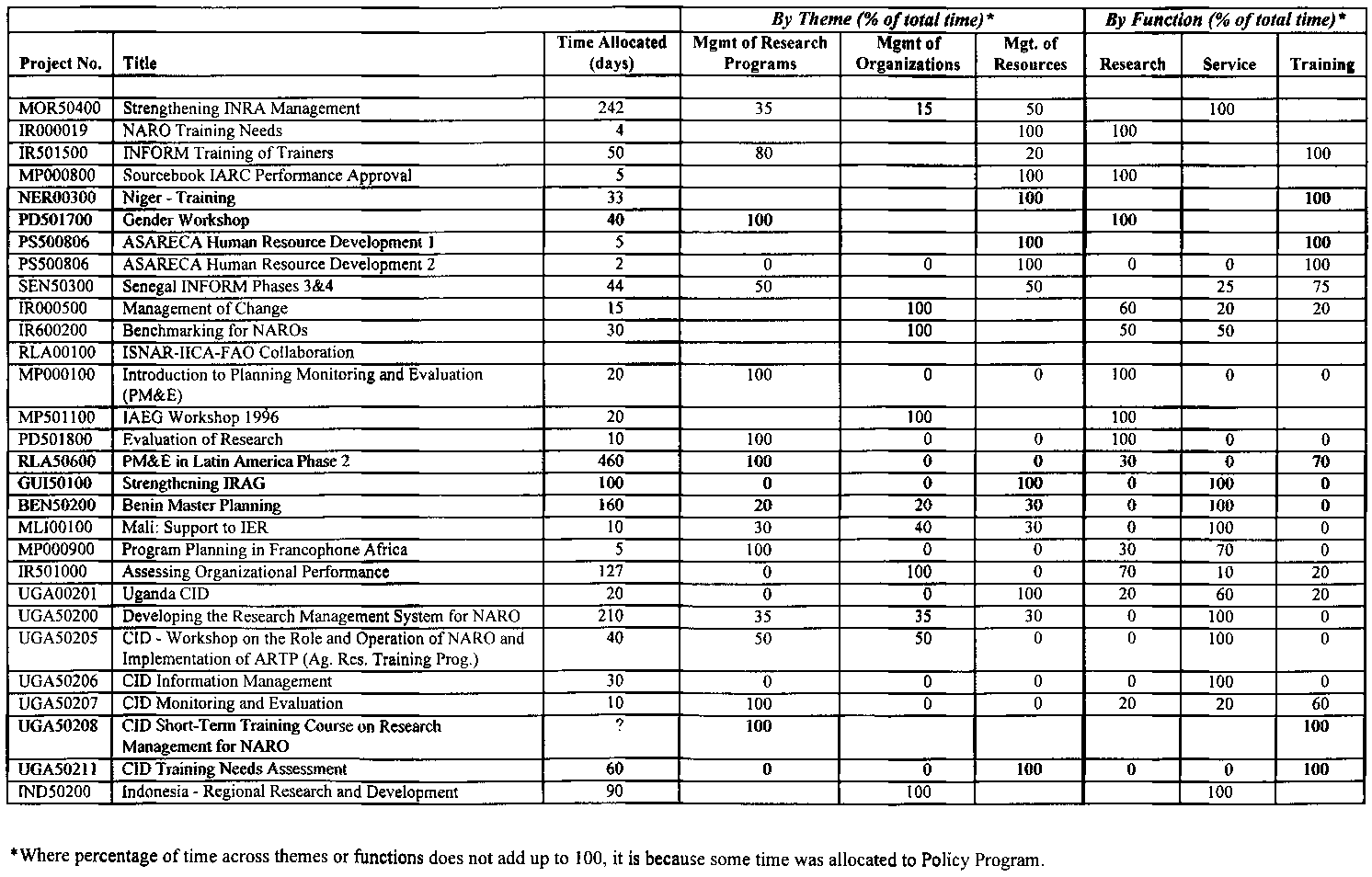
Table A2.2: Management Program current active projects
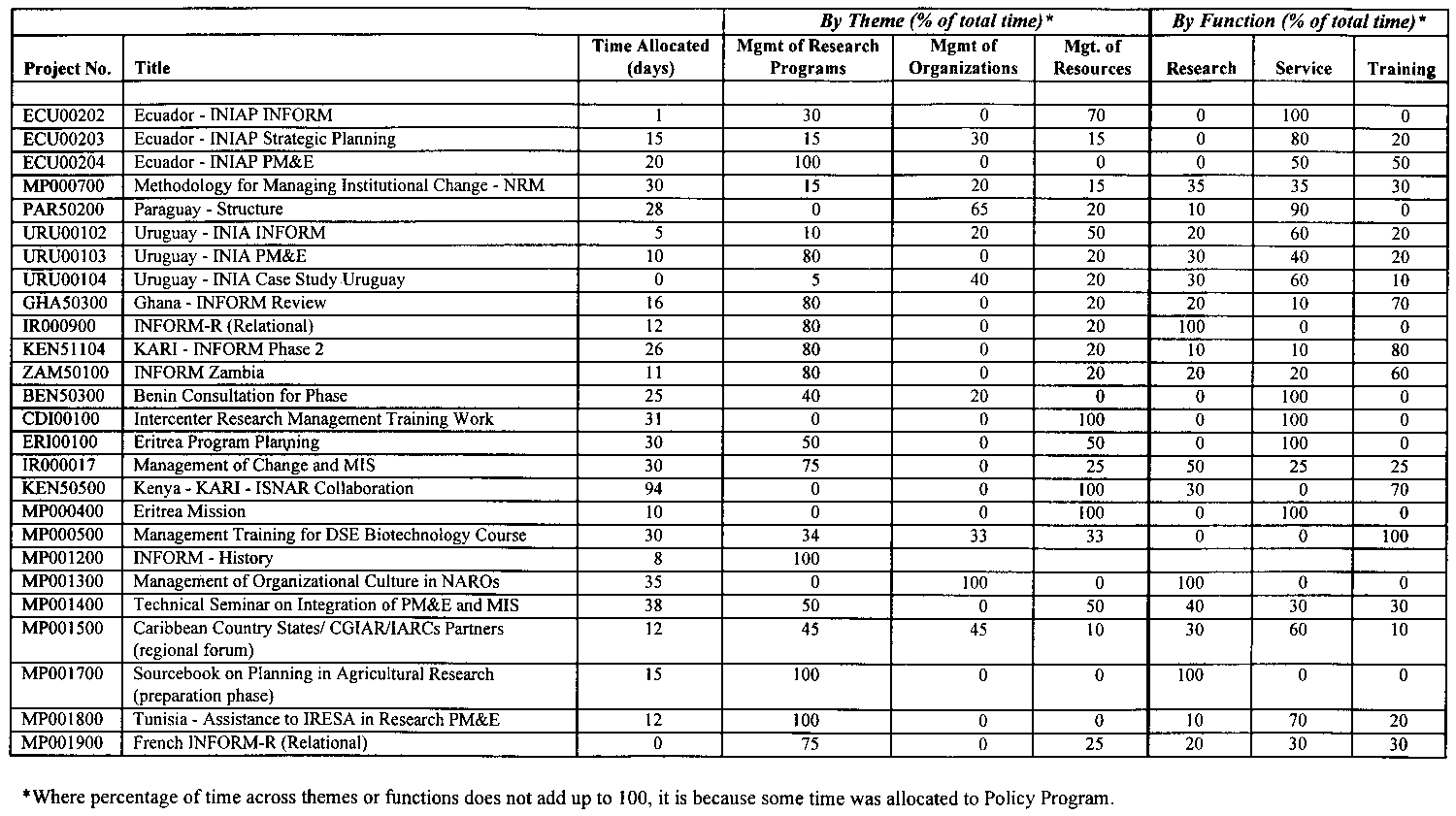
Table A2.2: Management Program current active projects (cont.)
Table A2.3: ISNAR external publications by authors in the Management Program
|
Name |
1991 |
1992 |
1993 |
1994 |
1995 |
Totals |
|
Baur |
|
|
|
|
1 |
1 |
|
Brush |
|
|
2 |
|
|
2 |
|
Dagg |
1 |
|
|
|
|
1 |
|
Hobbs |
|
|
|
1 |
|
1 |
|
Horton |
|
4 |
8 |
3 |
1 |
16 |
|
Kramer, Ch. |
|
7 |
2 |
|
10 |
19 |
|
Peterson |
|
|
4 |
|
|
4 |
|
Perrault |
|
2 |
1 |
|
|
3 |
|
Total |
1 |
13 |
17 |
4 |
12 |
47 |
3.1 Computer Services
3.2 Library
3.3 Publications
3.4 Training
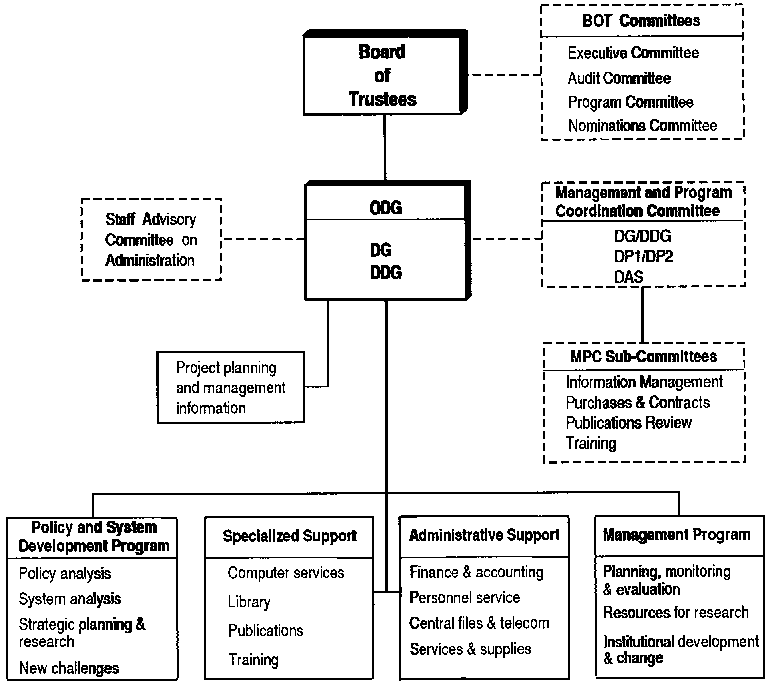
Following the reorganization of ISNAR in 1994, four "Specialized Services," each intended to support the work of ISNAR's two major programs, were organized under the supervision of the Office of the Director General. Each of these services (computer services, library, publications and training) had previously existed, although its organizational position and reporting relationship to the various programs was less well defined.
A second innovation was the creation of an Information Management Sub-committee to the Management and Program Coordinating Committee (MPC). This sub-committee, which is chaired by the Deputy Director General, includes the heads of the four specialized services, two representatives of the programs, and the Director of Administrative Services. While its formal functions are primarily focused in the area of publications, it also serves as a mechanism for coordinating the activities of the various specialized services.
The Panel was impressed with the overall quality of each of these four units, and feels that their position as service units to ISNAR's two substantive programs is the appropriate positioning for them. While some of these services have, in the past, offered services directly to external clients, management's general policy is that these four services focus their efforts primarily on serving their internal clients (and, in the case of computer services, CG-systemwide issues related to information technology) rather than offer services directly to ISNAR's external clients. In the paragraphs that follow, each of the four services is briefly described along with some of its achievements and quantifiable measures of output. Questions regarding the substantive nature of their output (especially regarding publications and training) are discussed here as well as in the annexes focusing on the programs themselves.
ISNAR's Computer Services Unit stands among the leaders in the CG system in the application of information technology to issues of office automation and communication. ISNAR not only has (and actively uses) electronic mail and full Internet connectivity, but has a fully functioning "intranet" on which various multiple-user data bases and other information sources are made available at each staff member's desktop. The unit has also been extensively involved with inter-center issues related to information technology, and it has played a leading role in the design of the integrated voice and data network and the CGNET, as well as in the organization of systemwide discussions and conferences on future aspects of the CGIAR information strategy. ISNAR also played a leading role in the negotiation of the first CGIAR systemwide software license (for GIS software).
The achievements of the Computer Services Unit during the period under study are many, due only in part to the rapid pace of technological change which characterizes this field. Major areas of change include a complete renewal of the center's entire computer network: hardware and software from an old WANG system to a network based on Windows NT, Windows 95, and Microsoft Office Suite.
In addition to systems maintenance and the planning, selection, and installation of software, the computer services unit conducts frequent staff training programs in order to insure that all staff, including newly hired members, are familiar with both the network and the individual applications packages available.
The unit has played a smaller role with regard to the direct provision of services to NARS. While members of the unit have successfully participated in selected projects, and have provided assistance to some NARS in the design and development of their own information systems, the unit's mandate and resources do not allow it to play more than a peripheral role in externally focused activities.
The Panel believes that information technology will play an increasingly important role in NARS, and that the demands for the sort of specialized expertise available from ISNAR's computer services unit will only increase. It is important that ISNAR develop a clear policy regarding the role the unit should play in research and services in this area.
ISNAR maintains a library primarily for use by its own staff, with over 23,000 books and monographs, including gray literature, information on countries and institutions, manuals and other training documents. The Library also receives some 140 journals and newsletters. Consistent with the accelerating trends towards electronic access to information, the Library is well connected to major data bases for both bibliographic searches and full-text retrieval. ISNAR's library budget for purchase of books and journals totals approximately $45,000, which is divided nearly evenly between these two categories.
In addition to maintaining its collection, ISNAR librarians (one full-time professional with two half-time assistants) routinely assist staff members with literature searches and interlibrary loans. Many such searches involve extensive use of the Internet, and the Library staff has not only developed its own skills in this regard, but has also developed a "road map" of Internet sites of interest to ISNAR staff, which is available on the center's "Intranet." Approximately 50% of staff requests for information are filled from the library's own collection, while the remainder must be filled either through interlibrary loans or through electronic means from external data bases.
The Library has also participated directly in external projects, although this has occurred only on an occasional basis and is not expected to increase.8 (Any substantial increase in requests for direct assistance to NARS should be evaluated, as in the case of computer services, in the light of ISNAR's overall strategy.)
8 The center is exploring mechanisms to permit librarians to charge time to individual projects for which they provide a significant amount of service. This move will allow the center to more accurately calculate (and recover) the direct costs of projects and reduce the amount of overhead. The Panel applauds this effort and urges the center to generalize the practice.
The Panel was unable to provide an in-depth independent evaluation of the quality of the Library's resources or user services but is of the impression that significant improvements have been made in both the Library's collection and its management, and that its users are satisfied with the level and quality of service provided.
The Publications Unit was the subject of considerable attention during the last EPMR, which made several recommendations regarding policies, organization, and quality control. These recommendations (as well as many additional recommendations contained in an internally commissioned review of ISNAR's publications which was also carried out in 1991) have been fully implemented, with the creation of both the Information Management and the Publications Review sub-committees to the MPC, and the establishment of policies and procedures governing ISNAR publications, including policies regarding the categories of ISNAR publications, quality control, and peer review.
3.3.1 Publications categories
Faced with a general criticism in the last EPMR regarding publication quality and focus, ISNAR has designed and launched new series of publications, each with its own purpose, target audience, and design and content parameters. The different categories of publications in the new series range from Briefing Papers to Research Reports, and appear to be an intelligent response to the need to segment ISNAR's "market" for publications by user group and need. Table A3.1 presents brief descriptions of each category of publication in the current series. Table A3.2 presents data comparing the number and categories of publications during the periods under review of this and the last EPMR. Strict comparisons between the two periods are difficult, as new series replaced older ones and peer review (see below) was implemented beginning in 1993.
3.3.2 Policies and procedures
A Publishing Policies and Procedures document, last revised in March 1996, was developed by the Information Management Committee and contains detailed descriptions of the various categories of publications, specifics regarding publishing policy, instructions for peer reviews, and specific guidelines and parameters for each of six categories of official publications subject to peer review, plus policies and procedures for unofficial documents (which are generally considered as works-in-progress which are not subject to peer review).
In response to the need for a greater degree of quality control, a Publications Review Subcommittee to the MPC was created with the specific purpose of administering the publications review policies established by the Sub-committee on Information Management. A review process has been established and implemented, and consists of peer reviews as well as final approval by program directors for each official ISNAR publication.
3.3.3 Electronic publication
A recent new area for the Publications Unit involves electronic publishing. ISNAR's Internet home pages are established, and the Publications Unit is now working on converting publications into electronic format for posting. All but a few briefing papers have now been converted, and several public relations texts are also available via ISNAR's Internet home page. The goal is to have materials on-line as research organizations in developing countries acquire access to the Internet.
Without commenting here on the substantive content of ISNAR's publications, it is the Panel's impression that the organization and management of the Publication Unit during the period covered by this review, has successfully resolved the issues raised in the last EPMR, and has created and implemented the reforms required to insure that both the focus and the quality of ISNAR's publications meet the needs and expectations of its various user groups.
3.3.4 Public awareness
In addition to its normal functions related to editing and publishing ISNAR's various publications series, the Publications Unit also works closely with the Director General in the design and execution of the center's public-awareness/public-relations activities. This function has never been as explicitly recognized at ISNAR as it is at most of its sister centers in the CGIAR system.9 However, there is a growing feeling within the Publications Unit that additional emphasis should be given to the job of telling ISNAR's story to its various publics, including donor organizations and their constituencies, as well as NARS leaders. This is especially important due to the difficulty in describing ISNAR's achievements in ways that are as powerful as those of ISNAR's commodity-oriented sister IARCs. The difficulty in conveying an image of service to NARS is argument in itself for the need for professional assistance. Recent failures to achieve expected coverage in various systemwide publications have heightened ISNAR's awareness of the need for focused attention in this area.
9 An audit of public-awareness capabilities of CGIAR centers was carried out in early 1996 and pointed out the need for improved public-awareness strategies for the system as a whole. A specific assessment of ISNAR's public-awareness activities is forthcoming.
Although the Publications Unit currently employs one part-time staff member who is trained in communications and devotes part of her time at ISNAR to public-awareness activities, additional focused attention and professional assistance may be required.
Recommendation: The Panel recommends that ISNAR develop and implement an explicit public-awareness strategy with the assistance of qualified public-relations professionals.
ISNAR's training function was the subject of an internally commissioned external review in June of 1996 (see figure A.3.1 for the Executive Summary of this Report), which also included a subsidiary review of one major training project. This review will comment on the conclusions of the two ICERs, but will refrain from engaging in a more in-depth review of the training function at ISNAR and refer the interested reader to the ICERs. (A statistical summary of ISNAR's training activities, including data breakdowns by region and type of event by year for the period covered in this report, is included as table A.3.3.)
An important observation made in the ICER on ISNAR's training function, and confirmed by this review Panel, is that while the quality of the services provided by the Training Unit is perceived to be very high, many training events which are conducted by ISNAR's substantive programs do not take advantage of these services and are frequently presented without any sort of communication or coordination at all with the Training Unit. Various reasons have been provided for this lack of coordination, including reference to a lack of clarity concerning the boundaries between training events, seminars, workshops, and conferences, as well as differences of opinion regarding the need for the unit's services in some of the latter categories.
The center's management has wisely refrained from forcing the Training Unit on the two substantive programs, preferring to let the unit create its own demand through the perceived value of its services to the programs. While the Panel endorses this approach, it does feel that some degree of coordination is required for all events in order to maintain the Training Unit's data base and assure the collection of consistent quality measurement data.
The Panel suggests that a formal statement of policies and procedures regarding training, analogous to those developed by the Publications Unit and described in a preceding section, be developed and implemented.
A second observation, made in the subsidiary ICER on the training program at KARI and mentioned elsewhere in this review Panel report, concern the relationship between training and other aspects of institutional strengthening and development. It was observed in the ICER on the KARI project that:
Although there are several positive changes and accomplishments, limited progress has been made in the area of integration of training activities and institutionalization. To get the maximum impact, training should be integrated within an overall capacity building and institutional development framework...
The implications of this observation are dealt with in other sections of this report.
With these caveats, the Panel endorses the conclusions reached by the ICER on ISNAR's training function and commends the Training Unit on the quality of its work since its most recent re-organization.
Table A3.1: Publication categories/series
|
Official Publications: Official ISNAR publications fall into seven categories/series. Target numbers of publications per year and suggested maximum numbers of pages are indicated for each: · Research Management Guidelines: 100 pages A4. Three per year. · Research Reports: 100 pages B5. Six per year. · Country Reports: Variable length, A4. Three per year, depending on ISNAR's contractual obligations to NARS. · Briefing Papers: 4-8 pages A4. · Reports of Meetings (Highlights or Summaries): 16-40 pages A4. Two per year. Full proceedings will only be produced in exceptional cases. · Full-length books: Variable length and format. One per year. · Corporate publications: Annual Report, Newsletter, Publications Catalog, brochures, PR materials. Discussion Papers: Supporting the seven categories of official publications is the informal Discussion Paper series (replacing Staff Notes). The series is intended as a means of recording preliminary ISNAR work or results and of soliciting critical comment. Discussion Papers are for limited distribution. They are not formally peer reviewed, are not official ISNAR publications, and may not bear the ISNAR logo. They are reproduced by photocopying. Informal Reports: Where the use of a Discussion Paper may not be an appropriate vehicle for disseminating information, program or service directors may produce Informal Reports, under their own authority. They may, for example, be used to report on a meeting or to provide an update on an ISNAR project to collaborating institutions and individuals. Like Discussion Papers, they are not formally reviewed and are not edited by Publications Services, but they may bear the ISNAR logo. The interior pages are reproduced by photocopying, but the cover may be printed. Training Documents: A policy covering training materials has yet to be set by the Information Committee. |
Table A3.2: ISNAR publications and documents
|
Publication Category |
Numbers (1986-1990) |
Numbers (1991-1996) |
|
Formal (Official) Publications |
||
|
Country Reports1 |
32 |
10 |
|
Books2 |
3 |
5 |
|
Briefing Papers3 |
|
37 |
|
Training Series4, 5 |
16 |
|
|
Conference Reports (Proceedings & Highlights)1 |
11 |
8 |
|
Corporate Publications |
|
|
|
Annual Reports6 |
15 |
11 |
|
Newsletters (English)1 |
12 |
14 |
|
Newsletters (French)3 |
|
10 |
|
Public affairs documents (brochures, etc.)1 |
15 |
5 |
|
Working Papers4/Research Reports3 |
36 |
1/13 |
|
Research Management Guidelines3 |
|
5 |
|
Special project documents7 |
32 |
18 |
|
Unofficial (Informal) Publications |
||
|
Staff Notes4/Discussion Papers3/Statistical Briefs3 |
94 |
17/74/30 |
|
Other documents of limited distribution (project-related proceedings, fliers, etc.) |
|
182 |
|
External Publications |
||
|
Journal articles,8 book chapters, conference papers,9 etc. |
429 |
397 |
|
Subtotal |
695 |
837 |
|
Other10 |
|
225 |
|
Total |
695 |
1062 |
Note: The database prepared for the impact study and the EPMR has a cut-off date of 1 September 1996.1. Series continued.
2. Books and monographs published by outside (commercial) publishers on behalf of ISNAR or by ISNAR itself.
3. New series; started in 1993. The new categories were designed to reach a better defined audience, to undergo more stringent peer review, to encourage publication of higher quality materials with fewer total numbers, and to give ISNAR's publications an identifiable corporate image. Note that they are not completely comparable to the old series.
4. Old series; discontinued in 1993.
5. This is an older series that is entirely unrelated to the new training modules developed by the PM&E project or the training unit. The new training materials are not included in this table.
6. An entirely separate annual report was previously done in English, French, and Spanish. In 1993, only one annual report was done-in English with a summary translated into Arabic, French, and Spanish and bound into one volume.
7. Special projects include OFCOR, RTTL, Small Countries.
8. Externally published papers are self-reported for the annual report. This process has not yet started for 1996, so the number of externally published papers reported here is for 1991 through 1995 only.
9. Inclusion of miscellaneous papers in the officially reported category has become more stringent. They must now be in published works in order to be listed. Conference presentations and papers in unpublished works are included in the "other" category (see below).
10. The numbers for 1986-1990 are the officially reported numbers that were published in the annual report and in the quarterly reports for the BOT. There are a large number of documents included in the database prepared for the impact study and the EPMR that are not included in the "official" numbers. These extra categories include speeches made by the DG, papers presented at meetings and workshops (but not included in published proceedings), mission reports and country documents, evaluation reports, etc.
Figure A3.1: Executive summary of ICER on ISNAR's training function
|
The subject of this ICER, ISNAR's training function, refers to complex issues that are related to training at ISNAR, ranging from policy views regarding present and future training, to organizational aspects, such as the mechanism and institutional structure to ensure good quality and efficient use of resources. Training interventions aim at the sustained improvement of NARS and their organizations. Over the years, training at and by ISNAR has developed into a comprehensive and varied package of activities. During the review period, training accomplishments feature clearly: the number of training events has grown by 20% with an obvious increase in the number of participants and a good number of workshops focusing on training-of-trainers; didactic tools and training materials have been developed to enhance the learning process and facilitate multiplication of the training effort by trained trainers; modules on various aspects of agricultural research management have been produced. The majority of training activities is conducted within the framework of the Management Program and the Policy and System Development Program. The Training Unit mainly conducted training in the context of special externally funded projects. Also, didactic and methodological support was given to a number of training activities that were conducted by the programs. A further integrating of the training function into the programs is required, covering all those activities that are considered as training according to the new definition of training at ISNAR. The Panel observed within ISNAR an overall recognition of the vital importance of training as an integral part of its services to NARS. However, the process of institutionalization of ISNAR's training function has to be shapened. Ongoing developments and the increasing demand for training in the fields of agricultural research management call for improved strategic planning for the whole of ISNAR, including training. The Panel observed within ISNAR an overall recognition of the vital importance of training as an integral part of its services to NARS. However, the process of institutionalization of ISNAR's training function has to be shapened. |
In the context, the following recommendations were made:
|
Issues |
Recommendation of the ICER on ISNAR's training function |
|
|
Mission |
That it be recognized both within the CGIAR system and within ISNAR management
that, in view of the special mandate of ISNAR, training will for the foreseeable
future be a major function. |
|
|
Corporate Plan |
That a Corporate Plan for ISNAR be developed, highlighting training as one instrument in conjunction with research and advisory services in achieving overall objectives of the Programs. The Corporate Plan should ensure that: |
|
|
|
· the training activities be jointly planned with the Programs which will set the long term priorities; |
|
|
· appropriate mechanisms be installed for follow-up, including monitoring and evaluation, technical backstopping and quality and impact assessment. |
||
|
Selection of Criteria |
That ISNAR clearly define its criteria for delivery of core as well as contracted services, taking into consideration |
|
|
|
· geographical equity for service; |
|
|
· systematic analysis of need for research management services by NARS; |
||
|
· full cost-recovery for contracted services; |
||
|
· training being part of an overall institutional development plan of the client organization. |
||
|
Organization and Management |
That the Training Unit be retained as an organizational unit within Program Support with additional staff resources. That - until the Corporate Plan has been worked out - an Interim Training Group be installed with the function of coordinating all training activities. This group should be compromised of the Head of the Training Unit and the two Program Directors and be chaired by the DG. This interim group will replace the present Training Committee. That all Program staff have the responsibility to involve the Training Unit for didactic and methodological inputs in all their training activities; this should be included in the performance assessment of staff. |
|
|
Follow-up |
That follow-up technical support in the implementation and institutionalization of training should be given proper attention, e.g., through outposting of staff where appropriate. |
|
|
ISNAR Expertise for Service Delivery |
That ISNAR should take a more pro-active role to ensure its high standard in the field of agricultural research management: |
|
|
|
· Subjects for training and training materials development to be implemented by ISNAR should be linked to priorities and backed up by innovative research. |
|
|
· Development of training materials should aim at flexibility at facilitating wide usage by others. |
||
|
· For other relevant subjects within the research management area ISNAR should consider the position of 'clearing house', using world-wide available expertise. |
||
|
Multiplier Effects |
|
· That ISNAR strengthen institutional and human capacity within selected MDI's, universities and selected NARS. |
|
· Training by means of modern electronic communication is to be developed. |
||
|
Future Training Plans |
If a flagship-course is to be organized, then this should be an outcome of the corporate planning process and meet the criteria of excellence, unavailability elsewhere and project the corporate profile of ISNAR |
|
Source: ICER on ISNAR's training function, 1996.
Table A3.3: ISNAR training events, January 1991 - June 1996
|
|
|
1991 |
1992 |
1993 |
1994 |
1995 |
1996 |
TOTAL |
|
Region |
No. of Events |
|||||||
|
|
Asia & Pacific |
0 |
8 |
4 |
3 |
1 |
0 |
16 |
|
SSA |
4 |
2 |
11 |
19 |
29 |
13 |
78 |
|
|
LAC |
0 |
1 |
4 |
1 |
1 |
3 |
10 |
|
|
WANA |
2 |
0 |
1 |
6 |
6 |
0 |
15 |
|
|
Developed Cs. |
0 |
2 |
0 |
1 |
4 |
2 |
9 |
|
|
TOTAL |
6 |
13 |
20 |
30 |
41 |
18 |
128 |
|
|
Category of Training Events* |
||||||||
|
|
Workshop |
5 |
8 |
19 |
26 |
33 |
17 |
107 |
|
Seminar |
1 |
2 |
1 |
1 |
4 |
1 |
9 |
|
|
Course |
0 |
3 |
0 |
3 |
4 |
0 |
10 |
|
|
TOTAL |
6 |
13 |
20 |
30 |
41 |
18 |
128 |
|
|
Region |
No. Participants |
|||||||
|
|
Asia & Pacific |
0 |
135 |
0 |
0 |
0 |
0 |
135 |
|
SSA |
143 |
54 |
96 |
570 |
514 |
113 |
1490 |
|
|
LAC |
0 |
84 |
120 |
34 |
26 |
26 |
290 |
|
|
WANA |
30 |
0 |
0 |
39 |
121 |
0 |
190 |
|
|
Developed Cs. |
0 |
16 |
0 |
5 |
42 |
43 |
106 |
|
|
TOTAL |
173 |
289 |
216 |
648 |
703 |
182 |
2211 |
|
|
Category of Training Events* |
||||||||
|
|
Workshop |
142 |
190 |
174 |
428 |
619 |
171 |
1724 |
|
Seminar |
31 |
17 |
42 |
0 |
67 |
0 |
157 |
|
|
Course |
0 |
82 |
0 |
220 |
28 |
0 |
330 |
|
|
TOTAL |
173 |
289 |
216 |
648 |
714 |
170 |
2211 |
|
|
Management |
|
|
|
|
|
|
|
|
|
Programs |
|
2 |
13 |
17 |
22 |
24 |
17 |
95 |
|
Training Unit |
|
4 |
0 |
3 |
8 |
17 |
1 |
33 |
|
|
TOTAL |
6 |
13 |
20 |
30 |
41 |
18 |
128 |
Note: Information from the ISNAR Database of Events. Note that participant information is only available for approximately two-thirds of the listed training events.*Course: formative event (few participants); workshop: "hands-on" learning through interactive exercises; seminar: informative event involving mainly plenary discussion.
4.1 Legal Status and Host-Country Relations
4.2 Board of Trustees
4.3 Organizational Structure and Climate
4.4 Management of Human Resources
4.5 Planning and Review Process
4.6 Management of Financial Resources
4.7 General Administration
ISNAR was established in 1979 as an international organization under the auspices of the CGIAR. A headquarters agreement with the Government of the Kingdom of The Netherlands was signed in June 1980, which recognized the center's international status and granted to it certain privileges and immunities.
Relations between ISNAR and the Government of The Netherlands have remained cordial, and the center has received significant support from the government in the form of contributions to core unrestricted income as well as paying the rental cost of ISNAR's headquarters offices. Panel members visited with representatives of the Government of The Netherlands, who indicated their satisfaction with the relations with the center and offered to facilitate additional collaboration with various Dutch organizations.
4.1.1 Legal status
Some lack of clarity regarding the exact legal status of ISNAR in The Netherlands had existed from the time of its founding until recently when, through the efforts of ISNAR, it was accepted by the Government of The Netherlands that ISNAR exists as an inter-governmental organization, created with the co-sponsorship of the International Bank for Reconstruction and Development, and the United Nations Development Program, and as such is covered by treaties signed by the Government of The Netherlands regarding the establishment of the United Nations and its specialized agencies. This clarification of ISNAR's legal status in The Netherlands has important implications for ISNAR staff regarding their tax obligations to the Government of The Netherlands, by establishing that ISNAR income shall not be taken into account when assessing income tax on income derived from other sources. It has also facilitated the establishment of an avenue for grievance resolution through the International Labor Organization.
While this legal clarification is an important step forward, several areas regarding legal status continue to be of concern to ISNAR's staff:
4.1.2 Visa status
ISNAR staff and their dependents carry an identity card issued by ISNAR and authenticated by the Ministry of Foreign Affairs of the Government of The Netherlands, which is designed to facilitate entry into the country, in lieu of a passport visa. Unfortunately, this identity card is not widely recognized by immigration officers, especially in other European Union countries through which ISNAR staff must frequently pass. Frequent airport delays and questioning have been experienced by members of the center's non-European staff and especially by their unaccompanied dependents.
The Government of The Netherlands has announced that these identity cards will be replaced in 1997 with another document which will be more widely recognized. Nevertheless, it will be important for ISNAR to resolve the problems faced by non-Western European staff and their dependents, and especially those members of its staff from Africa, Eastern Europe, the Near East, and South Asia, in traveling to and from The Netherlands and other European Union countries, and to make such additional arrangements for appropriate travel documents as may be necessary.
4.1.3 Spousal employment
The issue of spousal employment was discussed in the last EPMR and continues to be a problem. ISNAR spouses are not granted an exemption from the need for working papers (as are ISNAR staff), and are subject to Dutch law regarding employment outside of ISNAR itself or other international organizations. Under Dutch law, work permits are difficult to obtain for non-European Union members, and applicants must first have a firm job offer which cannot be filled by an equally qualified European. While some employers are willing to go through the necessary paperwork to hire a non-European citizen, most would prefer to hire people who already have or do not require working papers. An exception exists in the case of international organizations (of which there are several in The Hague) which are able to hire staff without regard to national origin.
The need for spousal employment opportunities is a binding constraint on ISNAR's ability to attract qualified international staff, and the Panel learned of instances in which offers for employment at ISNAR were turned down due, among other reasons, to the lack of spousal employment opportunities. In other cases, staff members have left ISNAR after their spouses were unable to find employment.
Recommendation: The Panel recommends that ISNAR benchmark best practices regarding spousal employment at other international organizations operating in The Hague and actively search for a solution in order to enhance the center's ability to attract and retain the quality of professional staff it requires to fulfill its mandate.
ISNAR is governed by a 14-person Board which currently is composed of seven people from developed and six from developing countries (there is currently one vacancy). Two members of the Board are women. Details of the current Board's membership, including committee assignments and terms of office are presented in table A4.1. The center makes a concerted effort to achieve a balanced Board in a number of dimensions, and maintains a database of potential candidates for this purpose. Despite such efforts, it has continued to experience difficulty in attracting Board members with formal training and experience in management as a discipline (it does include several highly experienced agricultural research organization managers).
The ISNAR Board meets formally twice a year, at which time its various committees also hold meetings. Individual Board members also attend other ISNAR events, including the Internal Program Review which was attended in 1996 by the Board Chair, the Program Committee Chair and the Board member nominated by the Dutch Government.
Among its activities, the Board conducts an annual self-appraisal in which each Board member provides his or her opinions on a questionnaire regarding the Board as a whole, his/her views regarding his/her personal role on the Board, and individual activities on behalf of ISNAR. Noteworthy results of the most recent questionnaire were the high degree of social ease and rapport with staff and management, and the high level of involvement and interest in the Board discussions. Of particular concern is a relatively low level of concurrence to the statements "The members of the Board demonstrated understanding of the mission of ISNAR and how that mission is achieved by the program" and "The Board formulated specific goals to guide its work". The Panel is impressed with the quality of the survey data and encourages the Board and management to work together to use the results to improve its effectiveness.
The Panel feels the Board has been generally effective in the execution of its oversight function. Board committees meet with relevant members of the programs and management on a regular basis to review program plans as well as administrative functions, and evidently spend considerable time discussing program- or management-related issues with ISNAR's senior staff. The Panel noted, however, that some members of the Board did have significant concerns regarding various aspects of the center's work, including issues related to strategic planning and priority setting within ISNAR, the composition of the professional staff, publications policies, and the center's organizational structure. These concerns were expressed both during the formal board meeting and in interviews with the Panel. The fact that such expressions of concern have not resulted in the desired changes suggests to the Panel that the Board may not have been sufficiently demanding in its requests for changes or improvements and may not have exercised its oversight function in sufficient depth in areas such as strategic planning and professional staffing.
The Panel was especially concerned to learn that the Board had not carried out any sort of a formal performance evaluation of ISNAR's Director General, as called for in the center's Board-approved staff procedures, during the period under study (this was also mentioned in the last EPMR).
Table A4.1: ISNAR Board of Trustees
|
Name |
Board Committees |
Gender |
Nationality |
Discipline |
Appointed by |
Start-term date |
End-term date* |
|
Al-Shayji, Naima |
M-NC |
F |
Kuwait |
Admin. |
CGIAR |
05/06/90 |
12/31/96 |
|
Bonte-Friedheim, Christian |
M-EC M-PC |
M |
Germany |
Agric. Economics |
Ex-Officio |
01/01/90 |
02/24/97 |
|
Bozzini, Alessandro |
M-PC |
M |
Italy |
Genetics |
Board |
10/17/93 |
12/31/99 |
|
Breman, Hank |
M-EC M-PC M-AC |
M |
Netherlands |
Biology |
Host Country |
09/25/92 |
12/31/98 |
|
Faaland, Just |
C-NC |
M |
Norway |
Economics |
Board |
10/17/93 |
12/31/99 |
|
Hayashi, Ken-Ichi |
M-PC |
M |
Japan |
Plant breeding & agronomy |
Board |
31/10/94 |
12/31/97 |
|
Hess, Charles |
C-BOT C-EC |
M |
United States |
Botany |
Board |
09/25/92 |
12/31/98 |
|
Ly, Mohamadou |
M-PC |
M |
Senegal |
Biochem. |
Board |
09/25/92 |
12/31/98 |
|
Makhubu, Lydia |
V-BOT V-EC C-AC |
F |
Swaziland |
Chemistry |
CGIAR |
09/28/91 |
12/31/97 |
|
Muhamed, Amir |
M-NC |
|
Pakistan |
Biology |
Board |
09/25/92 |
12/31/98 |
|
Peters, Kurt |
M-NC |
M |
Germany |
Livestock |
CGIAR |
05/06/90 |
12/31/96 |
|
Yusof Bin Hashim, Mohamed |
M-EC M-PC M-AC |
M |
Malaysia |
Agric. Economics |
Board |
10/01/91 |
12/31/97 |
|
Piñeiro, Martin |
C-PC |
M |
Argentina |
Agric. Economics |
Board |
10/01/93 |
12/31/99 |
|
Vacant |
|
|
|
|
CGIAR |
|
|
Board Committees: AcronymsC = Chairman
V = Vice-chairman
M = Member
BOT = Board of Trustees
AC = Audit Committee
EC = Executive Committee
NC = Nominating Committee
PC = Program Committee* Members are considered to begin their mandate immediately after the annual meeting at which they are elected and serve through the annual meeting according to the term for which they were elected (1 to 3 years). The Board meeting in the second semester of the year shall be considered as the "annual board meeting".
During the period under review, the center undertook two major structural changes.10 The first, partly in response to suggestions made in the last EPMR, involved the establishment of a more complex organizational structure for ISNAR and the creation of several additional levels of management. Whether due to the structure itself or to the personalities of those involved, this change led to a period of decline in organizational morale and may have contributed to the departure of several of the center's valued senior staff. Among the reasons cited for some of their departures was an ambiguous sense of direction in the center's work, a perceived lack of regard for research quality by some program directors who seemed to be more oriented towards advisory services, and a cumbersome and overly bureaucratic structure which seemed to limit individual initiative and creativity, especially among more junior members of the professional staff.
10 "ISNAR's Evolution and Response to Internal and External Forces" a paper prepared by Howard Elliott for this review, was found by Panel members to be especially helpful in understanding the evolution of the center's structure over time.
A new, flatter organizational structure was introduced three years ago, with simplified processes for planning, budgeting and project approval (see figure A4.1). The Panel has expressed concern elsewhere regarding the definitions and distinctions between the two major programs. While the Panel does not regard ISNAR's current organizational structure as an impediment to the planning and execution of its work, as ISNAR reviews and revises its strategy, it may find that additional adjustments or modifications to the organizational structure are required.
While the structural changes introduced three years ago have been of great benefit and staff morale had significantly improved by the time of this review, some elements of the organizational climate left over from the previous period may still be present. A significant number of staff members raised issues in the Staff Survey of Issues for the EPMR regarding human resource management and staff relations, and culture and staff morale. Some staff members interviewed by the Panel also mentioned the need for improvement in areas including teamwork and cooperation, communication and staff involvement in decision making, and in some instances, interpersonal relations, which may well be a by-product of ISNAR's multicultural environment. It should be noted that the Panel is unable to judge how widespread or valid these concerns are. The Panel has also interviewed numerous members of the support and professional staff who have not mentioned such concerns and who have indicated a high level of satisfaction with the degree of teamwork, staff involvement and interpersonal relations.
Finally, ISNAR's organizational climate is influenced by a philosophy that is perceived not to favor long-term career development within the center, and argues that its mandate is "to get the best ... it is not a mandate to develop people." It is suggested that were ISNAR to offer opportunities for career development, it would become a "closed shop" with all promotions from within, and would therefore not be able to bring in the "best" from elsewhere.
The implications of this philosophy are that staff at the professional level are rarely if ever promoted to higher grades or levels of responsibility, and opportunities are not actively sought to recognize and reward achievement (other than an occasional reward for "outstanding performance"). Furthermore, few long-term career-development opportunities are offered to the internationally recruited professional staff, nor are other efforts made to "invest" in their development. The assumption is that ISNAR staff will not be interested in making a career at ISNAR and that the center will always be able to attract outstanding talent as departing staff are replaced.
Figure A4.1 - ISNAR's Organizational Structure
The Panel feels that this policy should not stand in the way of retaining truly outstanding staff at ISNAR when other opportunities become available.
It is noted that both promotions and opportunities for training and development are much more prevalent at the support-staff level, and include tuition reimbursement for university and even post-graduate education, as well as shorter training courses.
Many concerns have been raised, both in interviews with Panel members and in the survey of staff issues conducted in preparation for the EPMR, regarding aspects of the center's staff turnover and organizational climate (see previous section). Panel members interviewed staff responsible for the design and implementation of the center's human resource management policies and procedures, as well as numerous members of the professional and support staff who are directly affected by them. The Panel had neither the mandate nor the resources to investigate individual personnel-related issues but did take note of the pattern of such comments in drawing conclusions regarding the general areas of problems.
ISNAR has experienced significant staff turnover during the period under review. As indicated in the previous section, during the 1992-94 period, a number of organizational factors led to especially high rates of turnover, which averaged 18% of the international staff per year, 21% for supervisory staff, and 31% for support staff. Turnover has been significantly reduced during the past two years at the international and supervisory levels, although it continues high at an average of 19% among the support staff.
Human resource management systems which directly affect staff turnover and the organizational climate include recruitment, selection, and placement; staff classification and promotion; performance assessment; salary administration; and mechanisms for addressing workplace issues including, but not limited to, gender discrimination. The human resource management structure, including its organization and staffing, constitutes a final area of importance.
4.4.1 Recruitment, selection and placement
The Panel notes what may appear to be a high number of support staff, and especially secretarial staff. Panel members were told that secretarial loads in some parts of ISNAR may be lower than elsewhere due in part to a lack of word-processing (typing) skills among some members of its international staff. Given the high cost of secretarial support and trends in some countries to increase secretarial loads by making optimal use of office automation technology, the Panel would encourage ISNAR to benchmark staffing and support practices in other institutions, and continue to insure that all staff resources are being utilized as efficiently as possible.
International search procedures appear to be rigorously observed regarding international staff, and extra efforts are routinely made to identify and short-list qualified female and developing-country applicants. Unfortunately, despite these efforts, ISNAR's international staff includes only three females (7%) in its internationally recruited professional staff of 41. Thirteen internationally recruited professional staff (32%) list developing countries as their nationality.
The Panel expresses its concern regarding the low percentage of women in the center's internationally recruited professional staff and, while recognizing the efforts which are currently being taken, is forced to point out that the results are still not satisfactory.
(The issue of spousal employment, covered elsewhere in this annex, is again emphasized as an important factor influencing international recruitment.)
4.4.2 Staff classification and promotion
ISNAR uses a five-grade professional staff and a three-grade support staff classification scheme. As discussed previously, ISNAR philosophy does not contemplate career development, and professional as well as support grades are described in terms of staff positions rather than levels or stages of professional development. Staff are recruited and appointed to specific positions within ISNAR; any changes of position would require the applicant to participate in an international search process.
Nationally recruited staff may be appointed to one of three support positions, plus one professional position (P-1: Research/Program/Administrative Assistant). Some members of the locally recruited professional staff have voiced frustration at their inability to be promoted to higher grades, while carrying out tasks which, in their opinion, are similar to those assigned to the lowest grade of internationally recruited staff (P-2). Furthermore, some members of the highest grade on the support staff (S-3), especially those who have university degrees or higher, report that they are often asked to carry out duties normally assigned to professional staff members at the P-1 or P-2 levels. (Not all staff see that as an imposition: some members of the support staff expressed their satisfaction at being offered an opportunity to engage in non-secretarial tasks regardless of their formal grade status.)
ISNAR's management is aware of the problems of assigning responsibilities at the S-3 and P-1 levels and is contemplating a change in the professional grade classification system to allow two grades of nationally recruited professional staff. The Panel endorses this change.
The Panel also would encourage ISNAR to reconsider the implications of a position-based classification system on its career development policy at the professional level. If a more developmental approach is elected, changes regarding the classification system and promotions policy will be called for.
4.4.3 Staff composition
As may be seen in table A4.2, ISNAR's total staff has grown by approximately 10% during the period under review, with most of the growth at the research assistant level. Regionally, there has been a small increase in European internationally recruited staff, with 27 of the center's 41 internationally recruited staff from either Europe or North America. Table A4.3 presents data regarding the post-graduate academic preparation of ISNAR's staff. As is noted elsewhere in this report, only one member of ISNAR's staff has formal training in management at the post-graduate level, and none have doctorates. At the other extreme, the center counts five staff at the Masters level, and 14 at the Ph.D. level in economics and development studies.
Recommendation: The Panel recommends that ISNAR make every effort to attract internationally recruited staff with advanced degrees in management.
Table A4.2: ISNAR staff composition 1991 vs. 1996
1991 STAFF COMPOSITION
|
STAFF GRADE |
TOTALS |
BY REGION |
LENGTH OF SERVICE |
|||||||||||
|
TOTAL |
MALE |
FEMALE |
N. AMERICA |
EUROPE |
AFRICA |
ASIA |
M. EAST |
L. AMERICA |
OCEANA |
<2 YRS. |
2-4 YRS. |
5-10 YRS. |
>10 YRS. |
|
|
P-5 (DG/DDG) |
3 |
3 |
0 |
1 |
1 |
0 |
1 |
0 |
0 |
0 |
1 |
0 |
2 |
0 |
|
P-4 (Directors, Sr. Officers) |
25 |
21 |
4 |
11 |
6 |
3 |
1 |
1 |
1 |
2 |
5 |
8 |
9 |
3 |
|
P-3 (Res./Prog./Adm. Officer) |
5 |
5 |
0 |
2 |
0 |
1 |
0 |
0 |
2 |
0 |
1 |
4 |
0 |
0 |
|
P-2 (Res./Prog./Adm. Assoc.) |
10 |
9 |
1 |
0 |
2 |
1 |
0 |
0 |
2 |
1 |
3 |
2 |
1 |
0 |
|
sub-total, international staff |
43 |
38 |
5 |
14 |
9 |
5 |
2 |
1 |
5 |
3 |
10 |
10 |
12 |
3 |
|
P-1 (Res./Prog./Admin. Asst.) |
7 |
4 |
3 |
1 |
3 |
2 |
0 |
0 |
0 |
1 |
2 |
3 |
2 |
0 |
|
sub-total, professional staff |
50 |
42 |
8 |
15 |
12 |
7 |
2 |
1 |
5 |
4 |
12 |
13 |
14 |
3 |
|
S-3 (Sr. Sec./Clerk/Techn.) |
13 |
2 |
11 |
0 |
10 |
0 |
0 |
0 |
2 |
1 |
2 |
7 |
3 |
0 |
|
S-2 (Sec./Clerk/Techn.) |
21 |
1 |
20 |
1 |
19 |
0 |
0 |
0 |
1 |
0 |
9 |
10 |
2 |
0 |
|
S-1 (Jr. Sec./Clerk/Techn.) |
3 |
0 |
3 |
0 |
3 |
0 |
0 |
0 |
0 |
0 |
1 |
2 |
0 |
0 |
|
sub-total, national staff |
44 |
7 |
37 |
2 |
35 |
2 |
0 |
0 |
3 |
2 |
14 |
22 |
7 |
0 |
|
sub-total, support staff |
37 |
3 |
34 |
1 |
32 |
0 |
0 |
0 |
1 |
1 |
12 |
19 |
5 |
0 |
|
Total ISNAR staff |
87 |
45 |
42 |
16 |
44 |
15 |
2 |
1 |
6 |
5 |
24 |
32 |
19 |
3 |
1996 STAFF COMPOSITION
|
STAFF GRADE |
TOTALS |
BY REGION |
LENGTH OF SERVICE |
|||||||||||
|
TOTAL |
MALE |
FEMALE |
N. AMERICA |
EUROPE |
AFRICA |
ASIA |
M. EAST |
L. AMERICA |
OCEANA |
<2 YRS. |
2-4 YRS. |
5-10 YRS. |
>10 YRS. |
|
|
P-5 (DG/DDG) |
2 |
2 |
0 |
1 |
1 |
0 |
0 |
0 |
0 |
0 |
0 |
0 |
1 |
1 |
|
P-4 (Directors, Sr. Officers) |
24 |
22 |
2 |
10 |
5 |
3 |
1 |
1 |
4 |
0 |
6 |
5 |
6 |
7 |
|
P-3 (Res./Prog./Adm. Officer) |
9 |
9 |
0 |
4 |
4 |
0 |
0 |
0 |
1 |
0 |
2 |
2 |
4 |
1 |
|
P-2 (Res./Prog./Adm. Assoc.) |
6 |
5 |
1 |
0 |
2 |
1 |
0 |
0 |
2 |
1 |
3 |
2 |
1 |
0 |
|
sub-total, international staff |
41 |
38 |
3 |
15 |
12 |
4 |
1 |
1 |
7 |
1 |
11 |
9 |
12 |
9 |
|
P-1 (Res./Prog./Admin. Asst.) |
14 |
6 |
8 |
2 |
10 |
1 |
0 |
0 |
1 |
0 |
5 |
5 |
3 |
1 |
|
sub-total, professional staff |
55 |
44 |
11 |
16 |
23 |
5 |
1 |
1 |
7 |
1 |
16 |
14 |
15 |
10 |
|
S-3 (Sr. Sec./Clerk/Techn.) |
12 |
1 |
11 |
0 |
11 |
0 |
0 |
0 |
1 |
0 |
2 |
2 |
6 |
2 |
|
S-2 (Sec./Clerk/Techn.) |
22 |
1 |
21 |
1 |
21 |
0 |
0 |
0 |
1 |
0 |
12 |
6 |
3 |
1 |
|
S-1 (Jr. Sec./Clerk/Techn.) |
6 |
2 |
4 |
0 |
6 |
0 |
0 |
0 |
0 |
0 |
3 |
2 |
1 |
0 |
|
sub-total, national staff |
54 |
10 |
44 |
3 |
48 |
1 |
0 |
0 |
3 |
0 |
22 |
15 |
13 |
4 |
|
sub-total, support staff |
40 |
4 |
36 |
1 |
38 |
0 |
0 |
0 |
2 |
0 |
17 |
10 |
10 |
3 |
|
Total ISNAR staff |
95 |
48 |
47 |
17 |
61 |
6 |
1 |
1 |
9 |
1 |
33 |
24 |
25 |
13 |
Table A4.3: Fields of study of ISNAR program staff with graduate degrees
|
|
MA/MSc |
Ph.D. |
Total |
|
Economics (including Development Studies) |
5 |
14 |
19 |
|
Agricultural or/and Environmental Science |
3 |
9 |
12 |
|
Political Science/Sociology/Anthropology |
3 |
3 |
6 |
|
Education/Human Resource Development |
1 |
2 |
3 |
|
Information Science |
2 |
- |
2 |
|
English |
1 |
- |
1 |
|
Management/Public Administration |
1 |
- |
1 |
|
Total |
16 |
28 |
44 |
Note: Excludes administrative staff and staff with BA or BSc degrees.
4.4.4 Performance assessment
ISNAR's Performance Assessment and Enhancement (PAE) system was extensively revised and improved in 1993. The approach taken in the performance assessment and enhancement form is decidedly developmental, with narrative but not categorical assessments made of numerous aspects of each staff member's performance, opportunities for response by the staff member being evaluated, and recommendations for future improvement, including recommendations for further training and career development.
The performance assessment and enhancement system is not directly linked to either pay increases or other forms of recognition, such as bonuses or awards, which management feels would introduce an unwelcome element of contentiousness into both the performance assessment process and the salary administration system, and would reduce its effectiveness as a developmental instrument. (A limited number of extra step increases, as well as one-time cash payments are awarded to staff each year for outstanding performance, and are based in part on the annual performance process.)
When questioned about the Performance Assessment and Enhancement system, staff members reported an uneven implementation pattern, with some parts of the center adhering more rigorously to assessment procedures and calendars than others. Some staff expressed concern that there was no follow-up or consequences to the PAE, and that the lack of follow-through was resulting in a decline of its importance at ISNAR. Other staff reported strict adherence to PAE guidelines, but also mentioned a lack of consequences - either positive or negative - to the assessment process.
The Panel notes that the use of performance appraisals as a basis for the awarding of merit increases or other performance-related rewards is widespread in many industries, and that "pay-for-performance" has gained in currency in public and non-profit organizations as well as in the private sector. The Panel also notes that the performance assessment process generally is taken much more seriously by staff and supervisors alike when real consequences are associated with the outcome, and that it can be a very positive source of motivation by offering a periodic opportunity to recognize and reward performance.
Given comments from staff regarding lack of recognition for their work (especially from support and lower-level professional staff), the Panel feels that steps should be taken to link the results of the annual performance appraisal to tangible outcomes, including salary increases, in order to provide recognition and motivation to as large a percentage of the staff as possible (see recommendation following next section).
The Panel also feels that additional performance and career review mechanisms might be introduced at ISNAR, including more formal end-of-project or end-of-contract reviews, which might be better able to assess a staff member's professional contribution.
4.4.5 Salary administration
ISNAR staff compensation policies are clearly described in the staff regulations manual and include base salaries plus various allowances, depending on a staff member's formal status within the organization (domestically or internationally recruited and Dutch or alien). All staff are exempt from Dutch income taxes on their ISNAR income, although they are required to pay an equivalent income tax to ISNAR. In practice, base salaries are calculated and paid on an "after-tax" basis, although gross salaries, including an imputed amount paid to ISNAR, are to be used for purposes of calculating a staff member's tax liability on non-ISNAR income. The gross salaries are also used as a basis for calculation of contributions to staff retirement funds managed by the Association of International Agricultural Research Centers (AIARC) or TIAA/CREF, a practice begun in 1991 and followed as well by at least three other centers in the CG system. (At the time this practice was initiated, ISNAR staff were asked to forgo the annual salary increase, in partial recognition of the increased cost to the center of the increase in retirement fund payments.)
Current, consistent, and comparable data regarding professional and support compensation levels were unavailable to the Panel, which was thus unable to arrive at an objective assessment of overall compensation levels. Subjective and anecdotal data suggest that, given the high cost of living in The Hague (where the cost-of-living index, as calculated by the US Department of State is 210 - Washington, D.C. is 100), international staff are able to live comfortably but are not overpaid. Support staff receive a level of net compensation which may be significantly higher than the local market but appears to be competitive with other international organizations operating in The Hague.
Base salary levels are determined by a staff member's position classification and grade within that classification. Each classification includes from 14 to 19 (professional) or 10 to 12 (support) salary steps of equal size, and under normal circumstances a staff member is awarded a one-step increase after each year of employment. Step increases are officially described in ISNAR publications as consisting of a combination of "increased seniority and inflation." Since promotions from one staff classification grade to another are not routinely made, the salary steps in each salary scale overlap, generally by more than 50%, with the next higher scale. In a minority of cases (less than 10%), two-step increases may be awarded to outstanding staff whose salaries are below the mid-points of their respective classification grades.
While the use of a seniority-based salary schedule is easy to administer and avoids confrontational issues related to pay-for-performance schemes, the Panel notes that such systems are generally discouraged in organizations which prize staff initiative and creativity, and wish to avoid simply rewarding organizational survival.
The Panel feels that the need to motivate and recognize performance, and to discourage simply rewarding longevity, outweigh the administrative simplicity of a seniority-based pay system.
Recommendation: The Panel recommends that ISNAR develop mechanisms to link the annual staff performance appraisal to tangible forms of recognition and reward, and to replace the current seniority-based pay system with one which explicitly links pay increases to performance.
4.4.6 Mechanisms for addressing workplace issues
Workplace issues of a personal nature which affect either individuals or groups of staff may be addressed through a number of different official and unofficial channels, depending on their nature and, in many cases, a staff member's personal preferences.
In addition to communicating with management either directly or through the personnel assistant (see next section for a description of duties), staff issues may be brought to the attention of management through the Staff Advisory Committee on Administration, or either of two gender counselors. A voluntary gender committee also exists at ISNAR as a forum for discussion of gender-related concerns, but not as a formal mechanism for communication between management and staff.
Members of the Staff Advisory Committee on Administration (SACA) are selected from both professional and support staff by the Director General from candidates presented to him by the committee itself. While theoretically serving as a two-way conduit between staff and management for issues of wide spread interest, it has been criticized by both staff and management as being overly representative of the other, and in general for its lack of transparency and visibility. Due to its nature as an appointed committee, SACA does not play an advocacy role, which in the eyes of some staff may have hindered its effectiveness in bringing workplace issues to the attention of management.
A recently conducted staff survey regarding concerns and opinions on SACA, together with other recent efforts to increase SACA's visibility through communications in the ISNAR Staff Bulletin may combine to raise the committee's effectiveness. Although opinion appears to be evenly divided on the issue of whether SACA should be an appointed or elected committee, its ability to function as an effective mechanism for addressing workplace issues may always be hindered by its non-representational nature and its non-advocacy role.
A Gender Committee was established through staff initiative in 1991 as "an informal committee that consciously remains ad hoc. Its primary goals are to strengthen staff morale and make ISNAR a 'gender friendly' place to work." Unlike SACA, it's main function is not to act as a conduit between staff and management, but rather to conduct on its own initiative, activities including workshops, movie screenings, etc., designed to increase the general level of awareness of workplace issues, especially those involving gender. (Most of the issues it deals with involve relations between predominantly male professional staff and predominantly female support staff, making such staff issues gender issues as well, and vice versa.)
Gender issues have been recognized at the CG level since 1991, and ISNAR management and staff have actively participated in gender-related events at the CGIAR and ISNAR. However, due to the organizational turmoil of the early 1990s, and its possible residual effect on ISNAR's workplace climate, the role of the gender committee continues to be an important mechanism to improve working conditions and relations between supervisors and support staff.
Finally, at the initiative of the gender committee, two senior professional women have been officially recognized as gender counselors, whose role is to provide an additional conduit between staff and management for staff issues, and to provide a mechanism by which individual staff members might address their own problems related to the working environment at ISNAR. While gender issues as such are not mentioned in the terms of reference of the gender counselors, many workplace issues generally have gender-related overtones.
All three of these mechanisms for addressing workplace issues seem to be needed and appreciated in ISNAR's current environment. Panel members questioned, however, to what extent the gender committee and the gender counselors are substituting for roles which could be more appropriately carried by a formal human resources (or personnel) officer, or SACA if it were to become a more truly representative body by being elected rather than appointed. The role of a gender committee at ISNAR (and all other centers) is of great importance in bringing about long-term change in attitudes as well as policies and practices, and should not be confused with a mechanisms for resolving short-term workplace conflicts.
4.4.7 Human resource management administrative structure and staffing
In the absence of a personnel officer, the Director for Administrative Services is ISNAR's chief personnel officer and, together with the Director General, assumes responsibility for the design and implementation of all human resource-related policies and practices.
The personnel assistant is ISNAR's only professional-grade (P-1) staff whose responsibilities are entirely within the area of personnel administration. As such, she has responsibility for contract and salary administration, insurance, recruitment, staff induction and training, overseeing the implementation of the performance assessment system, and maintenance of all personnel files. In addition to these duties, the personnel assistant is available to hear staff concerns and complaints regarding workplace issues.
While the Panel feels that the personnel assistant is an appropriately trained and experienced professional who effectively discharges her multiple duties, it also feels the need for a more integrated human resource strategy, designed in consonance with ISNAR's overall institutional goals and objectives. Such a strategy would integrate the center's policies regarding staffing, recruitment and selection, classification, performance appraisal and recognition, training and development, salary and benefits administration, and staff communication. The Panel feels that additional professional resources are required, at least on a temporary or part-time basis in order to design such a strategy and implement the necessary changes.
Recommendation: The Panel recommends the design and the implementation of an integrated human resource management strategy at ISNAR with the benefit of input from a qualified human resource professional with experience in similar organizations.
Formal elements in ISNAR's planning processes include the development of the center's strategy, the medium-term plans, annual funding requests, the annual operating plan, and project budgets. The review process involves the intervention of groups at various different levels, and includes reviews by the Board and by TAC of the center's strategy, medium-term plan and annual funding request; reviews by the Management and Program Coordination Committee (MPC) of program funding requests during the development of the annual funding request, and review and approval of all project proposals; and monthly monitoring by the Office of the Director General as well as finance and accounting of project expenditures against budget.
Additional elements of the overall review process include the annual Internal Program Review, periodic and selected internally commissioned external reviews, and a five-year External Program and Management Review.
The Panel recognized the improvements made in the planning and review process, although as discussed elsewhere in this report, it has raised concerns about the content of the strategic plan and about the center's success in selecting projects which effectively pursue the overall strategy.
During the period under review, ISNAR was able to avoid significant financial crises such as those experienced in other CG centers, thanks to an aggressive approach to fund-raising and prudent financial planning and management, including the accumulation and maintenance of reserves sufficient to permit the center to weather minor funding shortfalls without resorting to unplanned staff curtailments.
4.6.1 Fund management
As may be seen in table A4.4, ISNAR's total income, as well as the percentages of unrestricted and restricted incomes, have remained nearly constant during the period under review, fluctuating between a low of $10.4 million in 1993 and a high of $11.6 in 1995. Due to the systemwide funding crisis in 1993, ISNAR experienced a decrease in core as well as total funding of 8%. Given the experiences of most other centers during this period, ISNAR's ability to retain its basic funding pattern throughout the period is to be recognized and highly commended. It is also noteworthy that ISNAR has managed its affairs in such a way as to produce a very modest surplus during four of the five years of the period under review. A forecast funding deficit during 1996 is the direct result of the cancellation of an expected unrestricted donation in November, and is clear evidence of the need for a financial cushion. ISNAR is to be commended for its prudent financial management.
Table A4.4: ISNAR income and expenditure
Trends in funding
ISNAR, like all other centers in the CG system, relies on a combination of core and restricted grants to fund its research agenda, and is observing a steady shift by donors from unrestricted core to restricted project funding. While this tendency has yet to show up on ISNAR's overall financial statements, its effect is being felt in negotiations with donors, who are increasingly requesting that their donations to the center's core (unrestricted) budget be "earmarked" for special use, making them, in effect, restricted funds. This change in the funding pattern has a number of important implications for ISNAR (as well as all other centers), involving not only the funding of the complete research agenda, but also funding of the center's institutional overhead. As unrestricted funding becomes less and less available to finance project overhead costs that are not paid for through project funding, it will become increasingly important for all project grants to include adequate funds for overhead expenses. A portfolio of funded projects that only pay for direct costs may result in financial crises faster than unfunded projects in an otherwise fully funded project portfolio.
Project planning and management information
Consistent with the increasing importance of specially funded projects in ISNAR's funding pattern, the center operates an Office of Project Planning and Management Information, reporting to the Office of the Director General and staffed by a senior member of the international professional staff. Duties and functions of this office primarily involve providing guidance and assistance to staff members in developing project proposals, and monitoring project implementation in order to insure compliance with commitments to donors. (Numerous reports, including Back-to-Office Reports, Progress Reports, and Completion Reports, are used as part of the project management function.) In carrying out these functions, the office maintains several large databases of contracts and other agreements, and works with the finance and accounting office to develop and fully implement project-based management throughout the organization - see further discussion below.
Uses of funds
As may be seen in table A4.4, approximately 56% of ISNAR's total funds are used to pay salaries, which is equal to the systemwide average. The second largest expense item, supplies and services, actually includes all project-related expenses, often involving outside consultants and training costs, and is largely paid for with restricted project funds. This item also includes the cost of all external reviews.
4.6.2 Cash flow and asset management
ISNAR's cash flow management policies and practices involve the development of cash flow estimates based on donor expressions of interest in elements of the annual funding request and on firm donor commitments for the following year's funding as they are made. Efforts are made to encourage all donors to disburse their donations as early in the calendar year as possible, and the Financial Officer maintains personal relations with enough of his counterparts so as to generally insure timely disbursements and avoid cash-flow shortfalls. During the past year and a half, ISNAR has been able to maintain, due to prudent cash-flow management and the contribution of modest operating surpluses to its Operating Fund, an average cash balance equal to approximately two and one-half month's expenses. ISNAR also maintains a standby credit facility which it has never been forced to utilize.
Due to the mix of currencies in which ISNAR receives most of its income (60% US dollars and approximately 40% European currencies) and that of its expenses (60% Dutch Guilders and 40% Dollars), the center carries limited currency exchange risk, which at present is not covered. (It also assumes a limited risk regarding pledged donations in other currencies, such as the Japanese yen.) While the currency risk exposure is relatively small, the issue of currency management is one which should be understood by the Financial Officer, and Board-approved currency risk management policies should be developed and implemented.
4.6.3 Financial planning, budgeting and control
The financial planning process at ISNAR begins almost a full year prior to the start of the fiscal year, with the development of program budgets and their consolidation into the center's annual funding request. Program directors, as well as the heads of Specialized Services and other operating divisions prepare budget requests based on the medium-term plan, their current level of activities, and guidelines from the Office of the Director General regarding overall levels of increase or decrease. Program budgets are based on a combination of strategic direction and the research agenda, as expressed in the medium-term plan, as well as estimates of donor interests and possible sources of funding. Individual budget requests are consolidated in the Office of the Director General, adjusted to fit within overall levels of expected funding, and submitted to the ISNAR Board and to TAC for approval. Fundraising activities based on the request for funding take place prior to and during the annual International Centers Week, at which point the center should have a fairly accurate idea of its actual level of funding for the next year. Program and project budgets, as well as individual work plans, are developed and adjusted immediately prior to the beginning of the new year.
ISNAR's accounting structure is in the process of moving towards the full implementation of project-based accounting and management, in which all ISNAR activities will be charged to pre-approved projects which may be funded with unrestricted or restricted funds. The movement towards project-based management has organizational as well as accounting implications, as all project managers will be held accountable not only for the quality of their projects' output, but also for the allocation and use of resources to achieve the output. Working together with the director of the project office, the Financial Officer has begun a center-wide effort to acquaint all current and potential project managers with the implications of their new responsibilities, and to design and distribute the accounting information necessary for them to carry out their jobs.
The Financial Officer is aided by a package of computer software (the Ross system) which is currently felt to be most appropriate for the task. (Previously, questions had been raised regarding the suitability of this software to an organization as small as ISNAR; with the accumulated experience in working with the Ross system, management now feels comfortable with the software and does not contemplate a change.)
4.6.4 Finance administration and accountability
ISNAR's finance and accounting function is carried out by a staff of four people (2.9 full-time equivalents), including the Accountant and Financial Officer who reports to the Director of Administrative Services and routinely maintains a close working relationship with the Director General. As the center is too small to permit a complete separation of treasury and accounting functions, the active oversight and participation of the Office of the Director General is required to maintain strict financial accountability. As ISNAR's top management functions are transferred to the incoming Director General, it will be important to insure that such direct oversight is maintained.
As a routine part of the review process, Panel members met with ISNAR's external auditors who indicated their satisfaction with ISNAR's accounting and financial management, and who concurred with the need to continue to move towards a fully implemented project-based accounting structure. The same external auditors have been retained by ISNAR to audit the center's 1996 financial statements, and their audit report will be presented at the March 1997 Board meeting.
While ISNAR does not have a full-time internal auditor, one senior member of the professional staff devotes part of his time to carrying out major audits of selected areas of ISNAR management, which are reported on to the Director General and Board and forwarded to relevant management for comment and implementation. The Panel feels that this process has functioned well and encourages management to continue the practice.
4.7.1 Central flies and telecom
Detailed administrative procedures requiring all mail to be circulated first to the Office of the Director General and then to the addressee, plus routing protocols for internal communications and approval and signature authority for outgoing communications, are contained in an administrative circular on ISNAR Communications Protocol. Central to the protocol is the role of Central Files, which maintains an elaborate system for receiving, recording, distributing, and filing all incoming written communications, including mail, faxes, and e-mail, and for circulating and filing all outgoing written communication.
While it is beyond the scope of this review to conduct a complete process-flow analysis of the work of Central Files, evidence does suggest that some simplification of the communications routing and filing procedures is needed, especially since much of the incoming communications and virtually all outgoing communications may be both circulated and stored in electronic format.
In addition to their correspondence circulation and filing functions, Central Files also manages ISNAR's telephone exchange and fax facility, and maintains centralized databases of telephone numbers, addresses, etc. Although its three full-time and two part-time employees each have their own primary areas of responsibility, Central Files personnel are frequently asked to cover the phones when regular switchboard staff are absent.
Complaints of work overload by the Central Files staff appear to be motivated partially by the requirement that they fill in for absent telephone operators, and partly by the increasing difficulty of administering a system designed to manage the flow of paper correspondence in an environment increasingly characterized by electronic communication.
Recommendation: The Panel recommends that a formal work process reengineering study be carried out with regard to Central Files in order to understand ISNAR's needs regarding the circulation and filing of written communications in today's environment, and to design, utilizing today's advanced information technology (which is readily available from ISNAR's computer services unit), a more appropriate system to satisfy the center's needs.
4.7.2 Services and supplies
The Services and Supplies Unit at ISNAR operates under the supervision of the Director of Administrative Services and consists of two support staff (one of whom was on disability leave at the time of the Panel's visit). The functions of this unit include security management (building entrance, after-hours security protection, security logs, etc.), asset registration and control; administration of purchase orders; vetting of principle suppliers; coordination of office and conference room assignments and reservations, housing and international transfers, general office safety procedures, and oversight of building maintenance and recycling.
It is apparent from the above list of activities that the diversity of tasks, together with the level of hands-on work, as opposed to supervisory or administrative work, virtually assures that tasks must be prioritized and that there will occasionally be some internal clients who have concerns with one aspect or another of this unit's services due to inevitable delays and conflicting priorities. The Panel suggests that efforts be made to shift some of the tasks to other units or outsource them to venders.
1. ISNAR RESPONSES TO THE RECOMMENDATIONS OF THE LAST EXTERNAL REVIEW (JULY 1991)
2. TERMS OF REFERENCE FOR PANELS CONDUCTING EXTERNAL REVIEWS OF CGIAR CENTRES
3. PANEL COMPOSITION
4. BIOGRAPHICAL INFORMATION
|
No. |
Recommendations |
Implementation |
Comments |
||
|
Full |
Partial |
None |
|||
|
3.1 |
The Board should always have in mind that several members of the Board at any time should have experience and expertise in agricultural research management. |
|
· |
|
It proves difficult to find research management expertise, especially in developing countries. Nearly all Board Members have agricultural research management experience, either in universities or in research institutes or institutions. |
|
3.2 |
The Board should give serious consideration to reducing the size of its Program Committee. |
· |
|
|
In spite of serious and well-founded objections, the Board of Trustees has reduced the size of its Program Committee, which used to be a Committee of the Whole. |
|
4.1 |
ISNAR should take appropriate steps to involve the NARS early on in the process of strategic planning. |
|
· |
|
ISNAR has involved NARS leaders in the preparation of the annual funding requests for 1996 and 1997. ISNAR has used regional associations and other regional fora to identify needs and to assist in setting its priorities. For the Medium-Term Plan 1998-2000, ISNAR is involving many NARS and regional associations in the process of strategic planning. |
|
4.2 |
ISNAR should develop a more effective scheme for setting priorities among countries and regions according to the stage of development and needs and opportunities of the different NARS. |
|
|
· |
At present, ISNAR, in collaboration with others, is working on typologies of NARS which can also be used for setting priorities. |
|
5.1 |
There should be one Deputy Director General (as the structure is being significantly changed, this should be recognized as a new position, internationally advertised). |
· |
|
|
ISNAR has only one Deputy Director General. |
|
5.2 |
Three of four Program Directors should be introduced with line responsibilities for staff and budgetary authority. |
· |
|
|
Including Administration, there are 3 Program Directors with necessary delegated authority. |
|
6.1 |
ISNAR should promote an institutional approach, as distinct from an individual approach, to the measures required to strengthen the NARS that seek its advisory services; in this regard, more attention should be given to synthesizing ISNAR's country experiences. |
|
· |
|
ISNAR, in its pro active approach, favors institutional strengthening. At the same time ISNAR needs to test and improve certain tools and approaches. A number of NARS insist on the provision of specific tools only. So far. One synthesis has been developed, covering ISNAR's country experience (Bush and Bingen, 1994). |
|
6.2 |
ISNAR should more systematically address the important role of universities and schools of agriculture in developing-country NARS. |
|
· |
|
ISNAR has implemented Phase I of a linkage project with universities and NARS, a second phase has just started. So far, ISNAR has not sufficiently collaborated with universities in its training efforts. ISNAR is investigating the possibilities of involving universities and schools of agriculture in training. ISNAR, in collaboration with NATURA, is promoting a proposal for EU funding to offer a Master's degree in agricultural research management. |
|
7.2 |
In determining its research priorities, ISNAR should give more weight to the research needed by the advisory service to provide appropriate management tools for NARS. |
|
· |
|
ISNAR must also be proactive and identify issues and possible problems of future importance which require early research. Collaboration with universities and farmers' organizations are typical examples. |
|
8.1 |
The Training Unit should be given the responsibility and authority to ensure that: - basic procedures for training are followed for all ISNAR training events, and - procedures for monitoring and evaluation of training events are established. |
· |
· |
|
The Training Unit provides program activities with its services and collaborates in coordinating training activities with the programs and their projects. It does not have sole responsibility and authority over training events. Training is also the responsibility of ISNAR programs. ISNAR's Training Committee and its TOR were established in 1993. Regular meetings were held as of February 1995. Monitoring and evaluation procedures have been established for all training events. Evaluation forms have become a required part of every ISNAR event/workshop. The annual Internal Program Review provides the programs and units with an opportunity to present their experience in training. The Participant Action Plan Approach (PAPA) is employed to follow up on training, on learning experience, and action-oriented outcomes. |
|
8.2 |
ISNAR should actively pursue a training strategy that: - emphasizes a multiplier effect by developing training packages that can be used by intermediary institutions, - or used in a region through a network of competent trainers who can begin to provide much of the direct training services to middle-level managers in NARS. |
· |
· |
|
ISNAR's Training Strategy was produced and approved in 1993. ISNAR has developed training modules and 'mini-modules' since the last review, in order to address the need for stimulating a multiplier effect in training. ISNAR attempts to developed a network of component trainers for agricultural research management training. However, at this point they are limited to three main regions of the world (i.e., Eastern and Southern Africa and Latin America). ISNAR is currently involved in collaboration with some other IARCs to build a network of trainers in West and Central Africa. ISNAR's training modules are being used by intermediary institutions (e.g., SACCAR, ESAMI, other CG Centers, etc.) Furthermore, strengthening of the private sector and management development institutes (MDIs) is needed. ISNAR will inform donor agencies as well as consultants and others of ISNAR's availability to provide training courses, of the possibilities for ISNAR to conduct training events, or to assist others in holding such courses. |
|
9.1 |
ISNAR should review and rationalize its Publications Policy, so that its publications are appropriate for ISNAR's goals, especially the goal of serving the needs of its primary clients: NARS leaders and managers. |
· |
|
|
Most of ISNAR's publications are addressed to its primary clients. |
|
9.2 |
A new Publications Committee should be established with the authority to control quality and enforce ISNAR's Publications Policies and Procedures. |
· |
|
|
The Committee has been established and is chaired by the DDG. |
|
9.3 |
The Head of the Publications Unit should be given managerial authority over its operations, including its own budget. |
· |
|
|
This has been implemented. |
|
10.1 |
ISNAR should establish guidelines for staff assessment/rewards that reflect the changes to be introduced in the organizational structure and reinforce institutional goals. |
· |
|
|
The guidelines have been established for staff assessment. ISNAR is working on the development of CGIAR system-wide guidelines for rewards which can be also be applied by the NARS. |
|
10.2 |
The Director General should play a greater role in the guidance and oversight of human resource planning, management, and development at ISNAR. |
· |
|
|
This has become one of the DG's major responsibilities, but also the DDG's, and the Program Directors are fully involved. |
|
13.1 |
CGIAR, recognizing the central role of ISNAR in institution building, should increase its actual core funding by not less than $ 2 million in 1993 with some continuing growth thereafter. |
|
|
· |
Instead of an increase in core funding, the actual core contribution
to ISNAR developed as follows: (in thousands) |
2.1 Background
2.2 Purpose
2.3 The Report and Recommendations
2.4 The Response and Follow-up
The Consultative Group on International Agricultural Research (CGIAR) aims, through its support to international agricultural research, to contribute to promoting sustainable agriculture for food security in developing countries. The CGIAR has charged its Technical Advisory Committee (TAC) with the responsibility of ensuring that the programs supported by the Group are of high quality and relevance. TAC discharges this responsibility, in part, by organizing External Program Reviews of the Centers. The CGIAR has assigned a responsibility to its Secretariat for conducting External Management Reviews of the Centers to complement the External Program Reviews. TAC and the CGIAR Secretariat normally discharge these responsibilities by commissioning a joint panel to conduct an External Program and Management Review (EPMR). Such reviews are conducted for each center approximately every five years.
EPMRs are a cornerstone of mechanisms of accountability within the CGIAR System. As each center is autonomous, reviews provide a measure of central oversight. They inform the donors that their investment is sound, or recommend means to make it so. EPMRs are both retrospective and prospective, and thus serve as an essential component in the CGIAR's integrated planning and review system. They help ensure the centers' excellence, relevance and continued viability, and the System's coherence.
The broad objectives of an EPMR are to:
· provide members of the CGIAR, in particular the donors, with an independent and rigorous assessment of the health and contribution of a center that they are supporting; CGIAR members need to know whether the center is doing the right work, and doing it efficiently;· provide the center and its collaborators with assessment information that complements their own efforts;
· provide principal partners, beneficiaries, and other stakeholders of the CGIAR with information about the health and contribution of the center.
With these general objectives in mind, the Panel is specifically charged to:
1. assess the continuing appropriateness of the center's mission and evaluate its strategy and priorities in the context of CGIAR strategies and priorities, and comment on needs for change;2. assess the recent accomplishments and impact of the center, and comment on the effectiveness and potential impact of the center's work-in-progress;
3. assess whether the center is managed efficiently and suggest ways of enhancing the center's overall performance, in particular, comment on the systems in place for ensuring quality.
While the Panel is free to address any topic relevant to the purposes of the review, it may wish to use the list of broad topics (Attachment I) as a guide in organizing its effort. The Panel is expected to make a thorough and independent appraisal of the center and its activities, in accordance with the Guidelines to Panels Conducting External Reviews of CGIAR Centers.
The Panel is required to prepare a succinct report in plain language, in which descriptive material is the minimum necessary to set the analysis and the conclusions in context. The report should focus on noteworthy features, including recognition of the center's accomplishments where appropriate, and issues of major concern, with recommendations and suggestions for change. Recommendations should be justified by analysis and reflect the consensus view of the Panel; any recommendations for increases in staff or activities should include a discussion of resource implications.
The report should be as brief as possible. It should include a summary with qualitative and quantitative information following a standard format (Attachment II). Upon completion, the Panel Chair should formally transmit the document to the TAC Chair and CGIAR Executive Secretary.
The Board and management of the center under review should submit a response to the review, addressed to TAC and the CGIAR Secretariat. TAC then will discuss the report in the presence of the Panel Chair and representatives from the center, and prepare a commentary, in collaboration with the CGIAR Secretariat, including recommendations for follow-up action. The CGIAR will discuss the report in light of the center's response and the commentary or commentaries from TAC and the CGIAR Secretariat, and agree on follow-up action.
Panel Chair: Samuel Paul
Chairman, Public Affairs Centre
27, SBI Colony, Block 3, Koramangala
Bangalore 560 034
INDIA
Tel/Fax: (91-80) 553 7260 (Office)
Tel: (91-80) 553 1753 (Home)
Email: [email protected]
Jacques Brossier
President, Centre INRA
17 rue Sully, BV 1540
21034 Dijon Cedex
FRANCE
Tel: (33-80) 63-31-07
Fax: (33-80) 63-32-00
Email: [email protected]
Jesus Moncada de la Fuente
Dickens 52-401
Colonia Polanco
11560, Mexico D.F.
MEXICO
Tel: (52-5) 280-6410
Fax: (52-5) 280-8997
Email: [email protected]
Roberto E. Vazquez Platero
Yamandú Rodriguez 1420
11500 Montevideo
URUGUAY
Tel: (598-2) 601888
Fax: (598-2) 616855
Email: [email protected]
Kenneth L. Hoadley
108 North Haven Drive
Chapel Hill
NC 27516
USA
Tel: (1-919) 932 7118
Fax: (1-919) 932 7629
Email: [email protected]
Mandi Rukuni
Department of Agricultural Economics
University of Zimbabwe
P.O. Box MP 167, Mount Pleasant
Harare
ZIMBABWE
Home address:
6 Dorset Rd East, Avondale, Harare
Tel: (263-4) 303211 Ext. 1158 (Office)
Tel: (263-4) 302175 (Home)
Fax (263-4) 303544
Email: [email protected]
Resource Persons:
Initial Phase
Paramjit S. Sachdeva
Management Team
CGIAR Secretariat
1818 H Street, NW
Washington, D.C. 20433
USA
Tel: (1-202) 473-8941
Fax: (1-202) 473-8110
Email: [email protected]
Main Phase
Selcuk Özgedíz
Management Team
CGIAR Secretariat
1818 H Street, N.W.
Washington, D.C. 20433
USA
Tel: (1-202) 473-8937
Fax: (1-202) 473-8110
Email: [email protected]
Panel Secretary: Guido Gryseels
Deputy Executive Secretary, TAC
FAO
Via delle Terme di Caracalla
00100 Rome
ITALY
Tel: (39-6) 5225-5442
Fax: (39-6) 5225-3298
Email: [email protected]
Samuel Paul (India) is a former Director of the Indian Institute of Management in Ahmedabad. He has been an advisor on public sector management at the World Bank in Washington, Chief Technical Advisor to the International Labor Organization, senior advisor to the United Nations Commission on Transnational Corporations and a consultant to many organizations. He has taught at both Harvard and Princeton Universities, is the author of several books and numerous professional articles, and was a member of the first EPMR of ICLARM. He is presently the Chairman of the Public Affairs Centre in Bangalore, India.
Jacques Brossier (France) has a degree in Agricultural Engineering from INA in Paris and a Ph.D. in Agricultural Economics from the University of Dijon. His main research interest is in the area of farm management and farming systems. He also leads a multi-disciplinary research team on the relationships between farming practices and underground water quality. He is the Director of the Institut National de Recherche Agronomique (INRA) regional center in Dijon, and regularly serves as a consultant to the World Bank, FAO and GTZ.
Kenneth L. Hoadley (U.S.A.) is an independent consultant specializing in international management education and development. Most of his work in recent years has focused on helping organizations in the public, private and non-profit sectors of developing countries to improve their institutional capabilities through management education programs and other forms of direct intervention. From 1986 until 1994, Dr. Hoadley was Dean of the Arthur D. Little School of Management in Cambridge, Massachusetts. Prior to this he served as Associate Academic Director at the Central American Institute of Business Administration (INCAE) in Costa Rica, and as a member of the faculty of IPADE in Mexico City. Dr. Hoadley has served as a member of four external review Panels (for either internally or externally commissioned reviews) in an equal number of CGIAR centers. Dr. Hoadley received both his Master's and his Doctor of Business Administration degrees from the Harvard Business School. He currently resides in Chapel Hill, North Carolina, U.S.A.
Roberto Vazquez Platero (Uruguay) works as an international consultant and is a member of the editorial council of Uruguay's newspaper El Observador, the National Academy of Economics and the Board of Governors of the Christian Brothers College. He was previously Minister of Agriculture of Uruguay, President of the Inter-American Board of Ministers of Agriculture, member of the House of Representatives of Uruguay and President of the Science and Technology Committee of the House of Representatives. He was a Fulbright scholar and a Kellogg and Ford Foundation fellow. He received his degree as Agricultural Engineer from the University of the Republic of Uruguay, and his Ph.D. in Agricultural Economics from Texas A&M University.
Jesus Moncada de la Fuente (Mexico) is an independent consultant on agricultural research. Previously, he served as Chief Executive Officer of the National Institute for Forestry, Agriculture and Livestock Research (INIFAP), and Director General of the National Institute for Agricultural Research (INIA) in Mexico. He was a member of the Board of Trustees of CIMMYT and ICRISAT, and served as a consultant to USAID, Winrock, IICA, IDB and SPAAR. Dr. Moncada has a Ph.D. in Soils and Experimental statistics from North Carolina State University.
Mandivamba Rukuni (Zimbabwe) is Professor of Agricultural Economics at the University of Zimbabwe and is Chair of the Zimbabwe Agricultural Research Council. He also served as Dean of Agriculture at the University of Zimbabwe, and has published several books and articles in the field of agricultural research and development. Prof. Rukuni served on the CGIAR Task Force for Sustainable Agriculture, the EPMR of INIBAP and the FAO Oversight Committee for its Sustainable Development Department. Prof. Rukuni has a Ph.D. in Agricultural Economics from the University of Zimbabwe and a M.Sc. from the University of Reading.