1.1 Origin and Evolution of ICRISAT
1.2 Role of ICRISAT
1.3 Mandate of ICRISAT
1.4 ICRISAT's Strategic Plan and 1994-98 Medium-Term Plan
1.5 Transcending Issues
1.6 ICRISAT's Response to the Recommendation of the 1990 External Review
The International Institute of Tropical Agriculture (IITA) for the lowland humid and subhumid tropics in Africa, and its sister institute, the Centro Internacional de Agricultura Tropical (CIAT) for the lowland humid and subhumid tropics in Latin America, were established in 1967, and later incorporated into the CGIAR System. The suggestion had also been put forward from time to time by various agencies or persons concerned with international agricultural development that an international institute for the improvement of agriculture in the semi-arid tropics be established.
At the first meeting of the CGIAR's Technical Advisory Committee in mid-1971, a team was commissioned to examine this need, and recommended "the establishment, along the general pattern and principles of IRRI (established in 1960), of an International Crops Research Institute for the Semi-Arid Tropics (ICRISAT) to be located in India, which would serve as (a) a world research centre for improvement of sorghum, millets, pigeonpeas and chickpeas; and (b) a centre to promote the development and demonstration of improved cropping patterns and systems of farming which optimize the use of human and natural resources in low rainfall, unirrigated, semi-arid tropics". The team also recommended that "if major attention is to be given by the Institute to additional crops such as groundnuts, additional resources would be required". Groundnut was added to the list of crops in 1976.
Thus, unlike IRRI and CIMMYT which had been established with responsibility for only one or two commodities, ICRISAT (and IITA and CIAT, and ICARDA) had a mixed and broad responsibility that included commodity improvement for a basket of crops as well as for the development of production systems for the semi-arid tropics.
ICRISAT began formally on 5 July 1972 with the adoption of its constitution and the establishment of its Governing Board. ICRISAT defined its formal mandate, as stated in its 1973-74 Annual Report, as follows. ICRISAT is to:
(i) "serve as a world centre for the improvement of grain yield and quality of sorghum, pearl millet, chickpea and pigeonpea. Groundnuts will be added as a fifth crop next year;(ii) develop improved farming systems which will help to increase and stabilize agricultural production through better use of natural and human resources in the seasonally-dry semi-arid tropics;
(iii) identify socioeconomic and other constraints to agricultural development in the semi-arid tropics and to evaluate alternative means of alleviating them through technological and institutional changes; and
(iv) assist national and regional research programmes through cooperation and support and contributing further by sponsoring conferences, operating international training programmes, and assisting extension activities".
In 1982, the Institute celebrated its 10th anniversary with no further change in its formal mandate beyond the addition of the groundnut crop. By that time ICRISAT had research teams or scientists located in Mexico, Mali, Burkina Faso, Niger, Nigeria, Sudan, Kenya, Malawi, Zimbabwe, and Syria. In 1986, the ICRISAT Sahelian Centre (ISC) was established at Niamey, Niger, to serve as a regional centre for research and training.
Some two years before its 20th anniversary, ICRISAT developed its first Strategic Plan which was adopted by its Board in 1990. Finger millet was added to the mandate crops because of its importance in eastern and southern Africa. According to the Plan, ICRISAT's strategy for combining research with technology exchange is based on the concept of centres, teams and networks. ICRISAT Centre in India serves as the global centre where most of the strategic and upstream applied research and most of the advanced training is being done. ICRISAT Sahelian Centre serves as a regional centre where some strategic research and most of the applied research relevant to the West African semi-arid tropics and training are conducted.
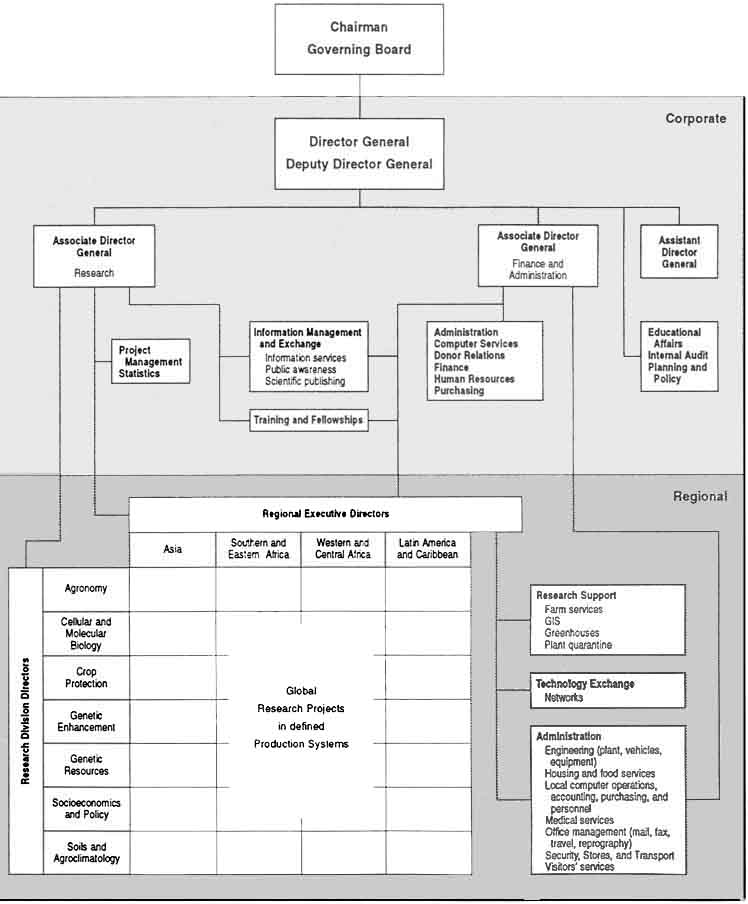
In 1993, ICRISAT restructured itself into a corporate organization with four regional entities: Asia, Southern and Eastern Africa (SEA); Western and Central Africa (WCA); and Latin America and the Caribbean (LAC) (Figure 1.1). The former ICRISAT Centre now comprises the Corporate Office and the ICRISAT Asian Centre (IAC). The ICRISAT Sahelian Centre (ISC) at Niamey (Niger) serves as the regional headquarters for Western and Central Africa, together with the teams at Kano (Nigeria) and at Bamako (Mali). The facilities at Matopos (Zimbabwe) serve as the regional headquarters for Southern and Eastern Africa, together with teams also at Lilongwe (Malawi), Nairobi (Kenya) and Addis Ababa (Ethiopia). No special facilities for Latin America and the Caribbean region have been established. For each region, a Regional Executive Director (RED) was appointed for the management and support of research focused on the main production systems of that region.
To facilitate the definition, development, management and conduct of global research and related projects, a two dimensional matrix management system was developed and introduced in 1994. One axis of the matrix includes the four geographic regions, each led by an Executive Director, and the other axis includes the seven disciplinary research divisions, each led by a Research Division Director (RDD). These divisions are global, including all scientists and senior technical staff within a cognate disciplinary area. The RDDs remain active scientists within projects, committing a portion of their time (15-30% depending on the size of the Division) to human resource management and quality control. According to ICRISAT, the axes of the matrix are designed to emphasize shared responsibilities, goals and outcomes through development and delivery of a global research project portfolio. In contrast to the previous hierarchical set up, the objective of the matrix approach was to devolve the responsibility for the management of research and resources to project teams and leaders, along with increased accountability.
At the time of the last External Review, ICRISAT's programmes were made up of 280 projects. In 1995, these were reduced to 22 global projects, and will be reduced to 12 in 1997. The research projects are based on the 92 core research themes embedded in the ICRISAT 1994-98 MTP. The 22 projects are made up of 15 commodity projects on 5 mandated crops, 4 integrated systems projects that focus on multi-commodity systems, 2 projects on markets and policy and impact assessment, and a genetic resources project. ICRISAT's relative resource allocation by activity category has remained unchanged during the review period. ICRISAT allocates 52% of its resources to increasing productivity; 19% to protecting the environment; 8% to saving biodiversity; 7% to improving policies; and 14% to strengthening NARS. Regional resource allocation is 56% to Asia and 44% to Africa.
Figure 1.1 Restructured ICRISAT as a Corporate Organization
ICRISAT's Strategic Plan of 1990 was entitled "Pathways to Progress in the Semi-Arid Tropics: ICRISAT's Strategic Plan for the Nineties". The Plan defined the future challenges as follows:
"If present trends of underproduction and population growth continue, the net food production shortfall in the Third World will be 100 million tonnes by 2000. Africa will be the major victim of this deficit, but Asia also will experience severe shortages. Global growth in demand for cereal feed for animals in the SAT will also continue to rise.The productivity of ICRISAT's mandate crops must be increased within the SAT to guarantee adequate supplies of food for the small-scale farmer's household and to assure that grain surpluses are available for sale as food, feed, and other uses. Surpluses will provide food for urban populations and income for the farmers.
ICRISAT, an agricultural research and training centre within the CGIAR System, must fit its mandate crops into different fanning systems, while addressing a range of ecologies and demand and providing an array of options to farmers."
ICRISAT 's role is reflected in its mission statement which states that "the rainfed semi-arid tropics (SAT) and other resource-poor regions growing ICRISAT mandate crops must be made productive and their agriculture more profitable and sustainable. Only then can people in these regions improve their lives and contribute effectively to national development and achieve food self-reliance. To this end, ICRISAT's mission and approach, as defined in its Strategic Plan document, is to:
· "foster, facilitate, and conduct research on mandate crops, resource management, technologies and institutions;· aim to increase productivity, versatility, and stability of ICRISAT's mandate crops and suggest appropriate ways of fitting these crops into existing and improved farming systems;
· emphasize a more judicious use of natural and human resources;
· undertake its mission in partnership with NARS and other institutions;
· encourage NARS increasingly to accept research responsibilities in order to solve their own problems and quickly provide technologies to their farmers; and
· adjust its research to meet shifts in research responsibilities within this partnership."
In the draft 1998-2000 Medium-Term Plan, currently under preparation, the above role is elaborated further as follows:
"In the world's poorest and most fragile area - the semi-arid tropics (SAT) - ICRISAT works to contribute to the relief of poverty, hunger, and environmental deterioration. Agricultural activity is inextricably linked to both the causes of, and potential solutions for, these three afflictions. ICRISAT's expertise in science-based agricultural development, together with its international, apolitical, non-profit, and humanitarian nature - uniquely position it to help the peoples of the SAT to work together to achieve effective practical solutions ... ICRISAT, as a global centre of scientific excellence, contributes the broadly applicable international public goods, while its regional, national and local partners translate these goods into the final products which help to improve the lives of the rural poor in their areas of responsibility."
Currently, ICRISAT serves as the Convening Centre for the Desert Margins Initiative (to become a Programme in 1997) in Sub-Saharan Africa, a component of the ecoregional approach for the arid and semi-arid tropics in Sub-Saharan Africa. ICRISAT also serves as the Facilitating Centre for the Rice-Wheat Consortium for the Indo-Gangetic plains, an element of the ecoregional approach for the arid and semi-arid tropics and subtropics in Asia.
Ecoregional approaches are designed to bring about: (a) the integration of crop improvement research with strengthened natural resources management research; (b) a new quality of IARC-NARS partnerships and interactions along the research-adoption continuum; and (c) improved linkages with global strategic commodity and subject matter IARCs in the CGIAR System.
ICRISAT added the groundnut crop to its mandate in 1976. By the time of the 1985 Annual Report, items (i) and (iv) of the formal mandate quoted in Section 1.1 had changed to read as follows:
(i) "serve as a world centre for the improvement of grain yield and quality of sorghum, millet, chickpea, pigeonpea, and groundnut and to act as a world repository for the genetic resources of these crops;(ii) assist in the development and transfer of technology to the farmer through cooperation with national and regional research programmes, and by sponsoring workshops and conferences, operating training programmes, and assisting extension activities".
This mixed and broad mandate has proved complex and difficult to implement for several reasons, mainly because:
· The global responsibility for improvement of yield and quality of the five mandated crops is not restricted to germplasm conservation, and genetic enhancement and breeding, but includes also the agronomic and natural resources management aspects to achieve improvement in crop productivity.· The semi-arid tropics and subtropics are extremely variable with respect to their biophysical and socioeconomic environments, offering a large number of natural resources management domains from which to chose.
· The mandate crops are part of many production systems, and ICRISAT's research targets 29 production systems.
· The mandate crops are not confined to the production systems of the semi-arid tropics and subtropics, but are important crops outside the semi-arid areas.
· The cost of undertaking research in Sub-Saharan Africa has remained high, and poor communications has added further to research costs.
· There are significant differences in the institutional environment between Asia and Sub-Saharan Africa, and whereas the NARS capacity in Asia has strengthened considerably since ICRISAT was established, the NARS in Sub-Saharan Africa have remained weak.
Consequently, ICRISAT must relate to a large array of partners, stakeholders and clients across the four regions, ranging from NARS, other IARCs, other research institutions active in the regions, to NGOs and farmers. To implement its broad and mixed mandate, ICRISAT currently manages 22 (soon to become 12) projects, 108 subprojects and some 1,200 activities; with a single activity sometimes spread over several ICRISAT locations and involving several scientists.
Despite the broad and difficult mandate, ICRISAT's 1990 Strategic Plan proposed adding finger millet to its crop commodity mandate for Eastern and Southern Africa, thereby adding to the difficulties. The 1990 External Review Panel concluded that ICRISAT's formal mandate as described above was very comprehensive, and that there was a need to exercise restraint in research. The Panel pointed out that ICRISAT's comparative advantage was in strategic research requiring a closer interaction with advanced institutions conducting basic research, and with institutions and scientists conducting applied and adaptive research in order to ensure the continued relevance and applicability of ICRISAT's research. The 1990 Panel recommended that not only should ICRISAT resist the strong pressure to go beyond the limits of its formal mandate, but that the Board should formulate an operational mandate which was well within the boundaries of the formal mandate, but at the same time more open to change.
In its response to the 1990 Panel's recommendation (see Appendix V), ICRISAT has argued that the 1994-98 Medium-Term Plan (MTP) was intended to define the operational mandate for ICRISAT for that period, and that financial constraints since 1992 had narrowed the dimensions of research, not broadened the mandate.
In the opinion of this Panel, the 1994-98 Medium-Term Plan does not contain a clearly formulated operational mandate that would define the scope, strategic focus or directions of ICRISAT's formal mandate. The 1994-98 MTP constitutes ICRISAT's proposals for research and related activities for the plan period. The MTP takes ICRISAT's complex and broad formal mandate as a given and assumes that it is an appropriate guide to setting research priorities and strategies. Consequently, ICRISAT's research agenda for the 1994-98 period could not be anything but broad and complex.
The Panel believes that there is now a strong and urgent need for ICRISAT to rationalize its broad formal mandate and to formulate an operational mandate so that the strategic elements and focus of work are clearly spelt out. The Panel commends ICRISAT for adopting a transparent and quantitative approach to priority setting but does not consider the approach or the 1994-98 MTP in the form submitted to be a substitute for a clearly formulated operational mandate to underpin the longer-term institutional strategy. This aspect is further dealt with in Chapters 3, 4 and 9 in the context of the future of ICRISAT.
ICRISAT's Strategic Plan defines the Institute's strategy for its operations in the 1990s in the context of priorities based on experience acquired from 18 years of research in wide-ranging locations in the semi-arid tropics. The Plan assesses the nature and essential elements of the challenge facing the Institute, anticipates the external environment in 2000, describes the target groups and partners, the guiding values and internal environment in which ICRISAT's work is done, and the regions where the Institute operates. The nature and elements of the challenge are assessed in terms of: crops and natural resources management research, including impact assessment research; training; technology exchange; the global and political environment; the physical environment; sustainability; partners; women in agriculture; new technologies; and new crop uses. Future ventures in crops, environmental and impact assessment research as well as in human resource development and technology exchange are described. The Plan ends with an assessment of the operational pathways by which the Institute's mission can be achieved, in collaboration with national programmes.
The Panel has no quarrel with the way the Strategic Plan is crafted except to note that until 1989 ICRISAT's global mandate for crop improvement (as opposed to germplasm conservation) covered five crops, sorghum, pearl millet, groundnut, chickpea and pigeonpea. However, the 1990 Strategic Plan implied that ICRISAT's global crop improvement mandate covered six crops by stating (see p.22) that "ICRISAT's mandate crops include three cereals (sorghum, pearl millet, and finger millet) and three legumes (groundnut, pigeonpea, and chickpea)". The Panel finds this statement puzzling. The Panel failed to find in the Strategic Plan either any solid analysis to support the basis for this decision, or any indication of the priority to be given to finger millet relative to the other mandate crops.
The 1994-98 MTP states that "ICRISAT's 1990 Strategic Plan has served as a valuable foundation" in the preparation of the MTP. The Panel questions whether the 1990 Strategic Plan provided a foundation for ICRISAT to formulate a clearly focused and manageable research agenda. If anything, the Strategic Plan recommended an expansion of the crops mandate without offering the much needed help towards making the implementation of the broad and complex formal mandate more manageable.
The Panel does not believe that the existing Strategic Plan can continue to serve the best interests of ICRISAT and its national partners in the future. Based on the arguments put forward in Chapters 2, 3 and 4, the Panel believes that time is ripe for ICRISAT to rethink its future role and to develop a new operational mandate, research strategy and organizational structure to respond to the challenges and opportunities within a global context. The shape of this "new" ICRISAT is outlined by the Panel in Chapter 9.
ICRISAT's 1994-98 MTP was formulated in the light of the Systemwide issues affecting the CGIAR. The MTP is a compilation of prioritized research themes designed to address the major biotic, abiotic, and socioeconomic constraints to sustainable growth in agricultural productivity in the SAT. Research has continued to emphasize the solution of priority constraints and the realization of new opportunities towards ICRISAT's goals of increasing efficiency, internationality, equity and environmental sustainability. These four criteria have been used to rank the 92 themes.
Priority research areas are: cereals improvement: sorghum and pearl millet; legume improvement: groundnut, pigeonpea, chickpea; genetic resources research; integrated pest management; production systems research: rainfed short-season; rainfed intermediate-season; rainfed low to intermediate-season; legumes in rotational cropping systems; socioeconomics research; and evaluation and impact assessment. ICRISAT's agreed agenda is implemented through 22 global projects, 108 subprojects and some 1,200 activities, and targets 29 production systems in the three regions. The Panel commends ICRISAT for developing and applying a quantitative and analytical approach to priority setting, and for creating a transparent and structured research agenda.
This Review represents a new approach to External Programme and Management Reviews (EPMRs). The anticipated merits of this approach are discussed in a document entitled "Improving the Quality and Consistency of the CGIAR's External Centre Reviews," a discussion note prepared by the CGIAR and TAC Secretariats for International Centres Week 1995. In preparation for the Review, members of the Panel attempted to identify major transcending issues to be considered. This was accomplished through extensive consultation with the ICRISAT Board, management and staff and through reference to the Centre Commissioned External Reviews (CCERs). Other reviews and consultant reports were utilized, and collaborating institutes in the CGIAR System and outside were surveyed to identify their concerns.
These transcending issues are grouped into four broad categories: (a) ICRISAT's strategic niche within the global system for agricultural research in the SAT: (b) the research strategy and programme thrusts; (c) the overall governance and management of the Institute; and (d) other key issues facing the Institute.
(a) Strategic Niche of ICRISAT
· Since the last review, ICRISAT has taken steps to globalize its programmes and integrate Asian and African efforts. Meanwhile, it has become apparent that core resources will be reduced drastically (~$3-5M in the coming year). Can the status quo model absorb the impending budget cuts? Should there be a global ICRISAT? Should it be divided into autonomous Asian and African units or should it focus exclusively on Africa? Should efforts in ICRISAT Headquarters focus on germplasm research and in Africa on natural resources management research? (see Chapters 2, 3, 4, 9).· What is ICRISAT's comparative advantage in contributing to international public goods? (see Chapters 3, 9).
· Among the IARCs, ICRISAT is uniquely situated in a NARS that ranks as one of the most extensive (~22,000 scientists with some 40% at the Ph.D. level) in the world. Whether ICRISAT has a role in interfacing the CGIAR System with its host country NARS should be examined, along with the possibility of ICRISAT operating more extensively in a contracting mode with India for both research and administrative services (see Chapters 2, 3, 4, 6, 9).
· Certain Systemwide activities are central to ICRISAT's mandate and participation seems essential. While additional resources may be available for start up, additional funding in the longer term is unlikely and transaction costs are considerable. Participation in these activities is an important issue for ICRISAT (see Chapter 6).
(b) Research Programme Issues
· It has been suggested by TAC and some donors that the Institute should position itself further "upstream" in its research activities. Unless comparative advantages are considered, this could place the Institute in competition with advanced research laboratories in the developed world. Also upstream research will inevitably result in 'intermediate' products and practices, making it more difficult to demonstrate farm level impact, the preoccupation of some donors. Therefore, positioning the Institute in the research continuum is an important question to consider (see Chapters 2, 3, 4 and 9).· Donor influence on the research activities of the Institute is an important issue. The current funding situation could push ICRISAT into an opportunistic approach to research. The "essential" programme thrusts need to be defined, for which continuing long-term funding could be sought (see Chapter 9).
· The commodity improvement portfolio presently consists of five crops. Whether some commodities should be dropped (pigeonpea was so identified in the previous EPMR) or added (finger millet is important in some SAT countries in Africa) is an important question to consider. ICRISAT has a global mandate for chickpea research. It includes desi and kabuli types. ICARDA shares a mandate for research in Kabuli types suited for the WANA region. About 80% of the global chickpea production is of the desi type being grown mostly in India. The collaboration of the two institutions has been fruitful, resulting in significant spillover efforts, (e.g. Ascochyta blight and soil-borne disease research) (see Chapter 2).
· Crop improvement programmes account for a large portion of ICRISAT's research activity and represent long term commitments by the Centre. The strategies employed need to be evaluated (see Chapters 2 and 3).
· A recent CCER is available on genetic resources but its recommendations have been questioned. Further review of the genetic resources programme may be needed (see Chapter 3).
· ICRISAT's research and related activities cover three contrasting continents. The nature of ICRISAT's efforts in each of the regions and the balance, integration and coordination of effort across the regions therefore pose important strategic questions (see Chapter 9).
· Advances in biology have implications for many of ICRISAT's programmes, and relationships exist with a number of laboratories in developed countries. Whether these relationships are appropriate and productive needs to be considered within the context of the commodity projects (see Chapters 2, 3, 6 and 9).
· The impact of ICRISAT since the last External Review and the mechanisms that are in place for monitoring impact should be considered. In harsh environments such as the semi-arid tropics, and the 'orphan' nature of the mandate crops, the gestation period for strategic research may be longer than for more favourable environments and better researched crops. Is there evidence to support this contention and, if so, what are the implications for ICRISAT? (See Chapters 2 and 6).
· Research in natural resources management has been a conceptual challenge for ICRISAT since the establishment of the Institute. Whether current efforts are adequate and appropriate needs to be reviewed in the light of different biophysical and socioeconomic conditions and the differential state of the NARS prevailing in Sub-Saharan Africa and Asia. A CCER report is available in this area (see Chapter 4).
· The revolution in information technology is one of the transforming features of modem society, and critical to the future of ICRISAT. The current status and strategy for information management needs to be considered as there are apparently a number of autonomous efforts in both administrative and research areas (see Chapter 8).
(c) Governance and Management
· Whether the Governing Board is appropriately composed and fulfilling its charter is an important issue. Questions have arisen as to whether the Board is maintaining proper oversight of Centre activities, particularly in the area of finance and management (see Chapter 7).· Five CCERs have been commissioned by the Board, and form the basis for the EPMR. Whether the reviews have been appropriately commissioned and implemented needs to be evaluated (see Chapter 7).
· A CCER report on Organization and Management has been undertaken, and has reviewed the changes introduced since the last EPMR. Whether the current research organization and management arrangements are serving ICRISAT well or whether they require further modification need to be examined (see Chapter 8).
· A number of management issues exist revolving around questions of leadership, a funding crisis, poor staff relations, cumbersome decision making processes and an apparent shortage in managerial skills. Questions have been raised about an excessive procedural orientation, at the cost of product delivery. Of immediate concern is the management of the Institute in the transition to a new director general and deputy director general in 1997 (see Chapter 8).
(d) Other Key Issues
· Training efforts have been affected by downsizing in the CGIAR System. The impact of these changes and the future direction of training efforts in ICRISAT are important questions (see Chapter 6).· Gender is a major issue for ICRISAT in terms of the orientation of ICRISAT's research and the composition of its scientific staff. This issue needs to be examined specifically and within the context of the research projects (see Chapter 5).
· Industrialization in and around the headquarters site at Patancheru has resulted in noticeable atmospheric pollution. The review team was several times subjected to noxious fumes from a nearby pesticide manufacturing plant. Whether the site is safe from the standpoint of human health and whether there are possible negative long-term effects on research results and products, especially germplasm, is an issue (see Chapter 8).
The 1990 External Review of ICRISAT made numerous and wide ranging recommendations and suggestions. Of the total of 45 recommendations, 26 were on the research programme and 19 on management. The recommendations were generally endorsed by TAC and the CGIAR. ICRISAT's then Director General stated in his verbal presentation to TAC that the Centre found the recommendations of the Panel largely acceptable and that it would adopt most of them. However, ICRISAT's written response to the Review was largely noncommittal with respect to Centre's agreement or disagreement with many of the recommendations and observations made by the Panel, causing difficulties for TAC in preparing its Commentary. TAC expressed its concern regarding this unsatisfactory state of affair as follows:
"While TAC understands ICRISAT's reluctance to provide a comprehensive response at this stage, the uncertainty of the ICRISAT's position particularly about the changes recommended by the Panels complicates the CGIAR decision-making about this review. A clearly stated ICRISAT position would have provided the CGIAR with an alternative rationale on issues ICRISAT disagrees with or does not fully endorse the viewpoint of the Panels. Also, a clearer response would have enabled TAC to provide a Commentary to the CGIAR in full consideration of possible differing views".
The Panel concurs with the above sentiments and hopes that this time round, ICRISAT Board and management will provide a clear and timely written response to the recommendations of this Panel.
ICRISAT's action in response to the recommendations of the 1990 External Review is tabulated in Appendix V, together with this Panel's comments. According to the assessment by the Panel, ICRISAT has fully implemented 26 recommendations, partially implemented 15 recommendations and not implemented 4. The Panel comments on ICRISAT's actions in the appropriate sections of this Report.