2.1 Origin and Creation of IIMI
2.2 Evolution of IIMI
2.3 IIMI's Current Strategy
2.4 IIMI Today
2.5 The 1990 Donor-Sponsored Review of IIMI and the Centre's Response
Two events in 1969 began the 15-year process that established IIMI. The first was a Bellagio Group proposal that stressed the importance of water management in agricultural development. The second was a joint proposal by the Ford and Rockefeller Foundations that recommended establishing an international centre to carry out multidisciplinary research on irrigation technologies, the economics of water management at national and farmer levels, and water policy issues at national and international levels.
Water management and irrigation issues surfaced repeatedly on the TAC agenda between 1971 and 1978, and a series of reports and discussion papers were commissioned. In 1979 TAC presented its third priorities paper to the Bellagio Group. Water management research was second on the list of initiatives proposed when additional funding became available. In 1980, following an IDRC-sponsored study, TAC submitted a draft proposal on water management to the CGIAR, which then commissioned a further study to generate alternative proposals. In 1982 the study team recommended to TAC that an International Irrigation Management Institute be established and funded by the CGIAR.
At its May 1982 meeting the CGIAR concluded that it would be financially inappropriate to add to the 13 Centres already funded, and did not endorse the recommendation. Instead, it encouraged interested members to explore the establishment of a centre along the lines recommended by TAC and mobilize new funds for this. This group of interested members initiated the formulation of a Support Group of 14 potential donors. The Support Group met in Washington D.C. in October 1982 and decided to establish and support IIMI as an independent international organization. Executive action to establish the Institute was entrusted to the Ford Foundation which sought a location for the Institute's headquarters, considering India, Sri Lanka and Pakistan. After an approach to India failed to produce an agreement, a decision was made to accept the invitation of Sri Lanka and to establish the headquarters of the Institute at Digana Village, built for the construction staff of the Victoria Dam and then being vacated. IIMI partially occupied the village in mid-1984 and expanded its occupation during 1985, beginning operations early that year. Control of the newly formed IIMI passed to the Institute itself in January 1985. It took over the management of the services and facilities at Digana Village from March 1986. IIMI moved to Colombo in 1989 and to present headquarters in 1992.
2.2.1 The CGIAR Involvement
2.2.2 Justification for IIMI's Entry into the CGIAR System at the Time of the 1990 Debate on the Possible Expansion of the CGIAR
2.2.3 TAC's Recommendations on CGIAR Priorities and Strategies in Public Management Research
IIMI's evolution may be divided into two phases. In the first phase, from June 1984 to December 1990, IIMI operated outside the CGIAR System, and received its funding from a Support Group of donors. The second phase began in January 1991 when IIMI joined the CGIAR System.
IIMI's Charter, which came into effect in 1984, stated that the specific objectives of the Institute were to develop methods, devices, procedures, practices and operational approaches to: (a) optimize the effectiveness of water use for agricultural production; (b) ensure dependability and equity in the distribution of the benefits of irrigation; (c) evaluate and improve the management and performance of irrigation systems; (d) protect, maintain and improve the quality of irrigated soil and the environment in areas affected by irrigation systems, as well as health, and the general welfare and quality of life in rural agricultural communities; and (e) improve the reliability of water supply, thus reducing the risk to investments in yield-increasing inputs, and to share and disseminate information thereof among potential user groups, organizations and other bodies and persons concerned with irrigations.
Although in its early years IIMI did not have a formal mission statement to guide its work within the broad framework of its Charter, IIMI interpreted its specific mission to be: "to strengthen national efforts to make more productive use of irrigation systems". In 1988, IIMI's Board approved a formal mission statement that gave the Institute's purpose as: "to strengthen national efforts to improve and sustain the performance of irrigation systems in developing countries through the development and dissemination of management innovations".
Initial activities took place within a handful of relatively nearby countries in Asia, and later expanded into Africa. Field offices with residential staff were established in Sri Lanka (1984), Nepal (1985), Philippines (1985-93), Indonesia (1986-89), Pakistan (1986), Bangladesh (1988), Burkina Faso (1988), Sudan (1989), Morocco (1989-93), Niger (1991) and Nigeria (1991). Given the mission in 1984 and the nature of available bilateral funding, IIMI's programme during the first phase evolved largely on a country and project basis, with specific emphasis on strengthening irrigation management capacity at the national level.
The combined impact of increasing population pressure and resource degradation, and the low productivity of irrigation systems, highlighted the need for a broadening of the emphasis in internationally supported research to give greater weight to issues of natural resources conservation and management.
In May 1988, at the CGIAR Mid-Term Meeting in Berlin the Group discussed the work of ten so called "non-associated centres" including IIMI, and asked TAC to undertake an examination of a possible expansion of the CGIAR System. At the Mid-Term Meeting in Canberra in May 1989, the CGIAR members agreed on a "Declaration of Intent on the Future Work of the CGIAR" in which they stressed "the evident and urgent need to investigate the significant research issues of natural resources management for sustained food production". The research needs in this area were considered to include the development of principles and methods for management of water resources for irrigation systems.
TAC, in its analysis, recognized the critical role played by irrigation in agricultural production in developing countries, and particularly in Asia. It was considered that greater benefits would flow if scarce irrigation water resources were more efficiently managed. TAC further considered that the training of personnel responsible for the management of irrigation systems and strengthening of the institutions responsible for irrigation management and research must be given high priority. In particular, research on socioeconomic aspects of irrigation management was considered to be critically important. Research was also needed on the policy of irrigation development and the role of irrigation development in food production.
TAC noted that some CGIAR Centres, e.g., IRRI, CIMMYT and WARDA, have some work in the area of water management. Also, IFPRI had conducted research to analyze the role of irrigation in relation to food policy. However, the organization and management of irrigation systems was not covered. TAC found that IIMI was filling a significant gap in the subject matter coverage within the CGIAR System and that its work complemented rather than duplicated the work of several other IARCs. TAC noted that IIMI operated largely through a series of country projects but that this was necessary in order to undertake research on the organization and management of irrigation systems. TAC considered that IIMI's mission as then defined "to strengthen national efforts to improve and sustain the performance of irrigation systems in developing countries, through the development and dissemination of management innovations" conformed more with that of ISNAR than with those of the commodity Centres in the CGIAR.
In considering the case for the admission of IIMI to the CGIAR, TAC noted that the term "irrigation management" as used by IIMI was a substantially different concept from those such as "soil and water management", sometimes referred to as "factor" research. Accordingly, TAC did not see IIMI as an institute working on a single factor of production to any greater or lesser extent than it might view ISNAR in this way. Consequently, in TAC's evolving terminology, IIMI was regarded, along with ISNAR and IFPRI, as a "subject matter" centre.
TAC also noted that there was little research in these areas outside the IIMI programmes, and as in the case of ISNAR, IIMI's role was not one that could readily be subsumed within the portfolios of existing CGIAR Centres. It required a different set of disciplines and a different paradigm. It was the combination of these considerations that justified admission of IIMI into the CGIAR System.
TAC noted that the concern about the ineffectiveness and inefficiency of public sector organizations had spawned substantial programmes of research on this problem. In the CGIAR context, research in this field needed to underpin the strengthening of national research systems and to improve the management of common property resources such as irrigation. Research was needed on the policy context of national research and on the organization and management of national research systems.
In terms of agricultural productivity, irrigation water was undoubtedly the most important common property resource. Poor management of irrigation systems by government and farmer organizations leads to considerable wastage and the inequitable distribution of water. Field research was needed to diagnose constraints to effective irrigation management and to develop management innovations to overcome the problems. TAC believed that some of the principles developed from research on the organization and management of irrigation systems may be applicable to other common property resources under public or communal management, such as wastelands and some types of rainfed farming.
Several CGIAR Centres were currently involved in different aspects of water management research. While research on irrigation management was addressed mainly by IIMI, important aspects of irrigated cropping systems in Asia, Africa and WANA are included in the work of IRRI, WARDA, CIMMYT and ICARDA. Similar research is likely to be needed on irrigated agriculture in Latin America. However, there was a need to study the efficiency with which increasingly scarce irrigation water is used for crop production along with resource degradation issues such as salinization and waterlogging. Also, several Centres, through cooperative arrangements with external agencies, have found the need to take into account watershed management, human health and downstream environmental considerations related to irrigated and wetland farming systems. TAC concluded that there was a need to bring all these different elements together through an inter-centre programme so that the capacities and interests that already exist in other CGIAR Centres, including CIAT, CIFOR and ICLARM can be integrated.
2.3.1 IIMI's Mission and Goals
2.3.2 Programme Structure and Approach
Joining the CGIAR System led to a number of programmatic, administrative and financial changes. The most significant change resulted from a closer identification with the overall mission of the CGIAR, a broadening of the Institute's early focus from "irrigation systems" to "irrigated agriculture", and a move away from being project-driven to programmes-based planning and project implementation. The new focus and mode of operation is reflected in IIMI's draft strategy document: "Improving the Performance of Irrigated Agriculture: IIMI's Strategy for the 1990s".
IIMI's Strategy is a response to two of the world's major problems: the expanding food needs in developing nations, and the competing demands for limited freshwater resources. IIMI believes that the answer lies in improved irrigation management, better policies and more intensive use of existing irrigated areas which would allow irrigation schemes to operate close to full potentials. Further, IIMI considers that while improvements in irrigation polices and management are a precondition for meeting future food requirements, they must be accompanied by many forms of technological advances, including improved crop varieties and production methods.
In its current strategy, IIMI defines its mission as being: "to foster the development, dissemination and adoption of lasting improvements in the performance of irrigated agriculture in developing countries".
IIMI sees its broad mission being achieved through three specific goals: generating knowledge to improve management and policy-making; strengthening national research capacity in irrigation management; and supporting the introduction of improved management and policy-making.
To achieve these goals, IIMI has identified two main sets of activities: research and institutional strengthening. Each is supposed to contribute to a lesser or greater extent to each of the three goals, although research contributes mainly to IIMI's first goal, while institutional strengthening activities contribute more to the second and third goals.
IIMI recognizes that there is a large number of organizations in the world carrying out research on irrigation, and considers this to be very appropriate because the subject is vast and complex, and IIMI by itself could never hope to address all the important research issues. As an international institution, IIMI expects to play a global leadership role in maintaining a "watching brief" on significant development worldwide, encouraging the work of others, helping to make information on important innovations available, and maximizing synergy among key research organizations. For the period of the 1994-98 Medium-Term Plan, IIMI will address a selected set of research issues in which it has an advantage over other organizations, and which it believes will have a significant positive impact on irrigated agriculture. These issues are grouped in five research programmes: (i) assessing and improving the performance of irrigated agriculture; (ii) sector-level management of irrigated agriculture; (iii) improving public irrigation organizations; (iv) toward the local management of irrigation systems; (v) sustainable management of water delivery and disposal.
IIMI has also identified four cross-cutting research themes: environment and health; choice and use of technology; gender issues; and improving global database on irrigated agriculture.
IIMI's institution strengthening objectives are addressed through four sets of activities: (i) organizational development activities; (ii) professional development activities; (iii) information dissemination activities; (iv) information networks.
According to the 1994-98 Medium-Term Plan (MTP), the Institute's core programme will focus on research and institution building activities that are designed to generate transnational rather than country specific results. The complementary programme will be made up of country-specific projects. IIMI has developed a concept of core add-on projects (CAPs). These are core funded projects attached to country specific collaborative research projects to allow the Institute to generalize from country- specific projects, and thus contribute to the generic core programme. By 1998, core and complementary activities would be of equal importance. The regional allocation of core resources would take into account the distribution of the areas under irrigation, i.e. 76% for Asia, 12% for WANA, 3% for Sub-Saharan Africa (SSA), and 9% for Latin America.
In assessing IIMI's MTP proposals, TAC expressed concerns about the issue of programme focus with respect to the broadened mission, and critical mass, particularly with respect to sector management and public organizations programmes for which only two core SSY (senior staff years) had been allocated. TAC also noted that the high proportion of complementary activities, in relatively few countries, presented a major challenge to IIMI in ensuring effective support to its generic research and institution building activities.
TAC recommended that IIMI be assigned core resources for 1998 of US$ 7.6 million (in 1992 dollars). At this level, the estimated total manpower allocation for core research and research related activities would be 12.5 SSY in 1994 rising to 13.75 SSY in 1998. In 1994, the proposed manpower distribution by core programme would be 5 SSY, 1 SSY, 1 SSY, 3 SSY and 2.5 SSY for the performance, sector management, public organizations, local management, and water management programmes respectively. Over the MTP period, training, information and documentation would account for 4 SSY per year. The balance of core effort among five categories of TAC defined activities in 1998 would be 38% for natural resources conservation and management, 45% for socioeconomics, public policy and public management research, and 17% for institution building. Corresponding figures for the balance of complementary effort in 1998 would be 38%, 42% and 20% respectively.
TAC also identified IIMI as the convening centre for a proposed Systemwide initiative on water management research covering inter-centre cooperation in irrigated cropping systems research, including watershed management, human health issues in irrigated areas, and downstream environmental problems created by irrigated agriculture.
The 1994-98 MTP developed by IIMI and approved by TAC in October 1993 serves as the basis for IIMI's programmatic efforts. IIMI's research activities constitute about two-thirds of its total expenditures - a proportion that has grown slightly with the growth of resources, as shown below in Table 2.1 The projected operating budget (net of transfer to reserves) for 1994, however, is currently US$ 8.8 million, a decline of about 8.6% from the 1993 expenditure level and below the MTP-approved level for 1994 of US$ 13.4 million (in nominal dollars). This represents a drop of 25.6% in nominal dollars from the expectations in the MTP.
Unlike most CGIAR Centres, the downturn in funding is quite recent for IIMI. IIMI's funding level had increased steadily from approximately US$ 1.0 million in 1984 to close to US$ 10 million in 1993 by a compound rate of about 26%. The Institute achieved this by enlisting new donors and attracting additional support from its "traditional" donors (see Section 7.5). Since 1991, when IIMI joined the CGIAR, its core unrestricted funding has continued to rise while core restricted funding began to decline (in 1992), as shown in Table 2.2. While unrestricted resources are increasing in absolute and proportional terms, they still account for only about one third of IIMI's total funds, whereas for the more established CGIAR Centres the proportion is closer to two thirds.
Table 2.1 Breakdown of IIMI's Total Expenditure (Including Capital) - 1989-93
|
|
1989 |
1990 |
1991 |
1992 |
1993 Projected |
|||||
|
US$ |
% |
US$ |
% |
US$ |
% |
US$ |
% |
US$ |
% |
|
|
Research |
3,854,256 |
61 |
4,254,666 |
63 |
5,619,992 |
66 |
5,928,381 |
65 |
6,433,968 |
67 |
|
Research Support |
562,470 |
9 |
677,804 |
10 |
704,040 |
8 |
856,534 |
9 |
816,600 |
9 |
|
Information |
346,000 |
5 |
385,755 |
6 |
539,683 |
6 |
474,008 |
5 |
455,500 |
5 |
|
Governance |
475,000 |
7 |
624,584 |
9 |
582,484 |
7 |
704,310 |
8 |
900,900 |
9 |
|
Finance & Administration |
649,392 |
10 |
736,790 |
11 |
619,850 |
7 |
867,248 |
10 |
723,800 |
8 |
|
Other Administration |
461,000 |
7 |
81,749 |
1 |
441,726 |
5 |
257,392 |
3 |
264,500 |
3 |
|
Total Expenditure |
6,348,118 |
100 |
6,761,348 |
100 |
8,507,775 |
100 |
9,087,873 |
100 |
9,595,268 |
100 |
Table 2.2 Type of Funding - 1989-93
|
Year |
Core Unrestricted |
Core Restricted |
Non-core or Special Project |
Total |
|
1989 |
1,744,929 |
1,448,179 |
2,690,435 |
5,883,543 |
|
1990 |
1,903,505 |
1,588,572 |
2,741,261 |
6,233,338 |
|
1991 |
1,899,395 |
4,071,107 |
2,075,657 |
8,046,159 |
|
1992 |
2,725,941 |
3,765,637 |
2,636,368 |
9,127,946 |
|
1993 |
3,342,397 |
2,808,074 |
3,738,503 |
9,888,974 |
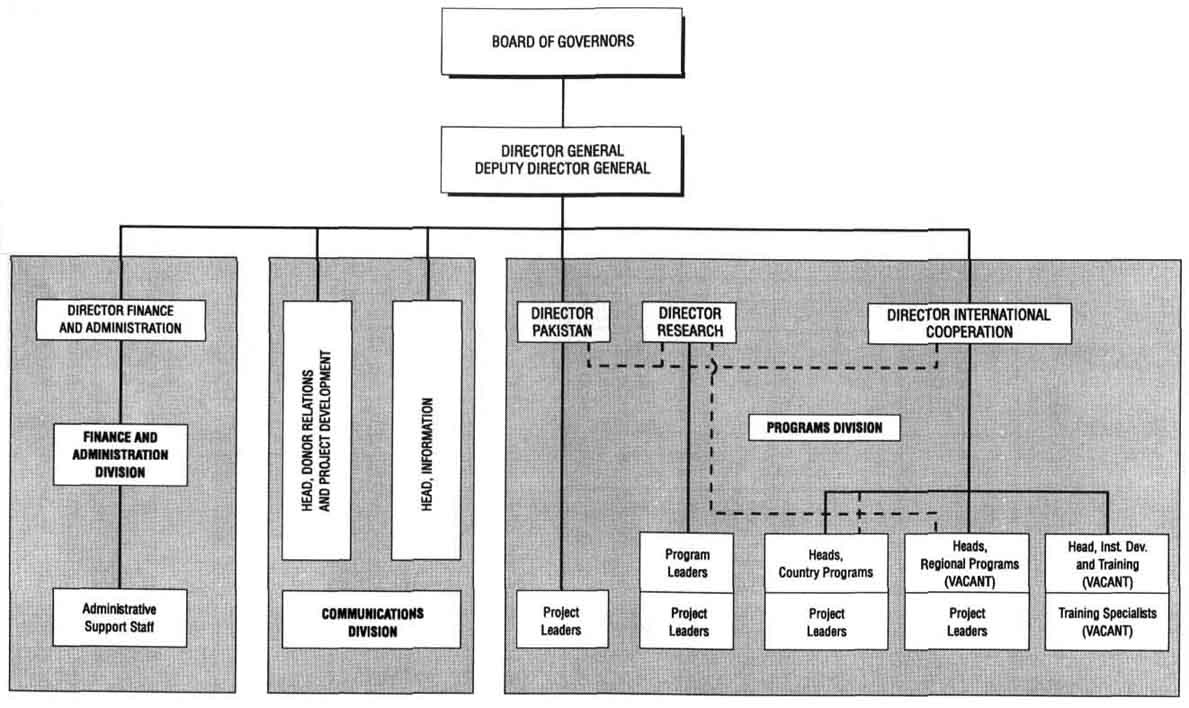
The staff who carry out IIMI's work are organized as shown in Figure 2.1. The structure is made up of three broad components - Programmes, Communications, Finance and Administration - reporting to the Director General (DG). The DG is assisted by a Deputy Director General (DDG) and four Directors (Research, International Cooperation, Pakistan, Finance and Administration), and is discussed in Section 5.2.
Figure 2.1 IIMI Organizational Chart - December 1993
In terms of staffing, the total number has increased by 36% from 1989 to 1993, with an increase of 23% (from 31 to 38) in international staff. In 1993, there were 19 international staff based at Headquarters (HQ) and 19 in eight field offices, most of whom were in Pakistan (7) and in Sri Lanka (4). Of the 33 Programme staff, 18 had a background in engineering, 5 in economics, 7 in social sciences, 2 in management, and 1 in agricultural science. Staffing patterns are presented in Table 2.3, and are discussed further in Section 6.1.2.
In 1994, retrenchment of staff is anticipated. Responding to the recent decline in total funding, in December 1993 the Board approved a 1994 budget that required a reduction in personnel costs. As a result, the DG has announced a proposal for staff reductions, expected to affect about 10% of national and international staff.
IIMI's first external review was commissioned by the IIMI Support Group. The panel made five programme-related recommendations, and six management-related recommendations. The programme-related recommendations covered the following areas: narrowing of research themes; over-extension of IIMI's activities; quality control; communications with personnel in collaborative agencies and those involved in policy making; and gender issues in irrigated agriculture. The management-related recommendations covered the following areas: Pakistan; legal status and governance; organizational structure; indirect costs; project budget and staff orientation; and position classification system.
IIMI's actions in response to the recommendations, are tabulated in Appendix VI, together with Panel's remarks and implementation scores. According to the assessment by the Panel, IIMI has implemented 5 recommendations in full, and 6 recommendations partially. The Panel comments on IIMI's actions in the appropriate sections of this Report.
Table 2.3 Total Staff Strength - International and National Staff - 1989 and 1993
|
|
Research |
Research Support |
Information |
Governance |
Fin. & Admin. |
Sub Total |
TOTAL |
|||||
|
HQ |
Field |
HQ |
Field |
HQ |
Field |
HQ |
HQ |
Field |
HQ |
Field |
||
|
1989 |
||||||||||||
|
International Directors and above |
- |
1 |
2 |
- |
- |
- |
1 |
1 |
- |
4 |
1 |
5 |
|
Other International Staff* |
7 |
17 |
1 |
- |
1 |
- |
- |
- |
- |
9 |
17 |
26 |
|
National Professionals |
30 |
16 |
- |
3 |
4 |
1 |
- |
9 |
8 |
43 |
28 |
71 |
|
National General |
15 |
40 |
- |
64 |
9 |
- |
5 |
57 |
- |
86 |
104 |
190 |
|
TOTAL |
52 |
74 |
3 |
67 |
14 |
1 |
6 |
67 |
8 |
142 |
150 |
292 |
|
1993 |
||||||||||||
|
International Directors and above |
- |
1 |
2 |
- |
|
|
2 |
1 |
- |
5 |
1 |
6 |
|
Other International Staff* |
12 |
18 |
1 |
- |
1 |
- |
- |
- |
- |
14 |
18 |
32 |
|
National Professionals |
19 |
42 |
- |
31 |
15 |
1 |
2 |
11 |
11 |
47 |
85 |
132 |
|
National General |
12 |
30 |
- |
114 |
9 |
- |
5 |
56 |
- |
82 |
144 |
226 |
|
TOTAL |
43 |
91 |
3 |
145 |
25 |
1 |
9 |
68 |
11 |
148 |
248 |
396 |
* Three associate experts are included in the International "Research" staff in 1989, and 6 in 1993 (3 are in Headquarters and 3 in Pakistan).