5.1 Governance
5.2 Leadership and Organization
5.3 Programme Management
5.1.1 Board of Governors
5.1.2 Board Committees
5.1.3 Board Leadership
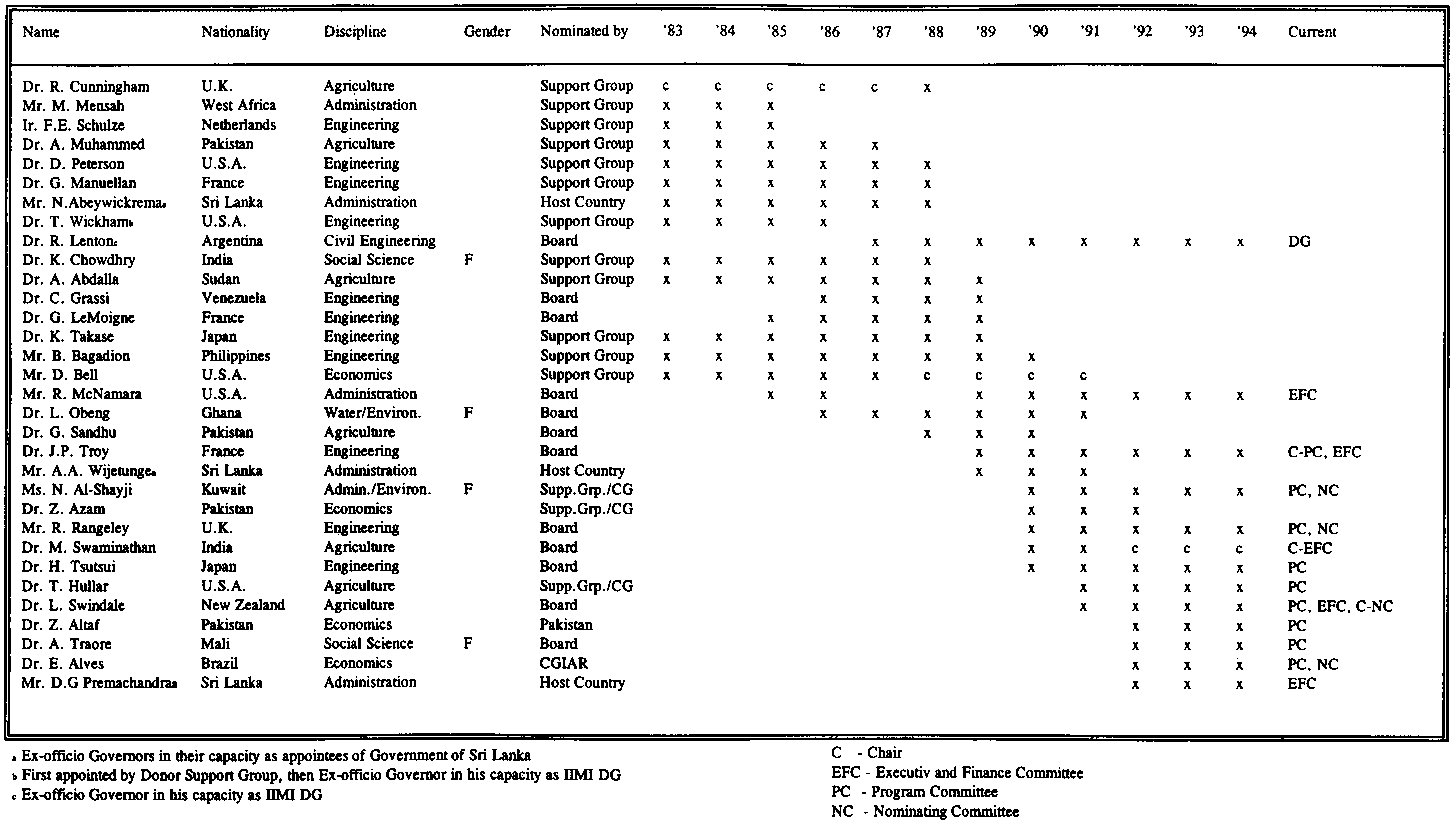
As shown in Figure 2.1, overall authority for IIMI's mandate and mission is vested in a self-perpetuating Board of thirteen Governors, which includes two ex-officio members. Meeting twice a year, the Board is responsible for approving IIMI's programmes, plans and budgets, and it accomplishes certain of these responsibilities through delegation to its three committees: Executive and Finance, Nominating and Programme. The composition of the Board over time, including nationalities, gender and disciplinary balance, is shown in Table 5.1.
The Board in its deliberations and actions subscribed fully to the mandate and mission of IIMI. At no time did the Governors display any doubt about the critical importance of irrigation management and IIMI's vital role in finding ways to bring about better irrigation management on a global basis. During the Board's several sessions in December of 1993, it was evident that all members came well prepared and regularly demonstrated an acceptable degree of familiarity with the subject matter.
The Executive and Finance Committee in its session showed an acceptable level of awareness of the essential issues of finance and accounting. The Committee came well prepared and asked appropriate questions of the representatives of the external auditing firm and the Director of Finance and Administration. Since there were no accounting issues of consequence, it was not possible to judge the Committee's capabilities under more demanding circumstances. Their considerable grasp of financial details and their willingness to challenge inconclusive statements by the professionals present suggest, however, that this Committee will rise to whatever challenges occur.
The Nominating Committee, which has three members, met at some length. On the positive side, the chairman did ascertain that the current Board chairman was prepared to assume the active leadership role which he had in the past year been unable to fulfil. Less productively, the Committee devoted a considerable amount of time to suggesting and commenting on possible Board candidates, only to agree later with the full Board that as a matter of economy the retiring Governors ought not to be replaced. It was disappointing that the Committee did not deal more conclusively with the case of a Board member who had been regularly absent.
The Committee then addressed the nomination of committee chairs for the forthcoming year, a process which was made difficult by the fact that two of the three members were Committee chairmen. Despite this possible conflict of interest, the two Governors who have and are to chair the Programme and Nominating Committees are well qualified and are fully accepted by the Board.
Table 5.1 Members of the IIMI Board of Governors
When queried, the Committee did not consider that its terms of reference called for a regular evaluation of Board make-up or Governors' performance. The Committee and the full Board need to know whether the membership has been sufficiently effective and whether the membership has an appropriate disciplinary balance, in programme and management fields, and, in particular, enough awareness of current science at the cutting edge to judge the promise and priority of new research initiatives (Table 5.1).
The Panel recommends that the Nominating Committee should develop a mechanism to assess regularly the composition of the Board and the contributions of individual Board members and officers.
The Programme Committee showed strong interest in the review of the research programme, but tended to confine its questions to matters of detail, rather than to those of relative importance and priority. It may have felt that the Board's probing during an earlier discussion on achievements and impact was adequate for these broader issues; in the Panel's view, a more penetrating style of questioning of management should be exercised.
By choice, the Programme Committee contains most Board members, an arrangement that has the advantage of giving most Governors the opportunity of participating directly in the essential business of IIMI. The December session of the Committee, however, was long and inconclusive, in part because all Governors present were eager to participate, but more importantly because most programme managers gave lengthy presentations with too much detail. They should have been challenged more about schedules, goals, or performance against one or both. The Panel suggests that the Programme Committee ought to require a standard format for programme presentations, and one which stresses key issues and tangible results. Additionally, the Committee should insist that every programme have defined goals, and, if possible, some definition of the "critical path" to each. Once these are established, the Board will be better placed to monitor IIMI's achievements and impact.
In the last year, the Board Chairman, due to other commitments and by prior agreement, has been comparatively inactive, and was replaced for all intents and purposes by a vice chairman. The absence of the Chairman was unfortunate in that it coincided with a number of critical events in the CGIAR System and in IIMI. The Panel is pleased to learn that the Chairman has been able to reorder his other commitments and is now able to serve normally.
During the Board sessions in December, the Chairman was effective in keeping the discussion focused and in affording the less vocal Governors with ample opportunity to express their views. He showed a very good level of knowledge about IIMI business and research. Since the current Chairman has in full the respect and reputation that Board leadership demands, he should be able to ensure that IIMI business is conducted effectively and expeditiously. What is needed now is a continuing insistence on goals and performance against those goals.
In carrying out his leadership responsibilities, the Panel urges that the Board Chairman also considers ways to improve the Board's effectiveness, and in that connection the Panel has five suggestions. First, the appraisal of the Director General and the setting of his goals for the ensuing year are a critical part of Board oversight, and these matters need to be given a clearer and more conclusive treatment than was the case in the December 1993 Board meeting. All appraisals of senior management should focus on output rather than input measures. Second, as the last item on each Board agenda, there ought to be a closed session in which the Governors assess how the Board and Committee meetings have proceeded, and what might be done in the future to improve their effectiveness. Third, before the agenda for a forthcoming Board meeting is finally decided, each Governor should be encouraged to suggest items which he or she feels should be included. Fourth, the Board should periodically review the quality of its decisions. Fifth, the Board should seek closure on important issues (such as definition and measurement of critical mass for country projects discussed at the April 1993 Board Meeting) to give IIMI managers clear policy direction.
5.2.1 Organization Structure
5.2.2 Leadership and Senior Management
5.2.3 Planning, Monitoring and Review
IIMI's organization chart is presented in Figure 2.1. The Director General functions as the Chief Executive Officer and is responsible to the Board of Governors for the overall management and development of IIMI. The Director General coordinates the various roles and functions of IIMI, and is assisted by a Deputy Director General, four Directors, the Head of the Project Development Office and the Head of Information, and by an Executive Management Committee. The latter Committee is comprised of the Director General, Deputy Director General and the Directors and meets every two months to discuss policy issues. A budget Subcommittee and a recently established Programmes and Projects Subcommittee report to the Management Committee. Each Subcommittee meets monthly, and in addition to the Director General and the Deputy Director General each includes appropriate senior management in its membership.
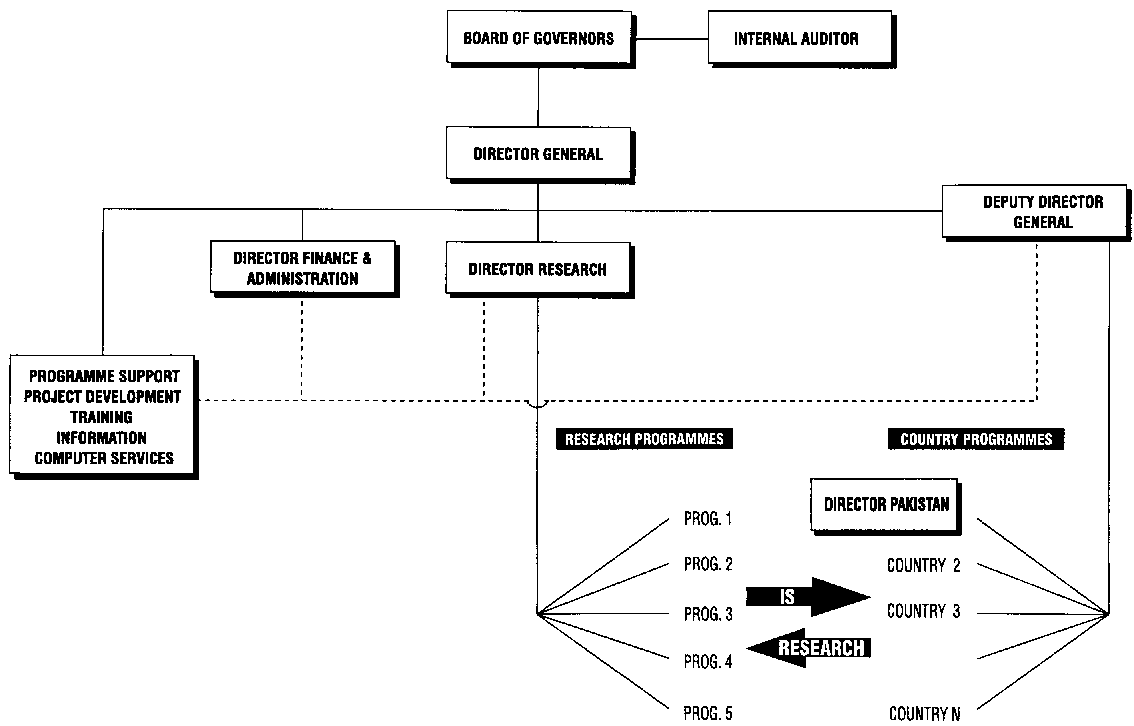
Outwardly at least the current organization structure is one that is reasonably traditional within the CGIAR System. However, it is not functioning as effectively as it should and is probably more expensive to operate than IIMI's financial circumstances can tolerate. As conceptually visualized in the attached organization chart (Figure 5.1), the Panel suggests the following changes: First, there appears to be a rather heavy concentration of staff at Director level. The Director of International Cooperation will go on half-time appointment as a transitional measure, after his contract comes to an end in June 1994. The past experience and the personality of the DDG make him very well suited to oversee the important country programmes, and it is intended that he should take responsibility for these in due course. The Panel feels that this is a good arrangement, and endorses it in the diagram in Figure 5.1. Second, since research is the primary function of IIMI, there ought to be a clearer delegation of responsibility from the Director General to the Director of Research along the lines described in Section 5.3.4. Third, given the importance of information, training, computers, and project development to the research agenda, the Panel urges that a Programme Support Group be formed and that it include the functions of information, training, computer services, and the Project Development Office. This will bring these services closer to research and institutional strengthening as part of the process of integration and decentralization recommended in this Report.
Figure 5.1 A Structure for IIMI.
The Panel recommends that a Programme Support Unit be created that includes project development, training, information and computer services.
In nine years IIMI has grown from nothing to its present important status, and we give credit to all members of the management team for the roles they have played in this. In particular, the present DG, who has been in post for seven of these years, deserves full recognition of his vital role.
IIMI has grown at a pace that has caused management systems and processes to lag behind the needs of the organization. Earlier IIMI had a strongly participatory style. Now, from the perspective of staff interviewed and surveyed by the Panel, the DG as well as the senior managers have consistently demonstrated their willingness to listen. However, in the case of some important decisions, employees who had provided inputs could not understand how the inputs were used in the final decision reached, and they perceived the DG's style as top-down and, at times even arbitrary. The DG has informed us that he recognizes that he has acted in a much less participatory style in the last two or three years. He believed that this was necessary because of the many important decisions that had to be taken following acceptance into the CGIAR. However, staff were not informed that there was a deliberate change of style. The Panel suggests that the DG could make the process of decision-making more transparent by clearly delineating where responsibilities lie and by specifying - when he makes decisions or accepts a consensus - how inputs will be used. Once decisions are made that impact on employees, he should, as a rule, explain the rationale behind the decision. In the Panel's view, the DG is an excellent communicator, and should rely more on these skills to increase staff confidence in management decisions. A great deal is gained by an open atmosphere, (see Section 6.1.1 on staff morale.)
The question is how IIMI should deal with decisions in the future. It has grown to a size where the earlier participatory style may no longer be practicable. However, participation can be regained by delegation of authority and responsibility to lower levels of the organization, as the Panel has urged elsewhere, where participatory action can be taken. However IIMI arranges these matters, it is absolutely essential that staff should understand what is expected of them, and where any particular decision is ultimately to be taken. We suggest that the DG needs to clarify these questions as soon as possible.
In this connection, the Panel considered the performance of the senior management team. The DDG is an efficient administrator, and has an excellent background in the practical management of irrigation systems. He would operate more effectively if he had a clearer job description, giving him duties that are more obviously segregated from those of the DG. The Panel agrees that the DDG will be well suited to assume responsibility for the non-research aspects of country programmes (that are under the Director of International Cooperation).
As the report indicates, the administrative parts of IIMI function well. In the Panel's view, the Director of F&A provides a strong and strategic management perspective to the senior management team. On the research side, lack of continuity has been a problem. The post of Director has been filled twice in rapid succession. The current Director of Research only took up the post in 1993, and is still working to control a complex and rather disorganized research structure. This gives him much less time than he should have for building up the science of his team and concentrating on research direction. Much of the Panel's report focuses on the need for IIMI to set procedures and systems in this area that will operate in a smooth and systematic manner.
In the Panel's view, effective partnerships were taking place among some but not all members of the senior management team. The Panel suggests that the senior management team should work as a team and thereby act as role models for cooperative efforts among their subordinates. In order to do so effectively, they will need clear mandates to manage in their respective areas, and time to do so. Consequently, the Panel suggests that, while consultation should continue to be IIMI's leadership style, the DG should require more timely closure of decisions than has been the past norm.
During the past five years IIMI has been busy with a continuous succession of planning and review exercises. Most of these are externally induced (by IIMI donors, the CGIAR, TAC) and their timing and content are not necessarily under IIMI's control. Since joining the CGIAR System, IIMI has had to revise its strategic plan and develop a medium-term plan. In some cases these exercises have even overlapped one another. For example, while IIMI was busy preparing its medium-term proposals, it had to engage in preparing for this Review for which documents had to prepared before the final decisions by TAC and the CGIAR were known. Clearly, such endeavours often compete with rather than complement the research and institution strengthening work for which IIMI exists, and too much time is consumed in this for some staff.
IIMI's first Strategy Paper was prepared in 1988. However, following the entry into the CGIAR System in January 1991, IIMI's Board and Management decided upon a review of the Institute's mission, goals and strategic direction. This was done to fully capitalize on the new opportunities and relationships offered by IIMI's entry into the CGIAR System, and also to assist the Institute in developing its medium-term proposals for consideration by TAC and the CGIAR.
To this end, starting in mid-1991, IIMI held a series of workshops to involve staff, Board, clients, donors, and collaborators in the preparation of its current Strategic Plan entitled: "Improving the Performance of Irrigated Agriculture - IIMI's Strategy for the 1990's". The result takes the Institute from an original, and relatively narrow focus on irrigation systems, to a wider view, that focuses the attention of IIMI's work on the irrigated agriculture sector as a whole. This change in IIMI's mission has been regarded as being "appropriate" by IIMI's national collaborators, as revealed in the survey responses (Appendix IV). However, judging from its medium-term plan and from our investigations, the Panel concludes that IIMI has a considerable way to go before the full implications of the wider mandate are adequately reflected at the programme level.
Our sense, as reflected in this Report, is that IIMI's broad vision of the future programme priorities as laid out in the strategic plan and the MTP are generally valid and appropriate in providing guidance for the Institute's overall organization, programmes and operations. However, the Institute must now concentrate on creating a stable operating climate which would allow it to move firmly and rapidly forward towards becoming a scientific organization that is focussed on performance and excellence.
Strategic and medium-term operating plans are seen as iterative. Revisions in operating plans with some shifts in programme focus occur frequently - in response to externally as well as internally induced forces, and the Panel makes some suggestions for programme focusing in the future in Chapter 3. However, the CGIAR System itself is currently being reorganized, and systemwide and ecoregional programmes will provide opportunities for new modes of collaboration and funding with international and national cooperators. IIMI must take steps to ensure that its planning processes are sufficiently flexible and responsive to take full advantage of the emerging opportunities in the CGIAR. This aspect is further discussed in Chapter 8.
In principle, IIMI has five mechanisms for monitoring performance: (1) Financial oversight through the annual programme and budget request. (2) Programme and project review by the Sub-Committee on Programmes and Projects. (3) Programme and project review during the annual Internal Programme Review (IPR). (4) Programme and project review during the April meeting of the Programme Committee of the Board of Governors. (5) Peer reviews as appropriate. The effectiveness and utility of these processes are assessed below.
In monitoring and review there is again a mixed record. The programme budgeting process is operative and is clearly being improved as a result of the efforts of the Director of Finance and Administration. The Panel, however, found that some managers had no clear knowledge of their budgets and in many instances budget overruns appear to have been accommodated, apparently without penalty on the budget holder. If overruns are countenanced, the discipline of budgeting is degraded not only in the minds of those whose overruns have been tolerated, but by the others who sacrificed to stay within budget and now find that it apparently did not matter. The Panel understands the Centre is in the process of developing stronger systems and procedures that could check this practice. However, even without these, the Panel sees no reason why budget overruns should not be charged to the budget holder in the succeeding year.
The monitoring and review practices of the Programmes and Projects Subcommittee are too new to be seriously evaluated or judged. The Panel would, however, caution IIMI management that its interviews revealed a much greater emphasis on input measures when discussing performance than on output measures. Hours and activity levels are not to be disregarded, but they tend not to differentiate between productive and less productive work and research efforts. As reported earlier (Chapter 3), the use of peer reviews has been much more infrequent than is desirable in a research organization.
The monitoring by the Board's Programme Committee has been remarked upon earlier (Section 5.1.2) and here we only emphasize the Board's concern with impact, and its expectation that the Programme Committee in particular will be requiring evidence of impact in the near term. The Board itself is, of course, concerned with monitoring and in addition to its expressed concern with impact, it has sought assurances about quality control, a subject it reviewed but did not conclude at its most recent meeting, but that presumably will appear on the April 1994 agenda.
The Panel is concerned that the foregoing processes appear to be more retrospective than prospective in many cases, and under the circumstances the Panel recommends that the programme review, forward planning, and monitoring processes be based on the pre-established objectives for each project, and be fully and consistently implemented.
5.3.1 Research Characteristics
5.3.2 Programme Organization and Management
5.3.3 Planning, Monitoring, and Review of Programmes
5.3.4 Proposed Changes to the Organization and Management of Programmes
IIMI's research programme was discussed in Chapter 3. The fundamental conclusion was that, while overall performance is encouraging, achievements are still significantly below potential, and making a transition toward strategic research has been slow. Improved research performance and greater focus on strategic research require adjustments in the management of research. In this section, we consequently review the structure and performance of research management and make a number of suggestions and recommendations for improvement.
In Chapter 4, IIMI's institutional strengthening (IS) programmes were reviewed. For improved performance, they also require a number of adjustments to IS management. Since both research and institutional strengthening are (and should be more) closely related, we discuss these two subjects as overall programme management.
We noted in Chapter 3 that IIMI's approach to research has distinguishing characteristics that relate to both the nature of the field of inquiry and the research strategy chosen. This creates a number of unusual challenges for the management of research which also bear directly on the management of institutional strengthening. Some of these characteristics are the following:
· The subject researched is multidisciplinary, including issues of engineering design, agricultural technology, biophysical processes, performance of public and grassroots organizations, management and information techniques, behaviour of households and communities, and performance targets that include considerations of efficiency, poverty, equity, gender, participation and empowerment, environmental impact, and inter-generational sustainability. Research consequently has to be cooperative.· One of the main subjects is the operation of public and private organizations, requiring direct involvement with these organizations through "action research". This implies a close interface between research and institutional strengthening, with the latter used as an instrument for research, and as an explicit goal in IIMI's mandate. Research and institutional strengthening activities, as well as headquarters and country initiatives, thus need to be managed as an integral programme.
IIMI has organized its research in five research programmes. Research is headed at headquarters by a Director of Research who himself acts as a programme leader, and has (presently) three programme leaders under him, who in total manage the five research programmes. Research projects conducted from Headquarters are linked to specific programmes, and they cut across programmes according to their need for specific personnel. Research projects conducted from country programmes are formally listed in one of the Institute's five research programmes, but in fact are in general very loosely related to the corresponding headquarters activity, if at all. This is not always the case, however, and an increasing number of multi-country programmes are being initiated that are under Headquarters programme leader supervision and some of which involve participation of country research staff.
Research and institutional strengthening activities are integrated in country programmes, currently with presence in 12 countries and clear critical mass in two locations, Pakistan and Sri Lanka. Apart from the Director of Pakistan Programme, who reports to the DG, country activities are coordinated at headquarters by a Director for International Cooperation, to whom country programme heads report. The problem of critical mass is important, as programmes with only one international staff member absorb the bulk of this staff's time in management, and make it difficult to achieve interdisciplinarity. Continuity is often hampered by dependency on one single ephemeral source of funding. The Panel believes that IIMI has still not solved the problem of developing consistent policies for small country programmes. It needs to clearly determine where it wants to achieve critical mass and why, under what conditions it can eventually operate effectively with only one international staff, and where it can conduct country activities without resident international staff. We believe that IIMI has not sufficiently explored the latter two models for its country-level activities. In particular, focusing exclusively on locations where it can establish critical mass, an option presented by management to this Panel, would be a serious constraint on capturing many opportunities for significant research.
For the moment, the Director of Research (DR) has coordinating authority over research programmes, and he is expected to work in close cooperation with the Programme Leaders and the Country Programme Heads. Because IIMI is a small institute, there are many informal interactions between the DR and the programme leaders. Programme issues are discussed in the Programmes and Projects Subcommittee of the Management Committee, with both the Committee and Subcommittee chaired by the DG. This system has three flaws. The first is that interactions between the DR and Programme Leaders tend to be induced by management problems, as opposed to full integration between considerations of scientific and management issues. The second is that the Programme and Projects Subcommittee also tends to be dominated by administrative matters, since it is a subcommittee of management and heavily staffed by management. The third is that decisions regarding research and IS tend to be taken separately. For instance, to this date, the DR has not visited many of the country programmes and the DIC is not involved in substantial issues of research. As a consequence, there is no formal platform where scientific matters concerning priorities for research and IS are sufficiently discussed and linked to management decisions. Now that IIMI has reached a significant size and is involved in a large number of countries, it is urgent that the scientific content of its research and IS programmes be much more systematically discussed among the main actors involved.
There is considerable formal decentralization of initiatives and decision-making to the level of programme leaders and heads, but effective decentralization that would transfer basic responsibility and authority and create a sense of ownership over these programmes is still lacking. The result is that the scientific and managerial potential of leaders and heads is not allowed to blossom.
The annual review of IIMI's programmes is conducted through the Internal Programme Review event. The forward looking implications of the lessons derived from this review are the inputs into an annual programme planning exercise which aims at adjusting the MTP, preparing research programme and country unit plans, and preparing an annual overall workplan for the Institute. For the definition of country programmes, Programme Working Groups are to be established that incorporate the country programme head, staff of the particular country unit, and programme leader(s) of the main programme(s) on which the activities are focused. This structure is, however, more on paper than in place. The Internal Programme Review has the potential for being both a valuable monitoring medium and an important means of sharing research developments and data. However, it will require a major restructuring of the sort of IPR which has been carried out in the recent years. Apart from the use of a room that was far too large and forced reliance on an unsatisfactory audio system, the meeting seemed to allow equal time for projects whose leaders were well-prepared and had something to communicate, and for those that should have been denied an audience until there was something of value to report. Additionally, much of the discussion was not of the quality and focus that a meeting of this sort warranted. Finally, of course, the cost of the IPR was excessive when one adds in the time cost of the many staff present. The Panel is fully supportive of an IPR which sets and enforces a standard of what is ready and acceptable for presentation as well as of a good standard of discussion. Conclusions from this review are inadequately translated into new directives, guidelines and incentives. Clearly, the planning and conduct of these important annual exercises, which are fundamental elements of the management of programmes, need to be seriously rethought as stated in the Recommendation in Section 5.2.3.
Monitoring of performance through the prior definition of goals and milestones and subsequent assessments of performance is an important instrument to stimulate greater achievements. However, in the field of research, this is insufficient to induce greater performance, because reasonable output levels are so difficult to predict, and because creativity is such a highly subjective concept. An important additional determinant of performance is the quality of the work climate that prevails at the Institute. As discussed in Chapter 3, the present situation is not satisfactory. Staff morale is low, interactions among scientific personnel are insufficient, and the climate of collegiality that once prevailed when IIMI was a smaller operation has given way to individualism and sometimes cynicism.
With the approaching end of contract term for the Director for International Cooperation, the issue of lack of coordination between research and institutional development, and between headquarters and country programmes, should be seriously reconsidered and redesigned. We recognize that this is a very complex issue, the resolution of which is fundamental for improved performance, but to which there is no simplistic or unique solution. In what follows, we suggest various reorganizations of the management of programmes, guided by the analyses made in Chapters 3 and 4. These are to be taken by IIMI's management and staff as inputs in participatory process of redesign.
To address the issue of the lack of scientific interactions between research programme leaders and the research component of country programmes, stated above, the Panel recommends that the Programme and Projects Subcommittee be chaired by the Director of Research and charged with guiding research and ensuring an adequate level of publication.
This committee would include the DR, the DDG ex-officio in the light of his country responsibilities, the research programme leaders, and scientific representatives of the country programme heads. The functions of this committee could be to supervise and guide the scientific content of research initiatives, make recommendations for the allocation of core funds, help define and screen proposals for contract research, monitor the overall progress of projects and the level of published output, make recommendations for staffing of programmes and supervise the scientific performance aspects of the personnel review process for research staff.
In reviewing the performance of research in Chapter 3, the benefits of greater decentralization in the management and supervision of research to the level of Programme Leaders was discussed. Implementation of this decentralization has a number of management implications including the possibility of reallocation of some support staff. Financial authority and accountability over allocated core funds and budgets for contract projects should be given to leaders and heads. They should acquire greater authority over staffing their programmes, subject to overall personnel strategies and management practices. There should also be greater expectations of aggressive initiatives by leaders and heads in defining projects and negotiating funding with the assistance of the PDO. Leaders and heads will need to learn how to use the services offered by administration in the management of budgets and in project development, in order to make more effective use of these services, and an appropriate training function should be organized by management.
In terms of programme management, the key feature of this change is that all research activities are affiliated to a programme and report to the DR whatever their location; and for all IS to be coordinated by the DDG whatever their location. The organization of Programme Working Groups, as suggested by IIMI, may help to relate IS activities and research, but we have not seen a definition of their composition and operational rules. The desired double integration will rest on the ability of the DR and the DDG (for IS) to work together and to integrate their activities both substantively and programmatically into a coherent and imaginative programme. This is an important challenge which is their joint responsibility. Ultimately, it is the role of the DG to create an environment that will make this integration occur effectively and to closely monitor its implementation.
We suggest that greater attention needs to be given to the prior specification of performance criteria and of milestones. These are needed to conduct programme, project, and personnel evaluations. The latter, however, inevitably rely on subjective and comparative criteria that weight relative difficulties of research initiatives and relative performances across programmes, projects, and scientific staff. A balance needs to be found between the sharper specification of goals and evaluations, and avoiding the trap of excessive bureaucratization and diversion of time and energies (Section 6.1.3).
Finally, research management has the important responsibility of creating a truly stimulating research climate that will result in enhanced performance. We stress that this will not occur without explicit attention to a set of initiatives, such as: (1) High expectations of performance which are mutually agreed upon by each individual scientist and management. (2) A work environment where curiosity, differences of opinion, and diversity of views are accepted and aired creatively. (3) Open, candid, and mutually supportive interactions between scientist and senior management. (4) A conviction that research at IIMI advances a scientist's career. (5) A continuing sense of intellectual enrichment through personal interactions and a learning environment. (6) A collegial atmosphere which places a high value on teamwork and cooperation.