1 Approach
In October 1993, on behalf of the First IIMI External Programme and Management Review Panel, the Executive Secretary of TAC distributed a questionnaire to 330 individuals in various institutions in Asia, West Asia and North Africa, sub-Saharan Africa and Latin America, who had some professional links with irrigation management research. The basis for selection of participants was the mailing list provided by IIMI.
The objective of the survey was to elicit respondents' opinions on (a) the importance to them of various programmes and activities of IIMI over the past five years (i.e., 1989-93), and (b) the expected importance of IIMI's work during the next decade (i.e., 1994-2003).
The respondents were asked to evaluate each area of IIMI's work in terms of a ranking using the following scale: 0, not known; 1, not valuable; slightly valuable; 3, moderately valuable; 4, very valuable; 5, extremely valuable.
Each programme areas was evaluated in term of research, strengthening of research capacity, strengthening of management capacity, and information dissemination activities. For the evaluation of IIMI's programmes during the next 10 years, the programme areas were subdivided according to activities within those areas. The respondents were also asked to evaluate the effectiveness of collaborative mechanisms, particularly networks and country projects, and soundness of IIMI's strategy and priorities. Finally, the respondents were requested to assess the level of their satisfaction with IIMI's interaction with their organizations during its strategic and medium-term planning exercises.
In addition to the above numerical evaluation, respondents were also requested to comment on: the recent change in IIMI's mission statement, IIMI's major strengths and weaknesses; and IIMI's major contributions.
2 Results
Although responses were anonymous, the respondents were asked to indicate their current position, type of institution, gender, and relationship to IIMI. Of the 47 responses received (representing 14% return), 28 were from Asia. Of the total, six were research scientists, 9 were research administrators, 6 were irrigation managers, 10 were policy makers, and 16 were not in any of these categories. Five respondants were female. Twenty two respondents reported more than three years association with IIMI, while 25 reported less than three years of association.
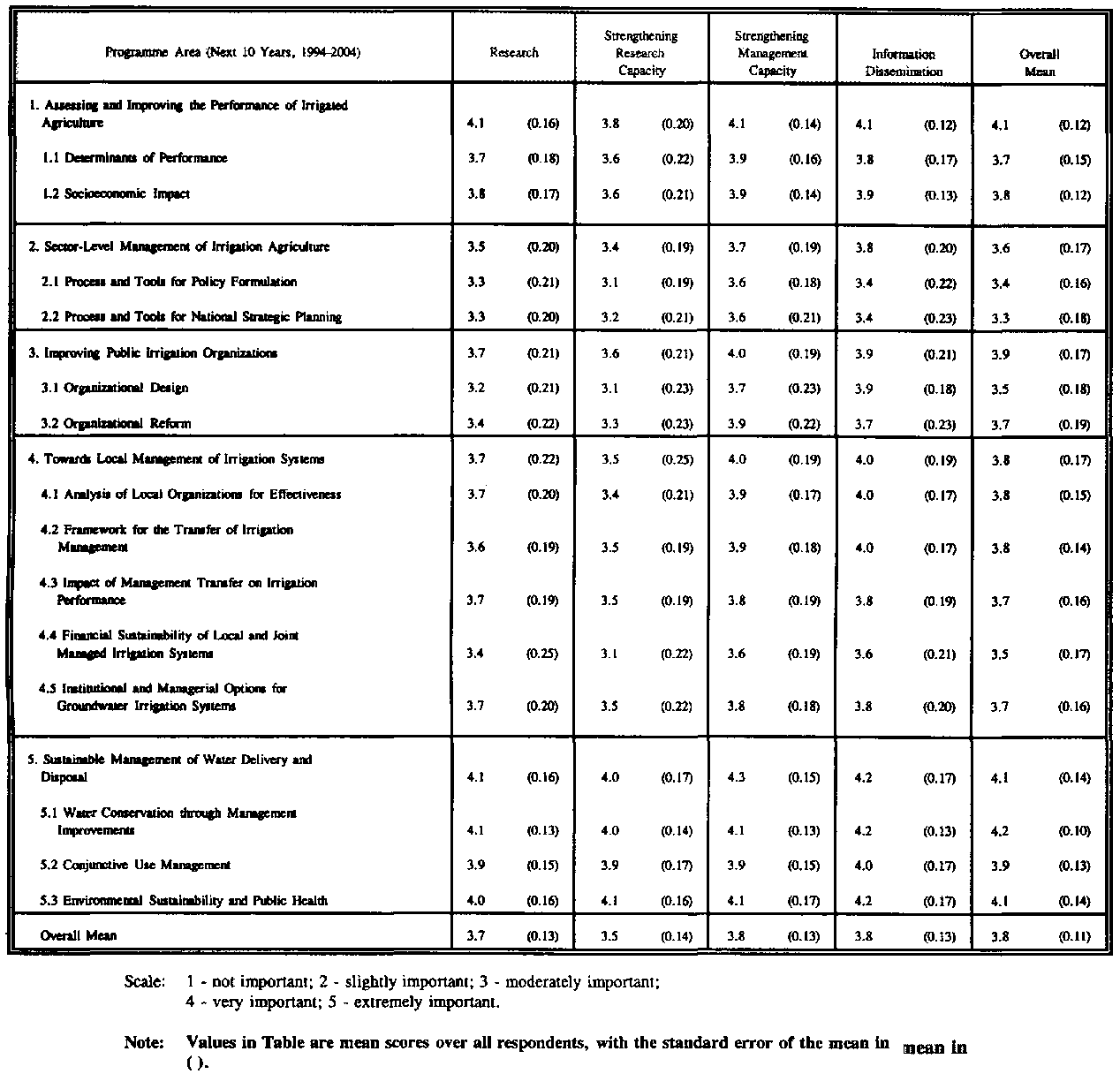
Response by programme area for each activity type (i.e., research, strengthening research capacity, strengthening management capacity, and information dissemination) for the past five years are summarized in Table 1, and for the next ten years in Table 2. Responses regarding the effectiveness of IIMI's collaboration, and IIMI's strategic and medium-term plans are presented in Table 3.
2.1 Numerical Evaluation
The score achieved for all IIMI's activities combined for the past five years (1989-93) was 3.0 (moderately valuable) (Table 1). Research, strengthening research capacity, strengthening management capacity, and information activities were considered more or less of equal value with mean overall scores of 3.0, 2.7, 3.2, and 3.0 respectively. In terms of specific programmes, activities related to management of water resources for irrigation, and to institutions for irrigation management were considered most valuable (mean overall scores of 3.2 and 3.1 respectively), and those related to management of financial resources for systems sustainability (2.6) the least valuable. Relatively higher value was given to research activities related to management of water resources for irrigation (mean score 3.2), management of irrigation facilities (3.0) and management of irrigation organizations (3.0). The lowest values were attached to research activities related to management of financial resources for system sustainability, and to management of irrigation support service to farmers (both 2.5 mean score).
Overall, researchers placed relatively less value than managers and policy makers on IIMI's activities (2.5 vs 3.1). However, researchers placed a particularly low value to activities related to management of financial resources for systems sustainability than managers and policy makers (1.5 vs 3.0).
The importance given to all IIMI's future (1994-2003) activities combined was higher than the value during the past five years (overall mean scores of 3.8 vs 3.1) (Tables 1 and 2). All individual future research activities were valued higher than the value during the past five years: research, mean score 3.8 vs 3.0; strengthening research capacity, 3.5 vs 2.7; strengthening management capacity, 3.9 vs 3.2; information dissemination, 3.8 vs 3.2. At the programme level, the greatest future importance was placed on the activities related to assessing and improving the performance of irrigated agriculture and to sustainable management of water delivery and disposal (both 4.1 overall mean score). At the programme activity level, the highest importance was given to activities related to water conservation through management improvements and to environmental sustainability and public health (both 4.2 mean overall score). All other programme activities received a score between 3.4 and less than 4.0 (moderately valuable to very valuable).
Respondents rated the value of networks to be close to very valuable (3.9) (Table 3), with the researchers placing a higher value to networks (4.4) than managers and policy-makers (3.8). Similarly, respondents from Asia placed a higher value (4.3) than respondents from outside Asia (3.6) to the value of networks. The different activities of country projects were rated about same in importance (3.5 to 3.8). There was better than moderate agreement (3.3) with the statement "that IIMI had a sound long-term strategy and clearly defined priorities". The respondents were moderately satisfied (3.1) with IIMI's interactions during its last strategic and medium-term planning exercises.
2.2 Respondent's Comments
Respondent's comments provide further supplementary insights to some of the trends summarized above. Three-quarters of the respondents considered that the recent change in mission from "irrigation systems" to "irrigated agriculture" was appropriate. Some felt the change to be forward-looking, in line with the needs of a changing world, and allowed better integration between management and production.
Responses to the question whether "IIMI has a sound long-term strategy and clearly defined priorities" were mixed, and so were the responses to the question regarding how satisfactory were "IIMI's interactions during the strategic and medium-term planning exercise".
Most respondents considered IIMI to have a variety of strengths including: being an international organization that is dedicated to irrigation management research and related activities; having experienced and good quality international staff; the possibility of conducting research of transnational value and its potential for international impact; physical country-level presence; and networking. Weaknesses included: its relatively small size; limited budget and operational base; lack of sustained country presence; slow in generating impact; and information dissemination and communications.
The following is a selection of comments to indicate how the respondents view IIMI's major contributions to their countries, and to note some interesting individual comments.
· "Getting Irrigation Department to develop a "culture" for research in irrigation management" (South Asia).· "IIMI has made a fair contribution in promoting participatory management of irrigation systems and to a limited scale the improving of water use technology and productivity" (South Asia).
· "Right now there is a growing awareness that irrigation performance can be improved" (sub-Saharan Africa).
· "IIMI has played a major role in pointing out major weaknesses in existing management of irrigation system in the country. It has focused on O & M issues, water conservation/use, irrigation system's reliability and equity in water distribution, cropping pattern and to some extent on institutional issues" (South Asia).
· "Awareness, realization and need for improved management of irrigation systems, training and dissemination of knowledge" (Asia).
· "Has stimulated thinking on the problems of irrigated agriculture" (sub-Saharan Africa).
· "Research on use of diversification, and creation of the national committee on crop diversification" (Southeast Asia).
· "Research findings on the farm level and farmers organizations" (West Asia).
· "Establishing relations with the organizations working in irrigated agriculture; and identifying some of the major problems facing irrigation management with special attention to two of our big schemes" (sub-Saharan Africa).
· "Conducting training needs exercises, workshops, training of trainers, developing curriculum and launching training programmes on irrigation systems management. Conducting workshops and round table discussions on strategic research on irrigation systems management (Southeast Asia).
· "An international seminar on measurement of performance of irrigation systems administered by farmers" (South America).
Table 1. Evaluations of IIMI's Past Programme Themes, 1989 - 1993
|
Programme Themes |
Research |
Strengthening |
Strengthening |
Information |
Overall |
|
1. Institutions for Irrigation Management |
2.9 (0.22) |
2.7 (0.23) |
3.3 (0.22) |
3.4(0.16) |
3.1 (0.16) |
|
2. Management of Water Resources for Irrigation |
3.2 (0.20) |
3.2 (0.22) |
3.2 (0.23) |
3.3 (0.19) |
3.2 (0.18) |
|
3. Management of Financial Resources for Systems Sustainability |
2.5 (0.26) |
2.5 (0.31) |
2.7 (0.30) |
2.4 (0.24) |
2.6 (0.27) |
|
4. Management of Irrigation Facilities |
3.0 (0.24) |
2.7 (0.24) |
3.0 (0.24) |
2.9 (0.23) |
3.0 (0.20) |
|
5. Management of Irrigation Organization |
3.0 (0.21) |
2.8 (0.23) |
3.2 (0.23) |
3.0 (0.21) |
3.0 (0.18) |
|
6. Management of Irrigation Support Services to Farmers |
2.5 (0.23) |
2.4 (0.23) |
3.1 (0.25) |
3.1 (0.24) |
2.9 (0.21) |
|
7. Management of Change in the Institutions for Irrigation |
2.6 (0.24) |
2.6 (0.25) |
2.9 (0.27) |
3.0 (0.22) |
2.9 (0.20) |
|
Overall Mean |
3.0 (0.16) |
2.7 (0.17) |
3.2 (0.17) |
3.0 (0.15) |
3.00 (0.14) |
Scale: 1 - not valuable; 2 - slightly valuable; 3 - moderately valuable; 4 - very valuable; 5 - extremely valuableNote: Values in table are mean scores over all responses, with the standard error of the mean in ().
Table 2. Evaluation of IIMI's Future Activities, 1994-2003
Table 3. Evaluation of Effectiveness of Collaboration, Agreement with IIMI's changed Mission Statement, and Extent of Interactions with National Collaborators
|
|
mean |
se |
Scales |
||
|
1. NETWORKS |
3.9 |
0.17 |
1 = not valuable |
||
|
|
|
2 = slightly valuable |
|||
|
|
|
3 = moderately valuable |
|||
|
|
|
4 = very valuable |
|||
|
|
|
5 = extremely valuable |
|||
|
2. COUNTRY PROJECTS |
3.6 |
0.14 |
1 = not valuable |
||
|
|
|
2 = slightly valuable |
|||
|
|
2.1 Strengthening Research Capacity |
3.7 |
0.17 |
3 = moderately valuable |
|
|
2.2 Strengthening Management Capacity |
|
|
4 = very valuable |
||
|
|
|
|
5 = extremely valuable |
||
|
|
(a) Organizational Development |
3.6 |
0.19 |
|
|
|
|
(b) Professional Development |
3.8 |
0.16 |
|
|
|
2.3 Information Dissemination |
3.6 |
0.20 |
|
||
|
2.4 Strategies and Long Term Planning |
3.5 |
0.20 |
|
||
|
3. IIMI'S MISSION STATEMENT |
3.3 |
0.15 |
1 = do not agree |
||
|
|
|
2 = slightly agree |
|||
|
|
|
3 = moderately agree |
|||
|
|
|
4 = mostly agree |
|||
|
|
|
5 = completely agree |
|||
|
4. IIMI'S INTERACTIONS WITH ESPONDENTS' ORGANIZATIONS DURING THE LAST MTP PLANNING EXERCISE |
3.1 |
0.18 |
1 = not satisfactory |
||
|
|
|
2 = slightly satisfactory |
|||
|
|
|
3 = moderately satisfactory |
|||
|
|
|
4 = very satisfactory |
|||
|
|
|
5 = extremely satisfactory |
|||