1.1 Origin, Mandate and Role of ICARDA in Arid Land Agriculture
1.2 ICARDA's Strategy
1.3 ICARDA Today
Readers familiar with ICARDA and its history should skip to section 1.3, or take up aspects of the core review in one of the three following chapters dealing, respectively, with (chapter 2) the research program, (chapter 3) research-related programs and (chapter 4) organization and management issues. Chapter 5 is concerned with the Review itself and related review processes.
The genesis of ICARDA has been comprehensively described in the Center's 1989 strategy Sustainable Agriculture for the Dry Lands. A few pertinent developments are presented here. Formal discussions on the establishment of a CGIAR-sponsored international center to conduct research on arid land agriculture commenced in 1972 when TAC commissioned a study of the research needs and priorities of countries in the Near East and North Africa (TAC 1973). The CGIAR in 1975 appointed IDRC as an executing agency to establish ICARDA. In January 1977, it was established as an IARC to undertake research relevant to the development needs of agriculture in West Asia, the Middle East and North Africa, taking over the activities of the existing Arid Lands Agricultural Development (ALAD) Program.
Initially it was envisaged that ICARDA would have its headquarters in Beirut, a main station in the Beka'a Valley and sub-stations in Aleppo, Syria (low altitude arid lands) and Tabriz, Iran (arid highlands). As a consequence of political disruption in the region, this original plan was not realized and in 1981 ICARDA moved its headquarters to Aleppo. Since then it has developed the Tel Hadya farm as its major research base from which it directs and supports its outreach research activities in North Africa, the Middle East and West Asia.
ICARDA's Charter entrusts it with "promoting improved and more productive agriculture in less-developed countries having a dry subtropical or temperate climate, through research and training activities conducted primarily in the countries of the Near East and North Africa and the Mediterranean region, in order to raise the standard of living and promote the social, economic and nutritional well-being of developing countries" (p. 3). Within this broad mandate, ICARDA was, at the international level, to conduct research on the improvement of barley, lentil and faba bean to which are added, at the regional level, wheat and chickpea. Research in animal husbandry was to be an integral component of ICARDA's mandate. ICARDA has interpreted its mandate in the context of the physical and social environments of its region and the challenges they pose.
ICARDA exists to meet the challenge posed by a harsh, stressful and variable environment in which the productivity of primarily rainfed agricultural systems must be increased to higher sustainable levels, and in which land degradation must be arrested and possibly reversed. ICARDA addresses this challenge through research, training and the dissemination of information in partnership with the national agricultural research and development systems.
The inherent challenge in ICARDA's mandate is demanding. The land resources in the region are of low potential and fragile. It has been estimated that only 8% of the region's 1.7 billion ha are arable, and that desert and semi-desert (steppe) constitute 70% of the area. The scope to expand the land area under crop production is limited. Irrigated land (35 million ha) amounts to a mere 2% of WANA's total area, but constitutes 27% of its arable land.
1.2.1 The Agroecological Thrust
1.2.2 The Commodity Thrust
1.2.3 The Activity Thrust
1.2.4 Institutional Linkages
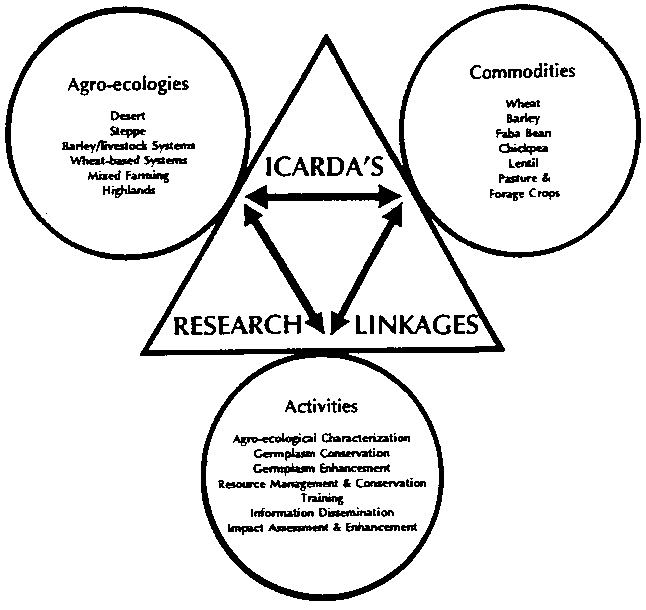
ICARDA's initial strategy focused primarily on the description, quantification and evaluation of the physical, biological and socioeconomic problems that determine and/or constrain agricultural production systems in the WANA region. Against this background and following extensive discussions with its main clients, the NARSs of the region, ICARDA formulated its long-term strategy following the Second EPR and EMR (ICARDA 1989). In its preparation, ICARDA was particularly conscious of the needs of its main target beneficiaries, the small-scale farmers in the region. The Center also took note of TAC studies on CGIAR priorities and strategies for agricultural research and the emerging concept of ecoregionality then under early discussion on the international research agenda. In the final analysis, ICARDA adopted a tri-modal strategy to encompass agroecological and commodity thrusts on which it has developed a set of seven activity thrusts. The elements of the agroecological, commodity and activity thrusts are presented in Figure 1.1.
Figure 1.1 An overview of ICARDA's thrusts and their supposed linkages
ICARDA's multi-disciplinary, multi-commodity mandate implies, almost by definition, an ecoregional approach to research. TAC coined the term 'ecoregion' to describe agroecological zones, regionally defined (TAC/Center Directors Working Group 1993). Within the WANA region ICARDA has identified five major zones, namely (a) deserts, (b) steppe and native pastures, (c) the barley/livestock zone, (d) the wheat-based system and (e) the highlands. The zones are primarily associated with different rainfall bands and, for the highlands, with climatic conditions associated with high altitude.
Deserts
Approximately 70% of the WANA region is true desert land, including the Sahara of North Africa, a vast expanse of Saudi Arabia and large parts of Iran and Pakistan. In these areas only irrigated agriculture and nomadic grazing are possible, and these have been largely excluded from ICARDA's mandate. This zone has consequently received little attention in the Center's work program.
Steppe and Native Pastures
Steppe land occupies most of the land in the region where annual rainfall is below 200 mm. These areas are used primarily for the communal grazing of small ruminants and camels and rarely support livestock on a year-round basis. Hence production systems that utilize these areas are generally integrated with the adjacent barley/livestock or wheat-based zones. Both land types and particularly the drier steppe areas are showing evidence of severe degradation. ICARDA's approach to these areas is to try to stimulate the communal development of improved livestock management systems so as to halt further environmental degradation. The main thrust of its work in this context is to develop simple low-cost technologies that will encourage the more effective utilization of by-product feeds (straw and crop residue grazing) in the adjacent croplands in conjunction with seasonally controlled grazing of the steppe. ICARDA has not attached high priority to this zone on the understanding that research on land areas in the region with less than 200 mm annual rainfall falls largely within the remit of ACSAD.
The Barley/Livestock Zone
In areas adjacent to the steppe with annual rainfall ranging from 200 to 350 mm, the predominant farming system is the integrated production of barley, sheep and goats; wheat is also grown in some areas. As regards barley, both straw and grain are used for livestock feed and, as livestock numbers increase, there is a tendency to put more and more marginal land under barley and to abandon the traditional barley/fallow rotation. Much of ICARDA's work on germplasm (barley) conservation and enhancement, on barley/fallow rotations, on feed legumes and on small ruminant production has direct relevance to this zone.
The Wheat-Based System
Wheat is the predominant crop in areas with a rainfall between 350 and 600 mm per annum. Bread wheat is most common above 450 mm. Elsewhere, durum wheat predominates. Wheat/fallow and wheat/food legume rotations are commonly practiced in this zone. Among the legumes, chickpea predominates in the wetter areas and lentils in the drier. Summer crops such as melon are also grown. Supplementary irrigation of summer and winter crops is considered profitable and is becoming increasingly common where appropriate water supplies (dams or rivers) exist. ICARDA attaches high priority to this area and the main focus of its genetic and agronomic research on wheat, food and feed legumes and livestock is directly relevant to this zone. ICARDA considers that its interaction with NARSs and the uptake of new technologies are most effective in this zone.
The Highlands
Plateaux, at altitudes of over 1000 m, constitute approximately 40% of the agricultural land in the WANA region and contribute about 30% of production output. These areas are subject to extremes of summer heat and cold winters and much of the highlands zone may be regularly snow covered for up to four months a year. Annual rainfall ranges from 200 to 600 mm. Soils are generally low in organic matter, high in pH and soil erosion is widespread. Production systems are heavily oriented towards livestock production and winter cereals (wheat and barley). ICARDA considers that the highlands have considerable potential for development, although their remoteness is a major constraint. Thus far, with the exception of its outreach program in Pakistan (Balochistan plateaux), ICARDA has not been in a position to develop a broad-based highlands research program. The Center plans to reverse this situation in the near future through the expansion of its outreach activities in Turkey and Iran.
The major commodities that the ICARDA research program addresses are the cereal crops, wheat and barley, the food legumes, chickpea and lentil, and livestock production based on pasture and forage crops. Earlier work on faba bean has been devolved to the NARSs of North Africa. Whereas the Center attaches primary attention to these mandated commodities, it also proposes undertaking limited "collaborative work" with other advanced research institutes on a number of oil and vegetable crops, including brassicas, safflower, sesame and sunflower to evaluate their possible contribution to the development of agricultural production in the WANA region.
Cereal Crops
Following the 1983 QQR, work on wheat at ICARDA was recognized as a regional activity of CIMMYT, with a seconded breeder working on spring bread wheat in Syria, a durum breeder also located at Tel Hadya and a joint CIMMYT/ICARDA breeder of facultative wheat dividing his activities between Ankara, Turkey and Tel Hadya. At the same time, the global mandate for barley was assigned to ICARDA with an outreach program for Latin America located in Mexico. The barley crop is assuming greater significance in ICARDA's role in the low-rainfall areas of the WANA region, with particular emphasis on drought tolerance and straw quality for feed.
Food Legumes
ICARDA attached high priority to faba bean research in its early years but, following TAC's recommendation arising from the Second EPR of the Center, it has now devolved this research program to the NARSs of North Africa where the bulk of this crop is grown. In contrast, ICARDA now attaches highest priority to chickpea, grown mainly as a pulse in the wetter areas within the region. The main focus of the work is on tolerance of abiotic stresses and resistance to pests and diseases. The Center also attaches importance to research on lentils and, in particular, to the genetic improvement of this crop. Its superior drought tolerance, coupled with the potential of lentil residue as livestock feed, identifies this crop as potentially important to the future development of crop-livestock systems in the drier areas within the WANA region.
Pasture and Forage Crops
The importance of livestock production in the WANA region dictates that ICARDA should attach high priority to livestock feed production. Emphasis to date has been placed on the breeding of forage and pasture legumes and the agronomic challenge of incorporating forage legumes, principally medics, in the barley/fallow rotation. Within its resource management and characterization program, ICARDA is monitoring the effects of overgrazing of the steppe and has undertaken limited work on the introduction of drought-tolerant non-leguminous shrubs in the arid highlands. ICARDA's work that is directly focused on livestock production is rather limited. In recent years, the Center has initiated a modest program on animal nutrition and in an even more minor way on animal health. In the Center's Strategic Plan, and as recommended in the 1988 EPR, there are, however, strong reasons advanced to justify increased attention to livestock research within the ICARDA program.
In order to collate the research foci of the agroecological and commodity thrusts in programmatic terms and in reference to CGIAR-defined activities, ICARDA has identified a set of seven research-related activities, namely, (a) agroecological characterization, (b) germplasm conservation, (c) germplasm enhancement, (d) farm resource management, (e) impact assessment and enhancement, (f) training and networking and (g) information dissemination.
Agroecological Characterization
ICARDA, in conjunction with NARSs, is developing methods to describe, quantify as appropriate and evaluate the agricultural resource potentials and constraints of different areas within the region, with due emphasis on environmental impact assessment. This activity necessarily embraces research on climatic factors, the quantification of soil/plant/animal interactions within the farming system and the evaluation of the economic and social dimensions of agricultural development within the area. ICARDA's research strategy in this activity is still evolving and to date has largely concentrated on climatic factors as they affect plant growth.
Germplasm Conservation
ICARDA's germplasm conservation activity is part of a worldwide program, coordinated by IBPGR, aimed at describing, preserving and, as appropriate, utilizing global plant genetic resources. Within this global genebank, ICARDA serves as a repository for barley, lentil, faba bean and chickpea germplasm. ICARDA attaches high priority to this work, even though it represents only a small component of the Center's program.
Germplasm Enhancement
This is ICARDA's largest single activity. Its objective is the genetic improvement of yield and yield stability of barley, wheat, lentil, chickpea and pasture/forage legumes, primarily for the WANA region. Three principles determine ICARDA's approach to germplasm enhancement - (a) yield stability under climatic stress, (b) yield advantage in low-input management systems and (c) adaptation to specific local environments. ICARDA makes strategic use of advances in biotechnology emerging from other advanced institutes, particularly as regards methods to identify genetic, physiological and biochemical parameters of abiotic stress tolerance and pest/disease resistance. The Center's work on wheat and chickpea is conducted in close collaboration with CIMMYT and ICRISAT, respectively.
Farm Resource Management
ICARDA seeks through this program activity to better understand and enhance the management of soils, water, soil nutrients, plants and animals so as to optimize sustainable output of the respective farming systems. It is ICARDA's strategy to focus primarily on the most vulnerable barley-livestock and highland mixed farming systems. ICARDA has developed a five-pronged approach to this research activity. This includes (a) testing new germplasm from ICARDA/NARSs breeding programs with emphasis on defining the conditions relevant to their environmental and economic success, (b) agronomic studies aimed at improving the farming system, (c) the study of soil erosion, water-use efficiency and the more efficient use of fertilizer inputs, (d) the development of sustainable integrated crop-livestock systems and (e) the more efficient management of livestock under communal grazing systems.
Impact Assessment
The monitoring of the environmental and socioeconomic impact of new technologies introduced as a result of ICARDA/NARSs' research is central to ICARDA's research strategy. This research embraces the development of methods to measure environmental impact, on-farm evaluation of socioeconomic factors that affect uptake of new technology and, in selected areas, a review of government policy measures that have a bearing on the stimulation or otherwise of advances in agricultural production. The latter studies logically involve inter-center collaboration with IFPRI.
Training and Information
Superimposed on each of the five activities referred to above, ICARDA attaches high priority to training and the dissemination of information. The Center has developed a comprehensive training program based on formal on-campus training courses at Aleppo and on-site training for NARSs and other clients involving seminars, travelling workshops, networking and hands-on training in the field, as a major component of the Center's outreach program. In support of this training program, ICARDA attaches high priority to the development of effective training materials and the dissemination of information suited to its target audiences. At the international level, ICARDA places high priority on publication in refereed journals of scientific papers by its professional research staff.
ICARDA from its beginning, has placed high priority on developing close linkages with its main partners and clients, the NARSs of the region. In recent years, the nature of these linkages has changed considerably. Whereas initially ICARDA's policy was to provide technical support to the NARSs, in recent years the Center's strategy has been re-oriented to seek to develop collaborative research programs with them on an equal-partnership basis. Following the devolution of the faba bean program to the NARSs of North Africa, ICARDA plans to identify lead national programs to take on regional or sub-regional responsibilities for specific research programs for which they have appropriate expertise. Increasingly, collaborative research is being conducted through networks and research consortia as well as through contracts with research organizations and individual scientists.
The emerging ecoregional approach also offers opportunity and encouragement for greater cooperation among the international research centers. As an agroecologically focused regional Center, ICARDA is in a good position to host joint inter-center collaborative (ecoregional) programs in the WANA region. Such programs and the implicit interconnections with the NARSs are of such significance for contemporary assessment and future direction that they are the subject of attention at many points in this Review. ICARDA also seeks active collaboration with regional, international and specialized research institutes in the more-developed world, especially in strategic upstream research that is highly specialized and for which the Center has no comparative advantage. Whilst surely important, these activities are not subject to such close scrutiny in what follows.
The long-term strategy described above became operational in ICARDA's Medium-Term Plan (MTP) 1990-94, which has formed the basis for the Center's current program. The Plan was developed in the late 1980s, in a time of financial growth, and anticipated that, by 1993, ICARDA's budget would grow (from US$24.1 million in 1988) to US$43.0 million, and the senior staff component would expand (from 64 in 1988) to 87. This has not been the case.
Currently, ICARDA is working on the assumption of a 1993 budget of US$19.3 million, below the 1992 total of US$20.6 million, and in real terms a significant decline from the late 1980s. Staff changes accompanying the budget decline follow in Table 1.1, and show a notable decline in Administration. While the total for international staff (P and RA2/RA3) has remained constant at 98, this has been achieved by a reduction of senior (P-level) staff (along with some reduction in the number of post-doctoral appointees).
Table 1.1 ICARDA staff, 1988 and 1993
|
|
Research |
Research Support |
Administration |
Total |
|
1988 |
|
|
|
|
|
P |
46 |
13 |
5 |
64 |
|
RA2/RA3 |
11 |
4 |
19 |
34 |
|
GSS |
220 |
126 |
247 |
593 |
|
1993 |
|
|
|
|
|
P |
44 |
10 |
6 |
60 |
|
RA2/RA3 |
10 |
13 |
15 |
38 |
|
GSS |
226 |
134 |
153 |
513 |
Source: ICARDA Personnel Office.
ICARDA's financial condition and budget strategy are discussed further in section 4.5.1.1, while sections 4.5.2.4 and 4.5.3.1 address several aspects of staffing.
The 611 staff currently employed by ICARDA represent 39 nationalities. International staff are from 30 different countries - about one-half from developed and one-half from less-developed nations, with just over one-fifth of the total from WANA.
The majority of international research staff are stationed in Aleppo. Currently ten are outposted in the region across the six outreach programs (section 3.3.1). This is a significant decline since 1988, when 15 research staff were outposted.
The median age of internationally recruited research staff is 46 years and median tenure is seven years, which in general terms is about as is to be expected in a Center such as ICARDA. Turnover has been at a reasonable level (section 4.5.2.7) in recent years for this and other groups of staff overall.
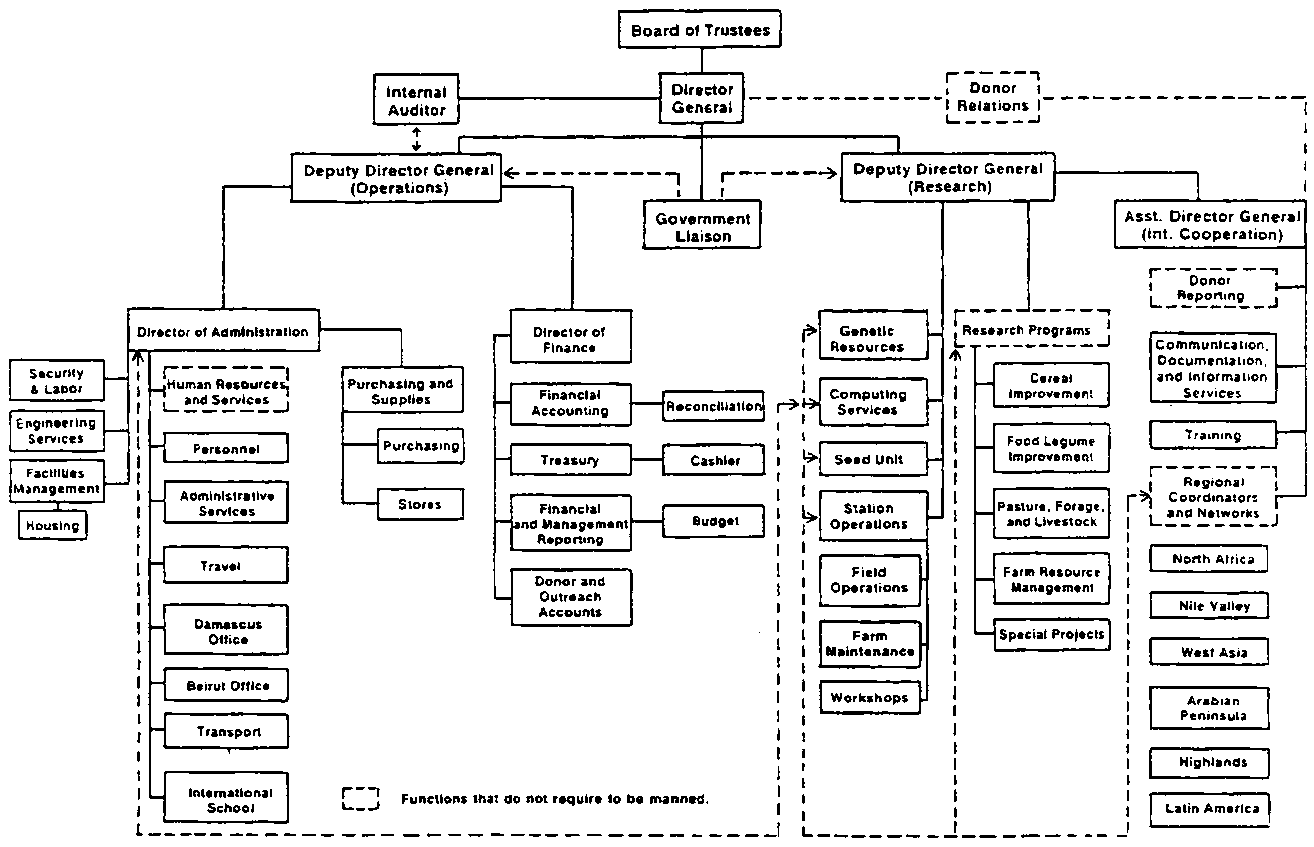
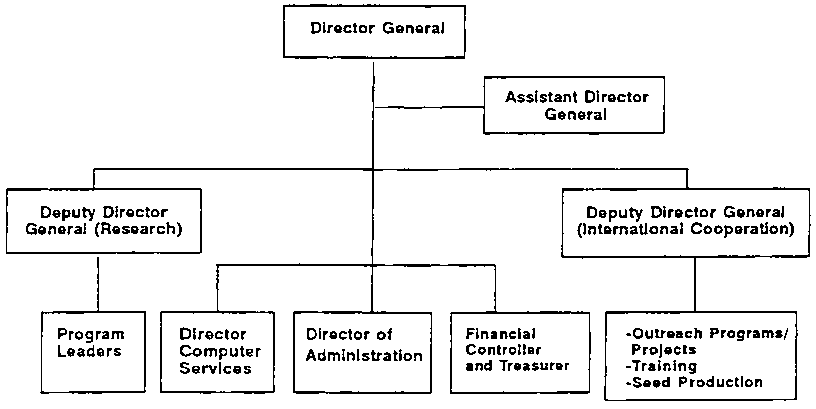
ICARDA's organizational structure is shown in Figure 1.2. Two main branches report to the Director General - Research and Operations. Figure 1.3 shows how ICARDA was structured in 1988, when Deputies headed Research and International Cooperation, and there were three Directors of administrative operations who also reported directly to the DG. In response to the 1988 external reviews, ICARDA's operational units were consolidated below a Deputy Director General of Operations, and International Cooperation was moved into the Research structure. In addition, a position of Assistant Director General of Government Liaison was created. Sections 4.2 and 4.4 address issues of management and research structure.
Figure 1.2 ICARDA organization - as at April 1992
Figure 1.3 ICARDA organization in 1988