Appendix 1: Terms of Reference for the Third External Program and Management Review of ICARDA
Appendix 2: Panel Composition and Bibliographical Information
Appendix 3: List of Persons and Institutions Contacted
Appendix 4: Survey of ICARDA Clients: Assessment of Past Performance and Future Needs
Appendix 5: Survey of ICARDA Research Staff: Questionnaire
Appendix 6: Survey of ICARDA Research Staff Summary of Responses
Appendix 7: An Agroecological Approach to Research Current Philosophy, Organization and Future Scenarios - A Concept
Appendix 8: Assessment of ICARDA's Response to the Recommendations of the 1988 External Program Review
Background
The Consultative Group on International Agricultural Research (CGIAR) has charged its Technical Advisory Committee (TAC) with the responsibility of conducting External Program Reviews (EPRs) of those International Agricultural Research Centers (Centers) that it supports financially. The CGIAR has assigned a similar responsibility to its Secretariat for External Management Reviews (EMRs).
TAC and the CGIAR Secretariat normally discharge these responsibilities by commissioning either separate panels or a joint panel to conduct the reviews. In commissioning panels, neither TAC nor the CGIAR Secretariat delegates its responsibility for reviews, but both use panels to facilitate the process. Panels submit their reports for consideration by TAC and the CGIAR Secretariat before they are transmitted to the CGIAR. While the main recommendations made by panels are normally endorsed both by TAC and the CGIAR, such endorsement cannot be presumed by either the panels or the Center under review. Equally, as autonomous institutions. Centers are not obliged to implement the endorsed recommendations. In practice, however, they usually implement most, if not all of them.
Purpose
Through its support of International Centers, the CGIAR aims to contribute to increasing sustainable crop, livestock, fish and tree production in developing countries in ways that improve the nutritional level and general economic well-being of low-income people. The purpose of external reviews is to help to ensure that the Centers continue to implement strategies and programs that are relevant to these goals; that they maintain or enhance their record of achievement; and that they are efficiently managed. In these ways, external reviews reinforce mechanisms of accountability within the System.
EPRs and EMRs are also essential components of the CGIAR's integrated planning process. The context in which they are undertaken is to be found in the document "Review Processes in the CGIAR."
The Review
Against this background, the panel is requested to make a thorough and independent appraisal of the Center and all its activities, following the broad topics below, as well as the appended list of questions and guidelines. Panels are encouraged to set their findings in the broader context of the CGIAR System, where this is relevant to the activity or program under review.
A. Recent Evolution of the Center
Important changes affecting the Center since the previous external review.
B. Mandate
The continuing appropriateness of the Center's mandate in relation to the mission and goals of the CGIAR.
C. Strategy and Programs
The policies and strategies of the Center, their coherence with CGIAR strategies, and the mechanisms used for monitoring and revising them.
The extent to which the Center's strategy is reflected in its current programs; the rationale for any proposed changes by the Center and their implications for future activities.
The quality of current programs and activities.
D. Center Guidance, Values and Culture
The overall effectiveness of the Center's Board of Trustees in governing the Center, and the effectiveness of leadership throughout the Center.
The Center's guiding values and culture, and their influence on the Center's performance.
E. Program Organization and Management
The mechanisms in place at the Center to ensure the excellence of the programs and cost-effective use of resources.
The adequacy of the Center's organizational structure, and the mechanisms it uses to manage and coordinate its research programs and related activities.
F. Resources and Facilities, and their Management
The financial resources available to the Center in relation to its present and future programs.
The land, laboratories and services available for supporting the programs.
The Center's human resources.
The Center's information resources and facilities.
G. External Relationships
The Center's relationships with national research systems1 in developing countries.
1 National research systems include all those institutions in the public and private sectors, including universities, that are potentially capable of contributing to research related to the development of agriculture, forestry and fisheries.
Collaboration with advanced institutions in research and training, in both the public and private sectors.
Collaboration with other CGIAR Centers and international agricultural research institutions, and undesirable overlap of activities.
The Center's relationships with the government of its host country or countries and with institutions therein.
H. Achievements and Impact
The Center's overall impact, its contribution to the achievement of the mission and goals of the CGIAR, and the methods used for making such assessments.
Recent achievements of the Center in research and other activities.
The potential of the Center's current and planned activities for future impact.
The Report and Recommendations
Panels are requested to prepare succinct reports in plain language (understandable to nontechnical readers), in which factual material is kept to the minimum necessary to set the conclusions in context. Reports should include clear endorsements of the Center's activities where appropriate, as well as recommendations and suggestions for changes.
Recommendations should be justified by the analysis and approved by panel members. Recommendations for increases in staff or activities should be accompanied by analyses of their resource implications. Reports should be formally transmitted to the Chairman of TAC and the Executive Secretary of the CGIAR by panel Chairs.
List of Questions for External Reviews
These questions supplement the Terms of Reference and illustrate the types of question the panel should consider in each category. They apply to most, but not necessarily to all CGIAR Centers. In addition, TAC and the CGIAR Secretariat usually compile a short list of questions that are specific to the Center under review. In preparation for each review, the questions are circulated to the members of the CGIAR and the Center inviting them to comment and, if considered essential, to add supplementary questions. The panel is not required to answer all questions explicitly, but to take them into account in making its own assessment of the most important ones.
A. Recent Evolution of the Center
1. What important changes have taken place in the Center since the previous external review? What were the principal reasons for change? What are the likely effects of these changes on the future performance of the Center?2. How responsive was the Center to the previous review?
B. Mandate
3. How appropriate are the Center's operational mandate and mission statement in relation to the changing mission and goals of the CGIAR?4. How well do the present and planned activities of the Center relate to the mandate and the mission of the Center?
C. Strategy and Programs
5. Does the Center have an up-to-date and well-reasoned strategy statement? In particular, does it:(a) reflect a thorough understanding of the needs of the Center's principal clients and of the relevant activities of its partners and collaborators?
(b) take into account the major changes expected to occur in the Center's external environment?
(c) spell out the Center's aims and objectives in different program areas and provide a clear justification for them?
(d) take into account the Center's internal strengths and weaknesses and the financial constraints likely to be faced?
(e) provide a clear justification for the future scale of the Center's operations?
6. Are national authorities satisfied with the Center's strategy and did they have adequate opportunity to contribute to its formulation?
7. Does the Center's allocation of resources to its programs reflect the priorities appropriately? Are the planned directions and priorities within programs appropriate?
8. Does the Center's strategy sufficiently take into account the determinants of sustainable production, the alleviation of poverty and preservation of the quality of the environment?
9. Has the Center analyzed the operational implications of its future strategy and priorities in terms of finance, staff and other aspects?
10. How well is the Center's current strategy reflected in its programs and activities?
11. How successful has the Center been in reaching its major objectives in each major program area since the previous external review? Have the approaches adopted been the most appropriate for the problems to be solved? What has been the quality of the Center's work in each program area?
12. How effectively does the Center's training program meet the needs of national research systems?
13. How much attention has the Center paid to gender considerations in planning and implementing its program activities? Is this adequate?
14. Does the Center give appropriate attention to post-harvest technology?
15. Has the Center made adequate provisions from its core funds for work on genetic resources? How effectively is this work exploited for the benefit of developing countries?
D. Center Guidance. Values and Culture
16. Is the Center's legal status appropriate for fulfilling its mission?17. How effective has the Center's board been in determining policy and providing oversight? How effective has it been in managing its internal affairs (e.g., planning, internal board structure, member selection and development, managing meetings, etc.)?
18. Are board-management relationships based on openness, respect for each other's roles, and mutual trust? Does the board regularly assess and provide feedback on the performance of the director general on the basis of explicit and objective criteria?
19. How effectively has the Center been led by the director general and the management team since the previous external review? How well do senior managers work as a team?
20. What principal guiding philosophies appear to shape the action of the board, management and staff? Are they conducive to high performance? (Among others, consider attitudes towards creativity, accountability, efficiency, and organizational change.)
21. What are the main features of the Center's current organizational culture? Do aspects of this culture serve as barriers to performance? Is the Center's organizational culture in harmony with its strategy, structure and management practices?
E. Program Organization and Management
22. Has the Center developed an organizational structure suited to good program performance? What coordination mechanisms are in place? Are they effective? Are there alternative structures that could serve the Center better in the future in the light of the Center's strategy?23. How effectively are the Center's decentralized activities linked with those at the headquarters? Do the staff outside the headquarters have adequate opportunities to contribute to overall planning and decision making?
24. How effective are the Center's strategic and operational (i.e. medium term and annual) planning processes? How well are they linked to budgeting? Do these processes ensure sufficient consideration of the views of the Center's clients and other key stakeholders?
25. Does the Center have an effective planning and management system for projects or activities?
26. How effective are the Center's program monitoring and internal review systems and processes? Does the Center have an effective peer review or a similar quality control process?
27. Do staff work effectively in teams? Do the structure and operating procedures of work-groups facilitate cooperation and teamwork?
28. Do the Center's program organization and management processes ensure efficiency and internal accountability? Are they conducive to innovation?
F. Resources and Facilities
29. How effective has the Center been in organizing, staffing and managing its human, financial, administrative and information resources?
Human Resources
30. Has the Center been able to attract and retain international and local staff of the highest calibre? Is the turnover rate one that ensures program continuity as well as healthy infusion of new staff into programs?31. Does the Center have appropriate personnel policies for international and local staff stationed at the headquarters and outside it? Are they seen to be fair and consistent? (Consider policies for staff recruitment, orientation, compensation, performance planning and assessment, career development, tenure, spouse employment, retirement, etc.)
32. Does the Center actively promote recruitment, retention and career development of women? Are there barriers to women's advancement in the Center?
33. How successful are managers and supervisors in managing people? In particular, how skilful are they in planning, coordinating and delegating work, communicating effectively, and motivating, developing and rewarding staff?
34. How satisfied are staff at all levels with their jobs? How are morale, trust, communication and teamwork perceived among the staff?
Finance
35. How successful has the Center been in securing funds for its activities? How stable is the Center's funding? Does the Center have a fund-raising strategy, and how effectively is fund-raising managed?36. Does the proportion of the Center's budget received as restricted funding distort the Center's strategy and the priorities accorded to its various activities?
37. How effective are the systems and processes used for financial management of headquarters and field operations? (Consider financial planning, analysis, reporting and control, accounting, budgeting, internal and external auditing, and cash and currency management.)
38. How strongly is financial management linked with program management? How much financial responsibility do the program staff have?
Administration
39. How successful has the Center been in establishing an administrative infrastructure that meets the needs of staff in an efficient manner?40. How cost-effective are the systems and policies used for managing the Center's:
- property (e.g., maintenance, development, construction, rental);- general services (e.g., security, housing and dormitories, food services, transport, travel services);
- procurement operations (e.g., foreign and local purchasing, receiving, stores)?
Information
41. How successful is the Center in acquiring, generating and managing the information it needs for decision-making, communication and integration of activities?42. How effectively are information services and technology managed? (Consider computerization, telecommunications, records management, archives, library, and documentation.)
G. External Relationships
43. How successful has the Center been in managing its relations with:- clients in developing countries;- institutions in the host country of its headquarters and of its substations in other countries;
- public and private sector institutions in developed and developing countries (including other CGIAR centers);
- donors, the CGIAR and TAC;
- the media and the general public?
44. Is the Center's strategy for collaboration with national research systems appropriate considering the sizes and stages of development of these systems? Are the priorities for collaborative work accorded to individual countries (in particular, the host country) appropriate? Does the Center actively promote a strategy of collaboration in international research with national systems and regional research organizations?
H. Achievements and Impact
45. What mechanisms does the Center have in place to monitor its achievements and impact? Are these adequate?46. How does the need to demonstrate impact influence the Center's priorities and strategies? Is there a tendency for long-term consideration to be sacrificed for short-term gains?
47. What have been the most notable achievements of the Center since the previous external review?
48. What benefits have developing countries derived from the Center's work since the previous review? What contributions has the Center made to strengthening national research systems through training, institution building, collaborative research and technical assistance?
49. What is the Center's potential for further impact, given its planned activities? Do these justify continued donor support for the Center? Is there a case for increasing the Center's funding level? Could funding be reduced without seriously affecting the Center's potential for further impact?
I. List of Supplementary Questions
1. Should ICARDA's role and mandate be reassessed at this stage in light of the very significant changes in Eastern Europe and Central Asia?2. In view of the rapidly increasing food deficit in the WANA region, should ICARDA's mandate be broadened to include irrigated agricultural production systems?
3. What is the current status of ICARDA's research program on broad (faba) bean in reference to TAC's recommendation (1988) that this program (with the exception of germplasm collection) should be phased out by 1992?
4. What is the outcome of ICARDA's in-depth cost\benefit analysis of research on lentil as recommended by the 1988 EPR and endorsed by TAC?
5. How does the Center justify its low allocation of resources to livestock research relative to its high investment in food legumes in view of the importance of livestock in the region, as highlighted in ICARDA's Strategic Plan?
6. Does the Center undertake socioeconomic research to underpin its research prioritization work and to strengthen its research planning mechanisms, its evaluation of research findings, technology transfer and impact assessment?
ICARDA External Review Team
Dr. Jock R. Anderson (Chair)
Agriculture and Natural Resources Department
World Bank
1818 H Street, N.W.
Washington, D.C. 20433
Dr. Adel S. El-Beltagy
First Undersecretary for Land Reclamation
Ministry of Agriculture and Land Reclamation
Cairo, Egypt
Dr. Kurt Finsterbusch
Department of Sociology
University of Maryland
College Park, Maryland 20742
Mr. Graham Jenkins
PBI Cambridge
Maris Lane
Trumpington
Cambridge CB2 2LQ
England
Dr. Peter Trutmann
Department of Plant Pathology
Cornell University
334 Plant Science Building
Ithaca, New York 14853-5908
Mr. William Carlson (initial phase)
4620 Butterworth Place, N.W.
Washington, D.C. 20016
Dr. John McIntire (initial phase)
Senior Agricultural Economist, Rm I 7107
World Bank
1818 H Street, N.W.
Washington, D.C. 20433
Ms. Elizabeth Field
CGIAR Secretariat, Rm N 5061
World Bank
1818 H Street, N.W.
Washington, D.C. 20433
Dr. Vivian Timon
TAC Secretariat/FAO
Via delle Terme di Caracalla
Rome 00100, Italy
Jock R. Anderson
Jock Anderson is an Australian agriculturalist, Emeritus Professor of Agricultural Economics at the University of New England, Armidale N.S.W., presently serving as a Principal Economist in the World Bank's Vice-Presidency for Environmentally Sustainable Development. He has worked for and with many elements of the CGIAR system, including in 1984-5 as Director of the CGIAR Impact Study. He is a Fellow of the World Academy of Productivity Science and a Fellow of the Australian Institute of Agricultural Science.
Adel El-Beltagy
Adel El-Beltagy is currently Director of the Agricultural Research Center, Egyptian Ministry of Agriculture. In this position he coordinates and initiates worldwide agricultural activities between the Ministry of Agriculture and Land Reclamation and international agricultural organizations. Plant stress physiology being his area of expertise, Dr. El-Beltagy develops and supervises a multi-disciplinary experimental research program in this specialization. He has supervised, coordinated and chaired numerous development projects conducted by organizations such as UNDP, FAO, World Bank, USAID, and Finida. Since 1991 he has chaired the Egyptian Steering Committee for the Regional Program for Nile Valley, which is coordinated by ICARDA. Amongst many other professional responsibilities Dr. El-Beltagy serves as Chairman of the Executive Committee of the Arab Center for the Studies of Arid Zones and Dry Lands (ACSAD) and General Secretary of the International Commission for Desert Development.
Kurt Finsterbusch
Kurt Finsterbusch is a professor of Sociology at the University of Maryland, U.S.A. and is currently working on a book on development project effectiveness and sustainability. He has conducted research for both USAID and the World Bank on the factors contributing to successful projects and on ways to improve organizational performance in less-developed countries. He has studied the agricultural research system of Sri Lanka, developed methods for assessing the social impacts of projects and programs, and examined the role of participation in externally funded development activities.
Graham Jenkins
Graham Jenkins is presently the Plant Breeding Director at Plant Breeding International Ltd., Trumpington, Cambridge, U.K. (formerly the Plant Breeding Institute). He has spent most of his career in cereal breeding, initially with rice in West Africa and later with oats, barley and spring wheat in the U.K. From 1979-83 he was Scientific Adviser for Plant Breeding at the Agricultural and Food Research Council in London. On his return to Cambridge as Head of Cereals and Deputy Director of the Institute he was involved in its transition to a private company in October 1987 as the Acting Director.
Peter Trutmann
Peter Trutmann is a Swiss plant pathologist specializing on Integrated Pest Management, who presently is a Research Fellow at Cornell University, Ithaca, New York. He has conducted research on temperate and tropical pastures and both grain and forage legumes. From 1984-1991, he was a senior scientist for CIAT in Africa and Colombia.
William Carlson
William Carlson is an independent consultant on agricultural/development planning and management. Retired from the U.S. Department of Agriculture after 23 years of service, the last five as Director of the Department's Office of Planning and Evaluation, he has served as consultant in Asia, Africa, the Middle East and Latin America as well as to agencies of the U.S. Federal and State governments. He is a member of the Board of Trustees of CIAT.
John McIntire
John McIntire is a Senior Agricultural Economist with the operations area of the World Bank, presently concentrating on agricultural and rural resource development and reform in Mexico and Central America. Dr. McIntire worked on technology assessment and livestock policy analysis for ICRISAT and ILCA for nearly 10 years in Africa before joining the Bank.
Elizabeth Field
Elizabeth Field is a management specialist at the CGIAR Secretariat in the World Bank and has participated in many external reviews of CGIAR centers. Prior to joining the Bank, she worked as a management systems analyst at IITA.
Vivian Timon
Viv Timon is presently Senior Agricultural Research Officer in the TAC Secretariat. Trained in animal breeding, he worked in the Irish Agricultural Research Institute in different capacities (research officer to Assistant Director) from 1963-85. In this period, he also held lecturer and professorship posts in Animal Breeding at North Carolina State University and the National University of Ireland. Prior to joining TAC, he worked as Senior Officer in the FAO Animal Production and Health Division from 1985-92.
Middle East Region
1. Syria (January 29-31, 1993)
Ministry of Agriculture
H.E. Dr. Asa'd Moustapha, Minister of Agriculture
Ministry of Planning
H.E. Dr. Abdul Rahim Subei, Minister of Planning
Dr. Toufik Ismail, Deputy Minister of State for Planning Affairs
Arab Center for the Studies of Arid Zones and Dry Lands - Arab League (ACSAD)
Dr. Mohamed El-Khash, Director General
Ing. Nuri M. Rohuma, Assistant Director General
Dr. Muhammad F. Wardeh, Director, Department of Animal Wealth
Dr. Jean Khouri, Director, Water Resources Division
Dr. M.A. El-Shorbagy, Director, Plant Studies Division
Prof. Arlani Abdelgawad, Director of Soil Division
Ing. Ryad Saad Eddin, Economist
Food and Agriculture Organization (FAO)
Dr. Joseph Chami, FAO Representative
United Nations Development Program (UNDP)
Mr. Kyaw Lwin Hia, UNDP Representative
Syria (April 20-21, 1993)
Ministry of Agriculture. Directorate of Agricultural Research, Douma
Dr. Khalil Abdul Halim, Plant Pathology Section
Mr. Salah Shaabi, Plant Pathology Section
Dr. Ali Shehadeh, Deputy Head, Field Crops Section and leader of Cereals Research Division
Douma Substation, Karhata
Mr. Reiad Balish, Station Manager
Mr. Ashmad Balleh, Barley Breeder
Mr. Yousef Athman, Wheat Program
Mr. Yehuja Abu Majena, Wheat Breeder
Mr. Ziad Hallak, Wheat Breeder
Directorate of Irrigation and Water, Douman
Dr. George Some, Director
Ministry of Defense. Meteorological Department Research
Dr. N. Al-Shalabi, Deputy Director, Head of Climatology
Dr. Mahmun Hafez, Climatology Division
Dr. Srour Al Hazim, Agro-meteorology Division
Mr. Abdul Khadir Kurdi, Agro-meteorology Division
Dr. Mahmum Tuneh, Computer Modelling
Mr. Imad Khalil, WMO Liaison
2. Jordan (January 31 - February 2, 1993)
Ministry of Agriculture
H.E. Dr. Fayez Khasawneh, Minister of Agriculture
Jordan University of Science and Technology (JUST)
Prof. Naji M. Abuirmeileh, Dean Faculty of Agriculture and Faculty of Veterinary Medicine
Dr. Mohamad Al Ajlouni, Assistant Professor of Plant Breeding, Faculty of Agriculture
Dr. Foud Al-Momani, Researcher Plant Biotechnology
Mr. Abdullah Abu-Ein, Researcher Plant Tissue Culture
Dr. Rida Shibli, Assistant Professor Plant Tissue Culture and Physiology
National Center for Agricultural Research and Technology Transfer (NCARTT)
Dr. Mahmud Duwayri, Director and Cereal Breeder
Mr. Nabil Katkhuda, Assistant Director
Dr. Kamal Tadros, Range Management Specialist
Dr. Mohammad Ababneh, Field Crop Coordinator and Forage and Pasture Researcher
Ms. Maha Q. Syouf, Genetic Resources
Mr. Adi Masadeh, Cereal Researcher
Office of Integrated Agricultural Development
Dr. Subhi Qassem, President
FAO/ESCWA Agriculture Division
Dr. Sami Sunna, Chief Agriculture Division
Mashreq Project
Mr. Qasem Mamdouh, National Coordinator
University of Jordan (UOJ)
Dr. Walid Abu-Gharabieh, Dean Faculty of Agriculture
Dr. Bassam Snobar, Deputy Dean Faculty of Agriculture
Dr. Awni Y. Taimeh, Soil and Irrigation Department
Dr. Mahmoud Kasrawi, Plant Production Department
El-Meshager Regional Center
Mr. Khalid Zakaria, Director
Mr. Akef Adeeb Al-Qassous, Legume Specialist
Mr. Mahmoud Al-Haweian, Horticulture Specialist
Mr. Mazen Faried Al-Rajabi, Soil and Irrigation Specialist
Mr. Mahmoud Saleem Ali, Soil and Irrigation Specialist
Mr. Fadel Ismail, Crop Specialist
former ICARDA Board of Trustees Member
Mr. Hassan Nabulsi, farmer, chemistry, education consultant
Forage Scientist
Dr. Ziat Shorat
3. Turkey (February 3-6, 1993)
Ministry of Agriculture and Rural Affairs
Alpaslan Pehlivantürk, General Director
Dr. Gürbüz Mizrak, Deputy General Director
Dr. T. Tugrul Balikçioglu, Deputy General Director
Prof. Dr. Erkan Benli, Undersecretary
Prof. Dr. Ersin Istanbulluoglu, Deputy Undersecretary
Dr. Hasim Ögüt, Deputy Undersecretary
Ankara University
Prof. Dr. Ali Erkan Eke, Vice President
Prof. Dr. Günal Akbay, Rector
Prof. Dr. Y. Sabit Agaoglu, Dean, Faculty of Agriculture
Prof. Dr. M. Lütfü Çakmakçi, Associate Dean, Faculty of Agriculture
Prof. Dr. Cemal Talug, Department of Agricultural Economics
Prof. Dr. Turan Günes, Faculty of Agriculture
Central Research Institute for Field Crops
Vedat Uzunlu, Acting Director
Ismail Küsmenoglu, Coordinator-Food Legume Project
Soil and Fertilizer Research Institute
Assoc. Prof. Dr. Necdet Yurtsever, Director
United Nations Development Programme
El Balla Hagona, Deputy Resident Representative
4. Pakistan (February 7-11, 1993)
Pakistan Agricultural Research Council (PARC)
Dr. Zafar Altaf, Chairman
Dr. Sulaiman Hamid, Member (Natural Resources)
Dr. Umar K. Baloch, Acting Member (Crops)
Dr. Mohammad Bashir, SSO (Pulses), NARC
Dr. Naeem Hashmi, Director, Crops Research Institute
Dr. A.L. Wadhwani (Deputy Director, Regional Research Office)
Arid Zone Research Institute (AZRI)
Dr. B. Roidar Khan, Director
Mr. Sarfraz Ahmad, Staff member (Plant Breeder)
Mr. K.N. Babar, Staff member (Agronomy)
Dr. Sarwat N Mirza, Staff member (Range)
Dr. Usman Mustafa, Staff member (Agricultural economics)
Dr. Shahid Rafique, Staff member (Livestock)
Chemonics International Consulting Division
Dr. Albert L. (Scaff) Brown, Associate Director
USAID/MART Project
Dr. Ronald S. Senykoff, Agricultural Development Officer
Dr. Muhammad Khalid, Project Management Specialist
Mr. D. Weller, Division Chief O/ARD
Mr. A.L. Brown, Consultant
Environmental Protection Agency
Mr. Muhammad Rafiq, Director General
FAO/UNDP
Mr. H.H. Heemstra, CTA, PAK/88/071
North Africa Region
5. Tunisia (February 3-5, 1993)
Ministry of Agriculture
Mrs. F. Larbi, Directorate of International Cooperation
Tunisian National Institute of Agronomy (INAT)
Dr. H. Ben Hamouda, Director
Dr. A.B.K. Dahmane, Professor and Chief Agronomy Division
Dr. M. Harrabi, Professor of Agronomy and Plant Physiology
Dr. Mnaouar Djemali, Professor and Animal Breeder
Tunisian National Institute of Agronomic Research (INRAT)
Dr. Gley Khaldi, Director
Dr. Mohmand Deghais, Breeder Cereal Group
Mr. A. Haddad, Cereal Group
Mr. M. Jendoubi, Cereal Group
Mr. A. Maamouri, National Coordinator
Mr. H. Seklani, Chief, Pasture and Forages Laboratory
Ms. Aziza Zoghlami, Researcher, Pasture and Forages
Dr. Mohamed Chakroun, Researcher, Pasture and Forages
Mr. Hassen Hamadi, Pasture and Forages
Mr. Mohamed Kharrat, Food Legume
Mr. H. Halila, National Coordinator
Institute for the Research and Higher Education of Agriculture (IRESA)
Dr. Abderrazak Daaloul, President
Dr. A. Salmi, Director General
Dr. Mohamed Mounir Hedri, Director of Research
Dr. Noureddine Akrimi, President Director General, Arid Regions Institute Medenine
Dr. Amor H. Yahyaoui, Director Higher Agriculture School Le Kef, Cereal Breeder/Pathologist
6. Algeria (February 5-7, 1993)
Ministry of Agriculture
Mr. Mouradi Benzaghou, Cabinet Chief
Technical Institute for Large Cultures (ITCG)
Dr. Kamel Feliachi, General Secretary
Mr. M.S. Mellouhi, Director General
Mr. Mohamed El Hadi Maatougui, Director Sidi Bel Abbes Station
Mr. Rachid Sayoud, Director Guelma Station
Mr. Abdelkader Benbelkacem, Director El Khroub Station
Dr. Abdelhamid Khaldoun, Cereal Coordinator Flautes Improvement Service
Ing. Mohamed Laddada, Head of Research Department
Dr. Kumar Assabagy, Services Department Chief
National Center for Control and Certification of Seeds
Mr. O. Ait Amer, Director
National Institute for Agronomic Research (INRAA)
Mr. Kamel Saka, Deputy Director General
National Institute of Agronomy (INA)
Mr. Abdelaziz Kedad, Director General
Dr. Z. Bouznad, Pathologist
National Institute for Plant Protection (INPV)
Mr. M. Ouffroukh, Virologist
7. Egypt (February 3-6, 1993)
Agricultural Research Council (ARC)
Dr. Abdul Salam Goma'a, Deputy Director
Dr. Safa M. Sharshar, Wheat Agronomist
Dr. Rashad Adou El Enien, Director of the Field Crops Research Institute
Dr. Mokhtar El-Sattour, Director of the Plant Pathology Research Institute
Dr. Galal Moawad, Director of the Plant Protection Institute
Dr. Magdy Madkour, Director of the Agricultural Genetic Engineering Research Institute
Dr. Mohamed El-Sherbeny, Coordinator of the National Legume Program
Dr. Sami Reda Sarby, Wheat Breeder, and Acting National Wheat Program Coordinator
Dr. Ahmed Sarby El-Gamal, National Barley Program Coordinator
Dr. Maher Noaman, Barley Breeder, Giza
Dr. A.E. Aboul-Ata, Virologist, Giza
Dr. Salah EldeinSerif, Wheat Pathologist, Giza
Dr. Mossad Mohamed Abdel-Aleem, Wheat Agronomist, Giza
Dr. Nabil Soliman Hanna, Wheat Breeder, Giza
Dr. Dorreiah F. Salem, Pant Pathologist, Giza
Dr. Mohamed Azmi Rizk, Lentil Agronomist, Giza
Dr. Ahmed Helmi A-Hussein, Faba bean agronomist, Giza
Dr. M.W.A. Hassan, Lentil Breeder, Giza
Dr. A.M. Khattab, Chickpea breeder, Giza
Dr. Risk Abdel-Khalek Risk, Barley Pathologist, Giza
Dr. Horny Abdel Rolnman, Pathologist, Giza
Dr. Ahmed El-Bakri, Tissue Culture Specialist
Dr. Adel M. Gouda, Team Leader, Sakha Station
Dr. Mamdouh m. El-Shami, Wheat Breeder, Sakha Station
Dr. A. H. Abdelatif, Wheat Breeder, Sakha Station
Dr. Farid A. Assad, Barley Breeder, Sakha Station
Mr. Khairy A. Amer, Barley Agronomist, Sakha Station
Dr. Mohamed A. El-Borai, Legume Agronomist, Sakha Station
Dr. I. Amer, Legume Breeder, Sakha Station
Dr. Mostafa M. Radi, Legume Breeder, Sakha Station
Dr. Mahmoud B. Abib, Legume Breeder, Sakha Station
Mr. Ahmed A El-Soradi, Legume Agronomist, Sakha Station
Mrs. Aola A.M. El-galaly, Legume Breeder, Sakha Station
NRC
Dr. Hassan Moawad, Chairman of the Microbiology Department
European Economic Community (EEC)
H.E. Mr. Michael Barrie McGeever, Ambassador, Head of Delegation
Mr. Erhard Loher, Councellor
Food and Agriculture Organization (FAO)
Dr. Atef Bukhari, FAO Regional Representative
Mr. M. Gaieb, Deputy Regional Representative
Dr. Sgaier, Regional Plant Production Officer
Dr. Gaddes, Regional Range Management Officer
Dr. M. Taher, Regional Plant Protection Officer
Dr. I. Haudan, Regional Research and Agro-Industries Officer
Dr. S. Galal, Regional Animal Production and Health Officer
Dr. A. Tabet, Regional Program Officer
Ford Foundation
Dr. David Nygaard, Regional Representative for the Middle East and North Africa
International Development Research Centre (IDRC)
Dr. Fawzi Kishk, Regional Director, Middle East and North Africa
Dr. Eglal F. Rashed, Senior Program Officer, Environment and Natural Resources Division, Middle East and North Africa
United States Agency for International Development (USAID)
Dr. David Delgado, Agricultural Officer
8. Morocco (February 6-9, 1993)
Centre Regional de la Recherche Agronomique de Doukkala, Abda, Chaouia (CRRA), Settat
Dr. M. El-Mourid, Director, C.R.R.A.. INRA-Settat
Dr. A. Amri, Barley Breeder, INRA-Settat
Dr. M. El-Yamani, Virologist, INRA-Settat
Dr. M. Margoum, Bread Wheat Breeder, INRA-Settat
Dr. N. Nasrallah, Durum Wheat Breeder, INRA-Settat
Dr. Bouhssini, Entomologist, INRA-Settat
Mr. Fatemi, Faba Bean Breeder, INRA-Douyet
Mr. R. Dahan, Agronomist, INRA-Settat
Mr. M. El-hadi, Chickpea Breeder, INRA-Settat
Mr. M. Lamnouni, Legume Pathologist, INRA-Settat
Dr. T. Gillard-Byers, Project Leader, Economist, USAID-MIAC
Dr. K.M. Moore, Sociologist, USAID-MIAC
Dr. M. Moussaoui, Economist, MIAC-INRA-Settat
Dr. Mr. M. Elgharous, Soil Scientist
ENA - Meknes
Dr. My. Mustapha El Youssoufi, Director of Studies and Research, ENA-Meknes
Dr. M. Boulif, Professor of Pathology, ENA-Meknes
Dr. M. Ouknider, Professor of Agronomy, ENA-Meknes
Mr. M. Zeddini, Pathology Trainee, INAT, Tunisia (UNDP funded)
Mr. N. Bendif, Pathology Trainee, ITGC, Algeria (UNDP funded)
Mr. A. Belkhiri, Pathology Trainee, ITGC, Algeria (UNDP funded)
National Institute for Agronomic Research (INRA) - Douyet Station
Mr. T. El-Maljodu, Director of Douyet Experimental Station, DPV-MARA
Dr. H. Betz, Regional Coordinator of the Faba Bean Program, GTZ
IAV-Hassan II
Dr. M. Sedrati, Director, IAV-Hassan II
United Nations Development Programme (UNDP)
Ms. Kadija Belfakir, Assistant Representant Resident, UNDP-Rabat
MARA
H.E. A. Meziane, Minister of Agriculture, MARA
Dr. H. Faraj, Director General, INRA
Mr. Abdellatif Rami, Director of Crop Production, Ministry of Agriculture
Latin American Region
9. Mexico (March 26-29, 1993)
CIMMYT (International Center for the Improvement of Maize and Wheat)
Dr. Roger Rowe, Deputy Director General for Research
Dr. Tony Fischer, Director Wheat Program
Dr. George Verughese, Deputy Director Wheat Program
International Organization's Headquarters
Food and Agriculture Organization (FAO), Rome, Italy
Dr. Eric A. Kueneman, Senior Officer, Field Food Crops Group
Dr. David G. Crespo, Pasture Improvement Specialist
Method
In February 1993, the Executive Secretary of TAC on behalf of the ICARDA External Program and Management Review Panel, issued a questionnaire to persons (n = 231) in the WANA region whose work relates directly to ICARDA's mandate and programs. ICARDA provided TAC with a mailing list of the potential respondents, most of whom were staff members of the NARSs in the region.
The objective of the survey was to elicit respondents' opinions on (a) the relevance and usefulness of ICARDA's program and activities over the past five years, and (b) the projected importance and prioritization of ICARDA's work over the next 5 to 10 years. The respondents were asked to retrospectively score each of ICARDA's six program areas as having been: extremely valuable = 5, very valuable = 4, valuable = 3, slightly valuable = 2 and no value = 1. Likewise they were asked to assign a score to each of the six program areas to reflect their perspective and prioritization of ICARDA's future program on a 5 to 10 year horizon, using the following scale: 5 = very high priority, 4 = high priority, 3 = medium priority, 2 = little priority and 1 = low priority. Each program area was evaluated in terms of research, training and information activities. Additionally, the respondents were asked to briefly explain their future rankings of the six program areas. A succinct definition of each program was provided.
The respondents were asked to indicate their current position, type of institution, nature and length of relationship with ICARDA and to identify their gender; otherwise, the respondents were anonymous.
Response
Sixty eight questionnaires were returned, representing a response of 29%. Among the respondents 40% were research scientists, 20% were research administrators, 22% research scientists-cum-research administrators, while the remaining 18% described themselves as government administrators, university teachers or extension personnel. Thirty four (51%) of the respondents worked in NARS and 19 worked in University research departments. Two-thirds of the respondents had collaborated with ICARDA, in most cases (80%) for three years or more. There was only one female respondent. The respondents' geographic coverage extended across 21 countries in the WANA region.
Statistical Analysis
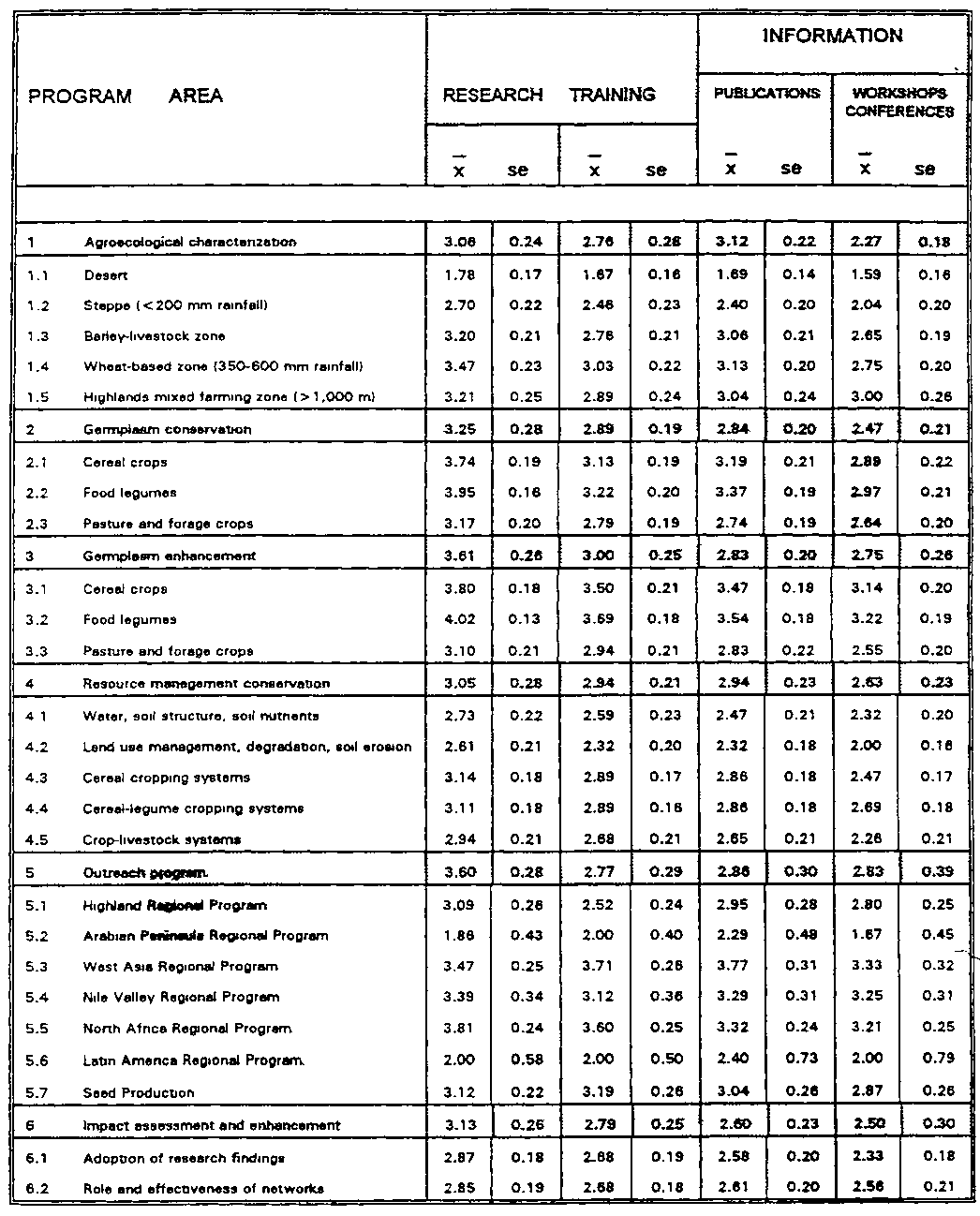
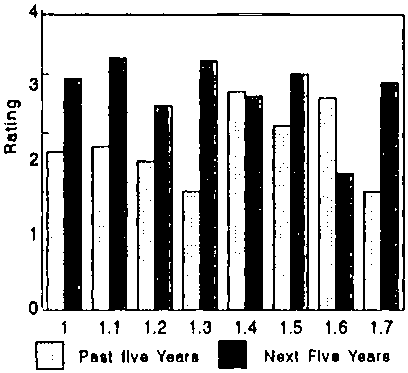
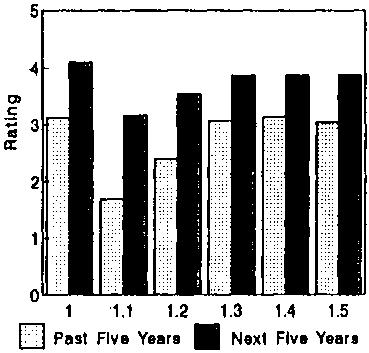
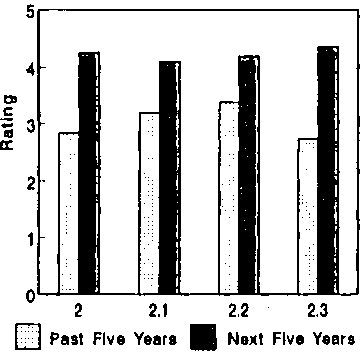
Average scores for each of the program and sub-program areas on each activity (i.e., research, training, publications, workshop) were obtained from the response data (see Tables A4.1, A4.2 and Figures A4.1-A4.3).
In order to compare the scores over program/sub-program areas, homogeneity of sampling variances was checked using Bartlett's chi-square test before carrying out a weighted analysis of variance. For the activities where homogeneous variances across program areas were detected, the weights were determined using a pooled error variance over program areas, otherwise the respective variances were used to compute the weights. The variability in 31 program/sub-program areas was partitioned across sources representing program comparisons (five degrees of freedom) and comparisons within each individual program, the sub-program versus program, and between subprogram areas were made.
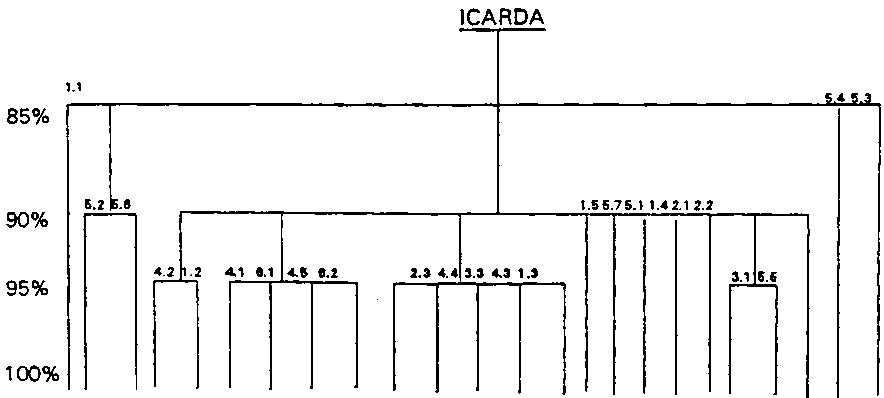
Tables A4.1 and A4.2 show the comparison of ratings for subprogram activities. The relationships among the sub-program areas in terms of similarities of scores on activities in the past five years and priority ranking of future activities were obtained using non-hierarchical cluster analysis based on single linkage and city-block similarity measures. The resulting dendograms (Figures A4.4 and A4.5) show the interrelationships among the program areas.
Results
Sampling errors for each of the four activities in the past five years were homogeneous across the 31 program/sub-program areas. They were heterogeneous for the three activities in the next five years. This indicates that ratings of ICARDA's work in the past five years differ to the same extent (consistent) for each program area whereas the variabilities in the future rating change over the program areas. There is an increase in the ratings on all areas and activities in future projected work when compared with the same area and activity in the past. Thus the respondents would like to see ICARDA doing much more work in the future on all fronts.
Research
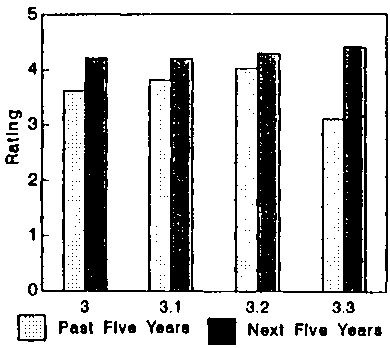
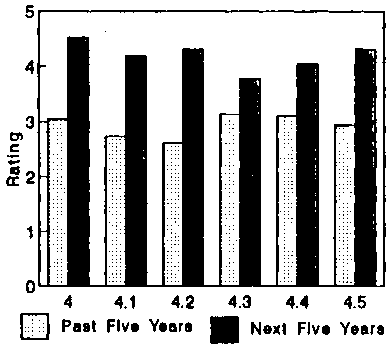
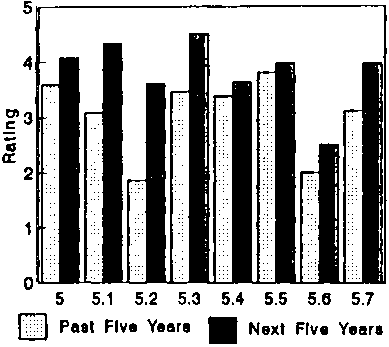
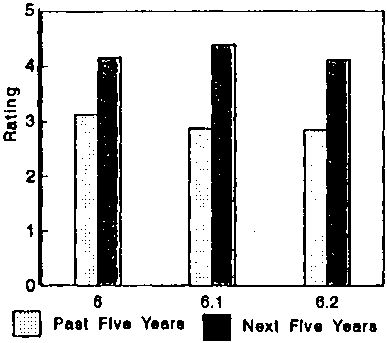
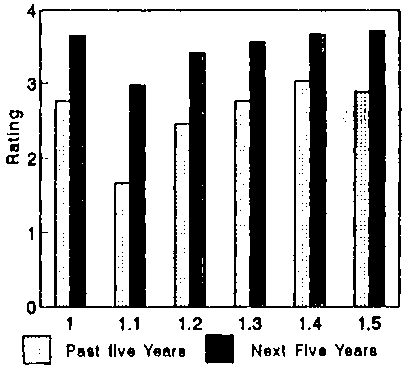
The results suggest that respondents ranked ICARDA's main research programs over the past five years as having been valuable (3.06 - 3.61), with little distinction between programs in terms of relevance and effectiveness; the slightly higher scores for germplasm enhancement (3.61) and the outreach program (3.60) are significantly different from the other programs. At the subprogram level the noticeably lower scores for the agroecological characterization of the desert (1.78) and for the Arabian Peninsula outreach program (1.86) reflect ICARDA's lack of attention to these areas.
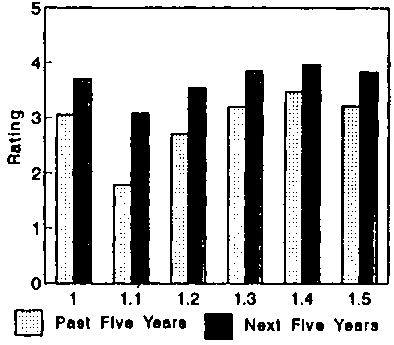
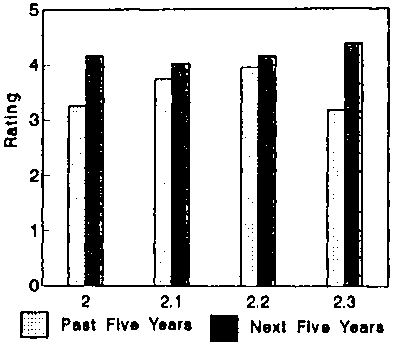
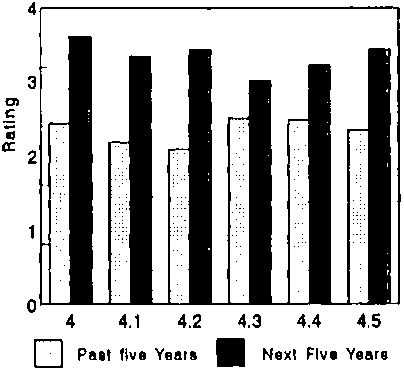
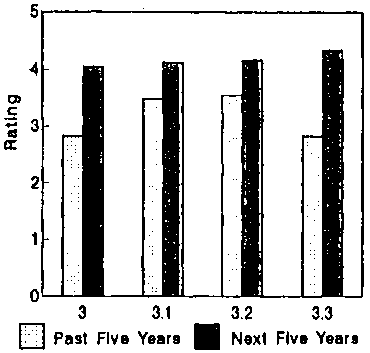
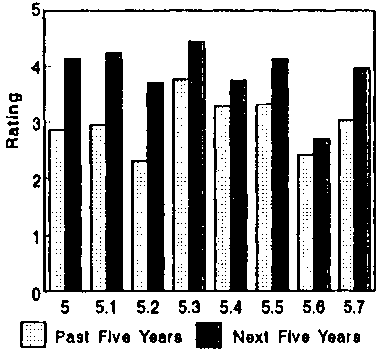
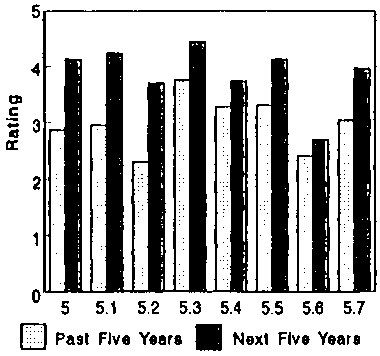
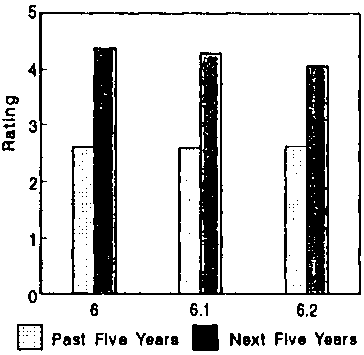
Of more immediate relevance is the contrast of scores assigned to past and future research programs, which is shown graphically in Figure A4.1. On aggregate, it is clear that respondents attach high priority for the future to all programs with little distinction between them; scores ranged from 4.07 to 4.52. The consistent and distinctly higher scores on the prioritization of ICARDA's program for the future, in contrast with past program relevance and contribution, could be interpreted as indicating that the respondents want more and greater impact from ICARDA in the future, and in particular from the Resource Management Conservation program area. At the subprogram level, small differences emerged with the Latin America Regional program (2.50) and the agroecological characterization of the desert (3.08) being assigned a medium to low priority.
The ratings among the program areas differ significantly both for rating of past and future prioritization. The overall rating did not differ from the average of the sub-program rating with one exception (resource management). This indicates consistency in the rating and a clear sense of priorities at program and sub-program levels. However, significant differences in the priorities were found between sub-program ratings of research (except in the resource management and impact assessment sub-programs) over the past five years and for the future with regard to germplasm conservation and enhancement and impact assessment. During the past five years, the top two performing areas were germplasm enhancement (3.61) and outreach (3.60). For the future, the data indicate a shift in priorities to resource management followed by germplasm enhancement, and higher priorities to be assigned to all sub-programs than in the past.
Training
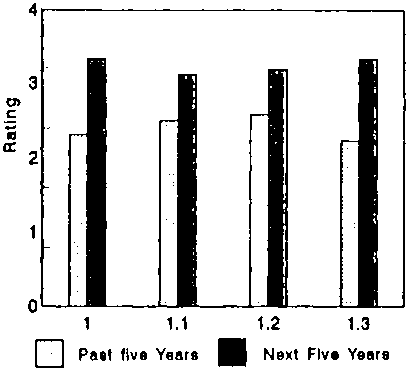
The pattern of the respondent scores on training is very similar to the results on research, and the aggregate scores for the two activities were not different. At the program level, ICARDA's training program over the past five years was considered to be reasonably valuable (scores ranged from 2.77 to 3.0); at the subprogram level, training areas such as characterization of the desert (1.67) and outreach training the Arabian Peninsula (2.00) and Latin America (2.00) was considered to be of little value, in contrast with training activities on food legume germplasm (3.69) and outreach programs in West Asia (3.71) and North Africa (3.60).
Again, the contrast between past and future training programs (Figures A4.1, A4.2) reveals a strong demand for greater ICARDA activity in this area. Respondents placed highest priority on Resource Management Conservation (4.57), followed by germplasm enhancement (4.05) and conservation (4.16). The data would suggest a demand for greater input by ICARDA on training in land use management, soil degradation and soil erosion.
The ratings between sub-programs, based on work in the past, differ significantly for agroecological characterization, germplasm enhancement, and outreach programs, whereas priorities for future training do not differ except for the outreach programs. Respondents gave highest rating to training on germplasm enhancement (2.89) and farm resource management (2.94), but would like to see a change in training priorities in future to farm resource management (4.57) followed by impact assessment (4.26).
Information
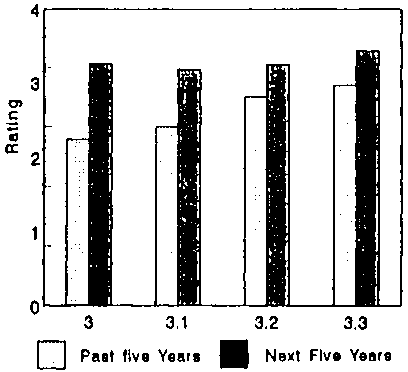
The largest difference between respondents' rankings of ICARDA's past and future programs was in the area of information dissemination. At the program level, past activities were not ranked highly; all scores were below 3 (valuable). Subprograms in germplasm enhancement (cereals and food legumes) and outreach activities in West Asia, the Nile Valley and North Africa scored best. With the exception of sub-programs 1.1 (agroecological characterization of the desert) and 5.6 (Latin America outreach programs), the information support to all other subprogram areas was ranked as deserving high priority in ICARDA's future activities. In the evaluation of the Center's past program, the respondents did not distinguish between workshops and other forms of information dissemination.
Past ratings of publications differed significantly over the subprograms in agroecological characterization, and germplasm enhancement while for the future the importance attached differs only for the outreach programs. In the past, respondents perceived that ICARDA performed best in the areas of farm resource management (2.94) followed by outreach (2.86). In future they would like to see ICARDA attach priority in the area of resource management publications (4.57) followed by publications on impact assessment (4.37).
All Activities Together
Cluster analysis of ratings of all past sub-programs (Figure A4.4) exhibit the following relationships. At the 95% level of similarity, the respondents identify four clusters:
(a) Steppe, land-use management, degradation and soil erosion;(b) Water, soil structure, soil nutrients, crop-livestock systems, adoption of research finding and effectiveness of networks;
(c) Germplasm conservation and improvement for pasture and forage crops, cereal cropping systems, cereal-legume cropping systems and agroecological characterization in the barley-livestock zone (200-350 mm rainfall); and
(d) Germplasm enhancement for cereals and North Africa Regional Program,
whereas other areas were not related at this level of similarity. In future they would like to see ICARDA attaching similar importance (based on research, training and publications) to the areas of:
(a) Arabian Peninsula and Nile Valley Regional Program;(b) Agroecological Characterization in barley-livestock zone (200-350 mm rainfall), wheat-based zone (350-600 mm rainfall) and highlands mixed farming zone (> 1000 m); and
(c) All other program areas except desert, and West Asia and Latin America Regional Programs.
Conclusions
Overall, the survey data suggest that ICARDA is held in esteem by its clients and its activities in research, training and the dissemination of information have made a valuable contribution to the technical problems constraining the development of agriculture in the region. Whereas some respondents commented that certain subprograms were particularly effective, this was not reflected in the average programs scores. On average, all six programs were ranked more or less equal.
Individual subprograms that scored markedly different from the rest, and on which some strong comments were made, include activities relating to the desert zone and the Arabian Peninsula outreach program. However, it is important to emphasize that the respondents, with a few exceptions, assigned low priority to these areas. This would indicate that ICARDA's low input to these zones has general approval.
Perhaps the most interesting and pertinent result of the survey emerges in the contrast of past and future scores for each of ICARDA's activities (See Figures A4.1, A4.2 and A4.3). These contrasts may be interpreted to suggest that ICARDA's clients want more effective output from the Center in the future, particularly in training and information activities. The program that appears to need greatest strengthening is resource management and conservation. Many of the individual comments indicated that the NARSs want more training and information in this program, especially on research methods to describe, quantify and monitor change in the natural resources of their region, a research area that they regard as being important, but in which they have little expertise. The next priority area is the germplasm enhancement. They would also like to see work published on impact assessment.
Summary remarks concerning the process described in this appendix, and the Panel's rather critical appraisal of the value of the information yielded by it, are reported in section 5.3.1 of the main part of this Report.
Table A 4.2. Prioritization of ICARDA's future (5-10 year horizon)
|
PROGRAM AREA |
RESEARCH TRAINING |
INFORMATION |
||||
|
|
se |
|
se |
|
se |
|
|
1 Agroecological characterization |
3.70 |
0.21 |
3.6S |
0.19 |
4.10 |
0.22 |
|
1.1 Desert |
3.08 |
0.26 |
2.97 |
0.27 |
3.16 |
0.27 |
|
1.2 Steppe (<200 mm rainfall) |
3.54 |
0.21 |
3.41 |
0.22 |
3.54 |
0.25 |
|
1.3 Barley-livestock zone |
3.84 |
0.14 |
3.56 |
0.14 |
3.87 |
0.14 |
|
1.4 Wheat-based zone (350-600 mm rainfall) |
3.96 |
0.14 |
3.67 |
0.17 |
3.87 |
0.16 |
|
1.5 Highlands mixed farming zone (> 1,000 m) |
3.83 |
0.16 |
3.71 |
0.17 |
3.88 |
0.19 |
|
2 Germplasm conservation |
4.16 |
0.21 |
4.16 |
0.24 |
4.26 |
0.23 |
|
2.1 Cereal crops |
4.02 |
0.15 |
3.90 |
0.15 |
4.10 |
0.14 |
|
2.2 Food legumes |
4.15 |
0.13 |
3.98 |
0.13 |
4.19 |
0.12 |
|
2.3 Pasture and forage crops |
4.38 |
0.11 |
4.16 |
0.13 |
4.36 |
0.10 |
|
3 Germplasm enhancement |
4.21 |
0.20 |
4.05 |
0.29 |
4.05 |
0.23 |
|
3.1 Cereal crops |
4.20 |
0.14 |
3.96 |
0.14 |
4.13 |
0.13 |
|
3.2 Food legumes |
4.29 |
0.13 |
4.04 |
0.13 |
4.17 |
0.12 |
|
3.3 Pasture and forage crops |
4.41 |
0.10 |
4.27 |
0.11 |
4.34 |
0.11 |
|
4 Resource management conservation |
4.52 |
0.13 |
4.57 |
0.13 |
4.57 |
0.13 |
|
4.1 Water, soil structure, soil nutrients |
4.18 |
0.13 |
4.16 |
0.14 |
4.19 |
0.12 |
|
4.2 Land use management, degradation, soil erosion |
4.30 |
0.12 |
4.23 |
0.12 |
4.24 |
0.12 |
|
4.3 Cereal cropping systems |
3.78 |
0 14 |
3.83 |
0.13 |
3.80 |
0.14 |
|
4.4 Cereal-legume cropping systems |
4.04 |
0.14 |
4.00 |
0.14 |
4.02 |
0.14 |
|
4.5 Crop-livestock systems |
4.31 |
0.11 |
4.13 |
0.12 |
4.14 |
0.12 |
|
5 Outreach program |
4.07 |
0.26 |
3.93 |
0.27 |
4.13 |
0.34 |
|
5.1 Highland Regional Program |
4.33 |
0.14 |
4.28 |
0.15 |
4.24 |
0.13 |
|
5.2 Arabian Peninsula Regional Program |
3.61 |
0.33 |
3.47 |
0.34 |
3.71 |
0.30 |
|
5.3 West Asia Regional Program |
4.50 |
0.14 |
4.22 |
0.15 |
4.44 |
0.14 |
|
5.4 Nile Valley Regional Program |
3.64 |
0.27 |
3.63 |
0.29 |
3.75 |
0.26 |
|
5.5 North Africa Regional Program |
3.97 |
0.23 |
4.00 |
0.22 |
4.13 |
0.21 |
|
5.6 Latin America Regional Program |
2.50 |
0.36 |
2.31 |
0.30 |
2.69 |
0.33 |
|
5.7 Seed Production |
3.97 |
0.19 |
3.86 |
0.19 |
3.97 |
0.17 |
|
6 Impact assessment and enhancement |
4.16 |
0.20 |
4.26 |
0.19 |
4.37 |
0.19 |
|
6.1 Adoption of research findings |
4.39 |
0.12 |
4.35 |
0.11 |
4.28 |
0.12 |
|
6.2 Role and effectiveness of networks |
4.12 |
0.14 |
4.02 |
0.15 |
4.06 |
0.14 |
Figure A 4.1. Ranking for Research Program - Past Five Years vs. Next Five Years
Agroecological Characterization
Germplasm Conservation
Germplasm Enhancement
Resource Management and Conservation
Outreach Program
Impact Assessment
1, Agroecological characterization; 1.1, Desert; 1.2, Steppe (< 200 mm rainfall); 1.3, Barley-livestock zone; 1.4, Wheat-based tone (350-600 mm rainfall); 1.5, Highlands mixed (arming zone (> 1,000 m); 2, Germplasm conservation; 2.1, Cereal crops; 2.2, Food legumes; 2.3, Pasture and forage crops; 3, Germplasm enhancement; 3.1, Cereal crops; 3.2, Food legumes; 3.3, Pasture and forage crops; 4, Resource management conservation; 4.1, Water, soil structure, soil nutrients; 4.2, Land use management, degradation, soil erosion; 4.3, Cereal cropping systems; 4.4, Cereal-legume cropping systems; 4.5, Crop-livestock systems; 5, Outreach program; 5.1, Highland Regional Program; 5.2, Arabian Peninsula Regional Program; 5.3, West Asia Regional Program; 5.4, Nile Valley Regional Program; 5.5, North Africa Regional Program; 5.6, Latin America Regional Program; 5.7, Seed Production; 6, Impact assessment and enhancement; 6.1, Adoption of research findings; 6.2, Role and effectiveness of networks.
Figure A 4.2. Ranking for Training Program - Past Five Years vs. Next Five Years
Agroecological Characterization
Germplasm Conservation
Germplasm Enhancement
Resource Management and Conservation
Outreach Program
Impact Assessment
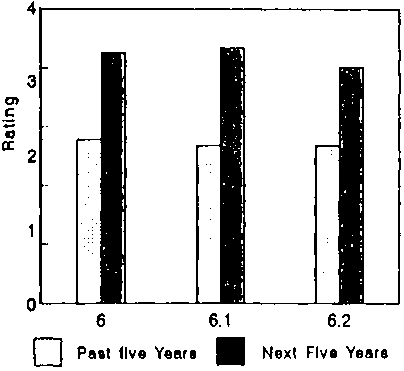
1, Agroecological characterization; 1.1, Desert; 1.2, Steppe (< 200 mm rainfall); 1.3, Barley-livestock zone; 1.4, Wheat-based tone (350-600 mm rainfall); 1.5, Highlands mixed (arming zone (> 1,000 m); 2, Germplasm conservation; 2.1, Cereal crops; 2.2, Food legumes; 2.3, Pasture and forage crops; 3, Germplasm enhancement; 3.1, Cereal crops; 3.2, Food legumes; 3.3, Pasture and forage crops; 4, Resource management conservation; 4.1, Water, soil structure, soil nutrients; 4.2, Land use management, degradation, soil erosion; 4.3, Cereal cropping systems; 4.4, Cereal-legume cropping systems; 4.5, Crop-livestock systems; 5, Outreach program; 5.1, Highland Regional Program; 5.2, Arabian Peninsula Regional Program; 5.3, West Asia Regional Program; 5.4, Nile Valley Regional Program; 5.5, North Africa Regional Program; 5.6, Latin America Regional Program; 5.7, Seed Production; 6, Impact assessment and enhancement; 6.1, Adoption of research findings; 6.2, Role and effectiveness of networks.
Figure A 4.3. Ranking for Publications In Program - Past Five Years vs. Next Five Years
Agroecological Characterization
Germplasm Conservation
Germplasm Enhancement
Resource Management and Conservation
Outreach Program
Impact Assessment
1, Agroecological characterization; 1.1, Desert; 1.2, Steppe (< 200 mm rainfall); 1.3, Barley-livestock zone; 1.4, Wheat-based tone (350-600 mm rainfall); 1.5, Highlands mixed (arming zone (> 1,000 m); 2, Germplasm conservation; 2.1, Cereal crops; 2.2, Food legumes; 2.3, Pasture and forage crops; 3, Germplasm enhancement; 3.1, Cereal crops; 3.2, Food legumes; 3.3, Pasture and forage crops; 4, Resource management conservation; 4.1, Water, soil structure, soil nutrients; 4.2, Land use management, degradation, soil erosion; 4.3, Cereal cropping systems; 4.4, Cereal-legume cropping systems; 4.5, Crop-livestock systems; 5, Outreach program; 5.1, Highland Regional Program; 5.2, Arabian Peninsula Regional Program; 5.3, West Asia Regional Program; 5.4, Nile Valley Regional Program; 5.5, North Africa Regional Program; 5.6, Latin America Regional Program; 5.7, Seed Production; 6, Impact assessment and enhancement; 6.1, Adoption of research findings; 6.2, Role and effectiveness of networks.
Please comment briefly on the following topics (feel free to use the back of this sheet as necessary)
1. Research structure. [Is ICARDA's research structure optimal given the Center's strategy and research goals? Should modifications be considered, and if so what?]
2. Research leadership. [How effective is research leadership and monitoring/oversight?]
3. Research planning and review processes. [How effective are ICARDA's (a) research planning and (b) review processes? Is there adequate link between planning and review? Is there an appropriate level of staff input into annual, medium-term and strategic planning?]
4. Project-based budgeting system. [Should ICARDA adopt a project-based budgeting system -YES/NO? Are decision-making and financial accountability sufficiently decentralized currently?]
5. Research environment. [How would you characterize ICARDA's research environment? (e.g., comment on communication, teamwork, etc.)]
6. Appraisal system. [How rigorous is the performance appraisal system for research staff? What is rewarded?]
7. Administration and program support. [How responsive are finance, administrative and program support units to your needs?]
8. Overall assessment. [What do you consider the major advantages and drawbacks of working at ICARDA? How satisfied are you with your job and employer?]
9. Institutional responsiveness. [How responsive is ICARDA to the region's research and training needs, and how effective are the mechanisms used for understanding these?]
10. Other comments. [Please comment on any other matters that you feel are relevant.]
Introduction
This report is based on the responses of 51 of the 80 ICARDA research staff who were given the questionnaire. It asked for comments on ten topics with some questions supplied as guides. This type of survey tends to obtain more negative than positive comments but, even taking this bias into account, it is clear that there is a lot of discontent with the management of ICARDA. It should be noted that, say, three respondents giving roughly the same specific comment to a general question would normally imply that it deserves particular attention, but one cannot determine exactly the degree of support for that opinion.
In the discussion that follows, the answers to the topic were coded as + = good/satisfactory/adequate, 0 = average/mixed/moderate, and - = bad/unsatisfactory/inadequate. It should be noted that the statistics are for the answers that were given for the given question. Relevant comments from other parts of the questionnaire were not applied to that question in order to standardize the reporting of results. If that material had been added, the dominant statistical patterns would have been even stronger.
(1) Research Structure - The research structure was satisfactory for most research staff who gave an opinion, provided that the funds are available for current staffing levels. Otherwise, eight recommended combining CP and LP and thereby eliminating duplicate specialists, and five recommended combining FRMP and PRLP. Here, and elsewhere in the survey, quite a few recommended decentralizing authority closer to the scientists and reducing the administration/research staff ratio. Some other points that were made were the need to define and justify the role of the FRMP, the need to redefine the role and place of the outreach program in the organization and the role of the regional coordinators, and the need to further strengthen cross-program interaction and problem-oriented research teams.(2) Research Leadership - Answers that were unspecified regarding level of the leader or referred to the DDG-R and DG were as follows: + (10), 0 (5), and - (18). When referring to Program Leaders, the answers were: + (11), 0 (3), - (1). The research staff were relatively positive toward the Program Leaders, except the comments indicated that this support was uneven across Programs. The problems that were cited regarding Management were: they are too consumed with details and non-research issues and were not focused enough on broad strategic issues and interactions with research staff; authority is too centralized; and monitoring and oversight needs strengthening.
(3) Research Planning and Review Process - The results for research planning are like the results for research leadership. Planning and review within the Programs were viewed positively but at the Center level were viewed negatively. At the Center or unspecified level, the responses were: + (11), 0 (5), and - (17). Within Programs they were: + (6), 0 (2), - (0). In general, the planning was viewed more positively than the review process. The links between the two were judged as follows: + (5), 0 (0), and - (7). The adequacy of staff input in the process was judged as follows: + (8), 0 (0), and - (6). Review, in particular, needs strengthening, and some noted that it is not critical enough and lacks a peer component.
(4) Project-Based Budgeting System - The research staff clearly favor project-based budgeting and the decentralization of decision making and financial accountability. They voted 30 in favor of project based budgeting, 6 against and 1 mixed. Only one judged ICARDA to be sufficiently decentralized, 1 was mixed, and 28 judged it to not be sufficiently decentralized. Some of these 28 may not have been critical but just observing that it is highly centralized, but the majority opinion is that the centralization is dysfunctional. Several concerns were voiced: the scope and size of projects need to be defined before a system can be implemented, the system should promote teamwork and not just create new boundaries, and the system should not "turn scientists into accountants."
(5) Research Environment - The overall research environment was judged quite positively. Some respondents were thinking of their own Program, and others were thinking more generally, but it was not possible to separate the two types of responses. The question asked about ICARDA's research environment, so it is to be assumed that most respondents were thinking generally. The results were: + (22), 0 (3), and - (3). Their judgement on communication was: + (13), 0 (1), and - (5). Their judgement on teamwork was: + (10), 0 (2), and - (7). Despite these generally favorable results, there were some strong criticisms that centered on the administration and on discrimination. Some perceived that teamwork is hampered by ethnic barriers, so greater cultural sensitivity may be required.
(6) Appraisal System - The appraisal system is also highly criticized. The main complaint is that few rewards are given out. Promotions or two-step raises are rare and bonuses are minimal. Other serious complaints are that the final review committee is not perceived as a good judge or fair, that low performers are not fired, that personal relationships and group or cultural prejudice play a large role, and that the emphasis on publications is perceived as causing important work to go unrecognized or unrewarded. Nevertheless, the appraisal system is a popular process at the program level. In sum, the process is perceived as well-designed but the results are perceived as unsatisfactory and a major reason for low morale. The failure is in the perceived "stinginess" of the reward system.
The following are the statistics behind these observations. The scientists' general attitudes toward the appraisal system are: + (5), 0 (1), and - (16). Their judgments on how rigorous it is are: + (2), 0 (1), and - (12). Seven complained that discrimination abounds in the system. Four complained that there is too much charity in the system. Seven called for more recognition and rewards for important work other than journal publications.
(7) Administration and Program Support - The picture on this topic is complex. The general evaluation of administration is positive, but there are some negative judgements of the administration department and the finance department, and throughout the questionnaire there were strong negative attitudes toward the increased bureaucratization of the Center. According to the research staff, there needs to be an improvement in the service orientation of the administrative and support staffs with particular attention to the need for greater availability, less rigid rules and "red tape," reducing the amount and level of approvals, reducing perceived favoritism in service provision, increasing quality control from within because errors take time to straighten out, and applying the incentive and appraisal system rigorously to promote quality service.
The overall attitudes toward administrative and program support are: + (19), 0 (10), and - (4); toward the Finance Department: + (7), 0 (1), and - (6); toward the Administration Department: + (3), 0 (0), and - (9); and toward the support programs: + (5), 0 (1), and -(0). Five scientists complained that the administration/research ratio is too high.
(8) Overall Assessment - The overall assessment by research staff of ICARDA was quite positive, but that is because respondents answered the question largely in terms of job satisfaction. Accordingly, they evaluated ICARDA as follows: + (30), 0 (1), and - (2). Advantages of working for ICARDA include challenging and interesting work, contributing to an important mission, and a positive research environment. Under the disadvantages, 10 cited the isolation of being cut off from the outside world, 6 cited the administration, 4 low advancement opportunities, 3 the problem of schooling for their children, 3 the poor social life in Aleppo, 3 the poor opportunities for their spouse, and 3 problems concerning the school fee allowance.
(9) Institutional Responsiveness to WANA Need's - The scientists overwhelmingly see ICARDA as responsive to the region's needs: + (30), 0 (4), - (0). They also favorably judged the current mechanisms for finding out the region's needs: + (8), 0 (1), and - (1). Some of them, however, criticized the quality or value of the training given to the NARS scientists.
(10) Other Comments - The feedback on this question cannot be easily summarized. Most of the comments are reflected in the summaries of questions 1 to 9. A few suggestions that have not been mentioned above are: the need for a more flexible mandate to work with the NARSs, extension planning should be part of ICARDA's training courses, the relevance of activities to the NARSs should be a major criterion for prioritizing work and for personnel evaluations, and the need for better insurance coverage and maternity leave.
Despite our improved ability to predict their onset and modify their impact, inevitable and recurrent drought remains a foremost singular factor affecting world food security, and it affects the condition and stability of land resources from which that food is derived. The 1980s, as for the preceding decade, began with drought, and such continues into the 1990s. In the less-developed world, the problem has been widespread and serious. Drought has hastened the collapse of many unstable, fragile food-production systems. It is therefore highly appropriate today, as was the case at ICARDA's inception in the late 1970s, that strategies to minimize drought impacts on the rural community and on the stability of marginal land resources be developed, transferred and secured.
One thought embodied in establishing ICARDA as an IARC was to provide as many as possible applied options for research and development programs in the dry areas. There is, therefore, a variety of programs dealing with food and fodder production, livestock production management, resource management, marketing, economics, environmental and social interaction, and the provision of a sustainable and economic way of life to the farmer. Few IARCs can, in fact, adopt and maintain this approach because of the associated commitment of human resources, physical facilities and financial support. With the abundant diversity and needs of dryland agriculture, taken in conjunction with the continuing population pressures, ICARDA has seen fit to diversify and expand some of its research activities and related educational programs. Greater focus and integration of its research activities, as argued in chapter 2, are deemed by the Panel to be necessary.
The 1988 EPR recommended that "ICARDA review the staff resources devoted to the agroecological characterization project to ensure that sufficient priority is accorded within the program to bring the project to a timely completion and facilitate the transfer of technologies to national programs, as appropriate." ICARDA has, indeed, initiated steps to decentralize part of its research program towards strategic locations in the region.
The diversity of the agroecological zones and farming systems within the mandated WANA region underscores the urgent need, strategically and quickly, to diversify and focus research activities to include a wider range of ecological settings. It is readily apparent that ICARDA's available resources, both human and financial, required to accomplish this necessary move will seriously hamper ICARDA's efforts. Decentralization in conjunction with enhanced coordination through fostering greater collaborative effort with selected NARSs, represents a potentially more cost-effective strategic solution.
ICARDA covers several distinctive agroecological zones in its mandated ecoregion. Recognition of these distinctions requires the development of a new structure that will enable ICARDA to meet more adequately the challenges of its mandate. One of the main operational objectives is to collaborate with and foster cooperation and communication among other national, regional and international institutions in the adoption, testing, and demonstration of improved crop, livestock and integrated farming systems. It is suggested, therefore, that the tasks of ICARDA outreach offices be changed to meet these cogent objectives.
In attaining these goals, several, say five, main agroecological zones could be selected in collaboration and cooperation with the NARSs. The results of research at representative sites within these zones could then be more readily transferred to similar agroecological zones in the region. The outreach Coordinator would focus on the joint research program implemented at these sites with NARS scientists. An essential first step is to identify zones within the dryland areas/countries served by ICARDA's research and outreach programs that have designated key environmental features and that capture the diversity of systems of production-management systems within WANA as a whole.
Each zone should be served by a "center of excellence" in applied/adaptive research activities. Ongoing larger scale research endeavors should be used as the "trunk" activities to identify improved germplasm, cultural practices tailored to stress-tolerant advanced genetic materials, and the development of outreach tools to disseminate the information to end-users. Satellite locations would then represent "branches" to further test, refine and deliver technology to a widening array of end-users in comparable agroecological zones.
The essence of this arrangement is depicted in Figure A7.1. Some of the existing ICARDA-NARSs links and working arrangements approximate this scheme already but what is presently missing is a more comprehensive coverage of the major agroecologies in the WANA region - a coverage that may prove challenging to accomplish under the present and prospective funding scenario - and a reorientation to the client-driven, capacity-building, persistent, NARS-based, sub-ecoregional programs now addressed.
For the reasons briefly outlined above, the Panel suggests that ICARDA might achieve greater impact, greater coherence of activities and greater resource-use efficiency by more fully integrating, cooperating and collaborating with NARSs. Sufficient databases, it is felt, have by now been generated to select satellite research centers that (a) reflect major agroecological zones consistent with ICARDA's primary focus, and (b) represent production systems (with targeted crops and fanning systems) that could serve as models to characterize better and improve their efficiency and sustainability. Strengthening formal links with these selected NARSs would allow ICARDA to capitalize on host-country resources and personnel, provide greater access to (and generation of) databases characterizing features of the climate, soil and water, land-use patterns and practices, cropping systems and efficiencies, and soil erosion and land degradation. Such improved linkages would also offer greater precision in characterizing and understanding farming systems, in assessing the impact of adopted technologies and their interaction with microclimate variations and, more importantly, in facilitating a higher probability of success in identifying comparable agroecological areas for extension of identified new and improved technologies.
ICARDA has a strong history of working with national programs. Strengthening formal linkages with core NARSs selected on the basis of agroecological zones and of host-country commitment will have numerous advantages for ICARDA. It provides for greater coherence in the research mandate, both by unifying a systematic element in the research program and by building an effective network for the adaption and adoption of technologies from the main research program. Satellite centers also have a potential advantage of facilitating information flows, training networks and in monitoring and documenting the consequences of farmers' adoption of modified technologies.
This concept outlined in this appendix is in complete harmony with TAC's recently articulated ecoregional approach (TAC/Center Directors Working Group 1993). There are three key aspects to this approach: (a) applied and strategic research on the foundations of sustainable production systems in the ecoregion, (b) the improvement of productivity in the ecoregion by drawing in appropriate global research activities and (c) strengthening of cooperation with national partners and development of transnational mechanisms of collaboration. In the transition from the medium to the long term, and as national systems become stronger, CGIAR ecoregional activities will be progressively replaced by work in national programs and transnational networks.
Figure A7.1 Scheme for an Agroecological Organization of Research.
The 1988 External Program Review (EPR) of ICARDA made 19 recommendations. ICARDA's response to these recommendations has been taken into account in the appropriate sections of the Report. The Review Panel's assessment of the Center's response is summarized in this Annex.
I. EPR Recommendations: Research Programs
|
Recommendation |
Implementation |
Comments |
|
Research Programs: |
Full (F) |
(section references are to those of this Report) |
|
Farm Resource Management | ||
|
Recommendation 1: That ICARDA review the staff resources devoted to the agroecological characterization project to ensure that sufficient priority is accorded within the program to bring the project to a timely completion and facilitate the transfer of the techniques to national programs as appropriate (para. 3.1.7. EPR report, page 30). |
P |
ICARDA has not increased the staff support to this project but has taken steps to strengthen the work in other ways. These include (a) better computer facilities to support the work, especially the crop-growth modelling work, (b) training of NARSs scientists to use the "Package of Agroecological Characterization (PAC)" in Morocco and Turkey, (c) further development of the weather generator model, and (d) training of its own staff in the use of crop growth models. |
|
Recommendation 2: That a full-time core (P-level) position for a social anthropologist be added to the FRMP, and that provision be made for research assistance for the socioeconomic group. |
P |
An anthropologist was appointed in January 1990 to study adoption. Two economists have been recruited, one on a visiting scientist basis. As noted in sections 2.6.3 and 2.6.4, research assistance to the group is still inadequate. |
|
Recommendation 3: That, in view of the importance of livestock in the future program of ICARDA, one of the current core (P-level) economics positions be assigned to work on livestock production systems, and that this position be transferred from FRMP to PFLP. |
F |
An economist was transferred to PFLP in September 1990. |
|
Pasture, Forage and Livestock | ||
|
Recommendation 4: That, in view of the importance of livestock in the future program of ICARDA, one of the current (P-level) economics positions be assigned to work on livestock production systems and that this position he transferred from FRMP to PFLP (para. 3.2.7. page 39). |
F |
Same as Recommendation No. 3, which has been implemented. |
|
Recommendation 5: That research on annual pasture legumes, grazing management and livestock husbandry be extended to important farming systems outside Syria. |
F |
ICARDA has expanded its work on pasture legumes and crop rotation to Algeria and Morocco. In 1991 it established a Regional Pasture and Forage Legume Network. Grazing management and livestock husbandry activities form an integral part of the evolving outreach programs in West Asia, North Africa, and the Highlands. |
|
Recommendation 6: That mixed-species herds and genotypes of different production potentials he included in research on management of livestock feed resources to obtain substantial increases in milk and meat. |
F |
ICARDA has established a small herd of goats for use in grazing management trials. The Center also imported Awassi sheep from Turkey to evaluate their milk yield potential in comparison with Syrian Awassi Sheep. |
|
Recommendation 7: That the number of livestock scientists be increased by two additional P-level positions. |
P |
A livestock scientist (ruminant nutrition) was recruited in 1991; a second post was advertized but was subsequently frozen because of financial cutbacks. |
|
Cereals | ||
|
Recommendation 8: That ICARDA and CIMMYT re-examine, as a matter of urgency, their respective stances on wheat improvement in the WANA region, taking a long-term view of the strengths of national programs and the shifts in emphasis of their own research. They should strive to reach formal agreement as soon as possible, incorporating all aspects of work on wheat by both Centers in the WANA region (para. 3.3.7. page 49). |
F |
A formal agreement between ICARDA and CIMMYT was signed in March 1989. The agreement appears to be operating fairly well. ICARDA is providing administrative support to a CIMMYT project in Egypt and office facilities to a CIMMYT scientist outposed in Turkey. (See section 3.3.3.4). |
|
Food Legume Improvement | ||
|
Recommendation 9: That ICARDA undertake an analysis of existing evidence on the value of legumes in production systems of the region with respect to both their contribution to soil fertility under stressful conditions, and the possibilities for expansion in their use as livestock feed. The results of this analysis should be used to determine ICARDA's strategy for future research on food and forage legumes (para. 3.4.7 page 57). |
F |
ICARDA with the support of IFPRI completed the suggested study in May 1990 and has implemented its main recommendations. Research on food and feed legumes have been combined into a single legume program (LP). The forage legume scientist in PFLP has been transferred to the LP. Currently, one senior scientist in LP (the PFLP transfer) and a postdoctoral fellow are working on forage legumes, (see box 2.2 - top right para) |
|
Recommendation 10: That work on lentil improvement be continued at the present level for two years and, in addition, ICARDA should immediately embark on an in-depth assessment of the potential payoff of further research investment on the improvement of lentil (taking into account the contribution to human nutrition, foreign trade and the sustainability of production systems in the region) in order to determine the appropriate allocation of its resources. |
F |
The ICARDA/IFPRI study recommended that work on lentil should continue at the present scale because of its contribution to the sustainability of farming systems in the WANA region. The report also recommended that, resources permitting, work should be initiated on the Indian subcontinent. A seminar on lentil research was held in New Delhi (March 1991) in collaboration with the Indian Council of Agricultural Research (ICAR). The meeting recommended the initiation of research on lentils in South Asia in consultation with NARSs and based on special project funds. These funds have not as yet materialized, [see box 2.2] The Panel observes that the work hardly constitutes "in-depth assessment of the potential pay-off of further investment." |
|
Recommendation 11: That ICARDA proceed to implement the CGIAR decision on faba bean as expeditiously as possible. |
F |
This recommendation has been implemented. In 1989 ICARDA transferred its work on faba bean to Morocco, and research on the crop (except germplasm conservation) at ICARDA's headquarters was discontinued. The final transfer was effected in 1992, when BMZ/GTZ agreed to fund and execute the "North Africa Regional Network on Faba Bean Improvement Research", in cooperation with INRA, Morocco. ICARDA's role is now confined to technical advice when requested, (but see box 2.5 for commentary) |
|
Genetic Resources | ||
|
Recommendation 12: That ICARDA review the overall staff requirements and the distribution of responsibilities in the Genetic Resources Program and its associated laboratories. Any deficiencies in staffing should he brought to the attention of TAC, which has accorded high priority to work on genetic resources and related seed health activities (para 3.5.7. page 63). |
F |
The MTP (1990/94) staff projections have been executed as proposed. The Unit now has a leader, a cereal curator and a legume curator. Other senior staff are involved in collection and seed health work. Special projects and collaboration with IBPGR have raised staffing to above MTP projections. In addition, IBPGR has located its Middle East Regional Office in ICARDA. |
|
International Cooperation | ||
|
Recommendation 13: That before ICARDA enters into a contract involving special project funds, there should be an appraisal of a proposal in relation to ICARDA's mandated responsibilities, the likely contribution to the Center's research programs, and the effects on the intended beneficiaries. All proposals should be examined against predetermined criteria listed at Annex VII (para 4.6.6. page 86). |
P |
Center Management accepts the need for stringent criteria against which special projects are evaluated. The Center also states its intention to ensure that special project funding docs not divert its work from its declared objectives. |
|
Recommendation 14: That special fund projects should, in addition to making a contribution to overheads, be required to make a financial contribution to the core activities of the Center directly related with the objectives of the project. The Center should consider making a matching supplementary contribution. |
N |
This condition is outside the control of ICARDA - short of turning down special projects that do not also make financial contributions to core activities. With the new nomenclature of core and complementary and its implications for the substance of acceptable special funding, the conditions of matching funds become less relevant, as long as donors finance approved activities. Substitution of core expenditure is, in effect, indirect core funding. |
|
Training and Information | ||
|
Recommendation 15: That since the needs of national systems for the effective development and operation of the subregional networks should drive the training priorities, this be explicitly recognized in ICARDA's strategy (para 5.1.7, page 93). |
F |
The Center's strategy acknowledges the implicit challenge of ensuring that the training offered by the Center is in support of the needs of NARSs in the various regional programs. In consequence, ICARDA has placed the oversight of both Training and CODIS with the ADG(IC). Yearly planning meetings with NARSs decide on training needs both for individual countries and regions. |
|
Scientific and Technical Information Program | ||
|
Recommendation 16: That ICARDA establish a Publications Committee with an initial task of developing a publications policy (para 5.2.7. page 97). |
F |
A Publications Committee has been operational since October 1988, comprising representatives from the various programs. Significant outputs have been a report on "Reorganizing the Scientific Information Services of ICARDA," and a "Publications Policy." The recommendations of the Committee are being implemented in a phased manner. |
|
Research Management and Organization | ||
|
Recommendation 17: That ICARDA consider introducing a matrix structure for organizing its future research work. The dimensions of the matrix should be determined as ICARDA's strategic directions are identified (para 6.1.5. page 106). |
P |
ICARDA has interpreted the introduction of a matrix structure to imply an arrangement that avoids the negative aspects of a purely disciplinary-based research management. The matrix operates at two levels: the program and project/activity. All ICARDA programs are more or less matrices that mesh commodities and activities in a coherent whole. Further, several of the Center's projects are activities with a multi-disciplinary composition. Other linkages are brought about through the sharing of research laboratories, equipment and methods. |
|
Recommendation 18: That ICARDA critically assess the suitability of its current monitoring and review systems to its future needs, in the light of its strategic plan, medium-term program, and project-based matrix management system. |
P |
The planning and monitoring procedures include annual plans and budgets, review/planning meetings both in-house and with cooperating NARSs, discussions in TRAC and the Board PC as well as interactions with visiting scientists. |
|
Research Support Services | ||
|
Recommendation 19: That the incipient microcomputer capacity be expanded and that scientists be encouraged in the use and development of their personalized, specialized software on both microcomputers and the mainframe (para 6.2.4. page 111). |
F |
The Center now operates over 200 microcomputers in its research and administrative programs. In-house expertise is in place on hardware software selection and acquisition. The Computer and Biometrics Services Unit now supports numerous software packages. The mainframe has been replaced by a VAX 4000-500 and a local area network has been installed. The new system is fully operational in 1993. |