


Swaziland's livestock production in 1996 has been modeled in the previous chapter. Now you may explore various scenarios by changing parameters. In this chapter, we will roughly look over how LDPS2 assists policy designing.
Milk consumption in Swaziland grew at the rate of nearly 4 percent p. a. between 1986 and 1995 largely because of human population increases. The demand for milk substantially outstripped production which, in the same period, grew at only 2.5 percent p. a. in average. The shortfall was made up by increased imports from South Africa. At the moment, indigenous cow milk production is about two thirds of the demand.
According to economical projections by the government, the demand will continue to increase over the next decades (Table 5).
| Scenario \ Year | 1997 | 2001 | 2006 |
| Low | 54.8 | 67.3 | 82.6 |
| Medium | 57.6 | 70.6 | 90.6 |
| High | 58.6 | 72.9 | 94.6 |
source: Ministry of Agriculture and Co-operatives, Swaziland
Will the indigenous milk production satisfy the national demand in 2006? The Demand-driven Routine shows that 90.6 thousand tons of milk (medium projections for 2006) can be produced by 37,750 heads of the current dairy breed cows (880 percent of the current number) or 579,500 heads of SNL cows (340 percent of the current number). However, the Herd Growth Routine shows that the number of the dairy bred cows will expand to 7,200 heads at maximum in 2006 and that of SNL cows will remain at the current level. It means that import of milk will be necessary also in 2006.
Then, let's model the dairy production in 2006 again, assuming indigenous production as 60,400 tons, 67 percent (the current self-sufficiency rate) of the projected demand. The production amount is tentatively divided into the dairy breed and the traditional SNL cattle. Milk production of SNL cows in the future will remain at the current level or decrease slightly, because of poor productivity and feed resources. Milk production of SNL cows in 2006 is therefore assumed as at the current level, 26,400 tons. The remaining part, 34,000 tons, is assumed to be produced by the dairy breeds.
In case productivity (parameters) is at the current level, the Demand-driven Routine shows that 14,200 dairy breed cows will be required to meet the demand, which are 330 percent of cows kept at the moment. However, as we have seen, the Herd Growth Routine shows that the number of dairy breed cows will be able to increase to 7,200, which is about half of those required in 2006. Then, the gap will have to be filled up by imported cows. Investment cost to import the number of cows can be calculated with price of cows, transportation, facilities for raising, etc.
Feed energy requirement of dairy breeds in 2006 will also increase to 21,000 LSUs, up 14,700 LSUs. The Resources-driven Routine shows that the increase is equivalent to 100,000 hectares of grazing lands (7 percent of the current grazing lands), or 12,750 tons of molasses in dry matter. As shown in the section 4 of the previous chapter, scarcity of feed resources, grazing resources in particular, is a major constraint for expanding Swaziland's cattle production. Efficient resources use, such as crop residues and food processing by-products which are not utilized at present, and further development of feed resources, such as molasses, are indispensable for the livestock sector.
Various scenarios for milk production of dairy breeds are shown in Tables 6 and 7. Scenarios shown in Table 6 are calculated with the same parameters used for 1996. Average fertility rate and milk yield per cow are changed in scenarios in Table 7.
| 1996 | 2006 (projection) | ||||
| Low* | Medium* | High* | Medium/2** | ||
| Milk production (ton)*** | 10,300 | 26,000 | 34,000 | 38,000 | 17,000 |
| Number of cattle | |||||
| Breeders | 4,335 | 10,942 | 14,308 | 15,992 | 7,154 |
| Replacements | 1,976 | 4,989 | 6,524 | 7,292 | 3,262 |
| Youngs | 1,923 | 4,855 | 6,349 | 7,096 | 3,174 |
| GRAND TOTAL | 8,234 | 20,786 | 27,181 | 30,379 | 13,591 |
| Females in milk | 3,433 | 8,667 | 11,333 | 12,667 | 5,667 |
| Meat production (ton) | 235 | 593 | 775 | 866 | 388 |
| Energy requirement (LSUs) | 6,370 | 16,081 | 21,029 | 23,503 | 10,514 |
source: Projected by the Demand-driven Routine of LDPS2
*: See Table 5.
**: Half of the medium projection = Indigenous maxmum production projected by the Herd Growth Routine of LDPS2
***: Projected demand - 26,400 tons (SNL milk production in 1996)
| 1996 | 2006 (projection) | ||||
| Medium* | A** | B*** | A + B | ||
| Milk production (ton) | 10,300 | 34,000 | 34,000 | 34,000 | 34,000 |
| Number of cattle | |||||
| Breeders | 4,335 | 14,308 | 12,264 | 13,627 | 11,680 |
| Replacements | 1,976 | 6,524 | 5,592 | 6,213 | 5,326 |
| Youngs | 1,923 | 6,349 | 5,442 | 6,316 | 5,414 |
| GRAND TOTAL | 8,234 | 27,181 | 23,298 | 26,157 | 22,420 |
| Females in milk | 3,433 | 11,333 | 9,714 | 11,333 | 9,714 |
| Meat production (ton) | 235 | 775 | 664 | 738 | 633 |
| Energy requirement (LSUs) | 6,370 | 21,029 | 19,056 | 20,479 | 18,590 |
source: Projected by the Demand-driven Routine of LDPS2
*: See Table 6.
**: Average milk yield is assumed to improve from 3.0 to 3.5 ton/cow/year.
***: Average fertility rate is assumed improve from 80 to 84 percent.
Regarding SNL cows, it will be difficult to increase both the number of animals and the production. On the other hand, the Demand-driven Routine shows that, if average fertility rate of them improves from 43 to 50 percent, the current milk production can be achieved only by 86 percent of cows kept at the moment. Improvement of productivity is one of major policy targets for SNL cattle production. This will also solve another major problem, scarcity of feed resources in the country. This is discussed again in the next section. Another problem is a large amount of distribution loss due to poor hygienic conditions and handling on the farms. In the modeling, the loss is estimated as about 10 percent of the production.
Beef cattle herds in the country can hardly expand their size because of low reproduction rate and relatively high mortality rate. Assuming that enough feeds are provided and the fertility rate improves from 43 percent to 50 percent, the Herd Growth Routine shows that the number of traditional SNL breeders (cows and bulls) in 1996 can expand to 223,000 heads, up 17 percent, at maximum in 2006 (Figure 1). This is only a scenario from the technical view and there are economical and social factors which also make large influences on the growth of cattle herd. However, it shows that improvement of productivity is indispensable for expanding cattle production in Swaziland.
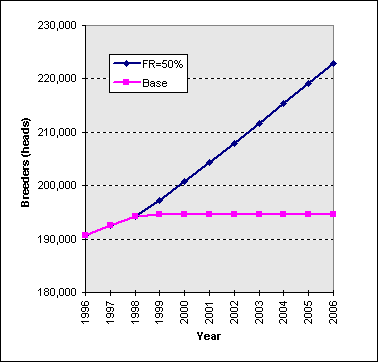
source: Projection by the Herd Growth Routine of LDPS2
Base: Base projection, FR=50%: Fertility rate is assumed to improve.
Though fertility rate of TDL beef cattle is higher than 50 percent, growth rate of the herd calculated by the Herd Growth Routine is around zero percent as they are with short production cycles and offtake rate is high. If the fertility rate improves to 60 percent, annual growth rate of the herd will increase to 1.7 percent. The improvements will also causes efficient feed resources use. If the fertility rates improves, total feed energy requirement to produce the same amount of the current TDL beef production will decrease by 3 percent from the current level.
Some technical inconsistencies in the statistics are detected by LDPS2, as shown in section 3.(3) and (4) of the previous chapter.
Firstly, beef production is thought to be over-reported, while slaughter number is under-reported, in the statistics. Both the slaughter number and the sales of cattle in Table 1 do not make sense, as the numbers are larger than the numbers of birth in TDL and GR. LDPS2 shows rational number of slaughters and amount of beef production.
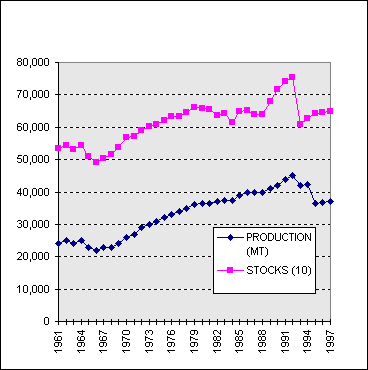
Next, the Herd Growth Routine shows that growth rates of beef cattle herds are around zero percent p.a. Surprisingly, the number of total cattle had grown at more than five percent during the early 1990s (Figure 2). The rapid growth in the period could be over-reported.
The third one is the distribution of total cattle number to the various age classes in Table 1. LDPS2 showed that there might be less 1-3 age cattle and more 3 age old and older cattle than reported. Ages of cattle may be recognized wrongly when the cattle number is counted.
It is recommended to check meat production, including slaughter number, and the growth of cattle herd in the statistics.
