
Introduction
Some facts about thawing
Methods of thawing
Thawing in still air
Air blast thawing
Thawing in water
Vacuum thawing
Electrical methods
Tempering
Choice of method
The continuing growth of quick freezing in the fishing industry has made necessary the development of industrial methods of reversing the freezing process, that is thawing the fish for further processing, for cooking or for sale as wet fish.
Rapid thawing enables the processor or distributor to meet market demands quickly, and with the minimum demand on labour and space. Methods have been developed for thawing frozen fish in the many forms now handled commercially, including large blocks of whole sea frozen fish, blocks of fillets or portions for catering use, single whole fish such as salmon, and blocks of shrimps.
Frozen fish is now being used increasingly by caterers and in the home, and methods of thawing on a small scale have been devised to assist in the preparation of frozen whole fish, fillets and fish portions for immediate cooking.
This note briefly describes the principal methods of thawing and discusses some of their advantages and disadvantages. There is no single procedure ideally suited to all purposes, since conditions will vary with each application. Some guidance is given about the factors to be considered when making a choice.
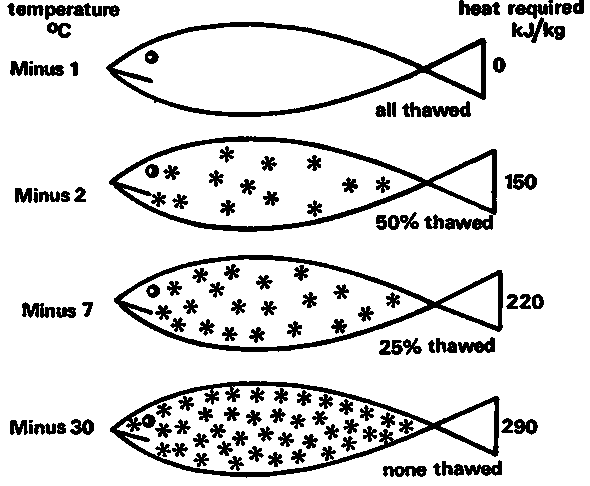
In order to thaw a given weight of frozen fish, a specific quantity of heat must be supplied, whatever the method used; for example 1 kg of white fish taken from a cold store at minus 30°C will require about 300 kJ of heat to thaw it completely. Fish that have a high fat content, for example herring in their prime, require somewhat less heat; only about 240 kJ are needed to thaw completely 1 kg of herring containing about 15 per cent fat.
Less heat is required to thaw fish that are stored at temperatures higher than minus 30°C since less of the water in the flesh is frozen, but for temperatures of minus 15°C and below the difference is small and can usually be ignored.
Thawed fish spoil as rapidly as wet fish, and must be kept chilled until required; the thawed fish can be iced, or the fish can sometimes be removed from the thawer just before thawing is completed, so that the fish has its own small reserve of cold. In any case it is absolutely essential that fish should not be overheated in the thawer since texture and subsequent keeping quality will be impaired. An experienced filleter can cut fillets from a partially frozen fish, provided the backbone is not encased in ice, although filleting will be slower; other disadvantages are lower yield, a rougher cut surface on the fillet and an increased risk of the knife slipping and causing an accident.
Fish will normally lose some weight on thawing; this drip loss may amount to up to 5 per cent for properly frozen and cold stored white fish, though it can be considerably more if insufficient attention is paid to thawing procedure. Very little, if any, of this loss is directly attributable to the thawing process itself; some is accounted for by changes in the nature of the flesh during cold storage, some is due to the melting of any glaze that has been coated onto the fish. Fish that have been frozen before the onset of rigor may complete the rigor process after thawing if the changes have not already taken place gradually during cold storage; this effect is usually more obvious with fillets than whole fish, the fillets contracting noticeably in length. It may be necessary to thaw prerigor fillets slowly in order to avoid distortion or shrinkage.
Fig. 1
Methods of thawing can be divided into two main groups, those in which heat is conducted into the flesh from the surface, and those in which heat is generated uniformly throughout the flesh.
In the first group, heat is applied to the surface of the fish by exposing it to still or moving warm air, by immersing it in or spraying it with water, or by allowing water vapour to condense on it. The outside of the fish thaws first and, since thawed fish is a poorer conductor of heat than frozen fish, heat flowing to the inside meets increasing resistance as thawing proceeds; this imposes a lower limit on the possible thawing time,
A further limit, applying to both groups of thawing methods, is imposed by the need to avoid overheating the fish. If fish temperature exceeds 20°C the quality will suffer and should the temperature rise to more than 30°C the fish will cook and the flesh will break up.
Methods in the second group depend upon the absorption of electrical power at mains, radio or radar frequencies. High rates of thawing are obtained by these methods, but a limit is imposed by the risk of uneven heating if power is fed into the fish too rapidly. This can lead to local cooking.
Single frozen fish, or blocks of fish or fillets, can be laid out overnight to thaw at room temperature and, provided the surface of the fish does not become too dry, the thawed product is perfectly acceptable. Air temperature should not be higher than 18°C. Blocks of herring should be warmed for the minimum time necessary in order to avoid the development of off odours and copious drip losses.
Extremely slow thawing, taking days rather than hours in cold weather for example, should be avoided, since the outer layers of a block may warm and spoil before the centre is thawed. Slow thawing should not be used for frozen whole herring intended for kipper production, since the flesh becomes soft and more prone to damage in splitting machines.
Still air thawing is generally practicable only on a small scale, since considerable space is required, the amount of handling can be excessive and the time taken is often very long, although it has the advantage that little or no equipment is required.
A typical block of sea frozen whole cod 100 mm thick, laid out to thaw in still air at about 15°C, can take up to about 20 hours to thaw; this time can be reduced by separating the fish as soon as this can be done without damage, thus increasing the surface area exposed. Single fish 100 mm thick take 8-10 hours to thaw, depending upon air temperature.
Frozen fish can be thawed much more rapidly in moving air than in still air. To do this most effectively, the fish should be supported on open mesh trays stacked on frames or trolleys not more than 2 m high. The distance apart of the trays should be about twice the thickness of the blocks being thawed.
The time taken will depend on the temperature of the air, the speed at which it moves over the fish, and the shape and size of the block. The air should not be warmer than 20°C or the outer layers of fish will be damaged before thawing is complete.
The air should be blown over the fish at a speed not less than 6 m/s to achieve the shortest thawing times and the flow should be as uniform as possible over the whole cross section. The air should be saturated with moisture to improve transfer of heat to the fish and to prevent drying of the surface; drying results in poor appearance and loss of weight.
The greater the surface area of fish exposed, the faster the fish will thaw; thus an irregular block of whole fish containing many airspaces will thaw much more quickly than a smooth, flat block of fillets of the same dimensions.
Thawing time can be reduced by separating the fish, either by
hand or mechanically, after the blocks have been in the thawer for about 2
hours. The time taken to thaw a block of frozen whole cod 100 mm thick, in humid
air at 20°C moving at 8 m/s, is
4-4 hours, depending on the
size of the individual fish and the compactness of the block.
hours, depending on the
size of the individual fish and the compactness of the block.
Industrial plant
Air blast thawers may be constructed to thaw fish either in batches or continuously. Both types employ recirculated air. Because batch thawers are relatively simple in construction they are cheaper to buy and are also easier to maintain. At the present time they are used in industry more extensively than any other type of plant.
In one type of batch thawer the fish blocks are supported on trays which can easily slide onto the trolleys. The trays are made of galvanized steel sheet shaped with deep corrugations which are aligned so as not to impede air flow when the blocks are placed on them. This arrangement permits air to come into contact equally with top and bottom surfaces of the blocks and also promotes automatic breakup of the blocks during thawing. Blocks of fillets and of flatfish do not separate so readily and no advantage is gained by supporting them on this type of tray.
A typical crossflow batch thawer (Fig. 2) holds 7 tonnes of fish. The working chamber has a cross section of about 2 m x 2 m and a length of about 7 m. Air is made to flow along the length of the chamber by a powerful reversible axial flow fan which is situated in the recirculation duct above the chamber. Periodically the direction of air flow is reversed so that the fish is heated more uniformly. The air, which is circulated at a rate of about 20 m3/s, is humidified in the recirculation duct by water sprayed from a bank of nozzles.
Fig. 2

Heat is provided by banks of finned hot water pipes placed in the air stream close to the fan. The air temperature is regulated by thermostats which control flow-regulating valves in the hot water supply lines. In some earlier air thawers the air flow is not reversible; trolleys have to be rearranged half way through the process to ensure uniform thawing.
300 MJ of heat are required for each tonne of fish thawed; thus a thawer that processes 5 tonnes of 100 mm thick blocks of sea frozen fish in 5 hours requires on average a power input equivalent to 84 kW of which about 20 kW are provided by energy from the fan. In the first hour of thawing, when the fish is at its coldest, about half the total power is absorbed but after that power consumption falls.
In general it is difficult to thaw all fish in a batch completely because it is inevitable that the larger fish will remain partly frozen unless the process is continued for such a long time that the smaller fish become overheated. It is therefore common practice in processing sea frozen fish to box the fish after a specified time in the thawer and to allow temperatures to equilibrate over a further period of 6-12 hours in a chillroom. Care should be taken to cover the fish with ice during this period to prevent dehydration.
Thawing in warm water can be a cheap and easy way of thawing all types of whole fish provided that an ample supply of clean water is available. Thawing can be by immersion, by spraying or by a combination of the two. A large immersion thawer should incorporate a system of recirculation to conserve both heat and water and this may introduce problems of filtration. If recirculation is employed, the water should be chlorinated or changed every day to prevent the number of bacteria building up to an unacceptable level.
Fillets thawed in water become waterlogged and may lose much
of their flavour, but thawing in water is acceptable for whole fish. Whole white
fish thawed in water may lose their gloss and the skin may become bleached.
Herring thawed in water lose most of their remaining scales and these may be a
problem in recirculation and filtration of the water. White fish increase
slightly in weight during thawing but the gain is usually lost by the time they
have been filleted. Water for thawing should not be warmer than 18°C, and
its velocity should be at least 5 mm/s. To thaw blocks 100 mm thick in as short
a time as possible this velocity should be increased to at least 22 mm/s, and
after 4 hours the fish
should be removed from the water and boxed until ready for filleting. Whole
herring in blocks 50 mm thick require about 2 hours to thaw under the same
conditions.
hours the fish
should be removed from the water and boxed until ready for filleting. Whole
herring in blocks 50 mm thick require about 2 hours to thaw under the same
conditions.
Simple immersion thawer
For small scale operation there are various arrangements that can be employed; a simple design is shown in Figure 3. The thawer consists of a tank in which vertical baffles cause water to flow in a serpentine fashion past blocks of fish supported in cages. The water is preheated in a heat exchanger, either by hot water or by direct steam injection. It is fed into the tank at the top in the position shown and is allowed to flow to waste through a drain at the other end. The bottom of the tank should slope towards the water outlet so as to minimize deposition of scales and other debris and to facilitate drainage when the tank is emptied.
The dimensions of the tank and the spacing of the baffles will depend on block dimensions and required output but, as a general guide, the distance between the baffles should be about twice the block thickness. The tank should hold a weight of fish equal to the average hourly output multiplied by the thawing time in hours.
The flow rate of water from the heat exchanger should be at least four times the average output of fish. For example, for an output of 250 kg/h, the minimum flow of water is 1 t/h; the initial water temperature should be 18°C. However, at this rate of flow, fish at the downstream end of the tank will thaw very slowly, so that in a practical situation it will be necessary to increase the flow of water to a rate somewhat higher than the calculated value.
Continuous immersion thawer
Continuous thawers are available which employ sprays alone, immersion alone, or a combination of both. Spray thawers are briefly described below.
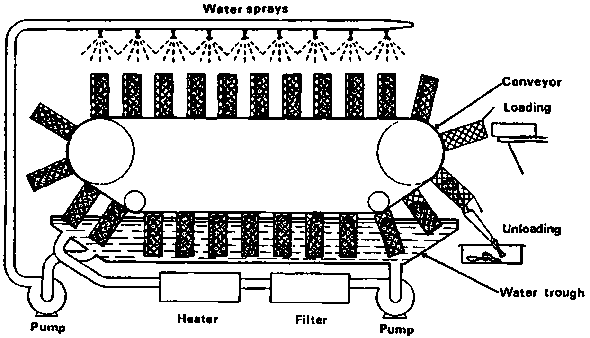
Continuous immersion thawers normally consist of a conveyor on which open mesh baskets are permanently attached (Fig. 4). Blocks are loaded into the baskets while in the horizontal position, are conveyed vertically through a trough and discharged beneath the loading point after a suitable residence time in the water. Although the flow pattern of the water around the blocks in the trough is not ideal, thawing times are not significantly greater than if the blocks were laid flat.
The water at 18°C is recirculated through a filter and heat exchanger, and pumped through overhead sprays. The spray water is drawn from near the input end of the trough where it is free from debris.
Fig. 4
Cleaning of continuous immersion thawers is a problem because there are many places where scales and small pieces of fish flesh and skin can become trapped. It is essential to clean the trough and all moving parts every day; for general advice on cleaning see Advisory Note 45.
Spray thawers
Blocks of fish can be thawed in batches by spraying them with water. In some designs of batch thawers, particularly those intended for thawing blocks of small fish, the blocks are supported on sloping shelves so that when the outer fish thaw and become detached from the frozen core, they slide off the shelves onto a moving belt or are flumed away. Although continuous spray thawers have been designed and operated they are not available ready made; they are normally made to order.
Spray thawing is not generally recommended because the process is difficult to control closely and is wasteful of water unless recirculation and filtration are introduced.
If air containing water vapour is cooled it eventually reaches a temperature below which water begins to condense as liquid; as it does so a considerable amount of heat is set free. At freezing point this amounts to 2·5 MJ/kg of water that condenses, which is equivalent to about 0·7 kWh/kg.
When water vapour condenses on the surface of frozen fish the heat released is immediately absorbed by the fish, and it eventually will thaw the fish completely. About 120 g of water will condense for 2 kg fish thawed.
Unfortunately, the presence of air slows down the rate of condensation but, if most of the air is removed, the rate of condensation becomes so high that it can provide heat as fast as it can be conducted to the inside of the fish. Removing the air also enables the water vapour to get into small spaces between individual fish and between blocks of fish. For some species this is a significant advantage; for example blocks of shrimps 65 mm thick can be thawed in 78 minutes and blocks of plaice 50 mm thick are thawed in 75 minutes. Thawing in this way can be as quick as by air blast or water thawing.
The blocks are stacked on trolleys, as for air blast thawing, and the trolleys are wheeled into an airtight chamber which is then evacuated by a special pump called a liquid ring pump; fig 5 shows a diagram of a commercial vacuum thawing unit. A small quantity of water in a shallow tank at the bottom of the chamber is heated to produce water vapour. It is usually heated by steam, though sometimes by a hot water heat exchanger or by electricity, to a controlled temperature, typically 18°C. Apart from the pump, there are no moving parts and there is nothing mechanical to go wrong. Since vapour is distilled from the water in the tank, it condenses onto the fish in a pure state and the product is not contaminated with any bacteria that might accumulate in the tank. The walls of the chamber remain dry. No smell is produced and the whole operation is hygienic. Little cleaning is required.
Although information is given here about three electrical methods of thawing frozen fish, it must be pointed out that at present none is used commercially, and the equipment is not readily available.
Dielectric heating
When blocks of frozen fish are placed between two parallel metal plates across which a high frequency alternating voltage is applied, heat is generated in the fish without the plates necessarily having to touch the blocks. Ideally, if the blocks are of uniform thickness, composition and temperature, and the voltage and frequency are sufficiently high, typically 5 kV and 80 MHz, heat is produced at a very high rate at all depths within the blocks, so that thawing will take place very rapidly. However, when the conditions are not ideal, such as when blocks are of irregular shape, or when some parts are initially slightly warmer than others, local overheating can occur unless precautions are taken.
In thawing blocks of large whole fish, for example sea frozen white fish, it is necessary to immerse the blocks in water and to pass them through a sequence of separate thawing units positioned above a conveyor. The purpose of immersing them in water is to make the electrical conditions more uniform within the blocks. The water itself plays little or no part in warming the fish but heat is generated much more evenly than it would otherwise be in the absence of water. Fish frozen singly can be immersed and thawed in the same way.
Thawing time for a block of whole cod 100 mm thick is less than 1 hour and for single fish in bulk can be as little as 40 minutes, excluding loading and unloading time.
Blocks other than of large whole fish do not require to be immersed in water and operating conditions are generally less critical; for example, whole herrings in blocks 80 mm thick can be thawed in only 13 minutes and need not be removed from the boxes in which they may be packed.
Dielectric thawing is the fastest method so far available for fish in any form.
Continuous dielectric thawers have been used commercially that can handle 1 t/h or more of frozen fish. Unfortunately, plant and fuel costs taken together are much greater than those of any other method. This disadvantage at present completely outweighs the advantages of high speed and flexibility in handling a wide variety of products.
For catering applications, where time is at a premium, the method may offer some advantage if it is necessary to thaw fairly thick portions of fish, such as steaks or whole flatfish, within a few minutes. Thick portions cannot be cooked direct from the frozen state because the outside becomes overcooked before the inside has thawed. If the fish is allowed to thaw naturally, the caterer must anticipate demand many hours ahead, and this can be wasteful. In this situation dielectric heating offers an advantage.
It is now possible to reduce the thawing time for packaged individual portions or whole flatfish to a few minutes using a small dielectric heater. The equipment, which is not at present made commercially, would enable the caterer to remove the fish from cold storage, thaw it, and then cook it during the time the customer is eating the first course of a meal.
Electrical resistance heating
This method depends on the same principle as an electric heater; when an electric current flows through a material, it becomes warm. Frozen fish at cold storage temperature is a poor conductor of electricity but this difficulty is overcome because fortunately it is a good conductor of heat at low temperature and because its electrical resistance falls as it warms. The method is therefore a hybrid one; the fish is first immersed in cold water where it rapidly warms so that, still frozen, it is able to conduct a high enough current to enable electrically generated heat to complete the thawing. The fish must be in the form of plate frozen blocks so that electrical contact can be made to the two larger surfaces by means of flat metal plates. Alternating current at mains frequency is supplied at a low voltage from a transformer; there is therefore no danger of electric shock if the operator were to touch the fish or the plates. In any case, accidental contact can be prevented by the design of the equipment.
In practice, fillets or small whole fish in blocks up to 50 mm thick are first immersed in tap water for 15-30 minutes, depending on temperature and type of block, and are then heated electrically for a further 15-20 minutes until they are thawed. Since the amount of current flowing increases as the temperature of the fish rises, the flow of current can be shut off automatically when the fish is thawed.
Electrical resistance thawing is probably most suitable for large or medium scale institutional catering or for fish fryers, where demand can be anticipated an hour or so ahead. At present, however, suitable equipment is not made commercially.
Microwave heating
Microwave power, which is generated by electronic devices developed for radar, also heats fish at a very high rate. But since radiation is absorbed by the flesh, there is progressively less heat produced as it goes deeper into the flesh; therefore the method is at present limited to very thin materials such as small single fillets or portions. Microwave heating does not offer any advantage over other methods, particularly in catering applications, since thin pieces can be cooked rapidly direct from the frozen state. The cost of suitable microwave heating equipment for thawing is very high.
Although it is normally necessary to thaw fish completely, or almost completely before processing it further, a particular application that requires raising of temperature without thawing is the softening of blocks of frozen fillets to enable them to be guillotined into portions or fish fingers. The range of temperature within which this can most effectively be done is minus 10°C to minus 15°C.
The process of softening, known as tempering or conditioning, is usually done very slowly to avoid severe reduction in yield when pieces become detached during cutting due to over softening of the outer layers. Blocks are stacked in separate layers on trucks and are left in a chillroom for about 24 hours until the desired temperature is reached.
This slow method, which is wasteful of chill storage space, can be replaced by a simple electrical method of tempering which enable blocks to be warmed sufficiently in about 20 minutes.
The amount of heat necessary to bring the temperature from minus 30°C to within the desired range is equivalent to about 0·01 kWh/kg offish. By metering this quantity of heat into the blocks over a period of 10 minutes or so, using suitable electrically heated plattens, and stacking the blocks for a further few minutes to allow the temperature to even out, they will then be in suitable condition for cutting. The cost of power is about 20p for every tonne of fish tempered.
|
Comparison of thawing methods |
||||||||||
|
|
|
relative cost |
|
|
|
|
|
|||
|
method |
typical output |
capital |
fuel |
maintenance |
labour |
relative speed |
versatility |
temperature distribution |
odour |
cleaning |
|
air blast |
1 |
1·0 |
1·0 |
1·0 |
1·0 |
1·0 |
high |
uneven |
high |
difficult |
|
water |
1 |
1·8 |
0·7 |
1·1 |
0·7 |
0·9 |
high |
uneven |
low |
difficult |
|
vacuum |
1 |
1·4 |
1·0 |
0·1 |
1·0 |
1·1 |
high |
uneven |
low |
easy |
|
dielectric |
1 |
4·3 |
3·8 |
1·4 |
1·0 |
4·0 |
high |
uneven |
low |
easy |
|
electrical resistance |
0·1 |
0·5-1·0 |
2·0 |
0 |
- |
2·0 |
low |
uniform |
low |
difficult |
|
microwave |
0·01 |
5-10 |
4·0 |
2·0 |
- |
high |
low |
uneven |
? |
? |
|
tempering |
1 |
? |
0·8 |
low |
? |
- |
low |
uniform |
? |
easy |
output of plantThe principal features of the various methods are compared in the table.
whether batch or continuous operation
type of product
whether or not fish must be completely thawed
capital cost, including cost of housing the plant
labour requirements
availability of steam or hot water
fuel, maintenance and other running costs
hygiene
ease of cleaning
speed of operation
flexibility of output
ability of plant to process variety of products
As an aid to choosing a thawing method, a decision diagram is also given (Fig. 6). Follow the arrows from top to bottom, answering each question, until a recommended method is indicated.


