
Introduction
Why composition is important
Structure of fish muscle
The principal components of fish muscle
The minor components of fish muscle
Factors affecting the composition of fish
Fish for human consumption
This note gives the chemical composition, in simplified form, of commercially important species of fish landed in Britain or imported in quantity. The note is in two parts. The narrative part describes the structure offish flesh, the nature and function of the main chemical constituents, their variation with season and their contribution to the human diet. The second part consists of tables giving the water, fat and protein content Of individual species and of some fish products, together with additional information on calorific value, mineral and vitamin content.
Since chemical composition can vary widely, not only from fish to fish of the same species, but also within an individual fish, precision is impossible; the tables are meant to serve only as a guide. The information has been gleaned from a wide variety of sources far too numerous to acknowledge individually, and brought together in one leaflet for easy reference.
The processor, the nutritionist, the cook and the consumer all have a direct interest in the composition of fish. The processor needs to know the nature of the raw material before he can apply correctly the techniques of chilling, freezing, smoking or canning. The nutritionist wants to know what contribution fish can make to the diet and to health, and the cook must know for example whether a fish is normally lean or fatty in order to; prepare it for the table. The consumer is interested not only in whether a particular fish tastes good, which is a matter of opinion, but also in whether it is nutritious.
While the consumer is interested mainly in the edible part of the fish, that is the flesh or muscle, the fish meal manufacturer is concerned with the composition of the whole fish, and the processor of fish oils wants to know what is in the liver. Measurement of constituents of fish products is sometimes necessary to meet specifications or to comply with regulations. For example, the fish content of fish cakes or the oil content of fish meal may need to be known in order to meet certain commercial or legal requirements. Fish is one of the most valuable sources of high grade protein available to man in this hungry world, and a knowledge of its composition is essential if the fullest use is to be made of it.
The diagram of a cod fillet shows the surface that was adjacent to the skeleton; the mechanical construction shown here is typical of all white fish, that is fish in which the fat is confined mainly to the liver. The blocks of muscle, which form the individual flakes in the cooked fish, are separated by thin sheets of what is known as connective tissue; these are curved within the fillet and run from the backbone to the skin. In fresh fish the muscle blocks are firmly attached to the connective tissue, and the surface of a cut fillet is smooth and continuous. There are also tiny blood vessels running through the muscle. The connective tissue accounts for only a small percentage of the total weight of the muscle, smaller than for example in beef muscle; this is one reason why fish is generally less tough to eat than meat.
Fig. 1
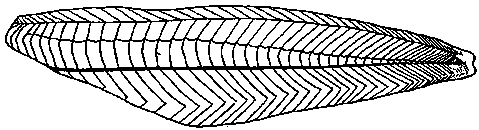
Fish muscle is of two kinds, light muscle and dark muscle. In white fish such as cod and haddock there is a small strip of dark, or red, muscle just under the skin on both sides of the body, running beneath the lateral line. In fatty fish such as herring and mackerel the strips of dark muscle are much larger in proportion and contain higher concentrations of fat and certain vitamins. Since it is not usually practicable to separate the dark, fatty muscle from the light muscle when preparing fish for cooking, as one might trim fat from beef for example, the values given in the tables for composition of flesh are for the total muscle, taking light and dark together.
Fig. 2

Water
The main constituent of fish flesh is water, which usually accounts for about 80 per cent of the weight of a fresh white fish fillet. Whereas the average water content of the flesh of fatty fish is about 70 per cent, individual specimens of certain species may at times be found with a water content anywhere between the extremes of 30 and 90 per cent.
The water in fresh fish muscle is tightly bound to the proteins in the structure in such a way that it cannot readily be expelled even under high pressure. After prolonged chilled or frozen storage, however, the proteins are less able to retain all the water, and some of it, containing dissolved substances, is lost as drip. Frozen fish that are stored at too high a temperature, for example, will produce a large amount of drip and consequently quality will suffer. In the living fish, the water content usually increases and the protein content decreases as spawning time approaches; thus it is possible, with cod for example, to estimate the condition of the fish by measuring the water content of the muscle.
In cod, the water content of the muscle is slightly higher at the tail than at the head; this slight but consistent increase from head to tail is balanced by a slight reduction in protein content.
Protein
The amount of protein in fish muscle is usually somewhere between 15 and 20 per cent, but values lower than 15 per cent or as high as 28 per cent are occasionally met with in some species.
All proteins, including those from fish, are chains of chemical units linked together to make one long molecule. These units, of which there are about twenty types, are called amino acids, and certain of them are essential in the human diet for the maintenance of good health. Furthermore, if a diet is to be fully and economically utilized, amino acids must not only be present but must also occur in the correct proportions. Two essential amino acids called lysine and methionine are generally found in high concentrations in fish proteins, in contrast to cereal proteins for example. Thus fish and cereal protein can supplement each other in the diet. Fish protein provides a good combination of amino acids which is highly suited to man’s nutritional requirements and compares favourably with that provided by meat, milk and eggs.
Fat
Taking all species into account, the fat content of fish can vary very much more widely than the water, protein or mineral content. Whilst the ratio of the highest to the lowest value of protein or water content encountered is not more than three to one, the ratio between highest and lowest fat values is more than 300 to one.
The term fat is used for simplicity throughout this leaflet, although the less familiar term lipid is more correct, since it includes fats, oils and waxes as well as more complex, naturally-occurring compounds of fatty acids.
There is usually considerable seasonal variation in the fat content of fatty fish; for example a starved herring may have as little as ½ per cent fat, whereas one that has been feeding heavily to replenish tissue may have a fat content of over 20 per cent. Sardines, sprats and mackerel also exhibit this seasonal variation in fat content. As the fat content rises, so the water content falls, and vice versa; the sum of water and fat in a fatty fish is fairly constant at about 80 per cent. Although protein content falls very slightly when the fat content falls, it nevertheless remains fairly constant, somewhere between 15 and 18 per cent.
The fat is not always uniformly distributed throughout the flesh of a fatty fish. For example in Pacific salmon there may be nearly twice as much fat in muscle from around the head as there is in the tail muscle.
In white fish of the cod family, the fat content of the muscle is always low, usually below 1 per cent, and seasonal fluctuations in fat content are noticeable mainly in the liver, where the bulk of the fat is stored.
Carbohydrates
The amount of carbohydrate in white fish muscle is generally too small to be of any significance in the diet; hence no values are given in the tables. In white fish the amount is usually less than 1 per cent, but in the dark muscle of some fatty species it may occasionally be up to 2 per cent. Some molluscs, however, contain up to 5 per cent of the carbohydrate glycogen.
Minerals and Vitamins
These include a range of substances widely different in character that must be present in the diet, even if only in minute quantities, not only to promote good health but also to maintain life itself.
Although fish is very unlikely to be the only source of an essential mineral in the diet, fish does provide a well balanced supply of minerals in a readily usable form. The table of mineral constituents of fish muscle gives values averaged from a large number of species and is intended to serve only as a rough guide. It would be impracticable in this short note, and of limited value, to give a detailed analysis for individual species.
Composition tables for fish often include a value for total ash. Since ash consists largely of a number of different minerals, and the total rarely exceeds 1-2 per cent of the edible portion, this figure has also been omitted, except from the table of fish products.
Vitamins can be divided into two groups, those that are soluble in fat, such as vitamins A, D, E and K, and those that are soluble in water, such as vitamins B and C. All the vitamins necessary for good health in humans and domestic animals are present to some extent in fish, but the amounts vary widely from species to species, and throughout the year.
The vitamin content of individual fish of the same species, and even of different parts of the same fish, can also vary considerably. Often the parts of a fish not normally eaten, such as the liver and the gut, contain much greater quantities of oil-soluble vitamins than the flesh; the livers of cod and halibut for example contain almost all of the vitamins A and D present in those species. In contrast, the same two vitamins in eels, for example, are present mainly in the flesh.
Water-soluble vitamins in fish, although present in the skin, the liver and gut, are more uniformly distributed, and the flesh usually contains more than half the total amount present in the fish. The roe, when present, is also a good source of these vitamins.
In general the vitamin content of white fish muscle is similar to that of lean meat and, with the exception of vitamin C, can usually make a significant contribution to the total vitamin intake of man and domestic animals.
The mineral and vitamin content of fish is not markedly affected by careful processing or by preservation, provided storage is not very prolonged.
Extractives
These substances are so called because they can easily be extracted from fish flesh by water or water-based solutions. Unlike the proteins, substances in this group have comparatively small molecules; the most important extractives in fish include sugars, free amino acids, that is free in the sense that they are not bound in the protein structure, and nitrogenous bases, which are substances chemically related to ammonia. While many of these extractives contribute generally to the flavour of fish, some of them, known as volatiles, contribute directly to the flavours and odours characteristic of particular species; as the name suggests, volatiles are given off from the fish as vapours. Most of the extractives are present at very low concentrations but, because of their marked flavour or odour, are nonetheless important to the consumer. Detailed analyses of these substances have not been given because of the large variation existing both between and within species. An additional complication is the way in which the concentrations of these compounds change during storage and spoilage.
When fish is stored after capture, the amount of some of the extractives present will change with time; thus measurement of the amount can often indicate the storage time and hence indirectly the quality. Extractive compounds whose concentration in fish varies directly with time of storage have long been studied since they may provide indicators of the quality of fish.
The composition of a particular species often appears to vary from one fishing ground to another, and from season to season, but the basic causes of change in composition are usually variation in the amount and quality of food that the fish eats and the amount of movement it makes. For example, fish usually stop feeding before they spawn, and draw on their reserves of fat and protein. Again, when fish are overcrowded, there may not be enough food to go round; intake will be low and composition will change accordingly. Reduction in a basic food resource, plankton for example, can affect the whole food chain. An example of how abundance of food supply can markedly change the composition of a species is shown by the sheepshead, an American freshwater fish: when taken from certain small lakes that were overstocked, the sheepshead had an average fat content of 1 per cent, compared with 6-10 per cent for those taken from rivers or lakes where food was plentiful.
Fish can form a very nutritious part of man’s diet; it is rich in most of the vitamins he requires, it contains a good selection of minerals, and the proteins contain all the essential amino acids in the right proportions. Although the amount of protein in fish varies a little from species to species and, on occasions, within a species, the protein content for meat and for fish is roughly comparable.
The extreme variability of composition of different species of fish accounts to some extent for the large variety of dishes than can be made from them; unfortunately fish are all too often lumped together in one category while pork, beef, lamb and mutton are invariably regarded as being quite distinct kinds of meat. In fact there is a much greater difference in composition, flavour and texture between, say, herring, haddock, halibut and salmon than there is between butcher meats, and this range is even wider when shellfish are included.
Through the ages, all kinds of dietary characteristics have been attributed to fish, some complimentary and some not. Some of the claims for fish as food have been based in the past on misconceptions that have not stood the test of time; for example in the nineteenth century fish was purported to be particularly good for the brain, because it is rich in phosphorus but, since there is no evidence to show that phosphorus in the diet increases brain power, and since meat and fish contain similar amounts of this element anyway, this claim is a fallacy.
Undoubtedly one reason for the rather poor reputation of fish in the past has been poor quality due to lack of rapid transport; nowadays, with modern techniques for freezing, storing and transporting very fresh fish, the consumer can receive fish that has a composition and flavour virtually unchanged from when it was caught, and should do so to an ever increasing extent in the future.
TABLE 1
Chemical composition offish flesh1
|
Species |
Scientific name |
water |
fat |
protein2 |
energy value |
|
|
angler |
Lophius piscatorius |
68 |
7·5 |
23·2 |
740 |
|
|
bass |
Morone labrax |
77 |
2·5 |
19·3 |
470 |
|
|
blue whiting3 |
Micromesistius poutassou |
79-80 |
1·9-3·0 |
13·8-15·9 |
340-420 |
|
|
brill |
Scophthalmus rhombus |
76 |
2·5 |
19·8 |
470 |
|
|
carp |
Cyprinus carpio |
78-80 |
2·0-2·2 |
17·5-18·9 |
420 |
|
|
catfish |
Anarhichas sp. |
78 |
2·1-3·8 |
17·0-19·7 |
410-530 |
|
|
cod |
Gadus morhua |
78-83 |
0·1-0·9 |
15·0-19·0 |
310-360 |
|
|
conger |
Conger conger |
80 |
0·2-11·9 |
19-1 |
360 |
|
|
dab |
Limanda limanda |
79 |
0·5-1·2 |
12·8-18·2 |
260-390 |
|
|
dogfish, picked4 |
Squalus acanthias |
75 |
3·9-5·6 |
19·6 |
600 |
|
|
eel5, 6 |
Anguilla anguilla |
60-71 |
8·0-31·0 |
14·4 |
|
|
|
flounder |
Platichthys flesus |
81 |
0·3 |
16·8 |
330 |
|
|
grey mullet |
Mugil sp. |
76 |
3·9 |
19·5 |
530 |
|
|
gurnard |
Trigla sp. |
76-77 |
1·1-2·3 |
19·7-20·2 |
410-470 |
|
|
haddock |
Gadus aeglefinus |
79-84 |
0·1-0·6 |
14·6-20·3 |
280-380 |
|
|
hake |
Merluccius merluccius |
80 |
0·4-1·0 |
17·8-18·6 |
320-380 |
|
|
-, S African |
Merluccius capensis |
79-84 |
0·2-1·4 |
15·2-18·6 |
320-380 |
|
|
halibut |
Hippoglossus hippoglossus |
75-79 |
0·5-9·6 |
18·0-18·8 |
440-740 |
|
|
herring6 |
Clupea harengus |
60-80 |
0·4-22·0 |
16·0-19·0 |
|
|
|
-, whole3, 5 |
|
57-79 |
0·8-24·9 |
14-18 |
|
|
|
John Dory |
Zeus faber |
78 |
1·3 |
18·4 |
400 |
|
|
lemon sole |
Microstomus kitt |
79 |
0·5-3·8 |
16·4-18·4 |
330-370 |
|
|
ling |
Molva molva |
78 |
0·1-0·4 |
19·5-22·2 |
370-430 |
|
|
mackerel5 |
Scomber scombrus |
60-74 |
1·0-23·5 |
16-20 |
|
|
|
megrim |
Lepidorhombus whiff |
80 |
1·0-3·9 |
17·8 |
360 |
|
|
Norway pout3 |
Trisopterus esmarkii |
73-77 |
4·2-5·1 |
16·0 |
480-520 |
|
|
perch |
Perca fluviatilis |
79-80 |
0·8 |
17·6-19·0 |
360 |
|
|
pilchard5 |
Sardina pilchardus |
60-80 |
2·0-18·0 |
17·0-20·0 |
|
|
|
-, S African3,5 |
Sardinops ocellata |
64-75 |
2·3-14·7 |
15·3-18·9 |
|
|
|
plaice |
Pleuronectes platessa |
81 |
1·1-3·6 |
15·7-17·8 |
360-490 |
|
|
pollack |
Gadus pollachius |
79 |
0·6-0·8 |
16·4-20·3 |
320-400 |
|
|
redfish |
Sebastes sp. |
73-79 |
3·2-8·1 |
16·8-19·7 |
460-670 |
|
|
red mullet |
Mullus surmulletus |
75 |
5·1 |
19·0 |
570 |
|
|
saithe |
Pollachius virens |
81 |
0·3-0·6 |
16·4-20·3 |
320-400 |
|
|
salmon5 |
Salmo salar |
67-77 |
0-3-140 |
21·5 |
|
|
|
-, Pacific5 |
Oncorhynchus sp. |
67-78 |
2·7-10·6 |
17·7-21·9 |
|
|
|
sand eel3 |
Ammodytes sp. |
73 |
6·8 |
17·8 |
620 |
|
|
sea bream |
Sparus centrodontus |
79 |
1·5 |
17·6 |
390 |
|
|
skate, ray4 |
Raja sp. |
77-82 |
0·1-1·6 |
18·2-24·2 |
400-450 |
|
|
sole |
Solea solea |
78 |
1·8 |
18·8 |
430 |
|
|
sprat3, 6 |
Sprattus sprattus |
|
|
|
|
|
|
|
|
7- 9 cm |
80-81 |
3·8-4·1 |
14·1-14·8 |
440 |
|
|
|
9-11 cm |
75-76 |
7·5-9·5 |
14·7-14·8 |
610 |
|
|
|
12-15 cm |
70-73 |
11·1-14·1 |
15·3 |
830 |
|
trout5 |
Salmo trutta |
70-79 |
1·2-10·8 |
18·8-19·1 |
400 |
|
|
tuna |
Thunnus sp. |
71 |
4-1 |
25·2 |
630 |
|
|
turbot |
Scophthalmus maximus |
78 |
2·1-3·9 |
16·8-20·6 |
390-420 |
|
|
tusk |
Brosme brosme |
79 |
0-5 |
18·4 |
360 |
|
|
whiting |
Gadus merlangus |
80 |
0·2-0-6 |
16·4-19·0 |
330-370 |
|
|
witch |
Glyptocephalus cynoglossus |
81 |
0-2-12·2 |
14·6-17·5 |
340·860 |
|
|
shellfish: |
|
|
|
|
|
|
|
crustaceans: |
|
|
|
|
|
|
|
crab, brown meat |
Cancer pagurus |
70 |
7·5 |
13·1 |
560 |
|
|
-, white meat |
|
74 |
0·2 |
22·4 |
430 |
|
|
king crab, white meat |
Paralithodes camchaticus |
81-91 |
0·4-1·7 |
6·9-14·8 |
230 |
|
|
lobster, brown meat |
Homarus vulgaris |
64 |
14·5 |
14·5 |
890 |
|
|
-, white meat |
|
75 |
0·3 |
19·7 |
410 |
|
|
Norway lobster, while meat |
Nephrops norvegicus |
77 |
0·6-2·0 |
19·5 |
400 |
|
|
prawn, white meat |
Palaemon serratus |
71 |
1·3 |
22·8 |
480 |
|
|
shrimp, white meat |
Crangon crangon |
68-70 |
0·9 |
10·5-23·2 |
450-500 |
|
|
molluscs:7 |
|
|
|
|
|
|
|
cockle |
Cardium edule |
79-92 |
0·3-4·8 |
9·1-9·9 |
390 |
|
|
mussel |
Mytilus edulis |
80-84 |
0·8-2·3 |
8·9-11·7 |
270-300 |
|
|
oyster |
Ostrea edulis |
77-83 |
1·1-2·5 |
8·6-12·6 |
320-460 |
|
|
scallop |
Pecten maximus |
73-79 |
0·5-1·0 |
19·5 |
350 |
|
|
squid |
Loligo vulgaris |
78 |
1·1-1·5 |
14·9-19·2 |
390 |
|
Chemical composition offish products1
|
Product |
water |
fat |
protein2 |
ash |
energy value |
|
brisling, canned smoked |
|
|
|
|
|
|
in oil |
50 |
29·2 |
18·3 |
2·6 |
1,540 |
|
-, in tomato |
67 |
17·1 |
12·2 |
3·0 |
885 |
|
caviar |
38 |
20 |
30 |
4·6 |
1,530 |
|
cod, fried |
69 |
4·7 |
20·7 |
|
635 |
|
-, steamed |
79 |
0·9 |
18·0 |
|
370 |
|
cod liver |
32 |
55·1 |
4·6 |
3·6 |
2,340 |
|
cod milt |
82 |
1·1 |
14·5 |
1·8 |
320 |
|
cod roe |
70 |
1·7 |
24·3 |
1·8 |
570 |
|
-, fried |
62 |
11·9 |
20·6 |
|
935 |
|
crab paste |
70 |
8·6 |
15·6 |
3·2 |
680 |
|
fish meal, white |
6-15 |
1·7-5·9 |
55-71 |
17·2-25·8 |
|
|
-, average |
11 |
3·6 |
63 |
22·3 |
|
|
fish paste |
64 |
9·5 |
149 |
|
790 |
|
haddock, smoked, |
72 |
0·9 |
22·3 |
|
450 |
|
steamed |
|
|
|
|
|
|
herring, fried |
59 |
15·1 |
21·8 |
|
1,070 |
|
herring meal |
9 |
8 |
71 |
9 |
|
|
herring milt |
82 |
3·0 |
15·1 |
2·8 |
385 |
|
herring roe |
66 |
2·4 |
24·3 |
1·5 |
590 |
|
kippers |
62 |
13·4 |
21·1 |
|
930 |
|
-, baked |
59 |
11·4 |
23·2 |
|
910 |
|
lobster, boiled |
72 |
3·4 |
21·2 |
|
540 |
|
pilchards, canned |
64 |
15·4 |
18·9 |
|
1,000 |
|
plaice, fried |
59 |
14·4 |
18·0 |
|
1,060 |
|
-, steamed |
78 |
1·9 |
18·1 |
|
420 |
|
salmon, canned |
67 |
9·6 |
20·6 |
2·4 |
800 |
|
salt cod |
33 |
0·5 |
42 |
22·2 |
|
|
tuna, canned in oil |
48 |
27·7 |
23·3 |
1·7 |
1,570 |
1. The values in tables 1 and 2 are for raw flesh, or organs, unless otherwise indicated; values for whole fish will of course be different from those for edible flesh.
Where a range of values is given, this means that a number of analyses have been made, but where only one value is given this usually means that the result of only one analysis is available, and not that the particular value is invariable.
Values for water content have been rounded to the nearest whole number, and other values to the first decimal place.
2. Protein values given are usually obtained by multiplying the total nitrogen content by 6-25; since 10-15 per cent of the total nitrogen content of fish is not in protein form, the values given are higher than the true protein content available for nutritional purposes. Comparisons between species are largely unaffected by this factor except in certain instances (Note 4).
3. These values are for whole, ungutted fish.
4. Dogfish, skates and rays have an unusually high proportion, about 30 per cent, of nitrogen in non-protein form; true protein content will thus be correspondingly lower than the values given.
5. Since the fat content of these migratory fatty fish varies within wide limits, the energy value, which is dependent on fat content, has been omitted. If the fat and protein contents of a particular sample of fish is known, the energy value can be roughly determined as follows: energy value, Cal/lb = 4·5 (4·1 x % protein + 9·3 x % fat)
Fat content and water content of fatty fish are usually directly related; thus it is possible to estimate fat content when water content is known, and vice versa. For example, the following formula applies to herring:
Similar expressions could be obtained for other fatty fish.
6. In these species, fat content is related to length of fish.
7. Values are for total contents of shell, except for squid, where the values are for edible portion.
TABLE 3
Mineral constituents offish muscle
|
Element |
average value1 |
range |
|
sodium |
72 |
30-134 |
|
potassium |
278 |
19-502 |
|
calcium |
792 |
19-881 |
|
magnesium |
38 |
4·5-452 |
|
phosphorus |
190 |
68-550 |
|
sulphur |
191 |
130-257 |
|
iron |
1·55 |
1-5·6 |
|
chlorine |
197 |
3·761 |
|
silicon |
4 |
- |
|
manganese |
0·823 |
0·0003-25·2 |
|
zinc |
0·96 |
0·23-2·1 |
|
copper |
0·20 |
0·001-3·7 |
|
arsenic |
0·37 |
0·24-0·6 |
|
iodine |
0·15 |
0·0001-2·73 |
1. This value has been derived by averaging values for a large number of species.
2. Most values lie between 20 and 40 mg/100g.
3. Most values lie near to 0·04 mg/100g.
TABLE 4
Vitamins A and D in fish
|
Species |
vitamin A |
vitamin D |
oil content |
|
a. flesh of: |
|
|
|
|
cod |
0-50 |
0 |
|
|
eel |
300-4,500 |
1-500 |
|
|
haddock |
0-50 |
0 |
|
|
halibut |
400 |
40 |
|
|
herring |
20-400 |
300-1,000 |
|
|
mackerel |
50-200 |
100-1,000 |
|
|
salmon, Pacific |
70-500 |
200-800 |
|
|
sprat |
400-1,000 |
300-1,000 |
|
|
b. Liver oil from: |
|
|
|
|
cod |
200-10,000 |
20-300 |
50-75 |
|
dogfish |
160-120,000 |
5-25 |
15-75 |
|
halibut |
2,800-360,000 |
550-20,000 |
15-20 |
|
herring |
3,600-10,000 |
|
10 |
|
mackerel |
2,500-130,000 |
750-1,000 |
5-20 |
|
salmon |
5,000-20,000 |
|
10 |
|
tuna |
40,000-800,000 |
16,000-30,000 |
10-35 |
TABLE 5
B vitamins in fish
|
Species or Product |
thiamine |
riboflavin |
niacin |
B6 |
B12 |
pantothenic acid |
biotin |
|
cod
|
0-7 |
0-8 |
20 |
1·7 |
0-01 |
1·7 |
0·03 |
|
0·5-1·8 |
0·2-1·6 |
15-23 |
1·2-2·8 |
0·002-0·011 |
0·8-3·1 |
|
|
|
cod liver |
|
3·4 |
15 |
|
0·11 |
4·3 |
|
|
cod roe |
2·5 |
5·5 |
8·0 |
1·4 |
0·15 |
19·7 |
0·17 |
|
crab |
|
0·9 |
17-28 |
2·3 |
0·13 |
7·1 |
0·10 |
|
crab paste |
0·6 |
1·9 |
12 |
|
0·44 |
15·7 |
|
|
eel
|
1·5 |
2·0 |
35 |
3·0 |
0·01 |
1·5 |
|
|
1·3-2·0 |
0·4-4·6 |
33-41 |
2·0-3·6 |
0·006-0·03 |
0·9-2·4 |
|
|
|
haddock
|
0·7 |
1·0 |
40 |
1·2 |
0·01 |
2·5 |
0·05 |
|
0·3-1·0 |
0·2-1·6 |
31-44 |
|
0·005-0·02 |
0·4-2·9 |
|
|
|
halibut
|
0·7 |
0·8 |
60 |
4·0 |
0·01 |
2·5 |
0·05 |
|
0·3-1·2 |
0·4-1·8 |
30-110 |
1·1-5·5 |
0·007-0·009 |
1·5-3·6 |
0·03-0·08 |
|
|
herring
|
0·4 |
3·0 |
40 |
4·5 |
0·1 |
100 |
0·1 |
|
0·1-1·3 |
0·9-3·3 |
20-63 |
3·5-4·2 |
0·08-0·14 |
9·3-9·7 |
0·09-0·16 |
|
|
herring roe |
|
3·2 |
14 |
|
0·1 |
17·3 |
|
|
kippers |
|
3·7 |
48 |
|
0·02 |
10·4 |
|
|
lemon sole
|
0·9 |
0·8 |
35 |
|
0·01 |
3·0 |
|
|
|
0·7-0·9 |
26-13 |
|
0·006-0·01 |
2·5-4·2 |
|
|
|
lobster |
0·8-0·9 |
0·4-0·6 |
12-21 |
|
0·01 |
|
|
|
mackerel
|
1·0 |
3·5 |
75 |
7·5 |
0·1 |
10·0 |
0·07 |
|
0·2-2·0 |
1·6-6·6 |
41-114 |
5·0-8·9 |
0·02-0·13 |
9·7-10·9 |
0·06-0·08 |
|
|
oyster
|
1·2 |
1·8 |
20 |
1·5 |
0·2 |
2·5 |
0·09 |
|
0·7-2·9 |
0·6-3·5 |
14-39 |
|
0·15-0·46 |
|
|
|
|
plaice
|
2·0 |
1·3 |
40 |
2·5 |
0·01 |
8·0 |
0·9 |
|
0·2-4·6 |
0·9-3·3 |
21-106 |
1·6-3·1 |
0·009-0·011 |
6·8-11·2 |
|
|
|
saithe
|
1·0 |
2·0 |
35 |
4·7 |
0·04 |
4·0 |
0·07 |
|
|
1·7-3·0 |
32-14 |
|
0·022-0·05 |
3·5-4·1 |
|
|
|
salmon
|
2·0 |
1·5 |
70 |
7·5 |
0·05 |
20 |
0·05 |
|
1·4-2·4 |
0·6-2·2 |
54-88 |
6·0-9·8 |
|
|
|
|
|
shrimp
|
0-2 |
0·3 |
25 |
0·3 |
0·01 |
2·5 |
|
|
0·1-0·5 |
0·1-0·7 |
11-53 |
0·1-0·6 |
|
1·2-3·8 |
|
|
|
white fish meal |
2·5-3·9 |
5·9-13·5 |
44-46 |
2·7-11·2 |
0·1 |
5·6-11·8 |
|

