No successful fishing trials could be made with the trawl in deep waters off the Ivory Coast. Echo sounder searches indicated that the sea bottom is very steep from about 100 m downwards and no suitable trawling grounds were found in the slope between 300 and 700 m depth.
A total of 23 trawl hauls were made on the shelf off Ghana and the Ivory coast mainly for the purpose of identification of echo recordings. A complete record of the catches by species is shown in Annex III and Figure 1 shows the location of the hauls. Size compositions of samples of the most important species are shown by samples in Annex IV and V and pooled in histogrammes in Annex I and II
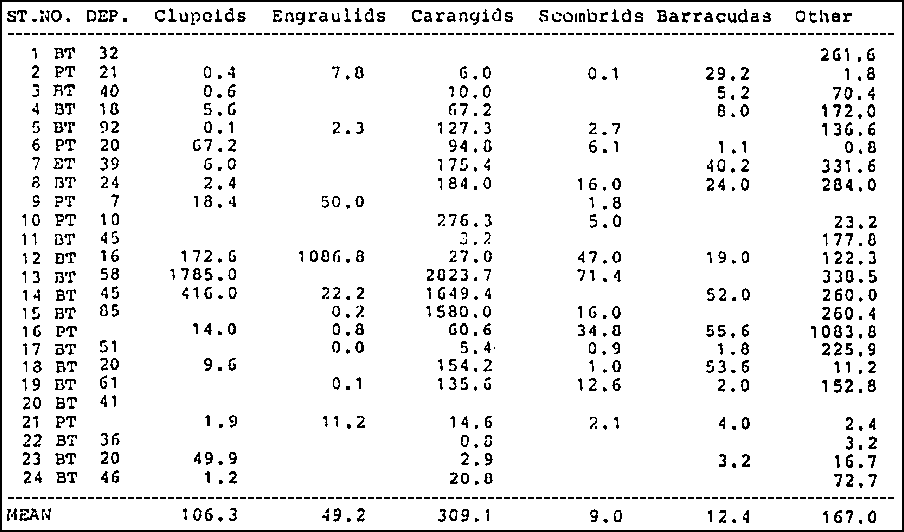
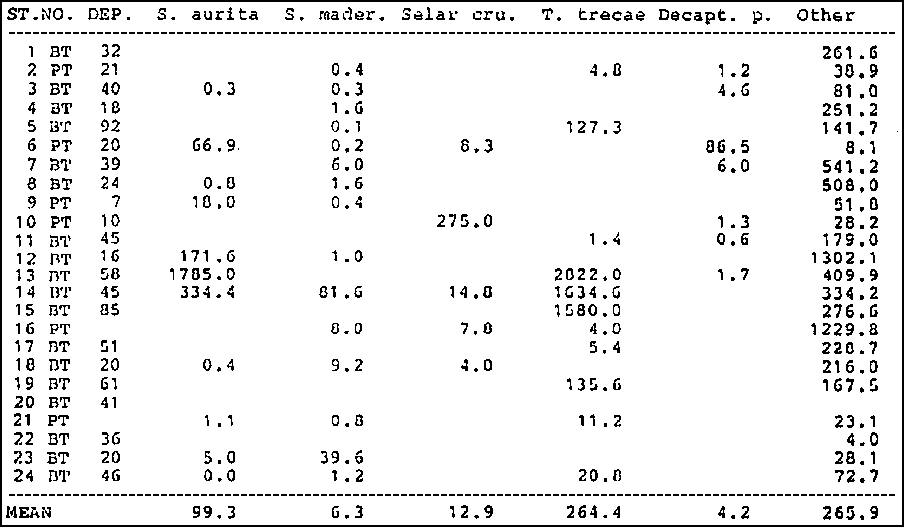
In Table 1 the catches are summarized by main groups of pelagic families and in Table 2 by main pelagic species or species groups. The catch rates were generally low except for some hauls off the western part of Ghana and the easternmost part of the Ivory Coast. When considering these catch compositions one should keep in mind that the catchability in a trawl may be different for the different species. The experience is that fast swimming large sized fish as sardinella has a low catchability. Carangids represent the most common pelagic group with Cunene horse mackerel as the dominating species. Other species of this group included the bigeye scad Selar crumenopthalmus and the round scad Decapterus punctatus. The carangids caught were small sized (see Annex I and II). Apart from one larger catch of anchovy Engraulis encrasiculus the dominating species of the clupeoids was the round sardinella, Sardinella aurita. The total catch of flat sardinella, Sardinella maderensis, was only about 6 % of that of the round. The sardinellas were small sized with several modal lenghts (see Annex I and II), but one should keep in mind that large sized sardinella be underrepresented in the catches. The scombrids consisted of small catches of chub mackerel Scomber japonicus and West African Spanish mackerel Scomberomorus tritor and the barracudas of Sphyraena guachancho with minor pans of S. sphyraena.
Table 1. Standardized catch rates (kg/hour) of pelagic fish by main groups.
Although the main objective of the survey was the description of the pelagic resources, fishing with bottom trawl provided some catches of demersal species. These data are too scanty for describing the composition of the demersal shelf stocks, but an analysis may add to already existing information.
Table 3 gives a summary of the most common demersal fish in the catches. The grunts represent the most common family with bigeye grunt Brachideuterus auritus completely dominating this group. This is a small sized species (see Annex I and II). The sea-breams, Sparidae, a commercially more interesting group, also occurred in most of the bottom hauls. As shown in Table 4 the most common species was the red pandora Pagellus bellotti with blue spotted seabream Sparus caeruleostictus next. Three Dentex species were caught in small numbers. The Sparids covered a relatively wide size range.
The bigeyes were represented by Atlantic bigeye Priacanthus arenatus only. Other commercial groups present in small quantities were groupers Serranidae by white grouper Epinephelus aeneus, croakers Sciaenidae mainly by long neck croaker Pseudotolithus typus and snappers Lutjanidae by golden African snapper Lutjanus fulgens.
Table 2. Standardized catch rates (kg/hour) of pelagic fish by main species.