The units of acoustic reflection is 0.1 × m2/nm2 reflecting surface. This unit is not directly proportional to the fish density since small sized fish give a higher acoustic reflection per unit weight than bigger fish, but in gross terms Figure 3 and 4 give a fair picture of the main distributional features of the small pelagic fish in the area. An arbitrary scale has been used to illustrate different levels of concentration. The integrator values were allocated to the following groups on the basis of trawl sampling and characteristic behaviour:
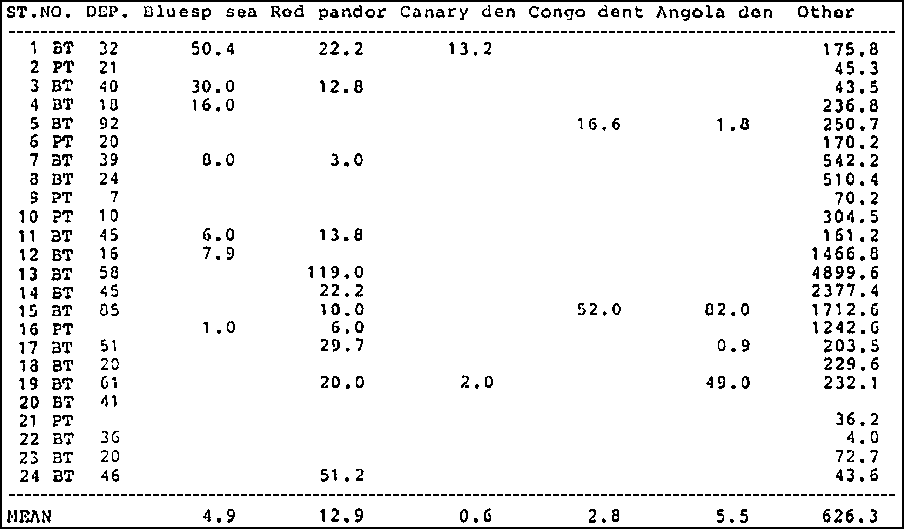
Pelagic fish type 1: Clupeids and anchovyTable 3. Standardized catch rates (kg/hour) of demersal fish by main groupsPelagic fish type 2: Carangids, scombrids, barracudas etc
Demersal fish in mid water.
Table 4. Standardized catch rates (kg/hour) of demersal fish by main species.
Ghana
Figure 3 illustrates the distribution of the two categories of pelagic fish observed off the coast of Ghana. Demersal fish was only recorded occasionally on the echo sounder during nighttime and is not included in the figures.
The Pelagic Fish type 1, sardinellas and anchovies were generally distributed on the inner part of the shelf with the densest concentration to the west of Accra. This coincided with the intensive gill net fishing by small boats at night which complicated the sampling. Smaller areas of relatively dense aggregations were found inshore also further west. The aggregations represent school areas usually with a mixture of medium sized and small schools and with catches showing the presence of both sardinellas and anchovies.
Pelagic fish 2, carangids mostly Cunene horse mackerel with dispersed scombrids, barracudas and scads were recorded relatively low densities over most of the shelf, Figure 3. A few small school areas of bigeye scad Selar crumenophthalmus were located near the shelf edge.
The total biomass estimate for the pelagic fish surveyed in this area is 98 000 tonnes. A separation into the categories described above gives:
|
Sardinellas and anchovies |
41 000 t |
|
Carangids, scombrids etc. |
57 000 t |
Ivory Coast
Figure 4 illustrates the distribution of the two categories of pelagic fish observed on this shelf. Dense aggregations were not located off any part of the coast. The Pelagic Fish 1 was more restricted to the inner shelf and consisted according to the catches of small sized sardinella and anchovy. The Pelagic fish 2 extended further offshore and catches showed mainly horse mackerel with a little chub mackerel, bumper and lookdown. An aggregation near the border with Ghana appeared to consist of hairtail Trichiurus lepturus and horse mackerel. The more dispersed distribution off Ivory Coast shown by the acoustic survey results is reflected in the generally low catches obtained in the fishing experiments in this part.
The total biomass estimate for the pelagic fish surveyed in this area is 39 000 tonnes. A separation into the two categories gives:
|
Sardinellas and anchovies |
6 000 t |
|
Carangids, scombrids etc. |
33 000 t |