


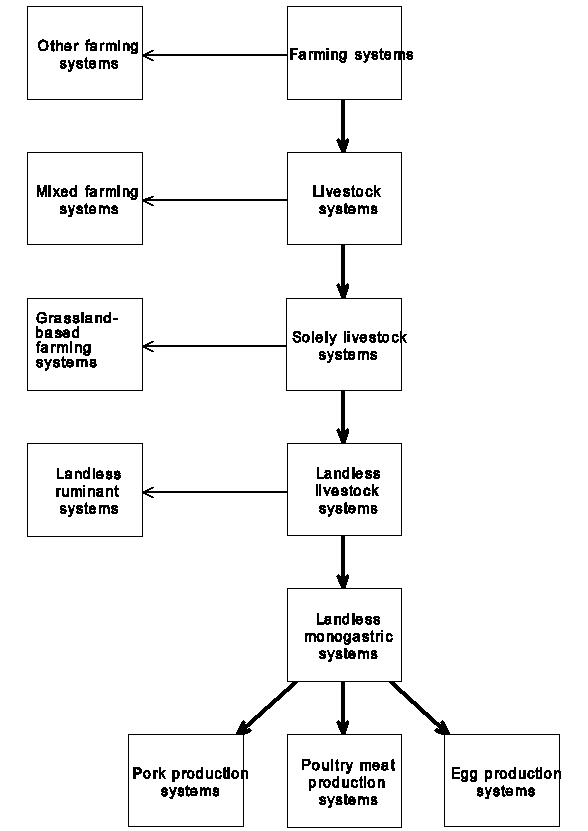
The delineation of “Landless Livestock Monogastric” production systems (LLM systems), as proposed by Sere & Steinfeld (1995), is schematically given in Figure 1 and explained below. Livestock systems are defined as a subset of farming systems, in which livestock contributes more than 10% to total farm output in monetary terms, or in which intermediate contributions of animal origin (e.g. animal traction, manure) represent more than 10% of the total value of purchased inputs. Within livestock systems, mixed farming systems and solely livestock systems are distinguished. For the delineation of LLM system, the definition of the latter is important: solely livestock systems are livestock systems in which more than 90% of the dry matter fed to animals comes from rangelands, pastures, annual forages or purchased feeds, and less than 10% of the total value of agricultural production comes from non-livestock farming activities. Solely livestock systems can either be grassland-based or landless. Landless livestock systems are defined as a subset of the solely livestock systems, in which less than 10% of the dry matter fed to animals is farm produced, and in which annual average stocking rates are above 10 livestock units (LU) per hectare of agricultural land1. Contrary to mixed and grassland-based farming systems, landless farming systems were not assigned to agro-ecological zones or to World Regions (a term used by FAO for the purpose of this study). In this respect, landless livestock systems are unique in the sense that in principle they can occur in all world regions. Finally we arrive at LLM systems by defining these systems as a subset of landless systems, in which the monetary value of outputs of the pig or poultry enterprise is higher than that of the ruminant enterprise. Within LLM systems, three subsystems can be distinguished: a subsystem in which pork is the end product, a subsystem in which poultry meat is the end product and a subsystem in which eggs are the end product.
1 To give an impression of the numbers needed to comply with this criterion, the calculation in Annex 1 shows that 10 LU roughly equal 50 pigs or 1100 broilers or 780 laying hens per hectare of agricultural land.
Meat and egg production from LLM systems was estimated per country in the following way (Sere & Steinfeld, 1995):
1) For pigs, total pork production of a given country was based on the degree of urbanization (expressed as a fraction), multiplied by a factor of 0.5 i.e. (0.5 * urbanization * national output). For countries with per capita incomes above US$ 6000 pa, the factor was raised to 0.7.2) For poultry meat and eggs, the straight urbanization factor was used to estimate the production volume from landless systems, i.e. (urbanization * national output). For countries with per capita incomes above US$ 6000 pa, the factor was increased by adding 0.5 * (1 minus urbanization) to the initial urbanization factor. Thus, levels of landless production share are higher than urbanization, while asymptotically reaching 100%.
The method to calculate the share of LLM systems in total production may not be very precise and it can be questioned to what extent this approach agrees with reality. For this reason, in Annex 2 the real situation in several countries is compared with the obtained results for pigs using the calculation method of Sere & Steinfeld (1995). It can be concluded that in general the calculation method applied, results in fair approximations of the share of LLM systems in total pork production.
In general, most environmental effects caused by LLM systems occur in the form of emissions. For example, the production of feedstuffs involves changes in land use, the use of pesticides/herbicides, fossil energy consumption for transport, etc. These effects are often characterized as indirect effects, caused by LLM systems.
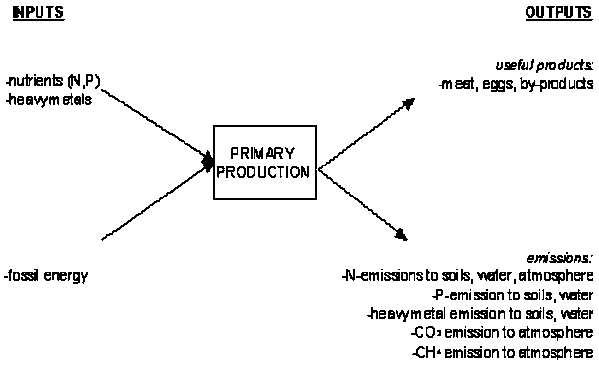
Emissions may be defined as flows, leaving the production environment and entering the external environment (soil, water, atmosphere). Most emissions are from manure, during storage or after application on soils. Emissions mainly result from the use of the main inputs in LLM system: fossil energy and concentrates. In Figure 2, the most important potentially polluting inputs and emissions are schematically given. The production of the inputs themselves has an environmental impact as well.
Other indirect environmental effects occur at the end of the production chain: slaughterhouses and animal processing industries produce all kinds of wastes, which may or may not cause pollution. A number of other issues typically related to LLM systems are also discussed in this report, but most of them do not directly cause environmental problems. These issues are the possible contribution of LLM systems to genetic erosion, the induced competition between food and feed, food safety problems and problems associated with animal welfare and high consumption levels of livestock products. The reason why these issues are discussed anyway is because they may have a significant impact on the future structure and importance of LLM systems.
Before dealing with the environmental impact of LLM systems in more detail (Chapter 3), a general description of the LLM system is given in Chapter 2. In Chapter 4, some options to mitigate the environmental impact of LLM systems are discussed. Finally, in Chapter 5 some concluding remarks are made.
