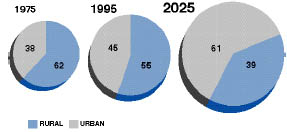
There is increasing concern about the impact of growing levels of urbanisation: by the year 2025, 61 per cent of the world population will be living in urban areas. Many will be living close to or even below the poverty line. How to adequately feed this rapidly expanding urban population is a challenge.
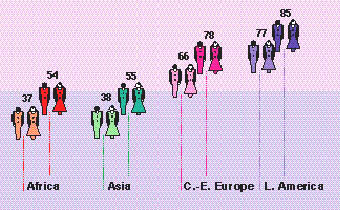
In the 1960s, two inhabitants in ten in Sub-Saharan Africa and in Asia lived in cities, whereas it is estimated that close on 60 per cent of the population will be living in urban areas by the year 2025. Many African and Asian cities have urban growth rates which will double their population in less than 20 years: Kampala (5.2%), Addis Ababa (5.2%), Nairobi and Conakry (4.3%), Rawalpindi (3.8%), are some examples.
 Supplying
the cities is also a major challenge as by the year 2020 it is estimated that
the population of the world’s cities will have doubled. This unprecedented
expansion calls for massive investments in food distribution, storage and marketing
facilities.
Supplying
the cities is also a major challenge as by the year 2020 it is estimated that
the population of the world’s cities will have doubled. This unprecedented
expansion calls for massive investments in food distribution, storage and marketing
facilities.
Jacques Diouf, Director-General of FAO World Food Day - 16th October 1997The situation is different in Latin America where rapid growth has already taken place and the problem is more in terms of feeding a population, 85 per cent of which will be urban by the year 2025. Urban populations are already characterised by high poverty levels, as evidenced in the large shantytowns surrounding most of the large cities in this region.
In the countries in transition of Central and Eastern Europe, urbanisation levels will be reaching 75-80 per cent in 2025 despite urban growth rates often below one per cent.
The challenge in these countries is represented by the need to organise food production, processing and marketing facilities so as to satisfy an urban demand characterised by growing poverty levels.
Changing world urban-rural population (%)
Source: UN (1994)The Habitat II Conference held in Istanbul in 1996 stressed the direct relationship between high urbanisation levels and rapid urban growth rates of many developing countries and countries in transition (DCTs) and urban poverty levels. This relationship is turning the problem of feeding urban populations into a pressing one.
Levels of urbanisation (2000-2025)
Source: UN (1994)In fact, forecasts indicate only a limited rise in urban inhabitants disposable incomes, which is likely to be offset by higher food prices, if food marketing costs are not contained.
In response to growing food needs, DCTs have in the past increased their imports. Economic stabilisation policies, and in many cases currency devaluation, are forcing them to restrict imports and resort increasingly to domestic production, which can, in turn, be stimulated by the recapture of domestic markets.
Urban food marketing and food security
Urban growth has a number of direct and indirect consequences on food supply and distribution. All of these are relevant in an assessment of urban food security.
For example, urban growth increases marketed food demand but reduces the availability of productive land.
The enhancement of
the broad range of rural-urban linkages would greatly support development
initiatives under the FAO’s Special Programme for Food
Security.
It modifies food-purchasing habits and makes existing market areas and infrastructure inadequate in both rural and urban areas.
Urban growth increases the price of available land, it intensifies traffic, alters the location of consumers and modifies their food consumption habits. It also increases the distances of consumers from their work sites and the cost of food transport. Newly urbanised areas need food market and sales outlets.
As urban food demand rises, food supply and distribution systems have to supply the inhabitants of cities with increasing amounts of food coming from ever more distant production zones and/or from more intensive production systems. Urban areas will provide the necessary incentives for increased national production made possible by more remunerative producer prices. Linkages between consumption and production areas need therefore to be strengthened, so as to contain the likely increase in marketing costs.
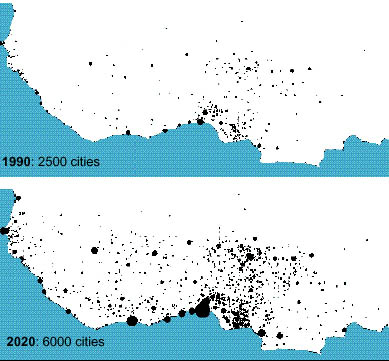
Growth of cities in Western Africa: (1990 - 2020)
Source: OCDE - Club du Sahel, 1997In fact, from harvest until the moment food reaches the urban table, a whole series of interventions (assembling, handling, processing, packaging, transport, storage, wholesaling and retailing) add to the price paid by consumers. If these interventions are inefficient, then not only will these costs be higher than they need be, but also there could be significant product losses which further increase costs.
Since direct action by State institutions has in the majority of cases proved ineffective (see, for example, the Grain Marketing Boards of many Sub-saharan and Latin American countries), there is now an urgent need to achieve an efficient and dynamic, private sector driven, distribution system.
Farmers and traders must be provided with an appropriate legislative and regulatory framework, adequate and well-managed market infrastructure, transport facilities, credit facilities, market information, investment incentives and skills.
As cities in DTC’s expand, the need for well planned and properly equipped retail and wholesale markets and storage facilities increases. Their design must be integrated into urban development plans because of their need for space, water, electricity, sewage and cleaning services and their implications for traffic, public health and the environment. Their management needs improvement.
New forms of food distribution, which better integrate producers with consumers, need to be stimulated, taking account of available economies of scale.
Efficient and well managed small and medium food processing enterprises able to satisfy the demand for processed food required by urban lifestyles, must be promoted with appropriate programmes.
All this requires investment which the public sector, increasingly confronted with financial difficulties, finds it difficult to provide. Private investment, if it is to be forthcoming, will need a stable political and economic environment and profitable opportunities.
Efficient and dynamic food marketing systems will facilitate a greater integration of domestic food producers with the market, in terms of their ability to produce in response to market requirements, the opportunities for selling their produce, and the reward for their effort. However, food producers may need to be oriented to better respond to market requirements and opportunities: there is a role for marketing information and extension services.
The International
Conference on Nutrition, held in Rome in 1992, underlined the need for an
interdisciplinary and inter-institutional approach to improving the quality and
access to food by rural and urban consumers.
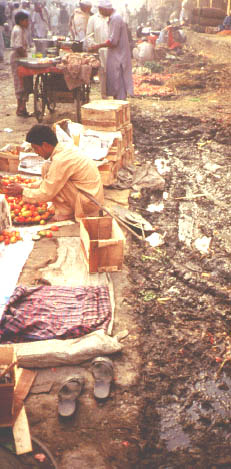
One of the main
challenges of forthcoming decades will be to achieve an efficient distribution
of nutritional and inexpensive foodstuffs to the poor sectors of urban
inhabitants.
Improved food marketing systems help job creation, notably of women, and therefore family incomes. Improving their efficiency should not necessarily mean the destruction of the small-scale informal sector, which plays an important role in supplying low-cost food to the poorer consumers. There is, of course, an element of contradiction between efficiency and social objectives in terms of employment, although varying levels of economic development may well accommodate different “mixtures” of informal and more modern forms of food distribution.
To achieve this, the role and responsibilities of public and private development actors, particularly municipalities, chambers of commerce and of agriculture need to be recognised. Private trader and consumer associations must be fostered and enabled to engage in a constructive dialogue with central and local government institutions.
The challenges facing decision makers in the years to come, include therefore how to meet the rapidly increasing urban food demand whilst reducing dependence on imports and achieving an efficient and dynamic distribution of nutritious foodstuffs at reasonable prices to the poorest sectors of urban populations, while creating jobs in the food marketing and distribution sector.
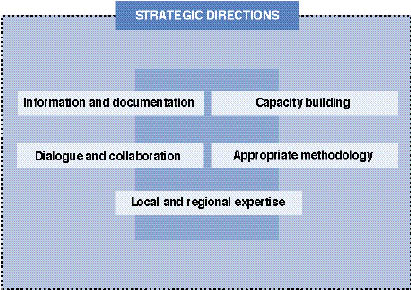
Action should be based on a) arranging a “table” for discussion and b) ensuring a flow of information to this table and to policy makers.
The number of
countries which will benefit from the activities and the assistance of the
programme will depend on the interest expressed by each country and the level of
donors’ support to the programme.
Geographic coverage of the programme
Development initiatives should be based on detailed interdisciplinary analysis of the implications that the future growth of urban food demand and city boundaries is likely to have on food supply, on the structure and organisation of food marketing systems and, finally, on the efficiency with which food will be moved to and distributed within urban areas.
This should permit the definition of policies and strategies and the preparation of development and investment programmes at urban, perurban and rural levels, with clearly identified priorities and responsibilities. Such programmes will reflect the variety of urban situations, specific problems and conflicts, and present appropriate solutions.
This is why the identification and subsequent implementation of development programmes and projects, which span urban and rural areas, require collaboration among research and development organisations as well as among institutions at various administrative levels (local and central).
Particular attention needs to be paid to the strengthening of local technical competence, particularly in the integration of food distribution into urban space management and into the preparation of rural development programmes.
Donors and the international financial community should continue to provide assistance to development and investment programmes which result from a concerted approach and are justified in terms of clearly identified food demand requirements. Demand conditions and marketing opportunities determine production decisions and investment opportunities, not vice-versa.