Food security of the poorest sectors of urban consumers in DTCs can be enhanced by more dynamic and efficient food supply and distribution systems (FSDSs) which improve food availability in terms of price, volume, variety and quality and expand national food production to cater for rapidly expanding urban food needs and urban spaces. This requires that policies, strategies and development programmes take into account food supply and distribution issues, at urban, peri-urban and rural levels.
The appropriate formulation, in DTCs, of such policies, strategies and programmes, is the objective of the “Food Supply and Distribution to Cities” inter-regional programme of FAO. This programme constitutes therefore a major contribution to follow-up and implementation of the commitments made by FAO member States at the World Food Summit, held in Rome in November 1996. The Summit gave priority to improving the efficiency of marketing systems and linkages between production and consumption areas, with the aim of increasing access to food, and hence food security, in developing countries and countries in transition.
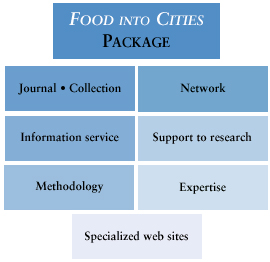
A wider circulation of information and documentation, national capacity building, inter-institutional dialogue and collaboration, an appropriate methodology, and local and regional expertise, represent the strategic axes of the programme.
Its direct beneficiaries include policy makers and FSDS actors namely: local authorities, central government, chambers of commerce and agriculture, associations of consumers, traders, producers, transporters, NGOs, research institutes, financial institutions, etc.). The programme will also benefit the poorest sections of urban society (through their improved access to food), small and medium scale traders (through a more dynamic and competitive trade system) and food producers (through their better integration in the market).
 The dependence of
urban food security not only on food distribution within urban areas but also on
the organisation and dynamism of FSDSs in rural and peri-urban zones means that
interventions must be formulated taking into account these linkages which are in
constant evolution. (FAO-ISRA Subregional Seminar)
The dependence of
urban food security not only on food distribution within urban areas but also on
the organisation and dynamism of FSDSs in rural and peri-urban zones means that
interventions must be formulated taking into account these linkages which are in
constant evolution. (FAO-ISRA Subregional Seminar)
There is a need to
develop specialisation and competence at all levels, adequate services and
well-managed infrastructure together with specific rules as well as a
legislative framework adapted to the evolving socioeconomic contexts. (FAO-ISRA
Sub-regional Seminar)
The main outputs of the programme will include a more precise assessment of the consequences of urban dynamics on FSDS, improved technical competence and proposals for policies and intervention programmes at urban, periurban and rural levels.
Programme structure and implementation
The programme is ongoing. The first phase (1995-1997), represented by the “Food Supply and Distribution to Francophone African Cities” subregional programme was funded by France, Italy and FAO. Several national and international organisations and universities also contributed.
This phase made it possible to define the state of the art in current research and knowledge about FSDSs, to collect specific technical documentation and to prepare the development programme of FSDSs in Dakar.
It also organised the FAO-ISRA Sub-regional Seminar “Food supply and distribution to Francophone African cities”, held in Dakar, Senegal, in April 1997, by FAO and the Senegalese Institute of Agricultural Research (ISRA). It was attended by a large number of participants including the mayors of African cities.
This seminar discussed some of the challenges posed in meeting the rapidly increasing urban food demand, at the lowest possible cost, identified the nature of FSDS constraints and evaluated their importance for urban food security.
Its main recommendations included: the urgency to reduce the cost of food supply and distribution, the need to develop specialisation and competence at all levels, the need for adequate services and well-managed infrastructure together with specific rules as well as a legislative framework adapted to the evolving socio-economic contexts. The important role played by local authorities in FSDS development and the interdependence of urban, peri-urban and rural areas was also underlined.
A copy of the proceedings of the FAO-ISRAseminar may be downloaded from the web site:
http://www.fao.org/ag/sada.htm
Phase II
The second phase of the programme makes available to institutions and professionals in DTCs a package of products and services, which include:
The second phase of the programme will, subject to the availability of donor funding, comprise five independent regional sub-programmes:
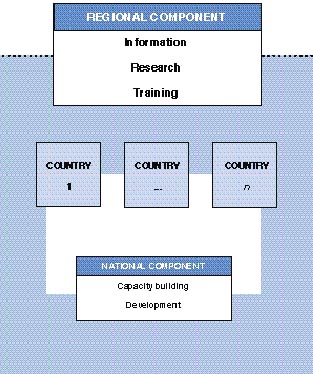
Sub-programmes will be structured into independent regional, sub-regional and national components.
Regional (or sub-regional) components comprise sensitisation, information, research and training activities organised at regional (or sub-regional) level.
Examples of regional/sub-regional projects which may be carried out under each sub-programme are:
1. Sensitisation of decision makers from DTC on:
- the consequences of urban expansion on food security of the poorest urban consumers, and the available alternatives for intervention;
- role of local authorities in developing food marketing systems and food security;
- food security, urban management and the environment;
- women and food commerce;
- legislative and regulatory constraints to food marketing systems development;
- food marketing systems as an factor integrating urban and rural areas;
- etc.
2. Intensive training of technical staff from local authorities on:
- the analysis of food marketing systems and the formulation of urban development programmes;
- market infrastructure planning and management;
- managing the environmental impact of food commerce;
- law and regulations in the development of urban food marketing systems;
- etc.
3. Training of urban planners on the integration of food commercial activities into urban programmes;
4. Training of public market managers;
5. Case studies of food marketing systems in specific cities and formulation of inter-institutional development programmes;
6. Exchange of experiences among cities from the same sub-region on urban food distribution and security matters.
7. Preparation and wide distribution of technical documentation and training material in the required languages.

http://www.fao.org/ag/sada.htm
Each national component includes activities, to be organised in selected countries through specific national projects, aimed at capacity building and the formulation of policies, strategies and programmes. National components can also be formulated for groups of countries.
Inter-regional conference “Local Authorities and Urban Food Security in the XXIst century”
The preparation of an inter-regional conference Local Authorities and Urban Food Security in the XXIst century to be attended by representatives of the local authorities of a number of cities from DTCs, is proposed to conclude the second phase of the programme.
This conference will highlight the important role which local authorities, which are often the forgotten partners in development, can play in improving urban food security. It will also formulate a plan of action to improve FSDS efficiency and promote collaboration and exchange among local authorities at South-South and North-South levels.
Information
Coordinator
“Food supply and distribution to cities”
Inter-regional Programme
Marketing and Rural Finance Service (AGSM)
FAO
Viale delle Terme di Caracalla
00100 Rome - Italy
Fax: (+39-6) 5705 6850 - 5705 4961
E-mail: [email protected]