Associa็ใo Brasileira de Celulose e Papel (Bracelpa)
After a year that brought a currency crisis leading to the adoption of a floating exchange rate, the fear of a strong recession with high inflation is now over. The latest Memorandum of Economic Policy released as part of the International Monetary Fund (IMF) agreement emphasized the importance of meeting inflation targets and implementing a tight monetary and fiscal policy. Inflation peaked immediately after the exchange rate move shocked the prices of imported raw materials. After the second quarter, inflation reduced its pressure and even with the rise of public tariffs and of the petrol price, the year closed with the consumer price index up roughly 9 percent. This is one percentage point above the original 8 percent target, but still within the wide band of 6-10 percent set under the IMF programme.
Meanwhile, government has acted conservatively, by keeping the key government interest rate (SELIC) unchanged at 19 percent throughout the year.
Economic activity figures continue to show timid signs of recovery as a response to the fall in income and reduced investments. The GDP grew 0.3 percent this year, which is a weak growth, but slightly better than the 0 percent forecasted at the beginning of the year.
The export growth was limited by external factors, such as the fall of most commodity prices and the lack of export financing lines, not allowing the revenues to reach expected growth.
Regarding the balance of payments, the trade deficit stayed at US$1.2 billion (US$48 billion export versus US$49.2 billion import), 82 percent lower than in the previous year. The final results were: current account deficit of US$24 billion, foreign investment of US$30 billion and foreign reserves of US$40 billion.
The preliminary 1999 figures for chemical, mechanical and thermo-mechanical pulp indicate a 6.8 percent growth over previous year, achieving 7.1 million t.
Bleached hardwood corresponds to the biggest share, with 5.1 million t, followed by unbleached softwood pulp, with 1.3 million t, which adds up to 89 percent of total pulp produced.
Bleached softwood is produced for domestic use, being complemented by imported pulp, which amounted to 381 000 t in 1998, an increase of 9 percent.
The domestic market, corresponding to domestic sales plus integrated consumption, equals to 4.2 million t, an increase of 3.7 percent over 1998, absorbing 59 percent of total Brazilian pulp production.
The Brazilian pulp exports, mainly bleached hardwood, reached 3.1 million t, a 11percent growth.
Paper production had a lower growth than pulp, due to the slow down of the domestic market.
Paper production reached 6.9 million t in 1999, showing a growth rate of 4.3 percent. The most significant segments in volume were wrapping paper, with 3.1 million t and printing and writing papers, with 2.1 million t. Together, both segments represent 76 percent of the total production and showed a growth rate of 6.8 and 5.6 percent, respectively.
Domestic paper sales, of 4.1 million t, grew 3.2 percent while papers converted into boxboard grew 4.2 percent, totalling 1.5 million t.
Paper exports were of 1.3 million t, with a growth of 9.3 percent over 1998. On the other hand, imports fell 17 percent, to 750 000 t, as a consequence of the slow down in the economy.
Paper apparent consumption run flat with a total of 6.3 million t and a per caput consumption of 38 kg.
The industry's trade balance had a positive result of US$1.3 billion, a 43 percent increase over the previous year.
Chemical and high yield pulp, as well as paper exports, reached US$2.1 billion, an 8.4 percent growth, while imports decreased 21.7 percent, to US$0.8 billion.
The main factors contributing to the positive balance result of the industry were the 18.6 percent growth of the pulp exports and the decrease of 27.4 percent in paper imports.
The Brazilian consumption of recycled paper reached 2.4 million t, with a growth rate of 3.4 percent over 1998. This volume represents 37 percent of the year's total paper apparent consumption.
The recovery of the international prices provides favourable prospects for the industry, as leading companies have a good production scale, an up-to-date technology and product quality. These mills will assume an expressive role in the export leverage and in the supply of the domestic market.
Part of the industry's investments has been oriented to the production of higher value-added products, replacing a significant share of imported paper, like the investments for wood-free coated paper.
The economical adjustments implemented by the Government of Brazil in 1999, the gradual interest reduction and a controlled inflation rate should contribute to a recovery of the industrial activity.
Most scenarios adopted by research institutes project a GDP growth of 3.5 percent for the Brazilian economy. In this context, the leading issues for the industry will consist in overcoming the obstacles to a new investment cycle, increase competitiveness, raise export volume and recover companies' results.
On 7 July 1999, the Ministerial Commission for Global Climate Change was created, having as its main objective to articulate the Brazilian Government actions related to the United Nations Climate Change Convention. The Commission is constituted by representatives of the following Ministries: Foreign Relations; Agriculture; Transport; Mines and Energy; Planning, Budget and Administration; Environment; Science and Technology; Development, Industry and Foreign Commerce; and Civil Affairs. Its presidency is exercised by the State Minister of Science and Technology and the vice-presidency by the Minister of Environment. The Commission's secretariat is co-ordinated by the Ministry of Science and Technology, which will supply technical and administrative support.
The Commission's main responsibilities are the publication of experts' reports and to subsidize sectional policies and government positions for discussion at the Convention. The Commission is also in charge of defining additional eligibility criteria, other than those considered by the Convention bodies in charge of the Clean Development Mechanism (CDM), as stated in Article 12 of the Kyoto Protocol as national strategies for sustainable development. It is its duty to evaluate and, if necessary, approve reports on projects which result in emission reduction and are considered eligible for CDM.
The Commission may ask other official agencies or private entities for collaboration, working in an articulated way, to reach its objectives.
In Brazil, there are 4.5 million ha of planted forests, of which 2.9 million ha are planted with Eucalyptus and 1.7 million ha with Pinus.
Having a huge territory, good soil and appropriate climate, Brazil is a country with great competitive potential in the forest sector. The productivity of its forests, both in quality and quantity, is much higher than that of many developed countries.
In the period 1990-1998, the pulp and paper industry planted 708 000 ha of Eucalyptus and 161 000 ha of Pinus, including the reform of old forests which had already completed their production cycle.
With the progress made in engineering, it was possible to clone favourable physical and chemical characteristics and high productivity. The technology was developed by research laboratories and introduced by the pulp and paper industry. These improvements induced the Eucalyptus productivity to 45 m3/ha/year; and that of Pinus, to 35 m3/ha/year.
Brazil participates in the discussions of CDM as it contributes to revert global warming, as registered at the Climate Change Convention.
There are four projects which take into account the CDM conditions, one of which was selected by the World Bank as a possible CO2 compensation pilot project.
With the growing worldwide demand for environmental certifications and for good forest management, many Brazilian companies are preparing to enter this new market segment. Timber certification in Brazil is becoming increasingly important. Brazil has developed its own forest certification system, which takes into account regional characteristics, and will be used from this year onwards.
The system ABNT/CERFLOR, which defines the wood origin and management practices, was originally developed by the Brazilian Silviculture Society and will be operated by the Brazilian Technical Standards Association (ABNT) for planted forest certification and chain of custody.
To date, in Brazil, the Forest Stewardship Council (FSC) certified nine companies, 29 products in chain of custody and other seven companies were certified by the ISO 14001 Standard. In total, FSC certified 668 000 ha of industrial planted forests and ISO certified 500 000 ha.
Canadian Pulp and Paper Association
Canadian producers of pulp and paper shipped a record of 31 million t of product in 1999. That represents an increase of almost 9 percent over the previous year when shipments were depressed by the drop-off in Asian demand and two lengthy labour disputes.
Supporting the recovery was a very buoyant North American economy which led to stronger demand for communication papers and paperboard. As well, there was the recovery in Asia, which boosted demand for market pulp and reduced the volumes of locally produced paper available for export. Finally, there were mill and machine shutdowns, mostly in the United States, which increased demand for market pulp and paperboard produced in Canada.
Domestic sales rose by 7 percent, supported by an 8 percent increase in consumption. Deliveries to the United States increased by almost 9 percent, while exports offshore grew by 10 percent.
Pricing for most products improved as the year progressed, at least when compared to the lows recorded in the fourth quarter of 1998 and the first quarter of 1999. However, the average US dollar product price (weighted by shipments) was still down marginally (-5 percent) for the year as a whole. However, with volumes up 8.9 percent and the average value of the Canadian dollar unchanged at US$0.67, it is estimated that there was nevertheless a modest improvement in industry earnings from pulp and paper operations. Preliminary estimates put net earnings at approximately $600 million, up from $304 the previous year.
The growth in shipments far exceeded the modest 0.5 percent increase in manufacturing capacity. As a result, the industry's overall operating rate (measured as shipments as a percentage of capacity) shot up 7 points to 94 percent.
The economic outlook is probably the most positive it has been in many years, largely due to the tremendous performance of the North American economy. Although a more restrictive monetary policy will likely moderate growth in 2000, GDP growth should still reach 3-3.5 percent.
In Western Europe, prospects are improving even if the German economy continues to under-perform. Overall, the region should register economic growth in the range of 2.5 to 3 percent.
The Asian economies, with the exception of Japan, surpassed expectations in 1999, with growth in the region reaching 6 percent overall. The outlook calls for growth in the region to exceed 5 percent in 2000. The recovery in emerging markets has also extended to Latin America, with economic growth in the region expected to turn positive in 2000.
Based on this economic outlook and expected market developments (e.g. capacity additions, stock movements, etc.) Canadian shipments of pulp, paper and paperboard are projected to rise 1.8 percent this year.
2000a |
1999 |
1998 |
2000/99 |
1999/98 | |
Newsprint |
9 245 |
9 170 |
8 510 |
+ 0.8 |
+ 7.8 |
Printing and writing |
6 005 |
5 690 |
5 155 |
+ 5.5 |
+10.4 |
Packaging |
4 705 |
4 650 |
4 260 |
+ 1.2 |
+ 9.1 |
Other |
645 |
645 |
610 |
0.0 |
+ 5.7 |
Pulp Exports |
10 900 |
10 800 |
9 895 |
+ 0.9 |
+ 9.1 |
Total |
31 500 |
30 955 |
28 430 |
+ 1.8 |
|
As a percentage of capacity |
95% |
94% |
87% |
a forecast
Most of the growth will come from increased shipments of printing and writing papers, largely SC-type grades, to the North American market. Other grades will contribute to the projected increase; however, in many segments capacity will be a limiting factor.
With shipments set to rise by almost 2 percent, and manufacturing capacity forecast to grow by 1 percent, the industry's overall operating rate can be expected to rise one point to 95 percent.
In 1999, Canadian shipments of newsprint jumped nearly 8 percent, wiping out most of the decline suffered in 1998. The operating rate rose six points to 92 percent.
This strong rebound reflects the surprising performance of the United States economy, the recovery in Asia, and the fact that in 1998, Canadian shipments were depressed by two labour disputes.
In the United States, a market which still accounts for 60 percent of Canadian sales, total newsprint consumption rose by 1.9 percent, about twice the increase that had been expected, and consumption by dailies grew by 2.1 percent. The main factor was growth in consumer spending which kept gains in ad lineage from slowing as expected. Newspaper advertising was also given a boost by the flurry of dot-com advertising.
Growth in United States demand will likely slow in 2000 as interest rates increase and consumers cut back spending on durables. However, export markets should ensure a healthy increase in world demand in 2000. As a result, it is anticipated that Canadian shipments will edge up by just under 1 percent.
Since newsprint capacity is estimated to decline by almost 3 percent, this forecast implies an increase in the operating rate to 96 percent.
Shipments of printing and writing papers had been expected to increase about 6 percent in 1999. In fact, shipments increased by a little over 10 percent and the average operating rate in this sector rose five points to 93 percent.
Deliveries of uncoated mechanical papers jumped 17 percent, due in part to good demand growth in North America and new SC-type capacity ramping up in Canada, but also to production losses the previous year which flattered the 1999 results.
Shipments of uncoated wood-free papers rose 6 percent, which pushed the operating rate to 94 percent. Deliveries of coated papers were almost unchanged.
In 2000, growth in North American demand for printing and writing papers will slow to just under 3 percent. That is still quite healthy and should be sufficient to push Canadian shipments up by another 5.5 percent. Again, uncoated mechanical papers will account for most of the growth. There is still new SC capacity entering production and North American demand for SC-type papers, used in flyers, magazines and some catalogues, should grow by another 4-5 percent. Growth in Canadian shipments of the fine paper grades will likely be constrained by capacity.
The packaging sector posted very strong results in 1999. Overall, Canadian shipments rose by 10 percent and the average operating rate rose eight points to 96 percent. Domestic shipments grew 7.6 percent, in spite of another sharp increase in imports, and those to the United States rose over 20 percent.
Leading the turnaround were linerboard and medium which posted gains in shipments of 14 percent and 7.5 percent, respectively. Increased demand from North American box plants was the main driver; however, the idling of about 2 million t of United States capacity also had a very positive effect on demand for Canadian-produced board.
Also contributing to the overall increase were shipments of boxboard which increased 6 percent.
The only category not to register a significant increase in sales was kraft papers. In total, shipments grew 0.8 percent. Deliveries to domestic customers fell 0.3 percent and those overseas declined almost 10 percent, offsetting healthy gains in sales to the United States.
The North American market should remain very healthy in 2000 even if GDP growth slows a little. However, with operating rates in the Canadian industry already nearing practical maximum levels, and very little incremental capacity projected, growth in Canadian sales will slow in 2000. The overall increase is projected to be about 1 percent.
The recovery in Asia and stronger than expected paper production in Western Europe contributed to an 8 percent increase in world market pulp demand last year.
Two additional developments, both in the United States, had an important influence on the pulp market last year. One was the shutdown of integrated pulping capacity at a number of United States mills. Some of the lost production was replaced by purchased de-inked pulp and recycled paper. However, much of it was replaced by market pulp, contributing significantly to the increase in world demand last year.
The other development was the shutdown of United States market pulp capacity, nearly 1 million t in all. These shutdowns had no effect on overall demand, but certainly boosted United States demand for Canadian pulp.
Overall, Canadian pulp exports last year grew 9 percent. Exports of chemical paper grade pulp rose by 8.9 percent, pushing the operating rate to 96 percent; exports of high yield pulp increased by 10.4 percent, and the operating rate reached 89 percent.
All the drivers remain positive for 2000. The printing and writing markets will remain strong, as will the tissue market. However, for Canadian producers growth in sales volumes will be limited. Most mills are already operating very near full capacity, inventories are low, and there is little incremental capacity growth projected for 2000. For these reasons, the forecast shows growth in pulp exports slowing to about 1 percent in 2000.
The increase for market pulp (a definition which excludes affiliated sales to the United States, but includes domestic market sales), will be larger because two recent acquisitions will result in about 150 000 t of capacity being reclassified as market from affiliated. Market pulp shipments should increase by 2-2.5 percent.
Canada has virtually no forest plantations in the usual sense of the term. Forest regeneration in Canada is accomplished through natural regeneration (approximately 55 percent), and planting (approximately 45 percent).
Virtually all of the seedlings are grown using seed collected from 30 native species of trees. The planted areas normally contain a mix of species and grow into stands which closely resemble natural forests and provide a wide range of forest values and ecological functions.
Efforts to reduce emissions and effluents continue to show success. Participation in the Canada-wide air quality improvement programme will engage industry efforts during the next two to three years.
The Pulp and Paper Research Institute of Canada is carrying out a five-year research programme on closed loop technologies for application in Canadian pulp and paper mills.
The Canadian pulp and paper industry has reduced greenhouse gases (GHG) from fossil fuel combustion by 27 percent per ton since 1990. Total GHG emissions are down 17.6 percent since 1990. Industry experts are participating in national consultations to develop the Canadian Climate Change Programme aimed at achieving Canada's Kyoto Protocol emissions reduction target (-6 percent based on 1990 emissions). The industry expects to make an additional significant contribution to achieving the target through further substitution of biomass energy for fossil fuels and the implementation of state-of-the-art energy management systems, improved pulping processes and biomass co-generation projects. Regulatory changes in energy generation and transmission will help to optimize opportunities.
The Kyoto Protocol includes very little of the world's forests - only areas of new forest established since 1990. Canada will probably include an ambitious afforestation programme in the national Climate Change Programme. The objective will be to establish new forest on cleared lands that are no longer used for agriculture.
In 1997, the pulp and paper industry established a forest biodiversity programme directed at ensuring that forest management planning and operations included conservation of natural biodiversity at the landscape level as one of the important management objectives.
The industry has been working with conservation non-governmental organizations, agriculture and mining for 20 months to develop, and propose to the Federal Government, a framework for an effective national Species at Risk Act which is expected to be put before Parliament in early 2000.
Canada is a participant in the Montreal Process and has developed and approved a set of Sustainable Forest Management Criteria and Indicators as the national objective for forest management. As provincial forest management legislation is revised, governments are including sustainable forest management objectives in the legislation.
The national policy to achieve sustainable forest management has resulted in a broadening of forest management planning objectives to include increased emphasis on: conservation of biodiversity, wildlife habitat management and the maintenance of soil productivity and water quality. All forest management plans address sustainable forest management objectives.
The 1992 National Forest Strategy which included 96 action items was renewed in 1997 with an expanded list of 120 action items.
The pulp and paper industry manages approximately 100 million ha of publicly-owned forest land through forest management agreements with the provincial governments.
Forest management certification has become a mainstream programme on Canadian forest management operations. Most companies are implementing ISO 14001 EMS to help demonstrate that they meet forest management objectives and are in compliance with all legislated requirements. Some companies have added an explicit sustainable forest management policy, as defined by Canada's Criteria and Indicators for Sustainable Forest Management, to their forest management objectives. Nine companies had received certification to ISO 14001 at the end of 1999.
The CSA Sustainable Forest Management standard has been successfully implemented on operations by two companies. This is expected to increase significantly in 2000. This standard uses an environmental management system compatible with ISO 14001 and also includes Sustainable Forest Management Criteria and Indicators, a requirement for extensive public consultation, forecasting using forest level computer models and audits of on-the-ground performance.
Some companies are considering application of the Forest Stewardship Council (FSC) system.
At the end of 1999, there were 11.9 million ha, with an annual production of 18.6 million m3 of wood, under certified management systems. This is about 10 percent of annual production. Industry experts predict that Canada will have 25 million ha certified by the end of 2000.
Corporaci๓n Chilena de la Madera
The main performance indicators of the country show that the behaviour of the Chilean economy in 1999 was poor, due to the economic crisis.
The growth of the economy in 1999, measured according to variation of GDP, reached a negative value of -1.1 percent, representing the first loss since 1983. This demonstrates that the amount of goods and services produced in the country in 1999 decreased with respect to 1998, when the economic growth was 3.3 percent.
Therefore, GDP per caput also fell in the second consecutive year. While in 1997 the figures reached the peak of US$5 149, in 1998 lowered to US$4 912 and, at the moment, it has reached US$4 493.
In terms of inflation, in 1999, the Consumer Price Index (CPI) showed a 2.3 percent variation with respect to the previous year. In 1998, the CPI was of 4.7 percent.
With regard to employment, the total labour force in the country reached 5 822 300 workers in the July-September quarter, of which 663 700 were unemployed, an increase of 1.5 percent with respect to the same period in 1998.
The largest employing sector is trade (20 percent), followed by industry (15 percent), agriculture and fisheries (13 percent), and communications (7.5 percent).
The unemployment rate was 11 percent in 1999 with an increase of four percentage points with respect to 1998, which can be considered low in terms of international standards.
The salaries have evidenced important increases in real terms, reaching a 4.2 percent average over the past five years. There are no final figures for 1999, but an increase near 2.5 percent is expected.
Regarding foreign trade, in 1999, Chile exported a total of US$15 616 million, 5 percent more than in 1998, and imported US$13 951 million, 20 percent less than in 1998, resulting in a surplus of the trade balance of US$1 664 million. The forest sector contributed with exports for US$1 955 million.
This surplus indicates a rise in the trade balance for the first time since 1996, which could be considered a good augury for the national economy.
In October 1999, our international reserves totalled US$14 563 million, 6 percent less than in 1998.
Finally, the Chilean foreign debt reached a total of US$33 973 million in September 1999, of which 83 percent is due to the private sector.
The following are the projections for the main indicators for 2000:
Projections for 2000
|
Growth |
5.5-6.0% |
|
Inflation |
3.5% |
|
Unemployment |
8% |
|
Exports (US$ million) |
17 400 |
|
Imports (US$ million) |
16 700 |
|
Balance of trade (US$ million) |
700 |
|
International reserves (US$ million) |
16 000 |
|
Foreign debt (US$ million) |
30 000 |
Source: Central Bank
The forestry sector is one of the most dynamic areas of the Chilean economy and has become a fundamental pillar of the country's political and economic strategy.
This sector has shown sustained growth that has earned it widespread recognition in the international sphere. Thus, from its capacity as an unknown supplier of limited volumes of timber raw materials, it has become a respected player in the world market, with increasing exports that have been incorporating more added value.
In 1998, forest harvest reached 31.7 million m3, of which 21.3 million m3 were destined to industrial use and 10.4 million m3 were used for fuelwood. The following table shows the total roundwood consumption of the forest industry.
Industrial roundwood consumption
|
Product |
1998 (million m3ssc) |
|
Pulp |
7.4 |
|
Sawnwood |
9.2 |
|
Wood-based panels and plywood |
0.9 |
|
Sawlogs to export |
0.23 |
|
Pulpwood to export |
0.19 |
|
Chips |
3.1 |
|
Others |
0.26 |
|
TOTAL |
21.3 |
Source: INFOR
Forest production by product
|
Product |
1998 (thousand m3) |
|
Sawnwooda |
4 550.7 |
|
Chipsb |
5 457.7 |
|
Hardboard |
54.6 |
|
MDF |
301.9 |
|
Particleboard |
320.9 |
|
Plywood |
129.2 |
|
Veneers |
104.1 |
|
TOTAL |
10 658.2 |
Source: INFOR
a 90 percent of sawnwood production corresponds to radiata pine (Monterrey pine)
b Includes chips produced from residue
Paper and paperboard production by grade
|
Type of paper |
1998 (mt) |
1999 (mt) |
|
Printing and writing paper Newspaper Other printing and writing paper |
300 475 162 985 137 490 |
354 465 225 206 129 259 |
|
Corrugated paper |
112 077 |
149 320 |
|
Kraft paper |
44 494 |
30 754 |
|
Folding cases |
68 684 |
124 890 |
|
Other papers and cardboard for packaging and packing |
7 295 |
18 000 |
|
Paper for household and sanitary use |
100 909 |
107 094 |
|
Other papers and paperboard |
8 051 |
11 290 |
|
TOTAL |
641 985 |
795 813 |
Source: CORMA-INFOR
Pulp production by grade
|
Type of pulp |
1998 (mt) |
1999 (mt) |
|
1. Mechanical pulp |
185 146 |
135 714 |
|
2. Thermo mechanical pulp (TMP) |
44 712 |
234 344 |
|
3. Chemical pulp 3.1 Sulphite 3.2 Sulphite and soda 3.2.1 Softwood Bleached Unbleached 3.2.2. Hardwood Bleached Unbleached |
1 979 716 0 1 979 716 1 537 898 1 175 589 362 309 441 818 439 940 1 878 |
2 064 066 0 2 064 066 1 624 055 1 258 054 366 001 440 011 440 011 0 |
|
TOTAL |
2 209 574 |
2 434 124 |
Source: CORMA-INFOR
The Chilean forestry sector is clearly oriented to exports, whereby its growth and development is based on the possibilities offered by the international market.
The forest industry has evolved on a par with the changes in the overseas markets, with a permanent modernization and expansion of the plants and through heavy investment in new industrial projects. Likewise, its exportable supply of lumber products has grown, showing an ever greater diversification.
Currently, exported products include those made from chips, pulpwood and sawlogs, sawn and elaborated timber, short and long fibre pulp, different wood-based panels and newsprint to products with a higher elaboration degree, such as furniture and components, doors and windows, toys, tissue and towelling papers, and other paper and paperboard of other types.
Forest exports by product
|
Product |
|
1998 |
1999 | ||
|
|
Unit |
Thousand |
Million US$ FOB |
Thousand |
Million US$ FOB |
|
Chemical pulp |
t |
1 744.6 |
692.3 |
1 892.5 |
762.7 |
|
Paper and paperboard |
t |
222.5 |
163.7 |
251.9 |
167.1 |
|
Sawnwooda |
m3 |
1 171.6 |
176.9 |
1 202.5 |
172.0 |
|
Chips |
t |
122.9 |
74.0 |
404.7 |
120.8 |
|
Hardboard |
t |
2 286.3 |
130.5 |
2 410.1 |
133.0 |
|
MDF |
t |
26.1 |
6.8 |
29.0 |
7.4 |
|
Particleboards |
t |
128.3 |
46.4 |
140.6 |
47.7 |
|
Plywood |
t |
15.7 |
4.6 |
15.1 |
4.0 |
|
Veneer |
t |
18.6 |
10.2 |
59.4 |
36.5 |
|
Sawlogs/pulpwood |
m3 |
40.6 |
18.6 |
45.6 |
19.9 |
|
Others |
t |
414.7 |
23.2 |
865.8 |
47.1 |
|
TOTAL |
|
345.6 |
291.5 |
376.5 |
436.8 |
|
|
|
|
1 660.5 |
|
1 955.1 |
Source: INFOR
a Approximately 92 percent of the sawnwood exported corresponds to radiata pine (Monterrey)
The pulp and paper industry is the activity showing the highest economic importance in the Chilean forest sector, both in terms of production and in terms of foreign currency generation. Pulp remains the main export, accounting for 40 percent of the total 1999 exports.
Paper and paperboard trade by grade
|
Type of paper |
1998 (mt) |
1999 (mt) | ||
|
Import |
Export |
Import |
Export | |
|
Printing and writing paper Newspaper Other printing and writing paper |
156 410 21 563 134 847 |
130 215 117 215 13 153 |
127 884 12 172 115 712 |
179 331 160 836 18 495 |
|
Corrugated paper |
179 013 |
1 404 |
142 839 |
10 828 |
|
Kraft paper |
3 343 |
18 006 |
2 657 |
24 079 |
|
Folding cases |
16 666 |
14 437 |
8 530 |
51 591 |
|
Other papers and cardboard for packaging and packing |
6 798 |
110 |
633 |
75 |
|
Paper for household and sanitary use |
1 458 |
22 682 |
0 |
17 584 |
|
Other papers and paperboard |
12 932 |
2 311 |
13 675 |
626 |
|
TOTAL |
376 620 |
189 165 |
296 218 |
284 114 |
Source: CORMA- INFOR
Pulp trade by grade
|
Type of pulp |
1998 (mt) |
1999 (mt) | ||||||
|
Import |
Export |
Import |
Export | |||||
|
1. Mechanical pulp |
0 |
0 |
1 |
0 | ||||
|
2. Thermo mechanical pulp |
0 |
0 |
0 |
0 | ||||
|
3. Chemical pulp 3.1 Sulphite 3.2 Sulphite and soda 3.2.1 Softwood Bleached Unbleached 3.2.2. Hardwood Bleached Unbleached |
0 |
1 744 609 1 744 609 1 444 421 1 132 940 311 481 300 188 300 188 0 |
13 743 42 13 701 13 699 13 604 95 2 0 2 |
1 892 453 0 1 892 453 1 575 190 1 215 195 359 995 317 263 317 263 0 | ||||
|
TOTAL |
0 |
1 744 609 |
13 744 |
1 892 453 | ||||
Source: CORMA-INFOR
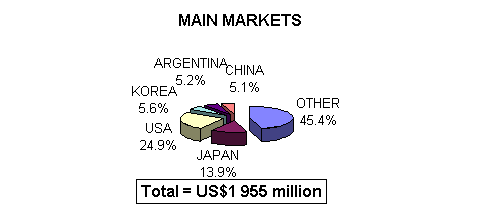
In 1999, forest exports (US$1 955 million) have increased compared with 1998 (US$1 660 million), due to the recovery of exports towards the Asian markets.
Asia continues to be the main destination, with an exported total of US$710.9 million, an increase of 23 percent with respect to 1998. Asia was followed by North America (27.7 percent), Europe (17.7 percent) and South America (17.3 percent).
Shipments to North America and South America registered an increase of 36 percent and 22.5 percent respectively, in relation to 1998. Forest products were exported to 95 countries. The main markets of destination are shown in the following chart.
After the mining sector, the forest sector is one of the most important in terms of investment. Over the past eight years, domestic and foreign companies have invested heavily in the area. According to CORMA's estimates, investments totalled US$3 820 million, with emphasis on the cellulose and paper sector, and to a lesser degree, on the timber production sector and in the development of new forests. Investment is expected to reach US$4 255 million by 2005.
Future investments in the forest sector
|
|
Historical |
Estimation |
|
Plantations |
360 |
205 |
|
Pulp and paper |
2 900 |
3 800 |
|
Sawmill and manufacturing industries |
255 |
100 |
|
Panels and plywood |
185 |
100 |
|
Others |
120 |
50 |
|
TOTAL |
3 820 |
4 255 |
Source: CORMA
The sustainable felling of radiata pine, which in the period 1998-2000 totalled 19.6 million m3 will have practically doubled by 2015. It is expected that at the beginning of the century the volume of eucalyptus harvested will reach a sustainable 7-8 million m3. This availability will allow the possibility of increasing the industrial installed capacity, such as pulp, paper and boards, and also a greater export of raw materials.
Future availability of radiata pine and eucalyptus wood, 1996-2015
|
Three-year period |
Radiata Pine |
Three-year period |
Eucalyptus |
|
1996-1998 |
---- |
1996-1998 |
2.15 |
|
1998-2000 |
19.6 |
1999-2001 |
4.25 |
|
2001-2003 |
30.5 |
2002-2004 |
7.07 |
|
2004-2006 |
30.3 |
2005-2007 |
8.49 |
|
2007-2009 |
30.5 |
2008-2010 |
9.34 |
|
2010-2012 |
30.4 |
2011-2013 |
9.78 |
|
2013-2015 |
30.3 |
2014-2015 |
9.88 |
Source: INFOR
Note: At present, approximately 2.4 million m3 of native woods are consumed for industrial uses and exports, which added to radiata pine and eucalyptus total 21.3 million m3 scc.
In 1999, seven companies, which are members of Chile's National Forest Product Association (CORMA), decided to collaborate to obtain the ISO 14001 certification by 2001. They have 1 477 300 ha of plantations, which are mainly of radiata pine.
This way, added to the three companies that in 1996 and 1998 reached this certification, it is expected that by 2001, 80 percent of the national plantations will have incorporated environmental management into their activities.
Additionally, CORMA has been closely following the ongoing work to build a system of mutual recognition of national standards. Presently, Chile still does not have such national standards, but CORMA is doing its best to meet the main players related to the forest sector in order to reach this goal.
National Association of
Manufacturers
(ANDI - Asociaci๓n Nacional de
Industriales)
One of the traditional achievements of the Colombian economy has been to maintain positive growth, a situation that had prevailed since 1932 once the initial impact of the global depression of the 1930s had been overcome. In 1999, after so many years, the country's GDP registered a drop in real terms. This serious situation occurred in a context of high unemployment, entrenched fiscal deterioration, unfavourable international environment and growing problems of public order. This result was to be expected given the effects of the recession and the costs incurred from the adjustments to the country's macroeconomic imbalances. However, the economic recession turned out to be much more serious than anticipated.
The GDP is estimated to have dropped by about 5 percent in 1999. The most serious situation was that of industry, the financial sector and construction, which recorded falls of over -10 percent. In manufacturing, the impact embraced virtually all industrial subsectors, accentuating the process of deindustrialization that has characterized the Colombian economy in recent decades. It is estimated that industry declined by about -13 percent in 1999. Recovery of the construction sector was again deferred. Another worrying feature of 1999 was the continuation of difficulties in the financial sector.
One of the main concerns for the country continues to be the unusual growth in unemployment, coupled with high levels of underemployment, informal labour and the general deterioration of quality of work situation. The unemployment level reached 20 percent in September 1999 and although it dropped to 18 percent in December 1999, underemployment continues at very high levels. The prospects for employment are not very encouraging, as the anticipated growth of the Colombian economy will be insufficient to make significant inroads upon present levels of unemployment.
The country's public finances have increasingly worsened since the beginning of the 1990s, a situation made even more acute in 1999 by the scale of the economic recession. Under these circumstances, the two-point reduction in GDP that had been the objective for 1999 was not achieved and the fiscal imbalance will be even greater than in 1998.
At international level, Colombia's neighbours and main trading partners have had domestic problems that have reduced demand for its products. As a result, growth in Colombia's exports was very modest in 1999 and was mainly due to the firming up of oil prices. However, certain positive aspects need to be highlighted: sales to the United States of America were particularly dynamic and up by more than 30 percent; and export performance has improved in recent months.
Although this overview of the Colombian economy in 1999 continues to be critical and calls for a co-ordinated cross-sectoral response, there are nevertheless a number of favourable aspects that need to be taken into account.
First, one of the most relevant features is the marked reduction in interest rates, which fell by about 20 nominal points in 1999, thus re-opening the way for investment. However, the levels are still high and real rates of interest need to be steered further down. In late 1999, the real level of interest on deposits was 6.6 percent and loans 15.7 percent. These rates have now fallen by about five points in real terms, but credit continues to be paralyzed.
A second important feature has been the successful reduction of inflation to single figures, to 9.2 percent, which produced a relative recovery in real earnings. Present conditions in the Colombian economy are in fact compatible with such moderate rates of inflation, which should prove beneficial to future generations.
The third positive aspect is that, despite difficulties in the exchange market, there was a successful recovery in real exchange rate without the disruptions that the other economies of the region had to go through. The economic authorities opted to change the regime from one of exchange limits to a floating rate. For the year as a whole, the currency devalued by 21.5 percent which, together with the moderate rate of inflation, will result in a greater competitiveness.
There have also been signs of recovery in recent months. Although most indicators are still on a decline, the reduction is less pronounced, which could suggest a change in trend. This directional change has been noted in demand for energy, in industrial and commercial activities, and in exports. In the case of manufacturing, the fall in production has slowed, the use of installed capacity has increased, stocks have been drawn down, demand is beginning to stir and, more importantly, business expectations are more optimistic.
There has also been an improvement in international relations, and loans have been received that will guarantee the external funding of the public sector for the next years. On top of this, the government signed an agreement with the International Monetary Fund, which is tantamount to an endorsement of government economic policy and helps build exchange stability and restore confidence in the country.
The outlook for 2000 is therefore more favourable, with economic activity scheduled to recover slowly but on the basis of solid fundamentals - thus holding out the prospect of better performance in the medium term. The CONPES macroeconomic programme for the year 2000 aims to revitalize the economy, generate employment, reform public finances and strengthen the financial system. To this end, there will be a mixture of policies consistent with economic revival: an easing of fiscal pressures with a less restrictive monetary policy that will help further reduce interest rates and support a competitive real exchange rate. The expectation is therefore one of renewed economic growth, rising from 3 percent in 2000 to 5 percent in 2002.
As regards the external situation, there is expected to be a sharp reduction in the current account balance of payments deficit in 2000, followed by a slight increase in the following years because of lower oil exports, but which should in any case be at about 3 percent. This is considered manageable as such a level can be financed through long-term resources and foreign investment.
With respect to public finances, reducing the fiscal deficit cannot be postponed any longer and the financial programme envisages a deficit of 3.5 percent in 2000 compared to 4.6 percent in 1999, with further reductions to 2.5 percent in 2001 and 1.5 percent in 2002.
However, the symptoms of revival are still incipient and the process of recovery is expected to be slow and entail certain costs. Clear and stable rules and regulations are needed to produce a better business environment and a consequent strengthening of domestic and foreign investment. Economic stability is also fundamental to encourage savings. Another aspect linked to economic revitalization that cannot be neglected is the need to generate conditions for the flow of credit to the productive sector. As regards the fiscal situation, the structural reforms to public finances which will be debated in Congress are vitally important.
Although the statistics for the wood and furniture sector have not yet been consolidated, everything suggests that this sector maintained its downward contribution to GDP, in part because of the crisis in the construction sector in the last three years, with some 17 percent of construction demand for inputs being for wood products. Wood is expected to continue to account for less than 0.5 percent of GDP, equivalent to 2.6 percent of total manufacturing GDP.
Within the forest industry processing sector, which includes the wood and furniture, and the paper and newsprint sectors, the latter's GDP share is more than double that of wood and furniture.
The Colombian pulp, paper and paperboard industry performed better than the industrial average and indeed better than the economy as a whole.
National pulp production rose by 6.3 percent, reaching 333 000 t, of which 189 000 t were wood pulp, 7 percent more than in 1998, and 144 000 t were bagasse and other fibre pulp, up 6 percent, this because sugarcane bagasse pulp is the raw material used for most printing and writing papers. With regard to production of wood pulp, there was a notable increase in semi-chemical pulp which is used in a variety of packaging materials. On average, more virgin fibre and less recycled fibre was used in the production of paper and paperboard.
Although there was negative growth (about -2 percent) in apparent consumption in the paper and paperboard industry, especially for packaging papers, the favourable price situation caused a fall in imports and better export opportunities. As a result, there was a slight increase of a little more than 1 percent in paper and paperboard production.
The production increase was mainly due to printing and writing papers, while tissues and packaging materials dropped significantly because of the crisis that affected the industrial sector and caused people to reduce their consumption habits.
The increase in production of printing and writing papers of more than 10 percent was due to import substitution and an increase in exports, as apparent consumption fell.
Imports of paper and paperboard fell by 5 percent in October 1999, while exports increased by 9 percent. Should these trends persist, the Colombian industry's share of the domestic market will increase from 62 percent in 1998 to 64 percent in 1999.
In 1998, the pulp, paper and paperboard industry as a whole registered a loss, albeit a small one. Although paper and paperboard prices recovered at the end of the year, the poor market situation is likely to eclipse this improvement in overall results for 1999, which are as yet not known.
The outlook for 2000 depends on international prices and the chances of recovery of the Colombian economy. The favourable international price situation, coupled with the fact that the Colombian peso has returned to its real parity level, will enable Colombian industry to raise its competitiveness on the domestic market and to maintain its presence on external markets.
Company finances, which were hard hit by the combination of low external prices and overvalued exchange rate, should show signs of improvement this year. However, if past problems of demand and holdings persist, the financial recovery might be slower than expected. The reduction in interest rates should also help financial positions.
If the official projections of industrial growth of 3 percent in 2000 materialize, the paper industry should also register positive rates of growth in apparent consumption of all grades of paper and paperboard.
Colombia continues to be a minor player in forest plantations, since the area given over to commercial plantations does not exceed 140 000 ha.
The area planted by the forestry industry in 1999 amounted to under 4 500 ha, of which more than 80 percent were to restock harvested stands. Although there are still no official data on the funding of plantations with the help of the Certificate of Forest Incentive, the total estimated planted area in 1999 does not amount to 12 000 ha.
The paper mills using wood as their raw material were all supplied by plantations which provided approximately 600 000 t of wood. Plants producing panels consumed some 110 000 t of wood from forest plantations. Statistics for the furniture and construction sectors are not yet available but consumption of plantation wood is estimated in excess of 300 000 t.
Interestingly, demand for plantation wood has increased because the wood used in exporting bananas and other industrial products is not from natural forests because of the commercial demands of certain clients.
Colombia adhered to the Convention on Climate Change in 1994, but has still not adhered to the Kyoto Protocol.
The following aspects are fundamental for Colombia:
– Inclusion of woodland projects given that forests sequester the main global warming gas (CO2) and that Colombia has not only vast tracts of forest land but also huge areas with forest potential, so the inclusion of this issue would improve national finances and open up opportunities for foreign funding of this sector.
– Compensations as a country exporting fossil fuels: exports of coal and oil could be affected by implementation of the clean development mechanism, as the developed countries could seek alternative sources of energy when they begin to meet their reduction commitments.
– Inclusion of the concept of unilateral models for project formulation, for these to be made available on international markets without the need for investors to come and formulate projects in the country.
– Recognition that each country should establish its model of sustainable development with its own criteria, avoiding the imposition of international obligations and criteria for project implementation.
– Additionality limits should be voluntary for countries contributing most to the problem. Given that this is a global problem, the part of the world where reductions are made is immaterial. Colombia offers more cost-effective solutions than others, and advocates that countries should be able to choose where to conduct their reductions, including in a non-source country. This would enable the developed countries to accomplish their reductions in other countries and would open a global market.
Colombia's forestry enterprises are following global discussions on sustainable forest management and certification, but await greater clarification of the issues before deciding to participate in a certification process.
Whatever the case, the main reforestation companies have adopted a framework of sustainable development based on the three pillars of economic growth, ecological efficiency and social equity. Their forestry operations are therefore guided by principles that are geared towards achieving sustainability.
In April 1999, representatives of the country attended a meeting convened by FAO in Sใo Paulo, Brazil, in which it was agreed that FAO should become involved in forest certification to avoid the imposition, by other international agencies, of certification schemes that do not benefit small reforestation concerns or the developing countries.
Finnish Forest Industries Federation
The year 1999 turned out relatively good for the Finnish economy. The GDP growth was 3.5 percent. The whole year was twofold, during the first six months exports decreased but towards the end of the year they decreased. In 2000, the growth in GDP is expected to continue at a higher rate, approximately 4.5 percent.
Due to a favourable increase in exports at the end of the year, the current account surplus amounted to Fmk 35 billion (5 percent of GDP). This was Fmk 4 billion less than in the previous year. Also the trade balance remained somewhat lower than in 1998 and reached Fmk 64 billion.
Consumer confidence has continued to be strong during the whole year. The volume of private consumption is expected to increase by 4.5 percent. Again, the fastest growth has been in durable goods.
Unemployment rate decreased during the year and slowed to 9.1 percent (229 000 persons unemployed) in December 1999. On average, unemployment rate was near 10 percent. However, it is expected to decrease below 9 percent in 2000.
Consumer prices increased by 1.2 percent on average in 1999. In December inflation rose above the European Union average to 2 percent. The rise in most costs remained moderate, but the real prices of crude oil and energy rose sharply in 1999. Export prices decreased by 4.5 percent whereas import prices decreased only 0.5 percent.
|
1998 (%) |
1999 (%) | |
|
GDP |
5.6 |
3.2 |
|
Consumer prices |
1.4 |
1.2 |
|
Private investment |
11 |
9 |
|
Private consumption |
5.5 |
4 |
|
Current account, percent of GDP |
5.9 |
5 |
|
Trade balance, percent of GDP |
9.7 |
9 |
|
EMU debt, percent of GDP |
48.5 |
43.5 |
|
Industrial production |
8.1 |
5 |
|
Unemployment |
11.4 |
10 |
Production in Finland's forest industry rose by 2.5 percent in 1999. Sawn timber and plywood production increased by over 3.5 percent. Paper and paperboard production was up nearly 2 percent compared with the previous year. Pulp production also rose by 2 percent.
In 1999, sawn timber production amounted to 11.7 million m3, an increase of more than 3.5 percent over the previous year. In spite of this growth, profitability declined and was unsatisfactory. Plywood production increased by 8.5 percent and broke the million cubic metre mark for the first time. The market situation for softwood plywood was relatively good and production increased by over one-fourth. This increase was accelerated by new capacity. Due to weak market situation, production of birch plywoods fell by about 7 percent.
Finland's production of paper and paperboard reached a record of 12.9 million t in 1999, up 1.9 percent over the previous year. Capacity utilization in the paper industry averaged 93 percent, compared with 94 percent in 1998. Total capacity was about 3 percent higher than the previous year. Paper production increased by 2 percent to 10.3 million t. Paperboard production rose by about 1.5 percent to 2.6 million t.
Production of printing and writing papers rose by 1.7 percent. Production of fine papers rose nearly 10 percent, but that of magazine papers (LWC and SC) was nearly 2 percent lower than in 1998. Newsprint production remained more or less on the previous year's level.
Chemical pulp production amounted to nearly 7 million t, up about 4 percent over the previous year. Mechanical pulp production declined by 1 percent, mainly because of the fall in magazine paper production.
During the first half of 1999, the economic development in Western Europe was relatively weak. This pressed down the demand for forest industry products in the European market, as well as prices.
On annual basis, the volume of forest industry exports increased about 3 percent. Paper and paperboard exports rose over 3 percent compared to the previous year. Due to increasing demand in main markets during the second half of the year pulp exports climbed more than 17 percent. Sawn timber exports decreased 1 percent by volume.
The average export prices were about at the same level as in 1998. The export earnings of the Finnish forest industry increased by 1 percent.
The recovering economies of the Asian countries seemed to have a positive impact on the demand for forest products. Deliveries from Finland to this region increased strongly during the second half of the year.
In 1999 the profitability of the Finnish forest industry companies improved. Result before extraordinary items went up to 8 percent (first nine months) of turnover (7 percent in 1998).
Compared to foreign competitors, especially North American companies, the result decreased.
The collective agreement on pay and related matters for paper workers expired on 15 January and the Paper Workers' Union broke off the negotiations on 17 February. The Union's wage claim is more than double compared to the general line already largely agreed in the Finnish industry and at least threefold compared to competitors. The Union also demands a substantial shortening of working hours which are already the shortest in the Finnish industry and shorter than in competing countries. The industry offered in January a wage increase of 3.1 percent (the general line) and a permanent solution to outsourcing and cannot make further concessions in order not to jeopardize competitiveness. The situation is grave.
The merger of UPM-Kymmene and Champion International will create a premier global paper and forest products company. The combined company will be called Champion International, with headquarters in Helsinki. The enterprise's value is approximately EUR 20.5 billion (US$20.2 billion). It will have a business portfolio with production plants in 17 countries and sales and distribution facilities in five continents. The combined company will have total revenues of approximately EUR13 billion (US$14 billion) and total papermaking capacity of about 12.1 million t per year, with some 49 000 employees. The UPM-Kymmene is one of the leading manufacturers in printing papers, including magazine paper, newsprint and fine paper. Champion's major businesses include coated papers and uncoated wood-free papers.
Stora Enso announced on 22 February 2000 that it has agreed to acquire Consolidated Papers, Inc. in a transaction valued at EUR 4.9 billion (US$4.8 billion). The combined company will be the largest producer of paper and board by capacity worldwide, with total 1999 sales of approximately EUR 12.4 billion (US$13.2 billion) and total paper capacity of about 15 million t. Total work-force will be around 46 800. Stora Enso is one of the two largest producers of lightweight coated, SC papers and coated fine papers in Europe. Consolidated Papers has similar strengths in North America in these three grades.
In 1999, the Finnish forest industry invested a total of 2.3 billion EUR, of which 1.4 billion EUR abroad.
European integration and globalization of the world economy are posing a new challenge for the industry. International trade has grown rapidly and tightening competition has required production to be transferred to locations close to markets.
The industry's determined drive to specialize in high-quality printing and writing papers has meant substantial investment. As a consequence, the Finnish paper industry now has state-of-the-art production facilities that guarantee top quality.
Future success will require continuing internationalization and strengthening of positions within and outside Europe.
From the perspective of climate change, the most important strength of the forest industry lies in the renewable raw material, wood. Forests act as carbon sinks. On the other hand, forest industry products are carbon stocks, and some of these products are so for a long period of time (archives, libraries, buildings and constructions, furniture and other wood products).
According to the definitions of the Kyoto Protocol, only forests established in non-forested areas after 1990 can be considered as carbon sinks. Under this method of calculation, only 1-3 percent of the net growth of European forests can be taken into account. The present definition of carbon sink in forests is inappropriate for the European practice of forest regeneration.
Getting the overall carbon stock of forests to be accepted as a sink is a key issue. The carbon stock concept may not, however, give rise to felling restrictions.
Utilization of wood primarily as a raw material is considered important by the forest industry. The industry must derive benefit from using renewable timber both as a raw material and as a source of energy. Production of wood energy in a competitive manner should be further developed, taking into account silvicultural aspects as well as the competitive price and sufficient availability of commercial timber. Moreover, in order to secure fibre management, care must be taken to ensure that the price relations of pulpwood and wood energy do not change unfavourably, for example through taxation.
Like forests, peatland functions as a carbon sink and stock. It is in the national interest of Finland to obtain more favourable treatment for peat in the carbon dioxide balance sheet either by approving peat as a renewable fuel or by adjusting the coefficient so that the process of binding in peatland is taken into account.
Tropical planted forests present a promising opportunity to take advantage of flexibility mechanisms in accordance with the Kyoto Protocol. In these projects, however, ecological and social aspects must be taken into account as well. Companies taking care of the plantations should be able to profit from the resultant sink effect.
The Finnish legislation on forests and nature conservation has been recently revised to meet the modern concept of sustainable forest management. The international agreements and commitments, especially after UNCED, as well as the overall concern on forest biodiversity contributed to the legal reform. As a result, the Act on Sustainable Use of Forests (Forest Act) and the Nature Conservation Act came simultaneously into force in January 1997 to ensure mutual compatibility. There are also several other laws which directly or indirectly influence forest management such as the Water Act, the Act on the Sami Thing, the Act on the Use of the Sami Language in Contacts with the Authorities, the Act on Archaeological Remains, labour legislation, etc.
Before the legal reform, a series of actions had been taken to adjust policies, a National Environmental Programme for Forestry with a regular monitoring mechanism had been set up earlier (1994). Forest management guidelines and recommendations have been revised to consider environmental impacts, and a wide-ranging network of forest conservation areas has been created. Finland has also been active in developing and applying criteria and indicators for sustainable forest management, both at the national and the intergovernmental levels.
In addition to the new obligation to safeguard biodiversity, the Forest Act also introduces a new instrument for enhancing sustainable forest management, the regional target programmes for forestry. The Forestry Centres (administrative districts) are responsible for drawing up these programmes in co-operation with environmental authorities, forestry organizations and other relevant parties.
Finland has in its national forest policy sought long-term solutions, the most important programme being Finland's National Forest Programme 2010. The National Forest Programme was approved by the government in March 1999. It recognizes the economic, ecological, social, and cultural aspects of the sustainable forest management. The Environmental Programme for Forestry (1994) and the Regional Forestry Target Programmes prepared by the Forestry Centres were utilized in the preparation of the programme.
Finland's National Forest Programme is an ongoing process. To implement and follow the National Forest Programme, a Forest Committee led by the Minister of Agriculture and Forestry is established in which various ministries, business interests, associations, non-governmental organizations and expert organizations are represented. There are work groups dealing with international forest policy, conservation of forests in southern Finland and summer harvesting. The environmental impact assessment was commissioned from an independent group of experts. In addition to the ad hoc work groups, the Forum for Innovation will work closely with the Forest Committee.
The Finnish forest owners have been urged to take good care of their forests also by means of extension services and various incentives. Knowing the quantity and quality of forest resources is the cornerstone of forestry extension. Forest plans have been prepared both for private holdings, regional Forestry Centres, as well as for the entire country for the purpose of improving the forest resource base.
For more than 75 years the Finnish Forest Research Institute has conducted national inventories to monitor the country's forest resources. At present, the geographic information systems and the latest satellite technology are being combined in forest inventories. This enables real-time monitoring of the forest resources, including the forest health and many aspects of biodiversity.
Also forest owners' associations - Forest Management Associations - provide management services for private forest owners. The number of Forest Management Association is 260 and their activities cover the whole country.
The Finnish forest certification process has advanced to producing results. At the end of last year, seven regional forest certificates were delivered by two independent, accredited certification bodies, Det Norske Veritas and SFS-Certification Oy. These certificates cover a forest area of 13.5 million ha or 62 percent of the total forest area. This involves more than 150 000 forest owners, including forest industry companies, communes and the Finnish Forest and Park Service. Only some 2-3 percent of non-industrial private forest owners refused to take part in the group certificate. External auditing costs have remained competitive: average costs were 14 Finnish pennies (about BEF 1) per hectare.
The preparatory work for external auditing of the remaining forest area, 8.3 million ha, has already begun. Finland's total forest area will be certified during this year.
The process to endorse the Finnish scheme under the Pan-European Forest Certification (PEFC) umbrella seems to take longer than anticipated. The decision of endorsement by the PEFC Board is expected mid-April.
Finnish companies have already bought substantial quantities of wood from certified forests. Most companies have ISO 14001 certified environmental management systems at their mills including the verification of the chain of custody. It is up to the companies to decide to what extent the PEFC logo will be taken into use after the endorsement by PEFC.
Association of French Pulp Producers (COPACEL)
In 1999, the upturn in paper markets in France and Europe quite logically tracked the trend of the general economic environment. After edging down in the first few months, activity gradually picked up and ended the year at a particularly high rate. Production volumes have risen for most grades. The stabilization, after a year of decline, followed by the rise in paper and board prices in the second half of the year, enabled paper companies to achieve some improvement in their financial results in 1999.
The end of 1998 was marked by a sharp slow down in economic growth in France. The growth shortfall continued throughout the first few months of 1999. During this period, consumer spending slowed and industrial production stagnated. The situation gradually reversed during the second part of the year. With each successive quarter, growth in GDP improved to give an annual rate of 2.7 percent in 1999, compared to 3.4 percent in 1998.
The recovery can largely be attributed to the new dynamism of the international environment. The euro zone saw its industrial activity speed up in the second quarter of 1999 with the upturn in global trade and the improved economic situation of many countries, particularly in South-east Asia and Latin America. In this favourable context, Europe took advantage of the weakness of the euro against the dollar. Growth in the euro zone reached +2.2 percent in 1999, following +2.8 percent in 1998.
French pulp production decreased by 3.2 percent in 1999 to 2.59 million t, following a 5.4 percent drop in the previous year. This drop is relatively limited in the circumstances, as one production unit was closed down, other sites were converted to the processing of waste paper and board, and downtime was taken in some pulp mills.
As for paper and board, French production was boosted by a favourable economic environment. After stagnating at a level of 0.2 percent in 1998, it advanced by 4.9 percent in 1999 to 9.6 million t. This increase is amongst the largest recorded in the major paper-producing countries. Production in the European Union as a whole rose by 2.9 percent.
The large increase in French production is mainly due to the strength of exports in 1999: +12.6 percent. French shipments to the domestic market advanced by only 0.8 percent in 1999 to 4.8 million t, after shrinking by 0.6 percent in 1998. This limited increase is markedly lower than the figure for apparent consumption.
The production of graphic papers rose by 8.2 percent in 1999, after declining in 1998. Newsprint production increased by 19.2 percent (+1.5 percent in 1998), boosted by a new production unit which became operational at the start of the year and by some large investments, making France a net exporter of newsprint. The production of printing and writing paper rose sharply (+4.9 percent), following a marked decline of 7.4 percent, which is closely linked to the conversion of a production unit last year. The volume of orders booked increased steadily throughout the year, resulting in an average production capacity utilization ratio of over 90 percent in 1999.
Production of packaging papers is particularly sensitive to trends in consumer spending and industrial output, and there was a more limited increase of +1.8 percent in 1999, after a rise of 6.7 percent in 1998. While the first half was difficult because of technical downtime and other incidents, the second half trend was much better in production terms: the figures were -0.8 percent followed by +4.5 percent relative to the same periods of the previous year. Containerboard production increased by 0.2 percent in 1999 after a rise of 9.6 percent. This low level of growth is partly the result of prolonged downtime on large machines, but mainly reflects the impact of destocking. Flexible packaging paper and board production achieved markedly better trends than in the previous year, with figures of 8.7 percent (-2.5 percent in 1998) and +5.4 percent (+0.5 percent in 1998).
The production of sanitary and household papers was up by 3.8 percent in 1999, after a drop of 3.8 percent in 1998, which was a result of lengthy periods of downtime on several machines for upgrading purposes.
The vigorous upturn in exports in 1999 (+12.6 percent) contrasts sharply with the virtual stagnation of 1998 (when the figure was -0.8 percent). The weakness of the euro against the dollar, the Swiss krona and the pound sterling contributed to this performance. Initial estimates are that exports reached 4.8 million t. Growth in exports is marked in all the countries of the European Union, where the overall advance was 8.2 percent.
Good performances were also recorded on distant export markets: +7 percent for the United States, +12 percent for Eastern Europe and +70 percent for South-east Asia (after a 40 percent decline recorded in 1998).
The turbulence in the general economic environment at the start of 1999 had a direct impact on apparent consumption of paper and board. In the first half of 1999, apparent consumption advanced by only 0.4 percent compared to the same period 12 months earlier. The turnaround during the second half reversed the trend. Apparent paper and board consumption grew by 2.4 percent in 1999 to reach 10.9 million t, compared to an increase of 3.4 percent in 1998. These growth rates are close to the long-term trend of 3 percent.
Consumption of graphic papers increased by 4.6 percent in 1999, following +3.2 percent in 1998. The growth in apparent consumption of newsprint was particularly strong in 1999; +9.3 percent, compared to +4.2 percent in 1998. Economic growth boosted advertising investments, and thus increased French newspaper pagination. Printing and writing papers achieved +3.7 percent growth in 1999, following +3.0 percent in 1998, with magazine papers also taking advantage of the increase in advertising and in the publication of printed media.
Overall, apparent consumption of packaging papers declined in 1999 by -2.0 percent, after increasing by +5.8 percent in 1998. However, the decline needs to be put into perspective. It is largely the result of the negative impact of substantial reductions in stocks built up in 1998. If this large stock reduction is taken out of the calculation, real consumption growth works out to around 2.5 percent. Apparent consumption of containerboard shrank by 0.6 percent (+7.8 percent in 1998), but without this massive de-stocking, consumption would have shown an increase of around 3.5 percent. Flexible packaging papers achieved a strong increase in apparent consumption (+10.6 percent in 1999, compared to -0.6 percent in 1998), while board showed a decline of 5.2 percent (after +2.7 percent in 1998).
Apparent consumption of sanitary and domestic papers, whose markets are closely linked to consumer spending, increased by 5.5 percent.
Imports reached 6.16 million t in 1999. The 6.1 percent figure for 1999 is comparable to the figure recorded in 1998 (+5.5 percent). The relatively limited growth in French paper markets does not seem to have held back the expansion of imports.
Imports from the European Union increased by 2.8 percent in 1999. Within the European Union, imports from Germany and Italy, major suppliers to French markets, advanced by 3.1 percent and 3.9 percent respectively. On the other hand, imports from Finland and Sweden declined by 0.9 percent and 5.5 percent, respectively.
The total sales of the paper industry increased by approximately 2.0 percent on initial estimates, with a highly contrasting picture in the first and second half of the year.
The upturn in paper and board markets enabled companies to restore their margins to some extent by raising paper and board prices. This action was necessary in that the slow down at the end of 1998 and the first part of 1999 had caused a substantial erosion of paper and board prices of about -2.7 percent between August 1998 and December 1998, and -2.8 percent between December 1998 and June 1999 according to INSEE statistics. The declines were particularly marked for printing and writing paper and containerboard according to the price surveys of the trade press.
During the summer, the erosion came to an end in most cases, and significant price increases were recorded from the end of the second quarter of 1999 onwards, and throughout the subsequent months up to the end of 1999. The INSEE index for the prices of paper and board increased by 5.5 percent during the second half of the year. Over the year as a whole, the price increase was 2.6 percent.
Non-integrated paper producers saw the price of their raw materials rise sharply during 1999. After stagnating at a relatively low level, raw material prices started picking up at the end of the first half of the year.
The pulp price substantially increased during 1999, after two years of limited increases and declines. Increases in the price of market pulp (softwood and hardwood) from the end of the first quarter of 1999, boosted by the significant strengthening of the dollar against the euro (+13 percent in 1999), were confirmed throughout the second half of the year. The new dynamism of the paper business in Europe, and the revival of Asian markets, together with a certain number of closures amongst market pulp mills throughout the world, helped to reduce the stocks of the main producers (NORSCAN stocks) and supported a succession of significant increases. NORSCAN pulp stocks reached one of their lowest levels since 1995, from the end of October up to the end of the year. At the same time, the stocks of market pulp buyers in Europe (UTIPULP stocks) advanced markedly, though not fully compensating for the decline in producers' stocks. The price of NBSK pulp rose from US$460 at the start of 1999 to US$600 at the end of the year, while the price of eucalyptus pulp over the same period rose from EUR 360 to EUR 580, representing percentage increases of 30 percent and 60 percent, respectively.
As far as waste paper and board are concerned, most grades recorded markedly higher increases over the same period. The main grades of waste paper and board (inferior grades and grades for de-inking) saw their price multiply by a factor of 2 or 3. The price of superior grades achieved advances quite close to those of virgin pulp over the same period. It is worth recalling that French consumption of waste paper and board by paper companies reached 5.18 million t in 1999, up by 7.1 percent, at a time when recycling and de-inking capacities have increased considerably.
From the viewpoint of the economic environment, 2000 should be in line with the end of 1999, according to the experts' forecasts, with growth rates of around 3 percent for France and the European Union. Despite the threat posed by certain unfavourable factors (such as the possibility of a stock market crash, a rise in the relative value of the euro, and the continuing fragility of certain geographical zones), paper markets should benefit from this particularly favourable context to begin a further year of growth, which paper companies should be able to turn to advantage in view of the relatively limited increase in production capacities in Europe and the rest of the world in 2000.
Verband Deutscher Papierfabriken e.V.
The German economy grew only slightly in 1999 as compared with other countries of the world. On average for the year, GDP rose 1.4 percent in real terms over 1998, placing Germany second-last before Italy as regards growth in Euroland (+2.1 percent). Growth in the eastern part of Germany was once again lower than in the western part of the country.
Economic forces in Germany only began to pick up in the middle of the year, after a sluggish first half. The economic recovery was due primarily to demand from other countries and ended the preceding slump in exports which had caused the downswing in the first place. Domestic demand only picked up in the last few months of the year.
The unemployment rate declined from 10.6 to 10.2 percent in 1999, due also to demographic reasons. However, unemployment effectively only decreased in the western part of Germany.
German pulp mills produced 700 000 t of sulphite pulp in 1999, 8 percent less than in the preceding year. Paper-grade pulp for 3.8 million t were imported to Germany in 1999, while only 320 000 t were exported.
Overall, 1999 was an acceptable year for the German paper industry. After a poor first six-month period with a distinct drop in production and sales, demand for almost all grades picked up tangibly after the summer months. The volume of domestic sales in particular developed better than expected, although exports also proved to be an important pillar of support for the paper industry in the second half of 1999. However, paper exports remained just below the record level of 7.7 million t in 1998. Despite the stagnation in domestic demand, imports declined by 4 percent.
Total production output by the German paper industry in 1999 rose 2 percent to 16.7 million t, 0.4 million t more than in 1998. Paper consumption remained unchanged at 17.1 million t and per caput consumption consequently also stagnated at 209 kg.
As a result of the positive expansion of output in 1999, sales once again reached the preceding year's high level. Compared with the previous year's price level, the price index for paper and board was slightly lower on average for the year. Although the situation as regards prices did improve in the course of the year, it is still unsatisfactory.
The German paper industry has started out in 2000 optimistically in view of the positive position as regards orders. The intention of several companies to increase their investment budgets again is due to their positive appraisal of market developments in the medium term.
Table 1: Fibres for the production of paper and board
|
|
1999a |
1998 |
1999:1998 (%) |
|
CHEMICAL pulp for paper production - Exports + Imports = Approximate consumption |
700 320 3 750 4 130 |
759 350 3 700 4 109 |
-8 -9 1 1 |
|
MECHANICAL pulp for paper production - Exports + Imports = Approximate consumption |
1 200 15 130 1 315 |
1 191 16 136 1 311 |
1 -6 -4 0 |
|
Recovered paper collection - Exports + Imports = Approximte consumption |
12 692 3 600 970 10 062 |
12 164 3 311 1 064 9 917 |
4 9 -9 1 |
|
FIBRES in total Approximate consumption |
15 550 |
15 375 |
1 |
a Estimated
Table 2: Paper and board
|
|
1999a |
1998 |
1999:1998 (%) |
|
Production |
16 665 |
16 311 |
2 |
|
Exports |
7 575 |
7 662 |
-1 |
|
Imports |
8 050 |
8 423 |
-4 |
|
Approximate consumption |
17 140 |
17 072 |
0 |
|
Export quota |
45.5 |
47.0 |
|
|
Import quota |
47.0 |
49.3 |
|
|
Recovered paper collection - Exports + Imports = Approximate consumption |
12 692 3 600 970 10 062 |
12 164 3 311 1 064 9 917 |
4 9 -9 1 |
a Estimated
Plantations producing wood as a raw material for industry are of no significance in Germany. The areas actually used for this purpose cover only a few hectares and have hitherto been used only for trials and research purposes.
In March 1995, German industry gave a voluntary undertaking to make a special effort to reduce specific CO2 emissions and specific energy consumption by 20 percent of the 1990 value by the year 2005. The German pulp and paper industry joined this initiative with a voluntary undertaking to reduce its specific CO2 emissions by 22 percent and the specific energy input by 20 percent.
That voluntary undertaking has been audited and verified by the Rhenish-Westphalian Institute for Economic Research. The monitoring report for 1998 shows that the specific energy input has been reduced by 19.5 percent between 1990 and 1997. The CO2 emissions were reduced by 892 t (6.2 percent) in absolute terms over the same period. This corresponds to a decrease of 24.8 percent in specific CO2 emissions.
The Forest Stewardship Council (FSC), German Group, was established as a registered association and has drawn up a national guideline.
To date, 108 733 ha of forest land have been certified in accordance with the FSC guidelines in Germany.
The Pan-European Forest Certification (PEFC) initiative was officially set up in Paris on 30 June 1999. The concluding document was signed by 12 countries and five others have followed suit since then.
The Confederation of European Paper Industry supports the aims of the PEFC as an extraordinary member.
On a national level, the PEFC system is being represented by the German Forest Certification Council (DFZR). Representatives of the forest industry are providing advisory services in this process.
The system description was finalized at the last meeting of the DFZR and unanimously adopted subject to the approval of the certifying agencies.
The Verband Deutscher Papierfabriken e.V. is actively involved in the compilation of a chain-of-custody guideline.
The regional model projects in Baden-W�rttemberg, Bavaria and Thuringia have now been brought to a conclusion. Eight German Lไnder have voiced their support for the PEFC as a certification system. These eight Lไnder have a total forest area of 8.47 million ha. Wood from PEFC-certified German forests is expected to appear on the market for the first time in 2000.
Fosuaba A. Mensah Banahene
Executive Secretary, Ghana Timber Millers
Organization
Ghana's natural forest zone covers an area of 8.2 million ha approximately and this represents one-third of its total area. The forest occurs in south-west Ghana, extending northwards to reach the upland evergreen areas of the Ashanti region and western parts of the Brong Ahafo region. The high forest in Ghana consists of the wet evergreen rainforest and the moist semi-deciduous forest.
Available studies indicate that 1.63 million ha of the high forest are under reserves.14 Of this, 352 500 ha (21.5 percent) are under permanent protection while 762 400 ha are designated timber production area. Information about off-reserve areas is sparse but it is generally accepted that there are about 400 000 ha of forest in off-reserves.
The present state of the forests requires that an intensive management plan be put in place to reduce the high rate of degradation. Of the 352 000 ha of protected forests, as much as 32 percent degradation has occurred and efforts are being made to rehabilitate 122 000 ha of that.15 On the whole, the forest of Ghana contains a standing volume of 188 million m3 of wood and it has a natural growth rate of 4.6 million m3 at an increment rate of 4 m3/ha/year.16
A plantation project was initiated late last year by the government with assistance from the African Development Bank (ADB). A Bill seeking to create a law to set up a fund to support widespread plantation development activities has been laid before Parliament. The Bill seeks to cultivate 10 ha of plantation annually for 20 years. This will add to the existing plantation size of about 40 ha. It is expected that the new law will place adequate control of the project in the hands of the private sector.
In Ghana, all land belongs to the traditional stools (chieftaincy) but they have been vested in the President of Ghana to be managed on their behalf. Legally, this means that the land owners have lost the right to allocate the resource but do retain the right to benefit from the resource. The system, therefore, allows for traditional landholding authorities (stools) to hold allodial title to land on behalf of the people. Members of the landholding group have usufruct rights and may permanently appropriate a portion of land. Migrants in a particular traditional area may, however, acquire land by outright purchase or by leasing, usually under customary law.
There is a great difficulty in coming up with a system of land use acceptable to all. However, the Ministry of Lands and Forestry has over the last five years been working on land use policy. The policy is expected to be announced soon.
The importance of the timber industry can be examined from several angles but, for the moment, employment benefits and contribution to GDP are considered.
About 75 000 adults/household heads were employed in the industry as at 1994 while 2 million people lived off the industry (TEDB 95). This situation has changed since 1996 with the industry now employing 100 000 household heads and not less than 3 million people depend upon the industry for their livelihood. In a country where the level of unemployment is as high as 20 percent, the industry's ability to maintain such a level of employment is very significant.
Foreign earnings from the sector have also been rising over the years. For instance, in 1994 timber exports contributed 18 percent to total external earnings of Ghana. In 1990, the overall contribution of the forestry sector to GDP was 5.1 percent.17 In 1995, timber exports alone contributed US$230 million which was 11 percent total export earnings. Export earnings from non-timber forest products are rising steadily and constitute a new area of employment for Ghanaians.
Without doubt, the forest industry has the potential to increase its contribution to the country's economy but this can be realized only when more enabling policies are put in place and industry also moves rapidly into further processing.
Last year, the government began reorganization activities to review institutional and organizational efficiencies with which sustainable forest management in Ghana is being pursued. This led to the re-enactment of the Forestry Commission law. There is now a new Forestry Commission with nine members, with two coming from the timber industry.
In addition, the various agencies in the forestry sector, with the exception of the Institute for Forestry Research, have been placed under one administration within the Forestry Commission. A Chief Executive for the Commission has been appointed while further changes are under way. It is expected that these changes will predispose the industry for increased investment.
As part of the effort to strengthen forest management practices in Ghana, the government has outlawed the use of `chainsaw' for felling trees. There were as many as 1 000 chainsaw operators throughout the country, most of whom had no permits to harvest trees.
With the ban, the domestic market has become starved of wood products, especially lumber. The government has adopted some measures to improve supply to the domestic market but without the active involvement of the key members of the leading industry associations, of which GTMO, the results expected may not be attained. The situation has a potential of inciting social disturbances in the future since local people are unable to access the wood they need for their buildings and furniture.
Ghana experiences deforestation like most countries in Africa. The Sahara Desert is said to be advancing southwards at a threatening rate and this translates into increased savanization of the forest areas.
Deforestation is, indeed, a phenomenon occasioned by increase in the number of human beings. There are more mouths to feed than 50 years ago when the population of Ghana was less than 6 million. Farming activities have increased and demand for energy has also increased. It is estimated that farming and woodfuel (including charcoal) procurement accounts for 79 percent of all the removals from the forest. Indeed, the Ministry of Mines and Energy has it on official record that charcoal industry and woodfuel account for 15 million m3 of trees removed annually from the forest. At the per caput consumption rate of about 1 m3 of fuelwood and 0.2 m3 of charcoal, the production in 1980 can be estimated at 11.5 million m3.18 Probably, if measures were to be taken to curtail this unacceptable level of woodfuel and charcoal consumption, the rate of forest destruction would be reduced to manageable levels.
The Government of Ghana envisages that as management plans are implemented, social needs would emerge and they would need to be addressed since the government's policy seeks also to see "all segments of society benefit from the sustainable development" of the forest resources.19
The rationale behind the government policy is that when others are removed from the management system, their actions, wilful or otherwise, will adversely affect the sustainable forest management plans. Therefore, as it has been pointed out earlier, it is necessary to get all parties, especially local people, involved in the process. But for local people, it is only when the forests have real value to them will they see the need to co-operate in efforts to protect and manage the forest. The 1994 Forest and Wildlife Policy makes adequate provision to attract the local people to participate in forest management. Looking at the thrust of the emerging policies in the forest sector, local people will in future be offered the opportunity to share in the financial wealth of trees in their farm. Currently, farmers are compensated financially when commercial trees on their farms are felled. There is now a growing propensity among local people to strive to provide ingenuous ideas towards forest protection. In addition to this, timber firms operating in the forests provide a lot of social needs for the people. Indeed, a `social responsibility' performance requirement is to be part of the new concession law being prepared.
The issue of forest protection is gradually moving to the top of Ghana's social agenda. Without trees, there is no life. In all African countries, efforts are under way to address the problem of deforestation. But it is important that the consuming world/markets also support the efforts of the poor countries of the world. One area that readily comes to mind is improved prices for African exports. Without sufficient income, investment in the field of sustainable forest management becomes unavailable.
FAO is urged to give priority attention to the setting up of a Forest Data Validation Network in Accra as a pilot scheme.
Zoltan Szikla
Vice-President, Dunapack Ltd
The year 1999 obtained a special place in the `new' economic history of Hungary. This was the first year, when the performance of each important economic field was better than expected. The declining tendency - which was characteristic to Hungary after the political change - stopped and the performance of the country reached the 1989 level in almost every determinant area. Though the increase started earlier (1993 and 1997), the economy could balance the losses suffered in the decade only by this year.
In 1999, GDP increased by 4.3 percent. The development of the economy by branches was quite differentiated. Industry took the prominent part in the economic growth and the total industrial output was 13 percent higher than last year. The majority of the production increment was mainly based on export but in the last months of the year also the increasing domestic demand contributed to the growth of the industrial production.
The country's foreign economic balance was negative but decreased to approximately US$2 billion compared to US$2.3 billion in 1998. The current account deficit amounted to 4.2 percent of GDP.
The pace of the increase in consumer prices has gradually slowed down during the year. The yearly average of 10 percent is less by 4.3 percent than the previous year's average. The unemployment rate was 7 percent at the end of the year and the trend has been also positive in this area.
According to the preliminary data, it is estimated that paper consumption increased by 5 percent in 1999 and developed as follows:
|
1996 (thousand t) |
1997 (thousand t) |
1998 (thousand t) |
1999 (thousand t) |
1999/1998 (%) | |
|
Consumption |
522 |
595 |
654 |
686a |
105 |
|
Production |
363 |
410 |
434 |
456 |
105 |
|
Export |
129 |
161 |
170 |
181a |
106 |
|
Import |
288 |
346 |
390 |
411a |
105 |
a estimated
The paper production was in line with the performance of the Hungarian economy and a growth of 5 percent can be stated. Though the production structure of the companies consolidated some years ago, the capacity enlargings resulted in smaller changes in the composition of the paper grades.
The breakdown of the paper production by grades and the changes are shown in the following table:
|
1996 (thousand t) |
1997 (thousand t) |
1998 (thousand t) |
1999 (thousand t) |
1999/1998 (%) | |
|
Total paper and board |
363 |
410 |
434 |
456 |
105 |
|
Newsprint |
- |
- |
- |
- |
- |
|
Coated p-w paper |
- |
- |
- |
- |
- |
|
Uncoated p-w paper |
142 |
169 |
184 |
202 |
110 |
|
Household and sanitary |
37 |
34 |
34 |
35 |
103 |
|
Linerboard |
30 |
30 |
32 |
43 |
134 |
|
Fluting medium |
96 |
110 |
128 |
125 |
98 |
|
Kraft wrapping and packaging |
29 |
34 |
35 |
33 |
94 |
|
Folding boxboard |
- |
- |
- |
- |
- |
|
Other paper and board |
29 |
33 |
21 |
18 |
86 |
Last year, investments were completed at Dunapack Ltd. The paper machine 3 producing corrugating medium was rebuilt with a new stock preparation and a press section. The investment resulted in a capacity increase of 25 000 t/year.
At Piszke Paper Ltd a deinking plant with a capacity of 200 t/day was installed and a smaller one with a capacity of 50 t/day will be set up this year.
The development of the Hungarian forests in the last years can be summed up as follows:
|
1996 |
19997 |
1998 | |
|
Forest area (thousand ha) |
1 736 |
1 756 |
1 758 |
|
Growing stock (gross million m3) |
315 |
317 |
320 |
|
Completed regeneration (thousand ha) |
19.4 |
20.2 |
20.9 |
|
Completed afforestation (thousand ha) |
5.5 |
5.7 |
6.3 |
|
Removals (gross thousand m3) |
6 604 |
6 713 |
6 579 |
|
Removals, in percentage of the annual forest plan potential |
79 |
80 |
77 |
It can be stated that both the forest area and the growing stock are continuously growing. The increase in forest area results from self-regeneration and afforestation. The health condition of the forest lands is improving. However, biotic and abiotic damages are still significant. The competency of forest management is of reasonable standard in Hungary.
The breakdown of the forested land by ownership is as below:
Owner Share (%)
State 59
Public (municipal, etc.) 1
Private 40
Total 100
Breakdown of forest land area by use:
Timber production 79.4%
Protection 15.4%
Public welfare 2.4%
Other 2.8%
These proportions did not considerably change last year. Parallel with a slight decrease of the share of productive forests there was an increase of forests for other purposes which is related to the designation of seed-producing stands, forest reservations and their shelter zones.
In the field of the removal, the unregulated situation of ownership is still a restrictive factor. The need for nature protection indicates a new problem in the management of forests. Currently, 20 percent of the total forest area is protected and this trend puts further limits to timber harvesting.
Tendencies in the wood processing industry have to some extent been contrary to what characterized the macroeconomy. There was a decrease of 2 percent in domestic sales. The changes in domestic sales are, however, very much different in the individual sub-branches.
The production volumes are as follows:
|
Product |
Production 1998 |
1998/1997 (%) |
|
Removals (net timber volume above cut surface) (thousand m3) |
4 070.9 |
99.0 |
|
Sawnwood (thousand m3) |
373.3 |
142.5 |
|
Parquet (thousand m2) |
3 266.8 |
151.5 |
|
Fibreboard (thousand m3) |
60.3 |
97.3 |
|
Particleboard (thousand m3) |
463.3 |
107.9 |
|
Veneer (million m2) |
14.7 |
118.5 |
Hungary considers the prevailing Hungarian forestry law (Act No. LIV of 1996 on forest and forest protection) as the base of certification, which is founded on the 200-year legislation tradition of the Hungarian forestry. This law offers a possibility to develop a certification structure. The forestry law is in line with the European forestry policy undertaking the obligations determined by the Helsinki and Strasbourg Ministerial Conferences.
N.S. Sadawarte
Managing Director, Aptech Consultants (India) Pvt.
Ltd
Indians were once again forced to witness election in October 1999, after the no-confidence motion was passed against the then Government of the Bharatiya Janata Party (BJP). In the mid-term election, as it was very obvious, a new front named National Democratic Alliance (NDA) came into power, again with the BJP, emerging as a key position holder in the alliance.
Congress, though emerged as the single largest party in the opposition, turned somewhat weak, with fragmentation.
The industry and the market welcomed the NDA coming to power.
After regaining the position, the Prime Minister, Mr. Vajpayee, took a major step in improving the relationship with the neighbouring countries, by signing the Lahore Declaration with Pakistan as well as visiting Bangladesh. However, Pakistan made India face the unwanted war-like situation in Kargil. India showed great courage by restrain and received support from all over the world and also won the war-like situation. Maybe the same anger was reflected by committing the most inhumane act of hijacking the IC 814 Indian Airlines carrier during the second half of December 1999. Currently, the fate of Pakistan is once again in the hands of military rule.
With this background, the Indian economy has stood a test of the time. The end of 1999 has brought good tidings for the economy. India's GDP now seems poised to grow at over 6 percent plus.
Industrial growth, sluggish at under 4 percent in 1998-99, has bounced back to 7 percent this fiscal year. Export growth which was virtually zero in 1998-99 has shown a sharp recovery to 10 percent this year.
The country's foreign exchange reserves, including gold and SDR, are at a high of US$34.94 billion as of December 1999. The value of the Indian rupee against the US dollar has remained close to Rs 43.5.
Inflation rate has remained low under 4 percent.
In the stock market, BSE Sensex which closed at 3060.34 on 1 January 1999 reached 5005.82 on 31 December 1999, showing an upward trend of 61 percent.
The doubling of oil prices in the last nine months, coupled with a marked upturn in the global commodity prices, have given some vitality to the sectors like refineries, cement, automobiles and steel. For a change, corporate India has responded robustly to the incipient signs of economic turnaround by restructuring, down-sizing, and selling off non-core business.
Paper industry started picking up from the third quarter of 1999. Companies which had offered large discounts in sale prices during early part of this year, have stopped incorporating the same. Now they are getting ready for price pick up in the first quarter of 2000.
On the whole, for the financial year 1999-2000 the growth rate is expected to be around 6 percent plus. The industry is hoping for the new year 2000 as a Green Year - a welcome beginning of the millennium.
The previous years prior to 1999-2000 were quite difficult for the paper industry. The drop in industrial production and economic recession in general led to lower demand for paper. This was coupled with the drop in international prices of paper, which led to continued imports.
The situation was so serious that many small units could not sustain and had to stop production. More than 100 small- and medium-scale units have been closed down. There was also a serious problem of how to meet the financial costs for the new units which started in recent years. Obviously, these units have to seek mergers with large established groups which bear low interest burden.
The total performance of all categories of paper mills with a share of newsprint paper is given in the following table:
Table 1: Production, demand and supply (all varieties), 1999
Year 1999 (thousand t)
1. Production a. Total 4 775 b. Newsprint (500)
2. Demand a. Total 4 721 b. Newsprint (735)
3. Imports a. Total 766 b. Newsprint (498)
4. Exports a. Total 70 b. Newsprint = exports are insignificant.
Overall, the industry would like to see an improvement for all concerned.
Realization has improved by over 20 percent over previous year.
During the last year, the full capacity of many large projects has become operative. These include:
a. Sinar Mas Pulp & Paper Ltd 50 000 t/year
b. Rama Newsprint & Papers Ltd 60 000 t/year
c. ITC Bhadrachalam Ltd 50 000 t/year
d. Gayatri Shakti 33 000 t/year
In addition, new capacities which will become operative by the end of 1999 and the beginning of 2000 following the completion of the expansion activity, are as follows:
a. Andhra Pradesh Paper Mills Ltd 10 000 t/year
b. Seshasayee Paper & Boards Ltd 55 000 t/year
c. Sirpur Paper Mills Ltd 6 000 t/year
d. Star Paper Mills Ltd 14 000 t/year
e. Servall Engineering Industries 60 000 t/year
The projects which are under implementation for the different paper varieties are as below:
a. Writing and printing paper 90 000 t/year
b. Duplex board (coated and uncoated) 110 000 t/year
c. Newsprint paper 100 000 t/year
The prices of writing and printing papers started improving from second quarter of financial year 1999-2000 for variety of reasons:
– increased domestic demand;
– higher international prices;
– stable supply to domestic market due to export pick up;
– increase in paper inventory by dealers and end users in anticipation of further price increase.
The margin of writing and printing grade paper mills based on domestic wood, improved but those based on imported wastepaper remained almost stagnant due to increase in prices of imported waste paper and pulp. The improved demand also started reflecting on better capacity utilization.
The start of exports due to higher international prices has also offset the impact of excess supply from new capacities which became operational. In addition, the notebook conversion season is starting which will continue to increase demand in this sector.
At present, there are definite signs of economic recovery, thus, increase in demand for industrial and kraft papers is expected.
Coated and uncoated duplex board prices have increased, mainly on account of the increase in prices of imported waste paper and pulp. However, due to large added capacities in this sector, the industry will have to depend on exports. The prospects for exports appear encouraging because of the increasing international prices.
It has suffered mainly due to sluggish national economy. As no significant capacity is added in this sector, improvement can be expected based on general national economy and growth.
There is a steady growth of 6-8 percent in demand in the last three yeas. However, the industry suffered as the capacity utilization dropped from 60 to 50 percent. This was mainly because of lower cost of imported newsprint.
Presently the international price of newsprint has increased by US$50 to around US$550. Due to this and to the accumulated inventory, it is estimated that import of newsprint will drop by 30 percent in the current financial year. However, the Russian newsprint price has remained at a steady level, and has harmed the profitability of the industry.
The increase in international prices is expected to result in a proportionate rise in the domestic newsprint price. The increased margin will be offset to some extent by the increase in the cost of imported waste paper.
However, 6-8 percent growth in demand coupled with 30 percent drop in imports will give a good scope to improve capacity utilization resulting in cost reduction. Thus, the newsprint sector can expect a better margin for 2000.
Even though standards for control of liquid effluents existed, it is only now that their enforcement has become very stringent. Similarly, non-governmental organizations or equivalents have become very vigilant and they do not leave any lapse unnoticed. The standards for COD and colour of the effluent needs both source correction as well as secondary treatment.
Industry is required to carry out a Business Re-engineering Process in this field as Courts are forcing industry to perform or close down.
The coming years are going to be extremely important for the `clean-up'. The mills will also have to explore other innovative techniques such as biotechnology.
India is approaching a population figure close to 1 billion mark. Along with this, cattle population is not lagging behind and is being considered as the largest in the world. Consequently, there is an excessive amount of pressure over the land for agricultural and forest needs. Some 80 percent of the population living in villages pick up the fuel load from the forest resources. In this context, it will be interesting to see that 2.4 percent of the earth land mass is available for the needs of 15 percent of the human population and livestock.
Most of the forestland is controlled by the government and legislations are not favouring afforestation by private parties. The industry is therefore pleading to allocate some land for captive plantation directly by the company or along with the farmers for sustainable source.
Most of the area has to rely on rainfed plantations since in these areas monsoon rains fall for 3-4 months which leaves 8-9 months as a dry period.
Industry can alternatively establish irrigated plantations for using their liquid effluent and such experiments are successful. (Great interest has been placed on the improvement of yield and development of clonal plantations and experiment in Andhra Pradesh are exemplary.) This will increase the yield per hectare to the range of 12-20 m3/ha/year to 20-44 m3/ha/year. This is a substantial improvement over productivity of 6-10 m3/ha/year for normal seed plantation of eucalyptus. Industrial roundwood requirements of India during the year 2010 are likely to be 37 million m3. Assuming a modest productivity of 15 m3/ha/year, based on genetically improved seed/clonal planting of various species required by the industry, this requirement can be met on a sustainable basis through 3.7 million ha of intensively managed plantation.
Total land required for plantation of 37 million m3 industrial roundwood and 287 million m3 of fuelwood will be 22.7 million ha. As India has 32 million ha of degraded forest lands and nearly 100 million ha of non-forest wastelands, there should be no difficulty for the government to set apart 22.7 million ha, equivalent to 17.5 percent of the total 130 million ha of degraded lands, for such plantations.
India's requirements for paper and paperboards are likely to be 8.5 million t/year, by 2010. Assuming 70 percent wood-based fibre furnish and 4 t of freshly cut pulpwood for production of 1 t of pulp and paper, the country's total pulpwood requirement would be approximately 24 million t. This requirement can be met on a sustainable and cost-effective basis through captive industrial plantation, based on genetically improved clonal planting stock, over an area of 12 million ha assuming on average improved productivity of 20 t/ha/year.
The value of 6 million t of pulp produced from these captive industrial plantations will be US$3 763 million per year at the current price of around US$600/t of pulp. Similarly, the Federation of Indian Plywood and Panel Industry has estimated timber requirements for plywood and panel industry to be 5.33 million m3 by year 2010. Industry sources feel that this requirement can be met from an additional 300 000 ha of man-made clonal plantations. That will mean a huge saving of precious foreign exchange, tremendous local value addition, and great employment opportunities for the rural poor. These clonal plantations will also help minimize the biotic pressure on the natural forests and conserve their rich bio-diversity natural forests.
Outlook for the coming years is very hopeful with respect to economic growth, paper industries growth as well as increase in profitability. Apart from growth in GDP, most of the experts have identified four strong areas of high economic growth in India: Information technology, pharmaceuticals, tourism, and service industry.
Indonesian Pulp and Paper Association
The economic and monetary crisis Indonesia is encountering is still ongoing, although it now seems less critical in view of the bright prospects for the future.
Population: 202 million (1998), 207 million (1999)
People living below the poverty line: 49 million (1998), 37.5 million (1999)
Unemployment: 20 percent (1998), 36 percent (1999)
Birth rate: 1.5 percent
GDP: US$124 billion (1998), US$150 billion (1999)
GDP growth: -13.2 percent (1998), 0.23 percent (1999)
Income per caput: US$613 (1998), US$682 (1999)
Inflation: 77.63 percent (1998), 2.01 percent (1999)
Foreign loan: US$151.2 billion (government US$67.6 billion and private US$83.6 billion)
Currency rate: US$1 = Rp2 400 (1997), US$1 = Rp8 000 (August-December 1998), US$1 = Rp7 000 (1999)
Paper consumption: 16.5 kg/caput (1997), 13.8 kg/caput (1998 the lowest was 5.5), 14.5 kg/caput (1999), 16.5 kg/caput (2000)
People living under the poverty line was down from 49 million in 1998 to 37.5 million in 1999. The GDP growth was -13.2 percent in 1998 to 0.23 percent in 1999. Inflation was down from 77.63 percent in 1998 to 2 percent in 1999. Currency rate per US$1 was strengthened from the maximum Rp17 000 to present Rp7 000. Paper consumption was up from the lowest 5.5 kg per caput to 14.5 kg per caput in 1999 and 16.5 kg per caput in 2000. However, the above statistics should not mislead as Indoniesia is still facing economic and monetary problems.
The IMF has pledged US$43 billion to help the economy to recover. About US$17 billion has been provided. The Consultative Group on Indonesia (Paris Club) also pledged US$7 billion to Indonesia, of which US$2.1 billion has been provided in 1999 and US$4.7 billion will be made available in 2000. The key points lay in political stabilization, security, and clean, credible government, especially in banking.
Since 21 October 1999, Indonesia has democratically elected a new President, Abdurrahman Wahid, and a new Vice President, Megawati Sukarnoputri, although Megawati's party was the front runner in the election, clinching 34 percent of the votes. Wahid is a devout Muslim intellectual, with liberal, broad and open mind. Both of them are clean, free of corruption, collusion and nepotism.
Wahid's records show that he gives all Indonesian equal treatment, regardless of races, ethnic groups, regions and religions. Wahid has a wide range of friends. When a Catholic clergyman had a problem with Suharto's government, he came to his rescue and support. He visited Israel on the invitation of Shimon Peres Peace Centre, and appointed as a board member. He has proposed to establish a relationship with Israel, starting with an economic one. He makes it clear that he wanted a market economy, a lawful country and enhancement of standard of living.
President Clinton gave him full support and stated that in addition to Indonesia being a fourth most populous country in the world, Indonesia is now the third largest democratic country worldwide. Ordinary people and people in business are upbeat with the new President and are confident that this is the starting point for recovery and growth.
Of course, the internal problems to be solved are still numerous and not easy. Indonesia still has to establish national security, to restructure the banking system, to restructure foreign and domestic loans, to avoid the country's disintegration, to put back military under civilian supremacy, to win back the people's full confidence and respect.
As already known through the mass-media, there are several attempts from provinces, especially from Aceh, to have a referendum on the separation from Indonesia. The central government's position is: to keep the country and national unity and give autonomy as far as possible. President Clinton stated that the United States favours for a strong and united Indonesia and will assist to reach it. Fortunately, the latest development showed that the demand for separation is subsiding now.
Personally, I am sure that this problem can be solved amicably. We feel more and more Indonesian, especially due to wide intermarriages between ethnic groups and people's mobility all over the country. About East Timor, the East Timorese had chosen to be free and separated from Indonesia and they won the referendum. We accepted that, and we are opening the atmosphere of friendship and co-operation with East Timor.
There were 81 pulp and paper companies, comprising of 10 integrated pulp and paper, 65 paper and pulp only in 1999. The total pulp capacity was 4.9 million t/year and paper and board 8.3 million t/year. Performance for 1998 and 1999 was as follows:
Pulp, waste paper and paper production, import, export and consumption,
1998 (million t)
|
Items |
Production |
Imports |
Exports |
Consumption |
|
I. PULP |
3 430 000 |
839 510 |
1 656 740 |
2 612 770 |
|
II. WASTE PAPER |
1 355 000 |
2 033 620 |
0 |
3 388 620 |
|
III. PAPER |
5 487 260 |
130 130 |
2 833 960 |
2 783 430 |
|
1. Newsprint |
477 740 |
3 690 |
351 120 |
130 310 |
|
2. Writing and printing |
1 855 080 |
30 080 |
1 516 700 |
368 460 |
|
3. Sack kraft |
92 210 |
18 790 |
13 700 |
97 290 |
|
4. Liner and fluting |
1 585 170 |
19 190 |
531 350 |
1 073 130 |
|
5. Boards |
1 205 880 |
12 770 |
378 520 |
840 130 |
|
6. Cigarette paper |
21 360 |
4 270 |
1 280 |
24 350 |
|
7. Wrapping paper |
39 590 |
11 860 |
1 790 |
49 660 |
|
8. Household paper |
111 420 |
680 |
29 340 |
82 760 |
|
9. Other paper |
98 810 |
28 800 |
10 150 |
117 460 |
1999 (million t)
|
Items |
Production |
Imports |
Exports |
Consumption |
|
I. PULP |
3 800 000 |
1 381 000 |
1 000 000 |
4 181 000 |
|
II. WASTE PAPER |
1 200 000 |
2 200 000 |
0 |
3 400 000 |
|
III. PAPER |
6 977 300 |
128 000 |
4 000 000 |
3 105 300 |
|
1. Newsprint |
531 600 |
2 700 |
345 100 |
189 200 |
|
2. Writing and printing |
2 733 200 |
22 600 |
2 203 100 |
552 700 |
|
3. Sack kraft |
109 200 |
13 000 |
12 400 |
109 800 |
|
4. Liner and fluting |
1 775 600 |
15 400 |
738 000 |
1 053 000 |
|
5. Boards |
1 487 900 |
13 600 |
601 100 |
900 400 |
|
6. Cigarette paper |
23 100 |
3 900 |
1 800 |
25 200 |
|
7. Wrapping paper |
44 500 |
19 800 |
2 100 |
62 200 |
|
8. Household paper |
161 500 |
900 |
78 800 |
83 600 |
|
9. Other paper |
110 700 |
36 100 |
17 600 |
129 200 |
In 1999, the local consumption has increased considerably and back to pre-crisis consumption of 16.5 kg per caput in 2000. The 1998 export value was US$3.5 billion and increased to US$4 billion in 1999.
Due to the price increases in 1999 (also in 2000), the companies are having profits and higher ones in 1999 compared to 1998.
The economic crisis has caused the companies to be in `wait and see' position. The international recovery since the end of 1999 has helped the companies to consolidate their position. For 2000, the capacity increase will be minimal. The industry's growth and expansion are expected in 2001.
The future of Indonesia's pulp and paper industry is very bright. About 80 percent of world supply comes from Norscan, which has reached maximum use of their forests. At the same time, the world's consumption is increasing by about 3 percent every year. The task to fill the demand increase falls to countries having enough forests such as Indonesia, Brazil, Chile, central Africa and then Russia. Except Indonesia, all countries in Asia have depleted their forests. So in Asia, Indonesia will play the role. From 141 million ha of Indonesian forests, 91 million ha are categorized for production and conversion, and at the moment, the pulp industry is using merely 3 million ha. Room for development is quite large because Indonesia has advantages such as: vast forest area; skilled operators with competitive or lower wages; Indonesia's big and growing domestic market; and Indonesia's geographical position in the midst of fast-growing Asia.
However, Indonesia still needs co-operation with advanced pulp and paper countries in fields such as: high expertise; process and technology; machinery and equipment; and financial support.
Indonesia has just had a new government, a government of reformation. From the change of governments, Indonesia has been having three Ministers of Forestry in the span of two years. The first two Ministers had their own forestry policy, while the present Minister has only been nominated two months ago and has not issued yet a forestry policy. This has placed the sector in an uncertain and `wait and see' position.
However, it is thought that forest plantation (HTI) is much better than cultivation of natural forests (HPH) and this idea is support for the following reasons:
– Under HPH, trees are cut in natural forests, then the area is left by paying a reforestation fund to the government. The reforestation by the government has experienced many obstacles. Under HTI, trees are cut and replanted, leading to the sustainability of the forests. In addition, the policy that every pulp mill has to use logs from its own plantation is supported. With HTI the forests can be preserved and the forest area even increased.
– The new regulation of giving maximum HTI area at 100 000 ha is not sufficient for each pulp mill, between 200 000 to 300 000 ha are needed. The new Minister indicated that he is willing to review this regulation.
– Support to the policy `Forest for the people' is given as it will create the establishment of people's or co-operative forests. If the policy is successful, it will minimize illegal logging and increase log supply. However, this policy has to be implemented wisely and carefully, since it needs forestry/tree know-how, experienced administration, financial ability and the people's patience to wait for 7-8 years (the mature age of short fibre tropical trees). Technical and financial assistance can be given by providing seedlings.
The Indonesian pulp mills are all modern mills equipped with sufficient anti-pollution systems. The problems at the moment are:
– Forest fires (800 000 ha in 1997, 500 000 ha in 1998, 200 000 ha in 1999) caused mostly by land clearing for the establishment of palm-oil plantations.
– Illegal logging, which is widely occurring. The illegal logs are smuggled to neighbouring countries without paying any fee, contribution and tax, and re-exported to Indonesia at prices lower than the domestic ones.
Efforts have always been made to reach sustainable management and certification implemented on a step-by-step basis. Anyhow, this has to be done, or exports will suffer. Several companies have received ISO 9000 or ISO 14000 certifications, and also ecolabel. With globalization, Indonesia is striving for a sustainable forest management in line with international standards and requirements.
Japan Paper Association
Japan's economic prospects are improving after a decade of stagnation. The government forecasts real growth of 1 percent for fiscal 2000 (which starts 1 April). This follows a 0.6 percent expansion projected for fiscal 1999 after -0.1 percent in fiscal 1997 and -1.9 percent in fiscal 1998. There are encouraging signs for the economy. The banking crisis has faded, thanks to the massive infusion of public fund into shaky banks; corporate profits are expected to increase in fiscal 1999, posting the first gain in three years; stock prices are rising; and foreign economies are prospering, which means that Japan's export should remain strong.
However, the economy is still fragile because several uncertainties still exist: insufficient capital spending, weak consumer spending, crude oil price increase, near zero interest rate policy, lingered economic restructuring and bubble-related bad debts. A structural reform is required for a self-sustaining, enduring recovery.
Thanks to the moderate economic improvement as well as a special demand for Y2K, tonnage for production and shipments for paper and paperboard in 1999 reached respectively the 30 million t level as shown below.
Table 1: Production and shipments of paper and paperboard - 1999
|
|
Production |
Percentage change |
Shipments |
Percentage change | |
|
|
(thousand t) | ||||
|
Newsprint Printing and communication Wrapping Hygienic Others Total paper |
3 295 11 350 1 019 1 704 1 030 18 397 |
0.9 4.1 -2.3 2.7 4.6 3.0 |
3 307 11 480 1 031 1 699 1 040 18 556 |
1.0 5.6 -0.9 1.9 6.1 4.1 | |
|
Containerboard Folding boxboard Others Total paperboard |
9 181 2 086 973 12 239 |
2.5 -0.2 -0.8 1.7 |
9 228 2 103 986 12 317 |
2.6 1.2 2.0 2.3 | |
|
TOTAL paper and board |
30 637 |
2.5 |
30 873 |
3.4 | |
Table 2: Imports and exports of paper and paperboard - 1999
|
|
Imports |
Percentage change |
Exports |
Percentage change |
|
|
(thousand t) | |||
|
Paper |
843 |
-10.7 |
999 |
26.5 |
|
Paperboard |
231 |
3.4 |
404 |
27.8 |
|
TOTAL |
1 074 |
-8.0 |
1 403 |
26.8 |
Recurring profit of the listed 18 manufacturers for the first half of fiscal 1999 as of 30 September, was ฅ8.9 billion, or 34.6 percent below the previous year. For the full fiscal 1999 ending 31 March 2000, the recurring profit is projected to be ฅ44.8 billion, or ฅ52.9 billion more than that of previous year.
The overall production for 1999 was the second highest after 1997 and shipments were a record high exceeding 1997 thanks to the economic recovery and special demand for Y2K. The exports exceeded 1 million t for the first time in 1999. The demand for coated paper in particular grew 9.6 percent over the previous year.
The industry forecasts that overall demand for home market for paper and paperboard will be exceeding 31.5 million t in 2000, or 1.5 percent increase over 1999; 1.6 percent increase to 19 million t for paper, 1.2 percent increase to 12.5 million t for paperboard. The industry still needs more profit for reproduction and sustainable management of paper manufacturing.
The Japan Paper Association continues its operation based on the Voluntary Action Plan on the Environment drawn in 1997 and designed for energy saving, further recycling of recovered paper, and plantations overseas, all of which are related to preventing global warming.
With regard to forest plantation, the paper industry is working together with other industries such as electric power companies, automotive companies, publishers, and trading firms. Already 380 000 ha of land has been afforested (230 000 ha overseas and 150 000 ha domestically) against targeting 550 000 ha in total by 2010. Almost 17 million t of recovered paper were consumed in 1999. The utilization rate was 56.1 percent on an average, which exceeded the projected rate of 56 percent to be reached by fiscal 2000 ending 31 March 2001.
Cแmara Nacional de las Industrias de la Celulosa y el Papel
The performance of the Mexican economy has been positive, not only because of consistent macroeconomic policy but also because of the improved international financial environment and the recovery of the international price of oil.
National economic performance in 1999 was as follows:
– The GDP growth of 3.7 percent, down slightly from 1998 due to restrictive economic policy and external limitation of funds.
– A drop in inflation to 12.3 percent, which is below the official target, thanks to restrictive monetary policy and an appreciating exchange rate, thus enabling the Bank of Mexico to begin rebuilding credibility.
– A current account deficit of 2.8 percent of GDP as a result of availability of capital and recovery of domestic demand. This should not present any problem as it can be financed through direct foreign investment, in contrast to the previous presidential term when it was through portfolio investment.
– Fiscal deficit at 1.2 percent of GDP, owing to fiscal discipline bringing the public finances under control.
In summary, the short-term outlook for the Mexican economy is positive: high growth and price stability. The danger lies not so much in the feared short-term crisis associated with the end of a presidential term, as in the arduous process of structural and fiscal reform in Mexico which could restrict long-term growth.
As regards the Mexican economy in 2000, government projections estimate a real GDP growth of 4.5 percent driven by a buoyant export sector, a strengthening domestic market, inflation at 10.8 percent due to tighter monetary restriction to lower this indicator, a current account deficit of 3.1 percent of GDP (63 percent to be financed through direct foreign investment), and a fiscal deficit of 1.0 percent carried by revenues from an improved economic situation. However, the solidity of fundamental balances, the discipline of fiscal and monetary policy, and the programme of financial consolidation - a basic component of government strategy - will ensure an orderly transition towards the next administration.
The outlook for 2000 is thus very encouraging, although there are underlying internal and external risks for economic performance. The internal risks arise from the uncertainty of the political process, social pressures, availability of internal funding and the present banking situation; the external risks stem from marked increases in interest rates by the United States Federal Reserve and a reduction in oil prices because of the failure of the producer countries to reach agreement.
Macroeconomic results
|
Variables |
1999a |
1998 |
|
GDP |
3.7 percent |
4.8% |
|
Inflation |
12.3% |
18.6% |
|
Financial surplus or deficit (proportion of GDP) |
-1.2% |
-1.3% |
|
Monetary reservesb |
US$30 733 |
US$30 140 |
|
Current account |
-2.8% |
-3.8% |
|
Trade balance |
-5 307 |
-7 742 |
a Estimated figures
b million US dollars
Reserves at the end of December 1999
It is believed that Mexico's recurring financial crises after conclusion of a presidential term will not be repeated, on account of the economic fundamentals: flexible exchange rate, high international reserves, low levels of debt maturity and a prudent fiscal position - all factors that should mitigate nervousness in the markets.
The pulp and paper industry accounted for 2.0 percent of manufacturing GDP and 1.5 percent of industrial GDP. The pulp and paper GDP rose by 3.6 percent against 1998.
Comparison of pulp production in 1999 and 1998 shows a marginal increase of 2.3 percent or 12 000 t, itemized as follows: short-fibre sulphate 12.0 percent, bleached non-wood fibre 4.0 percent, thermo-mechanical 52.3 percent, and chemical thermo-mechanical pulp whose manufacture has just begun. In contrast, there were decreases in long-fibre sulphate with -8.5 percent and unbleached sulphate -24.0 percent.
As regards total consumption of fibre materials for paper production in 1999, there continued to be a high proportion of secondary fibres representing 78.5 percent of total fibre consumption, the remaining 21.5 percent being virgin fibres. A breakdown of total fibres used for paper production is as follows:
Consumption of fibres, 1999
|
Variables |
Percentage of total 1999a |
Percentage of total 1998 |
|
Domestic virgin fibres |
13.6 |
11.6 |
|
Imported virgin fibres |
7.9 |
8.4 |
|
Total virgin fibres |
21.5 |
20.0 |
|
Domestic secondary fibres |
51.8 |
50.0 |
|
Imported secondary fibres |
26.7 |
30.0 |
|
Total secondary fibres |
78.5 |
80.0 |
|
Total |
100.0 |
100.0 |
a Estimated figures
The continuing increase in use of secondary fibres for paper production places Mexico among the world leaders in recycling.
As regards paper production in 1999 compared to 1998, there was an increase of 3.1 percent, equivalent to 115 000 t. This increase was basically due to a revival in the domestic market. Exports on the other hand were down 1.6 percent because of the overvalued currency. Imports continued to rise with an additional 151 000 t or a 13.2 percent increase over 1998, spurring a recovery in domestic demand of 5.9 percent.
Production of different grades of paper for 1999 is given in the table below:
Paper production, 1999 (thousand t)
|
1999a |
1998 |
Variable percentage 1999/1998 | |
|
Newsprint |
249.9 |
311.5 |
-19.8 |
|
Writing and printing |
692.3 |
619.8 |
11.7 |
|
Paper for sacks, bags and wrapping |
240.0 |
247.0 |
-2.8 |
|
Containerboard |
1 571.2 |
1 524.9 |
3.0 |
|
Folding boxboard |
349.5 |
321.6 |
8.7 |
|
Sanitary and facial |
660.5 |
621.5 |
6.3 |
|
Speciality |
21.2 |
23.0 |
-7.8 |
|
Total |
3 784.6 |
3 669.3 |
3.1 |
a Estimated figures
Imports of different grades of paper rose by about 13.2 percent against 1998, led by paper for newsprint.
Imports, 1999 (thousand t)
|
1999a |
1998 |
Variable percentage 1999/1998 | |
|
Newsprint |
144.0 |
106.4 |
35.3 |
|
Writing and printing |
283.6 |
267.4 |
6.1 |
|
Paper for sacks, bags and wrapping |
44.7 |
52.5 |
-14.9 |
|
Containerboard |
391.3 |
358.2 |
9.2 |
|
Folding boxboard |
58.0 |
45.0 |
28.9 |
|
Bleached kraft boxboard |
93.6 |
73.0 |
28.2 |
|
Sanitary and facial |
44.9 |
37.9 |
18.5 |
|
Speciality |
240.5 |
209.0 |
15.1 |
|
Total |
1 300.6 |
1 149.4 |
13.2 |
a Estimated figures
Exports fell by about 1.6 percent, basically because of the loss of competitiveness from an overvalued new peso.
Exports, 1999 (thousand t)
|
1999a |
1998 |
Variable percentages 1999/1998 | |
|
Newsprint |
35.2 |
63.6 |
-44.7 |
|
Writing and printing |
16.0 |
24.8 |
-35.5 |
|
Paper for sacks, bags and wrapping |
5.5 |
12.0 |
-54.2 |
|
Containerboard |
38.9 |
14.3 |
172.0 |
|
Folding boxboard |
34.1 |
32.6 |
4.6 |
|
Sanitary and facial |
93.7 |
79.6 |
17.7 |
|
Speciality |
2.4 |
2.6 |
-7.7 |
|
Total |
225.8 |
229.5 |
-1.6 |
a Estimated figures
The pulp and paper industry will no doubt benefit this year from the marked recovery in pulp prices, from the more positive international economic environment and from the recovery of domestic consumption. However, the widespread elimination of tariff barriers within the North American Free Trade Association (NAFTA) and the over-valuation of the currency will be an obstacle to the national pulp and paper industry.
As part of its Programme for Forests and Soil 1995-2000, the Federal Government undertook to promote private investment in the development of forest plantations, through institutional support and financial and fiscal strategies to stimulate investment.
In April 1997, the Federal Government implemented the Forest Plantation Programme (PRODEPLAN) as a dedicated programme of incentives to promote investment and stimulate this production activity.
The forest industry is beginning to develop forest plantations as it is presently based on natural forests.
Investments in forest plantations for the period 1994-1999 are estimated at US$26.6 million, with 50 percent corresponding to investments for technological development and research.
For the moment, there are few limited forest plantation projects covering some 33 000 ha, but the whole package of projects envisages the development of 875 000 ha in the next 25 years. At full operation, this will produce 18 million m3 of roundwood each year, more than double the present annual timber production of 8.3 million m3.
The Government of Mexico has introduced actions to comply with the Kyoto Protocol on climate change. It has drawn up a national inventory of emissions to determine the present state of affairs and devise actions to encourage a reduction in gas emissions. The National Programme of Climate Action has been set up to consolidate, in the medium term, a solid package of standards, policies and programmes on natural resources, energy, industry, agriculture, transport and urban development, which will help control and reduce the levels of increase of emissions of greenhouse gases.
Mexico ranks thirteenth in the world in terms of CO2 emissions with a contribution of 1.48 percent, while in terms of per caput emissions it occupies the seventy-second place, with 3.42 t of CO2 per year.
In the context of international negotiations on gas emissions, Mexico undertakes to:
– support and implement appropriate actions against climate change;
– adopt instruments and mechanisms of international co-operation that will help broaden mitigation efforts;
– implement and disseminate concrete proposals.
It has also set up the National Commission for Climate Action, an inter-departmental body charged with:
– evaluating policies and actions of the National Programme of Climate Action;
– promoting scientific research and disseminating information and expertise on climate change;
– co-ordinating the updating of the national inventory of emissions;
– defining actions to deliver on commitments made in international agreements and protocols;
– acting as executive board of the office of mitigation, which is the specialized body of mitigation projects.
Mhammed Mezzour
Vice Pr้sident Directeur G้n้ral, Cellulose du
Maroc
The 1999 economic performance did not experience any remarkable growth. Growth in GDP increased by 1 percent compared with 6.5 percent in 1998, a reduction mostly due to a 16 percent decrease in agricultural production. Excluding agricultural activities, the growth rate was 3.3 percent, similar to the previous year. This growth can be explained by the remarkable expansion of the tourism sector and renewed expansion in the following sectors: automobile, electric, electronic, food, building and public works.
Furthermore, investment rate was 23.7 percent, an increase of two percentage points over 1998. Gross fixed assets formation increased by 7 percent against 13.7 percent in 1998. Foreign investments amounted to DH17 billion, an increase of 273 percent, half of which being due to the transfer of the GSM licence. Foreign assets are estimated at DH59 billion, equivalent to six months of exports.
Deficit stayed at 2.3 percent and inflation increased by less than 1 percent compared to 2.7 percent in 1998. On the other hand, unemployment worsened and reached 23.4 percent compared to 19 percent in 1998, mostly due to the arrival of recent graduates on the labour market.
|
1995 |
1996 |
1997 |
1998 |
1999 | |
|
GDP, % |
-7 |
12.0 |
2.2 |
6.3 |
1.0 |
|
Unemployment rate |
22 |
19.0 |
17.0 |
19.0 |
23.4 |
|
Inflation rate |
7 |
3.2 |
1.0 |
2.7 |
0.7 |
|
Coverage rates (import/export, %) |
68 |
72.0 |
72.2 |
70.0 |
69.0 |
|
Production |
Import |
Exportation | ||||
|
1998 |
1999 |
1998 |
1999 |
1998 |
1999 | |
|
(thousand t) | ||||||
|
Pulp |
113 |
107 |
20 |
20 |
77 |
127 |
|
Paper and paperboard |
110 |
110 |
187 |
189a |
16 |
9 a |
a Estimate
James Griffiths
Chief Executive, New Zealand Forest Industries
Council
New Zealand's forest industry is well positioned for growth. Wood volumes are increasing; so too is world demand for high quality forest products from sustainable managed forests. The deregulation of the New Zealand economy since 1984, the privatization of the Crown's forestry assets since 1990, and private sector acquisitions and restructurings have transformed forestry.
Economic reforms over the last 15 years have effected the business environment in general (and hence the forestry sector) through:
– improved global competitiveness; the Swiss-based World Economic Forum ranked New Zealand fifth of 53 countries in 1997, although in 1999 this had slipped to thirteenth place;
– a low inflationary environment; one of the lowest inflation rates in OECD in 1998, and below OECD average for 1991-98;
– lower transport costs; road and rail charges have halved since 1984, and New Zealand now has the lowest port charges for log exporters;
– lower labour costs; which dropped 30 percent during 1992-98 and are below 1984 levels, while labour costs in other countries are increasing;
– competitive energy pricing; electricity costs are now at the lower end of the international range, while coal and gas prices are in the middle;
– formally separated forests into two estates - natural forests into the conservation estate, largely managed by Government (6.8 million ha, 24 percent land area); and privately owned plantation forests for industrial production (now at 1.7 million ha, 6 percent land area);
– internationalization of the forest industry with investors from the United States, Japan, China, Malaysia, China Hong Kong, Norway and Indonesia.
Overall, New Zealand experienced 3.7 percent growth in GDP while inflation remained below 1 percent throughout 1999.
Forests cover 8.1 million ha, or 30 percent, of New Zealand's land area. Of this, 6.4 million ha are indigenous and 1.7 million ha are planted forests. In the year ended 30 June 1999:
– 16.4 million m3 of wood were harvested from these forests;
– 11.0 million m3 were processed on-shore by New Zealand's industry mix of four pulp and paper companies, eight panelboard companies, more than 350 sawmillers and approximately 80 remanufacturers;
– the roundwood equivalent of 11.1 million m3 was exported, in raw and processed form, earning NZ$2.5 billion and ranking forestry third in terms of commodity exports;
– forestry directly provided jobs for more than 25 000 people;
– forestry contributed 3.9 percent of New Zealand's national income.
New Zealand has a well established wood processing industry. It currently consumes around 11 million m3 of wood annually, with the balance of the harvest being exported as logs. By 2010, the industry will have 13 million m3 of wood, additional to its current processing and log export requirements, to export as logs or to process into added-value products.
Of the current (June 1999 year) harvest of 16.3 million m3 from planted production forests:
– 32 percent was exported as logs;
– 38 percent was supplied to plywood mills and sawmills;
– 26 percent was used as a direct log supply to the pulp and paper and reconstituted product industries;
– the remaining 4 percent was used to produce other forestry products.
In the year to March 1999:
– more than 350 sawmillers produced 3.2 million m3 of sawn timber. Most mills produced less than 20 000 m3; only 9 percent produced more than 20 000 m3;
– five panelboard companies produced 770 000 m3 of fibreboard and particleboard;
– six panelboard companies produced 286 000 m3 of veneer and 192 000 m3 of plywood;
– four pulp and paper companies produced 1.4 million t of pulp and 814 000 t of paper and paperboard.
New Zealand's wood processing industry is concentrated in the central North Island, where the majority of the mature planted forests are located. The major wood processors, who are also New Zealand's major forest owners, have their processing plants close to or within their forests.
New Zealand's forest product exports are currently confined to a narrow, but slowly developing, product and market mix. The total value of forestry products exported in the year to June 1999 was NZ$2.5 billion. Some 32 percent came from pulp and paper, 21 percent from logs and wood chips, 23 percent from sawn timber, and 13 percent from panel products.
Approximately 76 percent of these products (by value) were consumed by four markets - Japan, Australia, Korea and the United States.
The United States, China Taiwan, China and other Asian markets hold promise as offering a greater diversity of markets and products for New Zealand's exporters. New Zealand-made remanufactured products, such as furniture and mouldings, sold to the United States, barely touch the potential of this large market. Similarly, the Taiwanese market could absorb a lot more of New Zealand's high-value wood products. China is a huge market with an enormous untapped potential for logs and wood pulp. Other Asian markets, such as Indonesia, the Philippines, Malaysia, Thailand, India and Singapore, could absorb greater volumes of New Zealand sawn timber, pulp and paper.
Table 1: Exports of forest products by value, year ended 30 June 1999
|
Product |
Value (NZ$ million) |
Percentage of total value |
|
Logs and poles Wood chips Sawn timber Wood pulp Paper and paperboard Panel products Other forestry products |
465 44 557 354 433 330 267 |
19 2 23 14 18 13 11 |
|
Total |
2 450 |
100 |
Source: Ministry of Agriculture and Forestry, 1999
Table 2: Export of forest products by country, year ended 30 June 1999
|
Country |
Value (NZ$ million) |
Percentage of total value |
|
Australia Japan Korea USA China Taiwan China Hong Kong China Indonesia Other countries |
749 564 303 246 84 83 66 54 301 |
31 23 12 10 3 3 3 2 13 |
|
Total |
2 450 |
100 |
Source: Ministry of Agriculture and Forestry, 1999
The New Zealand forest industry exported NZ$2.45 billion worth of products to about 40 countries in the year ended June 1999. These exports accounted for 68 percent or 11.1 million m3 of the 16.4 million m3 harvested from New Zealand's planted and indigenous estate in the same period.
Provisional export data for the 12 months to December 1999 show strong recovery in sales volume and value with total exports at NZ$2.75 billion - highest exports ever. This represents a 17.3 percent increase over the December 1998 figures and reflects strong recovery from Asian markets as well as increased sales in Australia and the United States markets. This means the sector accounted for 12.2 percent of New Zealand's total exports, up from 10.8 percent for 1998.
In global terms, New Zealand is currently a small player, accounting for 1.0 percent of the world's total supply of industrial wood and 1.2 percent of the world's trade in forest products. In comparison Chile accounts for 1.1 percent of trade, Russia 2.2 percent, Sweden 8.2 percent, and Canada 18.8 percent.
However, New Zealand forestry has huge potential - looking forward to 2010, it could:
– cover 2.1 million ha, or 8 percent, of New Zealand's total land area (at a new planting rate of 40 000 ha per year);
– supply 30 million m3 of wood per annum;
– account for 1.9 percent of the world's industrial roundwood (based on current total world production);
– have invested up to NZ$3 billion in new wood processing facilities if most of the forecast harvest of 30 million m3 per annum was processed on-shore;
– add NZ$5 billion to current export earnings;
– provide jobs for an additional 35 000 people.
New Zealand's 1.7 million ha of planted production forests are:
– contributing 99 percent of wood fibre to the processing sector;
– dominated by one species - radiata pine accounts for 90 percent;
– young, with 62 percent being 15 years old or younger;
– fast-growing - the average time to harvest is 28 years;
– intensively tended - 65 percent of the resource has been pruned to produce knot-free timber;
– managed in recognition of the inter-dependence of ecological, economic and social sustainability principles under an accord between industry and environmental groups, and according to principles for commercial forest management in New Zealand that are based on the accord;
– concentrated in the central North Island - other major forest growing areas include Northland, East Coast and Hawkes Bay, Nelson and Marlborough, and Otago and Southland;
– mainly owned by the private sector - the Government now owns only 6 percent of New Zealand's planted forest estate.
New Zealand's planted forest area is expanding. In 1998, some 51 900 ha of new forest were planted, and the average annual area of new planting for the five years to 1998 was 74 000 ha. However, estimates show that new planting in 1999 may have dropped to about 23 000 ha, reflecting a short-term loss of grower confidence based on the Asian crises of the previous two years.
Forests planted since 1992 will have their greatest effect on wood supply after 2020. Until then, past rates of new planting will determine potential supply. New Zealand's wood supply is forecast to increase from the actual harvest of 16.3 million m3 for the year ended 30 June 1999, to almost 30 million m3 by 2010, an 84 percent m3 increase.
New Zealand's increasing harvest levels mean that:
– Relative contribution of each region to the national harvest will change over time. Harvest levels in Northland and the East Coast are forecast to rise quickly. The Central North Island will become proportionately less dominant, but will still grow in absolute terms.
– Radiata pine will continue to be the dominant species, and will account for 90 percent of the total harvest in the short to medium term.
– The volume of pruned logs will more than double over the next ten years.
In 1998, New Zealand signed the Kyoto Protocol to the United Nations Framework Convention on Climate Change indicating an intention to proceed to ratification, subject to satisfactory resolution of the Protocol's outstanding issues. The Protocol's entry into force will result in legally binding emission targets which will require New Zealand to stabilize its emissions of greenhouse gases at 1990 levels, on average, over the period 2008-2012.
New Zealand's forest industry has four pulp and paper companies (eight plants), five panel manufacturers (12 plants, including the world's largest single site MDF mill) and around 350 sawmillers. Pulp and paper manufacturing is the second most energy-intensive industry in New Zealand.
Based on the expanding wood harvest (harvest expanding from 17-35 million m3 by 2015) and up to an estimated NZ$4-5 billion of further investment in value-added processing, it is estimated that the forest industry's energy consumption will expand from 1998 levels - 9.8 PJ of electricity and 7.7 PJ of natural gas - by between 2.2-2.7 percent per annum out to 2020.
The industry's internal energy generation levels are unquantified but are expanding, based on wood waste and cogeneration technology. New Zealand's two largest pulp and paper companies have entered into voluntary agreements with the Government of New Zealand to reduce carbon emissions (one company has achieved a 50 percent reduction to date on 1990 emissions).
The plantation industry is a major sequester of carbon, as indicated in Table 3.
Table 3: Total carbon stock (million t of carbon)
|
Forest |
Estimate stock at 31.12.2007 |
Estimated stock at 31.12.2012 |
Increment (annual increment) |
|
Total plantation forest estate |
215 |
241 |
+26 (+5.3 pa) |
|
Pre-1990 plantations a |
119 |
79 |
-40 (-8 pa) |
|
Pre-1990 replanted plantations |
51 |
81 |
+30 (+ 6.1 pa) |
|
Kyoto forest - planted after 1.1.90 |
46 |
82 |
+36 (+7.1 pa) |
a Reduces because of harvesting
Source: Based on data provided by Forest Research Ltd
While most of the plantation resources is owned by large, vertically integrated forest industry companies (top ten firms manage 65 percent of total resource), ownership and the location of the Kyoto forest in New Zealand is highly fragmented. Small-scale forest owners, farm foresters and investment syndicates have been responsible for most of the new plantings since 1992 (average 70/75 000 ha per annum).
The New Zealand forest industry also creates a significant carbon store in its manufactured forest products. Based on recent research which took into account harvest levels, product mix and retirement rates for forest products, during the First Commitment Period (2008/2012) harvested wood products will expand New Zealand's overall carbon stock by 10.4 million t.
The New Zealand forest industry has a number of key concerns about the impact of the Kyoto Protocol and New Zealand's emission reduction target (stabilization at 1990 levels). These are:
– Impact on New Zealand competitiveness - most of New Zealand's forest product customers and competitors are non-Annex 1 countries that have no emission reduction targets or costs;
– Kyoto Protocol and many of the design and process decisions made to date by SBSTA and IPCC severely limit the utility of forests as off-sets and does not recognize the role of forest product stores - thereby impacting on the global forest products industry.
The forest industry has been active in pursuing an effects-based approach to local authority plans produced under the Resource Management Act 1991, rather than the previous prescriptive approach.
The Resource Management Act 1991 (RMA) signaled a significant change in the way New Zealand's life-supporting resources (air, water and soil) are to be used, developed and protected. The most significant change was a move away from controlling activities for what were often `perceived' impacts, to effects-based planning, designed to avoid, remedy or mitigate the adverse effects of activities. Implementation of the RMA, however, has caused concern for the forestry industry.
Key forestry issues in the planning process include:
– treating forestry equitably with other land uses, which flows from controlling effects and not activities;
– justifying controls that impact on the development of forests and wood processing facilities;
– establishing planning certainty, especially given forestry's long timeframes;
– establishing clearly defined roles for district and regional councils, with no duplication of responsibilities;
– processing of resource consents (cost and time);
– developing self regulation and using Codes of Practice.
The Resource Management Amendment Bill addresses most of these issues to varying degrees.
The issue is debated from ecological, economic, social and cultural perspectives. Following the Rio meeting of the United Nations Conference on Environment and Development (UNCED), global attention has focused on the sustainable forestry management practices in the world's forests. Various international initiatives are developing criteria and indicators of sustainable forest management. In turn, individual countries are coming under pressure to ensure sustainable forest management practices.
New Zealand potentially has a significant advantage in these discussions in that, unlike most other countries, it does not rely on indigenous forests for its timber supplies. While this is one approach to sustainable management, different countries will have different approaches. New Zealand is involved in a number of international fora to ensure its position of relying mainly on planted forests for its timber resource is recognized. These various fora include the:
– Intergovernmental Panel and Forum on Forests;
– Montreal Process;
– International Tropical Timber Organization;
– Food and Agriculture Organization of the United Nations.
The Montreal Process benefits New Zealand by recognizing sustainable forest management at a national level and recognizing that New Zealand's planted forests are an integral part of sustainable management. In an effort to encourage early implementation of UNCED forest principles, and recognizing the importance of sustainable forest management at the national level, 12 non-European temperate countries including New Zealand, have formed the `Montreal Process'. Countries involved are: Argentina, Australia, Canada, Chile, China, Japan, Republic of Korea, Mexico, New Zealand, Russian Federation, the United States and Uruguay. The total forest area of these countries represents over 90 percent of the world's temperate and boreal forests.
The Montreal Process is one of several similar processes operating worldwide, and has developed seven criteria for sustainable management with each criterion measured by a number of indicators - 67 in total. The Montreal Process criteria and indicators provide a common framework for describing, assessing and evaluating a country's progress towards achieving sustainable forest management at the national level. The criteria are categories of values of the forest and the indicators are measures of aspects of each criterion, qualitative or quantitative, that can be measured or described.
The Montreal Process represents the prime international arrangement for the Government of New Zealand to demonstrate its commitment to sustainable forest management. New Zealand is heavily involved in the Process to ensure its unique position of relying predominantly on planted forests of introduced species, for our timber resource is recognized as sustainable forest management.
There is minimal domestic demand in New Zealand as most wood fibre is sourced from sustainable-managed plantations. The one exception is tropical timber imports and an importers' group has established an eco-labelling scheme covering imported furniture and components (certified less than 100 m3 per annum at this stage).
Certification, however, has emerged as an expanding international market requirement over the past 12-18 months. Within the New Zealand forest industry, several companies have already opted for ISO and FSC certification systems. One company had both ISO and FSC systems in place over a two-year period, but has recently relinquished FSC certification.
|
ISO |
FSC |
|
Forestry operations - 317 000 ha Current harvest - 1 395 000 m3 Tissue - 48 000 mt Sawntimber - 190 000 m3 Remanufactured - 20 000 m3 |
Forestry operations - NIL * Current harvest - NIL * Sawntimber - 165 000 m3 Notes: The one major forestry company with FSC certification (36 500 ha and annual harvest 400 000 m3) during 1997/98 withdrew from the scheme at the end of 1999. However, a further major forester (290 000 ha) is undergoing FSC assessment in 2000. |
In general, there is widespread concern within the industry about FSC, based on mandate, control and cost issues, but also because of FSC opposition to GMO deployment. New Zealand NGO groups are also sceptical about FSC and perceive it will allow or encourage industry to harvest natural forest areas when they view that these should be set aside. Hence, there is no consensus to develop a national FSC standard. As a result, companies in New Zealand with FSC certification operate on a set of interim standards.
Due to this expanding international market demand - largely from Asian customers supplying further processed products to the European Union and the United States - the New Zealand Forest Industries Council has set up a national certification project - the Verification of Environment Performance (VEP) system.
The VEP project is in its development phase and is undergoing design and development consultations with key non-forest industry stakeholders in New Zealand (environmental NGOs, local and central government officials, forestry academics, research scientists). The VEP system is likely to be in place by August 2000.
The VEP system has been developed to provide a cost effective environmental performance verification and communication tool for use by New Zealand forest industry companies. The VEP allows companies to report their performance against the resource consent conditions and standards set under the Resource Management Act (see section in 3.2). The VEP seeks to respond to what clearly is increasing international customer interest in the environmental attributes of forest products and an increasing focus on the environmental performance of forest industry companies from other stakeholders, like local government.
The VEP system is based on the ISO Type 3 Environmental Label concept. It consists of a User Guide - which provides detailed information on environmental performance measurements and indicators - and a Report Card, which enables users to summarize performance in a clear, simple and consistent format. The VEP is modelled on the Canadian pulp and paper industry's Environmental Performance Data Sheet.
The VEP user companies will require some form of environmental management system in place. However, it is anticipated that much of the information required for the Report Card is already being monitored by New Zealand forestry and forest products companies. The VEP is modular and, at this stage, draft User Guide and Report Cards have been developed for forestry, sawn timber and pulp and paper production functions. Additional features for VEP include:
– third party audited;
– controlled by an independent Board of management;
– linked, via mutual recognition protocols, with other national certification processes in the United States and European Union;
– is ISO based or linked;
– is WTO compatible;
– will have a logo or trade mark.
With 40/45 different national certification systems in operation or under development there is high potential that new environmental non-tariff barriers to trade will eventuate.
The international forest industry must be proactive in avoiding this through the development of `mutual recognition' processes that allows for the establish of equivalence between certification systems which operate in different jurisdictions, for different forest types and management objectives.
New Zealand sees mutual recognition between national systems being based on:
– agreement that each process fits under some - but not necessarily the same - credible, internationally recognized and agreed set of SFM principles - i.e. Roundtable SFM Vision, Helsinki Process, Montreal Process, UN Forestry Principles, FSC Principles, etc.;
– agreement that each process has an adequate degree of equivalence in terms of transparency, involvement of relevant stakeholders, use of consistent and technically appropriate reporting systems/tools, use of logos/trade marks, etc.
Since September 1999, the New Zealand Forest Industries Council has chaired a Working Group of the International Forest Industry Roundtable which is preparing a report on the creation of an international mutual recognition framework (for release in May 2000). This group has developed three analytical tools that can be used to assess the substantive equivalence of different systems - thereby providing the basis for mutual recognition between systems and agreement on the sharing of `benefits', such as logos and customer perception and acceptance.
The analytical tools are: (i) Principles covering the development and implementation of credible SFM standards and certification systems; (ii) a questionnaire to assess substantive equivalence between systems and conformity with these Principles; and (iii) an agreed glossary of SFM and certification terminology.
W.Z. Tarnawski20
Vice-Chairman, Association of Polish Papermakers
Despite the unfavourable economic conditions in the world paper markets in 1996-1998, in Poland high annual paper consumption growth rates were noted in these years, namely: 8.2 percent, 17.3 percent and 5.5 percent, respectively.
The paper consumption per caput also increased, amounting to 45.2 kg, 52.5 kg and 55.4 kg per head, respectively. This was undoubtedly due to Poland's high real GDP growth rates in that period: 6.0 percent, 7.2 percent and 4.8 percent. In the European Union (EU) the real GDP growth rate was estimated to about 2.5 percent in 1998, while the paper consumption per caput was as high as about 190 kg. Should this growth rate be achieved in the future, the paper consumption in Poland in 2025 would be similar to that of EU, reaching about 290 kg per head. Thus, it is high time to ask a question: How will the paper demand-supply balance be ensured in Poland in the future?
Accepting the well-known assumption that the future has its roots in the past, below are the most important data of 1994-1998.
Table 1: Paper market in Poland in 1994-1998
|
Specification |
1994 |
1995 |
1996 |
1997 |
1998 |
1999 | |
|
GDP |
annual growth rate, % |
5.2 |
7.0 |
6.0 |
7.2 |
4.8 |
4.1 |
|
Paper and board |
million t |
1.343 |
1.476 |
1.528 |
1.660 |
1.718 |
1.823 |
|
Production |
% from previous year |
13.2 |
11.3 |
4.7 |
7.2 |
3.5 |
6.1 |
|
Paper and board |
million t |
1.462 |
1.599 |
1.732 |
2.033 |
2.143 |
- |
|
Consumption |
kg/head |
37.5 |
41.4 |
45.2 |
52.5 |
55.4 |
- |
|
% from previous year |
13.4 |
10.4 |
9.2 |
16.2 |
5.5 |
- | |
|
Imports |
thousand t |
525.72 |
652.80 |
842.30 |
1 132.0 |
1 250.0 |
- |
|
Exports |
thousand t |
406.94 |
529.60 |
638.10 |
759.0 |
825.0 |
- |
|
Imports-Exports |
thousand t |
118.78 |
123.20 |
204.20 |
373.0 |
425.0 |
- |
|
Balance |
% from previous year |
10.2 |
3.7 |
65.7 |
82.7 |
13.9 |
- |
From Table 1 it follows that starting from 1994, the annual paper output growth decreased from 13.5 percent and since 1996 has been stabilized at a level of about 5 percent, while in the same years the annual paper consumption growth was maintained at a considerable level. In 1998, the paper production met the paper demand only by 80 percent. This means that the paper capacity in Poland begins to be insufficient, while the rapidly developing market makes up for the quantitative and qualitative supply shortage, with imports which since 1994 have gradually increased. Although the Polish exports increased too, there is a growing advantage of imports over exports (passive balance).
A similar situation takes place in chemical pulp production and consumption, as shown in Table 2.
Table 2: Chemical pulp market in Poland in 1995-1998
|
Units |
1995 |
1996 |
1997 |
1998 | |
|
Production |
thousand t |
671.2 |
687.7 |
706.7 |
746.0 |
|
growth, % |
- |
2.46 |
2.76 |
5.56 | |
|
Imports |
thousand t |
149.5 |
189.9 |
188.4 |
182.6 |
|
Exports |
thousand t |
69.1 |
95.4 |
93.1 |
74.4 |
|
Consumption |
thousand t |
751.6 |
782.2 |
802 |
854.2 |
|
growth, % |
- |
4.0 |
2.53 |
6.5 |
From Table 2 it results that imports exceeded exports almost twice. The continuously growing paper imports and considerable cellulose fibre imports bring about an increase in the current deficit of foreign trade.
Table 3 shows the paper products trade in foreign currency, confirming again that imports were twice as high as exports also in terms of value.
Table 3: Paper products trade (US$ million)
|
1994 |
1995 |
1996 |
1997 |
1998 | |
|
Imports |
668.9 |
1 070.4 |
1 238.2 |
1 340.6 |
1 447.4 |
|
Exports |
242.9 |
515.0 |
532.2 |
624.1 |
671.5 |
|
Balance |
425.8 |
555.4 |
706.0 |
716.5 |
775.9 |
Table 4 shows the value share of main paper products in the passive trade balance for the pulp and paper sector and Poland.
Table 4: Value structure of the paper foreign trade balance (US$ million)
|
1994 |
1995 |
1996 |
1997 |
1998 | |
|
Pulps |
17.8 |
63.3 |
57.7 |
55.8 |
56.0 |
|
Paper and board |
190.7 |
225.0 |
353.8 |
371.1 |
|
|
Paper products |
217.3 |
267.1 |
294.5 |
289.6 |
719.0 |
|
Total passive balance |
425.8 |
555.4 |
706.0 |
716.5 |
775.9 |
|
Poland's passive balance |
4 329.0 |
6 154.8 |
12 696.9 |
16 556.2 |
18 824.7 |
|
Share of paper balance in |
9.8% |
9.0% |
5.6% |
4.3% |
4.1% |
|
Printed materials |
180.8 |
204.4 |
236.7 |
199.7 |
207.4 |
From the presented data it can be seen that the highest share in the passive paper products balance in 1997 was shown by paper and board (51.8 percent) and paper products (40.4 percent).
The shares of particular grades in the passive balance of the given product group in 1997 were as follows:
Coated mechanical printing paper 100 percent
Coated wood-free printing paper 100 percent
Uncoated mechanical printing paper 61.1 percent
Various packaging papers and boards 49.1 percent
Cartonboard 33.2 percent
Bleached kraft pulps 21.2 percent
These data show that:
– some paper grades are not produced in Poland; and
– the output of some grades is insufficient or fails to comply with quality requirements.
The future of paper market growth depends on the development of Poland's overall economy. Therefore, various prognoses of paper consumption growth were prepared in association with alternative scenarios of the national economy development.
The expansion of the Polish economy up to 2010 may proceed according to three scenarios: base development, slow development and accelerated development. The appropriate levels of demand for paper in Poland corresponding to these scenarios are shown in Table 5.
From Table 5 it follows that the growth of demand for paper and board in 1998-2010 for various development scenarios will be:
– 61 percent for the base development, reaching 3.45 million t in 2010;
– 53 percent for the slow development, reaching 3.28 million t in 2010;
– 71 percent for the accelerated development, reaching 3.67 million t in 2010.
The slow development variant does not seem to be encouraging for serious foreign investors and therefore the paper industry would be expected mainly to modernize the existing capacity resulting in its moderate increase and to improve product quality as well as to change some paper range. The volume of paper imports in 2010 in this variant is predicted to be 2.119 million t, 69.6 percent up on 1998.
The average paper import price for 1998, calculated from data in Tables 1 and 3, is about US$1 160/t. Assuming the price is more or less stable in the future, the value of the predicted imports in the `slow' variant will be about US$2.458 billion.
In the same year, the domestic production will meet the demand for paper and board only in 54 percent, while our exports in relation to 1998 will decrease by 22.9 percent.
The `base' variant (modernization) assumes that higher modernizing investments should be undertaken to considerably increases the existing capacity associated sometimes with changes in product range, environmental protection and reduction of production costs. It is also assumed that the expected production growth will be partly compensated by the shut-down of old and unprofitable installations. As a result, the volume of imports will be reduced in 2010 by 269 000 t, i.e. by US$312 million. In the same year, the share of domestic production in paper demand will be 68.5 percent and exports will increase by 24.7 percent.
Table 5: Alternative prognoses of paper and board demand in Poland up to 2100
|
No. |
Specification Prognosis of the base development |
1995 (thousand t) |
1997 (thousand t) |
1998 (thousand t) |
2000 (thousand t) |
2005 (thousand t) |
2010 (thousand t) |
|
1. |
Paper and board consumption (kg per head) |
41.4 |
52.5 |
55.4 |
58.8 |
72.3 |
85.9 |
|
2. |
Paper and board consumption |
1 599.3 |
2 032.6 |
2 142.8 |
2 281.5 |
2 856.3 |
3 452.8 |
|
3. |
Printing paper |
640.4 |
809.8 |
910.4 |
934.4 |
995.8 |
1 151.4 |
|
4. |
Sanitary and household papers |
74.1 |
93.4 |
93.2 |
119.7 |
195.4 |
269.4 |
|
5. |
Packaging paper and board |
760.1 |
984.4 |
1 020.4 |
1 118.0 |
1 529.1 |
1 875.3 |
|
6. |
Other papers and boards |
124.7 |
145.0 |
118.8 |
109.4 |
138.1 |
156.7 |
|
No. |
Specification Prognosis of the slow development |
||||||
|
1. |
Paper and board consumption (kg per head) |
41.4 |
52.5 |
55.4 |
60.3 |
74.3 |
91.3 |
|
2. |
Paper and board consumption |
1 599.3 |
2 032.6 |
2 142.8 |
2 340.1 |
2 933.0 |
3 671.8 |
|
3. |
Printing paper |
640.4 |
809.8 |
910.4 |
944.8 |
1 020.7 |
1 230.3 |
|
4. |
Sanitary and household papers |
74.1 |
93.4 |
93.2 |
124.5 |
206.3 |
302.2 |
|
5. |
Packaging paper and board |
760.1 |
984.4 |
1 020.4 |
1 149.8 |
1 566.7 |
1 969.1 |
|
6. |
Other papers and boards |
124.7 |
145.0 |
118.8 |
121.0 |
139.3 |
170.2 |
|
No. |
Specification Prognosis of the accelerated development |
||||||
|
1. |
Paper and board consumption (kg per head) |
41.4 |
52.5 |
55.4 |
59.1 |
70.1 |
81.6 |
|
2. |
Paper and board consumption |
1 599.3 |
2 032.6 |
2 142.8 |
2 292.6 |
2 769.9 |
3 281.5 |
|
3. |
Printing paper |
640.4 |
809.8 |
910.4 |
929.9 |
968.3 |
1 075.2 |
|
4. |
Sanitary and household papers |
74.1 |
93.4 |
93.2 |
116.4 |
178.1 |
244.0 |
|
5. |
Packaging paper and board |
760.1 |
984.4 |
1 020.4 |
1 134.7 |
1 487.8 |
1 809.9 |
|
6. |
Other papers and boards |
124.7 |
145.0 |
118.8 |
111.6 |
135.7 |
152.4 |
The accelerated variant (investments) seems to be best fitted to the present and foreseen growth dynamics of demand for the future paper production in Poland. It assumes a high increase in capacity for both primary and recovered paper-based pulps as well as paper and board, including paper products. Modernization of the existing technological lines is also foreseen in this variant whose implementation should bring about an increase in paper and board capacities by 949.8 million t in 2010, thus 55.3 percent up on 1998. In the same year, the domestic production will covered the paper demand by 72.7 percent. The value of imports in 2010 will be about US$2.146 billion, being lower by US$312 million than that in the `slow' variant. Exports will increase by 38.5 percent, i.e. by about US$284 million.
The prepared prognosis of demand for paper and board in 2000-2005-2010 includes also specified demand components such as production, exports and imports.
In such an approach, the prognosis includes also the most important grades of paper and board (Table 6).
Table 6: Prognosis of the paper market in Poland in 1995-2010 (investment variant)
|
No. |
Specification |
1995 (thousand t) |
1997 (thousand t) |
1998 (thousand t) |
2000 (thousand t) |
2005 (thousand t) |
2010 (thousand t) |
|
1 |
Paper and board annual consumption per head (kg) |
41.4 |
52.5 |
55.4 |
60.3 |
74.3 |
91.3 |
|
2 |
Paper and board consumption |
1599.3 |
2032.6 |
2142.8 |
2340.1 |
2933.0 |
3671.8 |
|
3 |
% from previous period (5 years) |
*** |
------ |
------ |
46.3 |
25.3 |
25.2 |
|
4 |
Printing and writing papers |
640.4 |
809.8 |
910.4 |
944.8 |
1020.7 |
1230.3 |
|
5 |
Sanitary and household papers |
74.1 |
93.4 |
93.2 |
124.5 |
206.3 |
302.2 |
|
6 |
Packaging papers and boards |
760.1 |
984.4 |
1020.4 |
1149.8 |
1566.7 |
1969.1 |
|
7 |
Other papers and boards |
124.7 |
145.0 |
118.8 |
121.0 |
139.3 |
170.2 |
|
8 |
Production of paper and board |
1476.7 |
1660.0 |
1718.2 |
1892.8 |
2255.5 |
2668.0 |
|
9 |
% from previous period (5 years) |
*** |
------ |
------ |
28.2 |
19.2 |
18.3 |
|
10 |
Printing and writing papers |
484.5 |
565.0 |
594.5 |
613.0 |
691.0 |
811.2 |
|
11 |
Sanitary and household papers |
100.0 |
126.3 |
121.9 |
159.3 |
215.3 |
285.0 |
|
12 |
Packaging papers and boards |
814.4 |
888.2 |
927.2 |
1038.5 |
1278.7 |
1505.3 |
|
13 |
Other papers and boards |
77.8 |
80.5 |
74.6 |
82.0 |
70.5 |
66.5 |
|
14 |
Paper and board exports |
530.1 |
759.0 |
825.1 |
920.8 |
951.9 |
881.2 |
|
15 |
% from previous period (5 years) |
*** |
------ |
------ |
73.7 |
3.4 |
-7.4 |
|
16 |
Printing and writing papers |
208.4 |
316.8 |
338.4 |
358.8 |
396.6 |
417.2 |
|
17 |
Sanitary and household papers |
49.3 |
79.9 |
84.2 |
95.0 |
75.0 |
46.1 |
|
18 |
Packaging papers and boards |
249.9 |
334.3 |
393.4 |
457.8 |
471.5 |
409.1 |
|
19 |
Other papers and boards |
22.5 |
28.0 |
9.1 |
9.2 |
8.8 |
8.8 |
|
20 |
Paper and board import |
652.7 |
1131.6 |
1249.7 |
1368.1 |
1629.4 |
1885.0 |
|
21 |
% from previous period (5 years) |
*** |
------ |
------ |
109.6 |
19.1 |
15.7 |
|
22 |
Printing and writing papers |
364.3 |
561.6 |
654.3 |
690.6 |
726.3 |
836.2 |
|
23 |
Sanitary and household papers |
23.4 |
47.0 |
55.5 |
60.3 |
65.8 |
63.3 |
|
24 |
Packaging papers and boards |
195.6 |
430.5 |
486.6 |
569.1 |
759.5 |
873.0 |
|
25 |
Other papers and boards |
69.4 |
92.5 |
53.3 |
48.1 |
77.7 |
112.5 |
|
26 |
Share of the Polish products in the market |
59.2 |
44.3 |
41.7 |
41.5 |
44.4 |
48.7 |
From Table 6 it follows that during ten years since 1998 the growth of demand for paper products in particular grade groups will be:
– sanitary and household papers 224.0 percent
– packaging papers and boards 93.0 percent
– printing and writing papers 35.1 percent
– other papers and boards 43.3 percent
The shares of particular product groups in the paper market in 1998 and 2010 will be:
– sanitary and household papers 4.35 percent and 8.23 percent
– packaging papers and boards 47.6 percent and 53.63 percent
– printing and writing papers 42.5 percent and 33.5 percent
– other paper and boards 5.5 percent and 4.6 percent
The above data reveal that the most dynamic growth will be shown by the demand for sanitary and household papers (especially in the post-communist and developing countries) and packaging papers. This trend is consistent with the world prognoses.
The world prognoses indicate also a decrease in the demand for printing and writing papers in the future due to further dynamic development of the electronic media, with newsprint being most endangered to lose the market.
Within the five-year periods from 2000 to 2010, the paper and board growth rate will be practically at the same level (about 25 percent), while the production growth rate will be lower (18-19 percent). Therefore, the prognosis up to 2005 foresees the following trading:
– sanitary and household papers exports -21 percent, imports +9.1 percent
– packaging papers and boards exports +3.0 percent, imports +33.5 percent
– printing and writing papers exports +10.5 percent, imports+5.2 percent
– other papers and boards exports -4.3 percent, imports +61.5 percent
However, the situation is going to change in the period from 2005 to 2010:
– sanitary and household papers exports -38.5 percent, imports -3.8 percent
– packaging papers and boards exports -13.2 percent, imports +14.9 percent
– printing and writing papers exports +5.2 percent, imports +15.1 percent
– other papers and boards exports - the same level, imports +44.8 percent
The share of the Polish products in the market in the years 2000, 2005 and 2010 will be 41.5 percent, 44.4 percent and 48.7 percent, respectively.
Base of the analysis, the following conclusions may be drawn:
– The dynamic growth of the demand for sanitary and household papers will be covered mainly by the domestic production. This means that a high increase in capacity should take place in this product group.
– Considerably increased demand for packaging papers and board will have to be satisfied by the domestic production, which is associated with the need for increasing capacity. An incentive to do so comes also from the fact that 2000-2005 would see considerable imports.
– In 2000-2005, there will be excessive printing and writing papers (exports higher than imports), while after 2005 exports will drop and imports will increase. The gap might be filled owing to modernization of the existing installations.
– The demand for other papers and boards, with their domestic production being decreased, will be covered by increasing imports. This product group offers opportunities to the domestic investors.
– The implementation of the accelerated development variant will result in increased demand in 2010 for pulpwood by about 1.8 million m3 (with the consumption 4.4 million m3 in 1998, the total demand in 2010 will be about 6.2 million m3) as well as in increased demand for recovered paper by about 1.3 million t (with the present consumption about 0.7 million t, the total demand in 2010 will be 1.9 million t).
Generally, the investment variant requires the paper industry to increase its capacity almost in all product groups, which does not imply that all the paper and board grades should be produced in Poland. The production should take into account such paper grades which could be produced mainly from domestic raw materials - primary pulps (wood) and recovered paper (Tables 7 and 8).
Table 7: Pulp mills' capacities, their capacity utilization ratios and demand up to 2010
|
Pulp mill |
Capacitya) |
Utilization ratiob) |
Demand in 2010 | ||
|
Kraft pulp |
730.0 |
97.5 |
1100 | ||
|
Semi-chemical pulp |
105.0 |
71.0 |
108 | ||
|
TMP, CTMP, BCTMP |
40.0 |
78.0 |
130 | ||
|
Groundwood |
104.5 |
- | |||
|
Total |
979.5 |
- |
1 338 | ||
|
Recovered paper-based pulp |
710.0 |
75.0 |
1 330c) | ||
|
a) According to capacity in mid-1999 b) Concerning capacity in 1998 c) From about 1 900 000 t of recovered paper |
| ||||
Table 8: Proposals of investments required to achieve the predicted pulp growth
|
Investment/modernization |
Capacity |
Cost |
|
1. CELLULOSE PULPS Erection of one kraft pulp mill |
1 100a,b) t
|
US$1 billion |
|
2. MECHANICAL PULPS Erection of: One production line for TMC, CTMP and BCTMP from aspen wood or two smaller mills: One to produce BCTMP from aspen wood and the other to produce TMP, CTMP and BCTMP from spruce and fir woods |
|
|
|
3. RECOVERED PAPER-BASED PULPS According to the first variant of `Recovered Paper Programme' expansion of the existing and construction of nine new recovered paper-based pulp mills for the production of printing, and sanitary papers According to the second variant of `Recovered Paper Programme' additional construction of a `central recovered paper plant'c) which would supply small and medium-sized producers with recovered paper-based pulps |
|
|
a) Converted to the capacity of bleached pulp
b) Wood demand increase up to 2010: about 2.1 million m3
c) Its possible construction should be considered, using the experience of newly erected recovery paper plant in France
The utilization of the domestic raw materials becomes then one of the most important factors ensuring compatibility for the domestic producers. Therefore, reasonable utilization of raw materials (a high added value) by the domestic producers will be a strategic issue in the State's economic policy.
Research Project: `Needs and Developmental Possibilities of the Polish Paper Industry under Conditions of International Competition up to 2010'. Paper and Pulp Research Institute and the Papermaking and Printing Institute (Technical University of L๓dz) 1998-2000.
Luis Deslandes
Chief Executive Officer, Sociedade Portuguesa de Papel, SA
(SOPORCEL)
During 1999 the Portuguese economy in GDP terms slowed when compared to 1998, growing by just 3.1 percent (compared to 3.8 percent of the previous year). The lower GDP growth was mainly the result of the lesser growth of domestic demand (4.4 percent in 1999 compared to 6.4 percent in 1998) and of exports of goods and services (4.3 percent in 1999 compared to 9.1 percent in 1998).
The inflation rate stood at 2.3 percent in 1999, that is, considerably lower than the 1998 figure of 2.7 percent. Although the reduction of the inflation rate in 1999 was caused by the absence of episodic factors that had affected the performance of the Portuguese economy in 1998 (Expo `98 and the depreciation of the escudo ahead of joining the euro on 1 January 1999), the truth is that political containment of fuel prices during 1999 meant that the inflation rate was no higher.
The budget deficit for 1999 is thought to be about 1.4 percent of the GDP, that is, considerably below the 2.2 percent seen in 1998.
The forecasts made by the Organisation for Economic Co-operation and Development (OECD) and by the European Commission for the Portuguese economy in 2000 and 2001 coincide, and they provide a moderately optimistic view. The OECD predicts a GDP growth of over 3 percent, thus continuing real convergence to the average European income.
Forecasts suggest that investment will be considerable, although the current account deficit will worsen to 7 percent of the GDP in 2001 as a result of the import of capital goods.
According to the European Commission, inflation will tend to remain under control, though slightly above 2 percent (the ceiling established by the European Central Bank).
Portugal's international trade is mostly within the European Union (82 percent of exports and 78 percent of imports), and the Portuguese economy is therefore highly dependent on the performance of the European economy.
The total value of Portuguese exports of forest products in 1998 is set to have amounted to EUR 2 200 million, the estimate for 1999 being similar (9.9 percent of total Portuguese exports in 1998).
The total value of Portuguese imports of forest products is set to have amounted to over EUR 1 420 million, with a very slight fall expected for 1999 (4.1 percent of total Portuguese imports in 1998).
The main raw materials and products produced and traded by the Portuguese forest products sector in 1999 is summarized in the following table, where 1998 (actual figures), 1999 and 2000 (estimates) are also shown:
|
Production |
Imports |
Exports | ||
|
(thousand m3) |
(thousand m3) |
(thousand m3) | ||
|
Coniferous logs |
1998 |
3 100 |
34 |
35 |
|
1999 |
3 060 |
53 |
28 | |
|
2000 |
3 060 |
70 |
20 | |
|
Non-coniferous logs |
1998 |
300 |
614a |
28 |
|
1999 |
320 |
496a |
30 | |
|
2000 |
320 |
490a |
30 | |
|
Non-coniferous pulpwood |
1998 |
3 500 |
1 279 |
472 |
|
1999 |
3 800 |
1 255 |
463 | |
|
2000 |
3 900 |
800 |
480 | |
|
Coniferous sawnwood |
1998 |
1 120 |
43 |
416 |
|
1999 |
1 080 |
42 |
347 | |
|
2000 |
1 080 |
42 |
300 | |
|
Bleached eucalyptus kraft pulpb |
1998 |
1 386 |
- |
1 037 |
|
1999 |
1 420 |
- |
1 110 | |
|
2000 |
1 500 |
- |
1 150 | |
|
Total paper and boardb |
1998 |
1 136 |
594 |
693 |
|
1999 |
1 130 |
615 |
710 | |
|
2000 |
1 230 |
580 |
800 | |
|
Printing and writing paperb |
1998 |
551 |
308 |
449 |
|
1999 |
560 |
280 |
465 | |
|
2000 |
660 |
255 |
560 | |
|
Particleboard |
1998 |
770 |
47 |
351 |
|
1999 |
780 |
47 |
367 | |
|
2000 |
780 |
47 |
367 | |
|
Fibreboard |
1998 |
530c |
60 |
384 |
|
1999 |
545c |
46 |
378 | |
|
2000 |
545c |
46 |
378 |
a Approximately 75 percent is tropical timber
b 1 000 t
c 85 percent is MDF
Contrary to what was seen in 1998, the forest product industries, mainly involved in the domestic market, returned fairly modest results, though mostly showing a profit (sawmills, carpentry and wood-based panels used in building and public works).
The Glunz acquisition in early 1999 by the Portuguese SONAE Ind๚stria (owner of the Spanish TAFISA) generated an entity that ranks as the world's largest company in the wood-based panel industry, with a total installed capacity of almost 7 million m3 (plywood not included).
The pulp and paper industries reflected the progress of the international prices for their products and, generally speaking, returned profits clearly higher than in 1998.
The outlook for 2000 is somewhat linked to the forecast quantities shown in the table above.
In any case, two important factors will mark the Portuguese forestry product industry: in the pulp and paper field, the start up of Soporcel's PM2 during the second half, which will progressively increase the production and supply of Portuguese uncoated printing and writing papers; and in the field of the industry based on the maritime pine, the evolution of the maritime pine nematode found in Portugal in 1999 (limited to a coastal region to the south of Lisbon), the scientific and political monitoring of which is receiving close attention of the domestic and European plant-health authorities. The possible spread of the nematode would mean that all softwoods manufactured and exported by Portugal would have to be kiln-dried, and the Portuguese pine manufacturing industry is not technologically prepared for this.
Lastly, two economic factors, the effects of which cannot be determined at this time, involving European forestry and society must be weighed. On the one hand, the excessive supply of wood raw materials (in 2000 and 2001), and the result of the timber that was broken and knocked down by the winter storms in Europe. On the other hand, the political decision taken by the European Union to increase twofold by 2010 the energy produced from the forest biomass (it is still not known how or with what financial support).
The Portuguese wood and fibre producing forest is entirely based on plantations (maritime pine and eucalyptus), the two species occupying almost 60 percent of the total forest area of 3.1 million ha that occupies 35 percent of the country. (The remaining forest is mainly covered by the cork-oak - producing cork - and the evergreen oak that have no industrial use because it forms part of the sensitive Mediterranean ecosystem, typical in a certain way of the pre-desert zones with their open forests.)
There has been therefore considerable interest among the private forest producers in planting fast-growing species (such as eucalyptus) mainly in the Atlantic zones of the country, now occupying over 600 000 ha in Portugal - the figure in the early 1980s was a little more than 300 000 ha.
In Portugal, some 85 percent of the forest is privately owned and the entire area under eucalyptus is private (about 40 percent being acquired or leased by the paper industry).
Prevailing Portuguese legislation is very restrictive as far as the increase of the area of fast-growth plantations is concerned. The thinking is that only alterations arising from Europe's Common Agricultural Policy can free up marginal lands now used for farming which, in the future, could provide greater returns within the framework of intense forestry.
The environmental debate on commercial plantations (especially eucalyptus) was particularly intense in Portuguese society during the late 1980s and early 1990s. However, a major research and development and communicational effort made by the paper industry seems to have laid to rest the main concerns that people linked to eucalyptus plantations.
The question of climate change has not yet gained dimension and importance in Portuguese society and media, and no specific political measures exist yet aimed at containing the emission of greenhouse gases within the framework agreed by the European Union at the Kyoto Conference. This means lesser perception of the political opportunities that could be given to the new plantations and/or to the credits that industrial sectors or companies could invoke at the end of their carbon balance, after accounting the beneficial effects of the plantations as carbon sinks. The Portuguese forest products industries associations themselves have not yet adopted a stance in this connection.
The structure of private forest ownership in Portugal (85 percent of the total, as stated earlier) and the average size of the forests (there are over 400 000 forest owners in Portugal) create serious problems with regard to the practical application of any sustainable forest management system requiring the certification of each property.
Without prejudice to this, the authorities have been enacting legislation and overall sustainable forest development plans that will ensure that compliance with the national law is the same as sustainable forest management.
On the market side, however, some companies (particularly the particleboard and pulp and paper industries) have been pressing for the constitution of a Technical Commission (already in operation) which, within the framework of the National Quality System, is to produce a national standard for sustainable forest management.
The guidelines of the work have been directed at a search for a path inspired by ISO 14000 (bridging document for forest organizations) and by the principles of the Forest Stewardship Council (FSC), capable of giving rise to a standard that could be accepted and would fit in with the Pan-European Forest Certification initiative (PEFC). It is for this reason that the Portuguese delegation to the PEFC (to the principles of which it has subscribed) is firmly committed to the work of the said Technical Commission for standardization and includes industry, forest producers, consumers and environmentalists representatives.
On the other hand, there is growing pressure by the particleboard industry (which employs a large percentage of waste and/or recycled wood) to be allowed to use the Sustainable Forest Management logo, even if it does not employ roundwood directly from the forest. This position, which is commercially understandable, cannot be but paradoxical since a Sustainable Forest Management logo would not appear to be the best way to transmit to consumers the message associated with recycling and/or the use of industrial sawmill residues.
Portugal has seen no industrial demand for roundwood from certified forests, and the demands of foreign markets that import Portuguese forest products are not accompanied by any premium as far as price is concerned. (It can be expected, moreover, that the urgency to extract and market the hundreds of millions of cubic metres of wood affected by the storms in Europe will temporarily relegate backstage the pressures for certification of the forests of the regions affected.)
Edouard Akim
All-Russian Research Institute of Pulp and Paper
Industry
St Petersburg State Technological University of
Plant Polymers
There was a further growth in pulp and paper output in Russia in 1999. It was as follows (as against 1998):
– pulp after cooking - 30.7 percent (in 1998 - by 1.3 percent);
– market pulp - 26.9 percent (in 1998 - by 14 percent);
– paper and paperboard - 25.1 percent (in 1998 - by 7.2 percent)
including:
– all paper grades - 20.2 percent (in 1998 - by 9.8 percent);
– newsprint - 16.2 percent (in 1998 - by 16.5 percent);
– all board grades - 35.7 percent; (in 1998 - by 2.0 percent).
This significant increase in the pulp and paper output has been reached against a background of overall economic upturn started in Russia. According to estimates of most economists, GDP and industrial production increased by 2 percent and 7-8 percent, respectively, during 1999 instead of their expected decrease.
In recent years, great economic and political changes are known to have taken place in Russia. However, we can say in general of quite considerable political stabilization and a possible beginning of an economic one. A government constituted in autumn of 1998 and headed by Eugeny Primakov existed for slightly more than six months. Then less than three months, the government has been headed by Sergey Stepashin. In late August Vladimir Putin, who has been named by Boris Elzin as his successor to the President post, has been appointed as Chairman of the Government. Elections for the State Duma held in December 1999 have made a considerable change concerning the political forces that form it. Communists have lost their constitutional majority although they are the most numerous parliamentary party as before.
On 31 December 1999, Boris Elzin, the first President of Russia, has declared his early resignation and, in accordance with the Constitution of Russia, appointed Vladimir Putin, Chairman of the Government, as an acting President. Presidential elections have been moved from June to March 2000. Vladimir Putin is likely to gain a victory at these elections; he has the highest rating.
Because of this, it would be possible to speak of a more or less complete political stability only by the middle of 2000.
After a severe political, economic and financial crisis suffered in autumn 1998, Russia's economy not only stopped its recession in 1999 but also became more brisk. Instead of the forecasted reduction in GDP by 7 percent, there is its estimated growth by 2 percent with the simultaneous increase in industrial production by 7-8 percent.
In recent years, profound political and economic changes have taken place in Russia and it became a democratic open country. Large-scale privatization has actually been conducted in the economy and transition to a market economy is being realized. Owing to liberalization of foreign trade, a flow of imports has poured into Russia. This resulted in further curtailment of the production. As late as 1999, the setback of industrial production was brought to a stop and its growth began.
Some economists believe there will be an economic explosion in Russia in the next two-three years.
In late summer of 1999, after the surprise attack of Chechen irregular armed units against Daghestan, the Russian Government has been forced to start a new Chechen war, which is yet not completed (as of late January 2000).
A rather high level of criminality distinguishes Russia's political and economic life. Corruption, which is largely caused by inadequacy of the legislative basis, is deeply penetrating into all power structures.
Criminality also affects the economy. According to official data, no less than 30-40 percent of the production falls within the so-called shady sector. Manufacture of adulterated product resembling that of major world and Russian companies is of widespread practice. The Xerox Company informed for instance of the appearance of a large lot of the forged Xerox-business office paper on the Russian market. The company is taking a number of measures to stop forged papermaking and importation.
Russia's transition from a planned to a market economy was accompanied by a long-term recession with alternating periods of stability and depression. In summer of 1998, a bank crisis has taken place in Russia when six major banks of the country stopped paying deposits. The dollar rate (that did not show any variations during the previous 18 months and was in a so-called rather narrow currency gap) increased more than three times - from R6 to R22 per US dollar - during the period from mid-August to the end of 1998.
During 1999 the dollar rate changed much less than during the last four months of 1998 - from R22 to R26.5 per US dollar. The variations of dollar/rouble exchange rate of late 1998 and during 1999 changed radically the competitiveness of Russian and import goods in the Russian market and contributed to development of manufacture goods, which began to supplant imports in the Russian market.
A considerable rise of oil prices in 1999 (oil is one basic constituent of Russian exports) contributed also to the economic stability in Russia.
The total Russian wood reserves are estimated at 80.7 billion m3 which is considerably more than in Canada (27 billion m3), United States of America (23.1 billion m3), Finland (1.7 billion m3). The annual wood increment is utilized only by 15-20 percent; it is much lesser than in the United States of America, Sweden and Finland (55-70 percent).
In 1999 certain trends towards stability, which were already evident in 1998, were boosted in the forest, pulp and paper industries. The output of key pulp and paper products increased by 20-30 percent (Table 1). The first positive results of privatization and realization of investment programmes have shown up. Structural reorganization of the industry is proceeding. Russia's pulp and paper industry has become export-oriented (Table 2). A share of sulphite pulp output has been reduced. There was a drastic increase in A4 cut-size office paper production that made it possible to reduce significantly this paper imports. The newsprint output is really on the level of 1988-89 or of its peak and it can be said that newsprint mills are in full operation.
Compared to other industries, the Russian pulp and paper industry has a number of advantages, which explain its stability in 1999 and the expected growth in the years to come.
By the end of the1998-99 period, the situation of the pulp and paper industry was such that more than half of its products was exported. In this connection, the change in dollar rate relative to the rouble is likely to be rather a positive than a negative factor. The major cost components (wood, power and labour) underwent changes to a lesser extent than prices of pulp and paper products in Russian and world markets.
Exports of pulp and paper products are of considerably greater importance and have more prospects for Russia than exports of raw materials. Raw material conversion on site and manufacture of high-technology, science-intensive products provide the creation of new jobs and growth in the standard of living of the population and in its purchasing power. The national income per caput increases and this is also the case for the pulp and paper industry, i.e. paper and board consumption per caput is rising.
Russia's transition to a market economy resulted in a growth in consumption of a number of science-intensive pulp and paper goods, such as different office paper grades (above all, A4 cut-size), up-to-date types of board, paper package and containers, and tissue goods. The total imports of these pulp and paper products into Russia are as much as 600 000-700 000 t per year. At the same time, such products as market pulp, newsprint, kraft-liner, and to a lesser degree, reeled offset paper, which requires lesser research, were exported from Russia. Considering the current drastic change in the dollar/rouble exchange rate, it became evident that it would be profitable to manufacture all kinds of science-intensive pulp and paper products directly in Russia. The main investment programmes of strategic investors which entered Russia's pulp and paper industry have precisely these purposes.
In 1999 the majority of Russia's pulp and paper mills have increased their output and raised production profitability. This may be attributed both to adaptation of the mills to market conditions and to the change in the dollar/rouble exchange rate. Even though the cost of pulp and paper products in rouble terms underwent three-fourfold changes during the last 18 months, production costs increased only 1.5-2 times.
The preliminary comparative data as to consumption, production, exports and imports of pulp and paper products in 1998-99 are presented in Tables 1 and 2.
At the moment, there are about 160 pulp and paper mills in Russia. Ten major mills cover more than two-thirds of the total output.
The participation of strategic investors is presently typical and radically important for the Russian pulp and paper industry because in this way large-scale investment projects can be started and advanced strategic planning can be carried out. The Svetogorsk J.-S. Co., the Syktyvkar Forest Industrial Complex as well as the Ilim Pulp Enterprise Holding are the most prominent examples of this phenomenon.
The Svetogorsk J.-S. Co. In late 1998 the largest company in the world, International Paper Company purchased the mill from the Tetra-Laval concern. The International Paper Company is implementing a major investment programme at the mill (more than US$120 million). It was just this mill, which pioneered ECF-bleached pulp manufacture in Russia. A reconstruction of heating plants with their conversion to gas fuel was carried out, a large cycle of works is being performing to improve product quality (in particular, a new Sim-Sizer sizing press was installed). In April 1999 the A4 cut-size office paper line of an annual capacity of 140 000 t has been put into operation at the mill. This line is the largest in the world. All these measures allow the mill to export successfully about half of its products. A number of measures were taken for restructuring supervisory personnel and its training in Western management principles. Scientific support to the investment programmes was largely given by Russian scientists. The Russian University, which is a leader in professional training of specialists for the pulp and paper industry, started special-purpose training of engineers for the Svetogorsk J.-S. Co.
The Austrian Frantschach Company owns about one-third of the shares of the Syktyvkar Forest Enterprise; the other two-thirds are shared between European financial structures and the mill's management. Investment programmes are financed through the ExIm Bank (United States of America). The investment programme provides for a considerable growth in volume of production together with product upgrading. In 1999-2000 new Sim-Sizer sizing presses will be mounted in two paper machines. The A4 cut-size paper line of capacity of 40 000 t a year has been put into operation in 1999 and in 2000 another line of a capacity of 80 000 t a year will be also functioning.
Among Russian investors, the Ilim Pulp Enterprise Holding is the largest. This young, dynamically developing company is presently the main shareholder of the Kotlas Pulp and Paper Mill, the Bratsk Forest Industrial Complex, the Saint Petersburg Polygraph Mill and, moreover, it is a shareholder of a number of pulp, paper and timber enterprises. Thus, at present, the Ilim Pulp Enterprise Holding exercises control over more than one-third of pulp manufactured in Russia, over more than one-third of board and over a great part of paper. The Ilim Pulp Enterprise Holding is also the major exporter of pulp and paper products.
Processes of vertical integration were developed in the forest, pulp and paper industries in 1999. The major pulp and paper mills were developing their systems of wood supply. Contribution of Russia to the global pulp and paper output has dropped from 5.2 percent to 1.1. percent in the period from 1980 to 1997. However, in 1999 Russia's share has increased up to 1.5 percent.
Problems of financial activities of Russia's Forest Complex enterprises have been the point of issue in four conferences organized by the Adam Smith Institute (Amsterdam, December 1996; Vienna, December 1997, December 1998, December 1999).
Within the framework of the United Nations Economic Commission for Europe (UN/ECE), there is a special project for strengthening the financial base for trade and development of investment into Russia's Forest Complex.
After the crisis of August 1998, pulp and paper mills have built up their volumes of production, solved the tasks of refusing imports and mastering of science-intensive product grades.
The general structure of production cost is approximately as follows:
– about 25 percent of production cost falls on wood;
– about 25 percent of production cost falls on raw materials and chemicals;
– about 20-25percent of production cost falls on heat and power;
– 5-10 percent of production cost falls on wages;
– 10-15 percent of production cost falls on depreciation.
The cost of 1 m3 of wood with due regard to transport varies, depending on mill location in the range between US$10-12 and US$30.
The total number of people engaged in the pulp and paper industry amounted to 155 000. Before August 1998, an average pay in the pulp and paper industry ranged between US$200 and US$250 per month, and late in 1998 it has dropped to less than US$100. Most of the mills have drastically increased their profitability during 1999; as to the industry as a whole, its level of profitability is higher than 40 percent.
Because Russia has turned to the global scale of prices in recent years, the problem of switching to resource- and power-saving technologies is of greatest importance for the survival of Russian mills.
Availability of great forest resources together with the high scientific and technological potential and the positive experience of a number of mills where investment programmes have been realized allow to look forward not only to a rapid and unique rebirth of Russia's pulp and paper industry but also to its further development if economic and political stability is achieved. This is due to a number of reasons:
– The Russia's pulp and paper industry is based on the largest wood resources. Increasing of their utilization efficiency is not only Russia's target but also the worldwide target as far as the global climate change prevention is concerned.
– Russia's pulp and paper industry has essentially unlimited prospects for its growth in the context of the Kyoto Protocol. According to the Protocol, a reference level of greenhouse gas emissions is proposed to be that of 1990. For Russia's pulp and paper industry it was the time when it was in full operation even in the absence of any power-saving technologies. With an eye to a very high portion of plant fuel in the total power balance of pulp and paper mills, the pulp and paper production can be increased many times in Russia without any increase in the greenhouse gas emissions relative to their level of 1990.
– Russia's proximity to promising markets (Chinese, West and East European markets) makes long-term exportation of Russian pulp and paper products possible.
– The Russian pulp and paper industry features a low level of recovered paper utilization. First of all, this is due to a low level of paper and paperboard consumption per caput. Pulp and paper product exports from Russia introduce high strength virgin cellulose fibre to global pulp and paper flows. This creates further prerequisites for increasing globally average figures of recovered paper utilization.
– Despite the considerable growth in pulp and paper product output in 1999 (by 20-30 percent), the use of production capacities is still far from full in the majority of the mills. However, it is a reality for the majority of the mills not only to begin working to capacity (the level of 1988-89) within the next two-three years but also to increase in capacity by factors of 1.5-2.
– Reconstruction of the currently available mills requires lesser capital costs for a ton of products than construction of new mills. When pursuing the investment policy properly, a drastic growth in volume of production can be achieved in a short space of time. In 1999 the investment projects directed to the structural reconstruction of production and improvement of product quality have been successfully completed at a number of mills. This is especially true for the A4 cut-size paper lines at the Svetogorsk and Syktyvkar mills. The realization of these projects resulted in a considerable structural change in products generated by the Russian pulp and paper industry.
In 1999 the Russian Association of Pulp and Paper Makers was established which does not incorporate for the moment certain major mills.
In spite of all the economic problems, Russian universities continue to provide good training for specialists for the pulp and paper industry. It is these universities that can be expected to be the base for scientific support to investment programmes.
A number of leading mills continue certification of their production according to ISO 9000. It is planned that they obtain accreditation in national certification bodies in 2000. Since 1 April 1999 the ISO 14000 has been put into use in Russia. The pulp and paper mills are performing the preparatory work to apply these standards.
The experience of Finland, which up to 1917 was part of the Russian Empire, as well as that of China, where successful transition from a planned to a market economy was accomplished, point to the fact that such a scenario is possible.
In 1999 the Ministry of Science and Technology of the Russian Federation and the Russian Academy of Sciences issued a special fundamental monograph on Global Changes in Natural Environment and Climate - Carbon Cycle on the Territory of Russia. The monograph describes in details the role of Russian forests in preventing from a global climate change.
The pulp and paper industry in Russia, as in any other country of the world, is faced with a number of environmental problems. The first one concerns sustainable forest management. With an allowable cut of about 540 million m3, tree harvesting was never more than 300-350 million m3. As a result of economic recession of the 1990s, tree harvesting has dropped up to 82 million m3 in 1997 and up to 75 million m3 in 1998. Thus, no more than 15 percent of allowable cut is presently utilized. However, this does not preclude the necessity to consider the entire complex of problems related to sustainable forest management.
It is advisable to dwell on one distinctive aspect of the Kyoto Protocol. In the context of global carbon dioxide balance and prevention from greenhouse effect, it is better to process wood in the immediate vicinity of the place of growth instead of exporting roundwood from Russia. In this case significant drops in transportation costs and in power consumption for wood transportation would be achieved. In addition, the sites where carbon dioxide is absorbed by plants during their growth and where it is generated, namely, the forest and the mill, would be close to each other. This confirms the advisability to assess the structure of Russia's forest product exports from an environmental point of view and to develop intensively the pulp and paper industry in Russia.
The conversion to ECF-bleaching process is successfully realized at the Svetogorsk mill; such works are presently performing at the Kotlas Pulp and Paper Mill, the Arkhangelsk Pulp and Paper Mill, the Syktyvkar Forest Industrial Complex and at a number of others mills. Certain mills are performing the works for converting to the optimum-closed water management systems.
In 1999 Russia effected the obligatory certification of trees harvested from a forest. A number of international workshops on forest certification has been held where such forest certification systems as ISO 14000, FSC and PEFC have been discussed. Some pilot projects concerning different forest certification techniques are being started.
Pulp, paper and board output in Russia in 1995-1999 (thousand t)
|
Products |
1995 |
1996 |
1996-1995 |
1996 % 1995 |
1997 |
1997-1996 |
1997 %1996 | |
|
Pulp after cooking |
4 120.0 |
3 024.0 |
-1 096.0 |
73.4 |
3 167.7 |
+143.7 | ||
|
Market pulp |
1 736.0 |
1 234.0 |
-5 02.0 |
71.1 |
1 193.1 |
-40.9 | ||
|
Paper and board |
4 070.5 |
3 211.0 |
-859.5 |
78.9 |
3 331.7 |
+110.7 | ||
|
Paper total, including: |
2 772.9 |
2 293.0 |
-479.9 |
82.7 |
2 229.4 |
-63.6 | ||
|
Newsprint |
1 457.0 |
1 243.0 |
-214.0 |
85.3 |
1 197.7 |
-45.3 |
96.4 | |
|
Board total, including: |
1 297.6 |
918.0 |
-379.6 |
70.7 |
1 102.3 |
+184.3 | ||
|
Corrugated board: |
831.4 |
600.6 |
-170.8 |
72.2 |
785.9 |
+185.3 130.9 | ||
Source: PPB (express., author's handling)
|
Products |
1998 |
1998-1997 |
1998 % 1997 |
1999 |
1999-1998 |
1999 % |
1999/1995 |
1999/1988 | |
|
1998 |
(89), % | ||||||||
|
Pulp after cooking |
3 209.9 |
+42.2 |
101.3 |
4 195 |
+985.4 |
130.7 |
101.9 | ||
|
Market pulp |
1 360.4 |
+167.3 |
114.0 |
1 726 |
+365.4 |
126.9 |
99.4 | ||
|
Paper and board |
3 571.2 |
+239.5 |
107.2 |
4 468 |
+895.8 |
125.1 |
109.1 | ||
|
Paper total, including: |
2 447.0 |
217.6 |
109.8 |
2 941 |
+493.9 |
120.2 |
106.1 | ||
|
Newsprint |
1 394.9 |
+197.2 |
116.5 |
1 620 |
+225.5 |
116.2 |
111.2 |
95.1 | |
|
Board total, including: |
1 124.7 |
+22.4 |
102.0 |
1 527 |
+401.9 |
135.7 |
117.5 | ||
|
Corrugated board: |
781.7 |
-4.2 |
99.5 |
1 046 |
+264.0 |
133.8 |
125.8 63.8 | ||
Share of export of pulp, paper and board from former USSR in 1980-1990 and from Russia in 1993-1998 (thousand t)
|
Year |
Pulp |
Paper and board | ||||
|
Production |
Export |
Share, % |
Production |
Export |
Share, % | |
|
1980 |
2 457 |
821 |
33.5 |
8 688 |
1 018 |
11.7 |
|
1983 |
2 840 |
1 012 |
35.6 |
9 556 |
1 034 |
10.8 |
|
1987 |
3 371 |
1 088 |
32.3 |
10 566 |
1 252 |
11.9 |
|
1990 |
3 255 |
600 |
18.4 |
8 325 |
900 |
10.8 |
|
1992 |
2 109 |
856 |
40.6 |
5 750 |
1 568 |
27.3 |
|
1993 |
1 682 |
1 077 |
64 |
4 462 |
1 418 |
31.8 |
|
1994 |
1 328 |
1 028 |
77.4 |
3 410 |
1 264 |
37.1 |
|
1995 |
1 736 |
1 362 |
78.5 |
4 070 |
1 690 |
41.5 |
|
1996 |
1 277 |
1 095 |
85.7 |
3 224 |
1 380 |
42.8 |
|
1997 |
1 218 |
1 008 |
82.8 |
3 340 |
1 507 |
45.1 |
|
1998 |
1 394 |
1 056 |
75.8 |
3 540 |
1 783 |
50.4 |
Source: PPB (express., author's handling)
Swedish Forest Industries Association
In 1999, the Swedish economy gathered momentum during the course of the year, primarily due to increase of private consumption and good export development. The inflation rate remained very low, although during the second half of the year inflation expectancies increased. Short- and long-term interest rates increased and the Riksbank raised its rate to curb inflationary pressure. The trade balance showed a considerable surplus and also the current account balance was positive. Also the Government budget showed a surplus. The GDP growth in 1999 reached 3.6 percent.
Key indicators, percentage change:
1999 2000 forecast
GDP 3.6 3.6
Consumer prices 0.3 1.9
Total unemployment 8.9 7.4
Exports 4.7 6.7
Private consumption 4.0 3.8
The Swedish production of paper and board increased by 2 percent in 1999, and reached 10.1 million t. In the fourth quarter, production increased strongly compared to the same quarter of the previous year, following the very weak performance in late 1998. The capacity utilization was 92 percent.
Exports for 1999 were 8.4 million t, an increase by 400 000 t or 5 percent. Deliveries to the European Union countries increased by 3.6 percent and reached 6.5 million t. Large relative increase in exports was noted to Asia. Deliveries to the home market increased by 4.6 percent. For further details see attached statistics.
The Swedish production of market pulp was 3.5 million t - an increase of 4 percent compared to the year before. Exports increased by 230 000 t. See also statistics attached.
The consumption of recovered paper at paper and board mills increased by 4 percent to 1.8 million t in 1999. This resulted in an increase of the utilization rate to 18.2 percent.
The production of sawn timber declined marginally compared to the previous year, while exports remained at approximately the same level.
Investments in the pulp and paper industry in Sweden reached SKr 6.4 billion in 1999 and are predicted to reach SKr 6 billion this year. Investments in the sawmilling industry amounted to SKr 2.1 billion in 1999, and are forecast to SKr 1.6 billion in 2000.
According to preliminary figures in the most recent capacity survey, paper and board capacity will increase by 200 000 t to 11.16 million t in 2000. Market pulp capacity will increase by 275 000 t in 2000.
Forest plantations are not practised in Sweden.
A governmental committee is preparing the Swedish strategy and will present its recommendations in the end March. Simultaneously, the industry is evaluating its situation concerning emissions, sinks in forests, soil and products and the potential for substitution of fossil fuels. Sweden's present situation is such that the forest sinks almost balance the total antropogenic emissions in the country.
Swedish forestry has gone through some major changes during the last decade. All forest companies have introduced ambitious environmental programmes to be able to practise forestry without jeopardizing the biological diversity. Sustainable forest management is today not only a question of sustainable yield, but also of ecological sustainability. Some steps towards sustainability that have been taken are: site-adaptation, day-to-day conservation and ecological landscape planning.
The Swedish forest industry looks upon certification as a way to verify, and get credit for, the environmentally friendly methods that already have been, and will be, introduced.
The Swedish forest industry has been involved in the development of a certification standard according to the principles of the Forest Stewardship Council (FSC). In 1998 the Board of FSC endorsed a proposed Swedish FSC-standard. This was the first endorsed standard in the world. In early 1999, all major limited companies had certified their forest land, which means that approximately 40 percent of Sweden's forests now are certified according to the FSC system.
The FSC standard is by all companies combined with environmental management systems, such as ISO 14001 or EMAS.
New rules for labelling have been proposed by the Board of FSC. The proposed rules will make it easier for the companies to use the FSC mark and increased volumes of FSC-labelled products are foreseen in the future.
The production of white pulp during the last quarter of 1999 was 774 000 t, an increase of 5 percent compared to the same period last year. This year's total production of white pulp was 3.1 million t, an increase of 5 percent.
Exports of white pulp for 1999 was 2.7 million t, up by 9 percent on the previous year. Domestic deliveries for 1999 was 479 000 t.
Deliveries to the major markets, Italy, United Kingdom and France, rose by 29, 15 and 2 percent, respectively. Exports to Germany, the largest export market, were unchanged - 803 000 t compared to last year's exports.
Deliveries to Asia reached 187 000 t, an increase compared to the previous years. At the end of December producers' inventories of white pulp were 198 000 t, down 72 000 t at the end 1998.
This year's total production of paper and board reached 10.1 million t, an increase of 2 percent compared with 1998. Production of paper in the fourth quarter was 2.6 million t, up 10 percent compared to the same quarter last year.
Total deliveries in 1999 were 10.1 million t, an increase of 5 percent compared with previous year. Exports for 1999 were 8.4 million t, up 5 percent compared with 1998 and domestic deliveries also increased 5 percent to 1.7 million t.
Exports of wood-free printing and writing reached during the year 1.3 million t, 6 percent up on last year. Exports of wrapping papers and case materials were up 6 and 7 percent, respectively, compared to the previous year.
Exports to the major markets, Germany, France and the United Kingdom rose by 3, 6 and 1 percent, respectively. Exports to Asia reached 704 000 t for 1999.
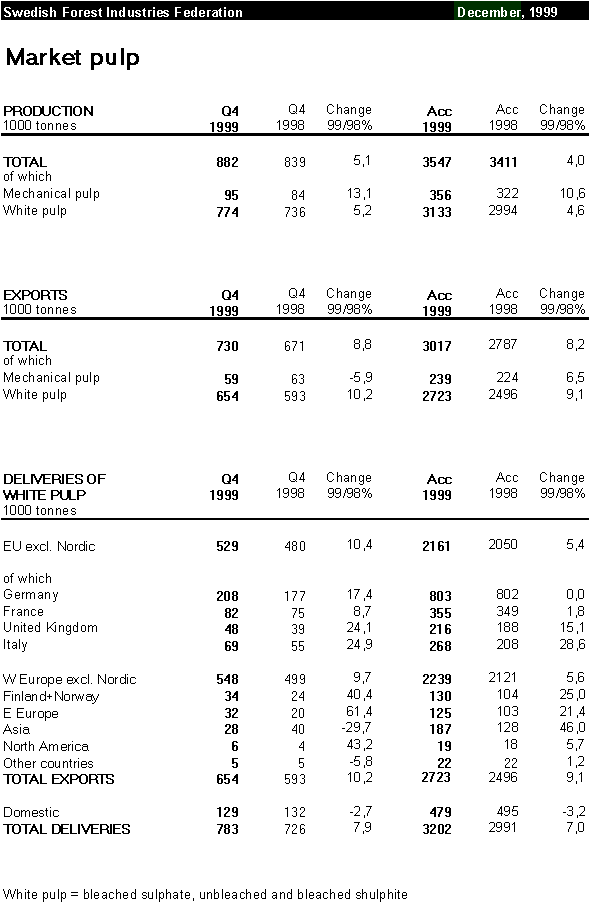

|
|
| |
|
|
| |
|
|
| |
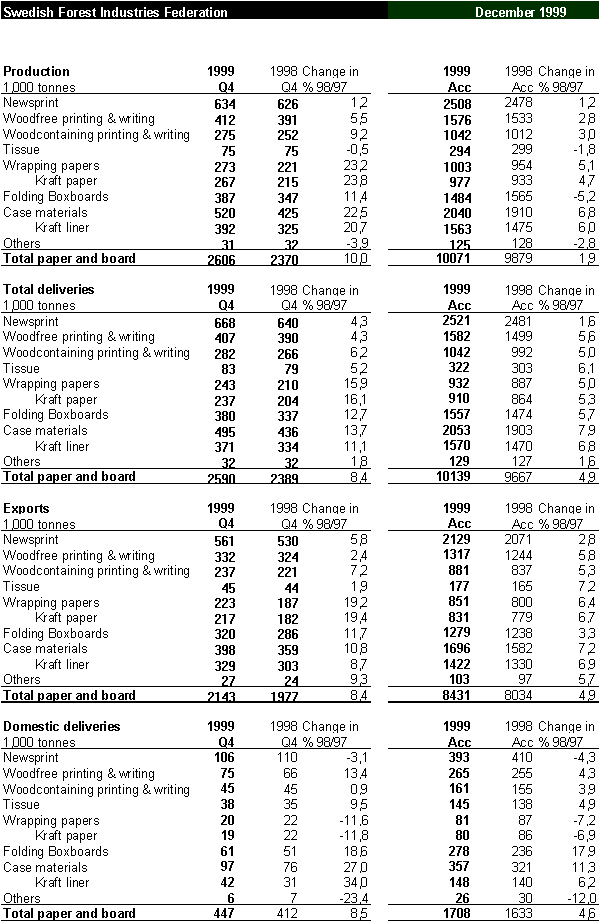
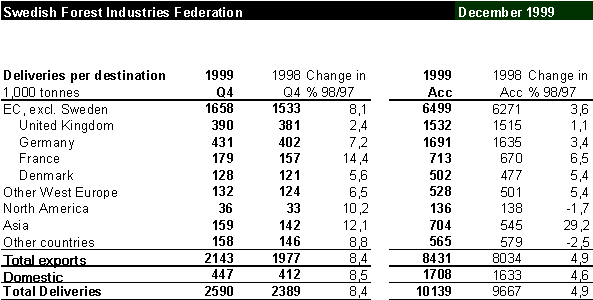

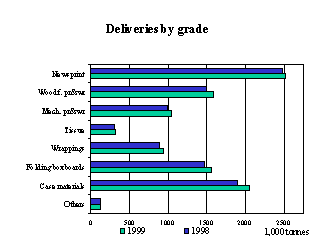
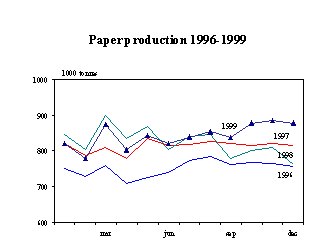
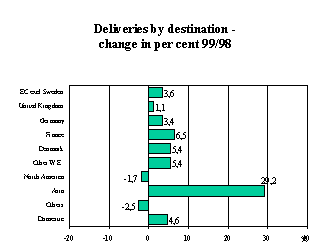
Somboon Chuchawal
Managing Director, Thai Paper Co. Ltd
Recovering from the economic crisis in mid-1997, Thailand's GDP in 1999 reportedly grew 4.2 percent from 1998 with an inflation rate of just 0.3 percent, according to the National Economic, Social and Development Board (NESDB). This resulted in increased consumption of paper and pulp in the country, which was strongly conceivable in the beginning of the third quarter of 1999.
In 1999, kraft paper, printing and writing paper, and household/sanitary paper consumption grew from 1998 by 12 percent, 21 percent, and 6 percent, respectively. More consumer spending, advertising and sale promotions, have been felt.
The Thai currency (Baht) strengthened from Baht 41.4/US$ in 1998 to Baht 37.8/US$ in 1999. This resulted in slightly lower selling prices of paper in Baht term in 1999, compared to those in 1998. However, the pulp and paper prices up trend in the second half of 1999 has pushed up domestic and export selling prices effectively since the fourth quarter of the year.
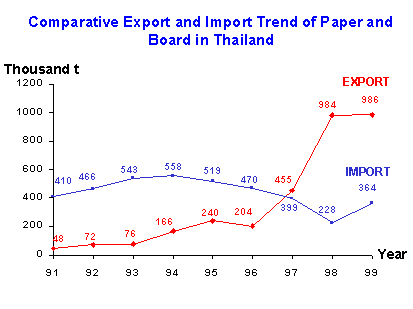
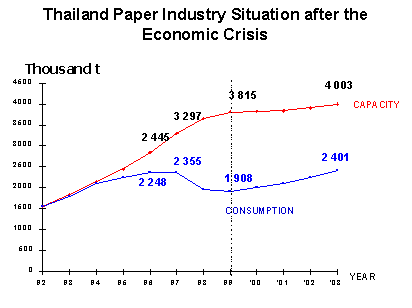
|
Name |
Type of short fibre pulp |
Total capacity (t/annum) |
|
1. Advance Agro Public Co., Ltd and AA pulp mill 2 2. Phoenix Pulp and Paper Public Company Ltd 3. The Siam Pulp and Paper Public Co., Ltd 4. Panjapol Paper Industry Public Company Ltd 5. Siam Cellulose Co., Ltd 6. Bang Pa-in Pulp and Paper Mill |
Eucalyptus Bamboo, eucalyptus, and kenaf Chemical (bagasse) CTMP (bagasse+eucalyptus) Eucalyptus and bamboo Eucalyptus Straw |
427 000 220 000 44 500 78 000 110 000 67 400 3 000 |
|
Total |
950 000 |
|
1998 (thousand t) |
1999 (thousand t) | |
|
Short fibre pulp - Consumption - Import - - Export |
710 33 216 |
843 29 230 |
|
Long fibre pulp - Consumption - - Import - - Export |
276 218 - |
201 336 - |
|
Waste paper - Consumption - Import - Export |
1 594 725 - |
1 500 935 - |
|
Paper capacity | |||
|
1998 |
1999 | ||
|
(thousand t) |
(thousand t) |
percent | |
|
Kraft paper |
1 970 |
2 042 |
54 |
|
Printing and writing paper |
1 060 |
1 117 |
29 |
|
Paperboard |
264 |
264 |
7 |
|
Household and sanitary paper |
130 |
130 |
4 |
|
Newsprint paper |
120 |
120 |
3 |
|
Other papers |
110 |
110 |
3 |
|
Total |
3 654 |
3 815 |
100 |
|
Consumption (thousand t) |
Import (thousand t) |
Export (thousand t) | ||||
|
1998 |
1999 |
1998 |
1999 |
1998 |
1999 | |
|
Kraft paper |
910 |
1 018 |
29 |
46 |
404 |
507 |
|
Printing and writing paper |
264 |
320 |
38 |
81 |
397 |
377 |
|
Paperboard |
203 |
163 |
33 |
61 |
43 |
17 |
|
Newsprint paper |
380 |
220 |
67 |
113 |
26 |
13 |
|
Household and sanitary paper |
63 |
67 |
6 |
8 |
38 |
28 |
|
Other papers |
130 |
120 |
55 |
54 |
76 |
44 |
|
Total |
1 950 |
1 908 |
228 |
363 |
984 |
986 |
|
2000 (thousand t) |
2001 (thousand t) |
2002 (thousand t) |
2003 (thousand t) | |
|
Consumption - Short fibre pulp - Long fibre pulp |
907 224 |
963 241 |
1 037 256 |
1 108 277 |
|
Capacity - Short fibre pulp - Long fibre pulp |
950 - |
950 - |
950 - |
950 - |
|
Surplus - Short fibre pulp (shortage) - Long fibre pulp (shortage) |
43 (224) |
(13) (241) |
(87) (256) |
(158) (277) |
|
Consumption - Waste paper |
1 533 |
1 605 |
1 693 |
1 796 |
|
2000 (thousand t) |
2001 (thousand t) |
2002 (thousand t) |
2003 (thousand t) | |
|
Kraft paper |
||||
|
- Consumption |
1 041 |
1 090 |
1 150 |
1 220 |
|
- Capacity |
2 085 |
2 102 |
2 162 |
2 252 |
|
Surplus (shortage) |
1 036 |
974 |
974 |
974 |
|
Printing and writing paper |
||||
|
- Consumption |
362 |
390 |
429 |
461 |
|
- Capacity |
1 117 |
1 117 |
1 117 |
1 117 |
|
Surplus (shortage) |
755 |
727 |
688 |
656 |
|
Paperboard |
||||
|
- Consumption |
163 |
168 |
180 |
192 |
|
- Capacity |
264 |
264 |
264 |
264 |
|
Surplus (shortage) |
101 |
96 |
84 |
72 |
|
Household and sanitary paper |
||||
|
- Consumption |
74 |
80 |
90 |
100 |
|
- Capacity |
130 |
130 |
130 |
130 |
|
Surplus (shortage) |
56 |
50 |
40 |
30 |
|
Newsprint paper |
||||
|
- Consumption |
240 |
260 |
280 |
300 |
|
- Capacity |
120 |
120 |
130 |
130 |
|
Surplus (shortage) |
(120) |
(140) |
(150) |
(170) |
|
Other papers |
||||
|
- Consumption |
120 |
122 |
125 |
128 |
|
- Capacity |
110 |
110 |
110 |
110 |
|
Surplus (shortage) |
(10) |
(12) |
(15) |
(18) |
|
Total |
||||
|
- Consumption |
2 000 |
2 110 |
2 254 |
2 401 |
|
- Capacity |
3 826 |
3 843 |
3 913 |
4 003 |
|
Surplus (shortage) |
1 826 |
1 733 |
1 659 |
1 602 |
|
Population (million) |
62.4 |
62.9 |
63.4 |
64.0 |
|
Per caput consumption (kg/head) |
32.1 |
33.5 |
35.5 |
37.5 |
American Forest and Paper Association
The United States economy expanded 4 percent in 1999, marking the third consecutive year of 4 percent-plus growth. The recent spate of strong performances compares with average long-term trend growth of 3 percent from 1970 through 1995.
There have been differing explanations for the United States economy's ability to grow briskly during recent years without triggering inflation. Some economists believe that more rapid non-inflationary growth is a permanent phenomenon, made possible by competition-enhancing structural changes such as the emergence of the Internet and the globalization of markets. Others contend that transitory factors such as the Asian crisis and the strong dollar were responsible and that there has not been a permanent structural shift but merely a temporary suspension of the normal trade-off between faster growth and inflation. Both these views probably hold some validity.
A negative side-effect of rapid domestic growth and the strong dollar has been a steep run-up of the United States trade deficit. The widening of the trade deficit has had a particularly severe impact on the manufacturing sector, which has not grown apace of the rest of the economy during recent years, although certain industries such as automobiles have performed well.
There have been some tentative signs during recent months that employment costs (wages and fringe benefits) are beginning to accelerate. In a precautionary move, the Federal Reserve Board raised interest rates by a quarter of a point in the beginning of February.
The consensus view among economists is that the United States economy will experience moderately slower growth in 2000 of about 3.3 percent, partly as the result of a higher interest rate environment. However, the same predictions of impending slower growth were made for the two previous years, but proved incorrect.
The United States production of paper and paperboard advanced 2.2 percent in 1999, after declining by 0.5 percent in 1998. However, the increase in production was only about half the 4.1 percent gain in apparent consumption of paper and paperboard (domestic production plus imports less exports), reflecting a further rise in net imports. In particular, United States imports of paper and paperboard increased an estimated 9.2 percent in 1999, to 16.5 million t, while exports declined 3.5 percent, to 10.7 million t. In certain grade categories, such as printing and writing papers, exports managed to rise in 1999, after losing significant ground in 1998.
The United States apparent consumption of printing-writing papers rose by 2.7 percent in 1999, but shipments increased by just 1.5 percent, as imports continued to capture a substantial share of incremental paper sales. However, unlike 1998 when United States exports of printing and writing papers declined, exports increased rather significantly in 1999.
The United States consumption of newsprint climbed to 11.85 million t in 1999, or by 1.9 percent. The shipments, however, declined by 0.4 percent, primarily because of an increase in imports of 284 000 t - or 5.0 percent. Imports from Canada rose by 355 000 t while offshore imports declined by 71 000 t.
Total kraft paper shipments increased 2.6 percent in 1999, to 2.02 million t, after recording consecutive annual declines during the four-year period from 1995 through 1998. The increase was concentrated in the unbleached grades, with both unbleached kraft bag and sack and multiwall advancing. This may suggest that substitution by plastics has eased. Bleached kraft paper shipments held essentially flat in 1999 versus 1998.
The booming economy appears to have been a plus for tissue paper demand. The United States tissue paper production increased nearly 4 percent in 1999 to 6.2 million t. The increase was significantly above the long-term expansion rate for tissue paper production, which averaged 1.9 percent from 1989 through 1998.
After declining in 1998, containerboard production edged up 1.8 percent in 1999 to 32.1 million t. The overall performance reflected a 4 percent gain in containerboard production for domestic use and partially offsetting a 15 percent decline in production for export. Export-related production previously declined 17 percent in 1998.
After a virtually flat performance in 1998, boxboard production expanded 4.5 percent in 1999 to 14.2 million t. Production of folding boxboard for domestic consumption increased 4.2 percent to a 1999 level of 6.3 million t, with unbleached kraft folding up 9.0 percent; bleached folding up 4.1 percent; and recycled folding ahead 1.6 percent. Export-related boxboard production declined 6.2 percent in 1999 to 1.45 million t.
The United States shipments of chemical paper grade market pulp increased 3.3 percent in 1999, to 7.6 million t. Shipments to the domestic markets were up 10.9 percent to 3.0 million t, while exports declined 1.2 percent to 4.55 million t. Most of the decline was accounted for by Western Europe, which saw exports decline 11.9 percent to 1.59 million t in 1999. The United States exports of chemical paper grade market pulp to Asia/Africa increased 5.6 percent last year, after their sharp decline in 1998.
The financial performance of the United States pulp and paper industry improved during 1999, with earnings increasing 30 percent relative to the depressed levels reported for 1998. Even with this increase, profits for the year can be characterized as mediocre due to the weak start and continued softness in certain grades.
While firming prices and solid demand contributed to the advance in profits, cost efficiencies were also a major factor. As a result of mergers and acquisitions, the closure of high cost capacity, particularly in the containerboard sector, and other economy measures, the United States paper industry has been able to lower its cost structure and therefore remain more profitable than in the past, even in weak markets.
The United States paper industry has entered a period of very slow capacity growth. In particular, aggregate United States capacity to produce paper and paperboard inched up just 0.6 percent in 1998 and then declined 0.5 percent in 1999 to 91.9 million t. The absence of growth reflects a cautious attitude toward expansion projects, as well as the impact of mill and machine shutdowns. Based on the December 1999 AF&PA Capacity Survey, total paper and paperboard capacity is scheduled to rise by an average annual rate of 0.7 percent during the 2000-2002 period.
Chemical paper grade market pulp, at 7.6 million t in 1999 was almost 7 percent below that of 1998. No appreciable growth is expected through 2002.
Construction, the main driver for wood products demand, has been a consistently strong performer throughout the current United States economic expansion. The value of all new construction totalled US$705 billion in 1999, a 6 percent increase over 1998. Housing starts totalled 1.675 million units in 1999, the highest level since 1986, and single-family starts totalled over 1.3 million units. Approximately 90 percent of United States housing units are wood-framed, relying heavily on structural lumber and panel products. Consequently, softwood lumber set a new consumption record for the third year in a row, estimated at 92 million m3. United States consumption of structural panel products also increased, to an estimated 31.7 million m3. Structural panels are defined as structural grade plywood and oriented strand board (OSB). For the first time, North American production of OSB exceeded production of plywood in 1999.
Lumber and panel demand has been increasing despite the rise in the use of engineered wood products, some of which directly substitute for lumber in housing and other applications. Engineered lumber products now account for an estimated 36 percent of the wood usage in flooring assemblies, an application that traditionally has employed wide dimension structural lumber.
Sales of furniture and kitchen cabinets, which use hardwood lumber and components, have mirrored the strength in the construction sector. Manufacturers shipments of residential furniture are estimated to have risen about 8 percent in 1999, to US$25 billion. Of this total, about 10 percent was furniture made of metal or other non-wood materials, leaving the balance about equally divided between wood and upholstery furniture. Both are major end-uses for hardwood lumber, particleboard and medium-density fibreboard (MDF). The United States shipments of particleboard and MDF in 1999 were up 4.1 percent and 7.8 percent, respectively. In contrast, United States hardwood lumber production remained flat at about 33 million m3 largely because demand for railroad cross-ties was down.
While demand for softwood lumber is at record levels, United States production is still short of its mid-1980s high. Since 1989, United States lumber production capacity has declined because of curtailments in federal timber supply and increased competition from Canada and other foreign sources. Over 330 mills in western United States closed permanently during the past decade as a result of reduced timber availability from public ownerships. Federal government timber sales dropped another 25 percent in 1999, to a new post-war low of less than 10 million m3. In the 1980s, sales routinely averaged over 50 million m3 per year.
While some of the reduction in federal timber availability has been offset by higher output from private lands, imports have largely filled the gap in domestic supply. Since the late 1980s, softwood lumber imports have increased by over 30 percent, primarily from Canada. While still a small percentage of the total (5 percent), softwood imports from other countries such as Brazil, Chile, New Zealand and Europe have also increased during the past few years. Imports of OSB are also significant. Imports from Canada now supply nearly 40 percent of United States OSB consumption. With new capacity planned in Canada and Chile, additional increases in OSB imports are likely.
Export demand for United States wood products, while lower than a few years ago, is showing signs of firmness. The United States wood exports during the first 11 months of 1999 were up 3 percent compared to 1998. Most of the increase stems from a turn-around in Pacific Rim markets. The United States lumber and wood exports to Europe dropped significantly in 1999, mostly because of lower hardwood exports.
The consensus forecast for 2000 suggests some modest reduction in United States construction activity and housing demand. The Federal Reserve has raised interest rates four times in the last six months and is poised to do so again. Mortgage and home equity loan interest rates have risen 100 basis points during the past year and the housing cycle has likely peaked. Nevertheless, domestic United States demand for lumber and wood products should remain strong barring any unforeseen circumstances. A reduction in demand due to moderation in housing starts will be offset by an increase in repair and remodelling activity. Export demand for lumber and wood products can also be expected to follow an upward trend as recoveries in Japan and other Asian economies take hold. With both domestic and export markets favourable, United States lumber demand should remain at record or near record levels in 2000.
The United States Forest Service recently released for general review updated forest statistics in draft form. The data indicate that United States forest land area increased by about 4 million ha between 1987 and 1996. In general, United States forest land has remained relatively stable over the past 50 years. The data also show that total forest inventory on timberland increased approximately 9 percent since 1987, while removals remained essentially flat (the removals data reflect the curtailment of harvests on government timberland). The data also depict a highly sustainable forest resource. In 1996, net growth exceeded removals by 42 percent. The growth-to-drain ratios were 1.26:1 and 1.69:1 for softwood and hardwood, respectively. Since 1953, net growing stock on United States timberland has increased by 36 percent.
Endangered species and water quality related regulations are making it increasingly more difficult and expensive to manage forest land for fibre and timber products. Government agencies (federal, state and local) control about 30 percent of the productive forests, but supply less than 8 percent of United States fibre supply. Over 90 percent of production is currently from forest industry and other private lands, owned and managed by over 9.9 million landowners.
Productivity on industry and other lands has been increasing dramatically through intensively managed plantations, particularly in the southern United States. About 11 million ha in the southern United States and an estimated 1-2 million ha in the northwest are planted in short-to-medium rotation stands. Genetically-improved seedling stock, coupled with intensive site preparation, weed control and fertilization is increasing yields by three-to-four times over natural pine stands. Companies are beginning to capitalize on research in genetically selected or manipulated plant genes. These hold tremendous promise for increasing yields while reducing the need for various pesticides.
The AF&PA Sustainable Forestry Initiative (SFI)SM programme is rapidly becoming the de facto standard for practising sustainable forestry in the United States The SFISM programme is a comprehensive system of principles, guidelines and performance measures for integrating growing of trees with the protection of plants, soil, air and water quality. As part of the programme, more than 29 000 loggers have completed comprehensive training programmes in sustainable forestry practices.
The SFISM programme has expanded significantly in some very important ways over the past several years. Participants can now elect to have their conformance to the SFISM Standard audited and verified by independent third parties. A number of large United States companies have completed these audits and many others are considering or have initiated the process. A total of about 8 million ha will be SFISM third-party certified by the end of 2000. In addition, through a licensing mechanism, the SFISM has enrolled landowners and companies outside of the AF&PA membership. As of today, over 23 million ha of forests are enrolled in the programme, making the SFISM the largest sustainable forestry programme in the world. The SFISM has also expanded to become an international programme. The standard is now being applied in Canada by several companies. The programme is also being used at the request of the United States Government in Honduras to assist in restoring a forest devastated by Hurricane Mitch.
Recognition and support for the programme has come from a growing list of conservation organizations including many of the major United States and international conservation organizations. No fewer than 10 States have also voiced support for the SFISM goals by passing resolutions in their legislatures, and the SFISM received a national award for Sustainability in Forests and Rangeland from Renew America and the President's Council on Sustainable Development.
The United States forest products industry believes that the carbon sink provisions of the Kyoto Protocol are ill-conceived and will deny governments, private entities, non-governmental organizations and the forest community a scientifically valid, measurable and cost-effective mechanism to remove carbon dioxide from the atmosphere. Instead of promoting and seeking to encourage sustainable forest management, the carbon sink Articles of the Protocol will neither provide incentives in, or encourage, sustainable forest management. Consequently, AF&PA has submitted substantive comments on the draft Intergovernmental Panel on Climate Change (IPCC) Land Use Change and Forestry report which is expected to be released in May 2000. The AF&PA has also been promoting with United States climate change negotiators the principles contained in the statement developed by the International Forest Industry Roundtable (IFIR) on the role of forests and forest products in the Kyoto Protocol. Those include:
– Adoption of internationally recognized forestry terms and definitions;
– Adoption of a carbon stock accounting methodology;
– Full recognition for carbon sequestered in all forests post-1990;
– Adoption of a more accurate description of what constitutes human-induced activities;
– Recognition of carbon storage in forest products and soils;
– Transparent inventory and reporting;
– Use of forestry activities in the flexible market mechanisms;
– Promotion of biomass as a net-zero contributor to greenhouse gas emissions;
– Recognition of the unique carbon profile of the forest industry in determining its carbon accounting baseline;
– Recognition of the positive role of paper and wood recycling in avoiding emissions and extending carbon storage in products.
14 Overseas Consultancy Service Report on Ghana's Forest: Study was under the United Kingdom Forestry Commission, June 1995.
15 Timber Yields from the Forest Reserves of Ghana: An Analysis of the Implications of Sustainable Forest Management. A paper presented by the Planning Branch of the Forestry Department of Ghana, March 1995.
16 Nolan, Tim (Forest Inventory Project Leader), Presentation in the Ghana Forest Inventory Project, Seminar Proceedings, 29-30 March 1989, Accra, pp. 55.
The Institute of Economic Affairs. AGENDA `96 Preparing Ghana for the 21st Century: Some Economic and Social Issues, Anansesem Publications, Accra, 1996, pp. 93.
18 FAO. "Potential of Forest Industries Development in Ghana", 1974. Based on the work of W.J. MacInnes and P. von Carlowitz. ECA/FAO Forest Industries Advisory Group for Africa. IND/59-Mr/54, Addis Ababa.
19 Information sheet on Collaborative Forest Management issued by the Forestry Department, July 1996.
*) Professor W.Z. Tarnawski, Ph.D., D.Sc., Papermaking and Printing Institute, Technical University of ๓d, also Vice-Chairman of the Association of the Polish Papermakers.