


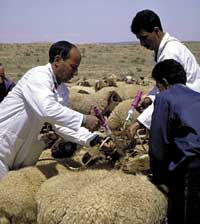
 A veterinary technician vaccinates - IFAD/A. Conti |
Animal disease surveillance and control are the first lines of defence against devastating livestock diseases such as foot-and-mouth disease (FMD) and Rift Valley fever, which can hit countries at any time. With IFAD funding, FAO has been working for five years to strengthen animal disease surveillance in North Africa and the Near East - regions where livestock play a fundamental role in the lives of hundreds of thousands of pastoralists.
RADISCON, the Regional Animal Disease Surveillance and Control Network for North Africa, the Near East and the Arab Peninsula, was set up in 1996. The Network targets 29 countries from North Africa, the Sahel, the Horn of Africa, the Near East and the Arabian Gulf.
IFAD provided a grant of US$1.25 million for the initial period of five years, which is due to close in December 2001. In addition, US$100 000 was granted by the Arab Gulf Programme for the United Nations Development Organizations (AGFUND) in support of the project's follow-up activities.
Increasing fisheries production in Bangladesh IFAD and WFP are working together on a project aimed at increasing fisheries and aquaculture production and income for the rural poor in Bangladesh. The joint project will reach 120 000 people, half of whom are women, through rehabilitation and management of water bodies and income-generating activities. The estimated value of IFAD's input is US$20 million, while that of WFP is US$1.2 million. WFP inputs are being used to support work on water bodies and rural roads that involves labour-intensive earthwork removal. |
For the first time in this part of the world, RADISCON has established a regional computerized network for disease surveillance and information exchange. It has assisted in the establishment of computerized national animal disease information systems equipped with hardware, software and GIS, with veterinarians trained in epidemiology, disease surveillance, data analysis and interpretation. For example, this system is being used in Saudi Arabia and Yemen to support Rift Valley fever surveillance.
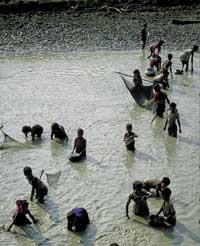 Fish is traditionally the principal - IFAD/A. Hossain |
RADISCON has also facilitated the start of a sheep pox eradication programme for the Mediterranean Maghreb countries (Algeria, the Libyan Arab Jamahiriya, Morocco and Tunisia) that aims to eradicate the disease by the year 2005. In Algeria, the Network played a catalytic role in FMD control, which has stimulated the formulation of a regional FMD project for the Maghreb.
An IFAD mid-term evaluation has recommended a consolidation phase to ensure RADISCON's sustainability and its smooth transfer as a tool for the countries of the region.
A project proposal to strengthen the Network is being submitted to donors. This coincides with the adoption by the FAO Regional Conference for the Near East of a proposal to establish an Animal Health Commission for the Near East. During this second phase, it is proposed that RADISCON serve as a template for a smooth implementation of the Commission. IFAD is also expected to play a major role in this respect.
Phase II will focus on common disease surveillance and control problems and will respond to demand-driven needs of member countries. During this phase, RADISCON ownership will be transferred gradually to the region.
