


IFAD has funded an FAO study in Latin America and the Caribbean on the effects of different land management techniques on food production, soil protection and carbon sequestration. The project continues the collaboration between the two agencies on the Convention to Combat Desertification (CCD) and is also working to create synergies between the CCD, the Convention on Climate Change (CCC) and the Convention on Biodiversity (CBD).
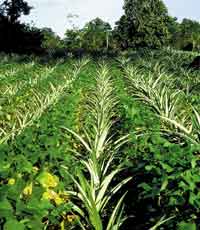 A pineapple plantation in Costa - IFAD/C. Salazar |
Agriculture is one of the major producers of the greenhouse gases that are causing climate change, but it can also contribute significantly to the reduction of such gases in the atmosphere. Agricultural soils are one of the planet's largest reservoirs of carbon and they have the potential to expand carbon sequestration - that is, to remove carbon from the atmosphere and fix it in the soil - thus mitigating climate change.
With US$80 000 from IFAD, FAO started work in April 1999. The project's main purpose was to create a knowledge base about the effects of different land management techniques on production, soil conservation and carbon sequestration.
Studies in poor rural areas of Costa Rica, Cuba and Mexico were evaluated and documented, together with baseline carbon-related data and information on land use. Thirty technicians from Cuba and Mexico were trained in field surveying, biomass measurement and soil carbon simulation modelling.
The project also looked at the methods of assessing the stocks of carbon pools by agro-ecological zones and considered the implications of better land management - in particular zero tillage and conservation agriculture - for productivity, soil biodiversity and conservation and carbon pools.
The second phase of the project is funded by the IFAD-based Global Mechanism that mobilizes funds for the fight against desertification, and was scheduled to start on 1 September 2001. It is expected to run until 31 December 2002.
