


IFAD has funded a study by the International Programme for Technology and Research in Irrigation and Drainage (IPTRID) - a multidonor programme based at FAO - on ways to improve the availability and efficiency of water-lifting technologies in West Africa.
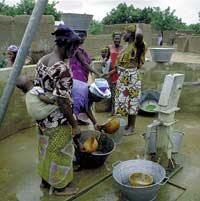 Women in Mali hand pumping - IFAD/H. Wagner |
Water-lifting technologies include all ways of drawing water, from the traditional low-cost bucket, through human-powered treadle pumps, to sophisticated diesel and electric pumps. The water lifted with these devices is used mostly, though not exclusively, for irrigation.
The Fund asked IPTRID, which is hosted by FAO's Land and Water Development Division, to carry out a preliminary study of the water-lifting technologies used in a sample of West African countries. The results of the study will enable IFAD to target investments and field interventions and improve resource-poor farmers' access to affordable irrigation technologies.
IPTRID estimates that, in developing countries, irrigation increases the yields of most crops by between 100 and 400 percent. Studies in Kenya and Zimbabwe show that on plots between 0.5 and 1 ha, irrigation contributes between 25 and 80 percent of household income, allowing families to cover health and education costs and injecting extra capital into the local economies. But the effects of irrigation go beyond the farming families and their communities.
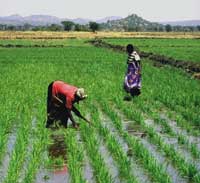 Farmers irrigate rice paddies with - IFAD/R. Grossman |
FAO estimates that irrigated agriculture produces about 40 percent of the world's food today, and will have to produce about 60 percent of the extra food required to feed a world population of around 8 billion by 2025. The bulk of improvements in food supply from irrigated agriculture are expected to come from small producers.
The IPTRID-designed research project started by looking at the water-lifting devices that are already available and being used in Chad, Ghana, Mali, Nigeria and Senegal. The next task was to design practical ways to improve water-use efficiency, cut operational costs and maximize social acceptability.
Field investigations and information-gathering were followed by a "brainstorming" meeting to review the different technologies. Indicators for long-term follow-up on their adoption by resource-poor farmers, their impacts on food production, on poverty reduction and on rural development were also proposed. The research project's final task was to prepare a technical assistance grant proposal for further testing of interventions and technological adaptations.
