


A joint FAO/WFP project to rehabilitate degraded areas around four major cities in Yemen started work in April 1998. The Watershed Management and Wastewater Reuse in the Peri-Urban Areas of Yemen Project was set up on the outskirts of Sana'a, Dhamar, Aden and Hodeidah.
Rapid urbanization and expansion of these cities has put extreme environmental pressure on the immediate surrounding areas. The project set out to work with the local people to improve watershed management and use treated wastewater from the cities to rehabilitate degraded land and forest resources.
Rehabilitation of irrigation schemes in the United Republic of Tanzania WFP's Food for Work programme is complementing IFAD's Participatory Irrigation Development Programme in the United Republic of Tanzania. WFP is providing food as payment for development activities such as desilting, farm-plot levelling, bund building and road construction. With WFP's support, seven irrigation schemes in the Districts of Dodoma and Manyoni have been rehabilitated and are expected to be serving the cropping season of 2001. The rehabilitated schemes will benefit a total of 2 246 farm households, each with an average of less than 0.5 ha, covering a total of 1 765 ha, and will help farmers to produce at least 1-1.5 tonnes of rice per hectare. |
Community participation was essential if the effects of the project were to be sustainable in the long term. A tool known as Community Land Resources Management Master Plans (CLRMMP) was used to structure and facilitate the participation of the local people and to ensure that women played an active part. Overall, 8 600 people were involved, more than 4 000 of them women.
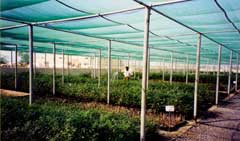 Project nursery at El Hodeida - E.Sene |
The CLRMMP approach mobilizes the community: it assists in identifying strengths and weaknesses, in diagnosing problems and setting priorities, in preparing and approving master plans, in preparing mini-projects, and in implementation, monitoring and evaluation. All the stages in this process are led by the community members and are driven by the demands and priorities of the beneficiaries. The approach gives access to land and water resources to poor groups and distributes the returns from income-generating activities among individuals. In Yemen, community funds were also established to pay for community development works.
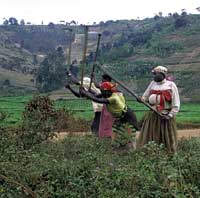 Terracing is being introduced to help - IFAD/R. Grossman |
This triangle of collaboration, between the Yemeni people, FAO and WFP, has been highly effective and the participatory approach in particular received a very enthusiastic response from the communities involved.
WFP provided "food-for-work", boosting food security and enabling the people to carry out preparatory tasks, before the activities began to generate income. An impressive number and range of activities have been completed.
The people have constructed three nurseries, with the capacity to produce about 600 000 seedlings between them. They have planted about 28 ha of land with seedlings for various purposes, including windbreaks and agroforestry. They have created more than 5 km of irrigation canals, so that the seedlings can be regularly watered. About 4 km of protective green belts have been planted around villages and cities to halt the encroachment of sand dunes. More than 2.5 km of windbreaks have been planted around farms, improving agricultural production.
Wastewater treatment ponds with a capacity of 1 200 m3 have been constructed or repaired to water the tree seedlings. Sustainable grazing practices have been introduced, and 15 ha of grazing land have been rehabilitated using a naturally renewable water harvesting system.
Gaining land for cultivation in Rwanda WFP is collaborating with IFAD to terrace hillsides and reclaim swampy land in Rwanda's Gikongoro and Ruhengeri prefectures, thus making more land available for cultivation. Through community-based organizations, WFP provides food-for-work support for two agricultural development projects initiated by IFAD. About 170 000 people are benefiting from the projects, including 35 000 women. The estimated value of WFP's and IFAD's inputs is US$1 million. |
The women had their own needs assessment and priority setting exercises and they put improved family food security firmly at the top of the list. Accordingly, 40 home gardens have been created so far, one larger horticultural site has been set up and a further six are in progress.
