


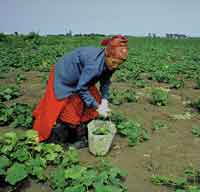
 A farmer harvests cucumbers to - IFAD/R. Grossman |
The work of FAO, IFAD and WFP regularly confirms that secure access to land, water and other productive assets is basic to lasting solutions to hunger and poverty. It results in increased productivity, improved household food security, greater resilience to climatic shock, improved capacity to recover from conflicts, and sustainable land use.
The three Rome-based agencies are among the core partners in the Popular Coalition to Eradicate Hunger and Poverty, an innovative collaboration of civil society, intergovernmental and governmental organizations. The Popular Coalition works to revitalize support for the property rights of the rural poor and to increase the capacity of communities to participate in the formulation of public policies that affect their livelihoods.
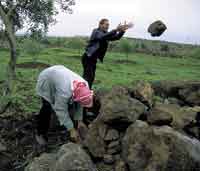 Clearing fertile land covered with - IFAD/J. Spaull |
Improving access to land and other productive assets for the landless and the rural poor is one of the most essential but also most difficult challenges in development. The Popular Coalition is currently active in 30 countries, and also receives growing numbers of requests for support from both governments and civil society organizations which are seeking new ways to improve the asset holdings of the rural poor.
The Popular Coalition is hosted at IFAD and governed by an International Council made up of its diverse partners from civil society, FAO, WFP, the World Bank, the European Union and other intergovernmental institutions.
Rock clearing and orchard development in the Syrian Arab Republic IFAD-financed projects for rock clearing and orchard development have taken advantage of WFP's assistance for development activities in the Syrian Arab Republic. Activities supported by IFAD and WFP in the country share the following objectives:
As the IFAD-financed rock-clearing operations carry a long gestation period before generating income, WFP's assistance ensures food security through "food-for-fruit-tree-planting" during this period. In addition, within IFAD-financed Women-in-Development activities, WFP's assistance has a special component targeting rural women, whereby food aid is used as an incentive for training in agricultural skills and income-generating activities.This training helped women trainees to gain access to credit through the IFAD-financed projects. |
