


When the protracted civil war in Tajikistan finally ended, Khavloeva Tojinisso and her family returned home after five harsh years in a refugee camp in Afghanistan. Home, however, was not as they remembered it: the house in Bokhtar region in south Tajikistan had had its roof blown off; inside, looters had stripped it of all the furnishings.
Tojinisso, 44, and her family of eight started their lives over - literally from scratch. They built a makeshift house of clay and wood with their own hands and this is where they still live. Tojinisso's husband, who suffers from epilepsy and chronic malaria, is practically bedridden.
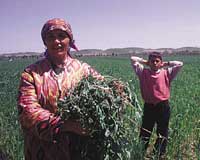 Supporting families in Tajikistan - WFP/S.Manuel |
So Tojinisso had to fend for herself and her family. Fortunately, she was able to grow her own food on a small piece of land that she farms rent-free under an arrangement between WFP and the government. In return, she gives a small part of her harvest to the government. Tojinisso, who now cultivates 0.25 ha, also received food aid and wheat seeds. The seeds, together with fertilizers and agricultural tools, were provided by FAO. "My children and I prepared the land and sowed the wheat," Tojinisso said. "We hope to have a good harvest." Until it arrives, she has 225 kg of wheat flour from WFP to get through the summer.
Tojinisso is one of many Tajik women who have to grapple with the aftermath of the breakup of the Soviet Union, the disappearance of state social services and a five-year civil war that decimated the country. About 85 percent of the population live below the poverty line. In order to survive, many have been forced into illegal trades such as drug smuggling (which carries severe prison sentences for those apprehended) and prostitution.
While Tajik women have benefited from recently enacted antidiscrimination legislation, they need help to regain the status they enjoyed during the Soviet era, when they had equal access to education and employment. Fortunately, they have also had the support of hundreds of local NGOs.
Given the economic problems of Tajikistan, WFP has undertaken a wide range of projects designed to give more than 20 000 widows, returnees and household heads a helping hand. In addition to the farm scheme, WFP supports training and income-generation programmes and school feeding schemes, and provides assistance to the health sector. Even within its own staff, WFP seeks to help more women. In the southern province of Khatlon where a large part of WFP activities in the country take place, most of the WFP food aid monitors are women.
