


Agricultural extension clientele traditionally include all the members of rural farm families, among whom there may be people with physical disabilities (PPD).
In large cities and rural areas, PPD usually have the opportunity to attend special technical schools and/or professional training centres where they can acquire skills that are appropriate for various types of employment. After several years of attendance at such centres, skilled PPD may be able to engage in a servicing or producing activity that provides them with a continuous source of income, allowing them to live independently. Rural PPD, on the other hand, rarely have such opportunities, since they live in villages with no, or very little, access to technical schools and training centres.
Rural PPD who live within families that are engaged in agricultural activities are often obliged or willing to collaborate with their families in farm activities. In many cases, however, PPD have not received any appropriate training and are not skilled in any profession, so they cannot participate actively in farming activities and are forced to remain relatively useless.
The main problem facing rural PPD is that they have no, or poor, accessibility to the special training schools, professional centres and agricultural and rural extension agencies that would help them to acquire appropriate technical knowledge. This means that they are unable to assume a responsible and useful role within their families or to contribute to independent farming operations.
Such a situation gradually leads to the general unemployment of PPD in rural areas and creates the feeling that people with disabilities are unproductive and a burden to the family households that support them. Among other consequences, this state of affairs becomes unbearable to PPD who see themselves as wasting their potential and, as a result, their lives. In response to such a serious problem, the objective of this study was to identify the training and extension needs of PPD engaged in agricultural activities in the areas concerned so that special training and extension programmes may be prepared for them.
A review of the relevant literature on national-level training programmes for PPD in the Islamic Republic of Iran shows that the National Welfare Organization (NWO) offers a wide range of services to its clients, most of whom are PPD.
Some of the services that NWO provides for PPD, according to its publication of June 1999 (NWO, 1999: 8-9), are in the following areas:
The community-based rehabilitation section of NWO is continuously examining the literature of international scientific agencies, such as the World Health Organization (WHO), from which it derives appropriate approaches. New guidelines, books and pamphlets are studied, translated and published and workshops are held in order to raise society’s awareness of NWO’s improved management of the rehabilitation process (NWO, 1999: 12-18).
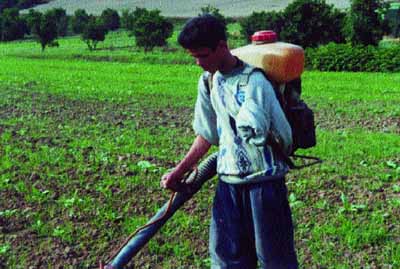
A young farmer who has lost a hand, spraying his tobacco farm, without taking safety measures
As well as the social services that NWO provides for PPD - such as financial aid, care and support - the organization also trains PPD to help them acquire handicraft and weaving skills (NWO, 1999: 24). NWO has a Rural Affairs Bureau which is interested in extending its services to PPD through rural complexes (NWO, 1991: 320-329). At present, the bureau carries out the following duties with regard to rural PPD:
social, economic and cultural development of rural women with physical disabilities;
training of rural youth with physical disabilities on reciting the Koran, acting, singing and handwriting, for their leisure time;
providing PPD with suitable physical education and sport competitions;
establishing rural libraries to help PPD strengthen rural culture;
providing employment opportunities at the village level by establishing professional courses on carpet weaving, which are usually followed by the provision of loans to trained PPD.
In addition to NWO, other agencies are concerned with PPD in the country. For example, the Imam Khomeini Relief (Emdad) Committee provides many general services to poor elderly people in villages, including training in appropriate primary skills such as handicrafts, carpet weaving, animal husbandry, apiculture and sericulture. Such training is usually followed by the award of financial aid, loans or credits, which allows the trained people to start earning and helps them to become self-sufficient.
The Mostazafan and Janbazan Foundation also undertakes a wide range of similar services for its clients, who are generally deprived people and those who were rendered physically disabled during the revolution and war.
The Technical and Professional Training Organization of the Ministry of Labour and Social Affairs is also involved in a wide range of training activities for its target groups, among whom are PPD. The training that this organization offers every year includes courses in agricultural professions such as horticulture, crop production, vegetable growing, fishery and beekeeping (Ministry of Labour and Social Affairs, 1999: 250-256). These courses are related to agricultural activities but they are not specifically for rural areas, nor are they specifically for PPD, although such people may participate if they are able to.
The Labour and Social Security Institute of the same ministry, among its many studies and publications, has translated and published a manual (ILO, 1993), which describes basic principles and training programmes for the professional training of PPD at centres in rural areas. This publication contains a wide variety of professions that would be practical for PPD in rural areas (Ministry of Labour and Social Affairs, 1993: 81-82 and 107). The Technical and Professional Training Organization already offers agricultural courses in urban areas and it is hoped that these training activities will be gradually extended to the villages. This would give PPD in rural areas easy accessibility to a wide range of appropriate training programmes.
Mention should also be made of the Special Education Organization and the Technical and Professional Training Branch of the Ministry of Education. The former is highly active in the education and training of people with special needs, i.e. students with mental and physical disabilities, and has schools and centres all over the country. Students with physical disabilities can also take part in the technical and professional training that the Professional Training Branch provides at high schools and colleges, according to their interests, abilities and capabilities.
Although these agencies are present and active all over the country, there are very few agencies that are specifically responsible for the agricultural training of PPD who live in rural areas and are engaged in agricultural activities.
In the Islamic Republic of Iran, three agencies are partially or fully responsible for national-level agricultural training and extension activities. The Technical and Professional Branch of the Ministry of Education, in addition to the activities mentioned in previous paragraphs, runs more than 100 high schools and colleges specializing in agricultural studies and practices. Students attend these schools and colleges for periods of two to four years before graduating with an agricultural technician’s certificate at level 2 or level 1. The Ministries of Agriculture and Jihad Sazandegi[1] are engaged in similar activities and, in addition to educating and training students in the fields of crop and animal production at technical schools and colleges, they are also responsible for the agricultural extension and training of rural people all over the country.
Each of these two ministries has its own agricultural extension system for the practical training of rural producers according to appropriate extension teaching methods. However, surveys show that neither of them yet has any specific programme to educate and train PPD engaged in agricultural activities. It is hoped that these two ministries will assume the responsibility of providing such a service as they develop in the future.
The province of Mazandaran, the area under study, has a total population of 4 028 000 (Iranian Statistical Centre, 2000: 7), of whom about 44 percent live in urban areas and 56 percent in 4 044 villages. The province covers a total area of 4 645 400 ha (Bagheri, 1995: 121), including 622 495 ha under annual crop production and 104 636 ha under fruit tree production (Ministry of Agriculture, 1999: 153-155). The area under natural forest is about 1 294 000 ha and that under pasture and rangeland is 1 857 020 ha (Hossein-Pour, 1993: 14).
The province’s total animal population is 4 370 516 head, of which 34.6 percent are in moving, 36.2 percent in semi-moving and 28.2 percent in stationery animal husbandry (Hossein-Pour, 1993: 16). Animal husbandry includes considerable cattle production and sheep raising. Poultry production, fish farming, silkworm raising and beekeeping are the other main agricultural activities in rural areas.[2]
The Ministries of Agriculture and Jihad Sazandegi are the two main government agencies that are legally responsible for supporting and promoting the agriculture sector in the area. The Ministry of Agriculture is responsible for crop and fruit tree production, and the Ministry of Jihad Sazandegi for animal, fishery and poultry production, as well as forest and pasture management. Each of these two ministries, and many executive, technical and scientific institutes, organizations and departments, has its own agricultural training and extension system which undertakes rural training and extension education activities on the basis of its own specific approach.
Each ministry has an administrative organization in Sary, the centre of the Province of Mazandaran: the Organization of Agriculture and the Organization of Jihad Sazandegi. Among the many provincial-level departments in each of these organizations, the Agricultural Organization has a Department for Agricultural Training and Extension, and the Organization of Jihad Sazandegi has a Department for Rural Extension and Participation. Scientific and technical staff in these departments includes subject matter specialists who are responsible for acting as a link between the research bases and the field extension branches.
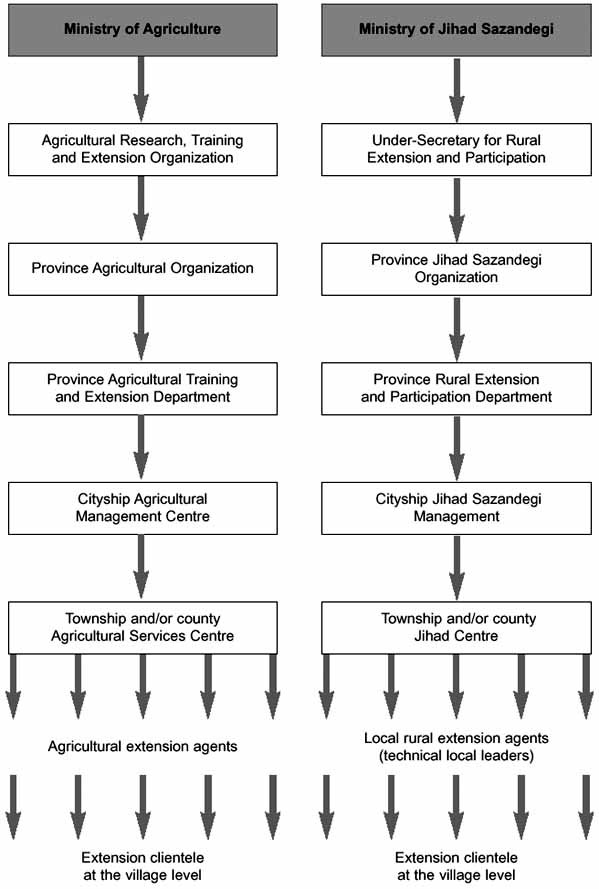
The departments of each organization have main branches in every cityship within the province. These branches, in turn, have sub-branches in the counties and sub-counties of each cityship. In both organizations, expert field workers from the branches and sub-branches, backed by subject matter specialists from the province, usually undertake agricultural extension and training activities in direct contact with rural clients. Figure 1 outlines the various relationships involved.
Figure 1
Agricultural extension and rural training: organizational chains of the two
ministries (year 2001)
In Mazandaran, in addition to the administrative staff of the Agricultural and Jihad Sazandegi Organizations, the Department of Training and Extension Education has 110 extensionists, including four M.Sc. specialists, 67 B.Sc. experts and 19 college graduate technicians; and the Rural Extension and Participation Department of Jihad Sazandegi has 101 technical and social sciences staff, including 15 M.Sc. specialists, 52 B.Sc. experts and 34 college graduate technicians. These members of staff are stationed in cityships all over the province and work as extension field workers in rural areas (Under-Secretary of Statistics and Information, 1999: 3 and 5).
Originally it was thought that the existing human resources could undertake training and extension activities for PPD in rural areas, at least in the first stages. However, extensionists are already involved in field extension and training activities for able-bodied farmers, and it was not clear whether they would be able to assume such demanding extra responsibilities. The answer to this question will be discussed later in this report, on the basis of the responses of the extensionists interviewed.
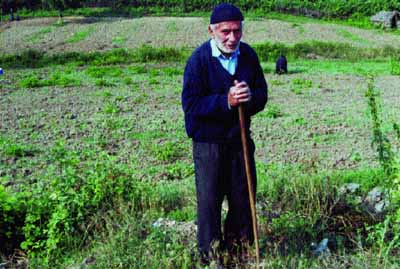
An elderly farmer without hearing who works as an active manager in the village
The results of the national census in 1986 show that there are 453 090 PPD in the Islamic Republic of Iran,[3] more than 50 percent of whom live in rural areas (Iranian Statistical Centre, 1992: 1). According to the same statistics, there are 28 381 PPD in the province of Mazandaran. Of these, 18 814 (66.3 percent) live in rural areas (Iranian Statistical Centre, 1992: 2). On the basis of the Mostazafan Foundation statistics for 1989, there are 4 682 war-disabled people in the province (Mostazafan Foundation, 1991: 8).
In 1998, a total of 3 046 PPD were attending the centres run by these organizations and NWO, which has more than 28 professional training, clinical and care centres in the Province of Mazandaran (Under-Secretary of Statistics and Information, 1999: 5). Given the large proportion of PPD in the province who are not attending such centres, there is a clear need to establish many additional centres, and to extend education and training activities so that most of the province’s PPD can benefit. This is particularly important because more than 55 percent of the province’s population of 2 750 000 live in villages and, as already mentioned, more than 66 percent of PPD live in rural areas of Mazandaran.
It therefore seems essential that, in addition to NWO, other organizations and institutions that are already involved in rural affairs should extend their activities and assume the task of educating and training rural PPD in villages all over the province (Under-Secretary of Statistics and Information, 1999). Two of the most important of these organizations and institutions are the Department of Training and Extension Education of the Ministry of Agriculture’s Agricultural Organization and the Department of Rural Extension and Participation of the Ministry of Jihad Sazandegi’s Jihad Sazandegi Organization. Both of these departments already have active networks of agencies to serve rural people at the city-ship, township and county levels of the province. This makes them suitable candidates to assume the innovative task of educating and training PPD who are involved in agricultural activities.
However, if extensionists are to take on such new and specialized responsibilities in addition to their other tasks, they will need psychological preparation, as well as special training, sufficient payment and physical facilities.
The main objective of the research undertaken by this study was to identify the needs of PPD with regard to agricultural extension and training programmes in rural areas. To obtain such information, it was necessary to reach the target group and find out its points of view.
The members of the target group were the men and women, both young and old, who reside in rural areas, are physically disabled and are engaged, or have the potential to be engaged, in agricultural activities. During the process of data collection, it was difficult to reach PPD within families which are scattered across villages all over the study area. It was also difficult to establish face-to-face communication and dialogue with them. However, it was essential that this group be interviewed, in spite of the difficulties and time involved.
PPD generally live with relatives, who care for them and manage their affairs. It was also necessary to interview these relatives in order to learn about their experiences, points of view and recommendations. Points of view and recommendations also had to be sought from the agricultural extension workers and rural trainers of the Ministries of Agriculture and Jihad Sazandegi, since they will be expected to satisfy the extension and training needs of PPD.
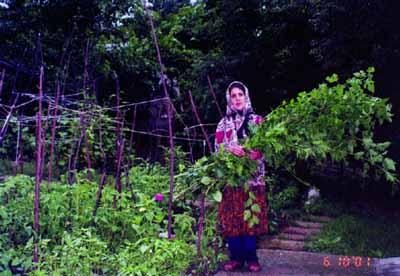
A farmer who is semi-paralysed, gathers mulberry leaves to feed silkworm
As a result, the following three groups were interviewed:
Using the simple random sampling method, 31 PPD, 24 of their nearest relatives and 23 agricultural and rural field workers and experts were selected for interview. Interviews were based on specially designed questionnaires (see Annex). The collected data were then analysed, tabulated and interpreted.
In the process of interviewing for data collection and analysis, some difficulties arose from:
|
[1] These two ministries were
merged in 2001, but the organizational units of the new ministry called Ministry
of Jihad-i-Agriculture, are still being formed, and their functions being
fine-tuned. [2] Most of the figures given here, which were taken from the Statistical Yearbook of 1377 (1999), refer to the census of the Year 1375 (1997), i.e. before the separation of Gorgan and Gonbad districts from the province of Mazandaran and the formation of the new province of Golestan. [3] This figure does not include the population of the new province of Golestan. |
